Collection · 100 studies

MiniMax-M3.1-Flash 100 HTML Files

One hundred self-contained visual studies — generative art, physics, typography, interfaces and scenes — generated with MiniMax-M3.1-Flash. Open any piece in a new tab, or expand a card to read the original generation prompt.

100 studies
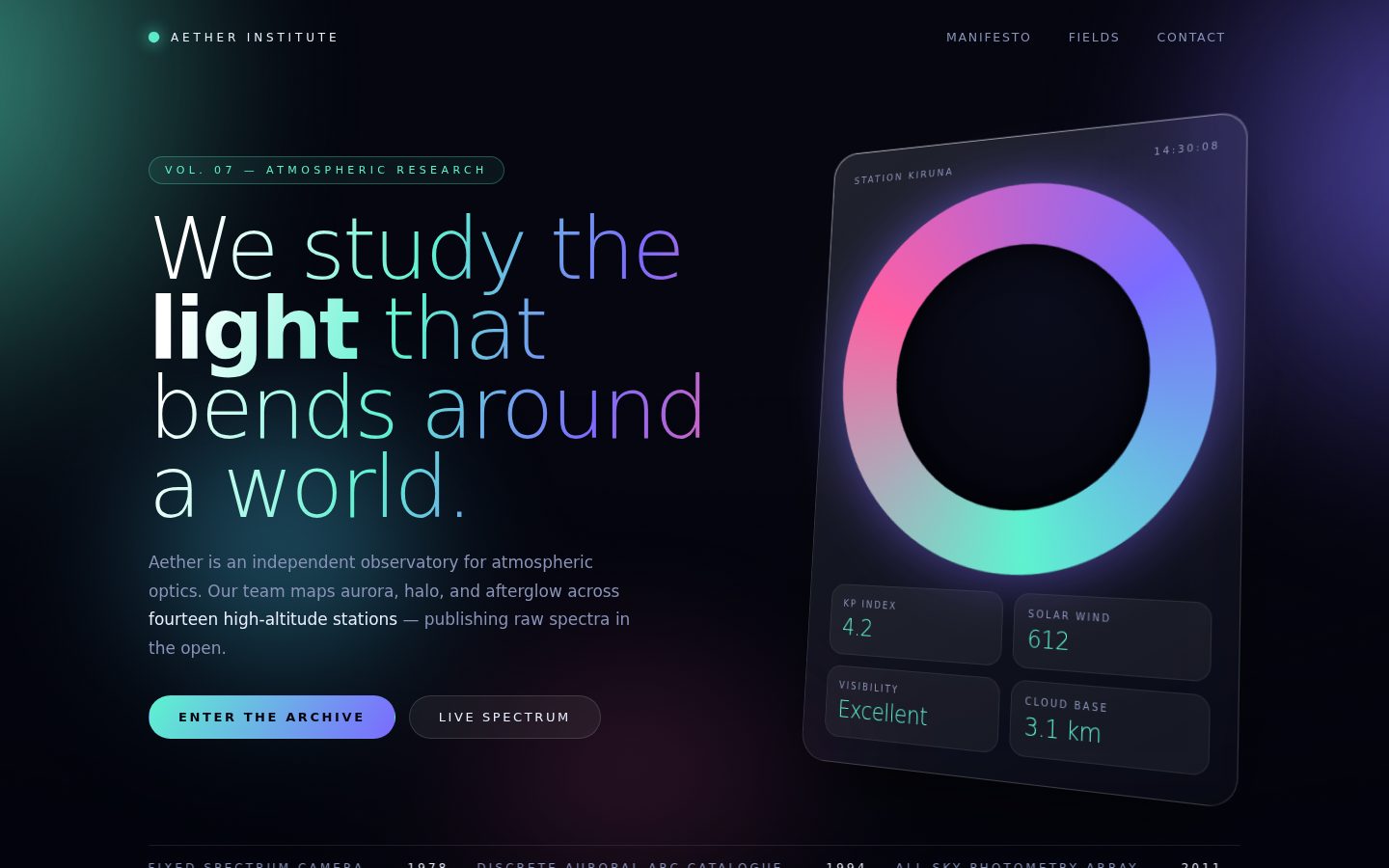
Aurora Glass — Aether Institute screenshot
001

Aurora Glass — Aether Institute

A dark, atmospheric landing page for a fictional aurora research institute. The visual language is soft glass over a slow-breathing aurora: large blurred colour fields drift behind a crisp, high-contrast glass card, an inline SVG grain layer adds filmic texture, and the headline is set in a light weight with a clipped multi-stop gradient. Live data readouts (UTC clock, KP index, orbital readout) and a pointer-driven 3D tilt make the panel feel like an instrument rather than a picture.

Open ↗
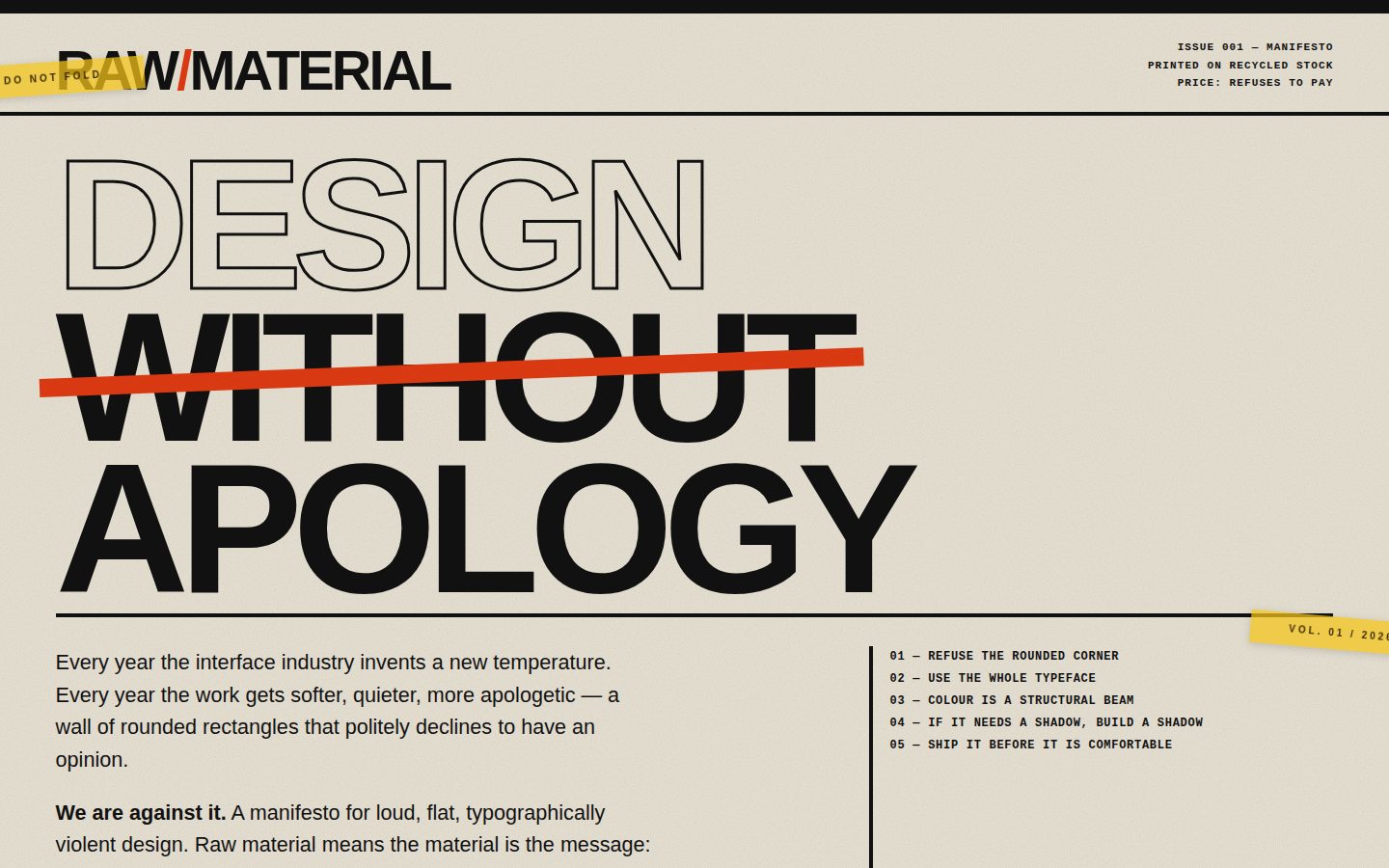
RAW MATERIAL — A Brutalist Manifesto screenshot
002

RAW MATERIAL — A Brutalist Manifesto

A typographically violent manifesto page that treats the browser like a broadsheet newspaper printed on rough stock. Every rule, colour block and hairline is deliberate; the only "soft" element on the page is the fractal-noise paper texture and the two strips of yellow tape stuck to the screen edges. The page argues for brutalist design in its own visual language — visible grid, real borders, oversized type and four flat spot colours.

Open ↗
Softline — Neumorphic Operations Console screenshot
003

Softline — Neumorphic Operations Console

A calm, tactile operations console rendered entirely in soft UI. Because every surface shares one background colour, depth is communicated only through paired highlight/shadow box-shadows, giving the page the sculpted, single-material feel of moulded plastic. Information density is high but the palette stays quiet, with colour reserved for status: blue, teal, amber and a single alert red.

Open ↗
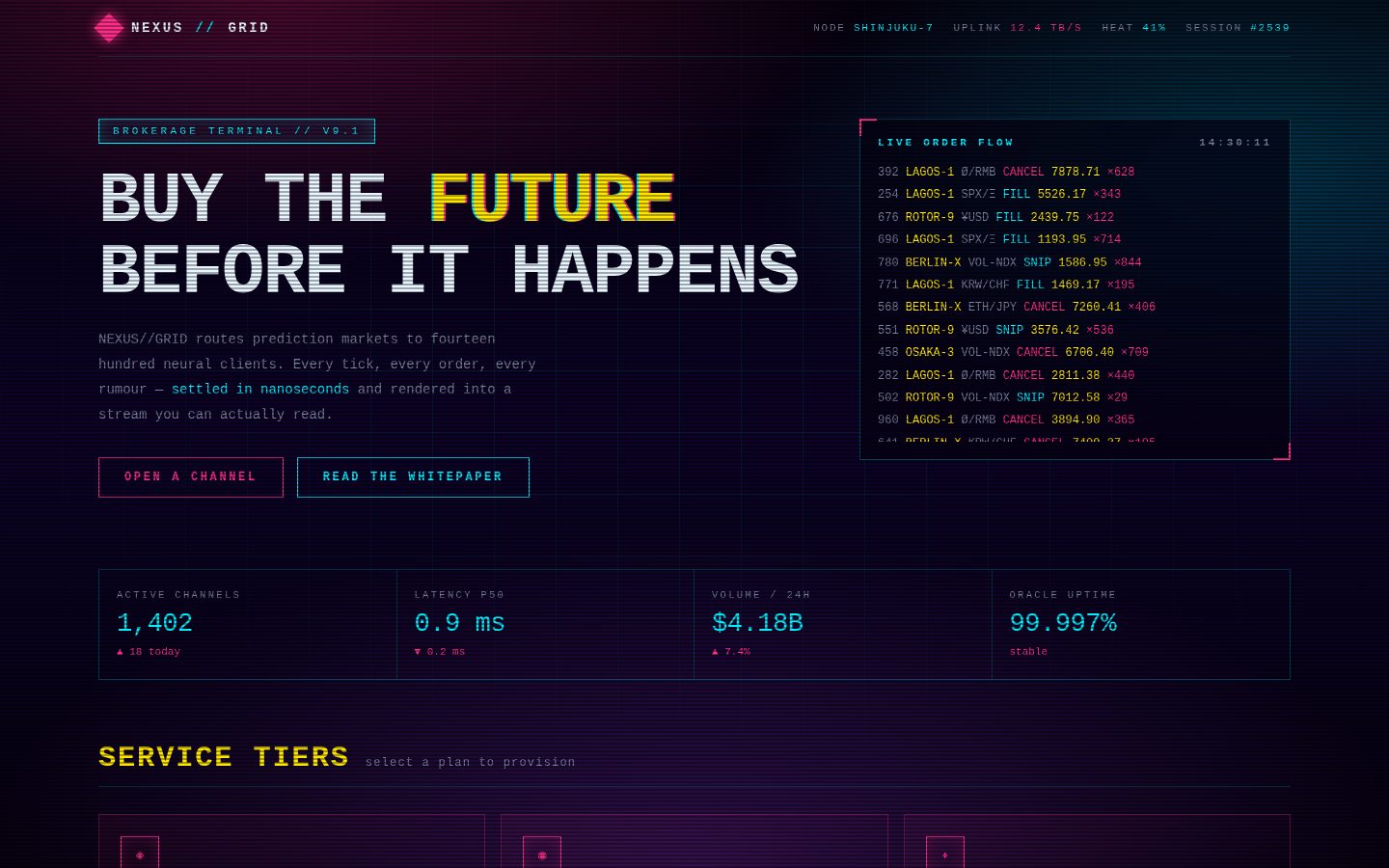
NEXUS//GRID — Cyberpunk Data Broker screenshot
004

NEXUS//GRID — Cyberpunk Data Broker

A neon-noir landing page dressed as a bleeding-edge trading terminal. The page leans on three classic cyberpunk signals — magenta/cyan chromatic split on the headline, a CRT scanline veil and a flickering frame — but keeps them disciplined with hairline rules, corner-bracket panels and a monospace grid of live market data. A self-typing shell transcript gives the bottom of the page a narrative payoff.

Open ↗
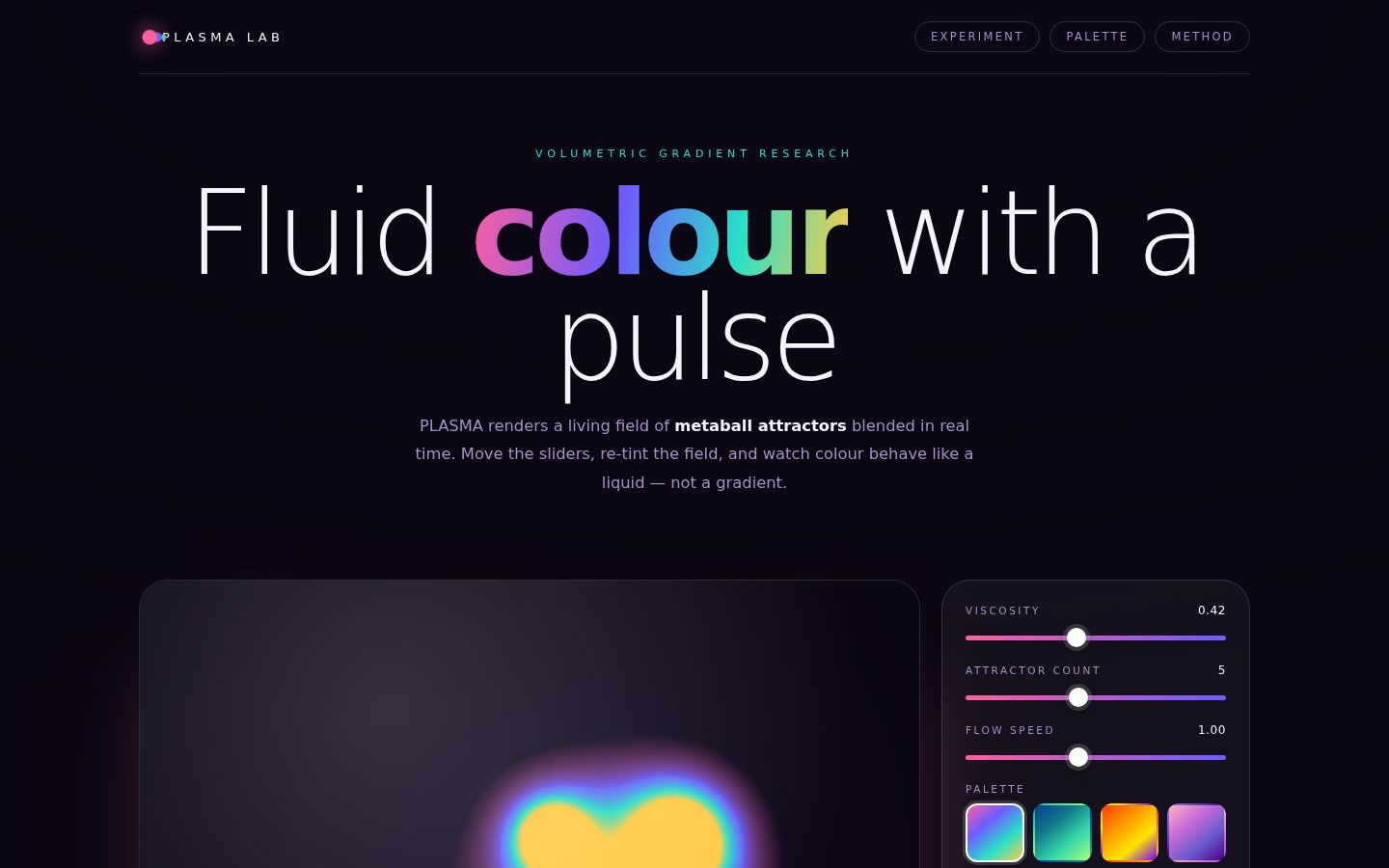
PLASMA — Liquid Gradient Laboratory screenshot
005

PLASMA — Liquid Gradient Laboratory

A hands-on visual laboratory where colour behaves like a fluid. Rather than faking liquid with blurred CSS blobs, the page computes a genuine scalar field on a coarse grid, thresholds it into a metaball isosurface, colour-ramps the result and upscales it with bilinear smoothing. The controls are real: viscosity tightens the isosurface threshold, attractor count changes the number of field sources, flow speed scales the drift, and switching palettes re-maps the ramp live.

Open ↗
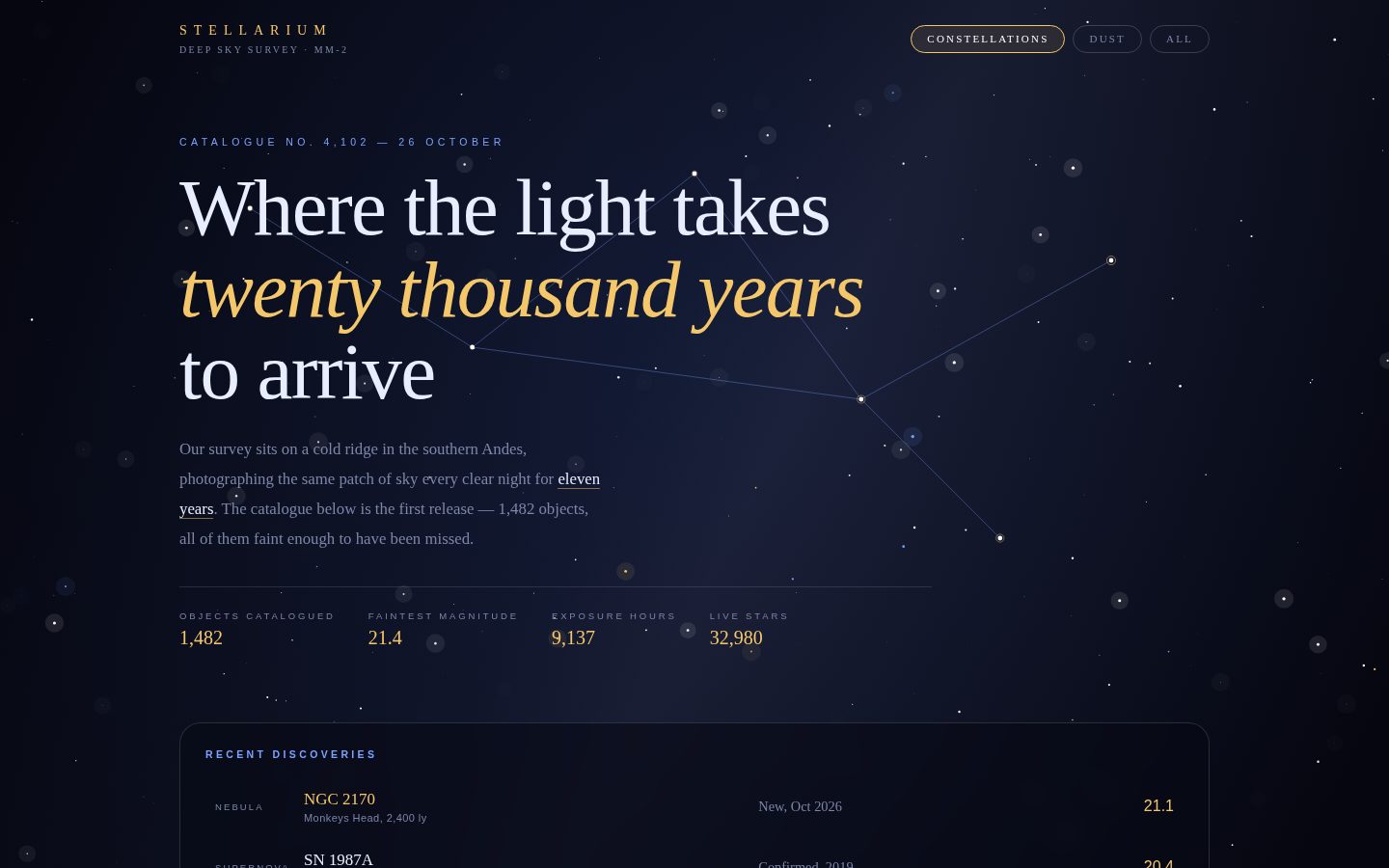
STELLARIUM — Deep Sky Survey screenshot
006

STELLARIUM — Deep Sky Survey

An astronomer's catalogue rendered with the gravity of an old scientific publication rather than a sci-fi HUD. Serif prose, gold figures, generous margins and a live canvas sky behind it. The visual pleasure comes from restraint: two accent colours, a real twinkling starfield with subtle pointer parallax, and inline-SVG astronomical figures that look drawn rather than clip-arted.

Open ↗
HÔTEL SOLENNE — A quiet house on the coast screenshot
007

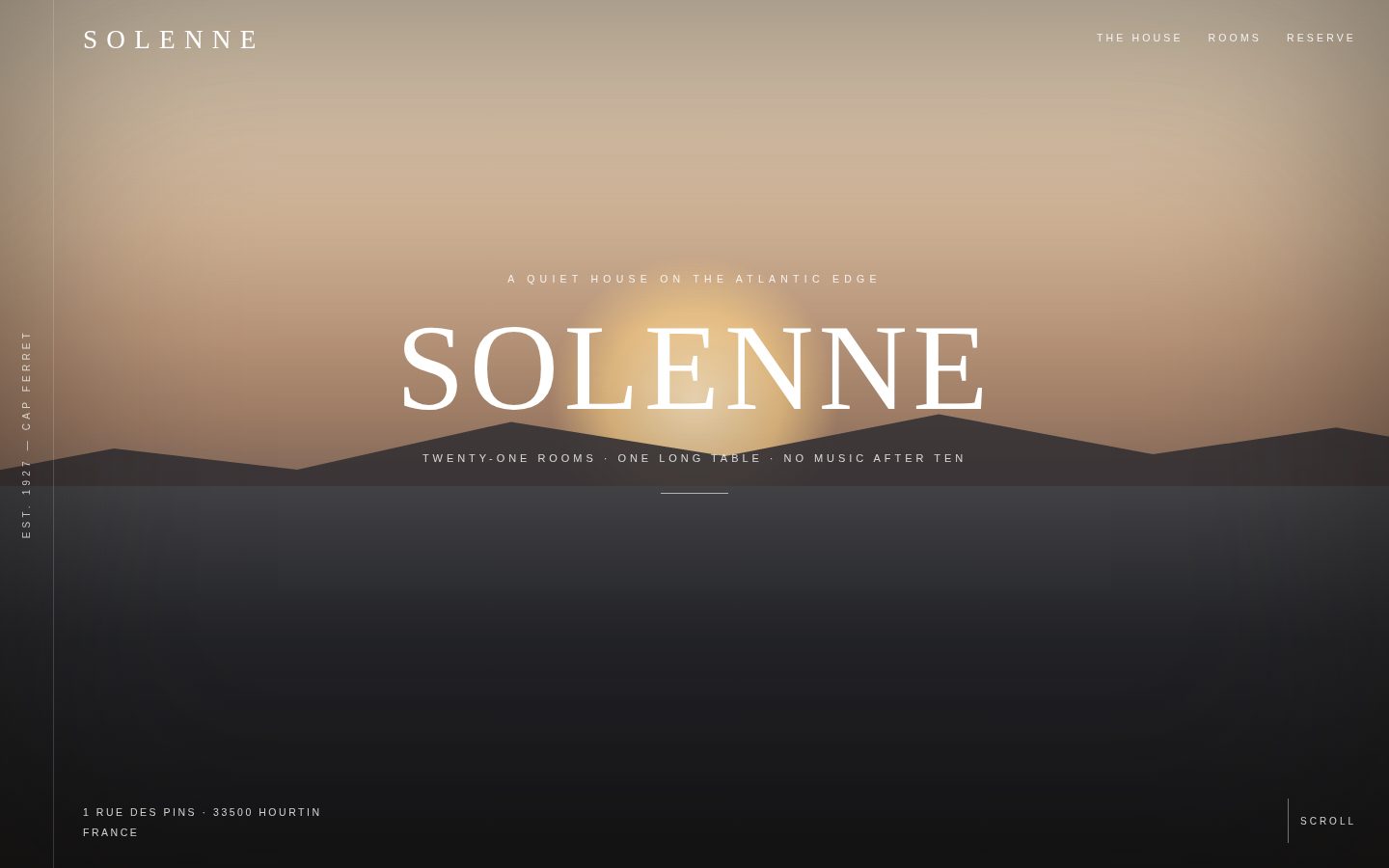
HÔTEL SOLENNE — A quiet house on the coast

A restrained, expensive-feeling hotel page where every image is drawn in CSS and every rule is a hairline. The dusk hero uses layered gradients and a clip-path ridge rather than photography, and the typography carries the luxury: a Didone wordmark, generous leading, brass used exactly three times per screen. The room list rewards attention with a pointer-following preview, and the reservation form confirms by naming the guest.

Open ↗
TIDE — A scroll through the sound of the sea screenshot
008

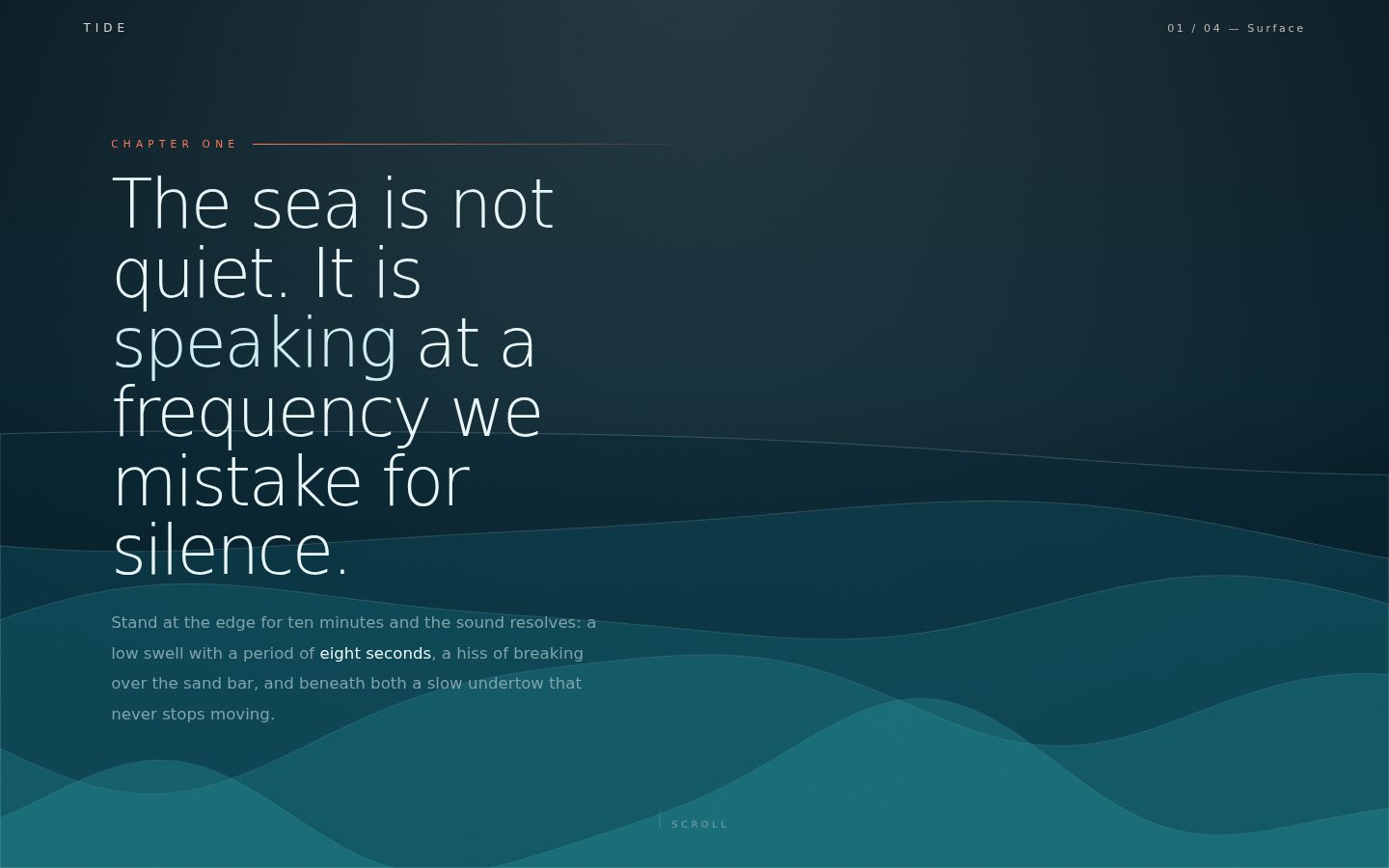
TIDE — A scroll through the sound of the sea

A long-form, scroll-told essay about what the ocean sounds like, staged like a descent. The canvas is the set — layered wave silhouettes that rise and deepen as the reader scrolls, lit from an off-screen surface. Chapters alternate sides so the eye zig-zags down the column, and the final sonar instrument turns the abstract into an instrument panel with contacts blinking at irregular intervals.

Open ↗
MASS — A kinetic type laboratory screenshot
009

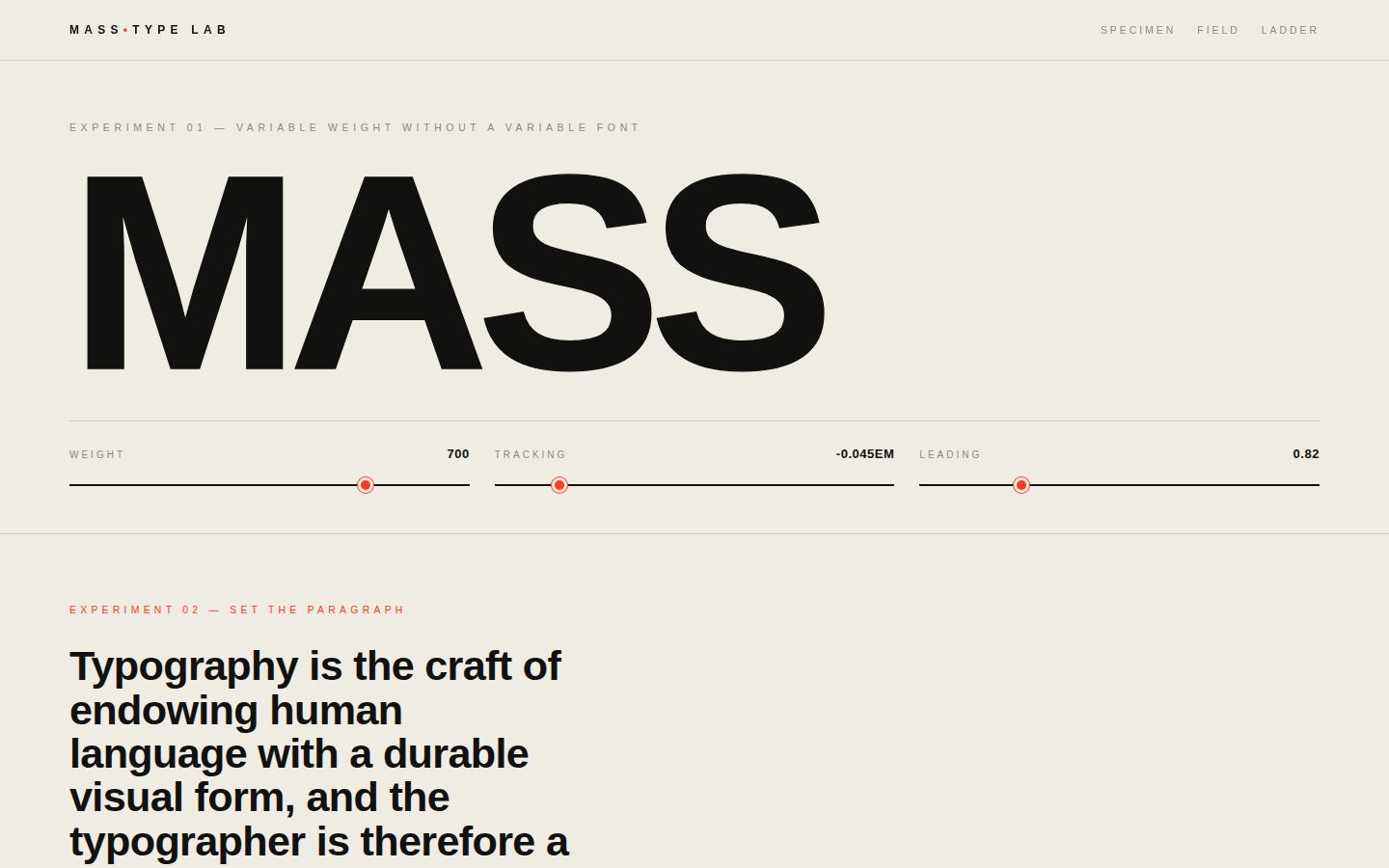
MASS — A kinetic type laboratory

A typographic workbench that makes the reader feel weight, tracking and leading as physical quantities. The headline trick is honest about its own trickery: the page has no variable font, so the weight axis is faked with a synthetic stroke that thickens as the slider climbs, giving a genuinely continuous ramp from hairline to black. A second experiment lets the pointer push a giant word around like a field of soft bodies.

Open ↗
FORM — Bauhaus Poster Studio screenshot
010

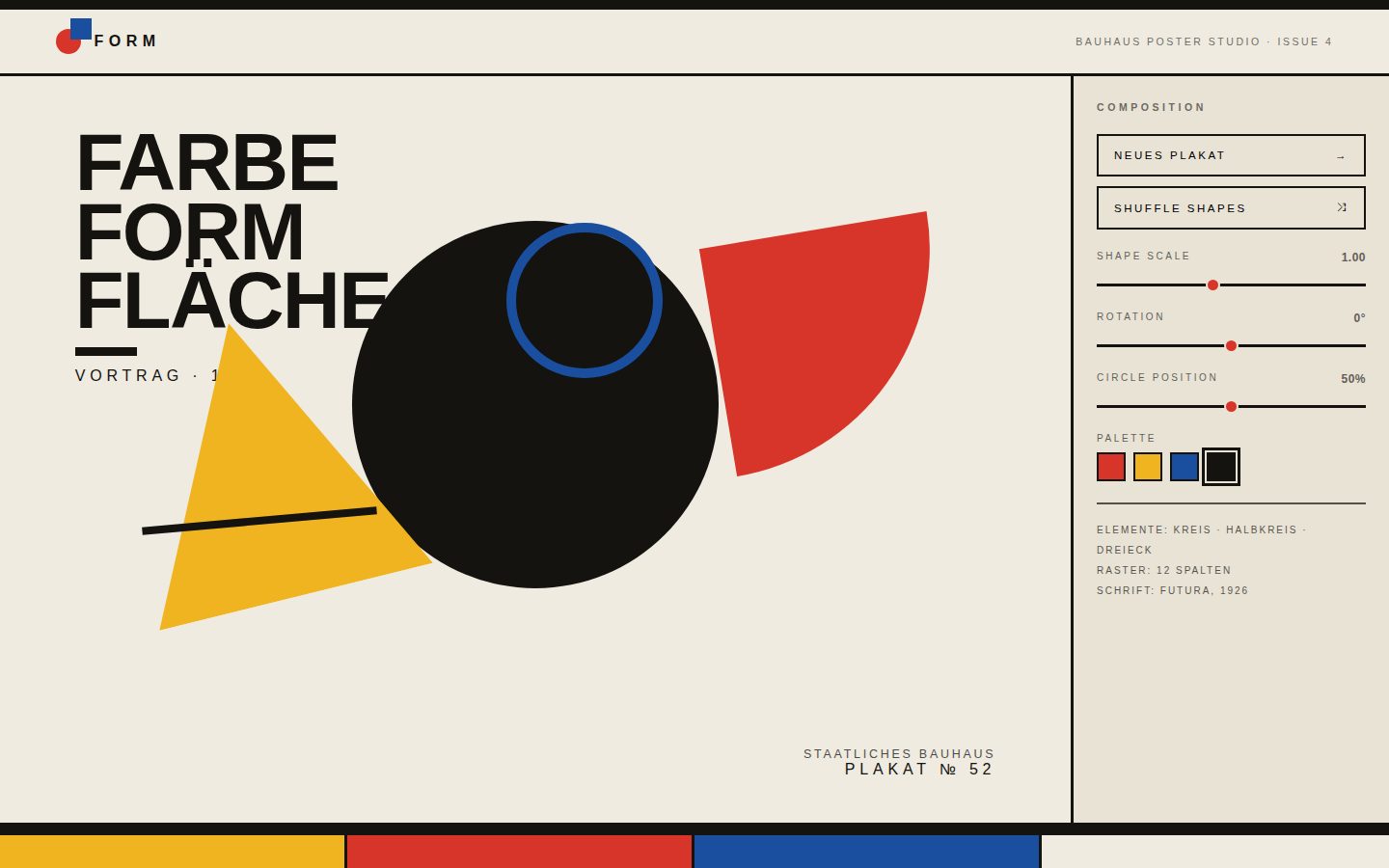
FORM — Bauhaus Poster Studio

A working poster press that runs in the browser. Every composition is assembled from a strict Bauhaus vocabulary — circle, half-disc, triangle, ring, bar — and set with a Futura-like uppercase. Rather than decorating a picture, the page treats the poster as an argument: a three-word headline, a rule, a caption, and a single dominant primary colour. Pressing the button re-runs the procedure and produces a different, equally valid poster.

Open ↗
ORBIT — A gravity sandbox screenshot
011

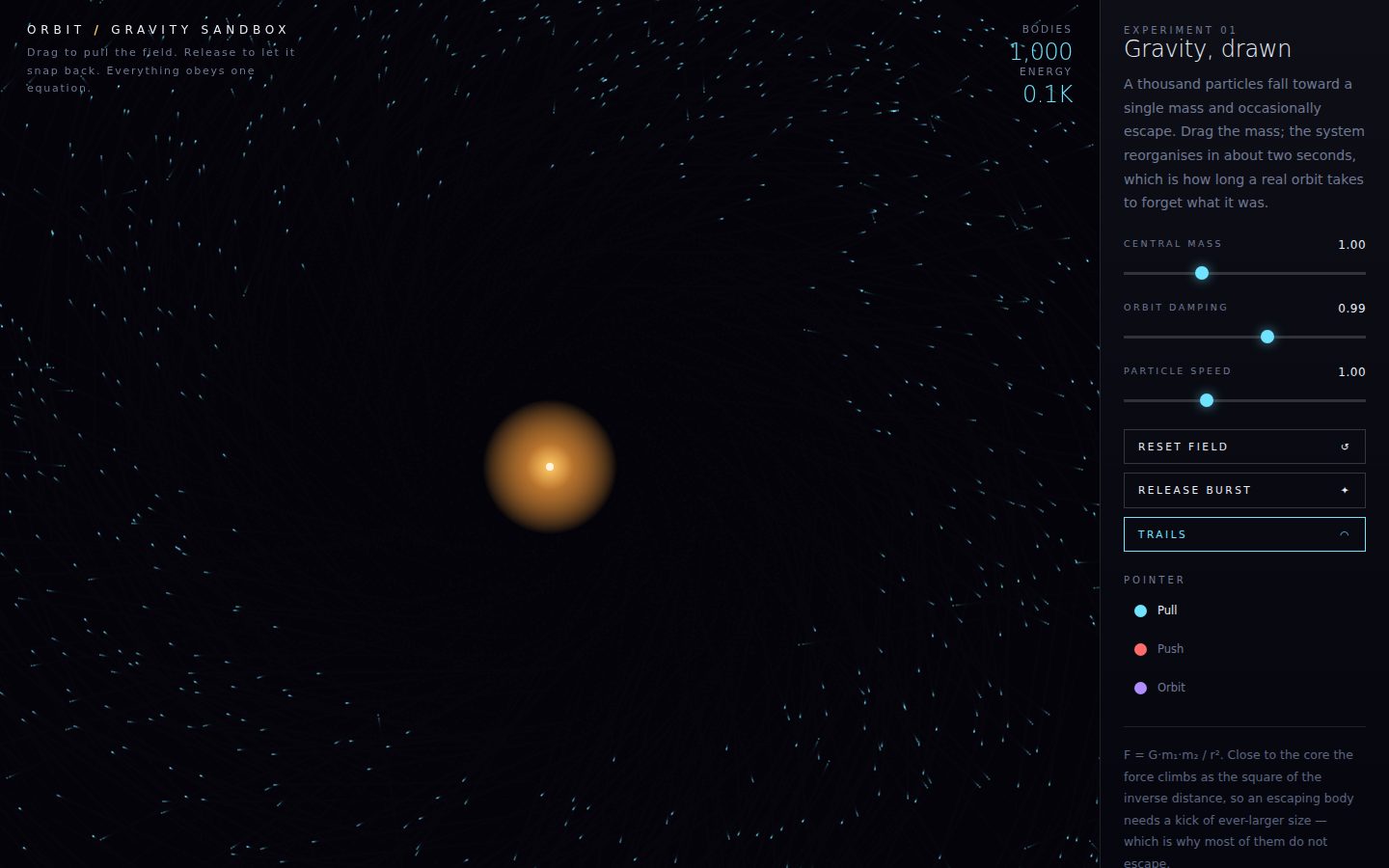
ORBIT — A gravity sandbox

A one-rule physics toy that looks like a piece of laboratory equipment. A thousand bodies fall toward a single gold mass, occasionally escape, and are quietly recycled back into the field when they expire. Because the force is genuinely inverse-square, the crowded core behaves differently from the sparse outskirts, and raising the damping slider visibly freezes the system into a lattice. The pointer acts as a second attractor you can flip between pulling, pushing and swirling.

Open ↗
BOOT//SEC — vintage machine console screenshot
012

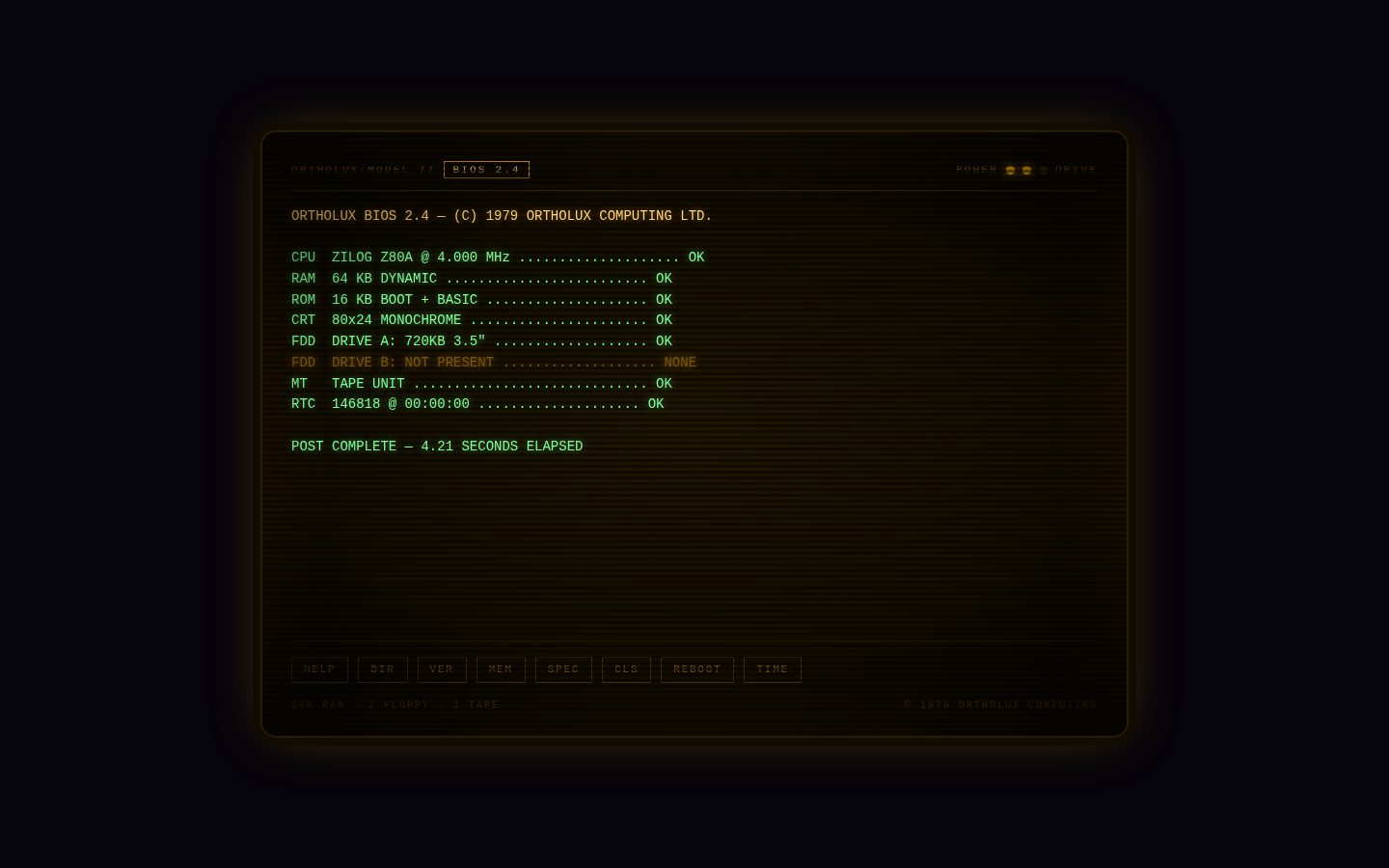
BOOT//SEC — vintage machine console

A lovingly modelled amber terminal that boots, fails a drive, and then hands you a working prompt. The nostalgia comes from the details rather than the nostalgia filter: the POST takes four seconds, one drive reports NONE, the memory map prints real memory addresses, and the cursor is a hard block that blinks. Everything is text, and the text is the interface.

Open ↗
侘 — 寂の庭 / A garden of imperfection screenshot
013

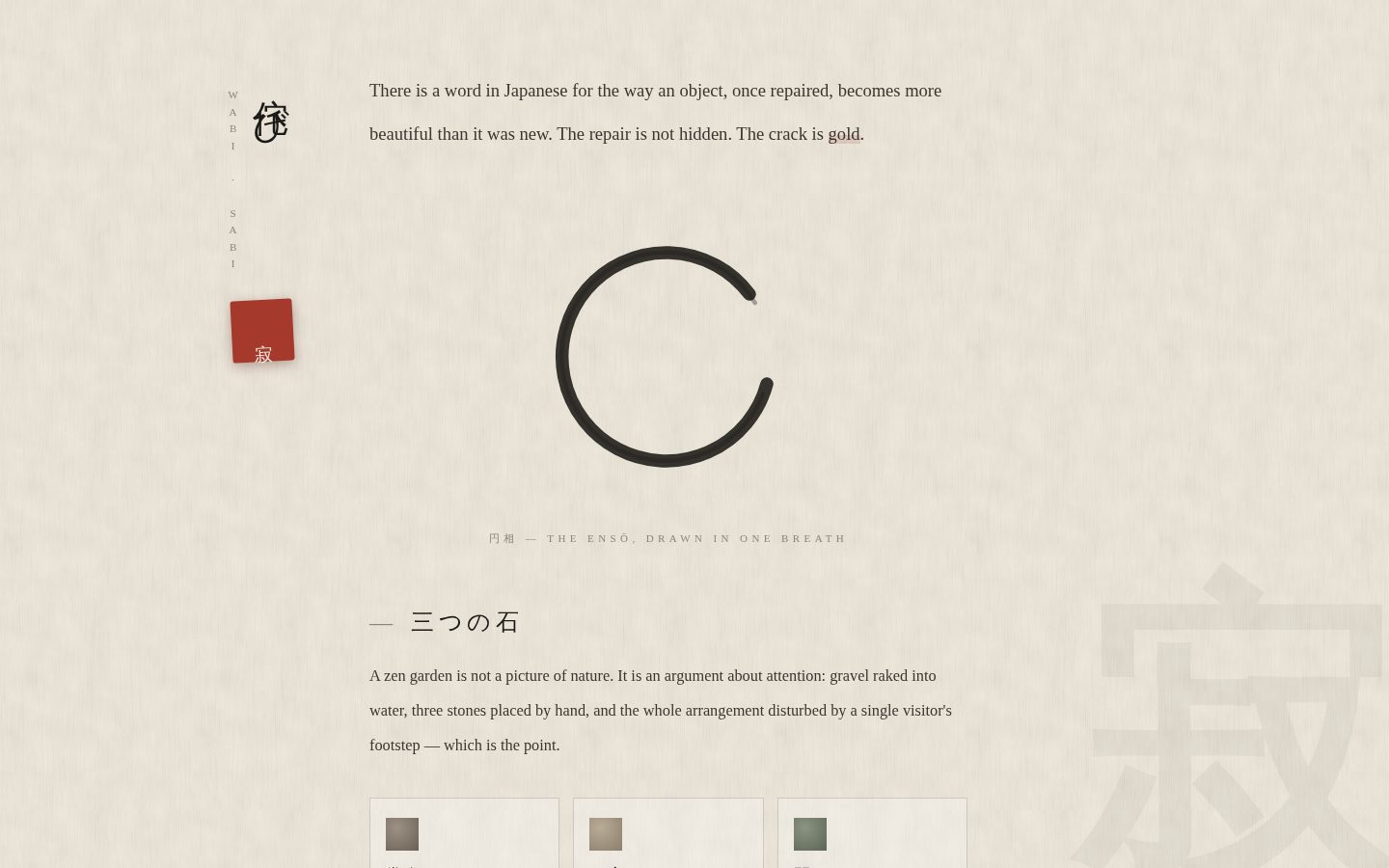
侘 — 寂の庭 / A garden of imperfection

A meditation on imperfection rendered with the materials it describes. The page surface is literally fibrous — two layers of generated turbulence, one coarse and one stretched into paper fibres — and the one piece of drawing on it, the ensō, is animated from nothing to a full circle in a single sweep, the way it would be brushed. Everything else is stillness: type, white space, and three stones.

Open ↗
CIVITAS — An isometric city that lives screenshot
014

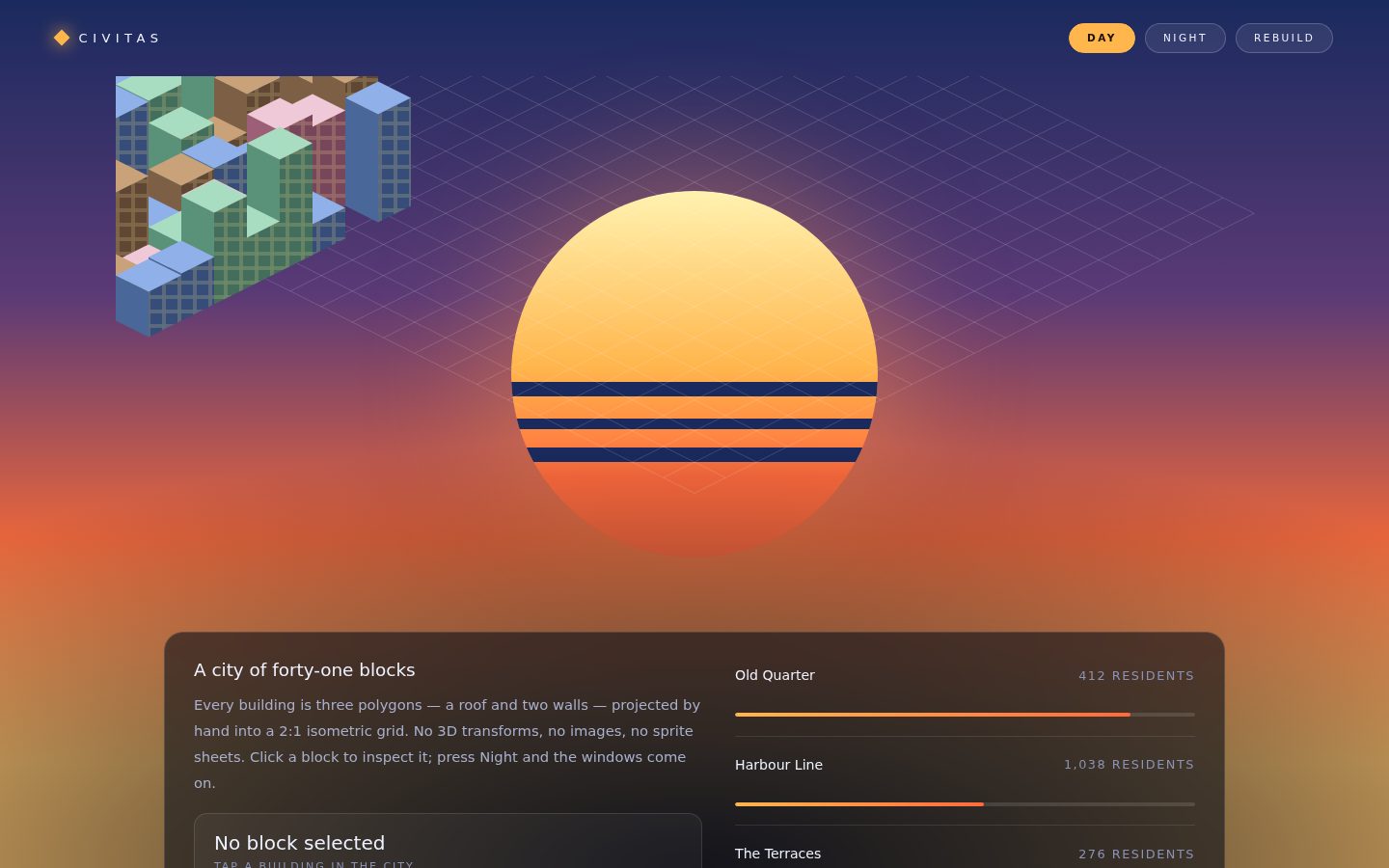
CIVITAS — An isometric city that lives

A small city drawn the way an architect draws one: a 2:1 isometric grid, four districts, and buildings assembled from three polygons apiece. The projection is computed in JavaScript rather than faked with 3D transforms, which means every roof, wall and window grid lands exactly on the grid. Switching to night doesn't hide the city — it reveals that the window rectangles were always there, waiting under a 20% opacity.

Open ↗
SNACK-O-MATIC — a vending machine you can operate screenshot
015

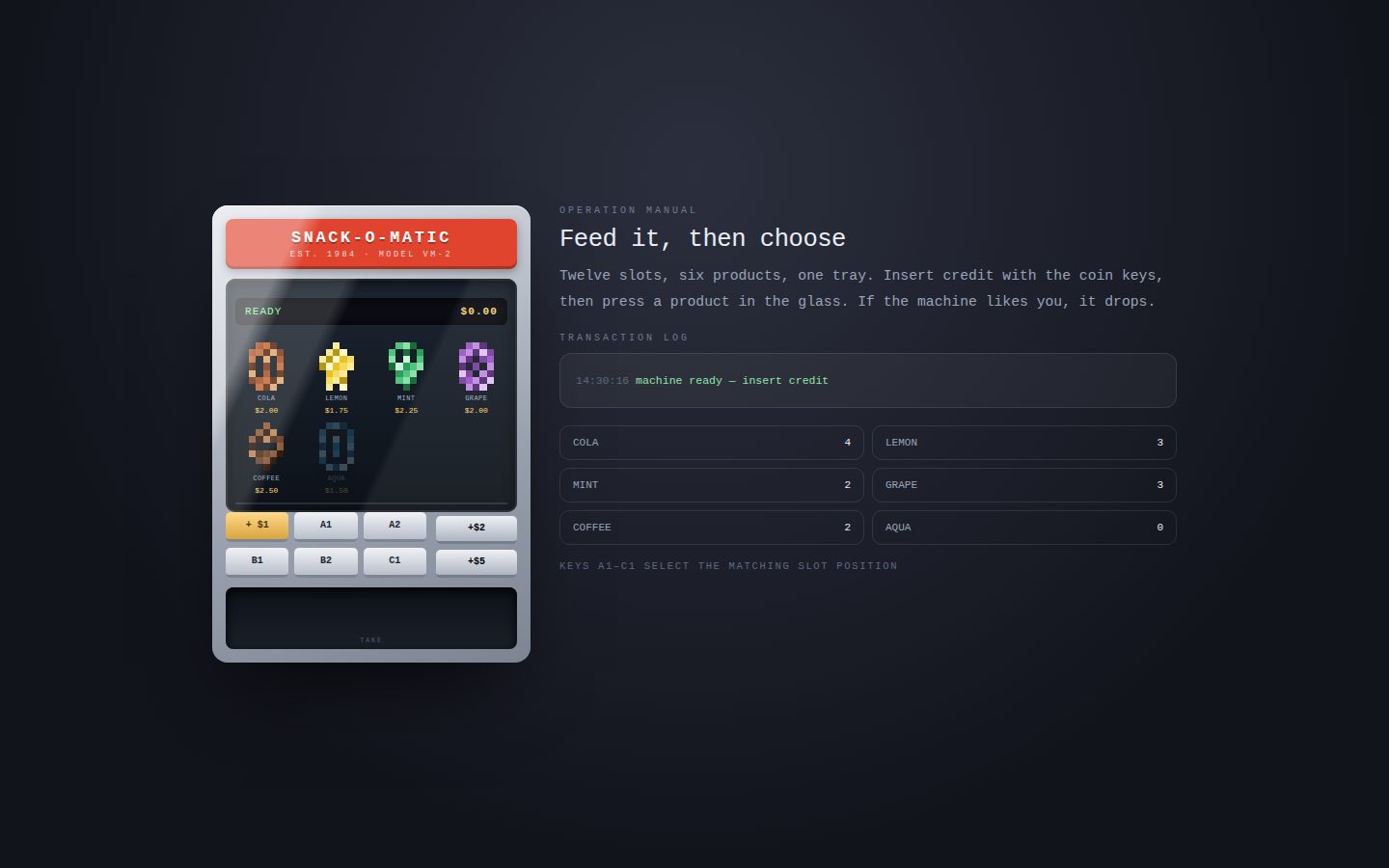
SNACK-O-MATIC — a vending machine you can operate

A complete micro-interaction: a vending machine you can actually feed. The products are hand-authored pixel sprites built from bitmask strings and painted cell by cell, so they look like 1984 hardware rather than emoji. The machine keeps honest state — credit, per-item stock, sold-out slots, a refusal when you are short — and the transaction log records every coin, refusal and purchase with a timestamp.

Open ↗
NEON HORIZON — Outrun tribute screenshot
016

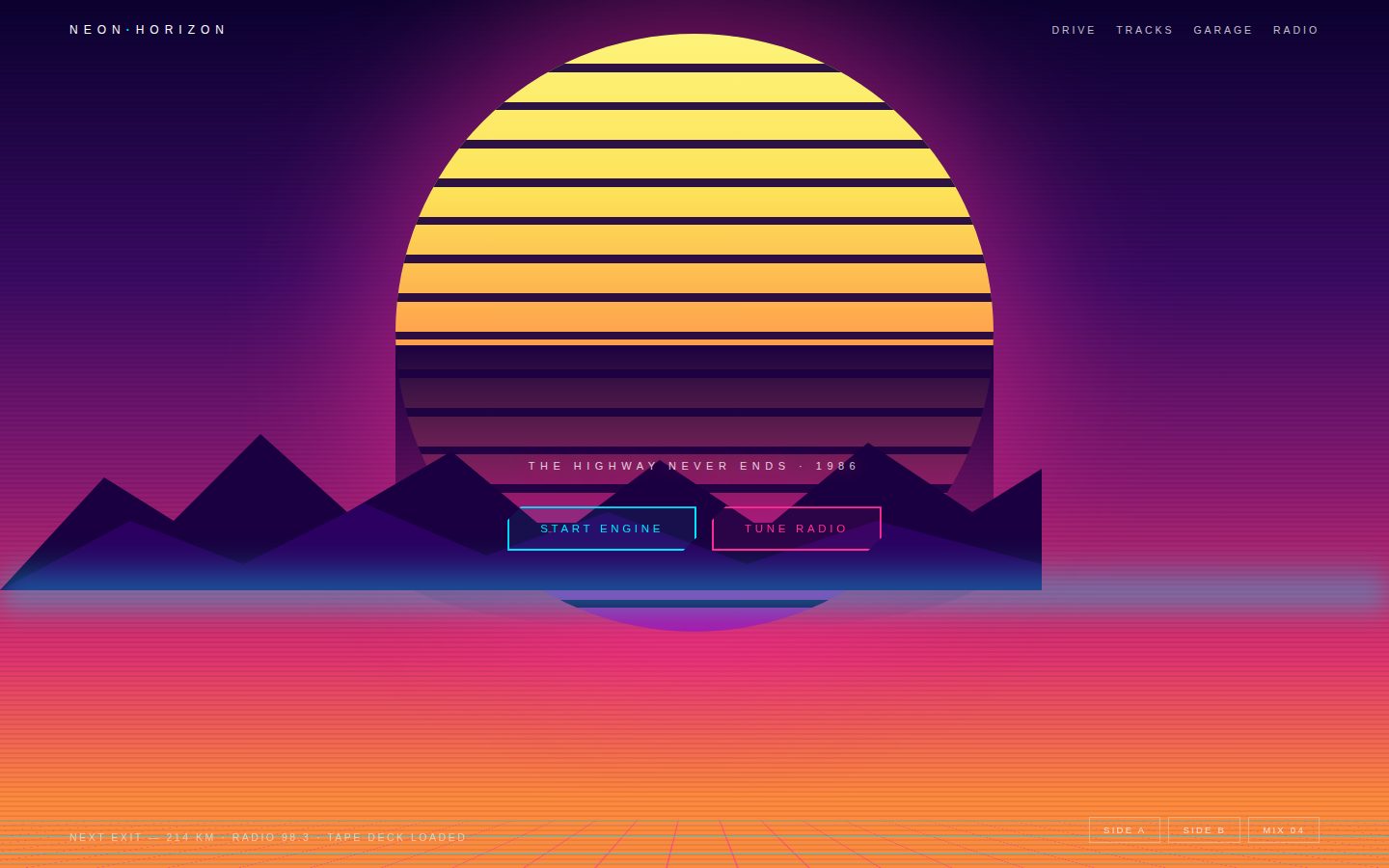
NEON HORIZON — Outrun tribute

A loving, precise reconstruction of the Outrun poster: banded sky, slit-cut sun, violet mountain silhouettes, a cyan and magenta perspective grid racing toward the viewer and chrome lettering that reads as polished metal. The grid is genuinely three-dimensional — a plane tipped into the ground with a pattern that translates along its own axis, so the lines accelerate as they approach — and the whole scene breathes slowly enough to be calm rather than frantic.

Open ↗
PAPIER — a papercut world screenshot
017

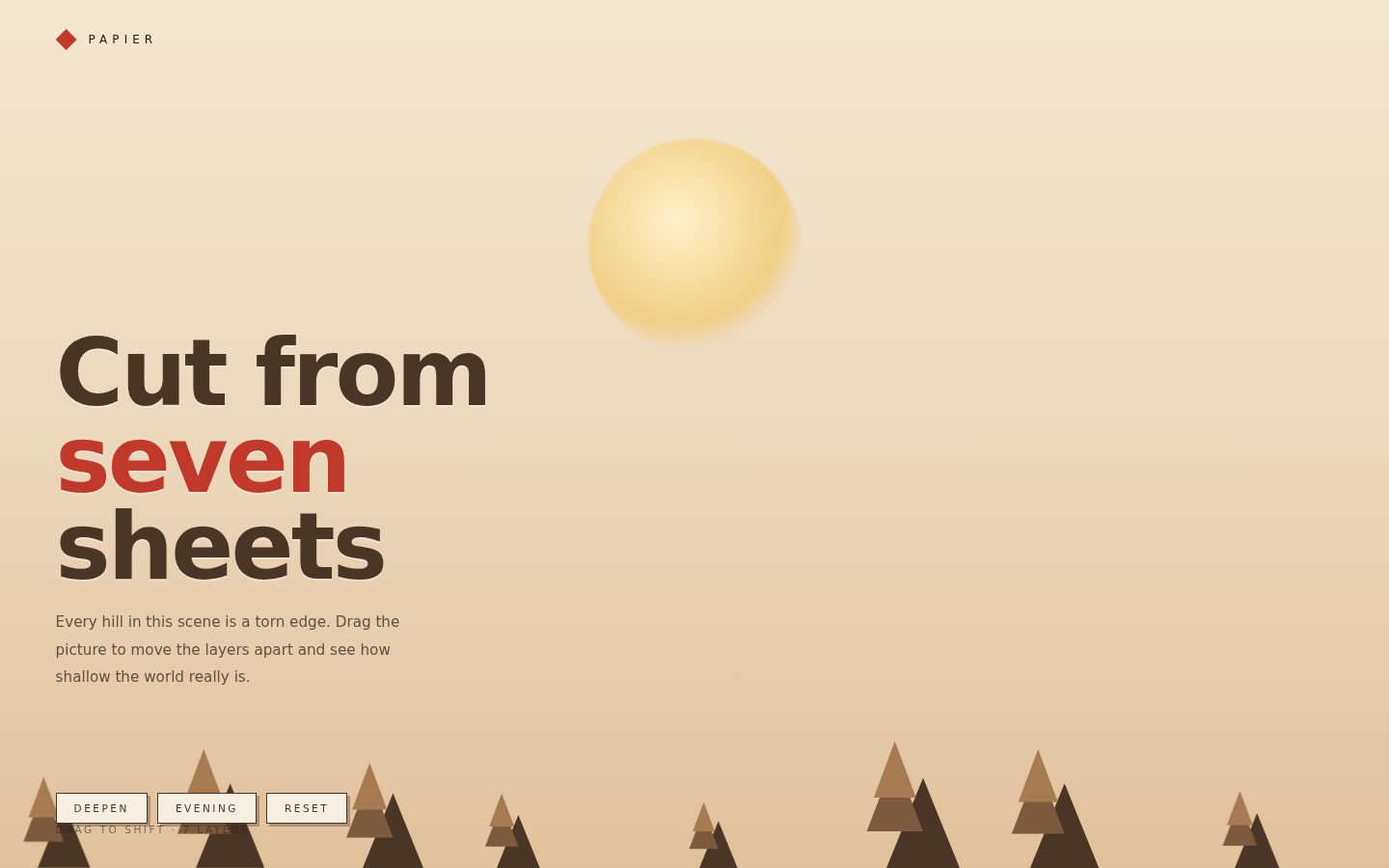
PAPIER — a papercut world

A seven-sheet world you can take apart. Each hill is a torn clip-path edge in a different paper tone, the trees are stacked triangles, and the whole diorama parallaxes as you drag it — the nearest sheets travel furthest, the way real mounted paper does. The Evening button repaints the entire scene from a cream afternoon into a violet dusk with a single red accent, and Deepen exaggerates the separation until the construction is obvious.

Open ↗
HELIOS — an energy sunburst screenshot
018

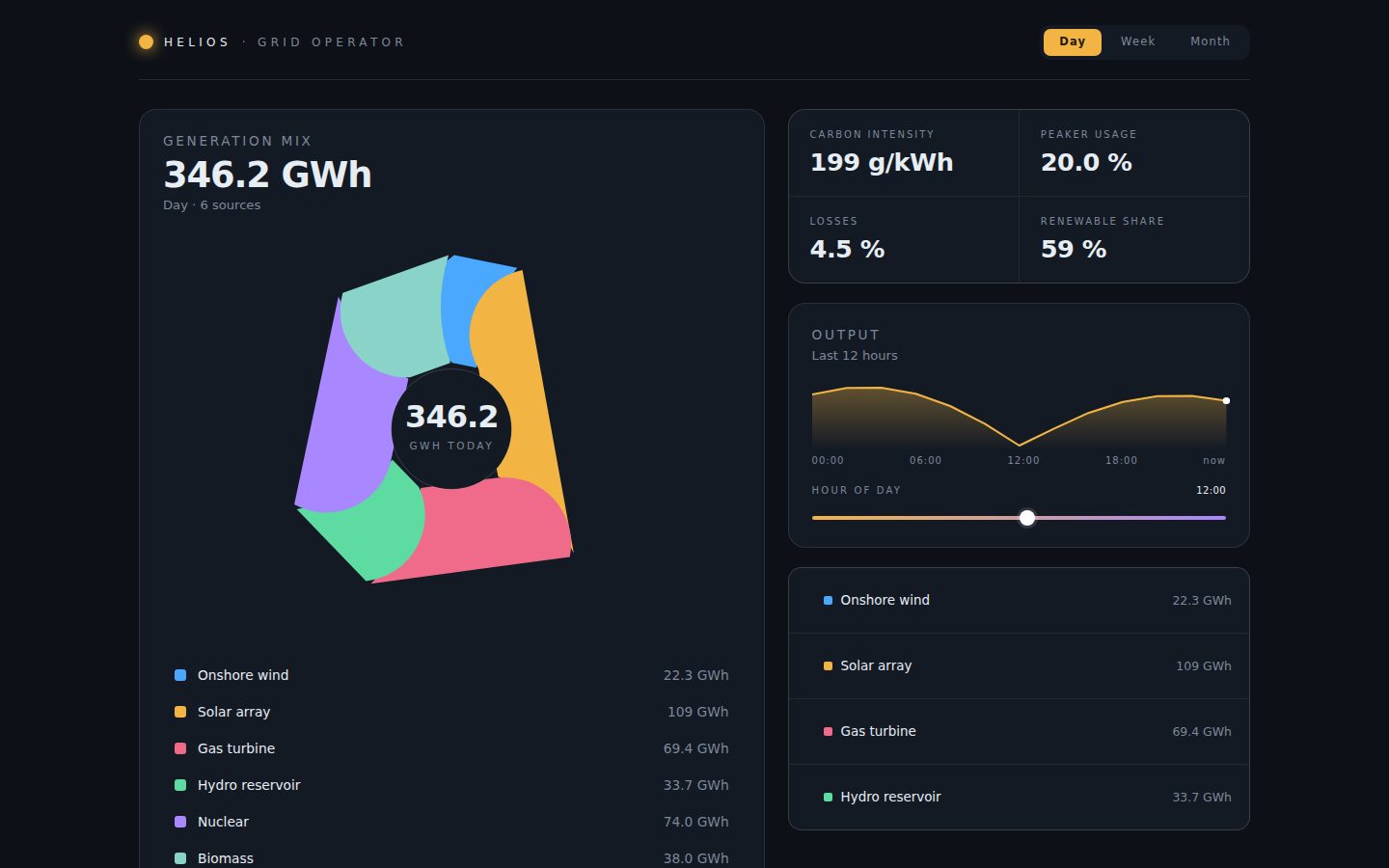
HELIOS — an energy sunburst

A dashboard where the hero visualisation is a sunburst rather than a pie: each generation source is an annular sector sized by its share of the day's output, drawn from computed arc geometry so the petals meet exactly. The data model is honest enough to be useful — solar dies at midnight, gas peaks in the evening, and carbon intensity falls as the renewable share rises — so scrubbing the hour slider visibly reshapes the whole page.

Open ↗
墨 — SUMI, a study of one brush screenshot
019

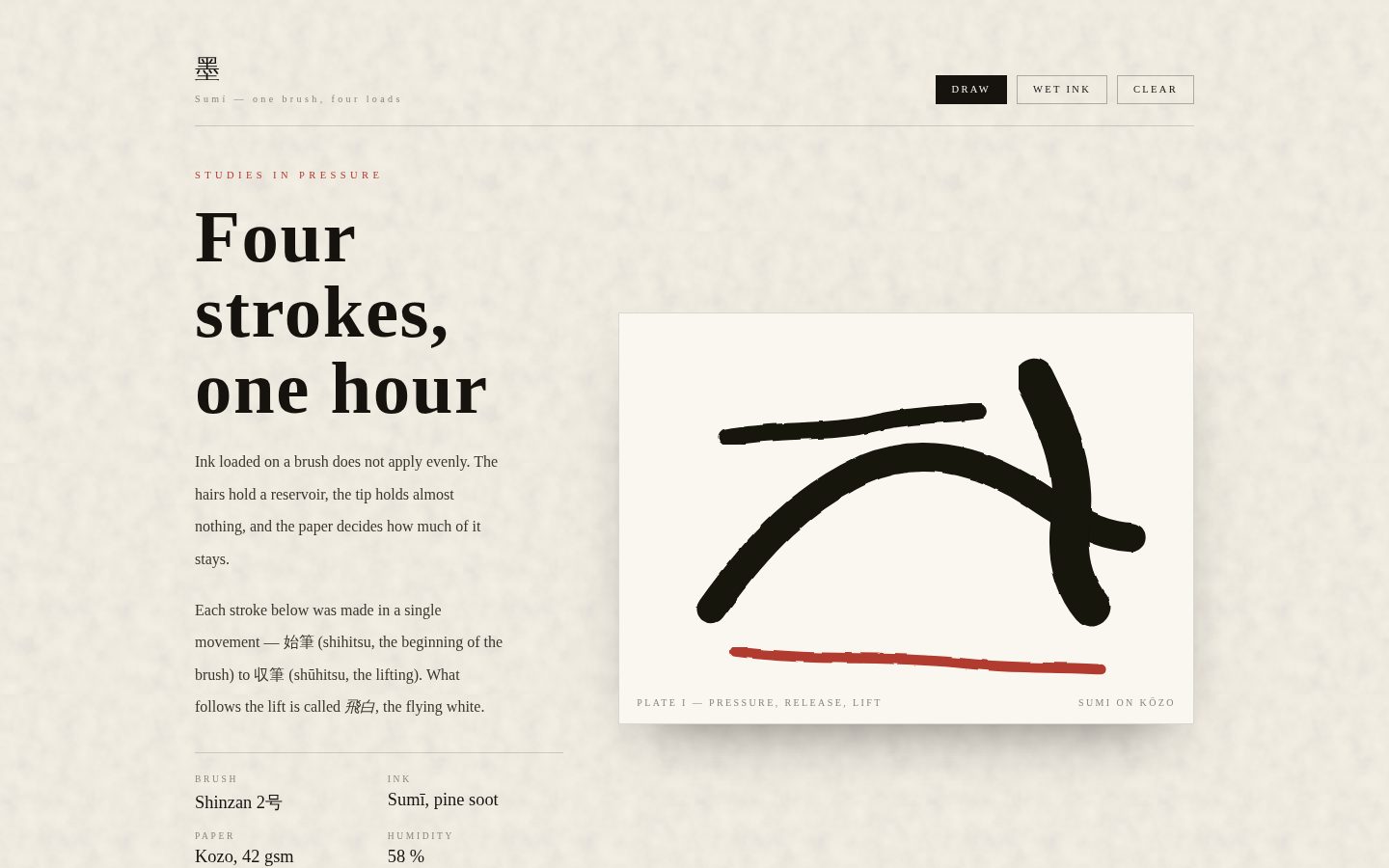
墨 — SUMI, a study of one brush

A study of one brush, rendered with real SVG filters rather than brush images. The strokes are drawn on load with a dash-offset animation so they appear to be made in a single movement, and the ink edge is genuinely roughened by a turbulence displacement filter — the same filter that makes a wetter, heavier mark when you press Wet ink. The cursor leaves a faint wash on the paper as it travels, which is exactly what a loaded brush would do.

Open ↗
LA ROUE — the great wheel at dusk screenshot
020

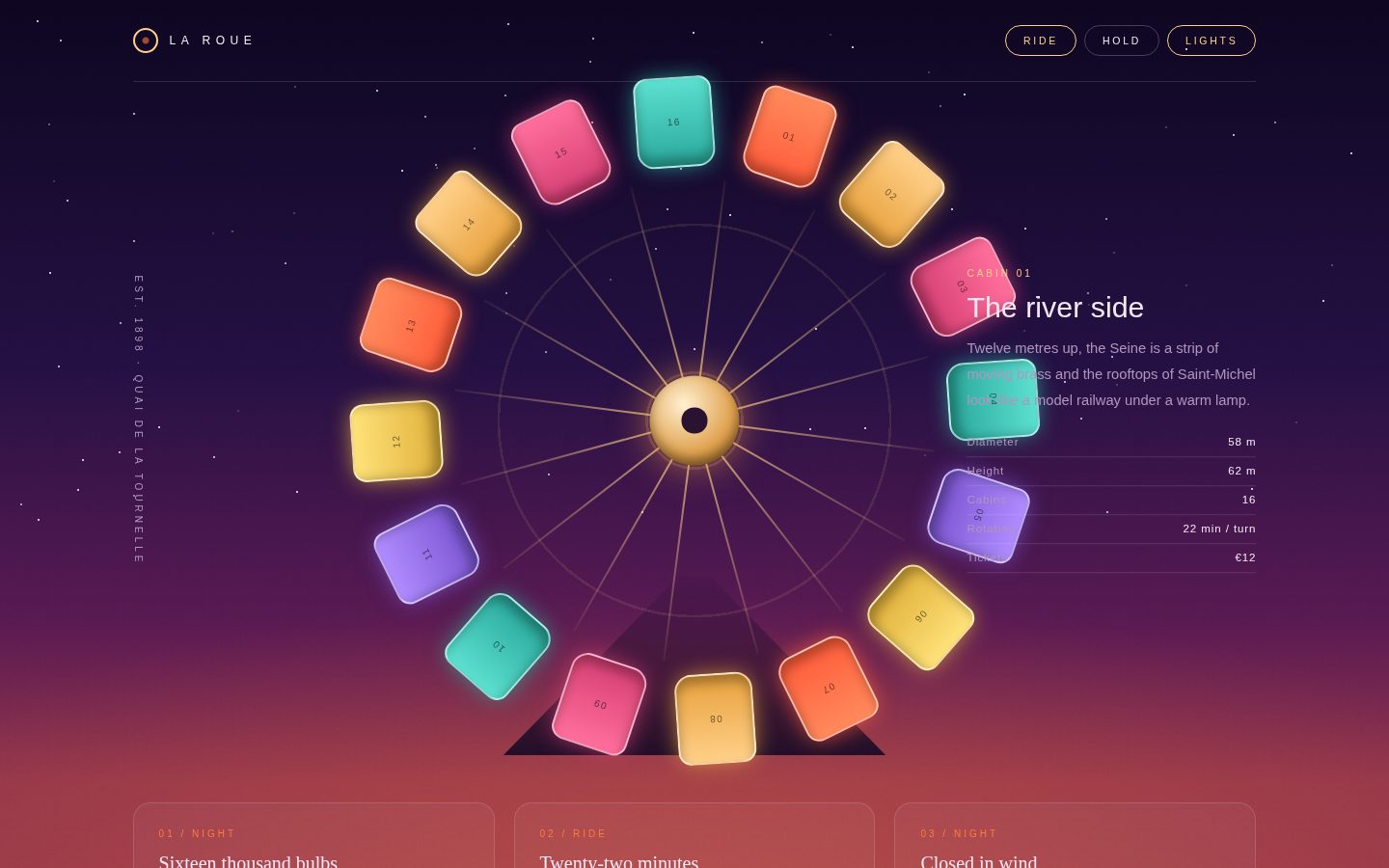
LA ROUE — the great wheel at dusk

A great wheel rendered as pure geometry, turning at a believable twenty-two minutes per revolution. The gondolas are the real trick: each one is anchored so that rotating it about its own base sweeps it around the rim, which means the cabins stay upright relative to the spoke and the whole assembly can be driven from a single angle. Clicking a cabin brings up the view from that seat — the Seine, the cathedral, the last ferry — which is a small piece of writing disguised as an interface.
Open ↗
MERIDIAN — Calibre 9 screenshot
021

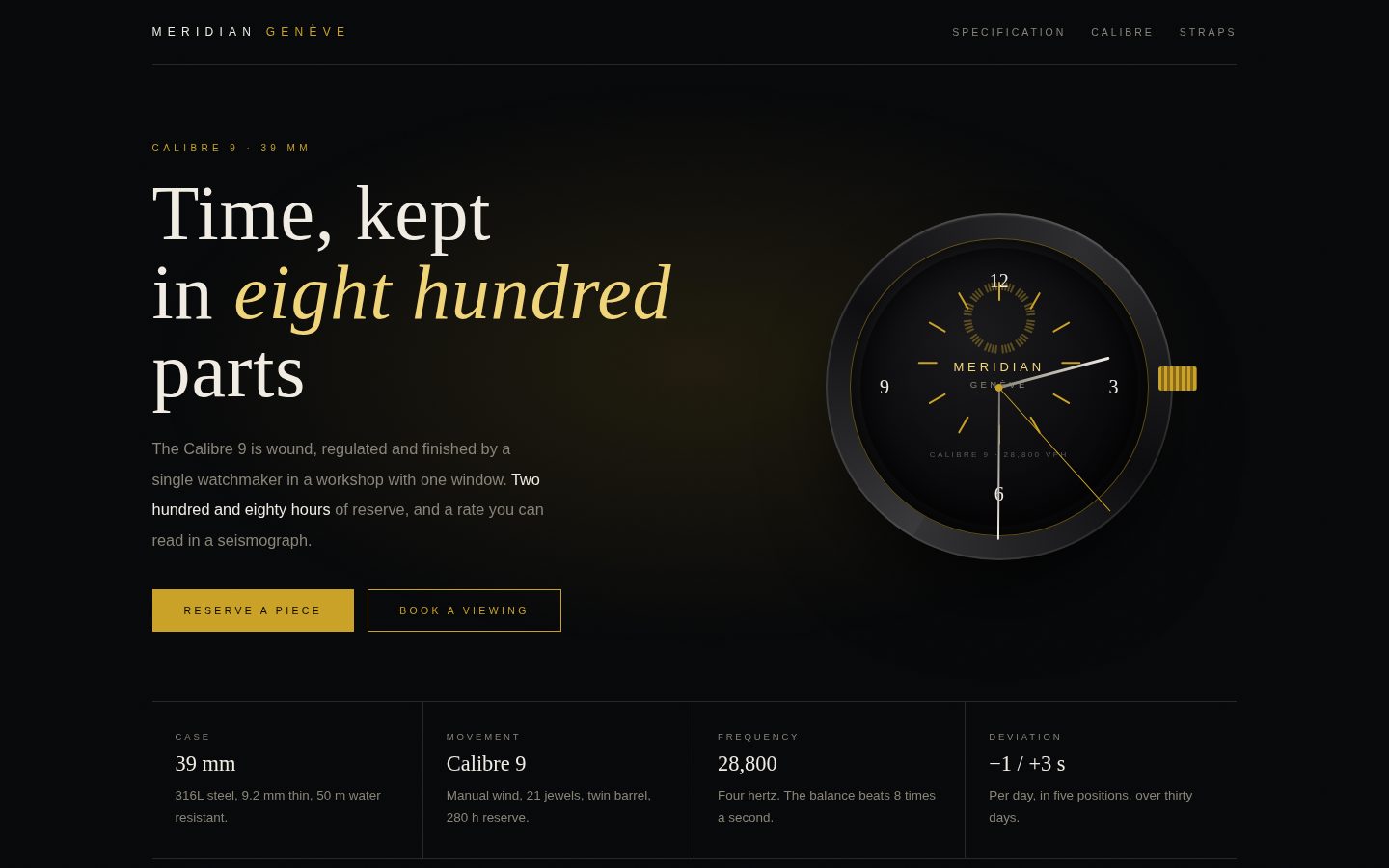
MERIDIAN — Calibre 9

A watch page with the confidence to use a lot of black and almost nothing else. The watch is not a photograph — it is a conic-gradient case, a radial dial, sixty generated markers and three hands driven by the actual system clock, so the time on the page is the time on your machine. The only playful element is the crown, which can be dragged upwards to wind the movement; the copy never mentions it, which is the joke.

Open ↗
PRISM — a glass interface kit screenshot
022

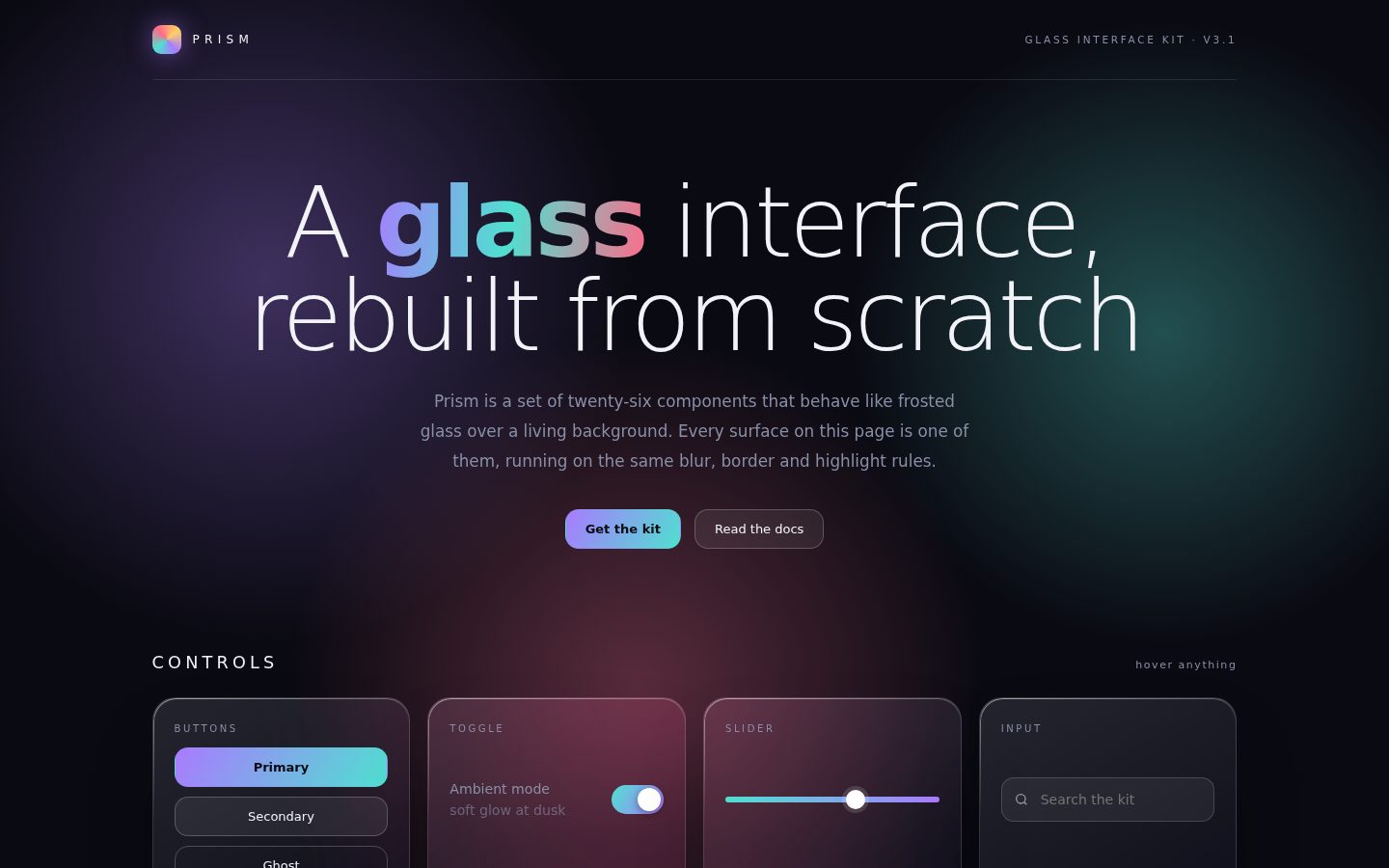
PRISM — a glass interface kit

A component library page that uses its own components. Every card, chip, button, notification and player on the page is the real thing from the kit, sitting on the same shared .glass rule, floating over a canvas background of drifting violet, teal and rose light so the blur and saturation are visible rather than asserted. The equaliser in the player is twenty-two individually timed bars, and the play button morphs between a triangle and a pause symbol without changing size.

Open ↗
ARBORE — a recursive forest screenshot
023

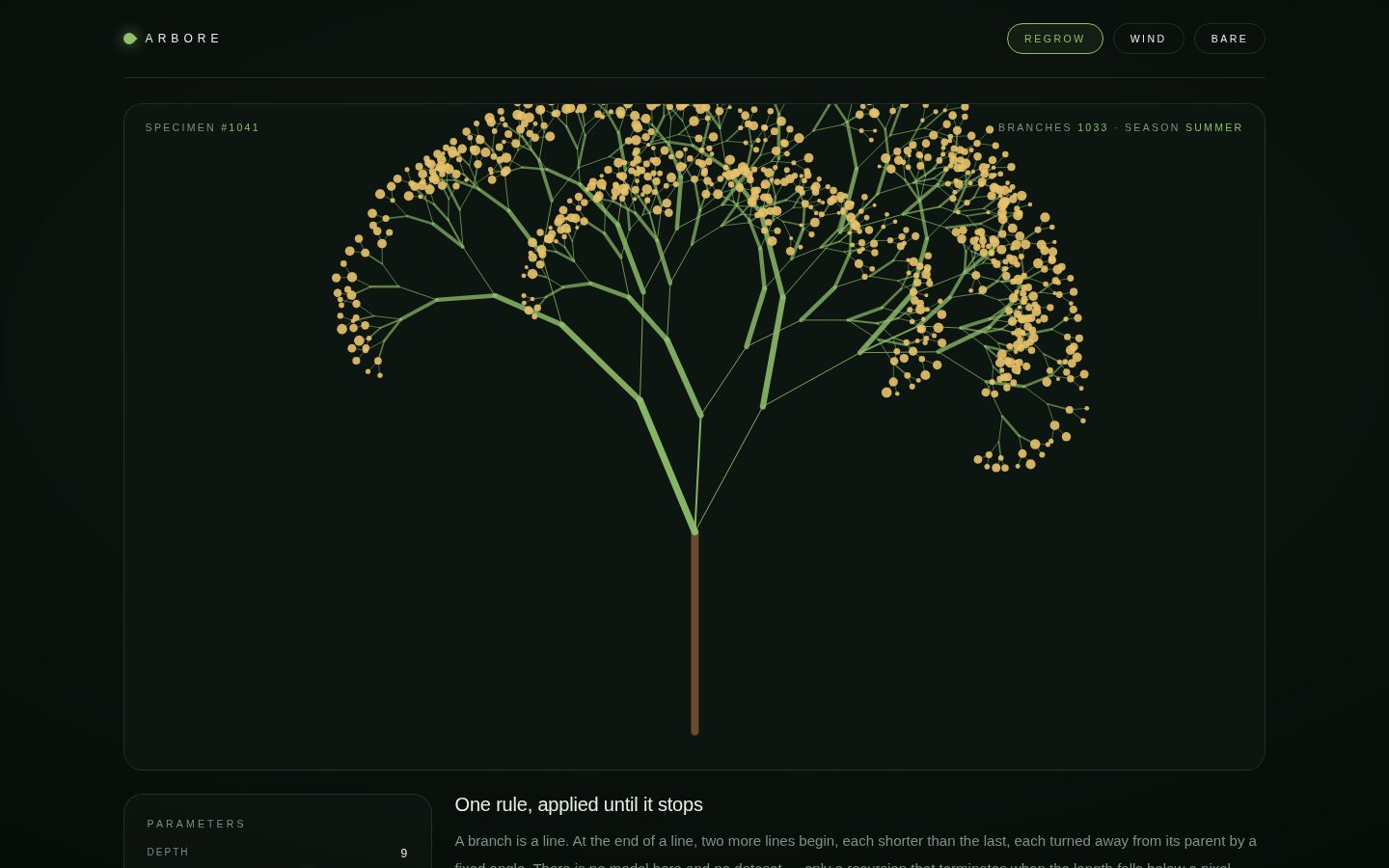
ARBORE — a recursive forest

A recursive generator with the pretence of a botanical instrument. The tree is real SVG, not a picture: a seeded random walk through angle, length decay and a third-child probability, with each line animating its own growth so the specimen appears to push itself up from the base. Because the seed is visible and editable, the same tree can be returned to at any time, which turns a toy into a specimen sheet.

Open ↗
LEDGER//ZERO — decentralised, badly screenshot
024

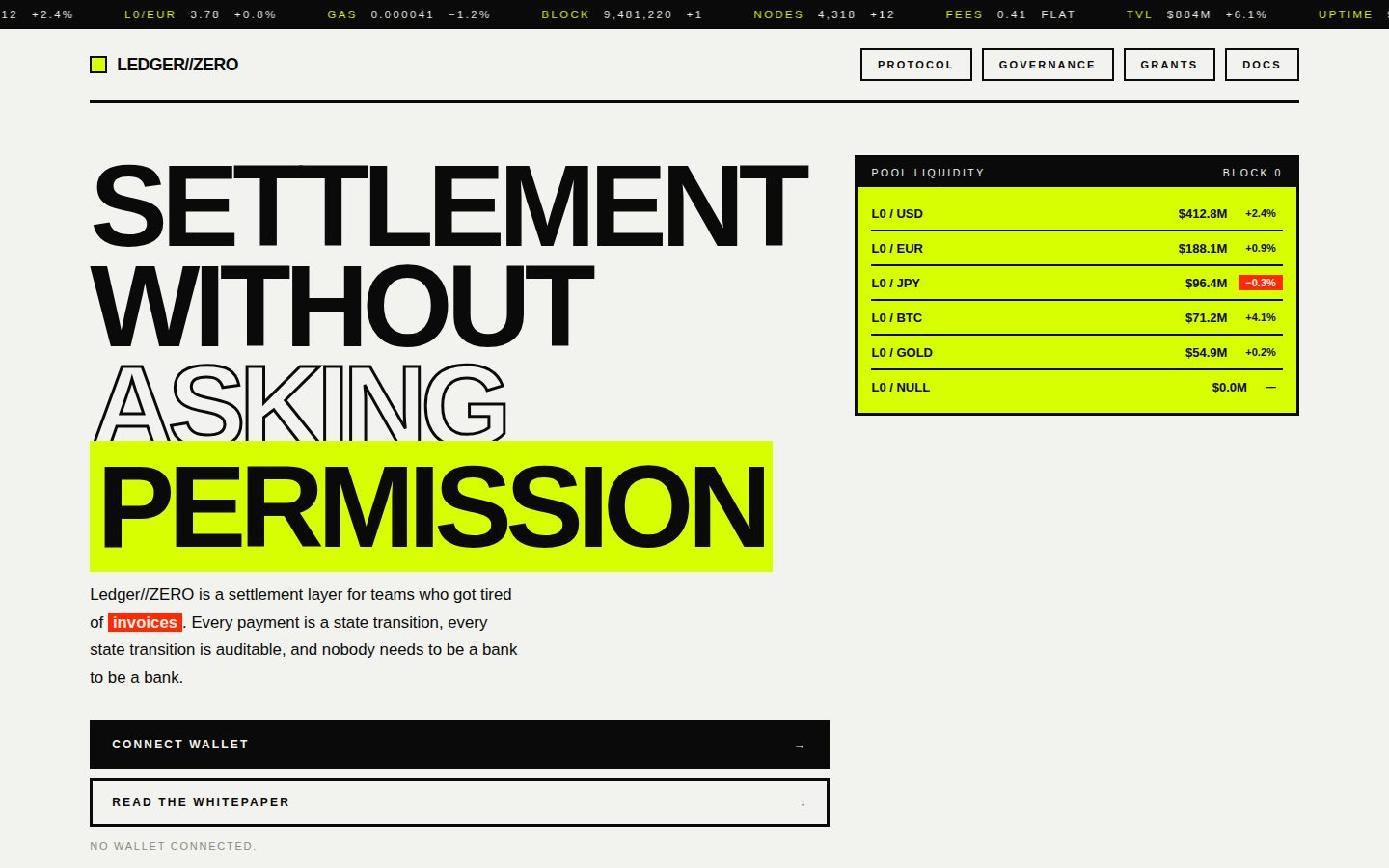
LEDGER//ZERO — decentralised, badly

A deliberately un-polished web3 landing page: flat acid green, hard black rules, a scrolling price strip and a terminal that replays nine million events to prove a point. The humour is in the confidence — "nobody needs to be a bank to be a bank" — while the visual language is exactly the cheap-loud register the genre is known for, rendered with care rather than irony.

Open ↗
CASE 1147 — The Halcyon Dossier screenshot
025

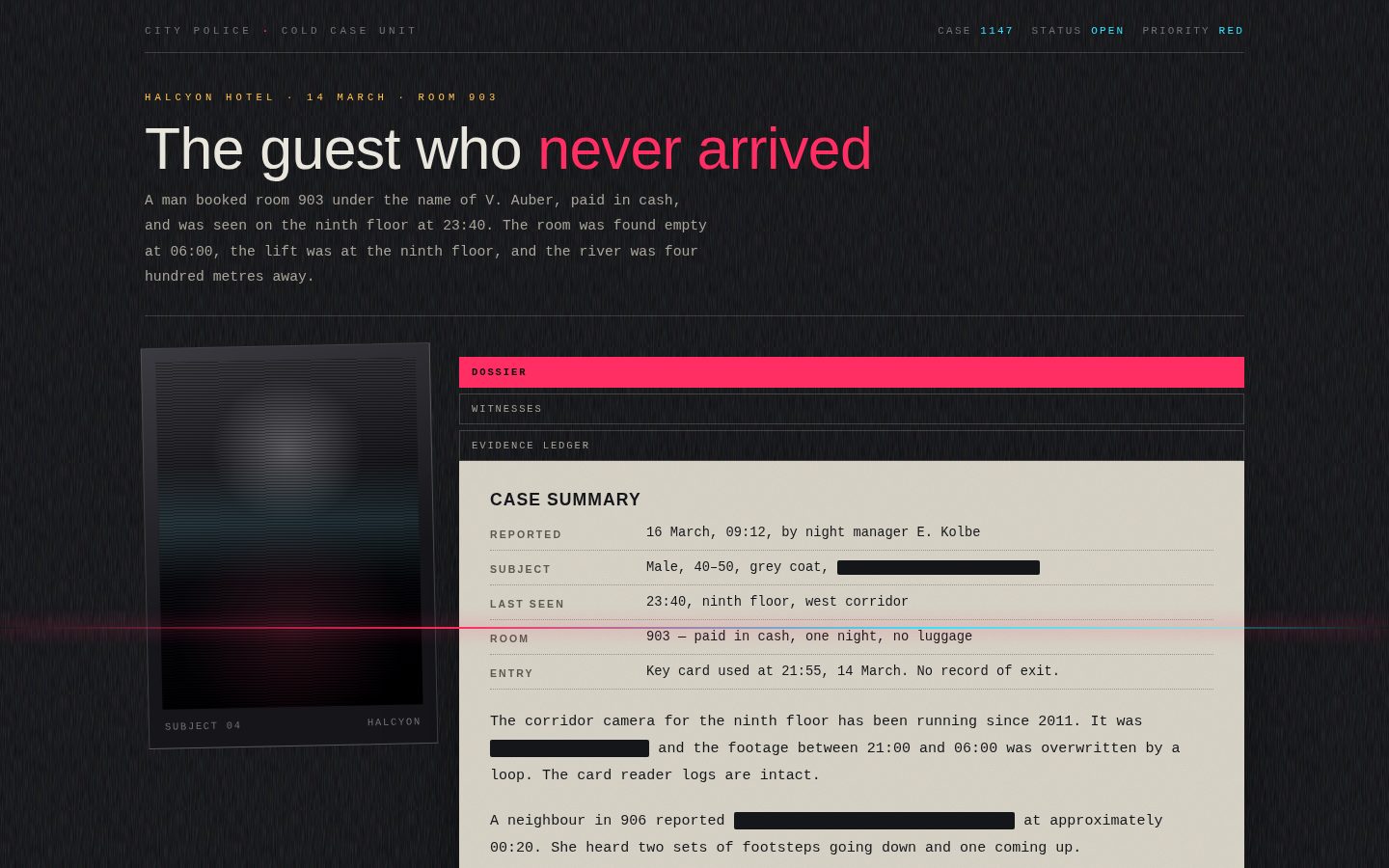
CASE 1147 — The Halcyon Dossier

A missing-person dossier that is also a piece of interactive fiction. The black bars are the interface: clicking one declassifies a fragment, and each of the three tabs carries different redactions, so reading the file three times reveals three different stories. The document is deliberately rendered as paper on a dark desk — dotted rules, a warm paper tint, a texture multiply layer — with the neon chrome around it doing the noir work.
Open ↗
MALL OF TOMORROW — open 24 hours screenshot
026

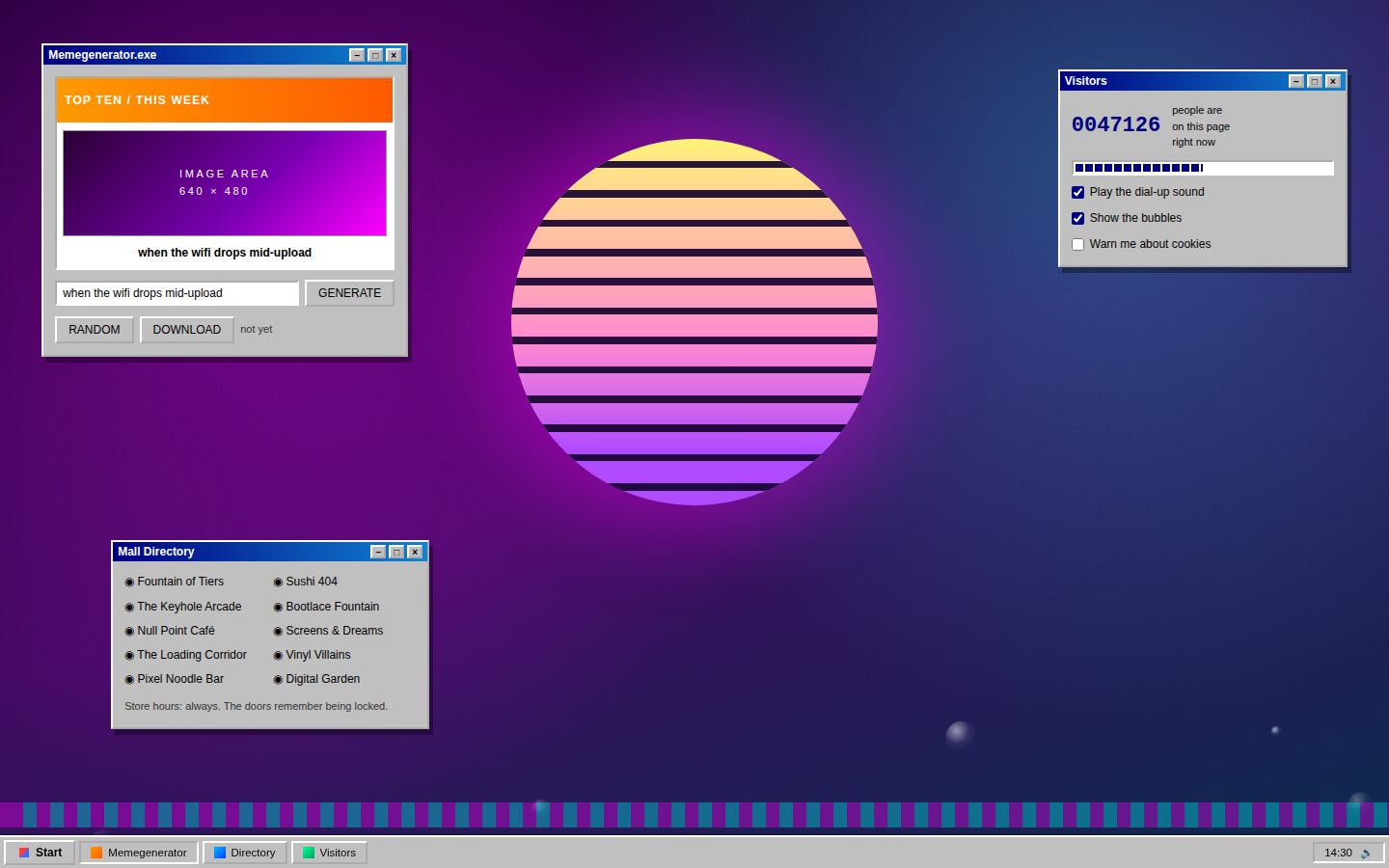
MALL OF TOMORROW — open 24 hours

An operating system as a place. The mall is a desktop: grey chrome, navy title bars, a teal wallpaper with a grid floor running to a banded sun, and three windows doing small satirical jobs — a meme generator, a visitor counter, a directory of shops that only exist in the late 1990s internet. Every classic 2px border and pressed-button state is reproduced by hand, and the bubbles drifting up the screen are the dial-up era's only animation.
Open ↗
MERIDIAN TYPE — a foundry screenshot
027

MERIDIAN TYPE — a foundry

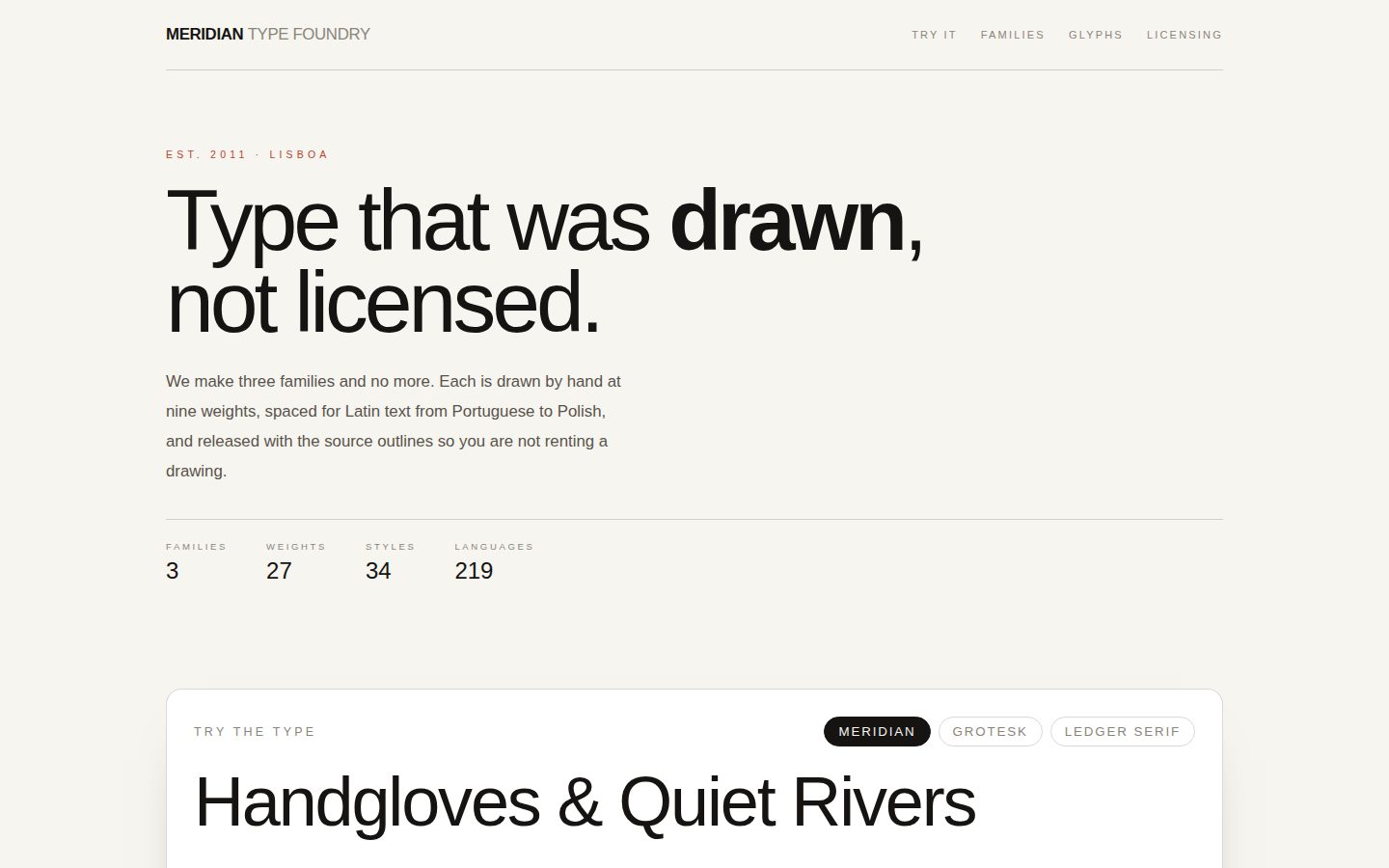
A foundry that behaves like a type shop rather than a marketing page. The heart of it is a real tester: three family tabs, a contenteditable specimen line and three live sliders, so the visitor can actually judge the type rather than look at a picture of it. Below, a specimen grid of over 130 characters is clickable — each one inserts itself into the line above, which turns the glyph chart into a small tool.

Open ↗
ABYSS — a descent in six stages screenshot
028

ABYSS — a descent in six stages

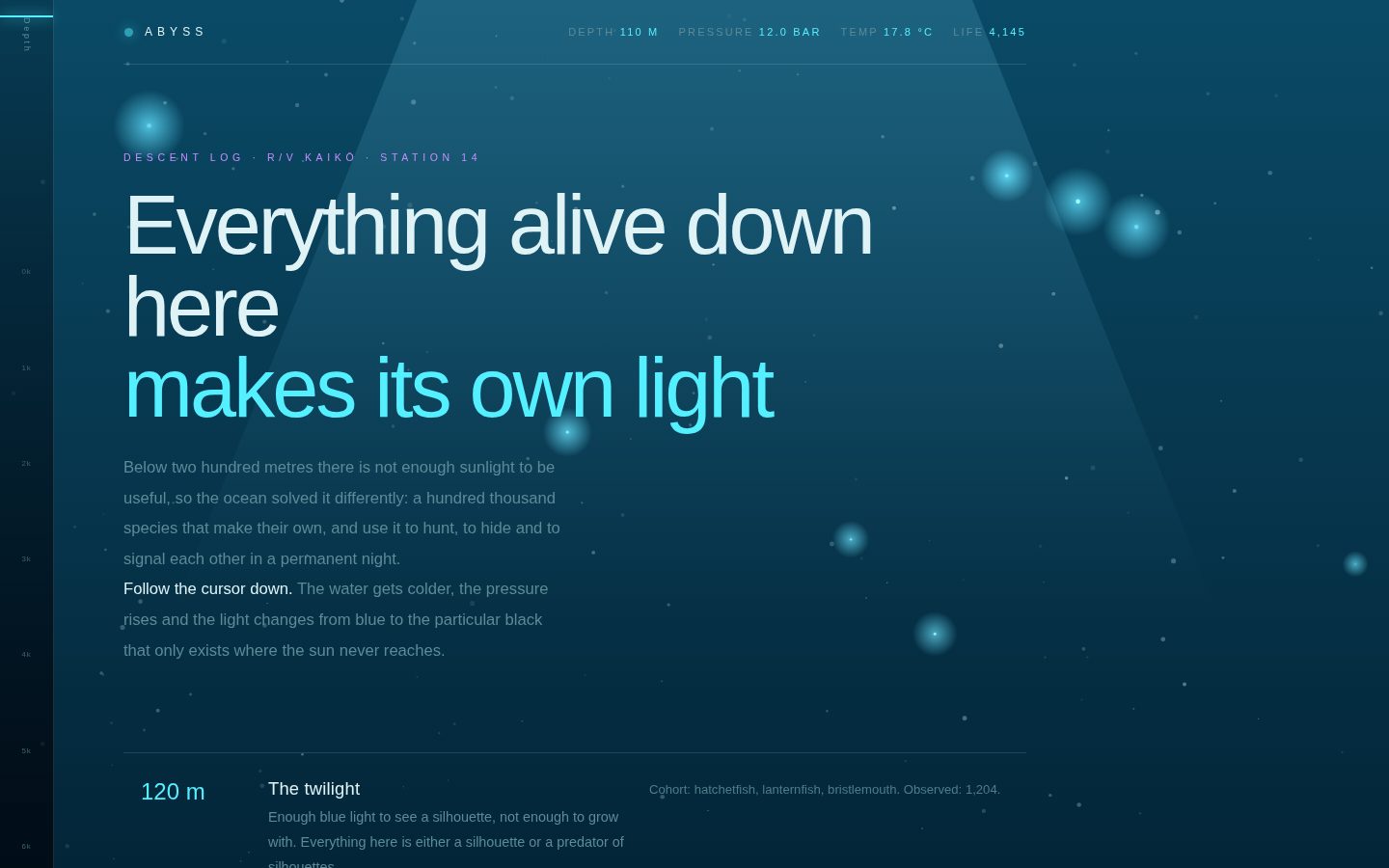
A descent you perform with the mouse. The canvas is a real depth simulation: the water gradient steps through six palettes from sunlit teal to the particular black of the hadal zone, the surface shaft fades out as you go deeper, and the marine snow falls faster under pressure. Bioluminescent flashes fire on their own in the dark. The jellyfish, the zone list and the HUD are all CSS and typography, so the page stays light while the feeling gets darker.

Open ↗
CAFFÈ OTTO — a small espresso bar screenshot
029

CAFFÈ OTTO — a small espresso bar

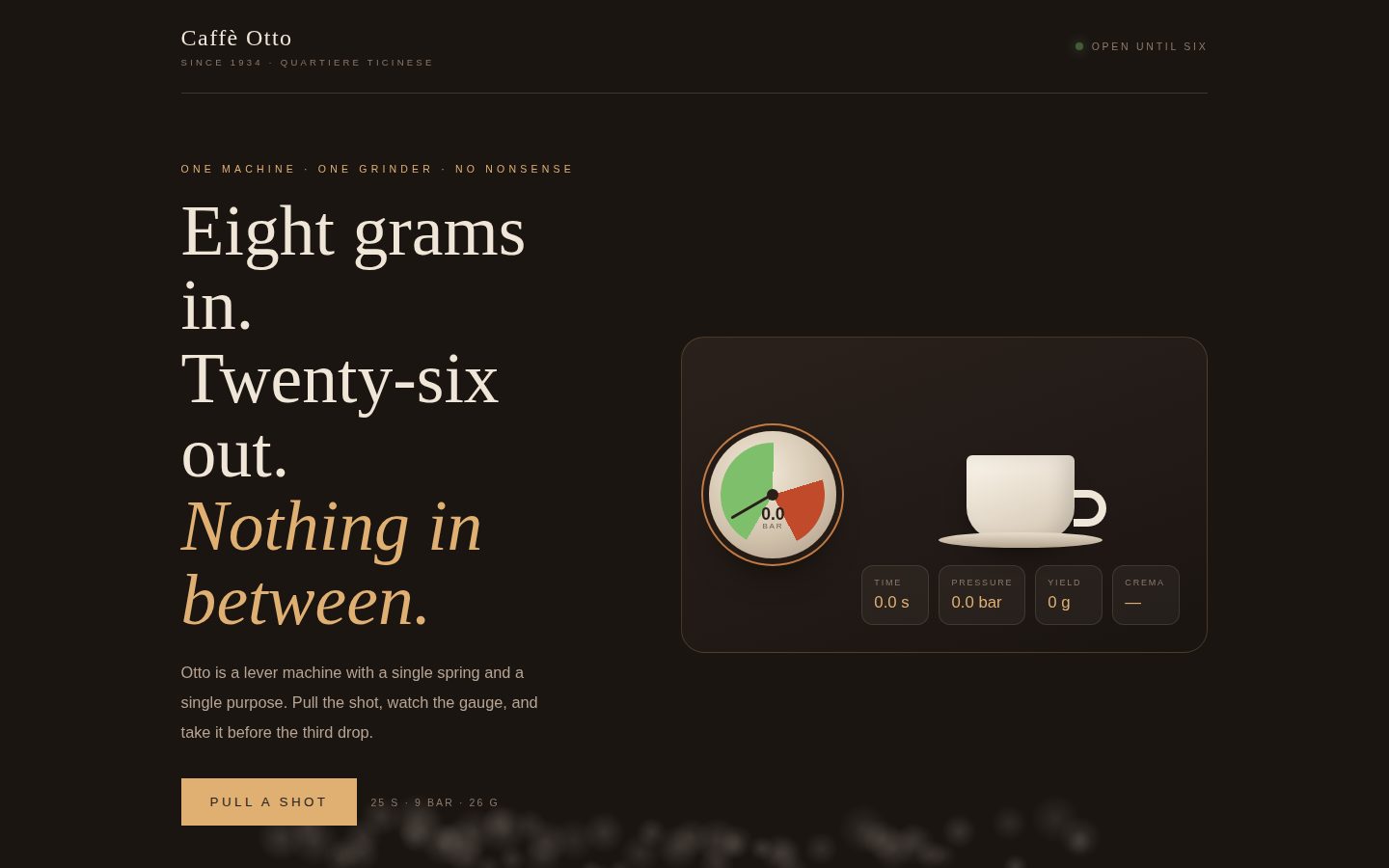
An espresso machine you can operate, with the two things that matter rendered honestly: a real pressure profile and a cup that fills. The gauge is a conic-gradient dial with a green working band and a red over-pressure band, and the needle tracks the lever's actual behaviour — fast rise, slow decay, a hold at 5.6 bar in the last third. Steam drifts up the page the entire time. Everything else is a quiet bar: brass, cream, and a menu with prices in euros.

Open ↗
RASTER — International Typographic Style screenshot
030

RASTER — International Typographic Style

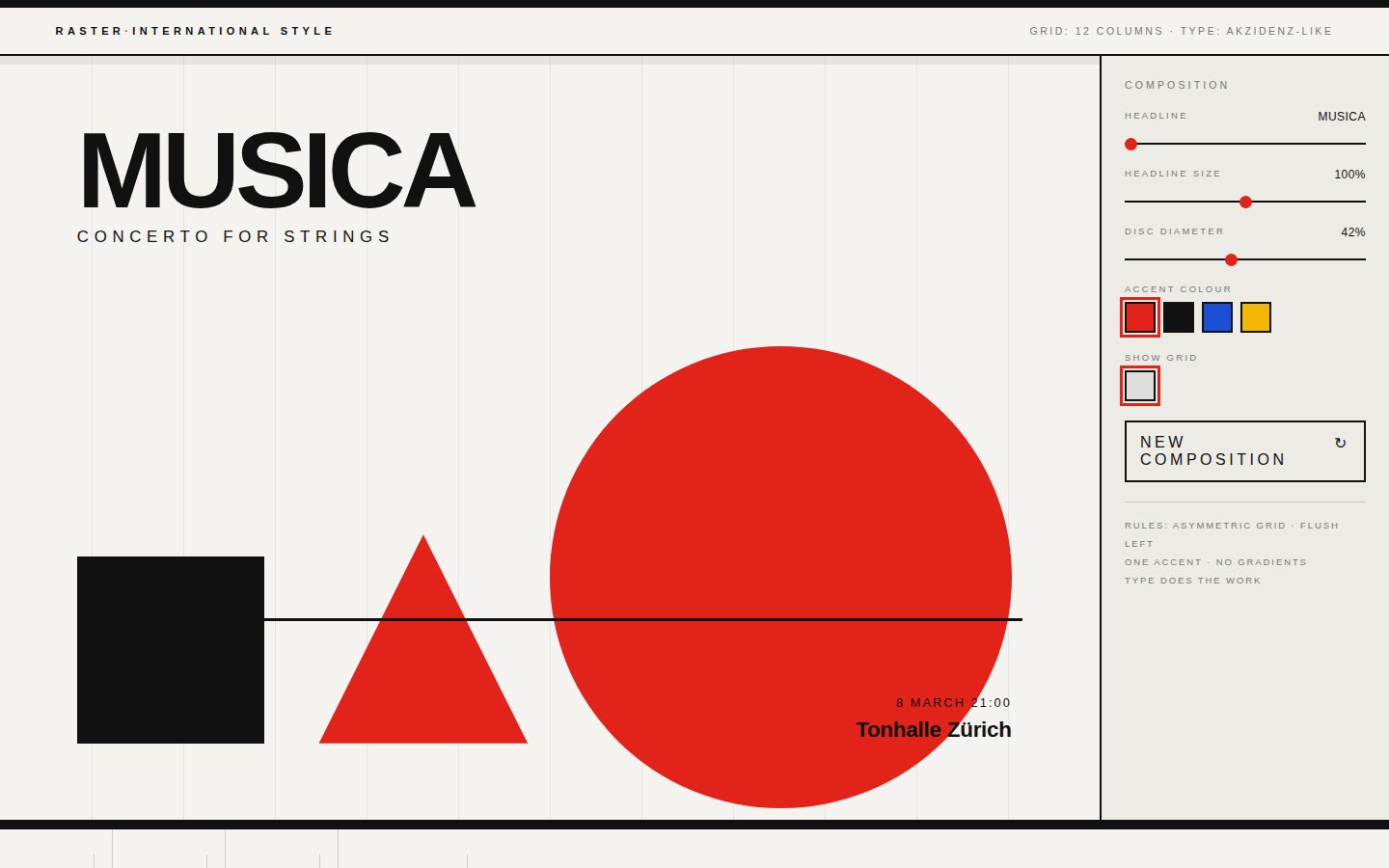
A machine for making posters that look as though they came out of Zurich in 1957. Everything is a rectangle or a circle, the type is one grotesque at two sizes, and there is exactly one colour besides black and white. The grid can be left visible so you can watch the discipline at work — and the sliders show how a single disc and a single headline can fill a page without decoration.
Open ↗
SIGNWRIGHT — a neon sign workshop screenshot
031

SIGNWRIGHT — a neon sign workshop

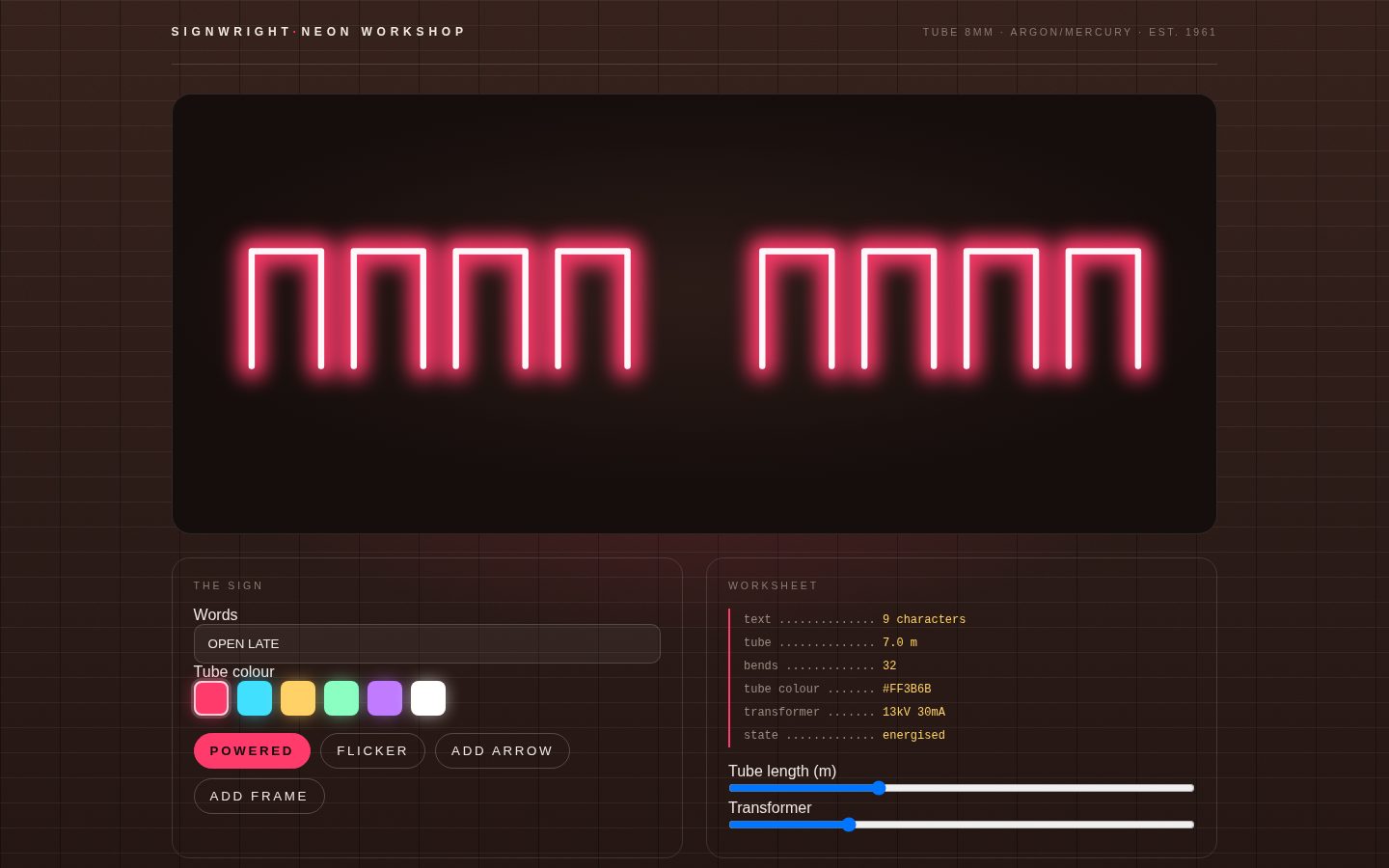
A neon workshop where the sign is built in the browser. The tube is drawn in two layers — a wide blurred bloom and a thin white-hot core — over a brick wall whose radial glow takes the colour of whatever is switched on. Type a phrase and the letters become bent tube paths whose spacing is computed from the character count; the worksheet then reports the bends, the tube length and the transformer you would actually need. It is a surprisingly convincing piece of signwriting, with none of the signwriting toolboxes.
Open ↗
ENDGAME — a study in sixty-four squares screenshot
032

ENDGAME — a study in sixty-four squares

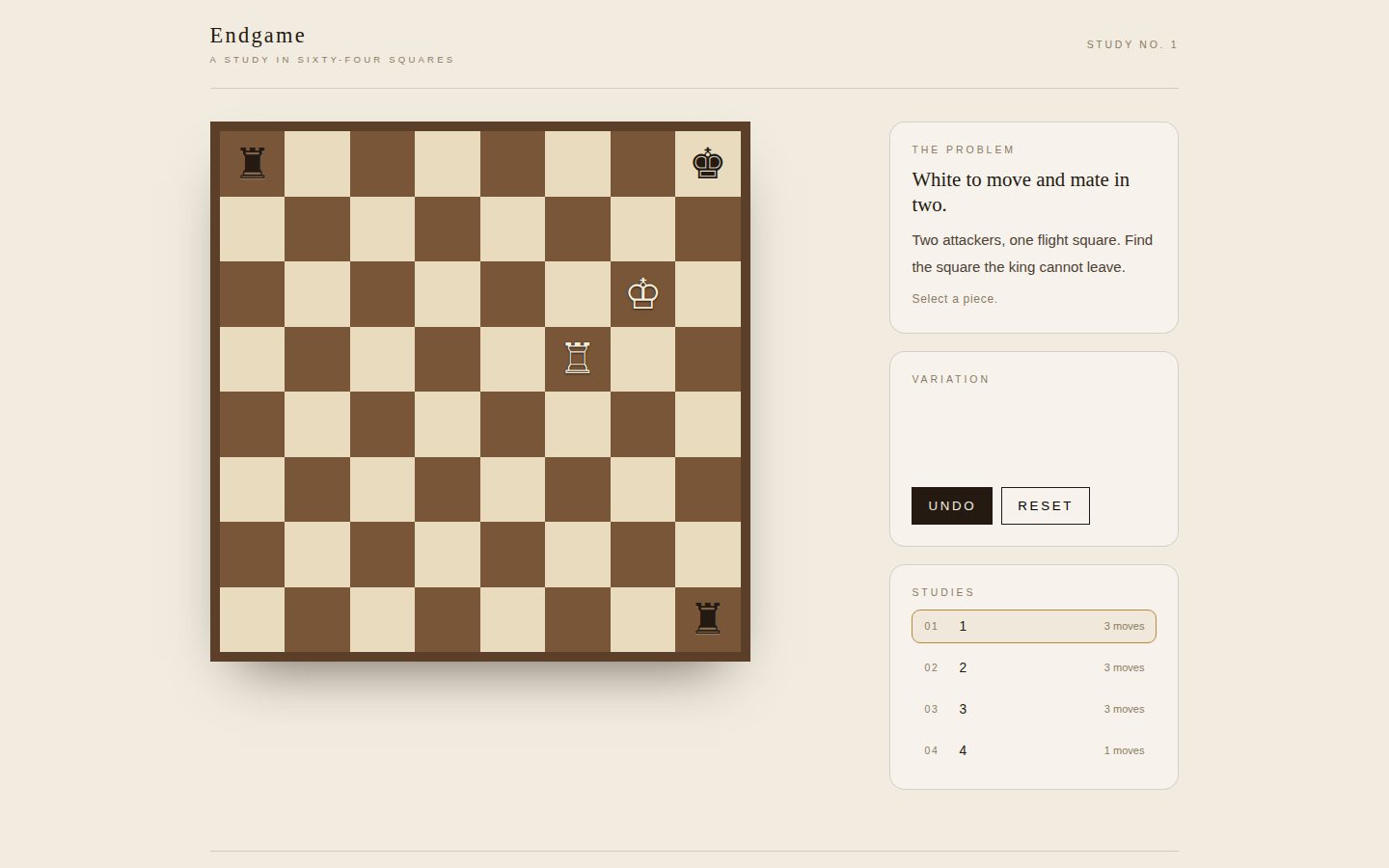
Four composed chess studies you can actually play. The board is CSS grid, the pieces are Unicode glyphs shaded to look carved, and the move checker compares your play against the solution line as you go — telling you when you've found it and when you haven't. The interesting part is that the wrong moves are accepted on the board; only the variation list and the status line judge.

Open ↗
ORRERY — a clockwork solar system screenshot
033

ORRERY — a clockwork solar system

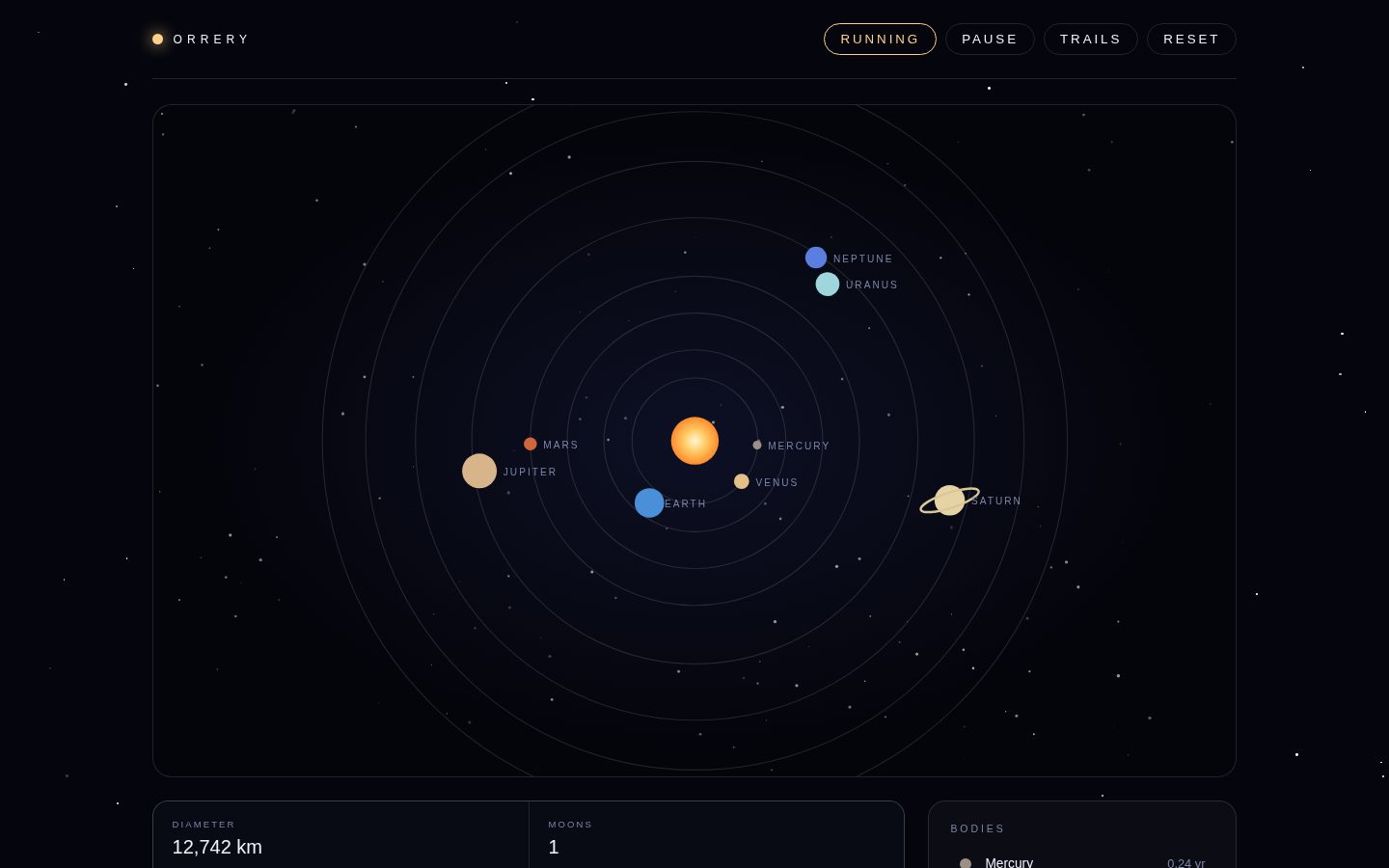
A solar system that tells the truth about time and lies about space. The periods are exact, so Mercury sprints and Neptune crawls exactly as they do in the sky; the distances are compressed logarithmically, because otherwise four outer planets would sit a pixel off the edge. Clicking any planet enlarges it and pulls its real statistics into a four-panel readout, and the speed slider lets you run the whole system at up to three times real time.

Open ↗
PANEL — issue no. 4 screenshot
034

PANEL — issue no. 4

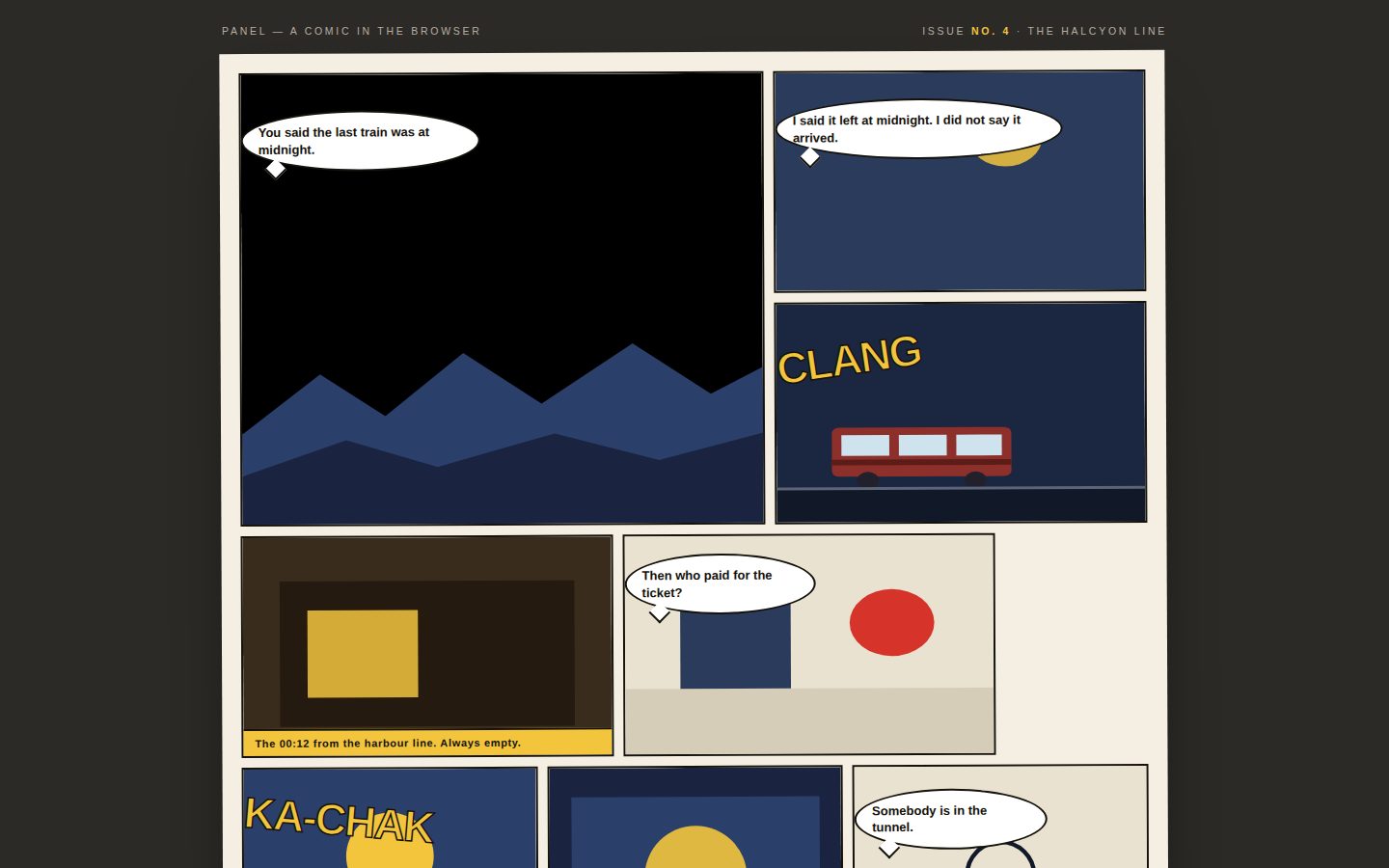
A comic that exists entirely in code. Every panel is an inline SVG assembled from a handful of shapes — a gradient sky, two hill silhouettes, a figure made of an ellipse, a path and two rectangles, a train with three windows — and every panel is bordered in heavy ink, the way a comic page is. The halftone is literal: a repeating radial-gradient of dots, which is exactly what a printing plate does. The story is a mystery about the 00:12 and it takes two pages and two turns of the sheet.

Open ↗
SEVEN SONS — a territory game screenshot
035

SEVEN SONS — a territory game

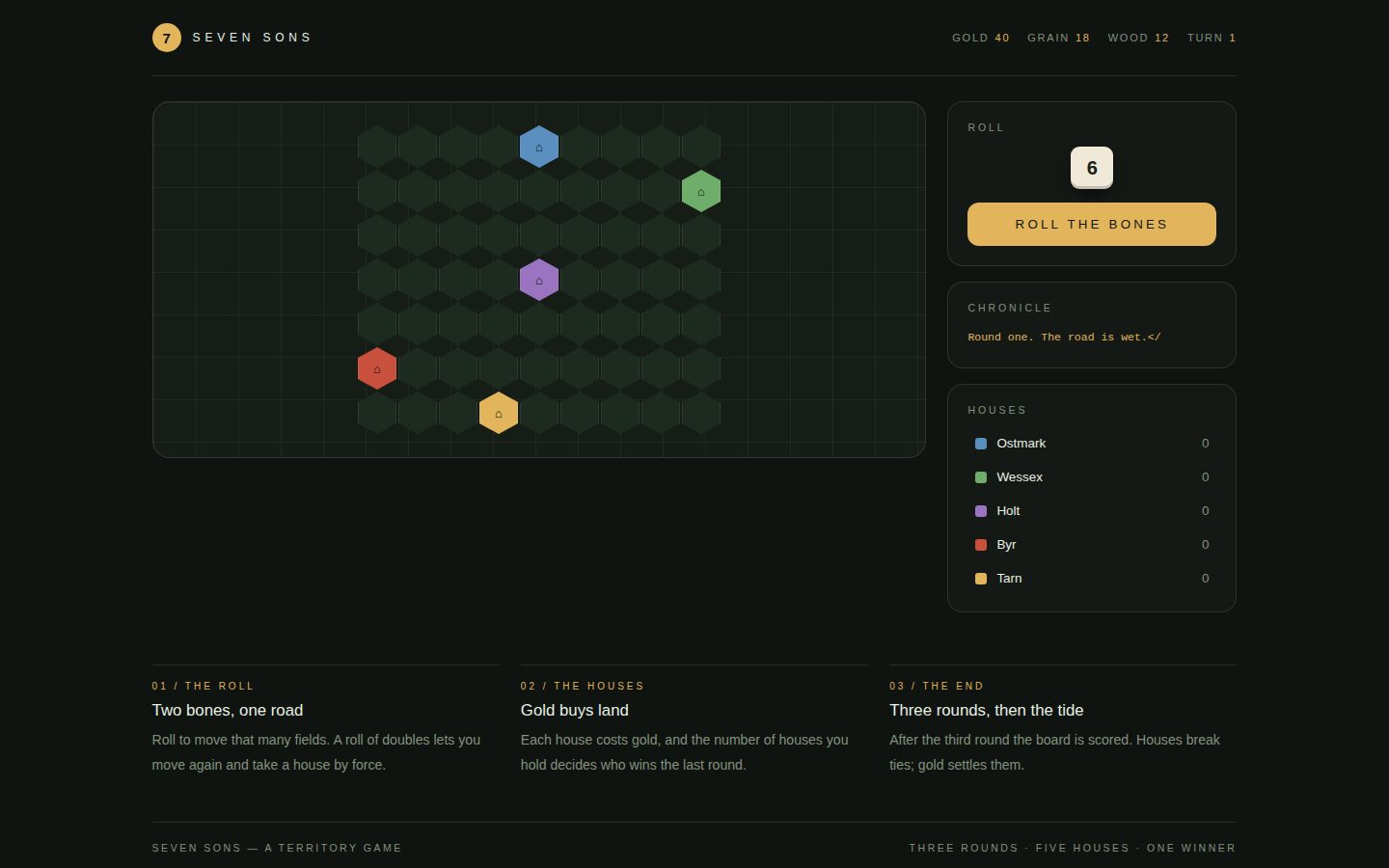
A complete, if tiny, board game. Sixty-three hexagonal fields, five houses, three rounds and one die — and every rule is actually enforced in the code: the gold comes off when you take a house, grain comes on when you land in the open, and the tide comes in after the third round to award the game to whoever holds the most. The chronicle records every decision in a different colour, which is the part that makes a small game feel like a real one.

Open ↗
CALDERA — an eruption in three acts screenshot
036

CALDERA — an eruption in three acts

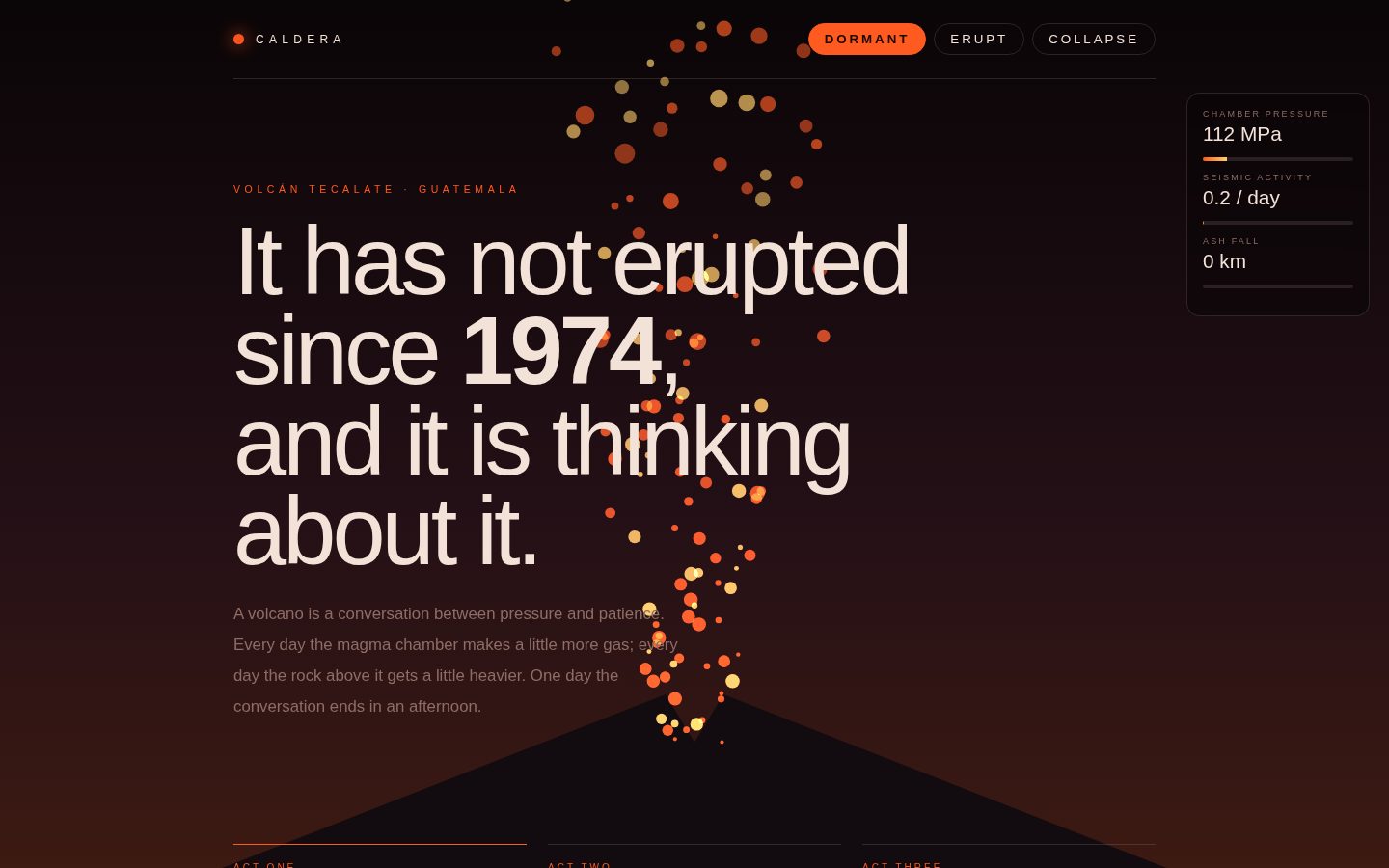
A volcano you can set off. The act buttons change the whole page: Dormant is a cold black cone under a dim red-brown sky with a slow wisp of steam; Eruption is a night sky burning orange with a column of glowing particles climbing eleven kilometres and ash starting to fall across the viewport; Collapse is a grey, post-eruption ash sky with the summit gone. The instrument panel reads out chamber pressure, seismic activity and the height of the ash column, and the bars move when you change acts.

Open ↗
L'ORÉL — an art deco travel poster screenshot
037

L'ORÉL — an art deco travel poster

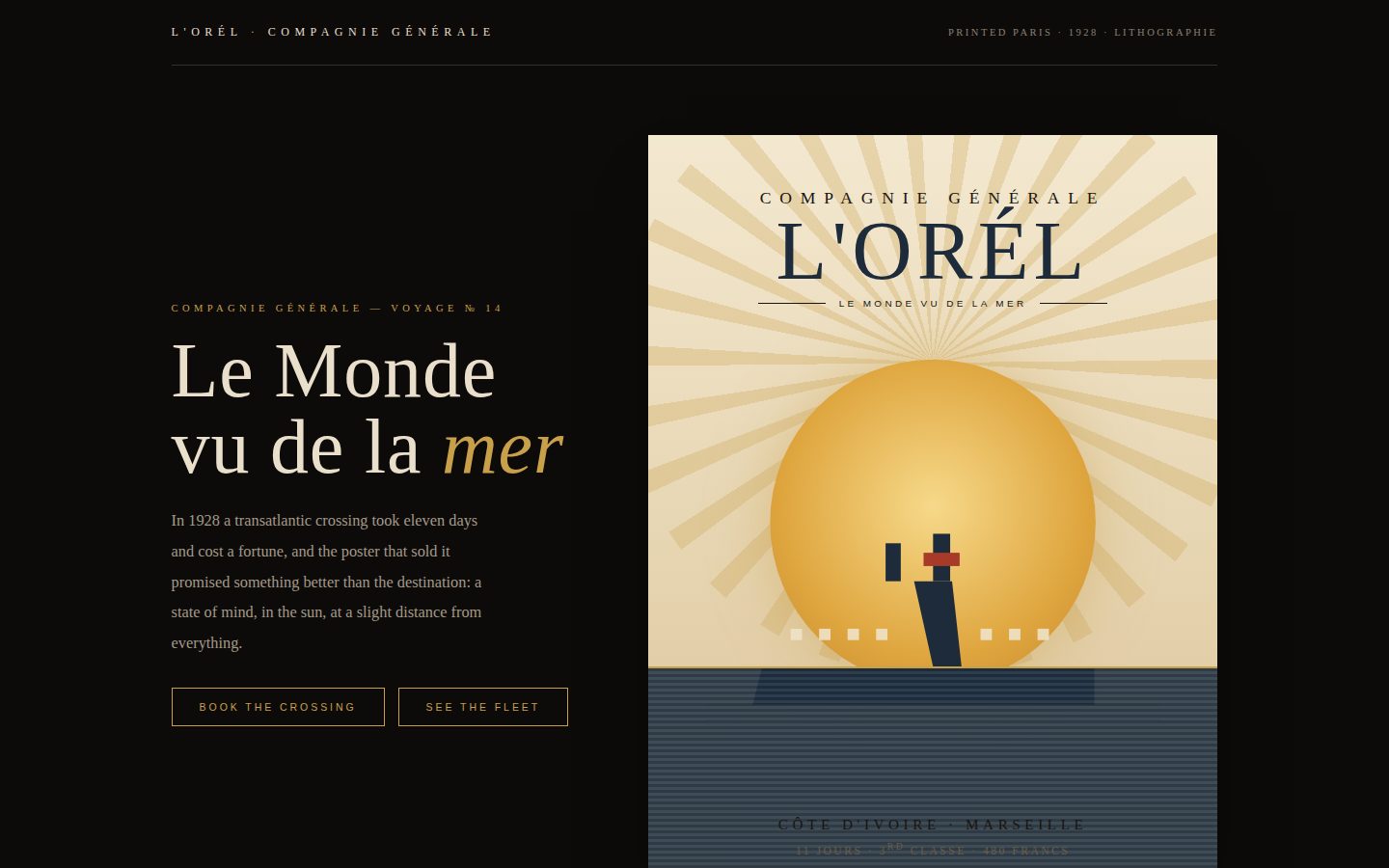
A single art deco travel poster, faithfully reconstructed in CSS and one inline SVG: the ray burst, the flat gold sun, the liner in profile with its portholes lit, the striped sea, and a title block set in wide Didone capitals with gold rules. The surrounding page is the gallery label — four columns on the poster's own rules and an essay on why a poster like this was the last thing you saw before a ship left. Nothing distracts from the poster, which is exactly the discipline the poster itself was teaching.

Open ↗
MARBRE — a stone library screenshot
038

MARBRE — a stone library

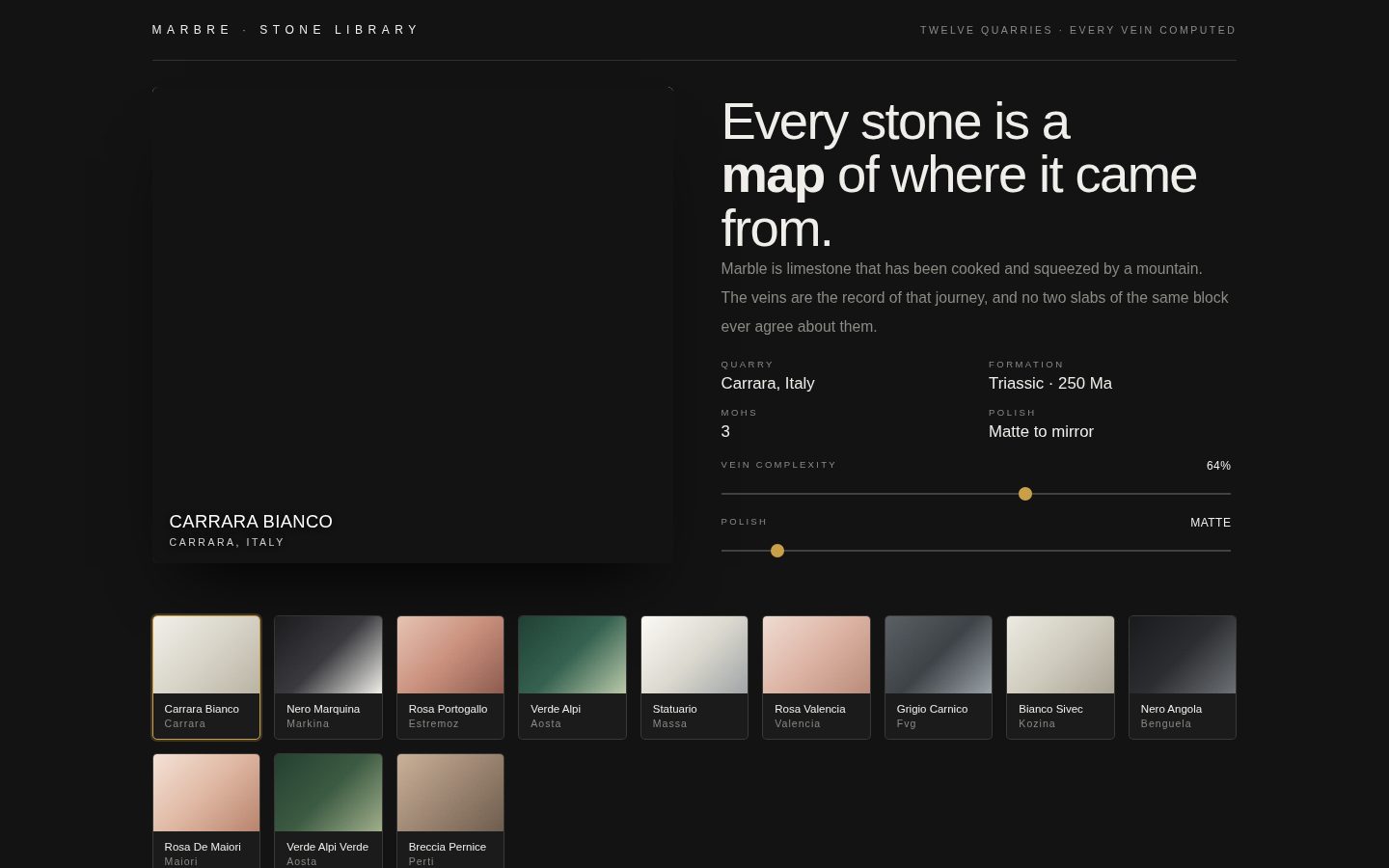
Twelve famous marbles, none of them photographed. Each is a family of repeating linear gradients at complementary angles, so the veins run in one direction and the bedding in another, exactly as a real slab does when you know how to read it. The polish slider is the nicest touch: it widens and strengthens the specular sweep until a matte Carrara turns into a mirror-black Marquina without a single image being loaded.

Open ↗
THE LONG WAY — a journey in six chapters screenshot
039

THE LONG WAY — a journey in six chapters

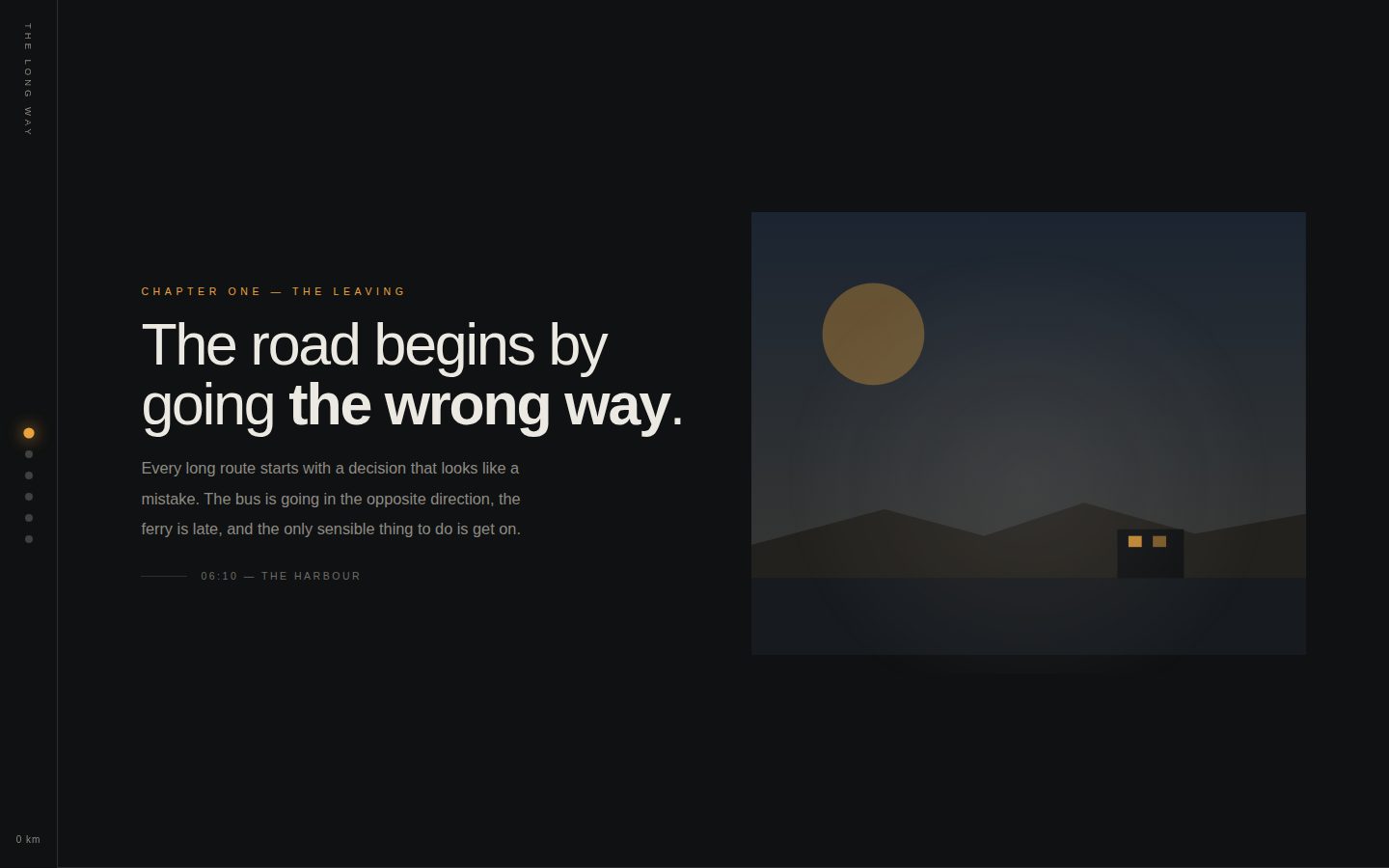
A travel essay in six chapters that behaves like a film. Each scroll position brings up a landscape illustration drawn in flat SVG — a harbour before dawn, two hundred kilometres of salt pan, a snow pass, four hundred kilometres of forest, the sea arriving all at once, and the same harbour at night — with text that fades in beside it on a stagger. The rail on the left keeps count, marking which chapter you are in and how many kilometres from the start you have gone.

Open ↗
SPECTRUM — an ambient player screenshot
040

SPECTRUM — an ambient player

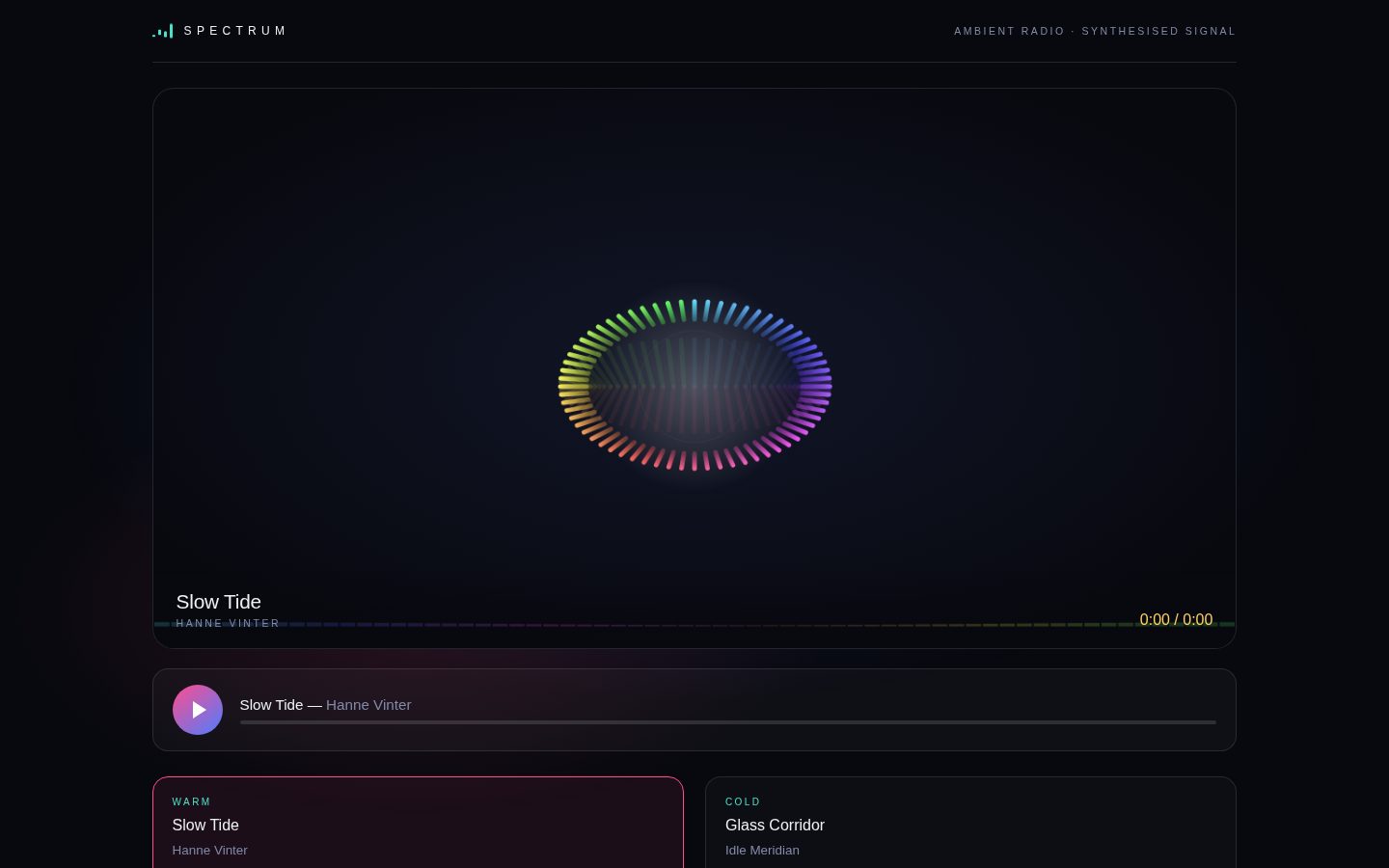
A visualiser that admits it is faking. There is no microphone, no audio file and no permission prompt — sixty-four bands are synthesised from layered sines and smoothed into the shape of slow ambient music, with a seeded profile per track so switching tracks changes the entire waveform rather than just the label. The rendering is the good part: radial bars with a hue ramp, a mirrored reflection beneath the ellipse, a glowing core, and a flat spectrum strip along the bottom.

Open ↗
PLOTTER — a pen on paper screenshot
041

PLOTTER — a pen on paper

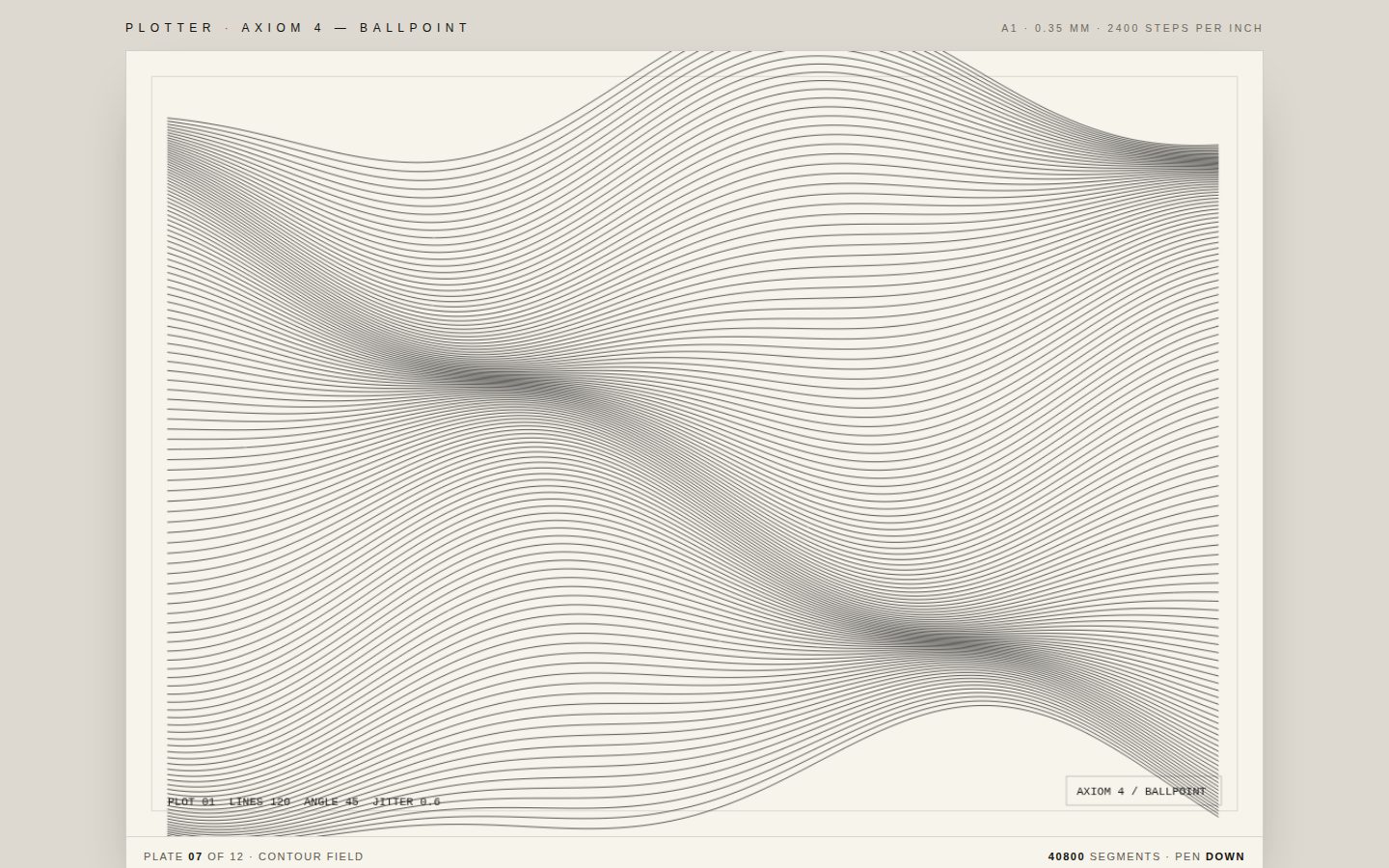
A ballpoint pen plotter, simulated honestly. The machine only knows how to move in straight lines, so everything expressive has to come from line density: a contour field, a cross-hatch, a spiral, a field of cells. The pen skips are the detail that sells it — faint white specks where the ball hitched at a direction change — and the title block stamped in the bottom margin is exactly the kind of thing every plotted drawing has carried since 1963.

Open ↗
CEEFAX — page 231 screenshot
042

CEEFAX — page 231

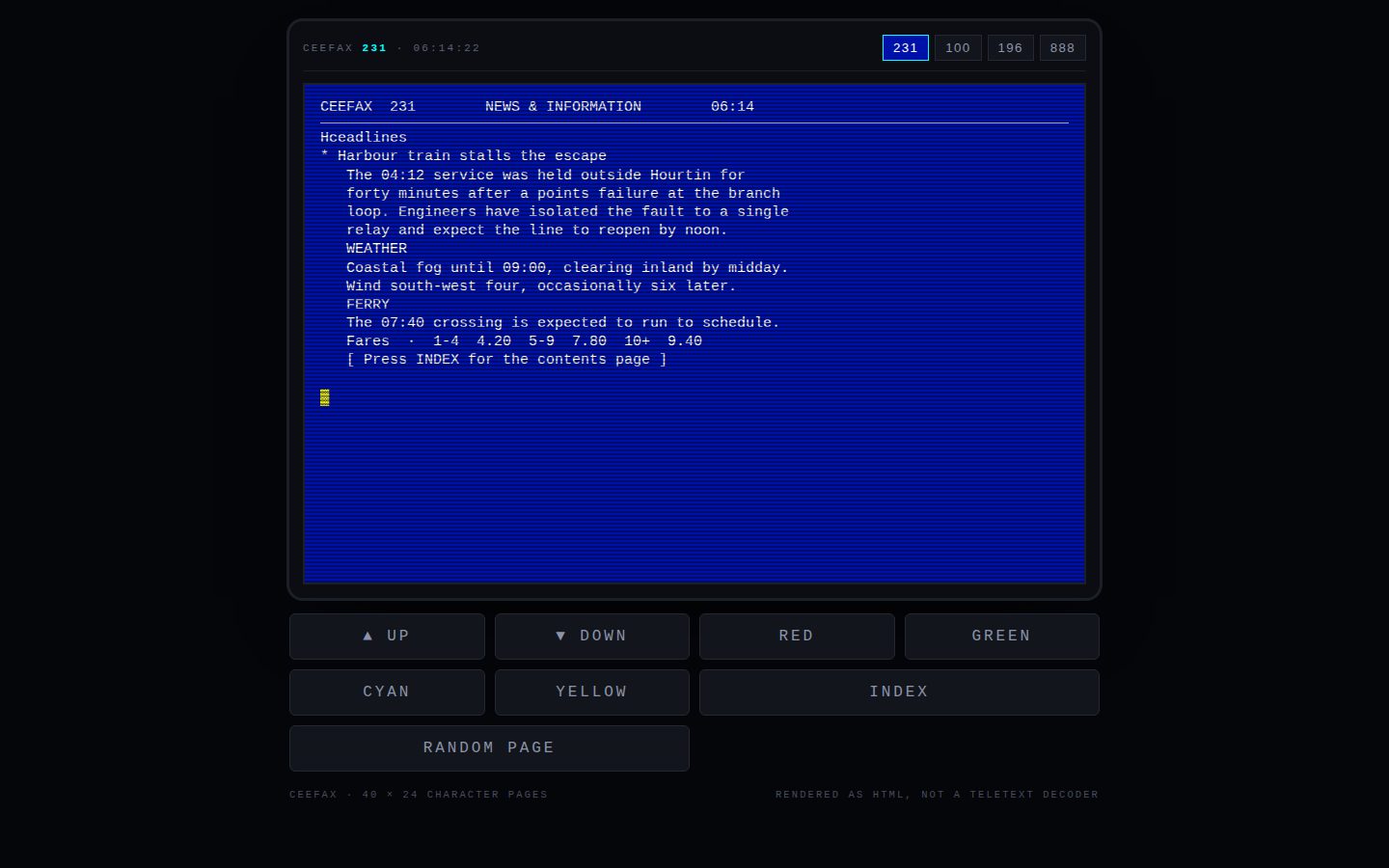
Teletext, rebuilt as HTML rather than decoded from a teletext signal. The characters are laid out one span each in a fixed-width monospace grid, so the column alignment is exact, and the colour model follows the real service: white for body copy, yellow for headlines, magenta for results, green for in-progress, cyan for links, red for warnings. Four pages are authored in full — news, an index, a council notice and the colour test card — and the remote control actually works, including the colour keys.

Open ↗
PLASMA CLAY — a soft operations console screenshot
043

PLASMA CLAY — a soft operations console

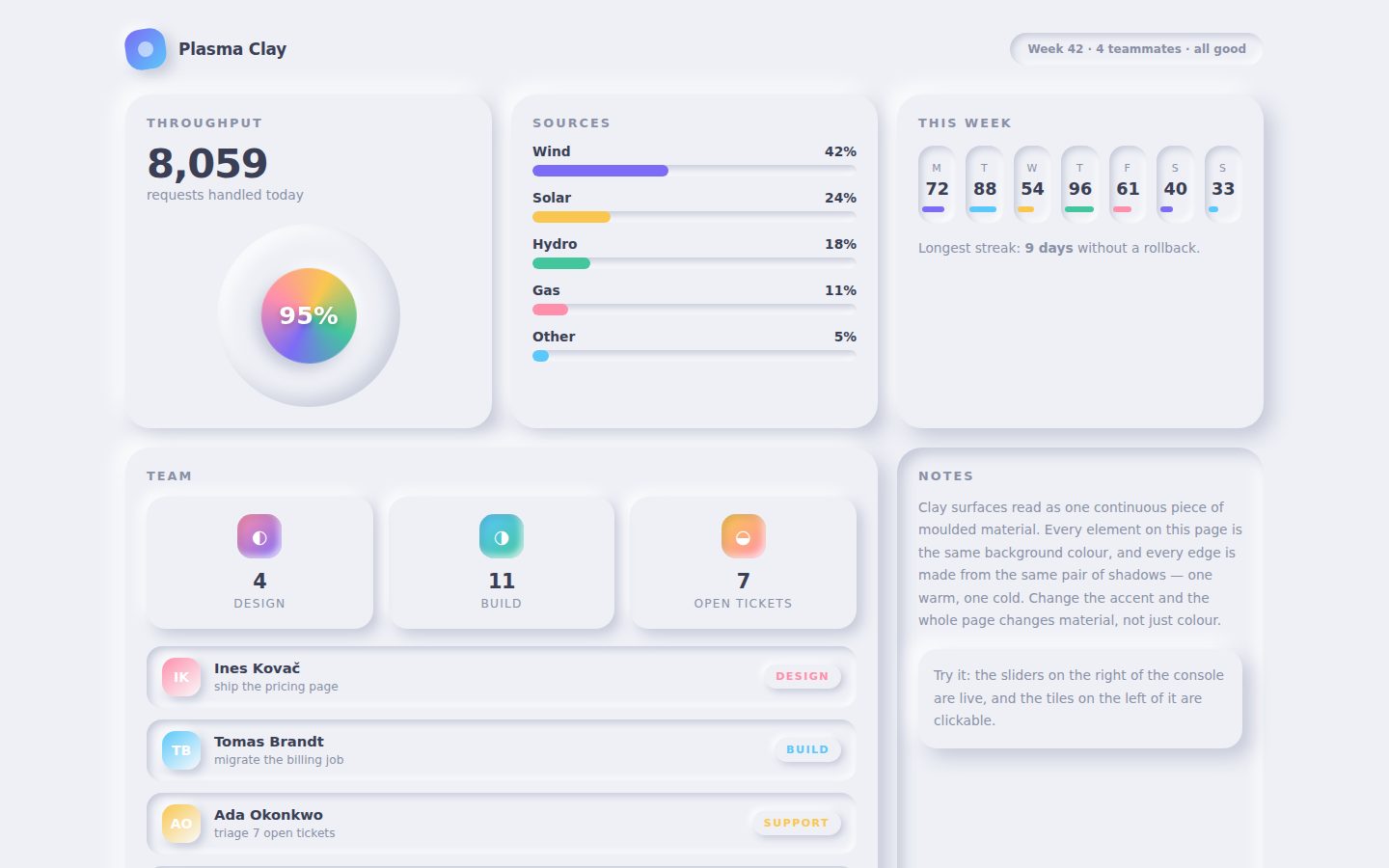
A console made of clay. The entire page is one pale surface, and all of its depth — the raised panels, the pressed wells, the concave note panel, the little statistic tiles — comes from the same two shadows: a warm grey below-right and a near-white above-left. The accents are plastic-bright and slightly candy-coloured, and because nothing has a fill of its own, changing the accent changes the material rather than the paint.

Open ↗
HERBARIUM — a pressed collection screenshot
044

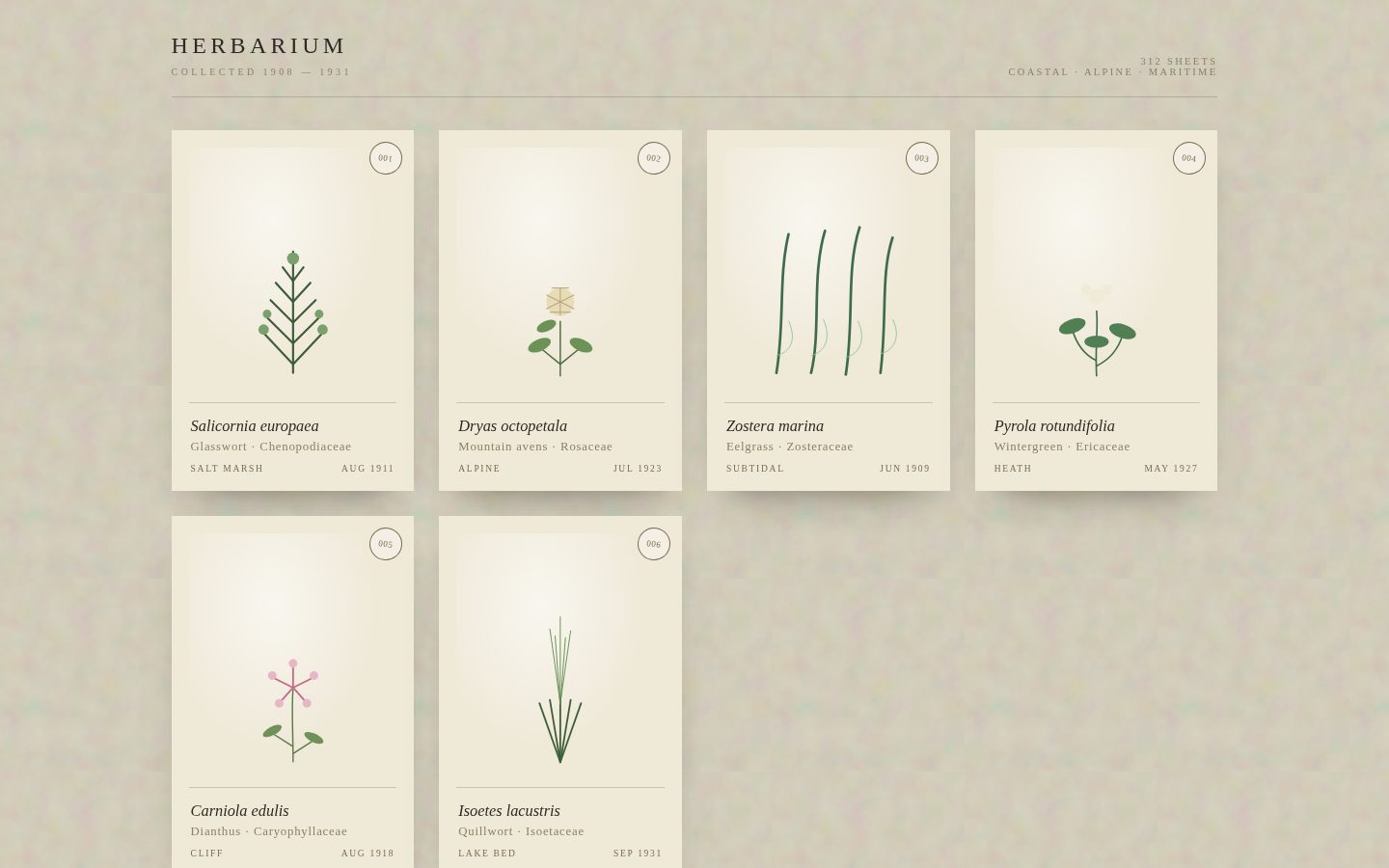
HERBARIUM — a pressed collection

Six pressed plants, drawn rather than photographed, mounted on the kind of card a 1911 botanist would have pinned to a sheet. Each drawing is built from strokes and fills in two greens and a paper cream — a glasswort's jointed arms, a mountain avens with a five-petal flower, eelgrass blades, a wintergreen raceme, a dianthus, a quillwort. The Latin names are italic, the habitats are honest, and the accession stamps in the corners do the institutional work.

Open ↗
MÉTROLINE — a neon transit map screenshot
045

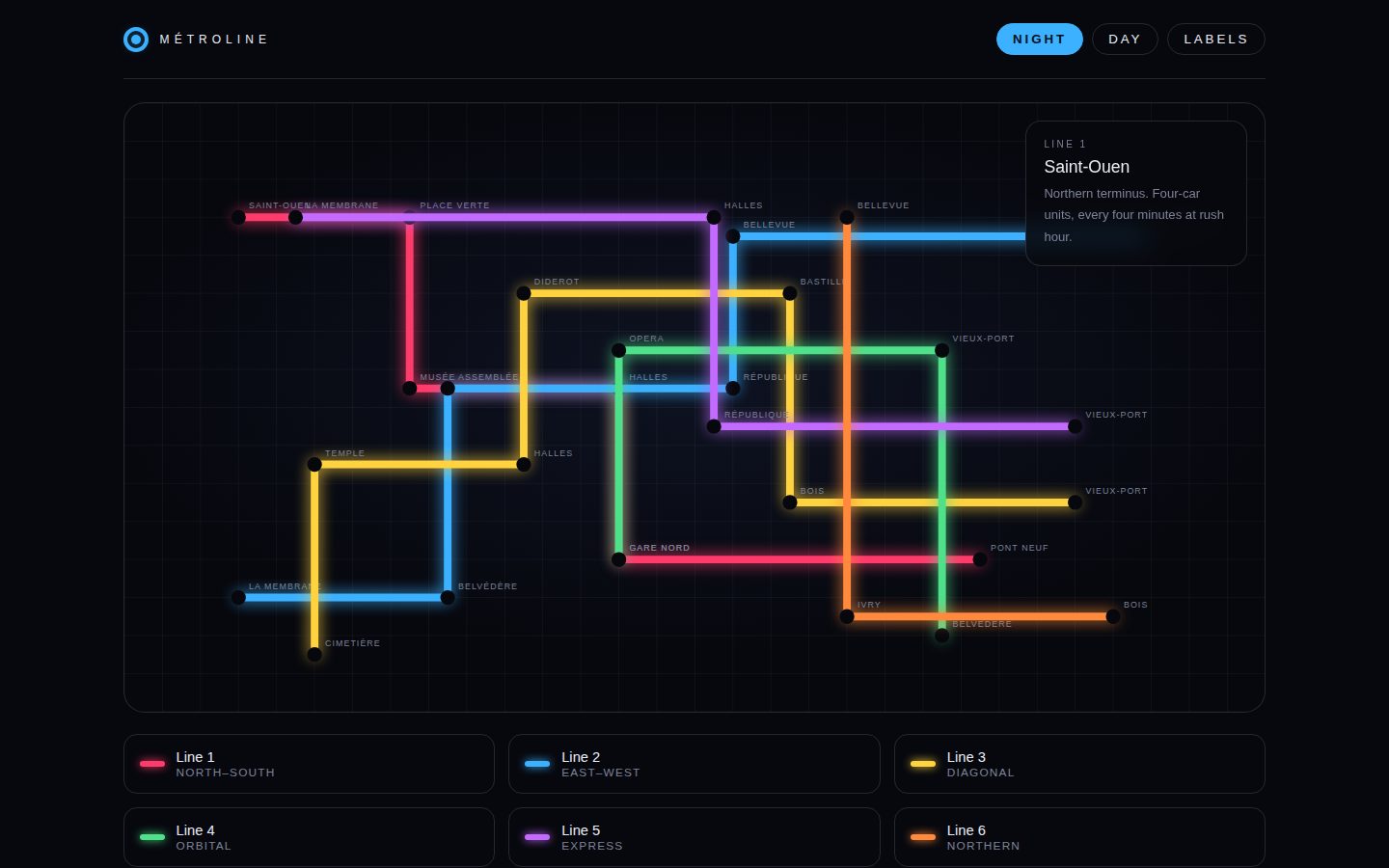
MÉTROLINE — a neon transit map

A transit diagram that lies about geography on purpose, and glows while it does it. Six routes are laid out on a strict 40px grid with 45-degree angles and constant spacing, exactly as Beck's original insisted, and every stop is a ringed circle you can hover to ask how long the journey is. Switching to Day removes the neon and leaves a flat printed diagram, which is the version most of us have actually seen on a wall.

Open ↗
BOX 14 — a scrapbook of small summers screenshot
046

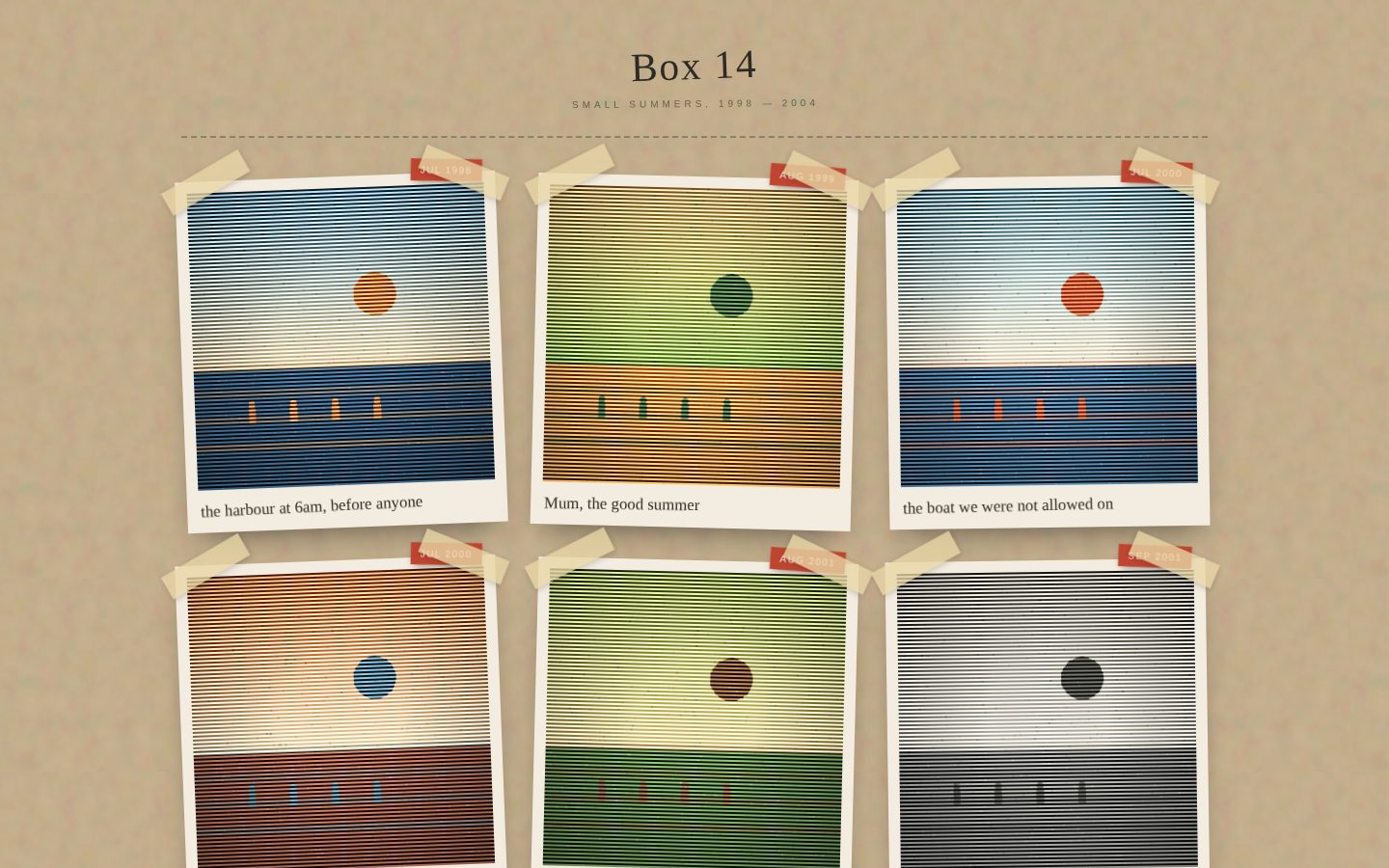
BOX 14 — a scrapbook of small summers

Nine Polaroids from seven summers, each one a small canvas painting with grain, a vignette and a four-colour palette, and each one initially covered in the horizontal static of a print that has not developed yet. Hovering develops it; the static returns when you leave, because that is how the actual thing works. The Polaroids sit at slightly different angles on kraft board, taped down, with red date stickers in the corners, and the captions are handwritten.

Open ↗
RIDGELINE — four passes, no photographs screenshot
047

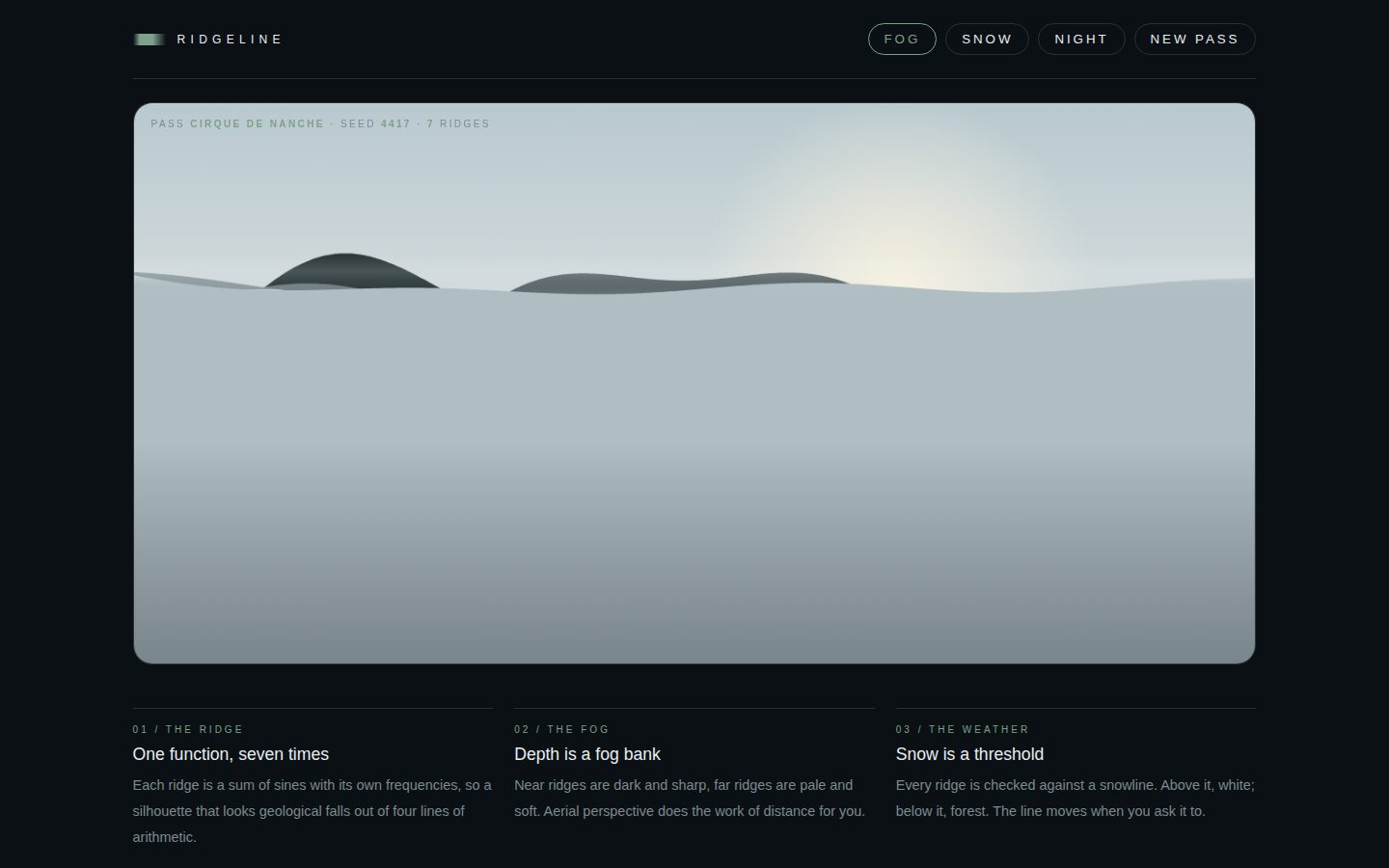
RIDGELINE — four passes, no photographs

Seven ridges, each one a sum of three sines, arranged back to front so that distance is built entirely from fog. The snow is a threshold rather than a texture — a vertical gradient clipped to the ridge silhouette — and the palette shifts from pale grey distance to near-black foreground, which is the whole trick of aerial perspective. New Pass re-rolls the seed and the mountain's name; Night, Fog and Snow each take one layer of the illusion away.

Open ↗
ARC — type that follows a line screenshot
048

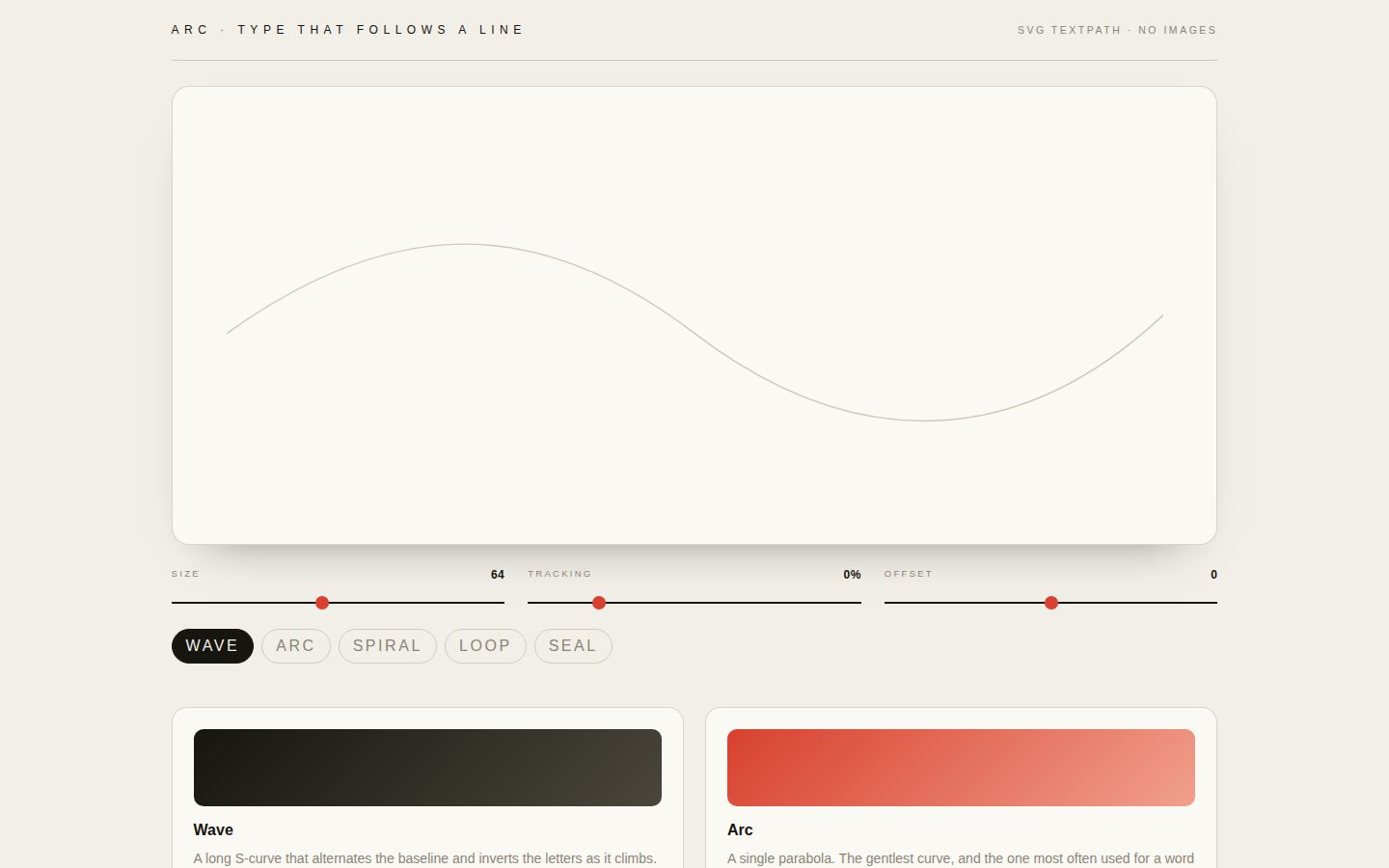
ARC — type that follows a line

Live type on a path, set with SVG's textPath so the letters remain actual text — selectable, searchable and scalable. Five path shapes are offered, and the difference between them is the point: a wave inverts the letters as it climbs, a spiral turns the last of them upside down, and the plain rectangle is there to prove that the curve was doing all the work. Size, tracking and baseline offset sliders restyle everything instantly.

Open ↗
TRACE — a board that thinks screenshot
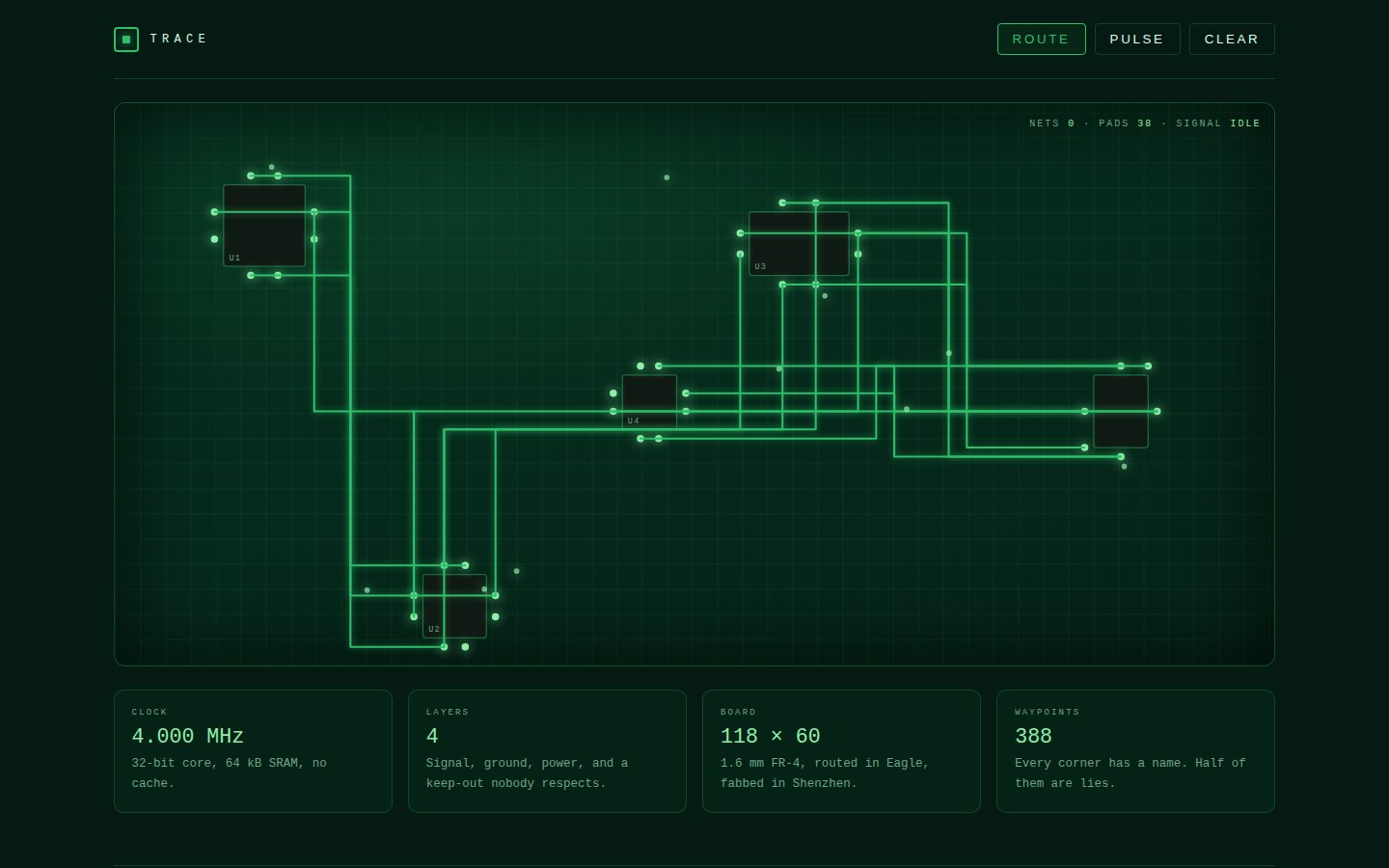
049

TRACE — a board that thinks

A printed circuit board that actually routes. Five chip footprints sit on a 20px grid, pins are placed on all four sides, and a router walks Manhattan paths between them — snapping to the grid, choosing whether to go via the x-axis or the y-axis, and dropping vias where the layers have to meet. Press Pulse and a bright segment travels every net at once, which is the closest thing to watching a clock tick that a board can do.

Open ↗
MIRAGE — a mirror that remembers screenshot
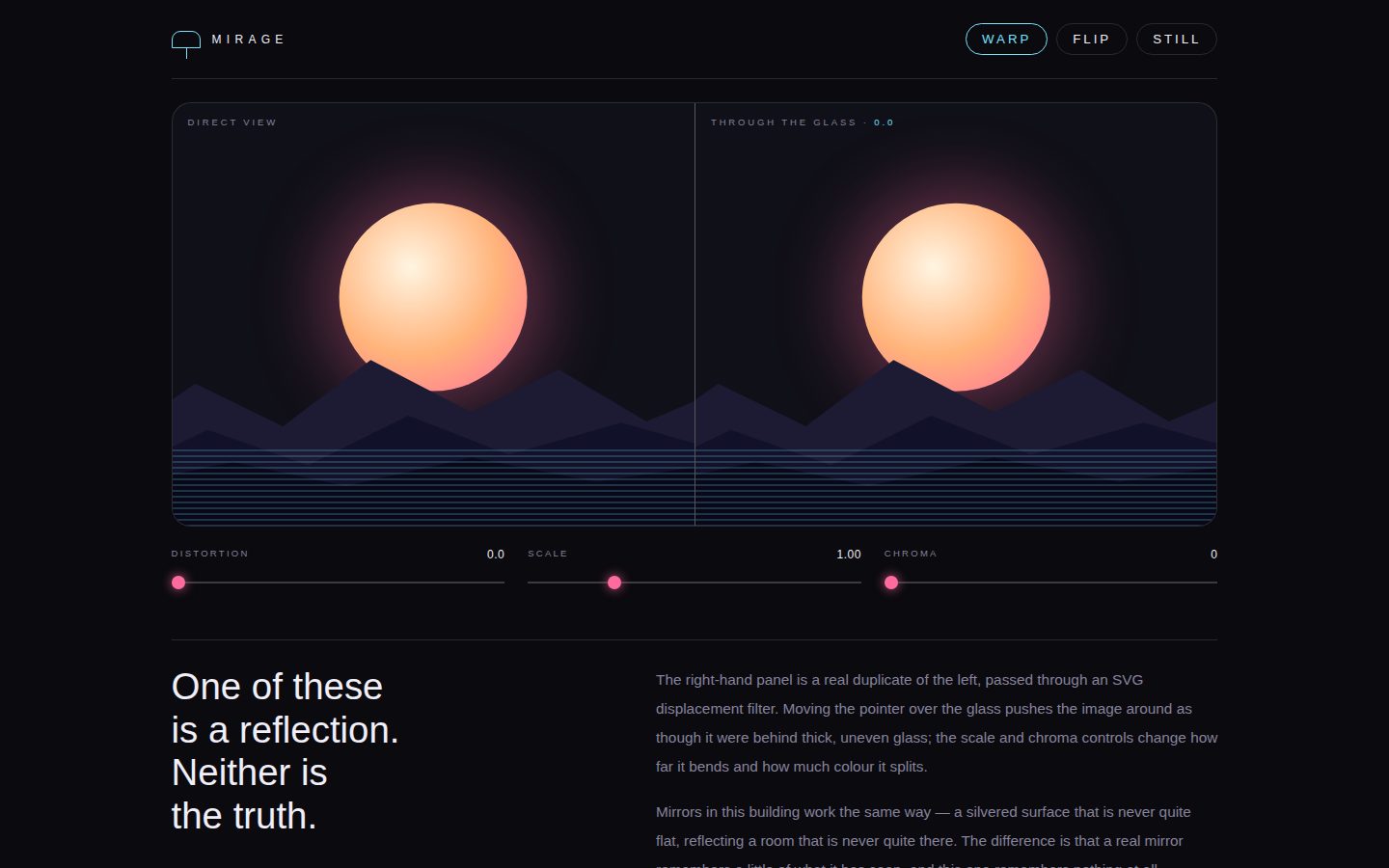
050

MIRAGE — a mirror that remembers

Two identical sunsets side by side, one of them behind glass. The right-hand panel is not a picture of a reflection — it is the same CSS scene passed through a live SVG displacement filter, so the turbulence genuinely pushes the pixels around, and moving the pointer pushes them further. The chroma slider offsets the red and blue channels in opposite directions so the glass splits the colour the way real thick, old glass does.

Open ↗
DUST — a portrait in twelve thousand points screenshot
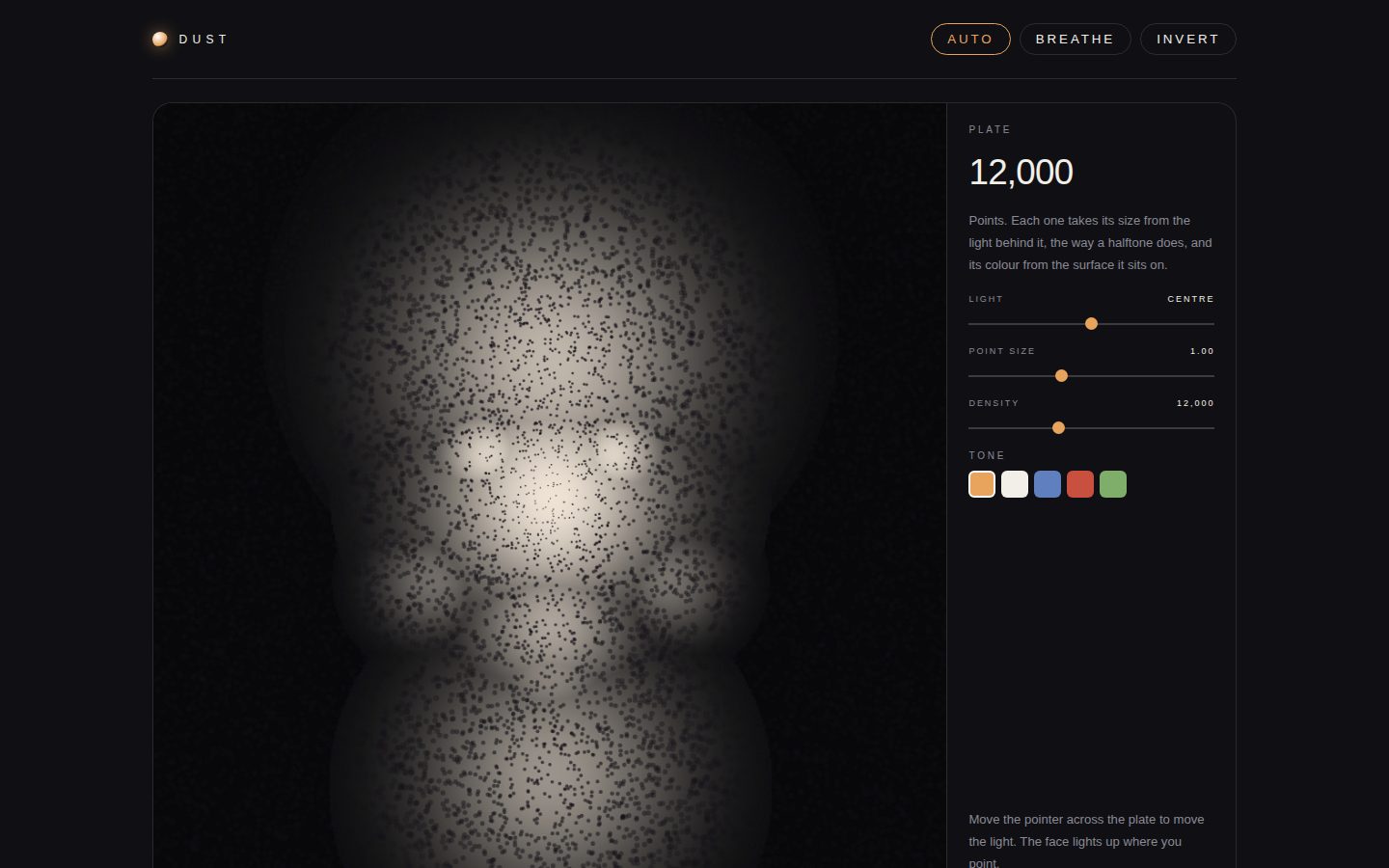
051

DUST — a portrait in twelve thousand points

A face that is really a lighting diagram. Eleven soft radial fields describe a skull, and a directional term from the light position shades it. Then twelve thousand points are scattered over the top, each sized by how much light reaches it — so the portrait emerges from the dots rather than being drawn by them. Move the pointer and the whole face relights, which is the most satisfying thing about pointillism and also, it turns out, the most satisfying thing about a lighting rig.

Open ↗
INFUSION — a pour-over, timed screenshot
052

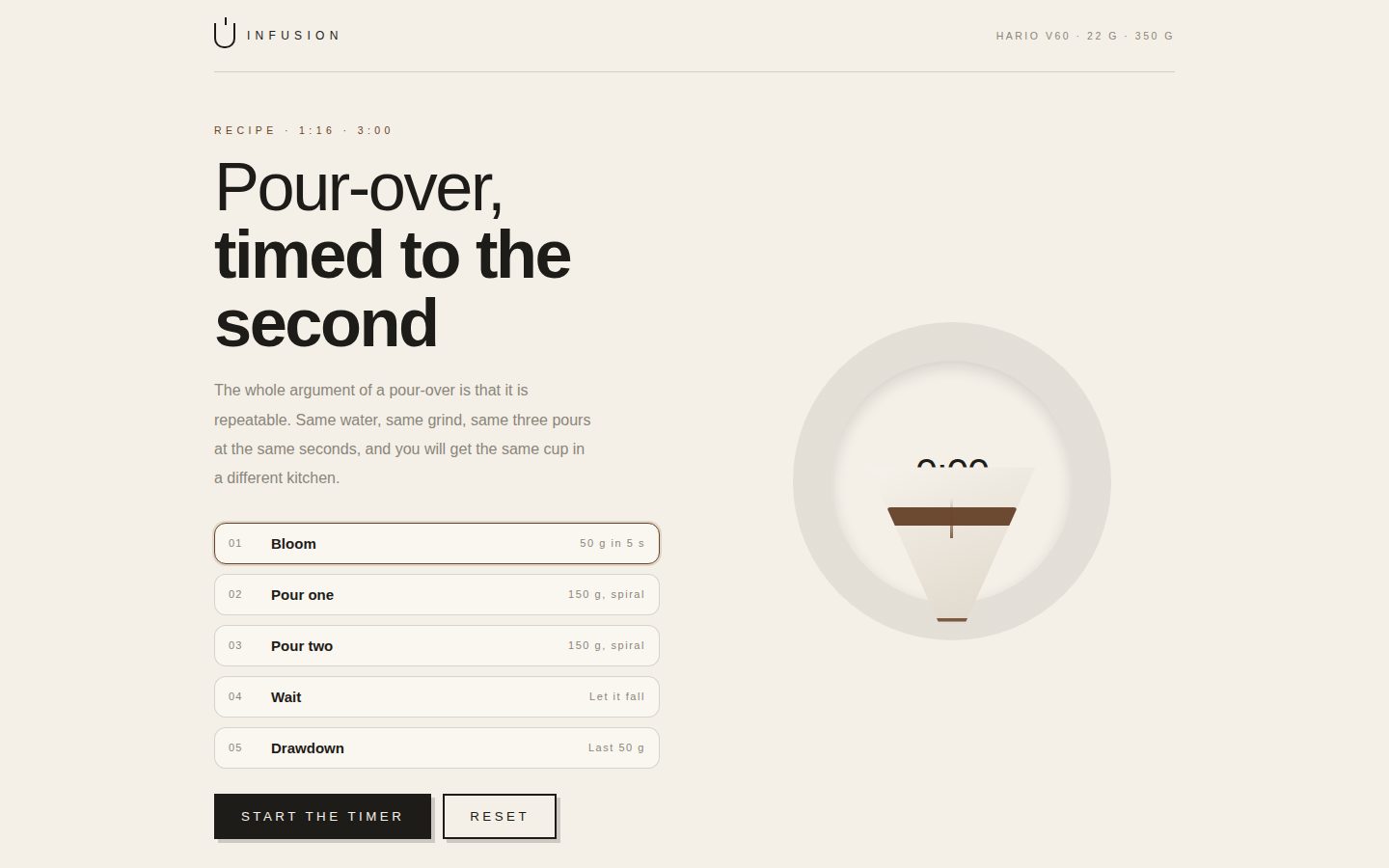
INFUSION — a pour-over, timed

A pour-over recipe as a stopwatch. Most brewing guides say "around 30 seconds" and "wait until it drops halfway", which is both kind and useless; this one gives you the exact seconds. Press start and the ring fills over three minutes while the phase name, the step list and the pouring stream all advance together, so you can follow the clock with one hand and the kettle with the other.

Open ↗
ORU — one sheet, thirty folds screenshot
053

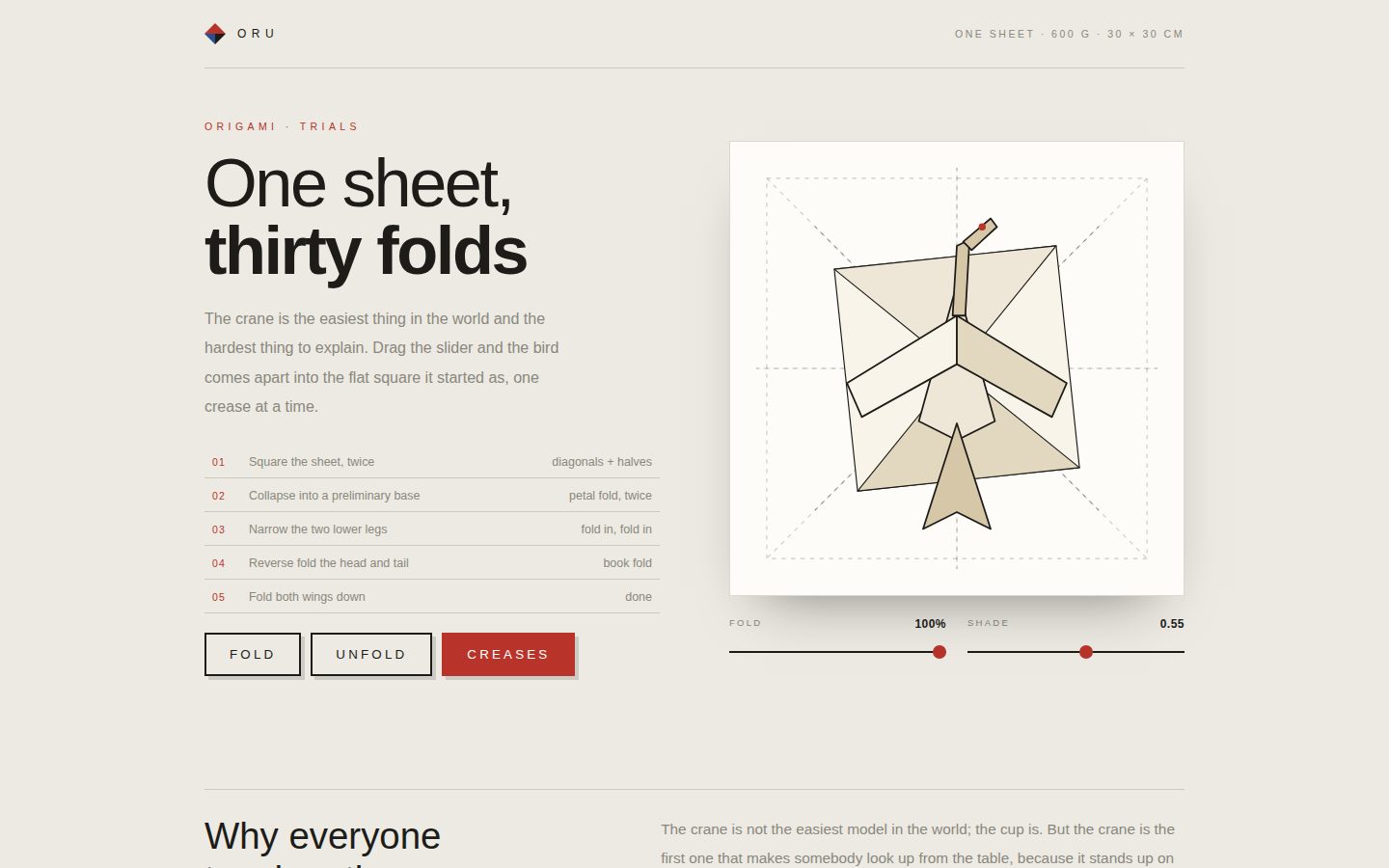
ORU — one sheet, thirty folds

An origami diagram that actually unfolds. Drag the slider and the crane comes apart: the square base shrinks and rotates away, the bird's opacity rises, and the dashed crease lines of the original 30 cm sheet stay underneath the whole time so you can always see where the hinges are. The paper is drawn in four close tones with heavy ink outlines, the way a printed folding diagram is, and the red eye is the only colour on the page.

Open ↗
VELLUM — the Cartographer's Complaint screenshot
054

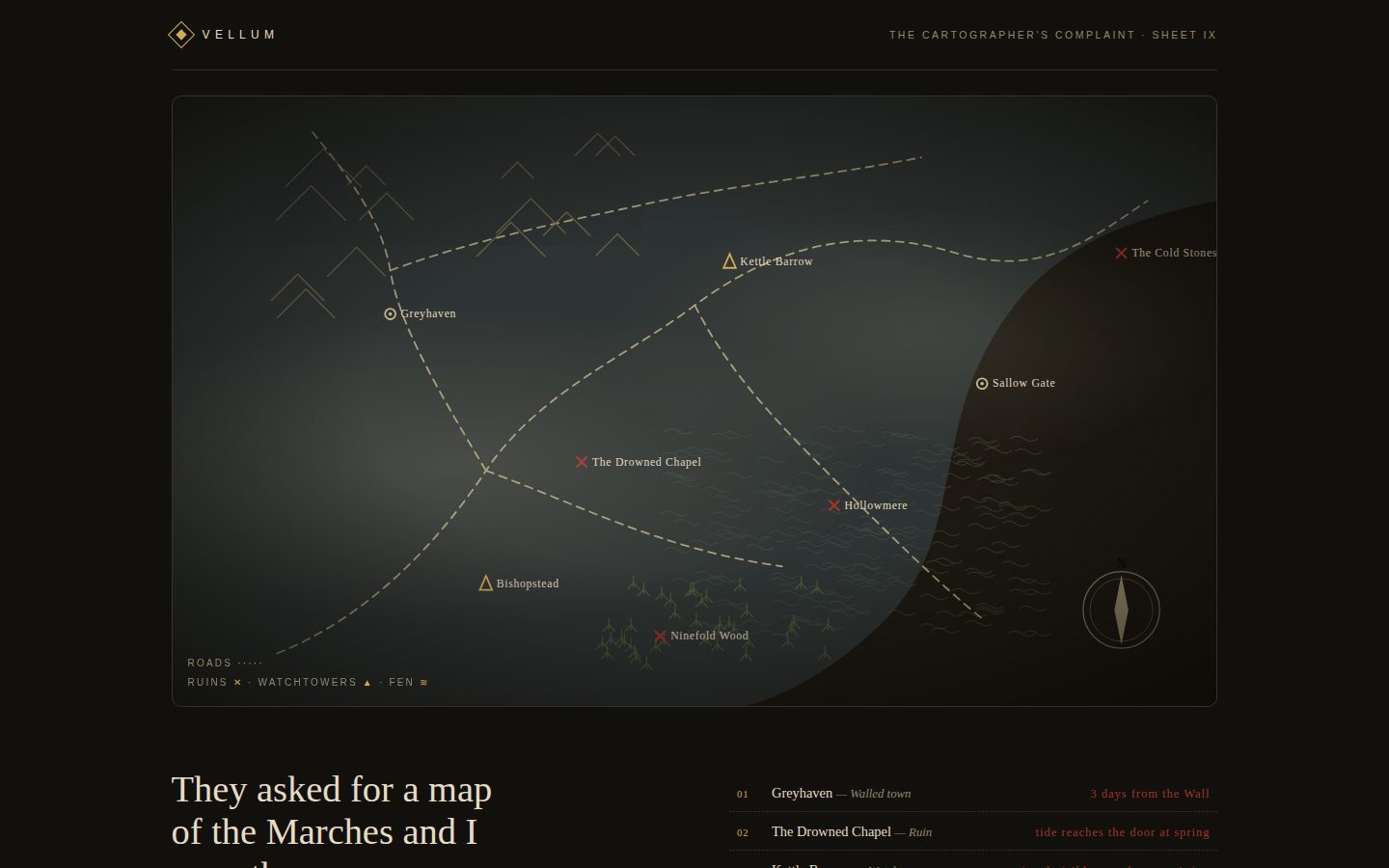
VELLUM — the Cartographer's Complaint

A hand-inked map of the Marches, generated rather than drawn: the fen is two hundred little wavy strokes, the forest is forty conifer glyphs, the mountains are bare triangles, the roads are dashed and thin, and the coast is a single translucent shape. Eight places sit on it as rings, crosses and gold triangles, each with a warning attached — "tide reaches the door at spring", "no road, do not attempt after dark". Fog drifts over the whole chart, which is the correct condition for a place called Hollowmere.

Open ↗
DEPARTURES — board 4 screenshot
055

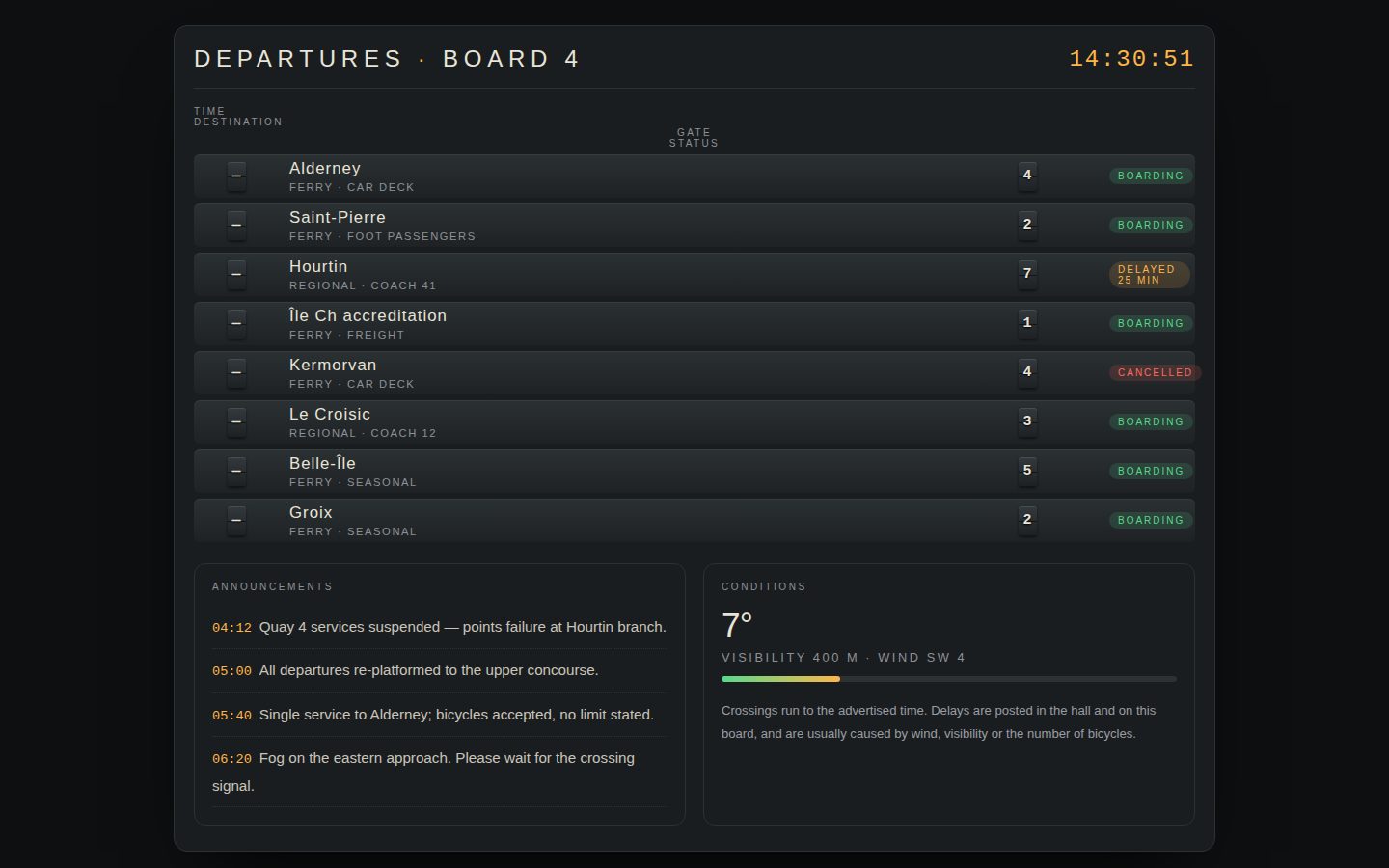
DEPARTURES — board 4

A departure board that behaves like the real thing: every character is a separate plastic flap with a hairline down the middle, and when a value changes only the cells that actually differ flip. The clock in the header is the system clock, so the board really does go red behind you as the morning's sailings slip past. The announcements underneath carry a timetable's worth of small administrative dread — points failures, re-platforming, and an unbounded number of bicycles.

Open ↗
HALO — a studio for soft light screenshot
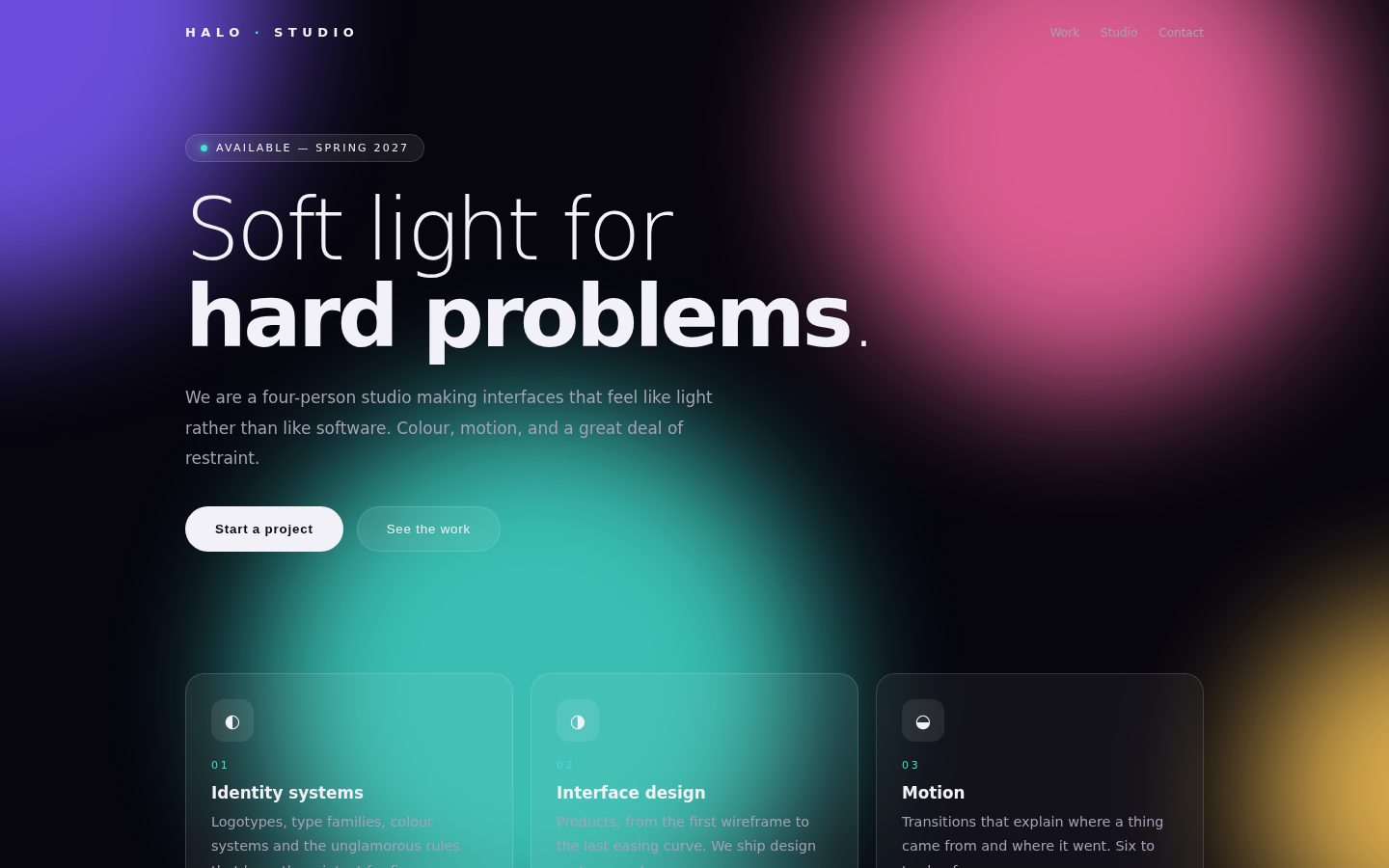
056

HALO — a studio for soft light

A studio page whose background is genuinely alive. Four blurred colour fields drift on independent sine paths, composited in screen blend and heavily blurred, so the page sits in a slow-moving room of light rather than on a flat picture. The four sliders under "The mesh" are not decoration — they change the hue, the spread, the blur and the speed of that room in real time, which is the most convincing way to show a studio that works with colour.

Open ↗
ROOM 4B — 02:40 screenshot
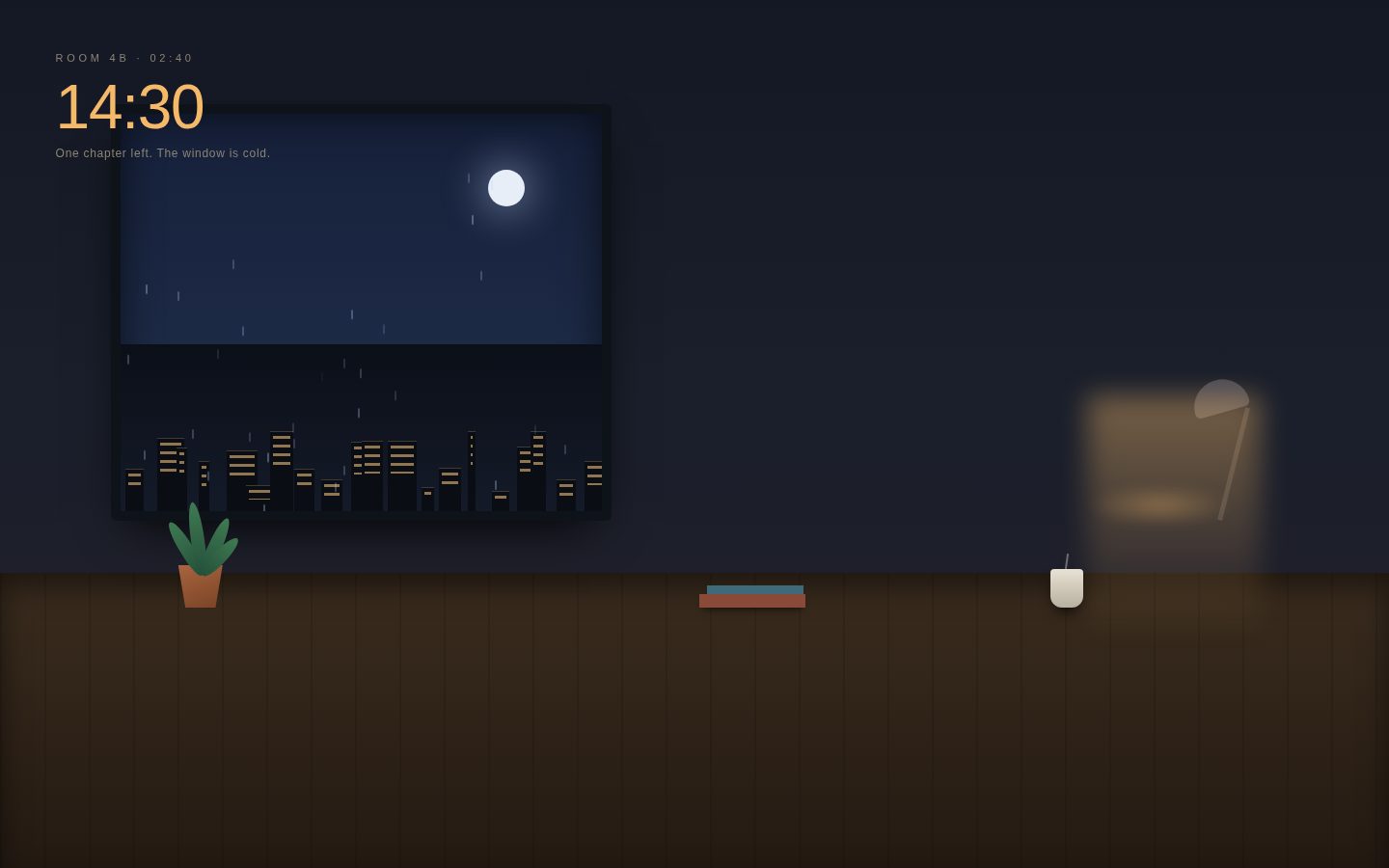
057

ROOM 4B — 02:40

A room, at night, drawn entirely in CSS: a window with a moon and a skyline of lit towers, rain running down the glass, a desk lamp throwing a warm cone and an elliptical pool across the wood, a cup with a thread of steam, two books, and a plant whose leaves are five rotated ellipses. The clock in the corner is the system clock, so the room is genuinely 02:40 only if it is 02:40, and the little player bar underneath is the only thing on the page that moves.

Open ↗
MOSAIC — a hundred patterns screenshot
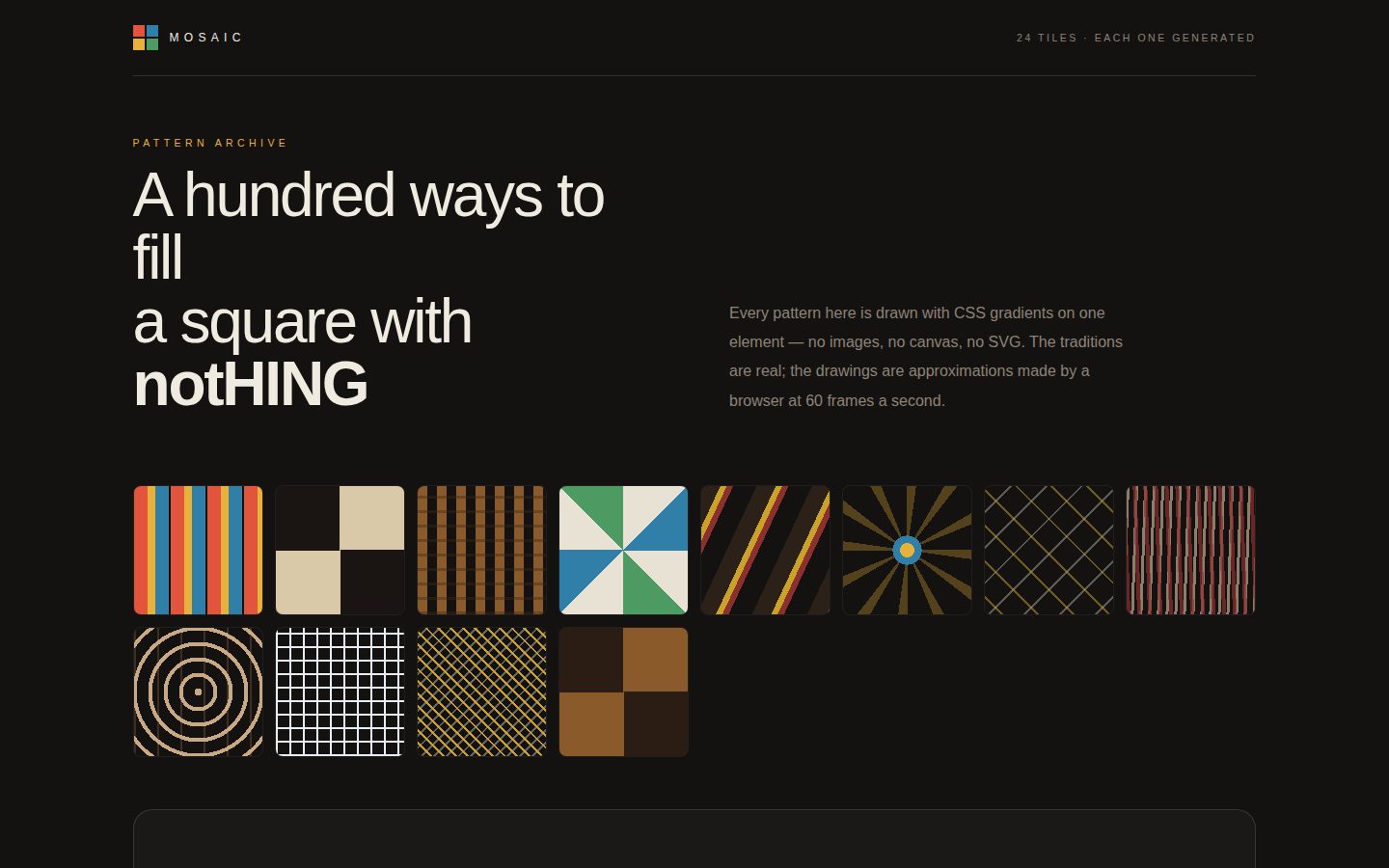
058

MOSAIC — a hundred patterns

Twelve patterns, each one nothing but a background. A kilim band is hard-stop repeating gradients; an eight-pointed zellige star is a single conic gradient with twelve-and-a-half-percent stops; ikat is two repeating gradients that have been deliberately misaligned by four degrees. Hovering a tile blows it up and explains what tradition it is borrowing from, and the big panel shows it at two hundred and sixty pixels, which is usually enough to see that the "Navajo lightning" is really just a stepped diagonal.

Open ↗
MERIDIAN — a wall of clocks screenshot
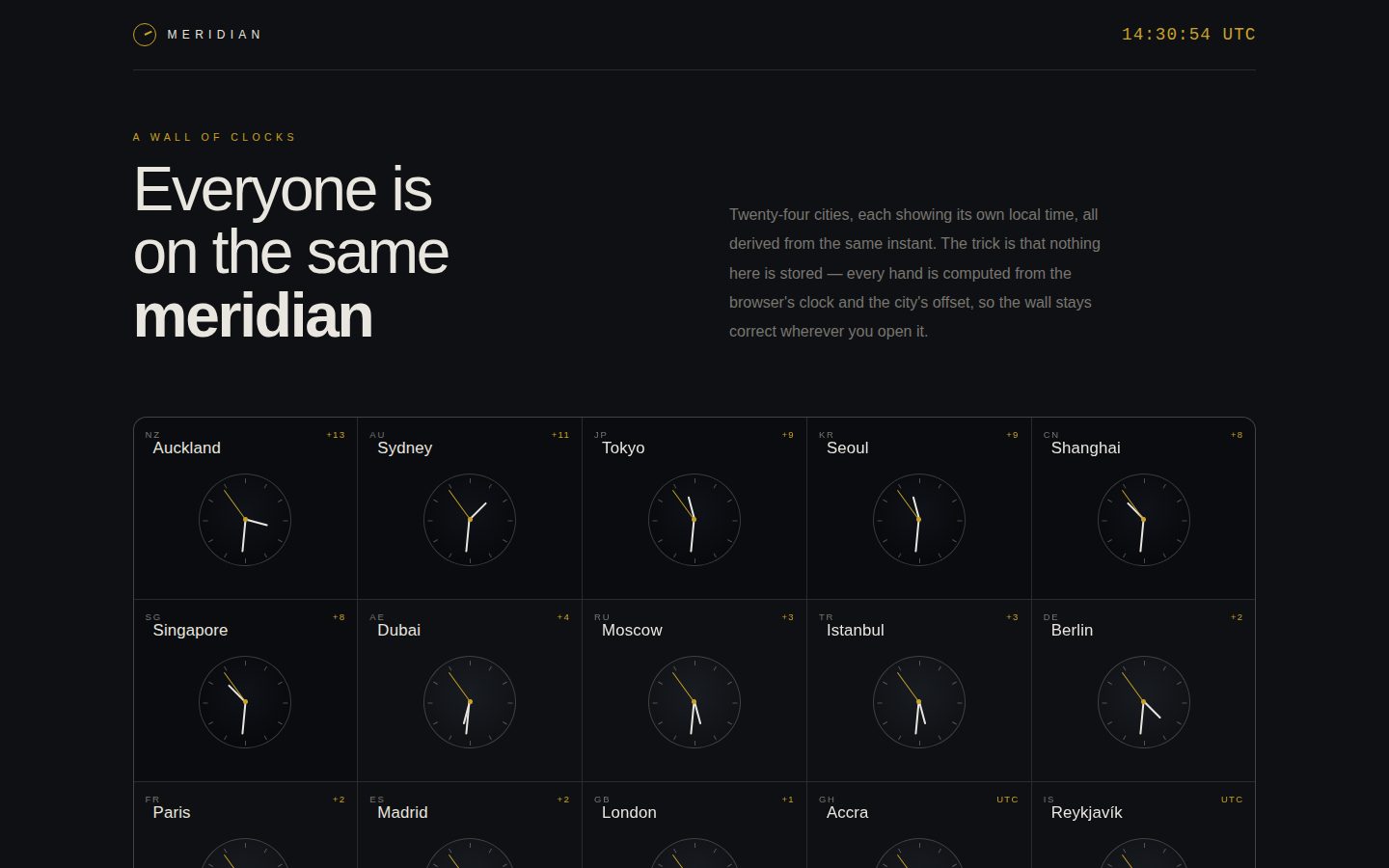
059

MERIDIAN — a wall of clocks

Twenty-four cities, one instant. Nothing on this page is stored: every hand is recomputed each second from the browser's UTC clock plus a fixed offset, which means the wall is correct wherever you open it and the "night" treatment on a city is genuinely that city's night. The dials are CSS only — a radial-gradient face, twelve generated ticks, and three hands pivoting from their own bottom edges.

Open ↗
COPPERPLATE — an engraver's plate screenshot
060

COPPERPLATE — an engraver's plate

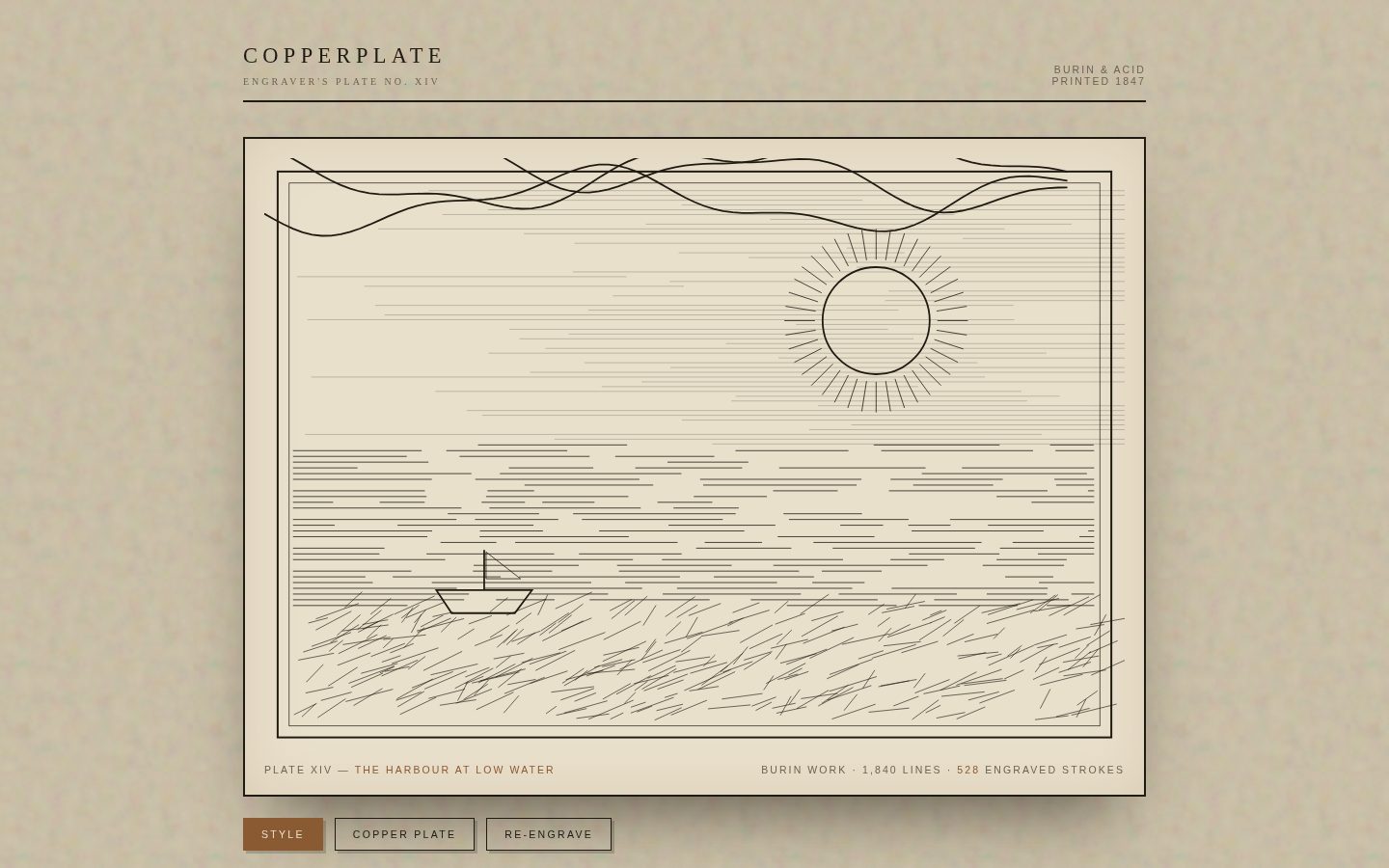
A line-engraved harbour, cut fresh every time you press the button. The sky is hundreds of short horizontal strokes, the sea is long broken ones, the foreground is a hatch of three hundred diagonals — and because a real engraved line is never one line, the Paired Lines style doubles every stroke with an offset hairline, which is the shoulder of the groove catching the ink. The stroke count in the caption is the honest total.

Open ↗
LIQUID — type that behaves like matter screenshot
061

LIQUID — type that behaves like matter

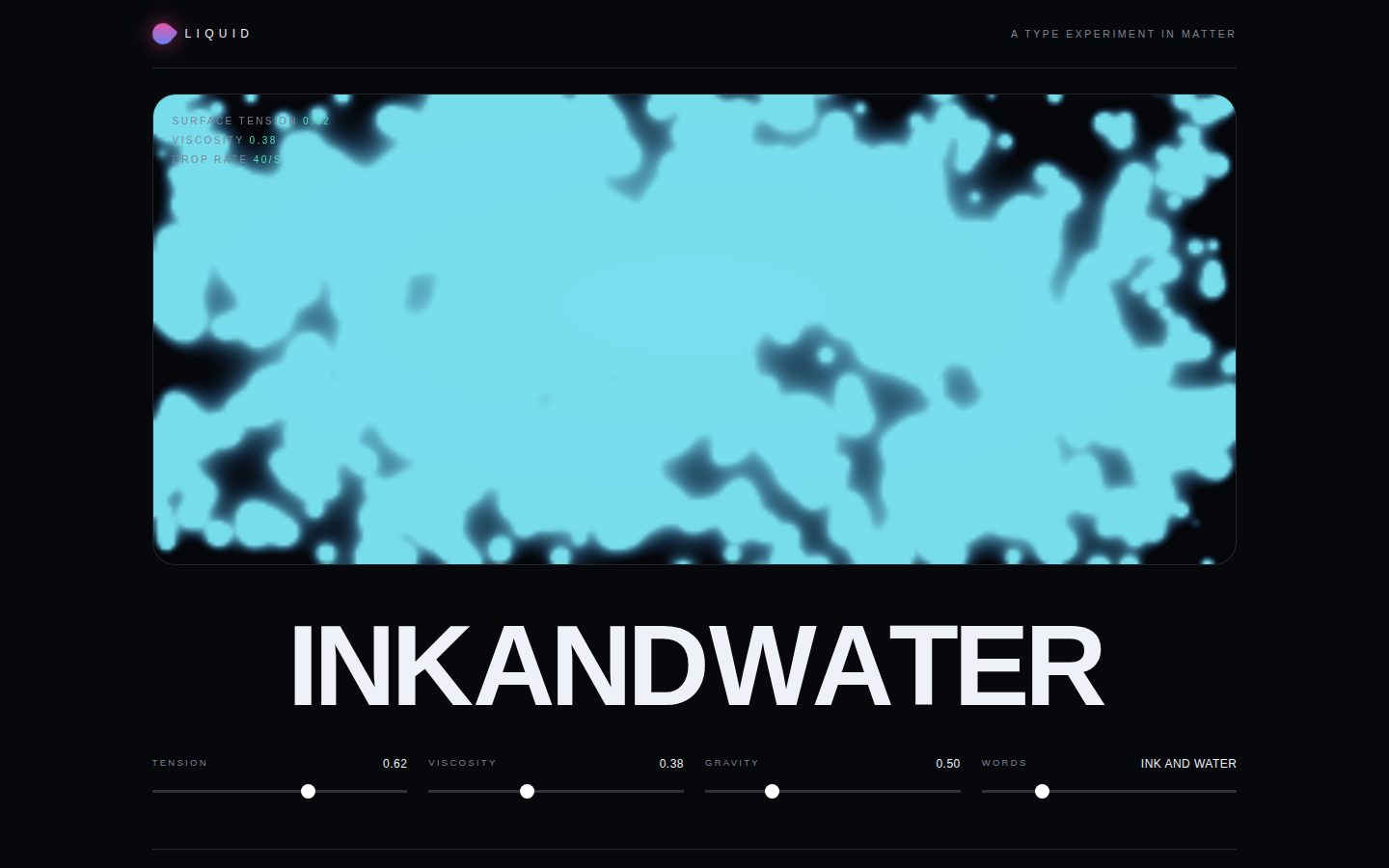
Type treated as a fluid. The word is a cloud of drops, and the sliders are the physics: raise the surface tension and the drops pull into tight beads; lower it and they run together into a single sheet; raise gravity and the whole thing falls and reforms at the bottom. It is a metaball field solved on a quarter-resolution grid and upscaled, so the merging is real rather than a stack of blurred circles.

Open ↗
MEMORY — a game of pairs screenshot
062

MEMORY — a game of pairs

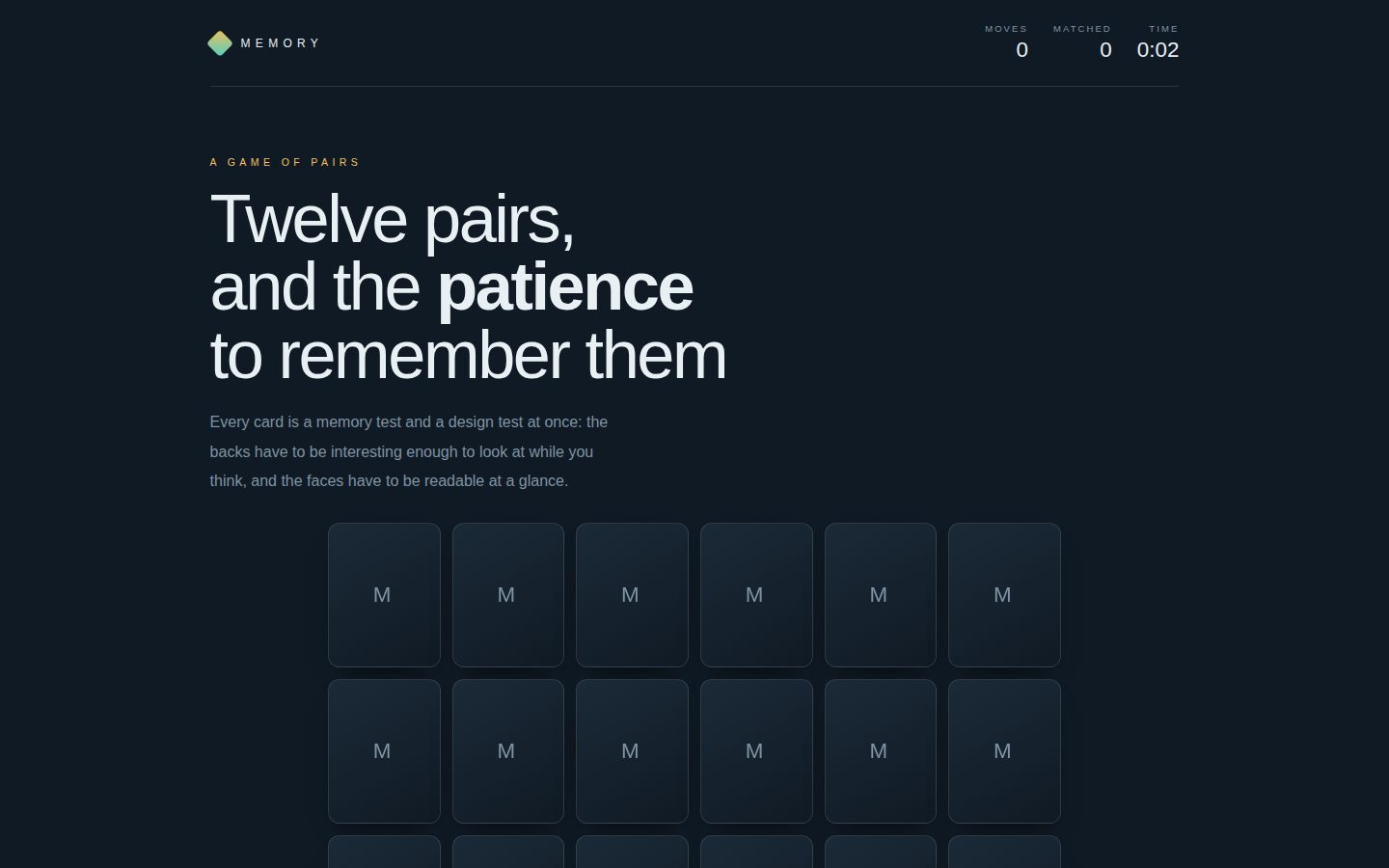
A complete memory game, correctly built: real rotateY flips on 3D-transformed faces, honest move counting, and a match state that locks the pair with a teal outline. The Hint button is the interesting one — it reveals a single pair, which feels like cheating and is actually a gift, because the match is easier when you have a position to attach the memory to.

Open ↗
QUADRANT — a decision surface screenshot
063

QUADRANT — a decision surface

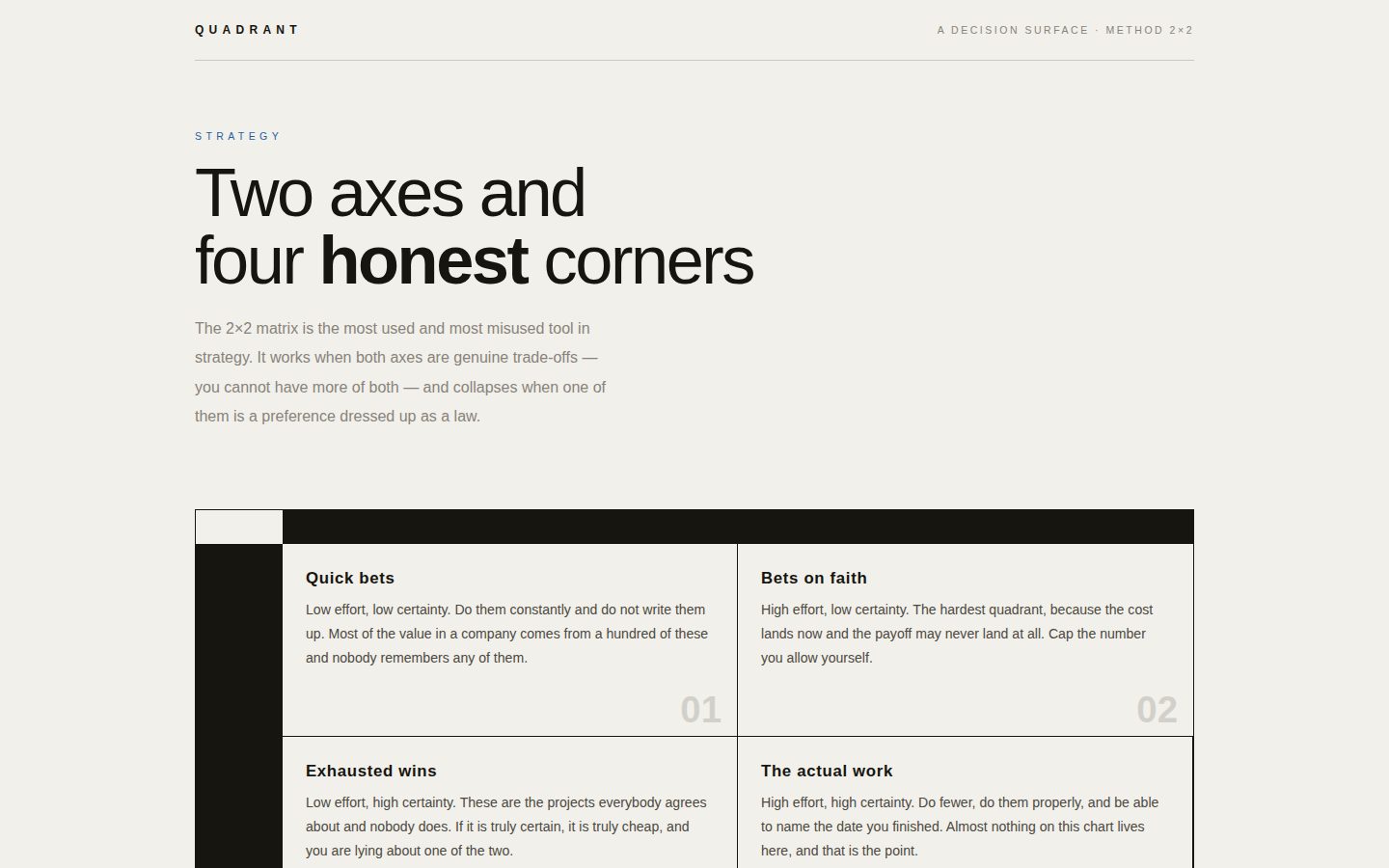
A 2×2 matrix with an argument attached. The four corners are Quick bets, Bets on faith, Exhausted wins and The actual work, and the live list underneath tests the thing that usually goes wrong: when you move an item into a quadrant, the code reassigns its effort and certainty so that the two axes stay in genuine tension, and the integrity score reports how often that trade-off is real. Click a quadrant to filter the list to what is in it.

Open ↗
SOLSTICE — the longest night screenshot
064

SOLSTICE — the longest night

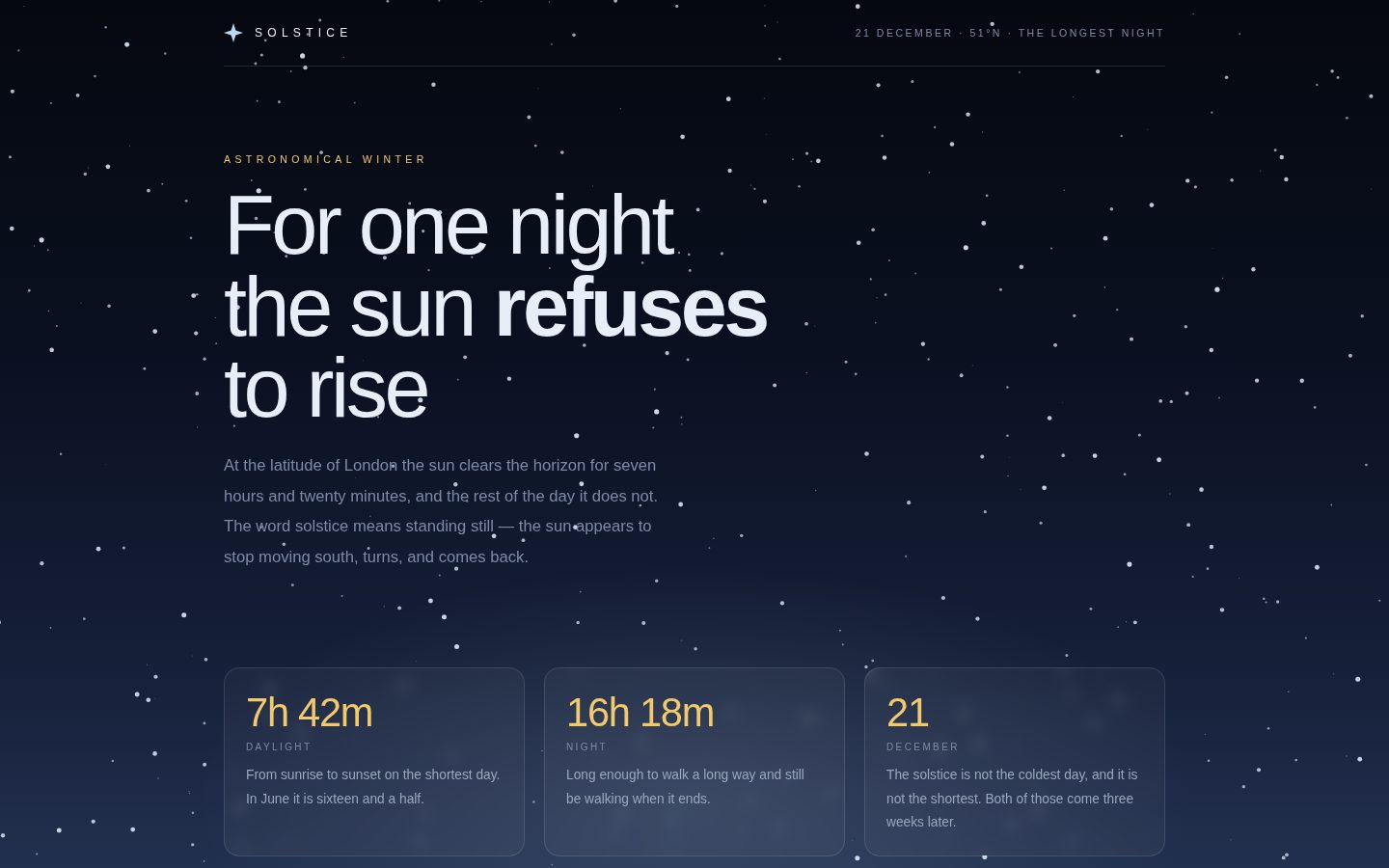
The longest night, rendered as falling snow over a fixed night sky. The chart in the middle is the sun's declination through the year — regenerated every frame, with a gold marker sliding along it — and the interesting shape is the flatness at the solstices, which is precisely why the days seem to stand still in early December and then suddenly start lengthening. The Blizzard button turns the snow from a drift into a storm.

Open ↗
PALIMPSEST — what was written before screenshot
065

PALIMPSEST — what was written before

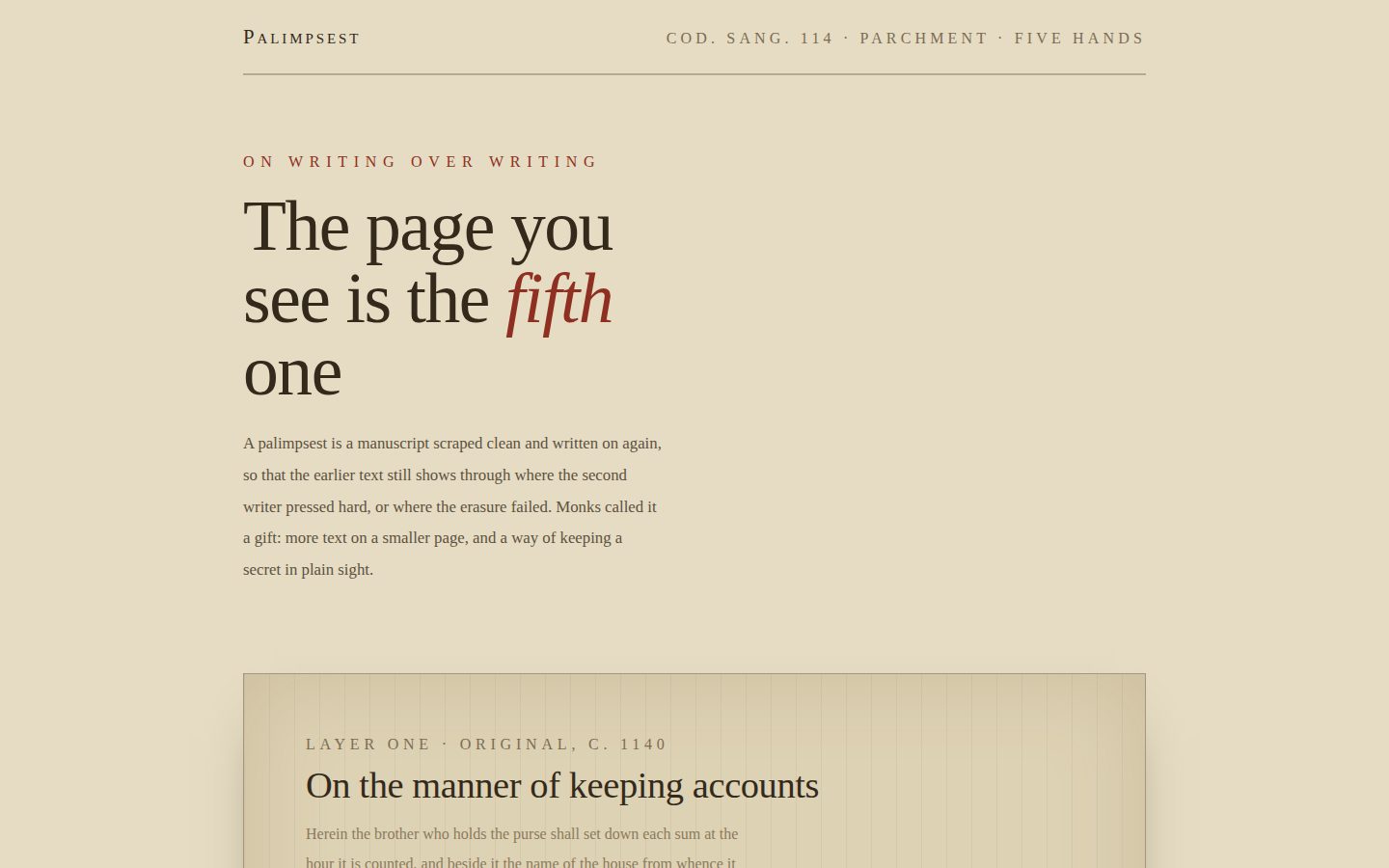
A palimpsest you can scrub. Three hands are stacked on one leaf — the 1140 accounts, the 1280 entry about a stolen reliquary, and the dull 1711 complaint about the ink. The middle panel is a real compositing trick: a canvas sits over the older text and is erased with destination-out where you drag, so the surface you uncover is literally the pixels underneath, not a swap.

Open ↗
OSCILLOSCOPE — a green trace screenshot
066

OSCILLOSCOPE — a green trace

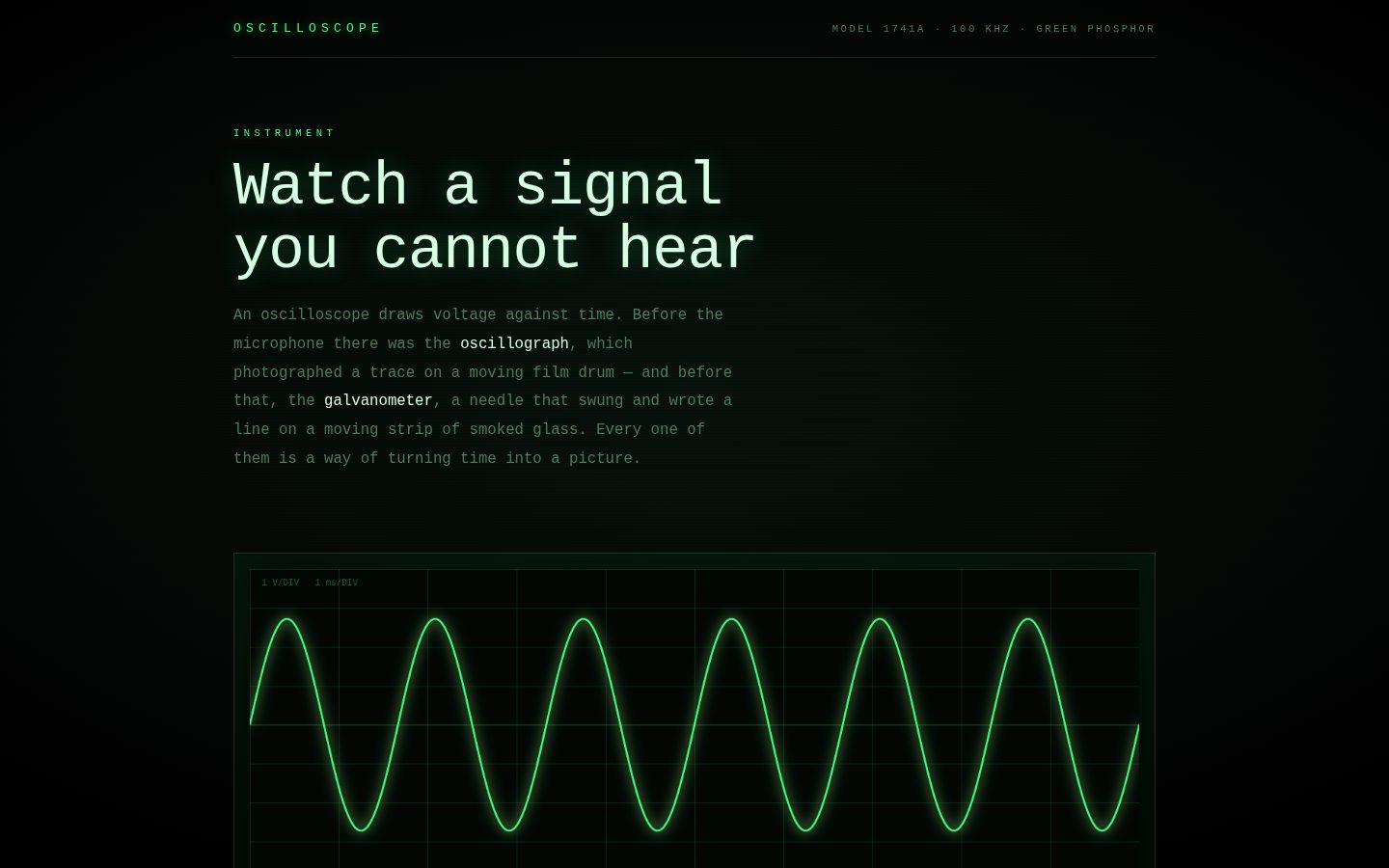
An oscilloscope with a green phosphor trace and an amber reference channel, drawn live on a canvas every frame. The square wave is genuinely stepped on the phase counter rather than approximated, so the trace has the hard vertical edges of a real digital signal, and the graticule is a proper ten-by-eight division grid with a brighter centre line. Freeze holds the trace so you can read it.

Open ↗
COMMONWEALTH — a type specimen screenshot
067

COMMONWEALTH — a type specimen

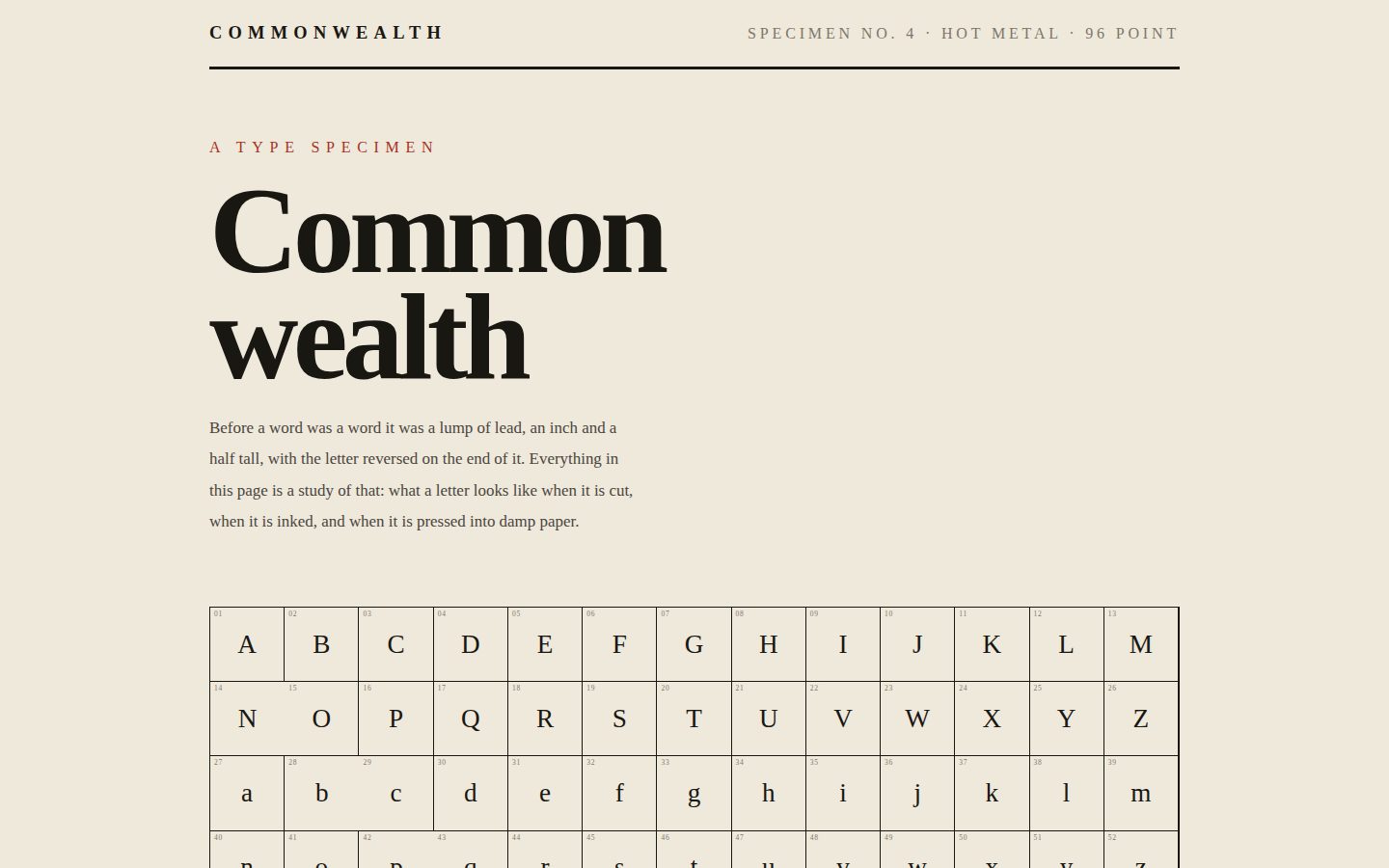
A type specimen you can pull by hand. The proof line is set at ninety-six point and the impression slider rebuilds its text-shadow stack live — a white highlight above, a dark shadow below, a second contact shadow — so the type visibly sinks further into the paper as you push the slider. Wet mode bleeds the ink outward with a blur. Clicking a sort in the case makes it jump in the proof.

Open ↗
ISOBAR — the pressure field screenshot
068

ISOBAR — the pressure field

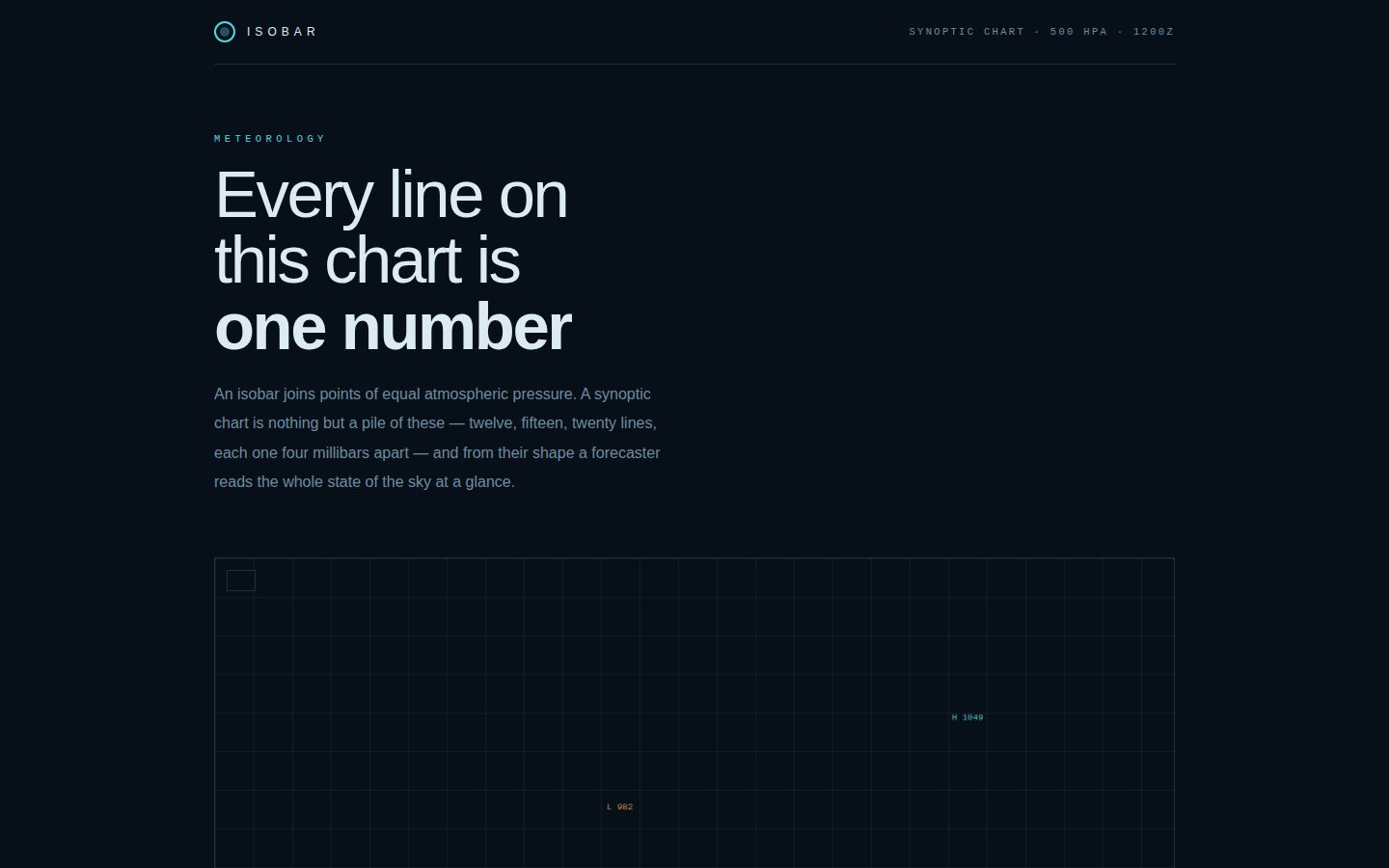
A synoptic chart that is actually computed. The pressure field is a sum of a Gaussian low, a Gaussian high and a travelling sinusoidal ridge, and the isobars are traced with marching squares — the same algorithm cartographers use — with each crossing linearly interpolated along the cell edge. Turn on the wind and four hundred tracers advect along the gradient rotated ninety degrees, which is exactly how a geostrophic wind behaves.

Open ↗
STRATA — a core through the ground screenshot
069

STRATA — a core through the ground

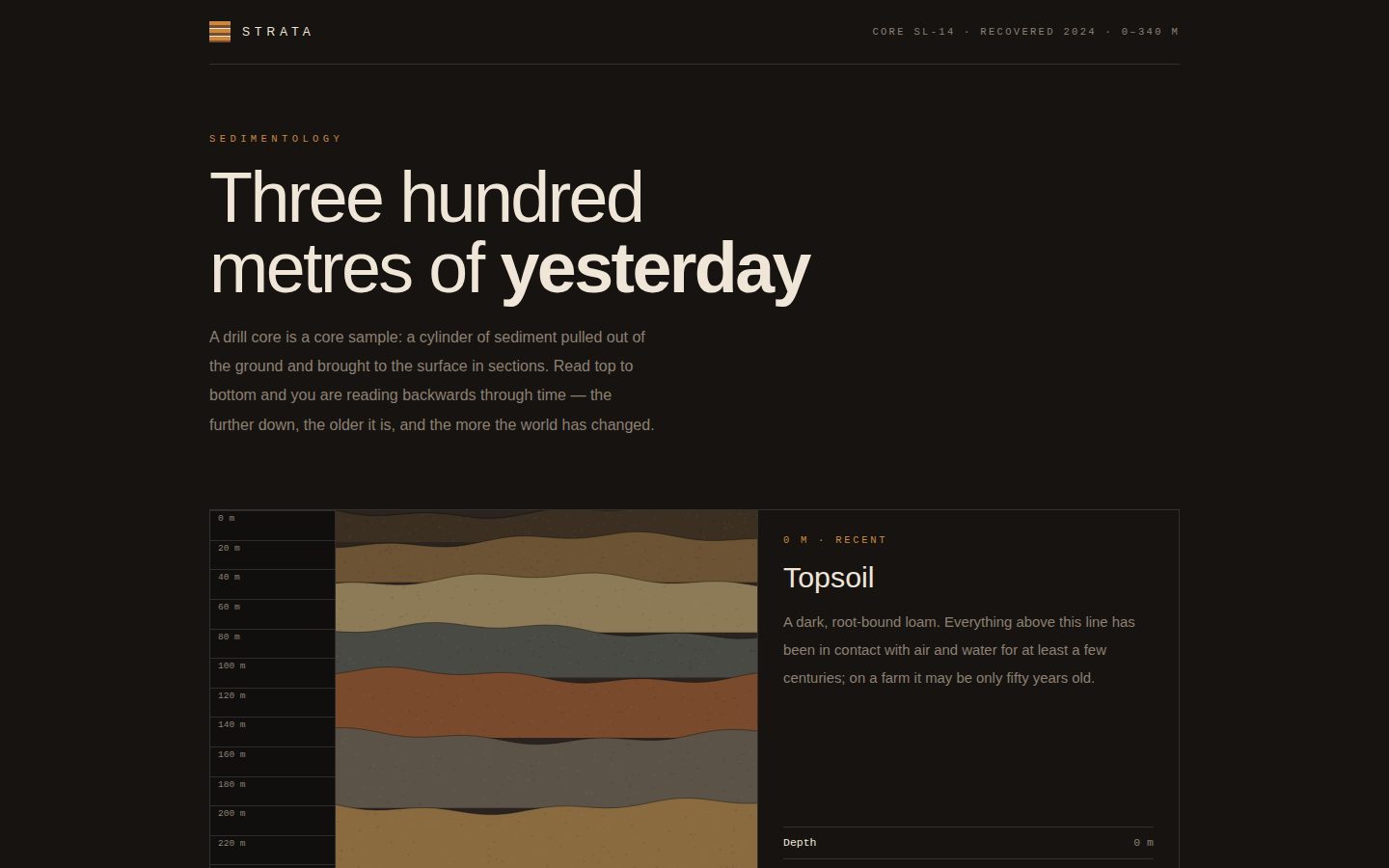
A drill core you can walk down. Nine beds — topsoil, charcoal silt, aeolian sand, glacial varves, a flood sand, marine clay, sandstone, Jurassic limestone and basement basalt — are stacked with irregular bedding planes and speckled with grain, and the reading panel changes as you move through them. Scan core sends an ochre line down the column while the text follows it.

Open ↗
ZOETROPE — the drum of pictures screenshot
070

ZOETROPE — the drum of pictures

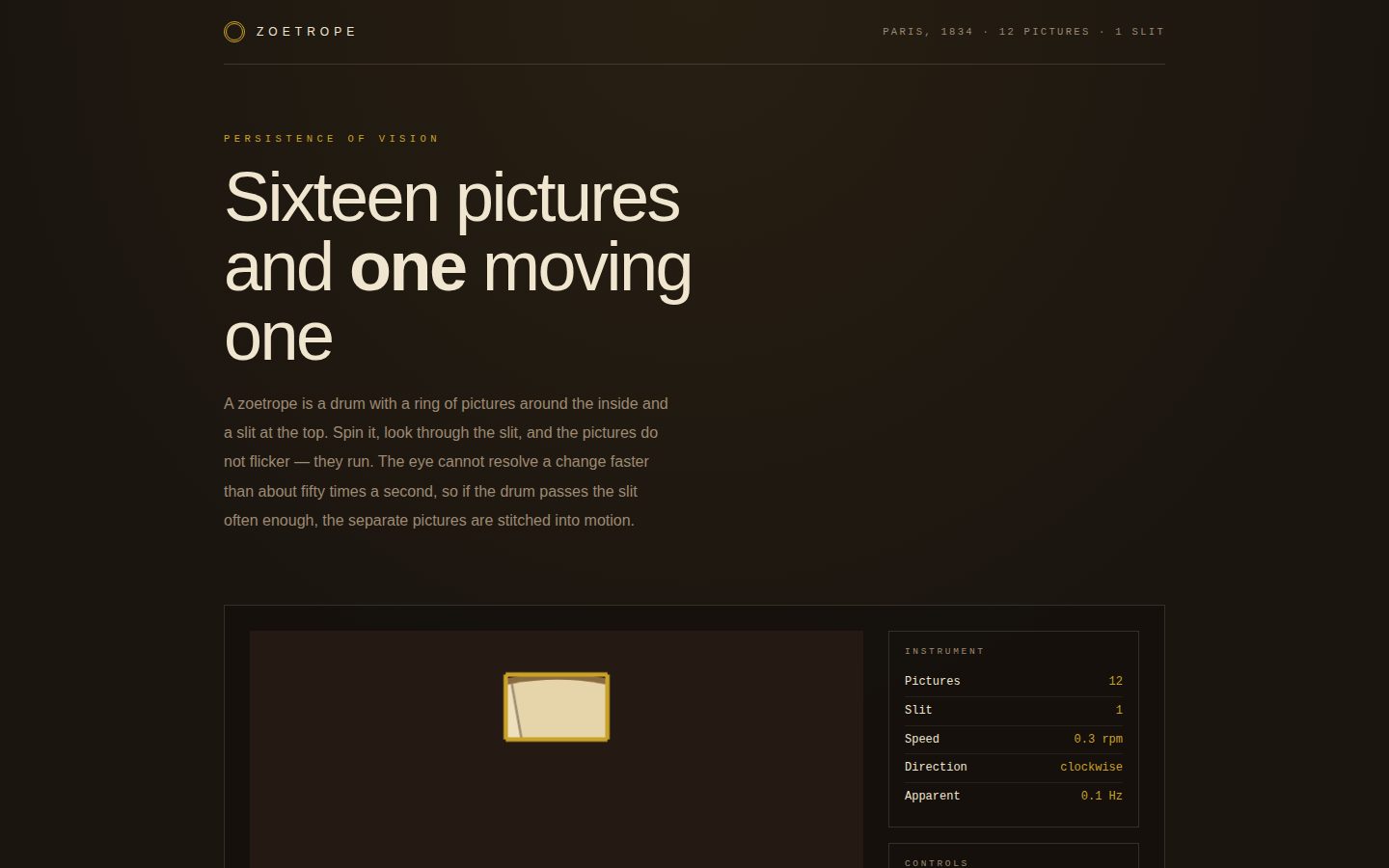
A working zoetrope. The bird is drawn procedurally, frame by frame, with its wings beating through a sine of the frame index; the disc is masked with an even-odd fill so that only the brass-framed slit at the top stays open, and the drum is re-drawn clipped to that slit. Peek removes the slit and shows you all the pictures at once, which is the whole trick and the whole secret. Drag the drum to spin it by hand.

Open ↗
AUREA — gold leaf and rubrication screenshot
071

AUREA — gold leaf and rubrication

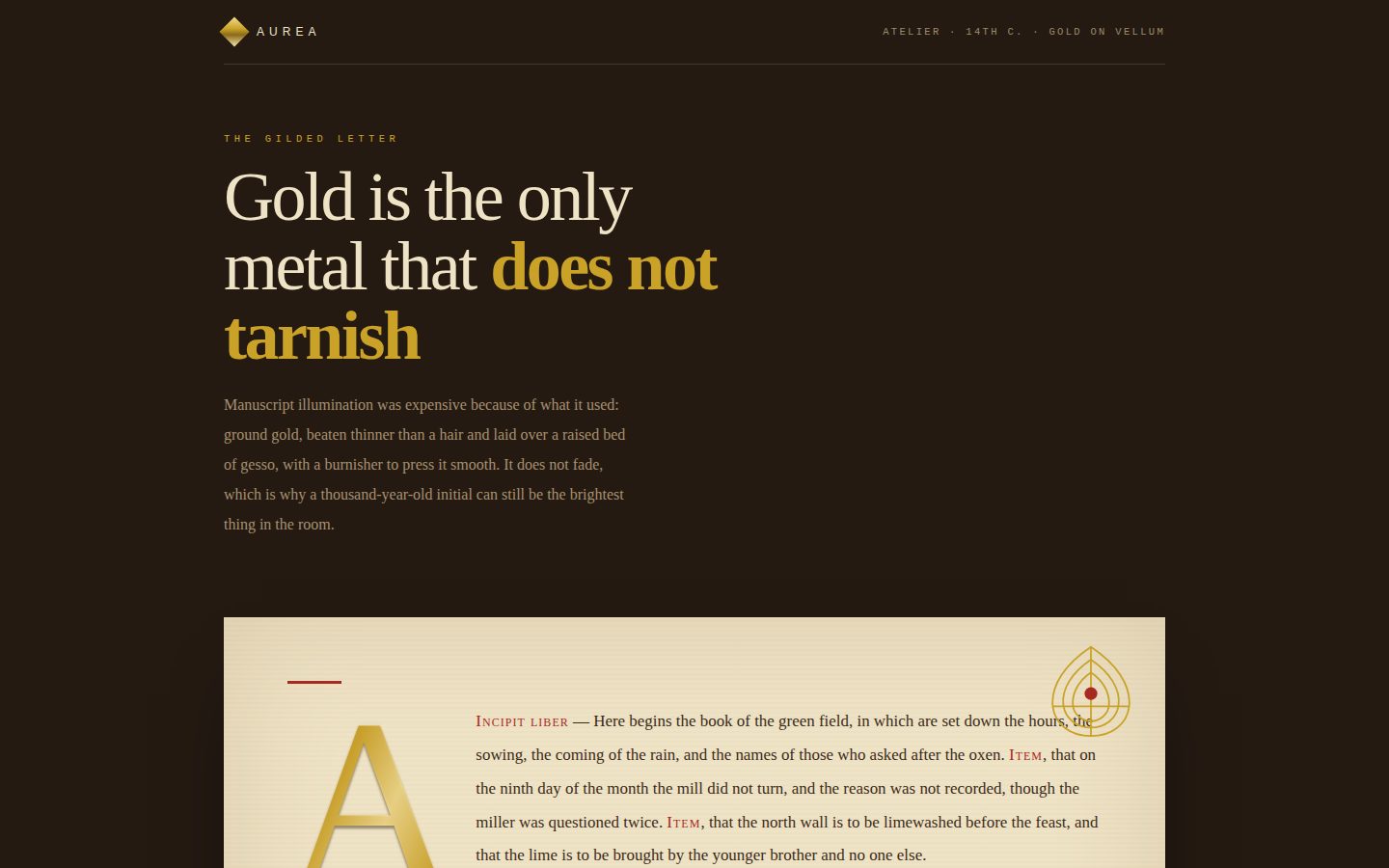
A gilded initial, painted live in the browser. The letter is a CSS background-clip gradient whose stops are recomputed from the sliders: a thin leaf gives a narrow bright band and a wide specular bloom, a thick leaf gives a broad band and a tight one, and burnishing tightens the highlight and deepens the shadow where the letter presses into the gesso. The page around it is a rubricated manuscript leaf with a marginal ornament drawn in SVG.

Open ↗
ENIGMA — a rotor machine screenshot
072

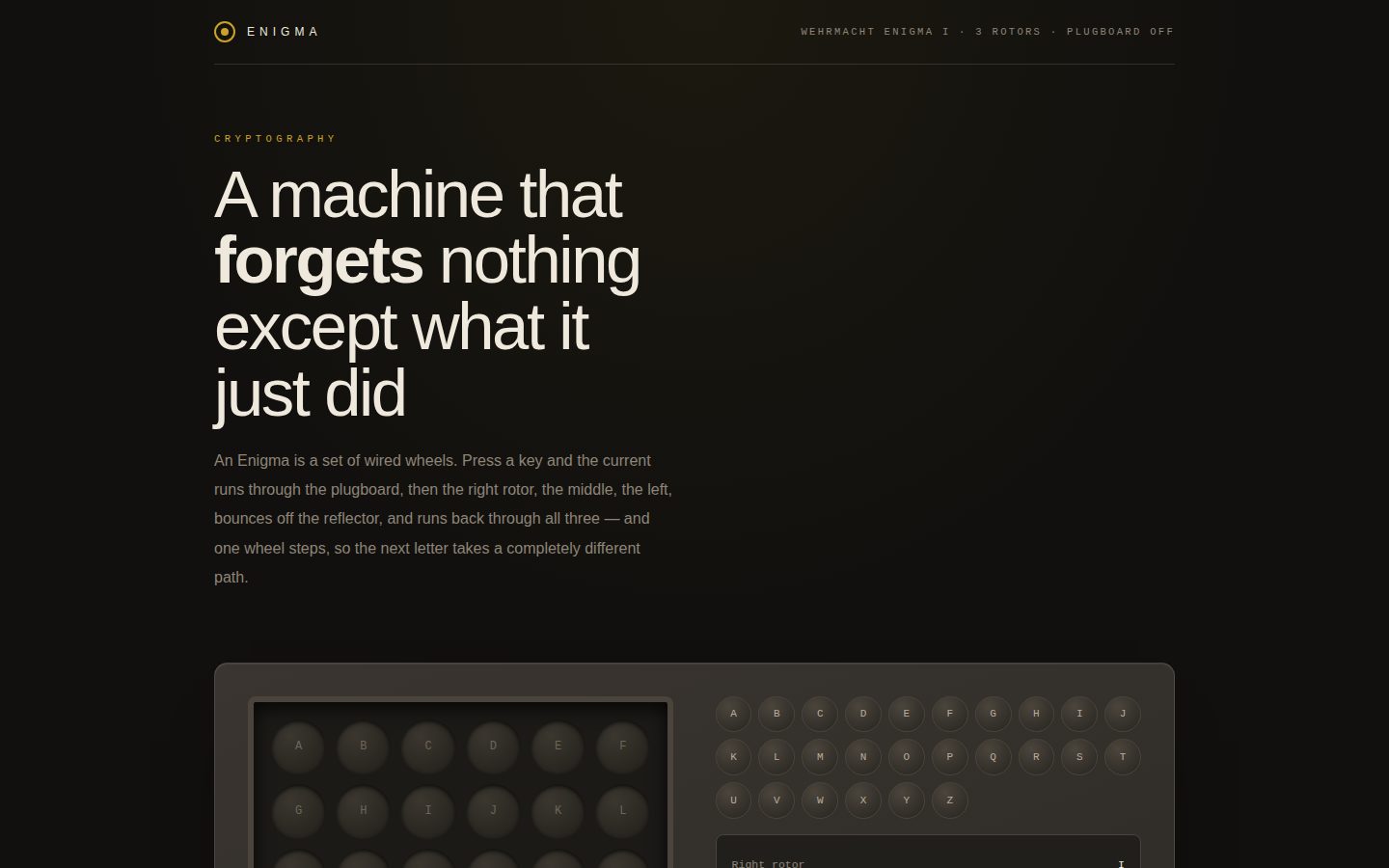
ENIGMA — a rotor machine

A working Enigma, not a picture of one. The rotors carry their historical wirings and notch letters, the reflector is UKW-B, and the stepping follows the real double-step rule, so the windows genuinely turn and the machine's state is genuinely different for every message. Click the keys or type on the keyboard and the lampboard lights with the letter the signal produced.

Open ↗
SEISMOGRAPH — the record of a shaking screenshot
073

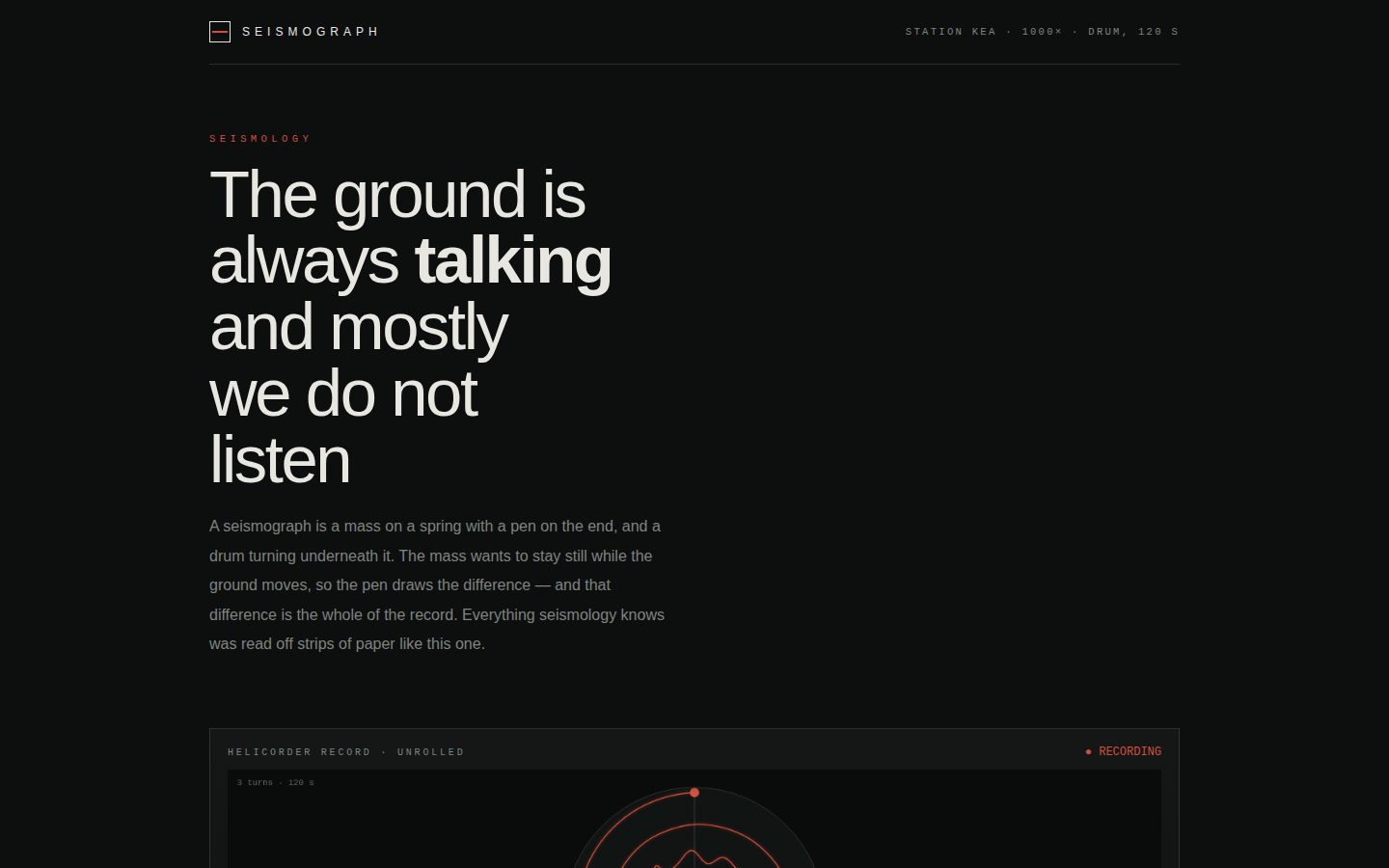
SEISMOGRAPH — the record of a shaking

A seismogram you can make happen. The record is built sample by sample — background microseism, a fast small P wave, a bigger slower S wave, then long surface waves — with the distance slider genuinely moving the arrivals apart and the magnitude slider scaling the amplitude on a logarithmic curve. Drum view redraws the same data as a spiral on a turning drum, with a pen at the end of the trace.

Open ↗
CARILLON — a tower of bells screenshot
074

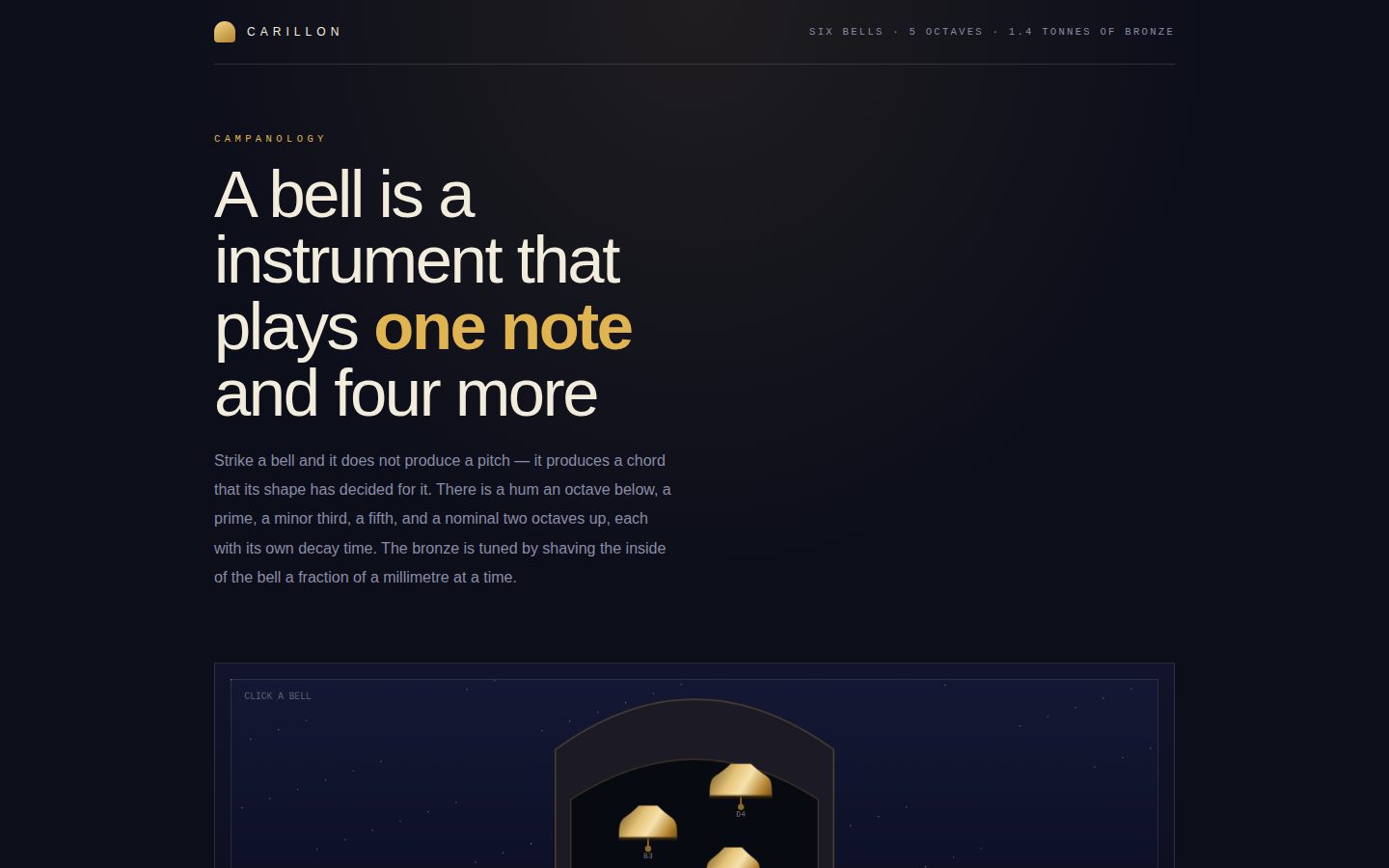
CARILLON — a tower of bells

Six bells that actually sound. Each one is eight partials at the ratios a real bell has — hum, prime, tierce, quint, nominal and three above — each with its own gain and its own decay, detuned slightly so they are not perfectly harmonic. The bar display is driven by the same partial table that drives the audio, and the bells swing and send gold wavefronts across the tower when you strike them.

Open ↗
MYCELIUM — the network under the wood screenshot
075

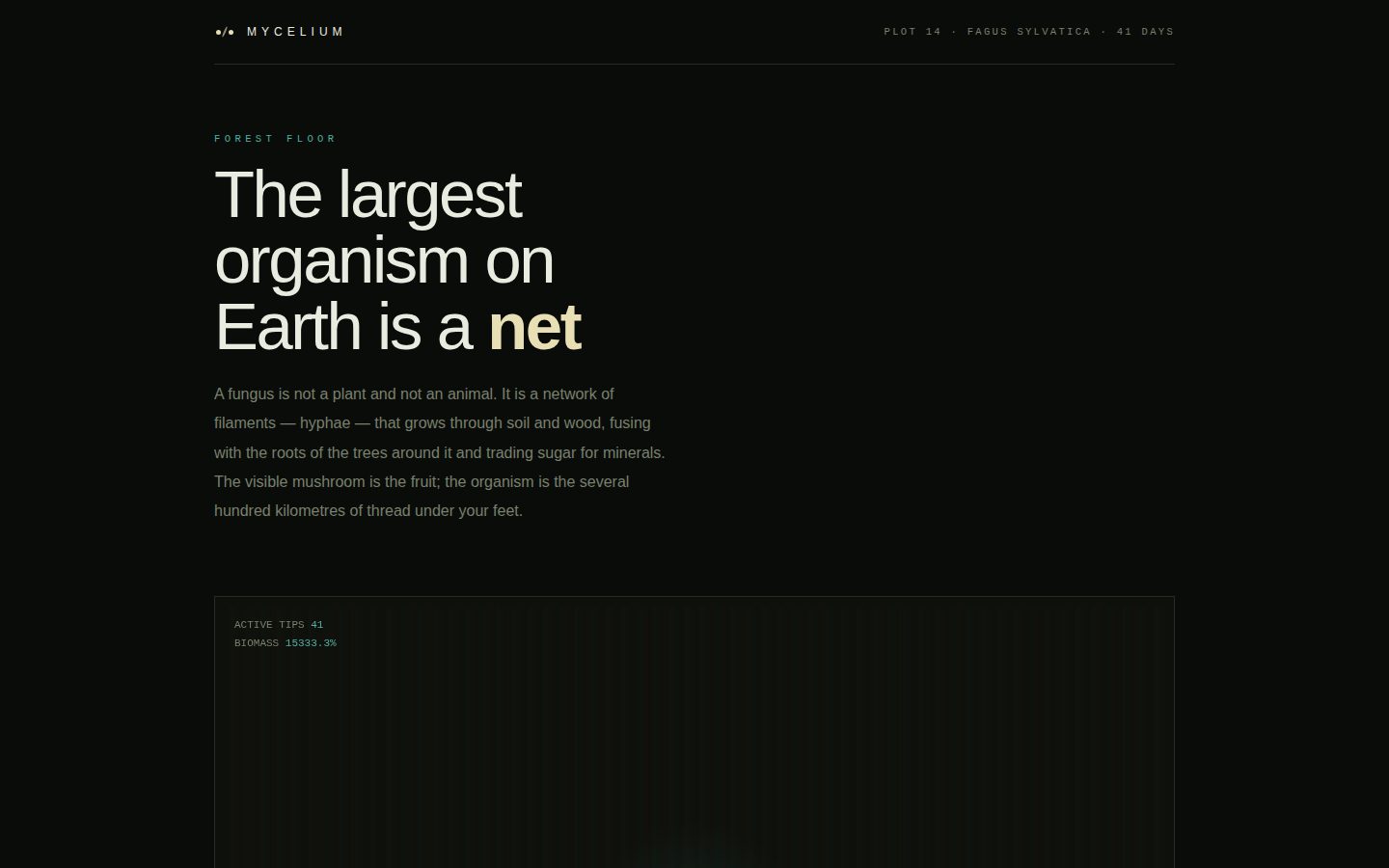
MYCELIUM — the network under the wood

A fungal network grown from local rules. There is no brain and no plan — each tip simply samples its eight neighbours, moves towards whichever holds the most nutrient, and occasionally splits — and the branching fans that emerge are the sum of those thousands of tiny decisions. Click anywhere to drop a blob of food and watch the threads find it.

Open ↗
KILN — a firing schedule screenshot
076

KILN — a firing schedule

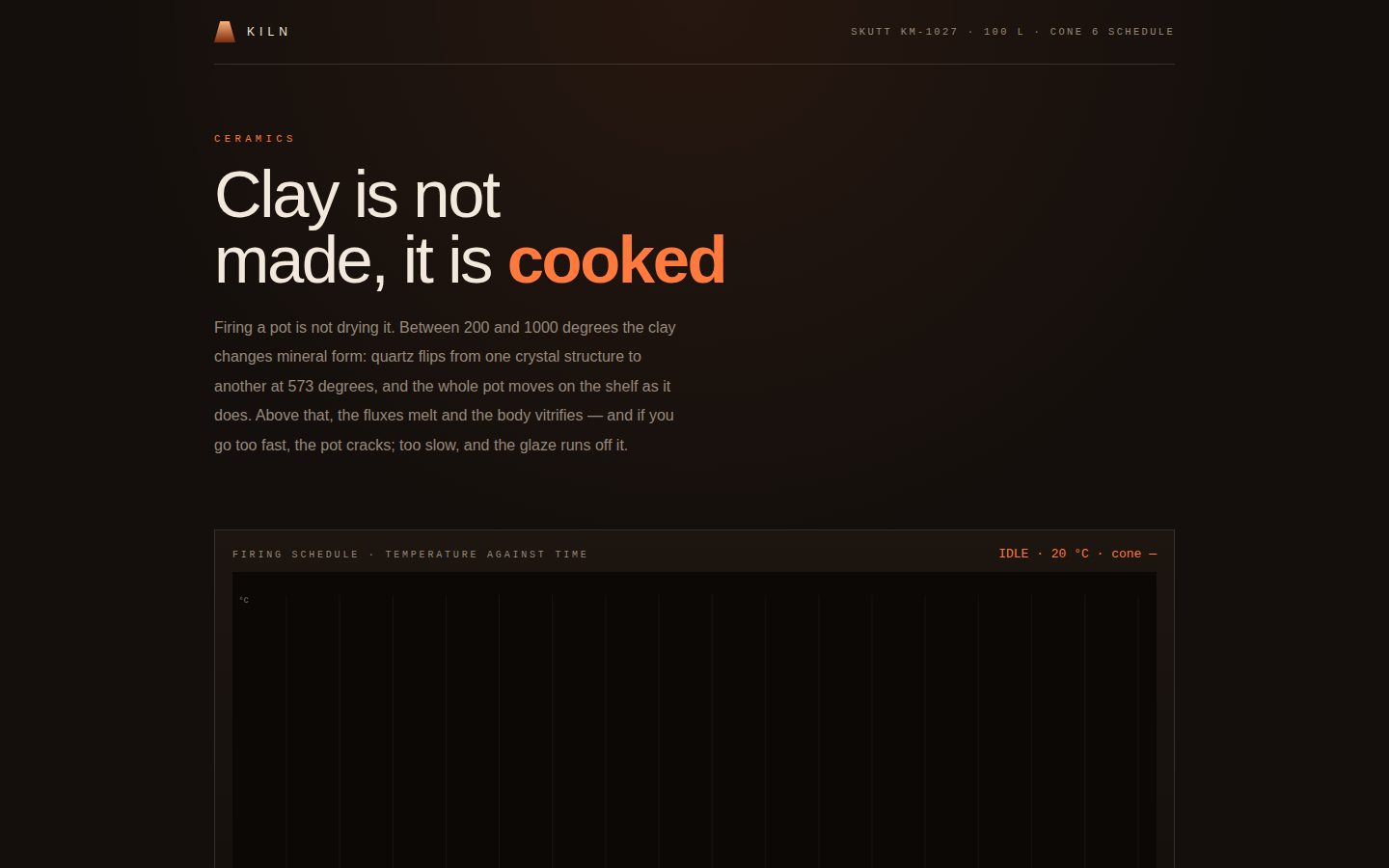
A firing schedule you can run. The curve is built from real segments — water smoking to 200 with a hold, a ramp through quartz inversion to 600, a controlled climb to the target with a soak, and a controlled cool — and the marker climbing it updates the elapsed time, the temperature, the ramp rate and the name of the stage the kiln is in. Move the target temperature and the whole curve changes shape underneath the cone lines.

Open ↗
PENDULUM — the double fall screenshot
077

PENDULUM — the double fall

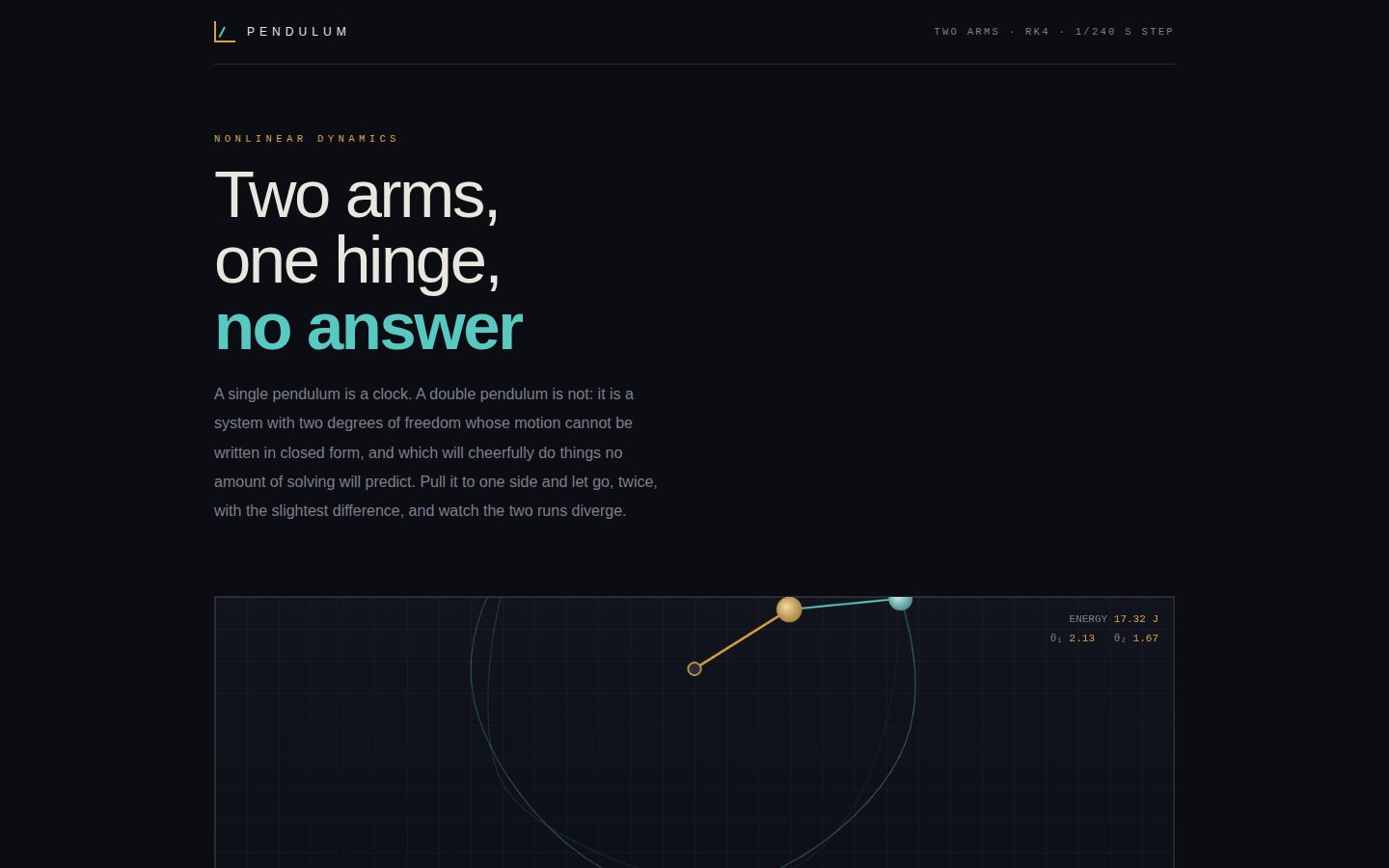
A double pendulum that is really simulated. The coupled equations are integrated with fourth-order Runge-Kutta six times a frame, and the energy readout is the honest expression including the cross term, so the drift figure tells you how well the integrator is doing. Drag a bob and let go; the teal trail of the lower bob is the only honest way to see what chaos looks like.

Open ↗
PRISM — the colour inside white screenshot
078

PRISM — the colour inside white

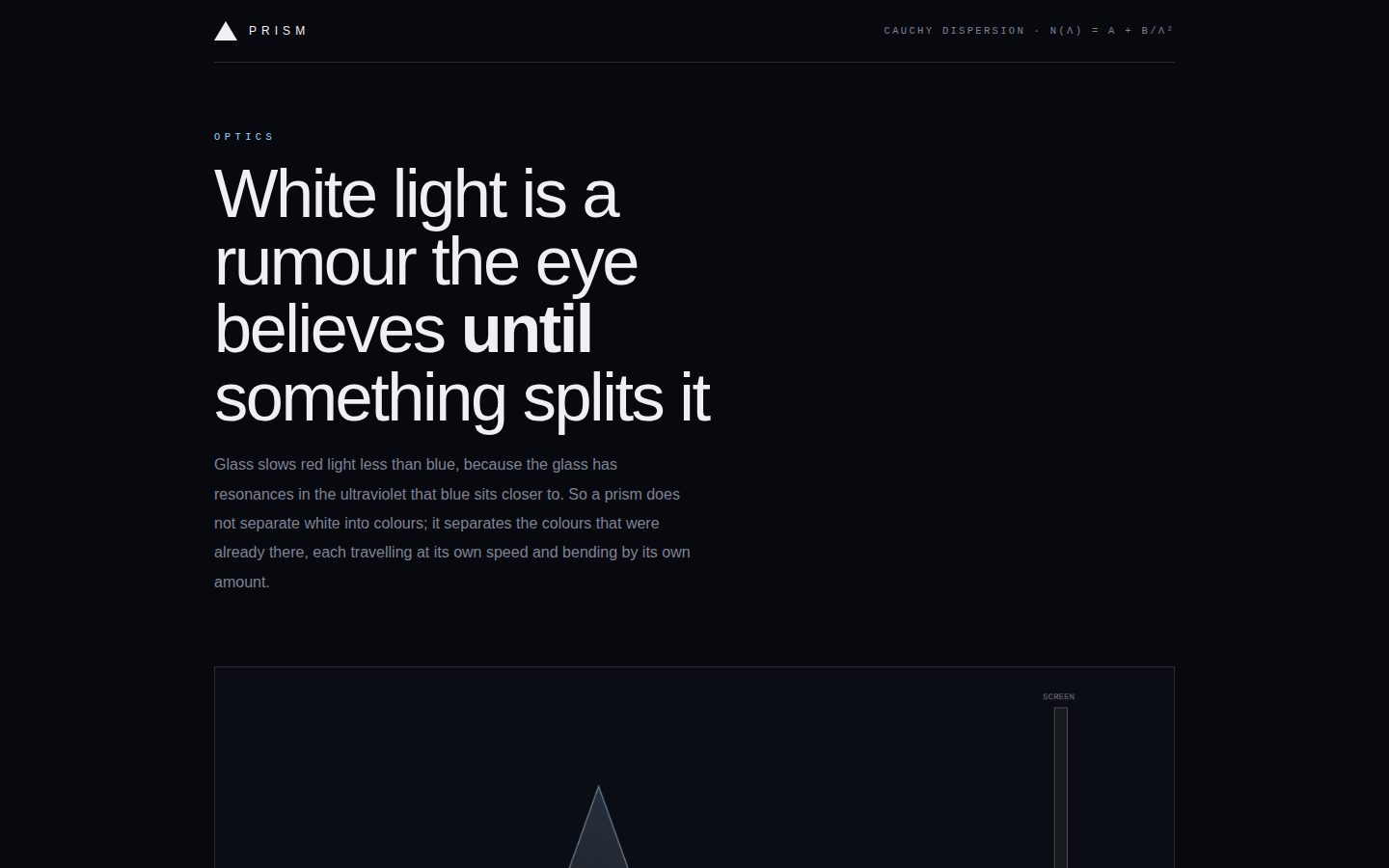
A prism that is actually traced. For each of eighty-one wavelengths the ray is intersected with the prism's first face, refracted through it with the vector form of Snell's law, refracted out of the second face and run to a screen — and because the index comes from Cauchy's formula, the spread of the band on the screen changes with the medium in the way it should. Switch from crown glass to flint and the fan opens; switch to diamond and it almost closes again.

Open ↗
TETROMINO — the falling block screenshot
079

TETROMINO — the falling block

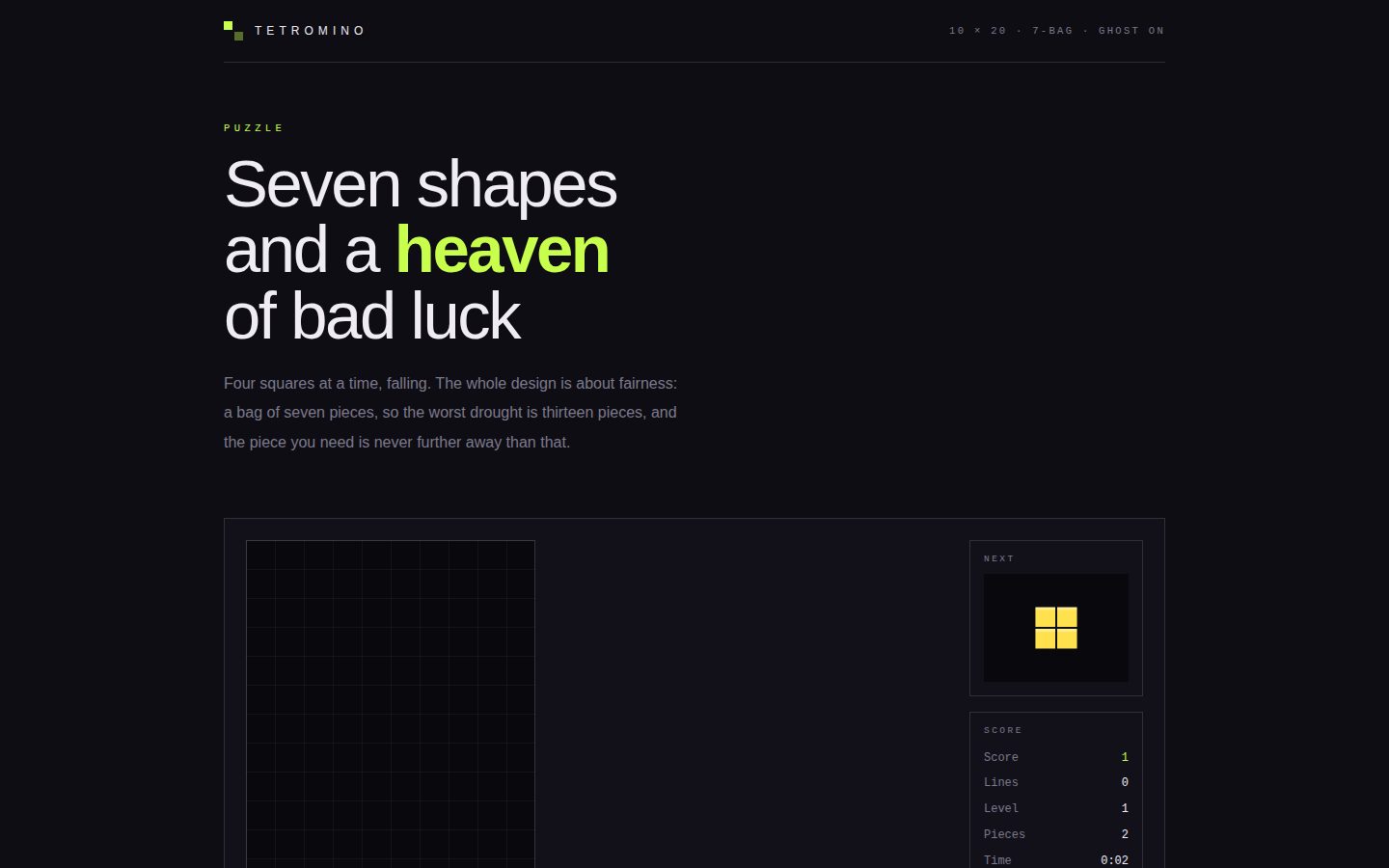
A complete, fair falling-block game. The seven-bag randomiser means the longest drought is thirteen pieces, wall kicks at nine offsets mean a rotation in a tight space works, and the ghost piece shows exactly where the piece will land. Clearing four lines is worth 800 and is the only moment in the game that feels like winning rather than tidying.

Open ↗
RAIN — the window at dusk screenshot
080

RAIN — the window at dusk

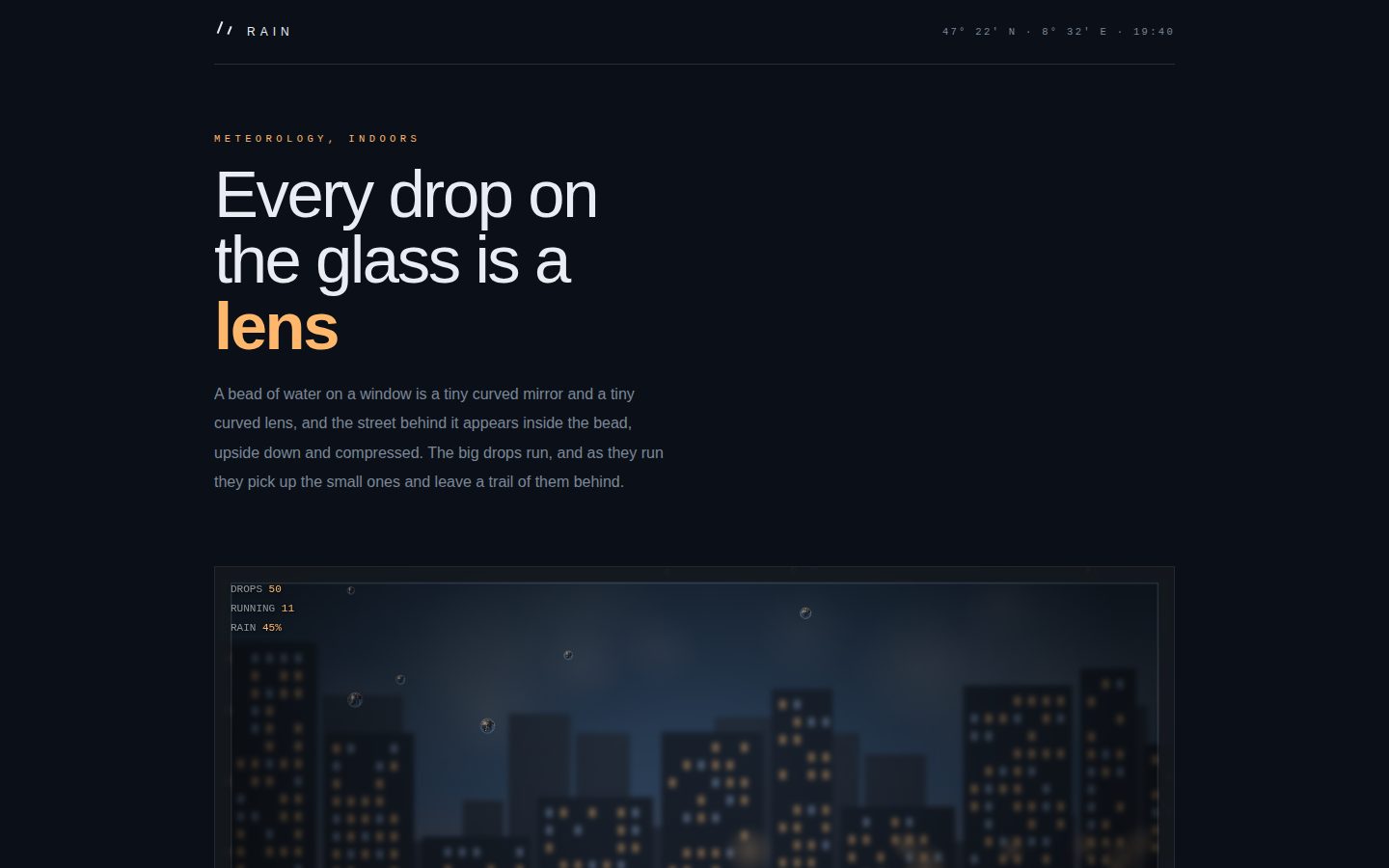
Rain on a window, with the optics done properly. Every bead is a real lens: the street behind the glass is clipped to a circle around the drop and drawn flipped in both axes, so the building appears inside the bead upside down and compressed. The drops behave too — they grow, break loose when they are heavy enough, run, accelerate, shed residue behind them and swallow the small drops they meet.

Open ↗
DIAL — the sundial that knows screenshot
081

DIAL — the sundial that knows

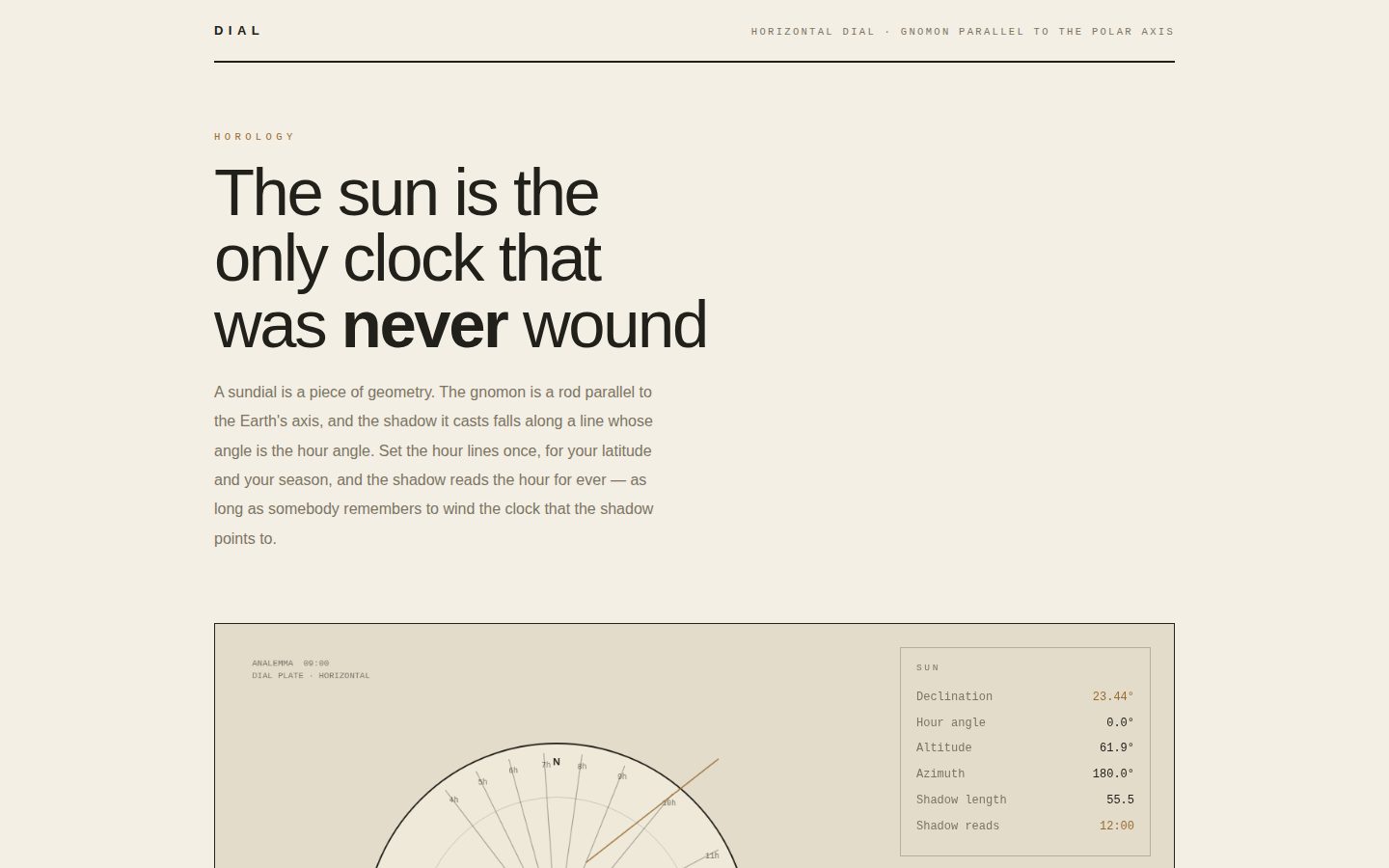
A sundial that actually works, computed from spherical astronomy rather than drawn. The declination comes from the Sun's ecliptic longitude, the shadow is laid along the anti-solar azimuth with its length set by the tangent of the altitude, and the hour lines are each solved individually — which is why they bunch towards noon and spread towards the horizon instead of sitting in tidy thirty-degree sectors. The analemma is traced from the same equations at a fixed nine o'clock.

Open ↗
ROSE — a window of stone and light screenshot
082

ROSE — a window of stone and light

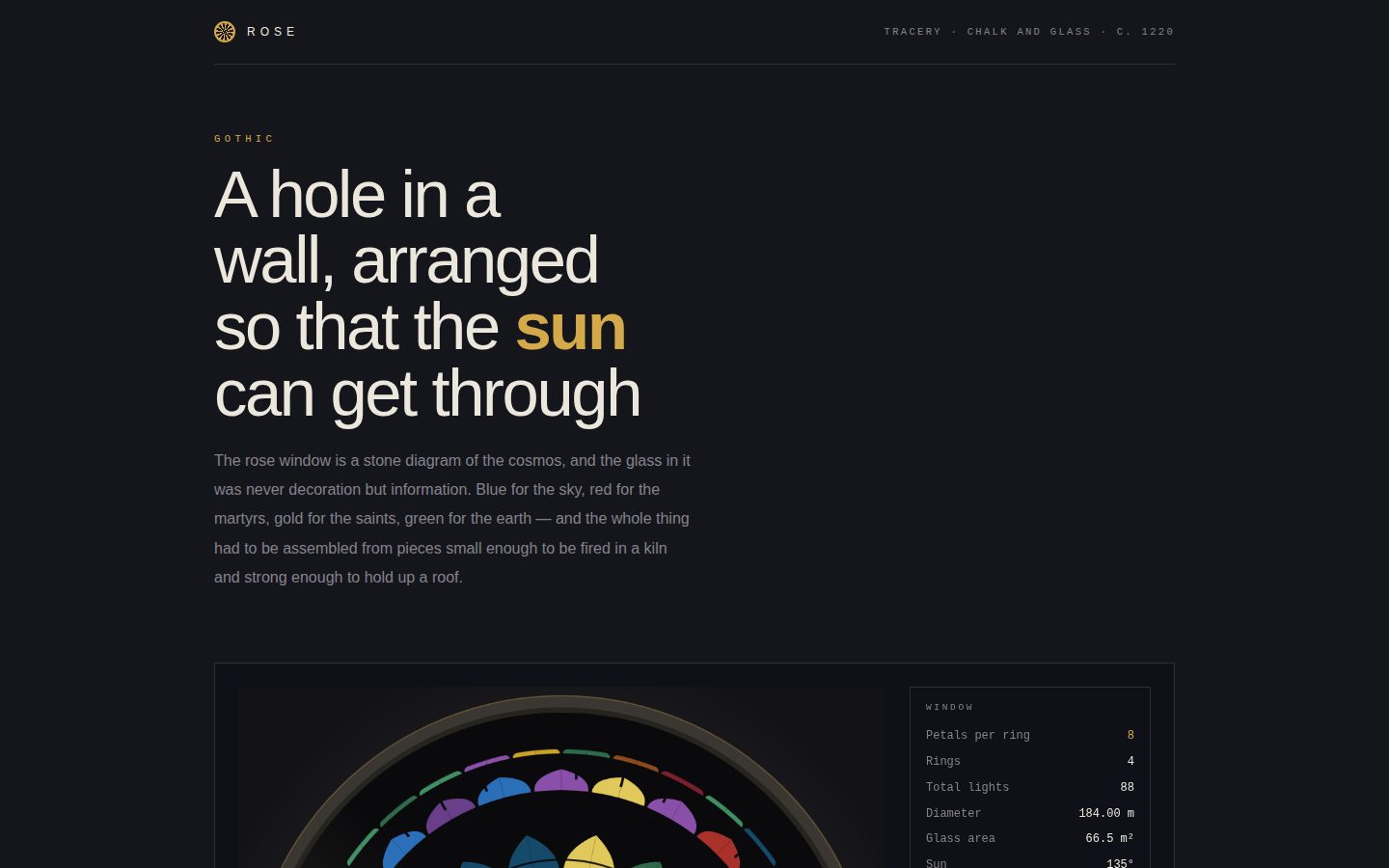
A rose window, cut and glazed on the fly. The petals are real lancets — an arc along the base and two quadratics meeting at a point — hung in concentric rings with dark leading between them, and every light is clickable so you can re-glaze it. The lights and petals controls rebuild the whole tracery, the sun angle sweeps a highlight across the glass, and New glass re-seeds every colour from the fourteen-colour medieval palette.

Open ↗
PRECESSION — the heavy top screenshot
083

PRECESSION — the heavy top

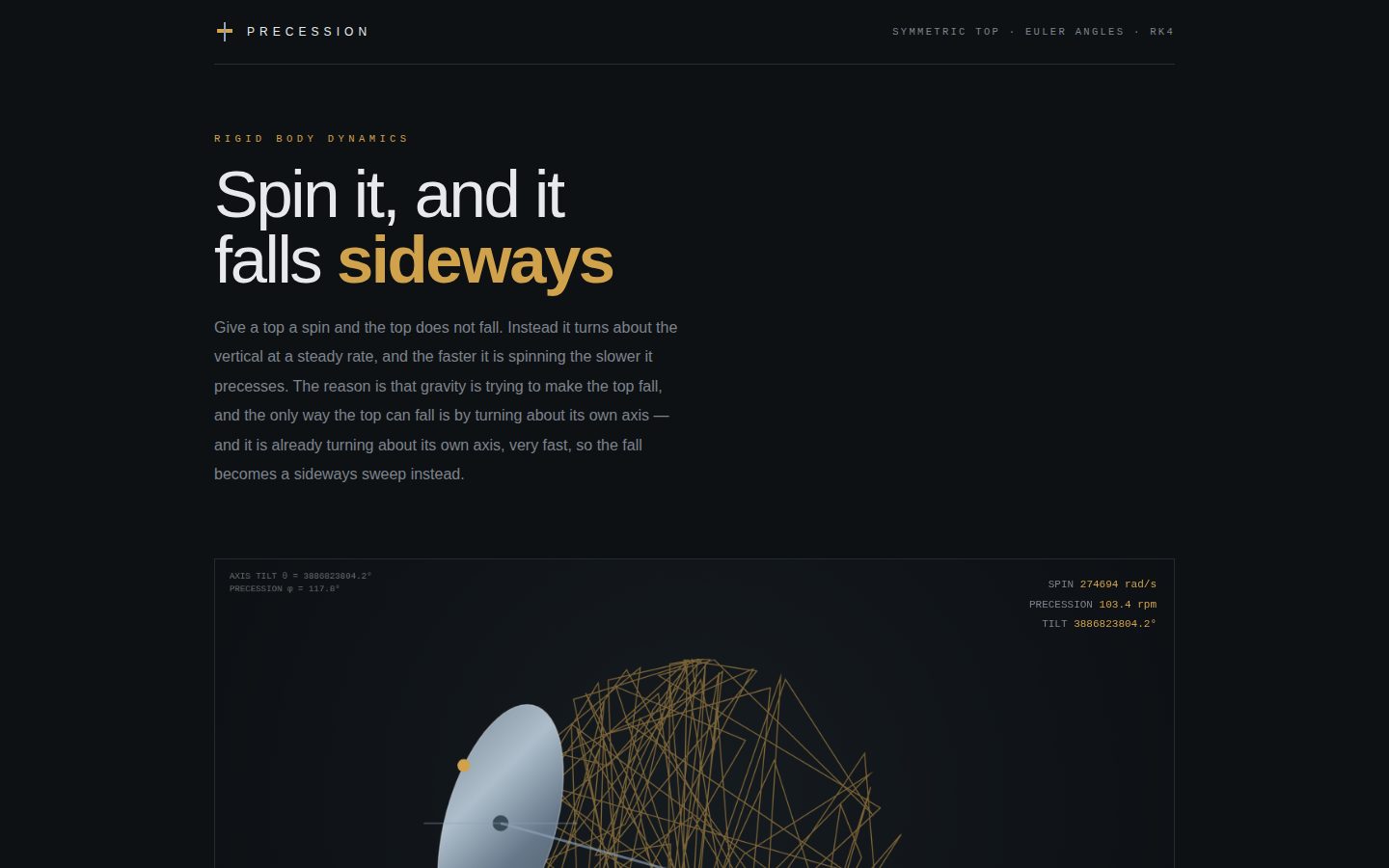
A heavy symmetric top, integrated properly. The precession rate comes out of the closed-form solution for a top with two conserved momenta, so the famous result falls out of the mathematics rather than being asserted: the faster you spin it, the slower it precesses. The disc is drawn in weak perspective from its true orientation, with the brass marker riding round it at the spin rate and the trace of the axis tip sweeping a circle behind.

Open ↗
ARMORY — a maker of arms screenshot
084

ARMORY — a maker of arms

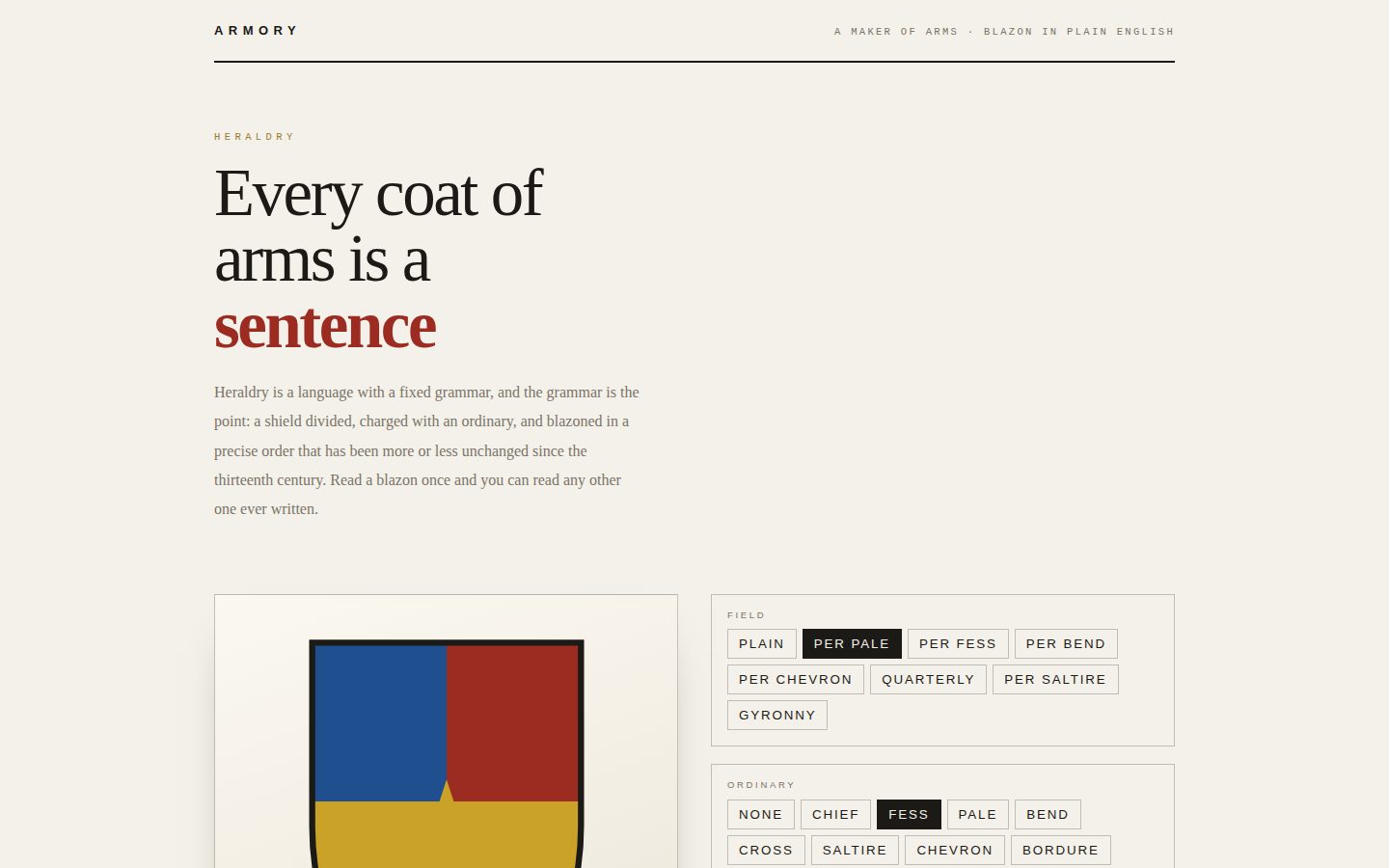
A heraldic workshop. Pick a division, an ordinary and a charge, and the shield redraws and the blazon is written out in the correct order — field, then ordinary, then charge — with the tinctures named in English. The notes line underneath reports which of the colours you have used are metals and flags a metal-on-metal conflict, because that is the one rule the system really cares about.

Open ↗
LOOM — a draft for a cloth screenshot
085

LOOM — a draft for a cloth

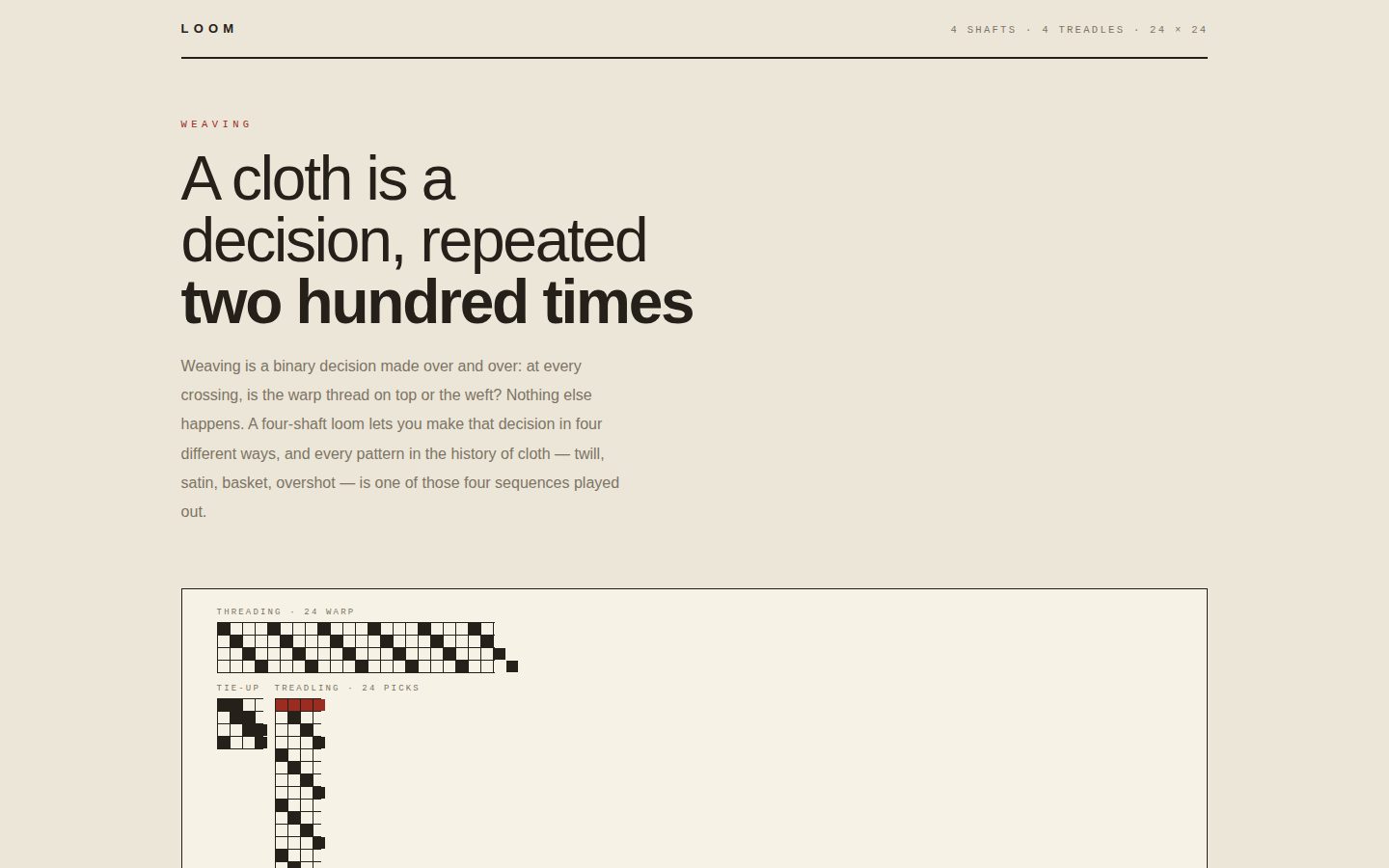
A working four-shaft loom. The cloth on the canvas is the true product of three grids: the threading says which shaft each warp thread is on, the tie-up says which shafts each treadle lifts, the treadling says which treadle is pressed for each pick, and at every crossing the code works out whether the warp or the weft is on top. Change any one of the three and the whole cloth changes — which is exactly why a weaver's draft is the design and the cloth is only the consequence.

Open ↗
ECHO — a room that answers screenshot
086

ECHO — a room that answers

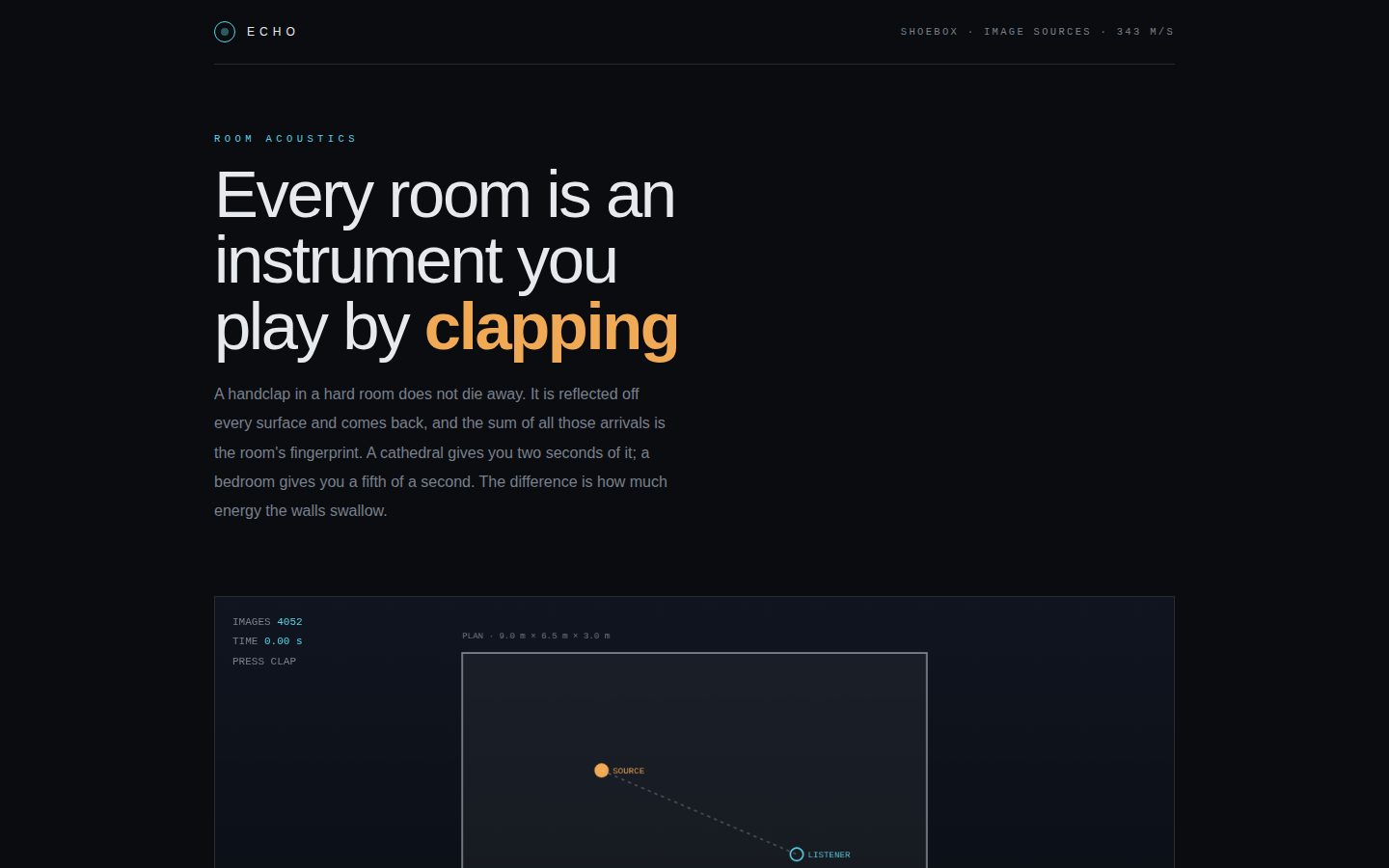
A room you can hear. The impulse response is built with the image-source method in three dimensions — every mirrored copy of the source across the six walls is placed, its distance gives the delay and its amplitude the reflection coefficient raised to the number of bounces — and that array is loaded into a convolver, so the clap you hear is genuinely the room you have built. The plan view draws the same wavefronts expanding and reflecting, from the same list of images.

Open ↗
FERROUS — the shape of a magnet screenshot
087

FERROUS — the shape of a magnet

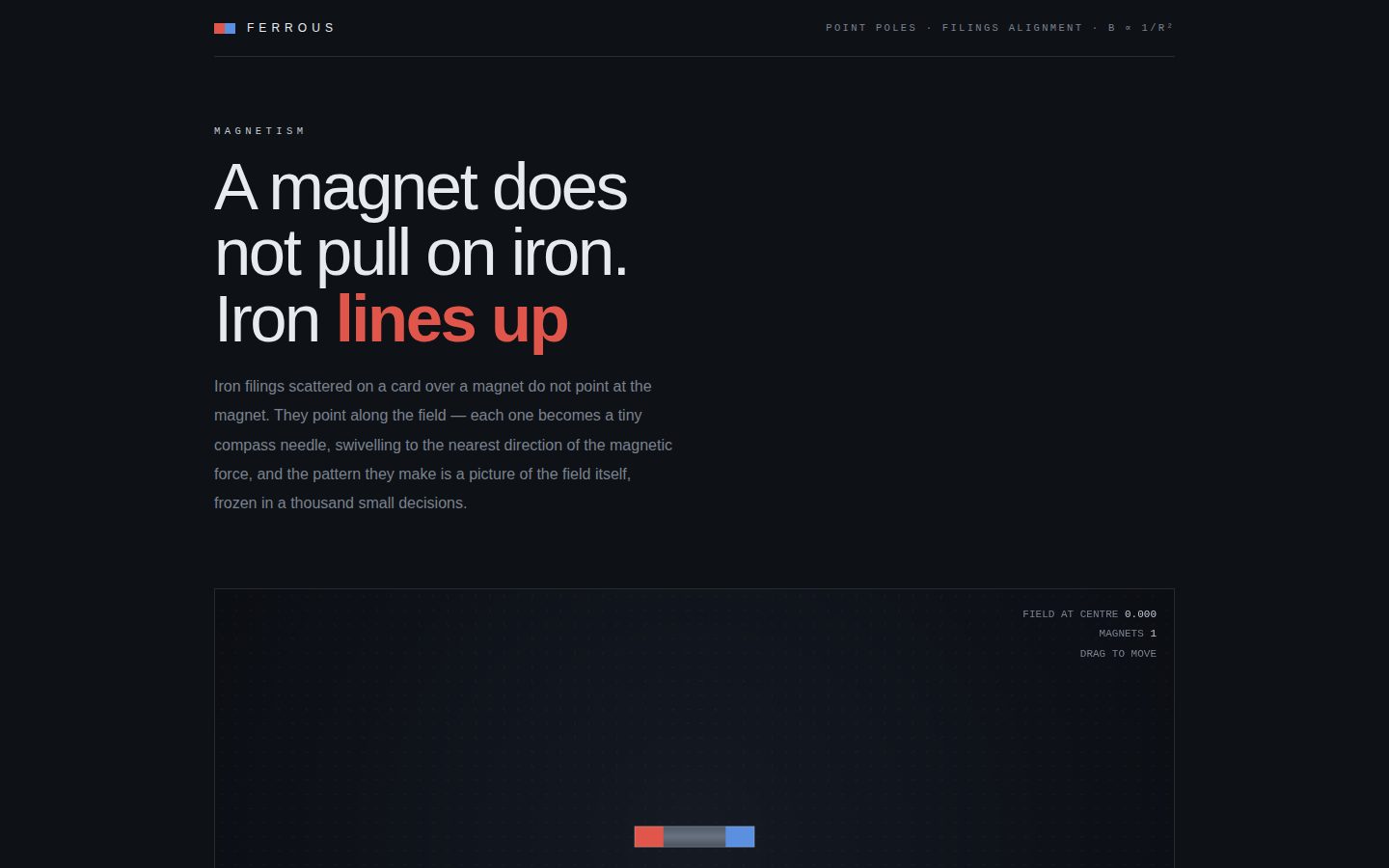
Iron filings, computed rather than photographed. Every filing on the page is a short line drawn in the local direction of the magnetic field, with its opacity set by the strength of the field — which is exactly what a real filing is, since each one is a tiny compass needle that swivels to align. The field itself is the sum of inverse-square contributions from point poles at the ends of each bar magnet, so the shape of the pattern is the shape of the real field, and the bare wedge between two like poles is genuine.

Open ↗
PHYLLOTAXIS — one angle, two hundred and thirty-three screenshot
088

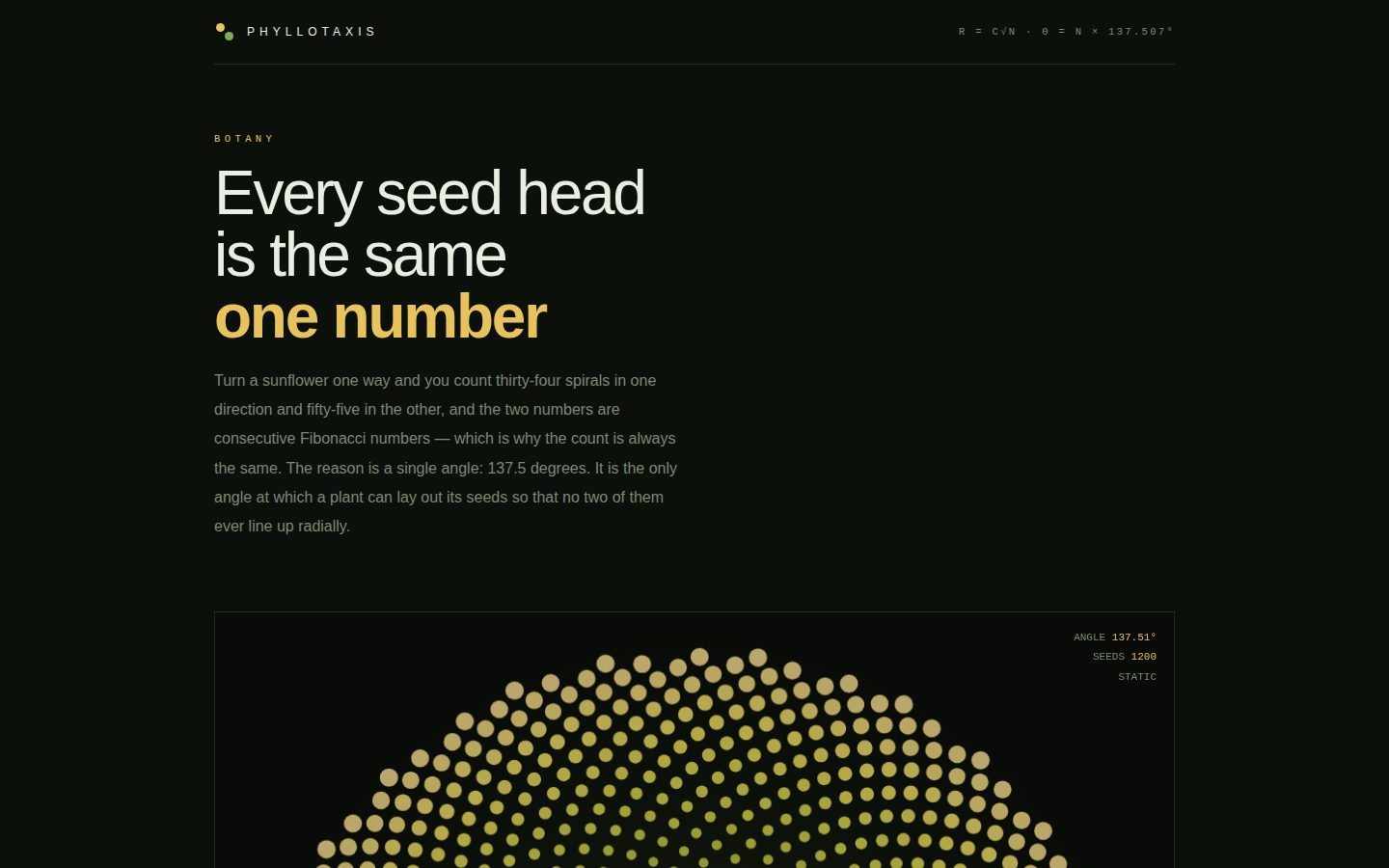
PHYLLOTAXIS — one angle, two hundred and thirty-three

A seed head generated by the real construction: the nth seed at a radius of c√n and an angle of n times the divergence angle. Drag the angle away from 137.5 degrees and the head develops scars — at 90 degrees it collapses into a square grid, at 120 degrees into three rigid spokes — and the Fibonacci overlay draws the individual spiral families that you can count in a real sunflower.

Open ↗
LATHER — the colour of a thin film screenshot
089

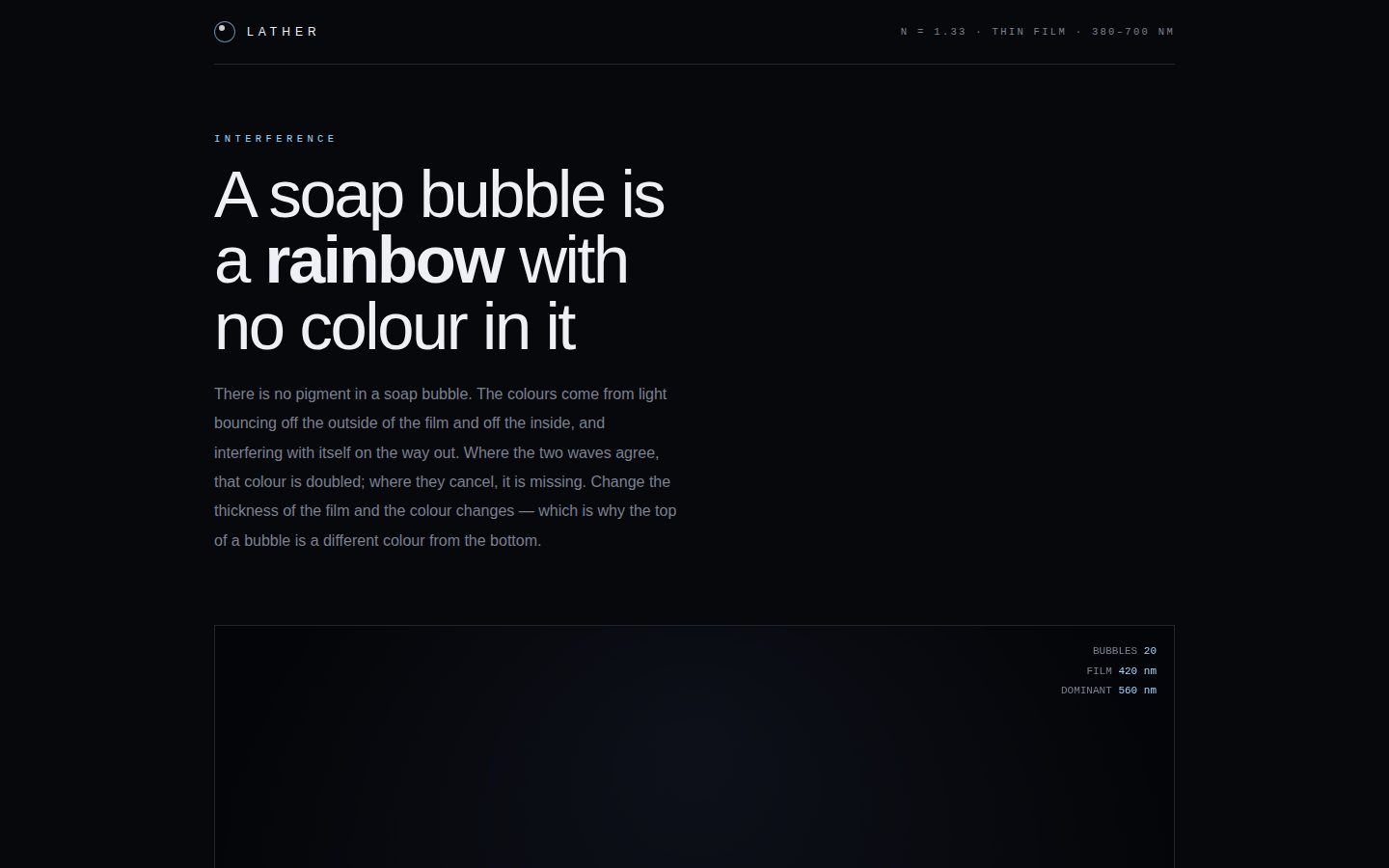
LATHER — the colour of a thin film

A soap bubble, with the colour computed from the optics rather than picked from a palette. The film is thin at the top and thick at the bottom, and because a thin film reflects some wavelengths and not others, the two regions show completely different colours — so each bubble is drawn as a stack of bands, each coloured by the interference calculation for the thickness at that height. Change the film thickness and every bubble on the page changes colour at once.

Open ↗
RIPPLE — a tank of interference screenshot
090

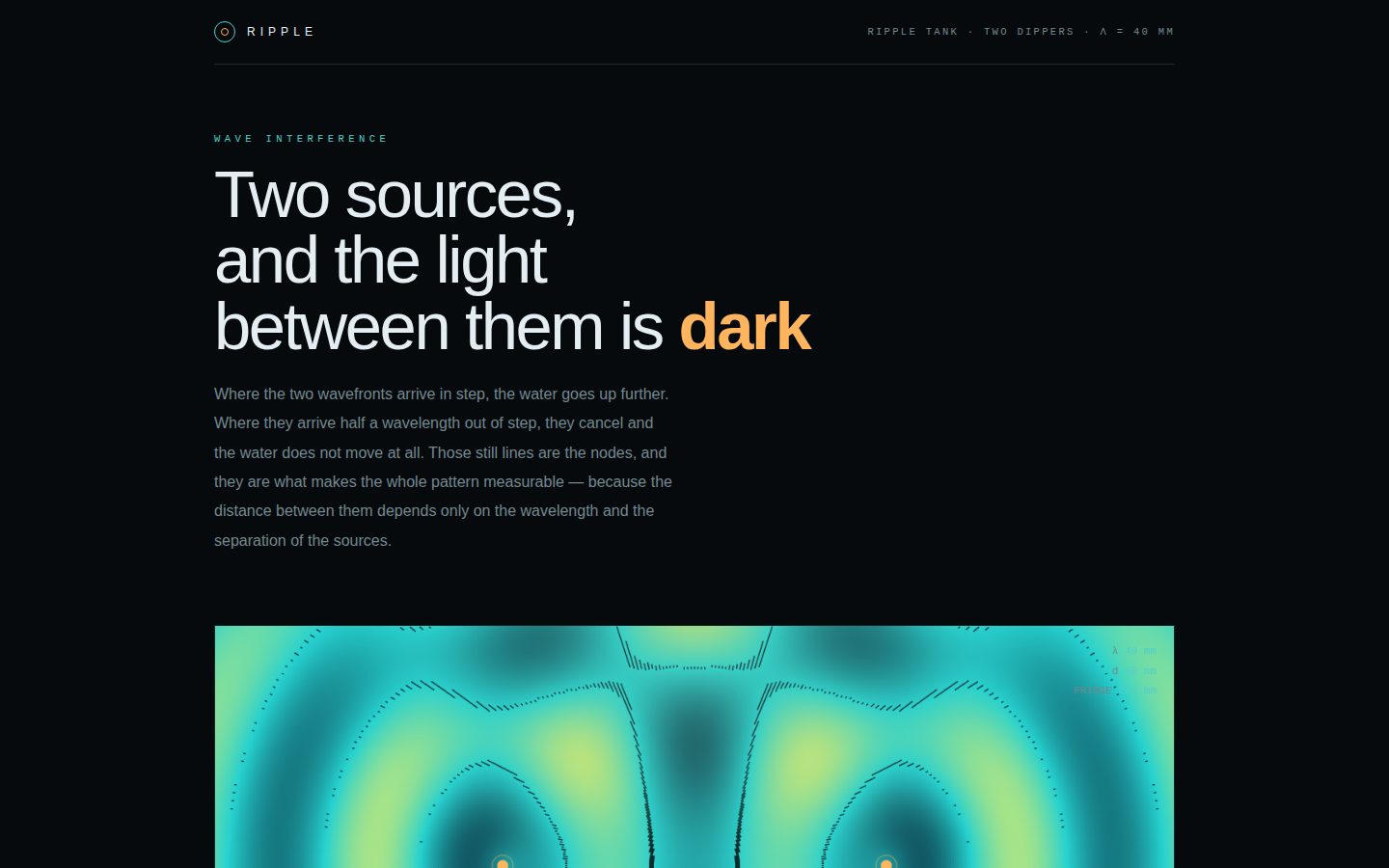
RIPPLE — a tank of interference

A ripple tank, solved pixel by pixel. Two dippers on the surface send out circular waves, and the height of the water at every point is the sum of the two, so the antinodal lines appear as a fan of bright ridges and the nodal lines as dark spokes. The fringe spacing is computed from the real relation, and the count of fringes across the tank comes out of the solution rather than being drawn on. Take one dipper away and the whole interference pattern collapses into ordinary rings.

Open ↗
TURING — a machine on a tape screenshot
091

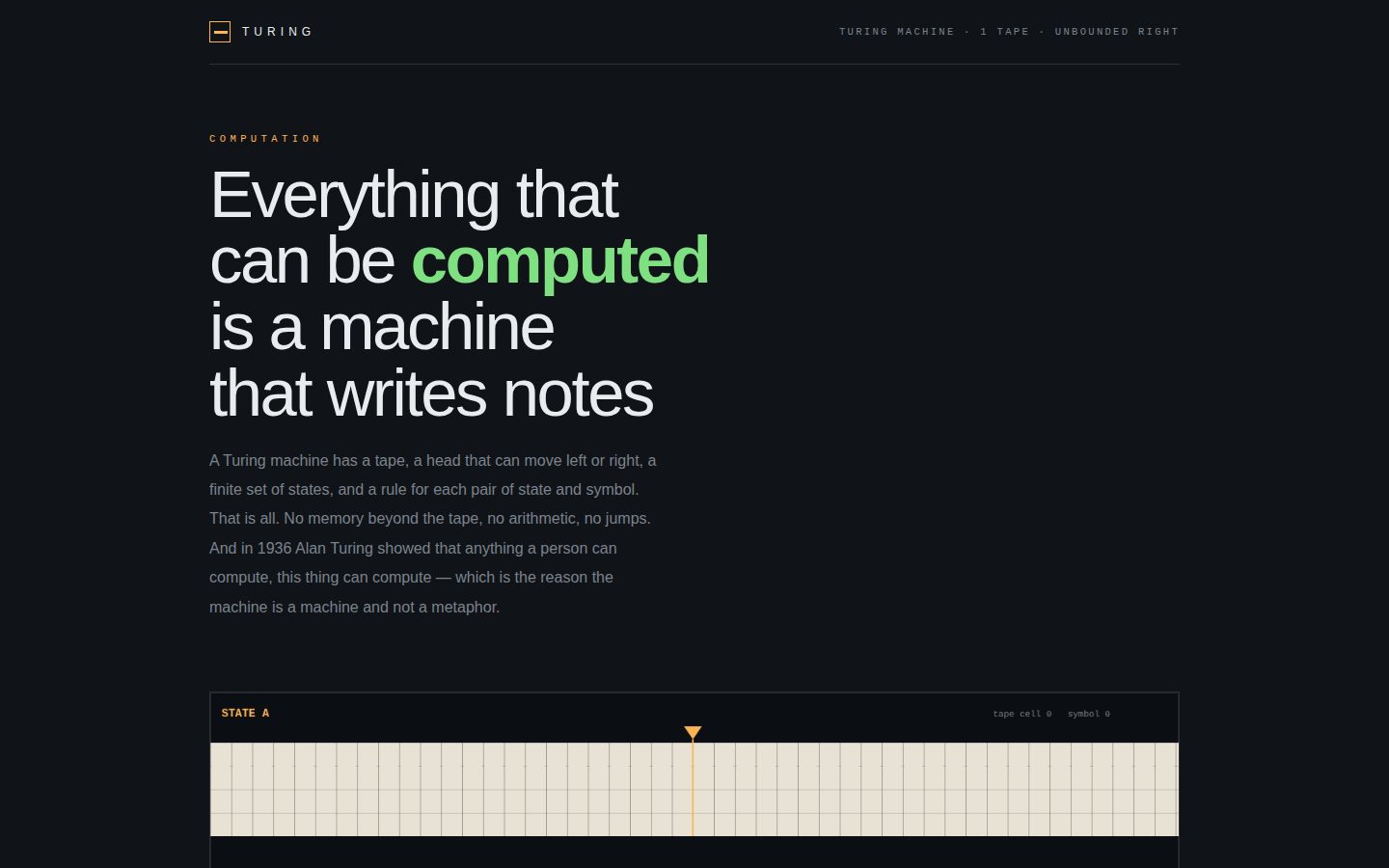
TURING — a machine on a tape

A Turing machine that actually runs: a sparse tape, so it is genuinely unbounded, a head that moves left and right, a state, and a rule table you can edit. Step through it a transition at a time and watch a row of ones appear; run one of the three preset machines and watch the stripes, the counter or the halt. The table is live, so you can change the machine and see a different machine.

Open ↗
HOURGLASS — sand, and the patience to watch it screenshot
092

HOURGLASS — sand, and the patience to watch it

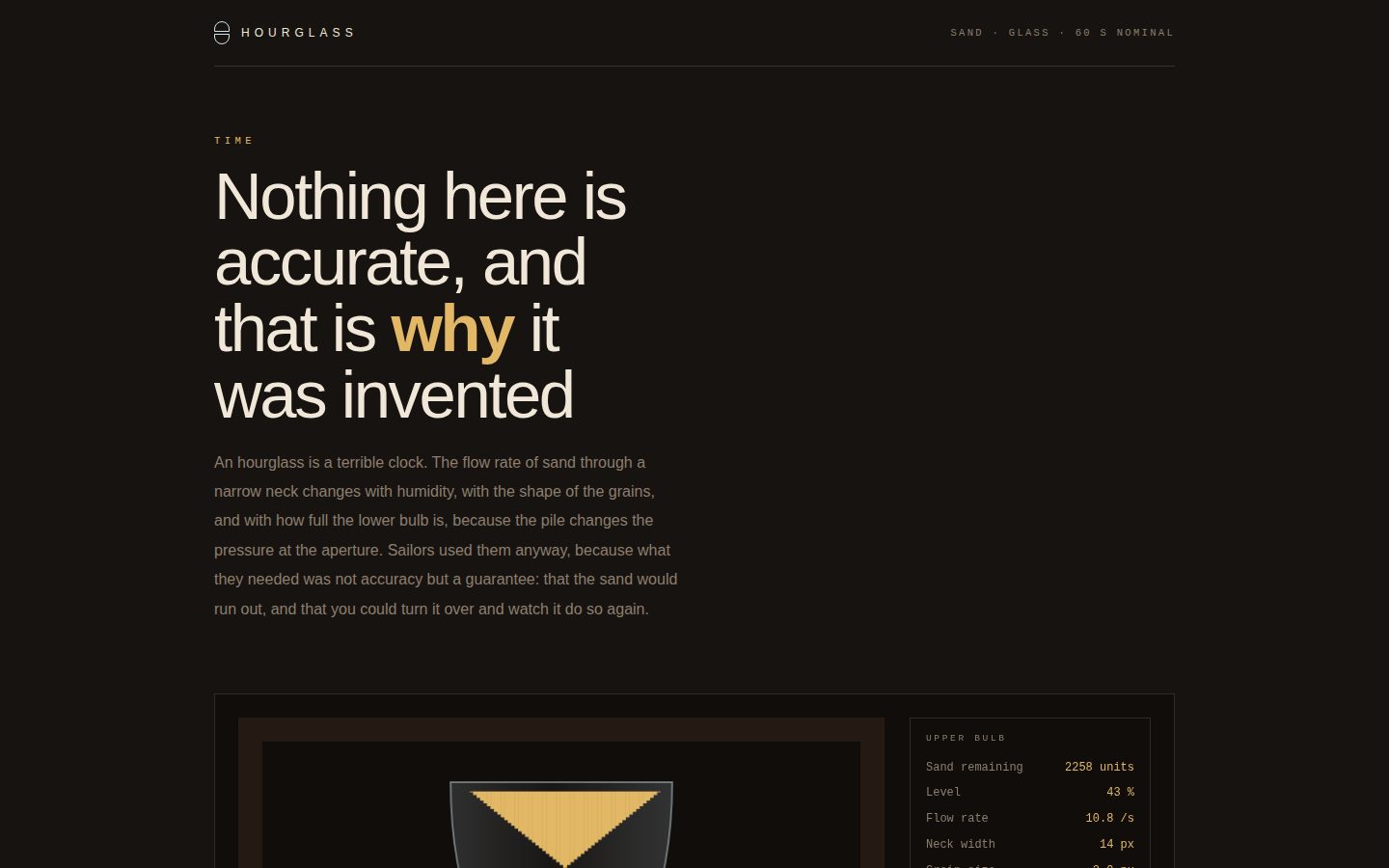
An hourglass, with the heap simulated properly. The sand in the lower bulb is a height field of sixty-four columns that relaxes after every grain according to the angle of repose, so the pile is a cone with a flat top rather than a bump, and it grows by eating its own sides. The flow rate is proportional to the square of the neck width, so a wider neck really does empty faster, and turning the glass over mirrors the heap into the top — which is a lovely little inaccuracy every hourglass has always had.

Open ↗
TERRA — a world of noise screenshot
093

TERRA — a world of noise

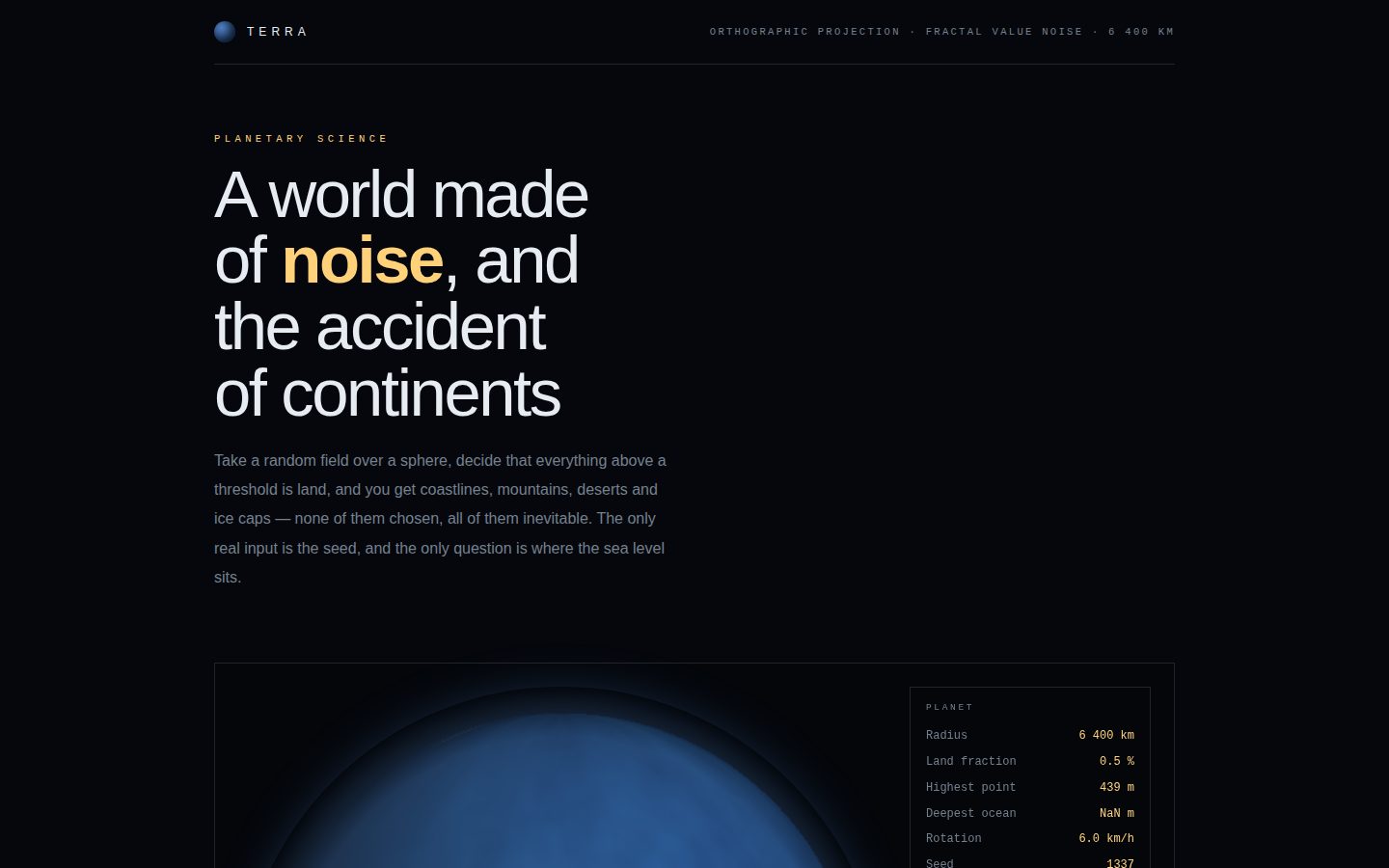
A planet made of nothing but noise and a threshold. Four octaves of value noise decide where the continents are and a fifth decides what kind of place each one is, and the coastlines are simply wherever the height field crosses the sea level — so moving the sea level slider drowns the lowlands and raises new islands. The projection is orthographic, so the far side is never drawn and the limb is a true circle, and the terminator moves as a real great circle when you turn the sun.

Open ↗
LATTICE — the packing of atoms screenshot
094

LATTICE — the packing of atoms

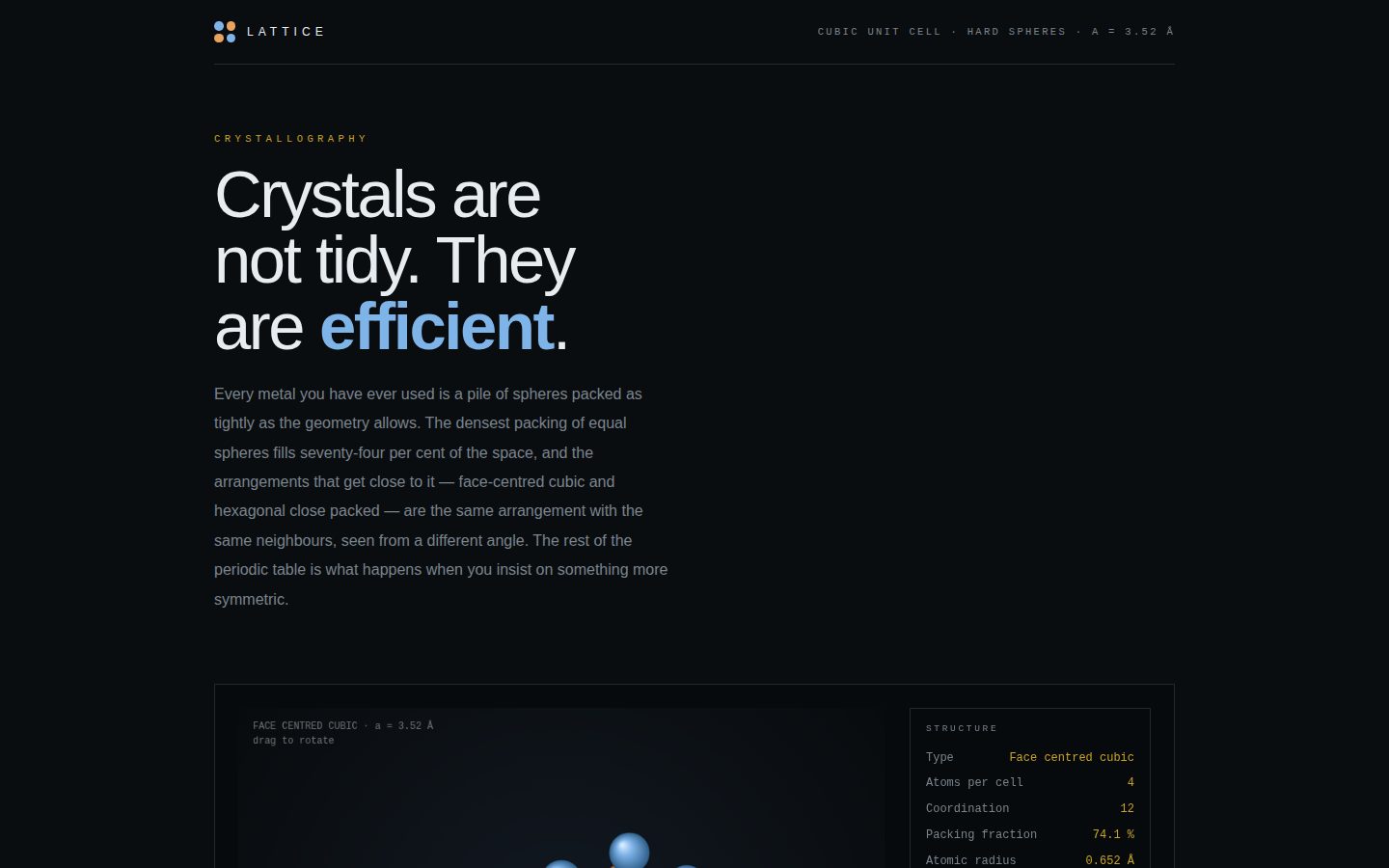
The packing of atoms, drawn as real unit cells and rotated under the pointer. Switch between simple cubic, body centred, face centred, hexagonal close packed and diamond, and watch the coordination number and the packing fraction change with the geometry — because they are not decoration on the picture, they are consequences of where the spheres sit.

Open ↗
AUTOMATA — one hundred cells and a rule screenshot
095

AUTOMATA — one hundred cells and a rule

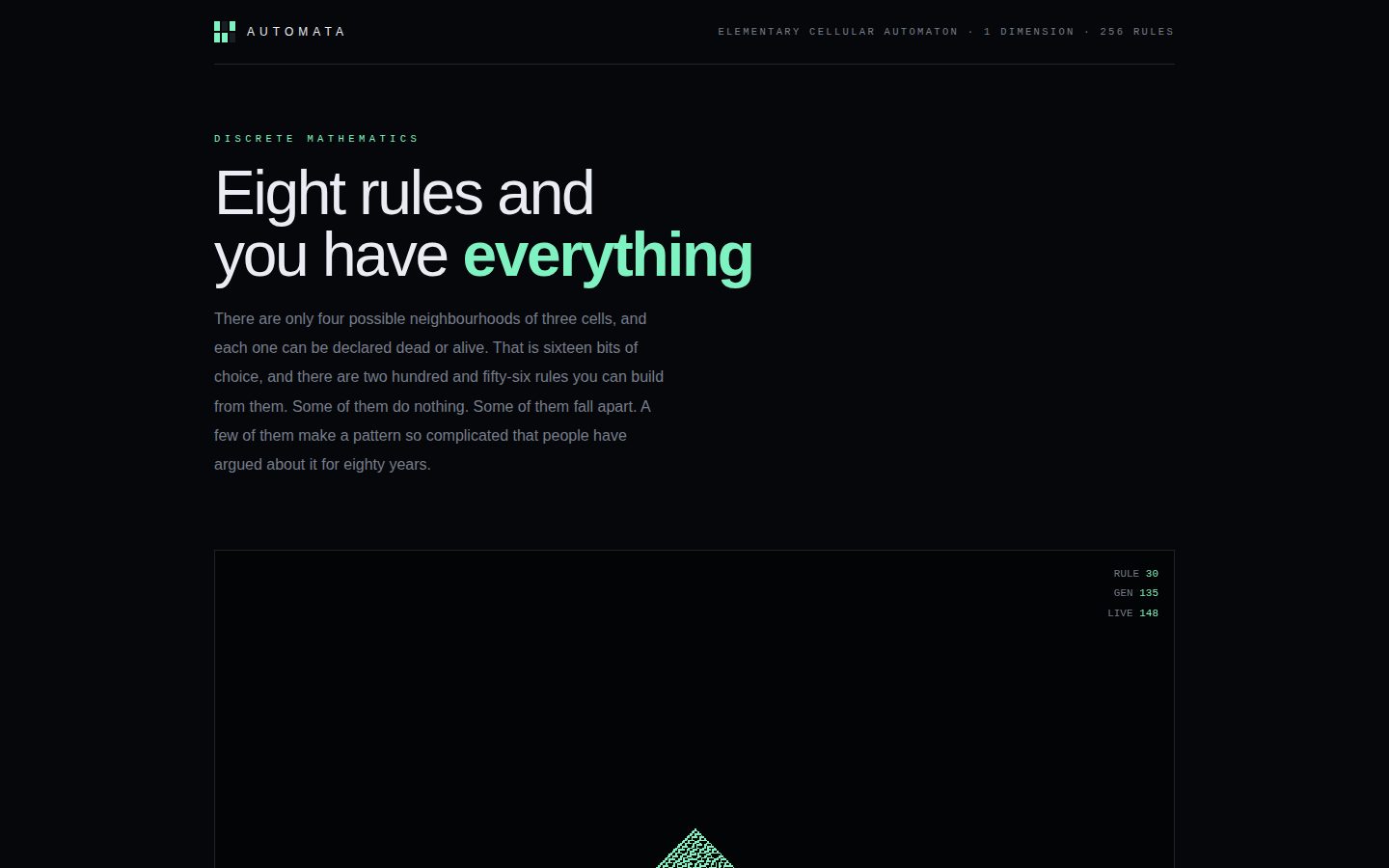
A one-dimensional cellular automaton, running for real: the rule's eight binary digits are looked up by neighbourhood index, so rule 30 gives the chaotic triangle and rule 90 gives the Sierpinski gasket, drawn as a space-time diagram with each generation a new row. Sweep the rule slider through all two hundred and fifty-six and watch the whole taxonomy of behaviour go past.

Open ↗
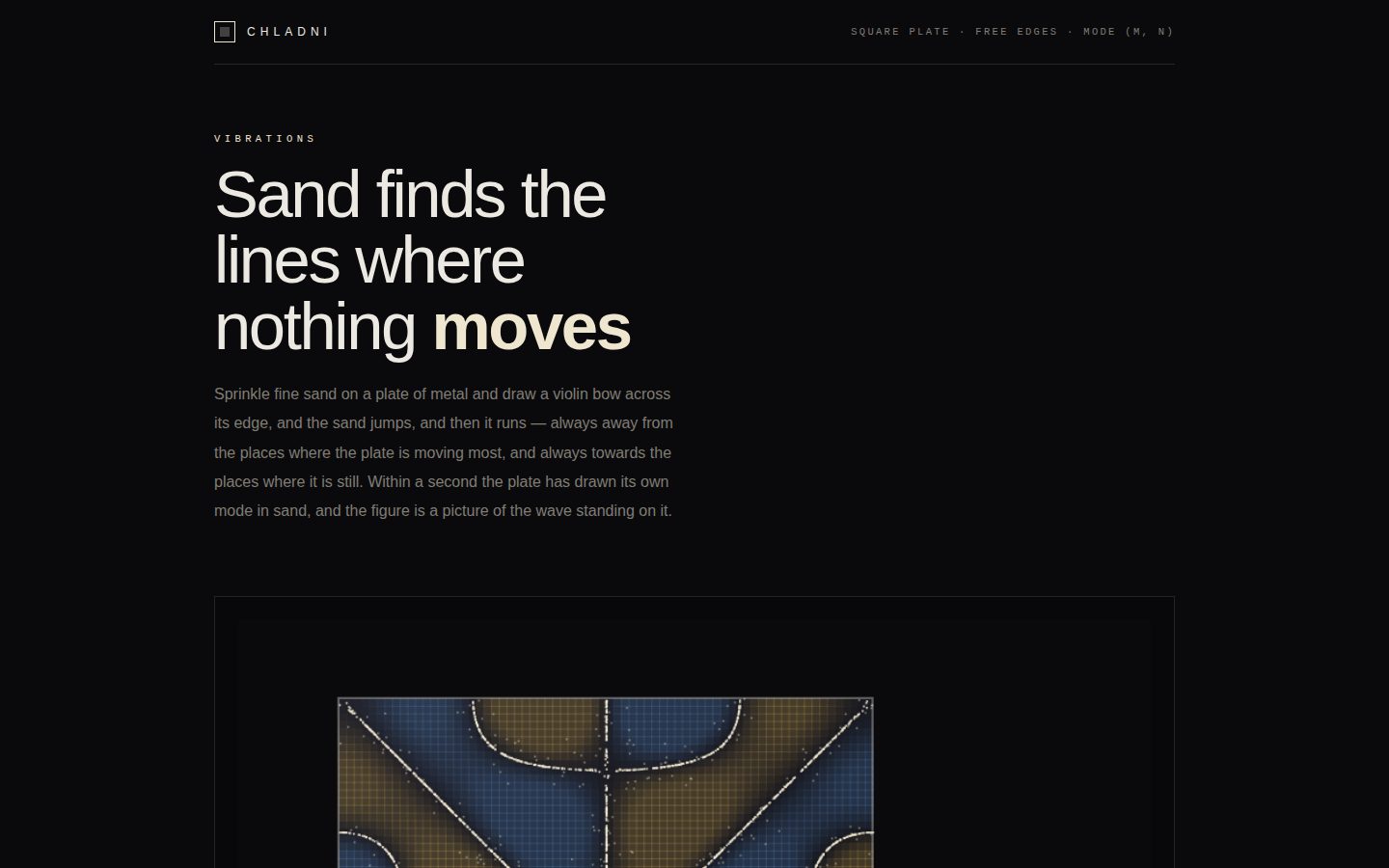
CHLADNI — the figures in sand screenshot
096

CHLADNI — the figures in sand

Chladni figures made the way they are actually made: by sand. Every grain walks downhill on the gradient of the square of the plate's displacement, so it ends up exactly where the plate is still — and because the mode is the difference of two products of cosines, the figure that emerges has the right number of node lines and the right symmetry. Change the mode and the sand redraws the plate's own picture of itself.

Open ↗
GLIDER — the arithmetic of staying up screenshot
097

GLIDER — the arithmetic of staying up

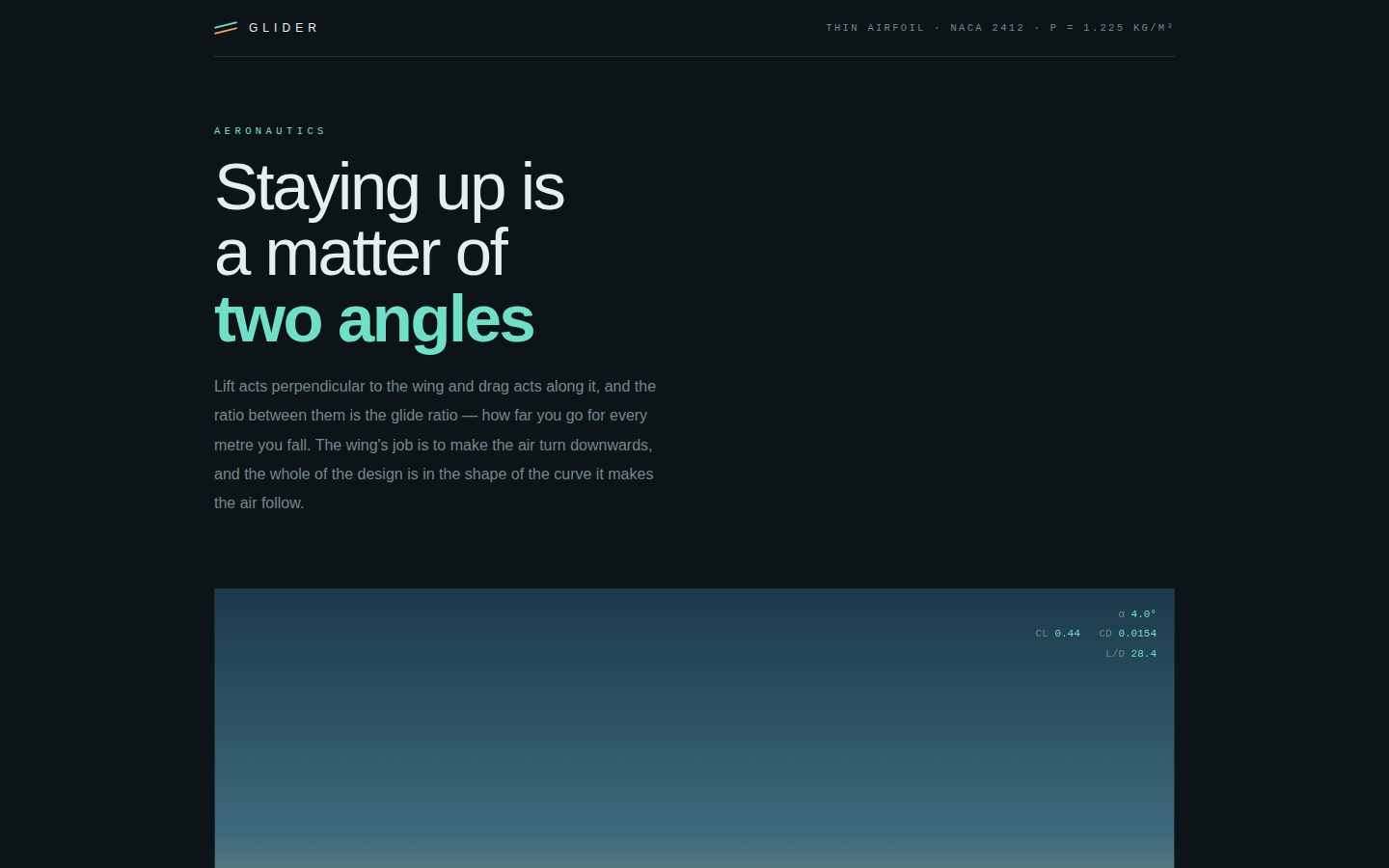
A glider, with the arithmetic done properly: thin-airfoil lift, parasite plus induced drag, and the speed that follows from the force balance. Sweep the angle of attack past sixteen degrees and the lift collapses while the drag climbs, the glide ratio falls apart, and the sink rate goes through the roof — which is what a stall is.

Open ↗
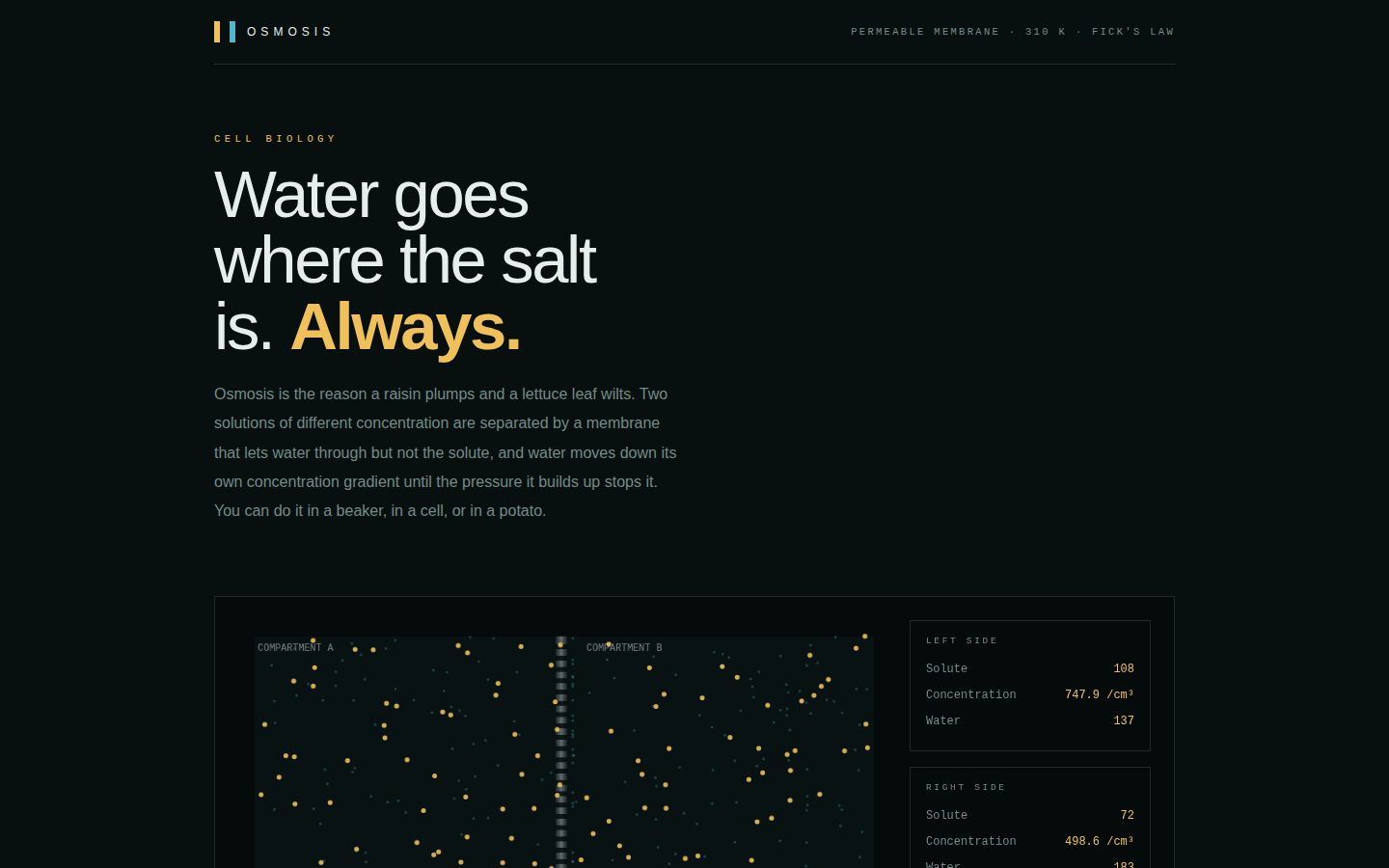
OSMOSIS — a membrane and its argument screenshot
098

OSMOSIS — a membrane and its argument

Two compartments, one membrane, and the two rules that govern them. The solute is stopped dead if it is too big for the pores and the water is not, so the water keeps moving towards the concentrated side and the osmotic pressure builds until it balances. Open the pores up and the whole argument collapses into ordinary diffusion.
Open ↗
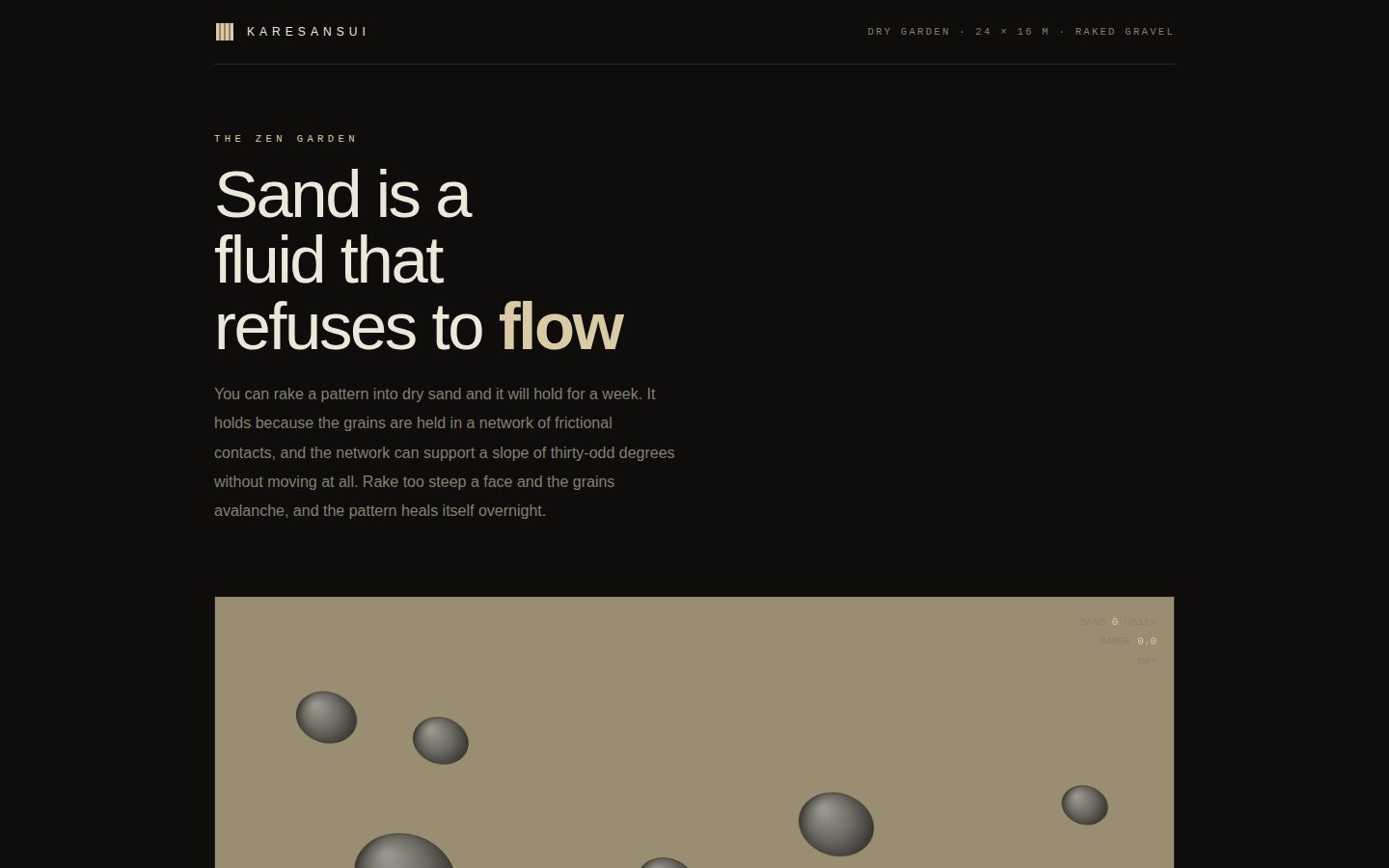
KARESANSUI — a garden of raked sand screenshot
099

KARESANSUI — a garden of raked sand

A dry garden you can actually rake. The sand is a height field with an angle of repose, so a steep cut avalanches and fills itself in while a shallow one keeps its edge — and dragging the rake lowers a line and pushes the displaced sand out to either side, which is what the teeth of a real rake do. Sweep the garden and the pattern comes out around every stone.
Open ↗
BEACON — the light that keeps a coast honest screenshot
100

BEACON — the light that keeps a coast honest

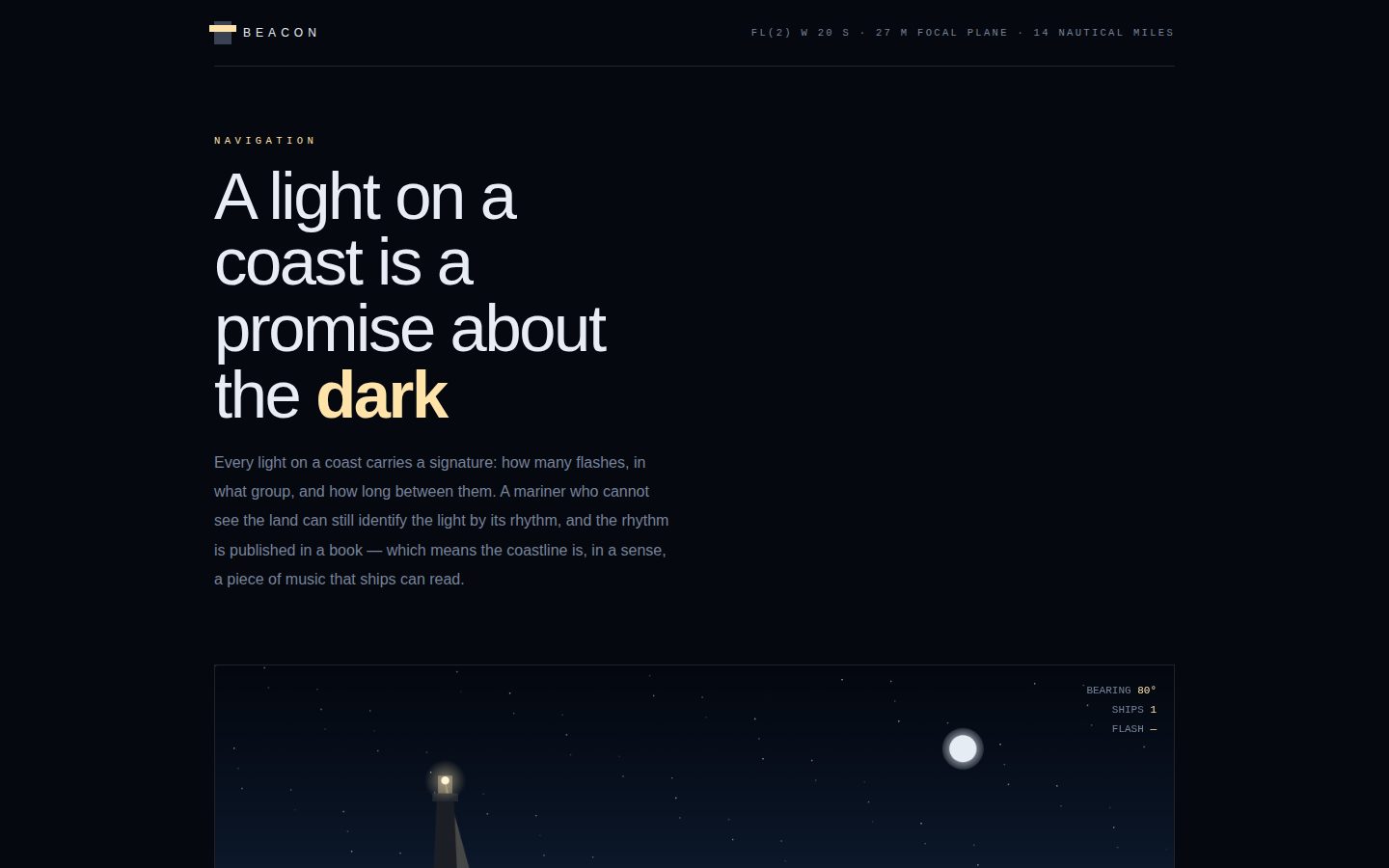
A lighthouse doing the only thing a lighthouse does: turning, and being read. The beam sweeps the horizon, and a ship is lit when the bearing to the ship falls inside the wedge — which is the whole mechanism by which a mariner identifies a light in the dark. Turn the fog up and the cone thickens and shortens at once, and the character of the light changes with the rotation rate, because a light's signature is its rhythm.

Open ↗