Collection · 100 studies

Claude Sonnet 5.5 100 HTML Files

One hundred self-contained visual studies — generative art, physics, typography, interfaces and scenes — generated with Claude Sonnet 5.5. Open any piece in a new tab, or expand a card to read the original generation prompt.

100 studies
001
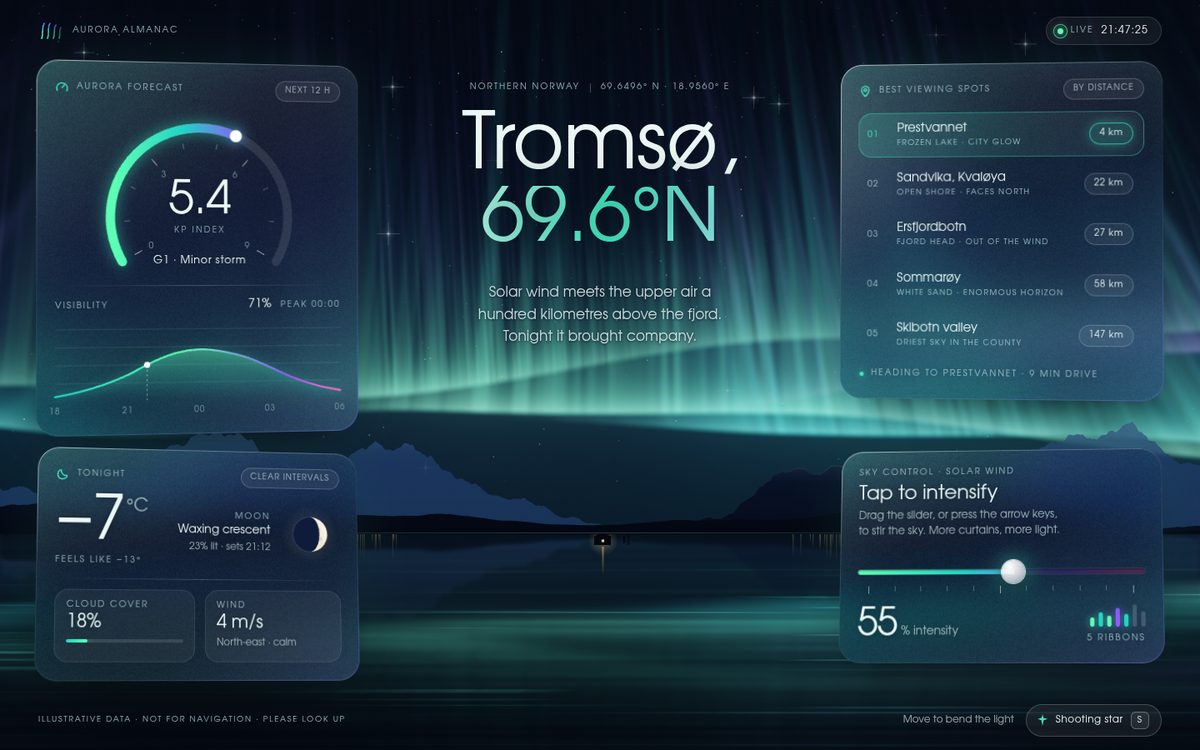
A single-screen travel-and-weather dashboard for Tromsø floating on frosted glass above a living northern-lights sky. Behind everything, a WebGL fragment shader paints up to seven sinuous aurora curtains (green, teal, violet and a rare rose) with a razor-bright lower edge, fine field-aligned rays and soft under-glow, over a polar-night gradient from #040914 to #0b1633. A 2D canvas adds a twinkling star field with a faint Milky Way, jagged midpoint-displacement mountain ridges with snow caps and green rim light, a scatter of town lights on the far shore, and a lone lit ice-fishing cabin with a stargazer and tripod. The frozen lake below mirrors the aurora and the mountains, blurred and rippled, with glinting ice streaks. On desktop, four glass cards flank an open central view of the sky and the huge light-weight title "Tromsø, 69.6°N": an Aurora forecast card (Kp arc gauge with a gradient stroke and glowing thumb, plus a 12-hour visibility sparkline with a hover read-out), a Tonight card (−7 °C, 18% cloud cover, a drawn waxing-crescent moon at 23% lit), a Best viewing spots list with distance chips, and a "Tap to intensify" slider card. On tablets and phones the cards stack over the fixed sky. Card borders, glows and highlights are tinted live by the colours currently dominating the aurora. Type is a light geometric sans with tabular numerals and +0.18em uppercase micro-labels. The tone is calm, cold, patient and a little wondrous.
Open
Original prompt
Design a glassmorphism weather-and-travel experience called "Tromsø, 69.6°N" set over a living aurora borealis. Background: a full-screen aurora rendered as layered, slowly undulating curtains (canvas 2D or WebGL) — vertical luminous ribbons of green (#5dffb4), teal (#22d3c5), violet (#8b5cf6) and a rare rose (#ff6fb5) over a deep polar night (#040914 to #0b1633), with a fine star field, a faint snowy ridge silhouette and a soft reflection in a frozen lake at the bottom. Foreground: 3–4 frosted-glass cards (backdrop-filter blur(24px) saturate(160%), 1px translucent white borders with a gradient highlight, soft inner glow): an "Aurora forecast" card with a KP-index arc gauge and a 12-hour visibility sparkline; a "Tonight" card with temperature, cloud cover and moon phase; a "Best viewing spots" list with distance chips; and a "Tap to intensify" slider that raises aurora intensity. Type: light-weight geometric sans (Avenir Next / Century Gothic stack) with tabular numerals and uppercase micro-labels tracked +0.18em. Interaction: the pointer bends and brightens the curtains where it moves; cards tilt subtly in 3D toward the pointer (max 6°) with a specular sheen following the cursor; the slider (keyboard accessible) changes intensity and the number of ribbons; entrance choreography staggers the cards rising from below. Details: a tiny pulsing "live" dot, card highlights tinted by the current aurora colours, and pressing the S key launches a shooting star. TECHNICAL REQUIREMENTS: Deliver one completely self-contained, standalone HTML5 file with all CSS inline in a <style> tag and all JavaScript inline in a <script> tag. No external dependencies of any kind: no CDN, no external fonts (system font stacks only), no external images, no external SVG files, no libraries, no network requests. It must work by simply opening the file in a browser, fully offline. It must be responsive from 360px phones to large desktops, validate as standard HTML5, respect prefers-reduced-motion, support mouse and touch input, and run without console errors. Hand-craft it as a premium, award-worthy piece of digital art with real, evocative copy (no lorem ipsum), a disciplined palette, careful typography, polished motion and delightful details.
001-aurora-glass.txt
002
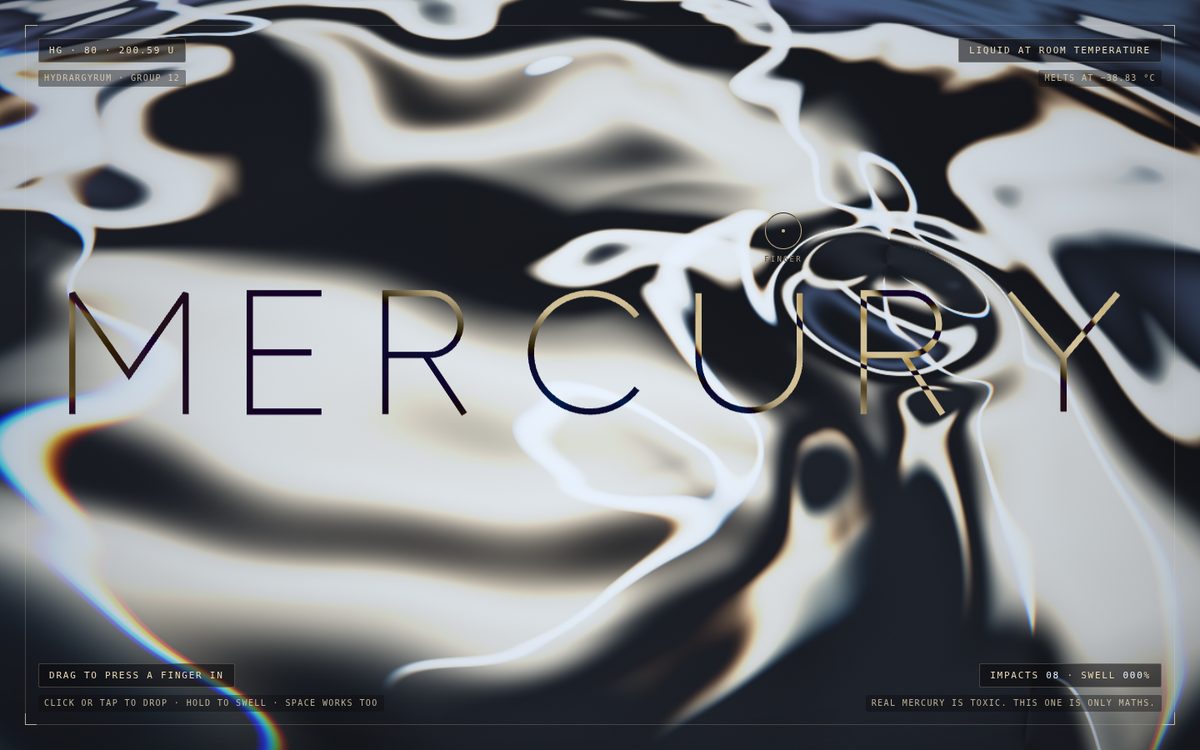
A full-screen pool of liquid mercury with one word floating over it. A WebGL fragment shader looks down at the metal from a pitched perspective camera and shades a slowly heaving surface built from a domain-warped, three-octave value-noise height field with analytic derivatives, a drifting broad swell, a heavy gaussian finger dent with a raised meniscus, and up to eight expanding ring-wave impacts. The normals reflect a procedurally generated photo studio (a long warm strip light, an overhead soft-box, a vertical tube light, a cold blue rim strip, a cold horizon gradient and a gunmetal dome) through Fresnel, edge-growing chromatic aberration and a faint oil-slick film of #7df9ff, #ff7ad9 and #ffe27a that appears only where the metal turns away. The result is graded into the palette: gunmetal shadows, silver mid-tones, ice highlights. Over it hangs the single huge word MERCURY, drawn as wide-tracked, thin monoline SVG capitals in champagne #e8d9b5 with mix-blend-mode: difference, so it turns to inked midnight over blazing highlights and glows champagne over dark metal; each letter draws itself on after a first droplet lands. Tiny mono captions sit in the corners inside dark glass chips ("Hg · 80 · 200.59 u", "Liquid at room temperature", a live impact and swell readout), inside a hairline plate frame with champagne corner brackets. On portrait phones the word turns vertical like a book spine. Without WebGL, layered rotating conic-gradient chrome takes over. The mood is cold, heavy, exact and a little dangerous.
Open
Original prompt
Build a WebGL full-screen piece titled "MERCURY" — a pool of liquid chrome. A fragment shader shades a slowly heaving silver-mercury surface (domain-warped fbm height field with analytic normals, or a small raymarch) reflecting a procedurally generated studio environment (soft-box strips of warm white, a cold blue rim light, a horizon gradient), with fresnel, subtle chromatic aberration toward the edges and a whisper of iridescent oil-slick tint only at grazing angles (#7df9ff, #ff7ad9, #ffe27a). Palette: gunmetal #0a0b0d, silver #d9dde3, ice #eaf4ff, and one champagne accent #e8d9b5 for text. Typography: the single huge word MERCURY in a wide-tracked light grotesque set with mix-blend-mode: difference so it inverts over the highlights, plus tiny mono captions ("Hg · 80 · 200.59 u", "Liquid at room temperature"). Interaction: the pointer drops a heavy finger into the metal, creating gaussian dents and expanding ring waves (keep the last ~8 impacts as uniforms with position and start time); click/tap drops a droplet ripple; press-and-hold makes the whole surface swell. Idle: an invisible drifting finger keeps the surface alive. Fallback without WebGL: an animated CSS conic-gradient chrome. Render at ~0.75 resolution scale on high-DPR screens for speed. TECHNICAL REQUIREMENTS: Deliver one completely self-contained, standalone HTML5 file with all CSS inline in a <style> tag and all JavaScript inline in a <script> tag. No external dependencies of any kind: no CDN, no external fonts (system font stacks only), no external images, no external SVG files, no libraries, no network requests. It must work by simply opening the file in a browser, fully offline. It must be responsive from 360px phones to large desktops, validate as standard HTML5, respect prefers-reduced-motion, support mouse and touch input, and run without console errors. Hand-craft it as a premium, award-worthy piece of digital art with real, evocative copy (no lorem ipsum), a disciplined palette, careful typography, polished motion and delightful details.
002-liquid-chrome.txt
003
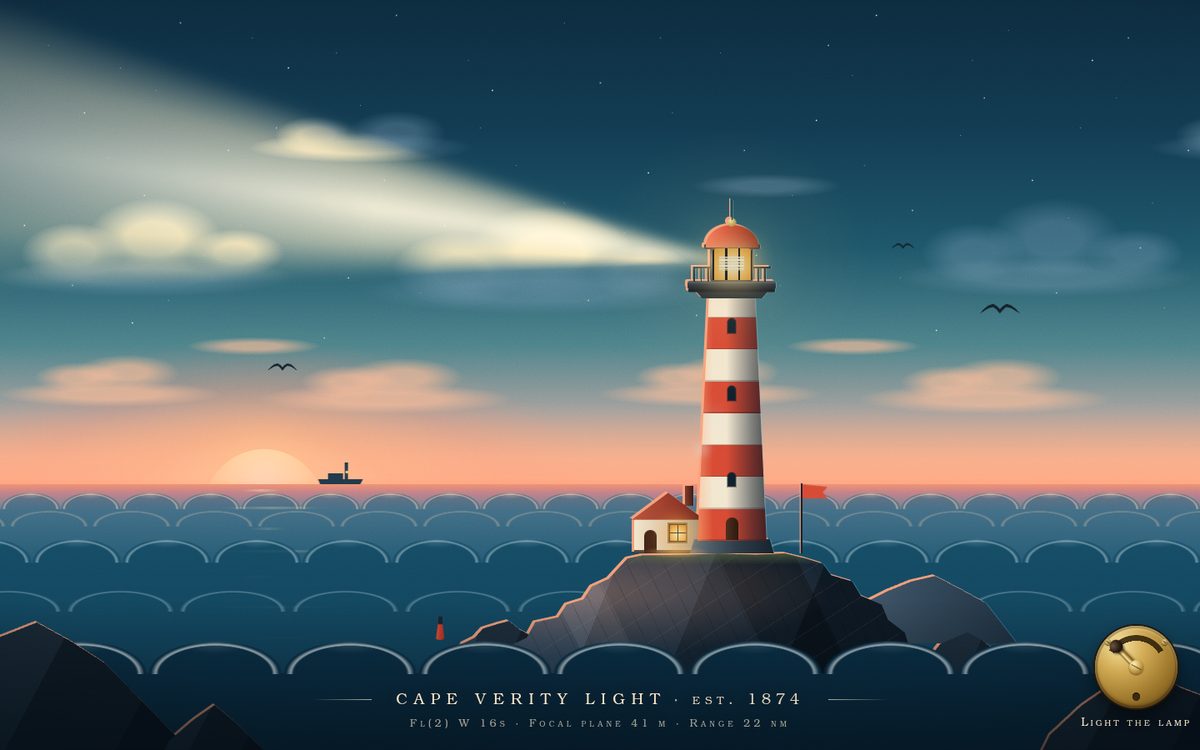
A dusk portrait of a fictional 1874 lighthouse, drawn entirely with divs, gradients, clip-path, masks, filters and box-shadows, with no script in the file. A deep-teal sky (#0d2b3e) melts through teal and dusty mauve into a coral-peach horizon (#ff9a76) where a low sun sliver and a distant ship sit. Above a craggy islet stands a cream-and-signal-red (#d64933) tapered tower with a gallery, railing, a glowing lantern room and a domed red roof; beside it a whitewashed keeper's cottage with a flickering window, a chimney that breathes smoke, and a fluttering red flag. A blurred conic-gradient beam sweeps across the sky once every eight seconds (Fl(2) W 16s, as the small caption says) and lights the drifting clouds it crosses, while a glare blooms in the lantern as the beam faces the viewer. Five rows of scalloped waves, cut by radial-gradient masks, slide at different speeds and directions with foam-lit crests; a buoy blinks, gulls glide with occasional flaps, and the rocks wear warm sun rim light on their left edges and cool sky light on their right. A brass lever at the corner lights the lamp: the sun sinks, the sky deepens to polar navy, a crescent moon and more stars appear, windows light up and the beam becomes blinding. The bottom caption reads CAPE VERITY LIGHT · est. 1874 in spaced old-style serif small caps, with a light-characteristic line beneath. A whisper of film grain and a vignette finish it.
Open
Original prompt
Create a PURE-CSS illustration (no JavaScript at all) of a lighthouse on a rocky islet at dusk, titled "Cape Verity Light". Compose it from divs, gradients, clip-path and box-shadows (a single tiny inline <svg> filter for film grain is allowed). Scene: sky gradient from deep teal (#0d2b3e) to a coral-peach horizon (#ff9a76) with a low sun sliver; twinkling stars (box-shadow stars with keyframed opacity); drifting layered clouds; a striped tower (cream and signal red #d64933) with gallery and lantern room; a rotating beam made from a conic-gradient wedge with soft blur that sweeps across the sky and lights the clouds as it passes; three layers of animated waves (translateX loops at different speeds using radial-gradient masks) with foam highlights; a few seagull silhouettes gliding; rocks with rim lighting; a window that glows and flickers. Typography: a small elegant caption at the bottom, "CAPE VERITY LIGHT · est. 1874", in spaced old-style serif small caps. Interaction using CSS only: :hover on the lantern boosts the beam brightness, and a :checked checkbox hack styled as a brass lever toggles day/night ("Light the lamp"). Use vmin units so the scene scales gracefully on any screen, and a prefers-reduced-motion fallback that slows loops. TECHNICAL REQUIREMENTS: Deliver one completely self-contained, standalone HTML5 file with all CSS inline in a <style> tag and all JavaScript inline in a <script> tag. No external dependencies of any kind: no CDN, no external fonts (system font stacks only), no external images, no external SVG files, no libraries, no network requests. It must work by simply opening the file in a browser, fully offline. It must be responsive from 360px phones to large desktops, validate as standard HTML5, respect prefers-reduced-motion, support mouse and touch input, and run without console errors. Hand-craft it as a premium, award-worthy piece of digital art with real, evocative copy (no lorem ipsum), a disciplined palette, careful typography, polished motion and delightful details.
003-css-lighthouse.txt
004
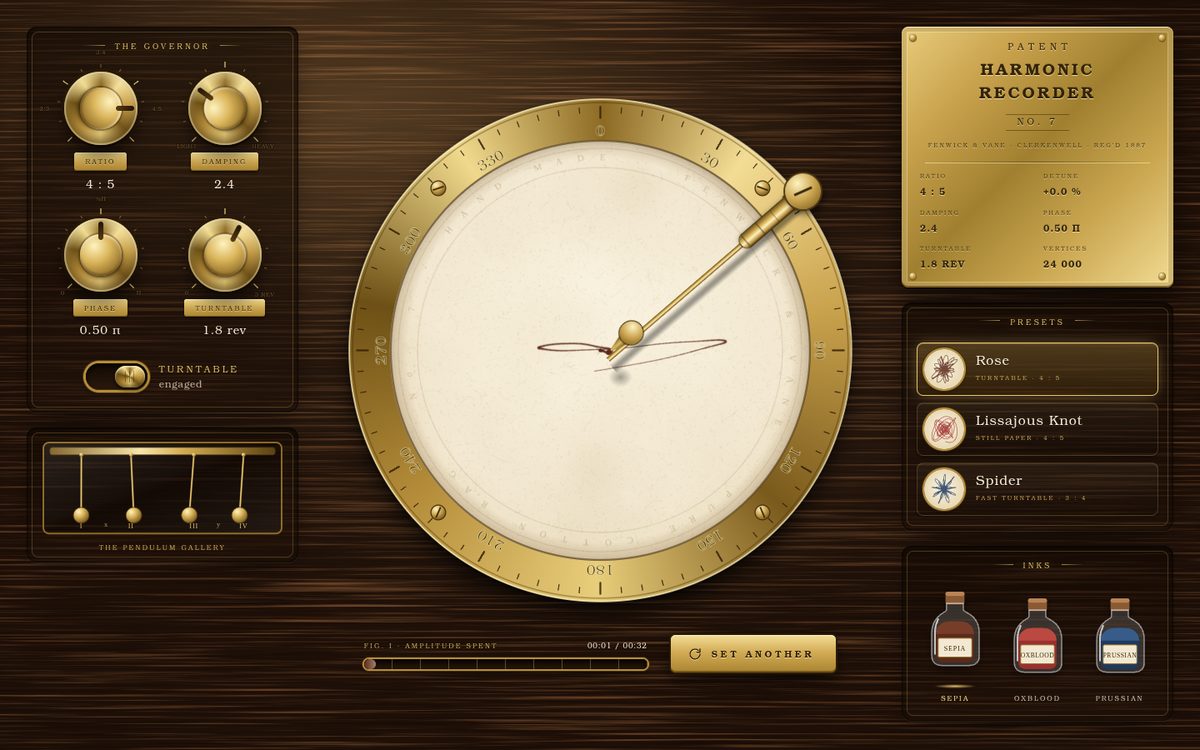
A Victorian brass harmonograph on a dark walnut board, lit as if by a gas lamp. At the centre a cream cotton-paper disc, mottled and fibrous, with a printed watermark round its rim and a centring cross, sits inside a knurled brass bezel engraved with degrees every five, numerals every thirty and four slotted screws. A telescoping brass boom hinged on a post beside the bezel carries a small pen: it extends onto the paper, draws a curve built from four damped pendulums (x = A1 sin(f1 t + p1) e^(−d1 t) + A2 sin(f2 t + p2) e^(−d2 t), y likewise) over 32 seconds with pressure that thickens the ink where the pen slows, a hairline of hand tremor and faint bleed, in sepia, oxblood or Prussian blue, then withdraws to the bezel to reveal the finished figure. Left: "The Governor", four knurled brass knobs (Ratio, Damping, Phase, Turntable) with engraved scales, a brass rocker switch for the turntable, and a glass-fronted gallery of four brass pendulums that swing exactly as the four components do and slowly come to rest. Right: a riveted brass plaque, "Patent Harmonic Recorder No. 7", with a live small-caps ledger of ratio, detune, damping, phase, turntable and vertices; three presets with tiny drawn thumbnails (Rose, Lissajous Knot, Spider); and three glass ink bottles with paper labels. Below the disc, a slotted brass meter counts the amplitude spent ("Fig. II · complete") and a brass "Set another" button pulses when the sheet is done. Type is old-style serif with small caps and old-style numerals, with engraved highlights on brass and gilt lettering on walnut.
Open
Original prompt
Craft an antique-instrument simulation: a Victorian brass harmonograph that draws with damped pendulums. Central stage: a cream cotton-paper disc on a walnut board; a small brass pen nib with a soft shadow draws in sepia/oxblood ink (#5b2a1c, #9c2f2f, #1f3a5f selectable) the curve x = A1·sin(f1·t + p1)·e^(−d1·t) + A2·sin(f2·t + p2)·e^(−d2·t), y similarly with two more pendulums. The drawing progresses over ~25–40 s of accelerated time onto a canvas with subtle pressure variation and a paper-grain overlay; when the pendulums have decayed the drawing is complete and a "Set another" button starts a fresh drawing with new ratios. Controls: four brass rotary knobs (draggable, keyboard-accessible with arrow keys) for frequency ratio (musical ratios 2:3, 3:4, 4:5 with slight detuning), damping, phase and paper turntable speed, plus little glass ink bottles to choose the ink. An engraved plaque reads "Patent Harmonic Recorder No. 7" with a live readout of the ratios in small caps, and a list of presets ("Rose", "Lissajous Knot", "Spider"). Palette: parchment #f3e9d2, walnut #3b2416, brass #c9a24d / #8c6a24, ink sepia. Type: old-style serif with small caps and old-style numerals; engraved labels via text-shadow highlights. Delight: the pen wobbles by a micro amount, and the paper slowly rotates like a turntable when the "Turntable" switch is on. TECHNICAL REQUIREMENTS: Deliver one completely self-contained, standalone HTML5 file with all CSS inline in a <style> tag and all JavaScript inline in a <script> tag. No external dependencies of any kind: no CDN, no external fonts (system font stacks only), no external images, no external SVG files, no libraries, no network requests. It must work by simply opening the file in a browser, fully offline. It must be responsive from 360px phones to large desktops, validate as standard HTML5, respect prefers-reduced-motion, support mouse and touch input, and run without console errors. Hand-craft it as a premium, award-worthy piece of digital art with real, evocative copy (no lorem ipsum), a disciplined palette, careful typography, polished motion and delightful details.
004-brass-harmonograph.txt
005
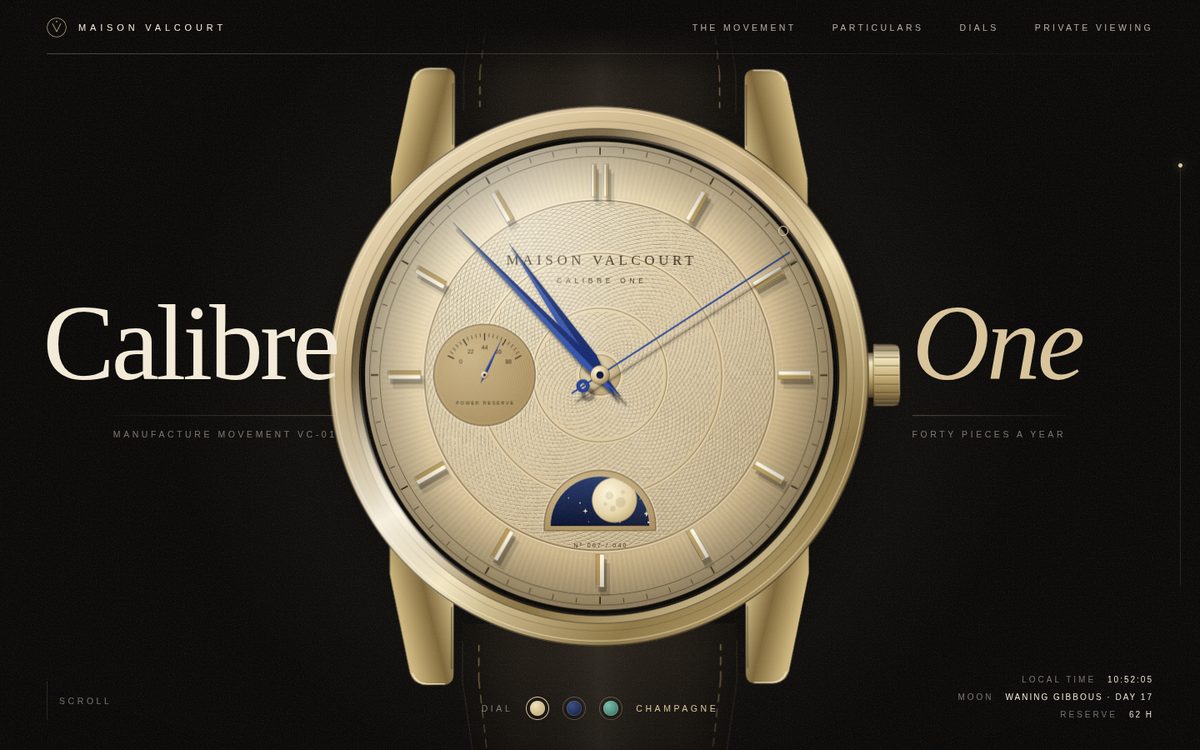
A silent, expensive, patient landing page for the fictional watchmaker Maison Valcourt, set on near-black with champagne, ivory and smoked-bronze accents. The hero is a centre-stage inline-SVG watch: a champagne-gold case with lugs and a leather strap that fades into the dark, a satin sunburst chapter ring, two-tone applied indexes with soft cast shadows, a three-band rose-engine guilloché of wavy antiphase rings, blued dauphine hands, a fine sweeping seconds hand that shows the visitor's real local time, a power-reserve subdial that the crown can wind, and a moon-phase aperture that shows the real age of the moon. "Calibre" and an italic "One" are set in huge, light Didone-stack lettering on either side of the case and reveal letter by letter. Scrolling pins a six-layer exploded view of the movement (hands, dial, bridges, balance, going train, mainplate) that tilts, yaws and separates with the scroll, with meshing gears and a beating balance. Below come a horizontal specification list drawn with hairlines, a "Three hours of the day" dial selector that recolours the SVG between champagne, midnight and verdigris, and a "Request a private viewing" form with underline inputs, ending in a footer with an outlined VALCOURT wordmark. Everything is drawn with inline SVG, CSS and two small canvases; there are no external files.
Open
Original prompt
Design a minimal-luxury landing page for a fictional watchmaker, "MAISON VALCOURT — Calibre One". Palette: black #0b0a09, champagne #d8c39a, ivory #f3ead8, smoked bronze #6b5a3c. Typography: an ultra-thin high-contrast Didone serif (Bodoni / Didot stack) at huge scale, paired with tiny tracked capitals. Hero: an SVG watch dial centre stage — engraved guilloché pattern from concentric wavy paths, applied indexes, blued hands, a sweeping second hand showing the real time with a tiny overshoot bounce, a power-reserve subdial and a moon-phase aperture; a conic-gradient glint sweeps across the case following pointer position and scroll. On scroll: "The movement" (an exploded view of gears in SVG with parallax), a horizontal specification list with hairline dividers, a dial-colour selector (champagne, midnight, verdigris) that recolours the SVG smoothly, and a "Request a private viewing" form with elegant underline inputs. Details: a small circle cursor that expands over interactive items, letter-by-letter headline reveal, hairlines that draw themselves, and almost imperceptible film grain (inline SVG feTurbulence in the DOM). The mood is silent, expensive, patient. TECHNICAL REQUIREMENTS: Deliver one completely self-contained, standalone HTML5 file with all CSS inline in a <style> tag and all JavaScript inline in a <script> tag. No external dependencies of any kind: no CDN, no external fonts (system font stacks only), no external images, no external SVG files, no libraries, no network requests. It must work by simply opening the file in a browser, fully offline. It must be responsive from 360px phones to large desktops, validate as standard HTML5, respect prefers-reduced-motion, support mouse and touch input, and run without console errors. Hand-craft it as a premium, award-worthy piece of digital art with real, evocative copy (no lorem ipsum), a disciplined palette, careful typography, polished motion and delightful details.
005-champagne-timepiece.txt
006
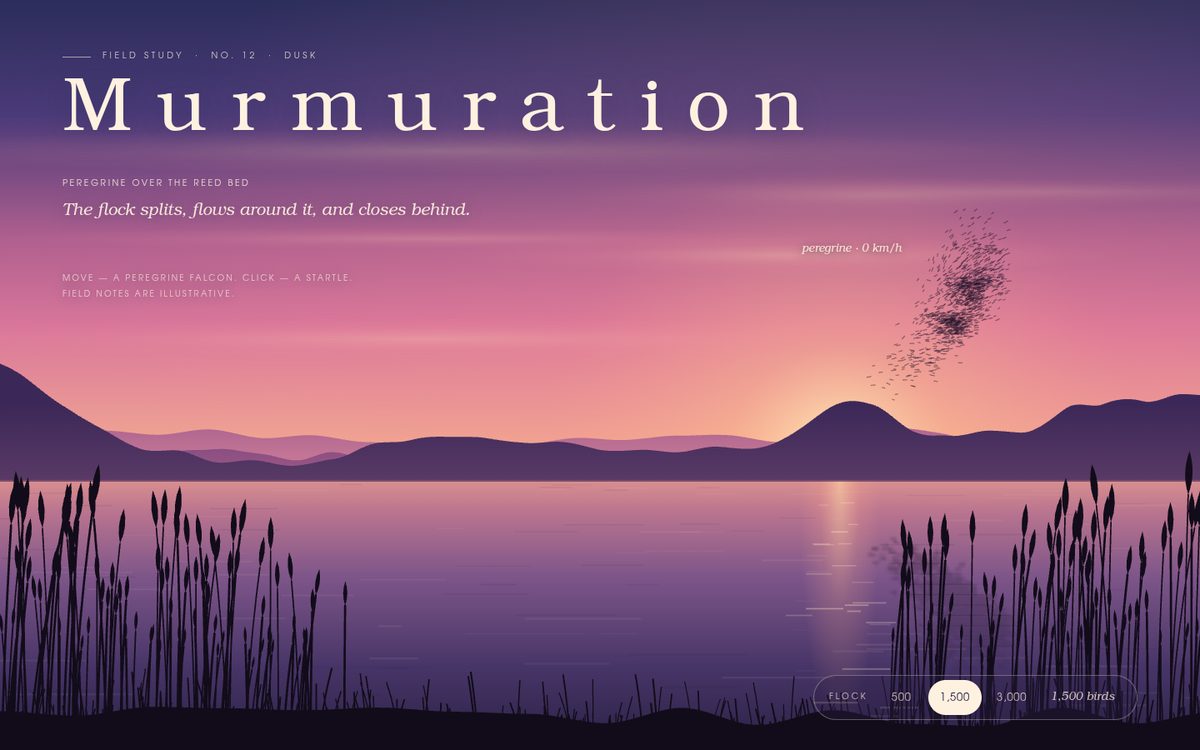
A full-screen dusk over a reed-fringed lake, drawn on two canvases: a static one with the peach-to-rose-to-indigo sky, a low sun with a wide glow, three layers of hazy hills, a lake that echoes the sky with a glittering sun path, and a bank of short reeds; and a live one carrying drifting rose clouds, the flock, its mirrored and blurred reflection, swaying tall reeds with plumes, a startle ring and a peregrine falcon. The flock is a 3D boid simulation projected with perspective, drawn as short dark ticks whose alpha accumulates into smoke, with a smaller sub-flock that chases a second roost so bridges and streamers form between clouds. The title "Murmuration" is set in a light old-style serif with very wide tracking on the indigo sky, above a rotating field note in tracked capitals and italics, and a pill control chooses the flock size.
Open
Original prompt
Simulate a murmuration of ~1500 starlings at dusk over a reed bed, titled "Murmuration". Canvas 2D boids with separation, alignment and cohesion plus a roost attractor that moves along a Lissajous path so the flock naturally stretches into rolling ribbons and vortexes. Render each bird as a tiny dark tick (a 1–2 px line oriented by velocity) with slight alpha so density builds smoky shapes. Sky gradient: peach #f7b48a to rose #d9769a to dusk indigo #2b2d5b with a low sun glow; foreground: silhouette reeds and hills, and a still lake reflection (a faint, blurred, flipped copy of the flock). The pointer is a peregrine falcon — the flock splits and flows around it; a click causes a sudden startle burst and re-forming. Text: a spare typographic composition — "Murmuration" in an elegant light serif with wide tracking, and a rotating line of field notes ("Rome, Nov 6 · 18:12 · ~40,000 birds"); a small control to change flock size (500 / 1500 / 3000). Use a spatial hash grid for neighbour search and cap counts by screen size for performance. Palette: peach/rose/indigo sky, black birds, warm cream text #fff1e0. TECHNICAL REQUIREMENTS: Deliver one completely self-contained, standalone HTML5 file with all CSS inline in a <style> tag and all JavaScript inline in a <script> tag. No external dependencies of any kind: no CDN, no external fonts (system font stacks only), no external images, no external SVG files, no libraries, no network requests. It must work by simply opening the file in a browser, fully offline. It must be responsive from 360px phones to large desktops, validate as standard HTML5, respect prefers-reduced-motion, support mouse and touch input, and run without console errors. Hand-craft it as a premium, award-worthy piece of digital art with real, evocative copy (no lorem ipsum), a disciplined palette, careful typography, polished motion and delightful details.
006-starling-murmuration.txt
007
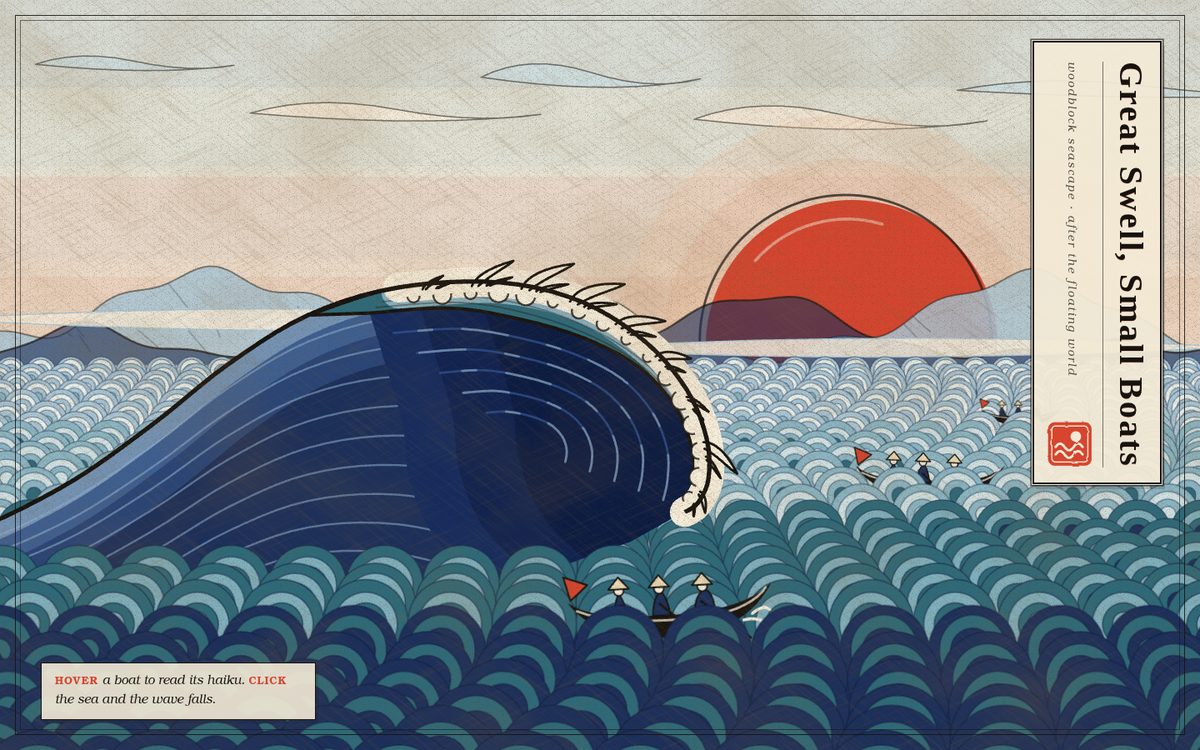
A flat, carved-outline woodblock seascape on cream washi. A huge vermilion sun sits low behind two ranges of misty indigo mountains, printed slightly off its sumi outline; stepped pale-blue washes and long tapering kasumi mist bands fill the sky. Below, some 25 rows of seigaiha scales grade from pale blue through teal to indigo, growing with depth. On the left a great wave (its back slope shaded with stepped bokashi and fine contour lines, its lip a teal shell edged with cream foam and hooked claw-like fingers over a dark hollow) rises, curls, crashes and falls on a 12-second loop. Three small fishing boats with straw-hatted fishermen bob on the swell. A cream cartouche at the right carries the bold vertical title, a small italic subtitle column and a vermilion hanko seal. Paper fibre, mottling, speckle, a soft edge vignette and a double neatline finish the print.
Open
Original prompt
Build an animated woodblock-print seascape in SVG titled "Great Swell, Small Boats" (original artwork inspired by the genre, not a copy of any specific print). Layers: cream washi paper (#f2e8d5) with fibre noise via feTurbulence; a huge vermilion sun disc (#d6452f) low on the horizon with slight block-print misregistration; misty indigo mountains; rows of seigaiha (concentric scale-wave) patterns in indigo (#1b2f5b), teal (#2d6a7a) and pale blue (#a9c7d6) that undulate, each row translating and scaling with staggered sine offsets so the sea heaves; one large curling wave with claw-like foam fingers (hand-drawn paths) that slowly crests and falls on a 12 s loop; three tiny fishing boats bobbing; a bold serif title set vertically on the right with a red hanko-style seal stamp. Palette: indigo, teal, vermilion, cream, sumi black #16130f. Interaction: pointer x shifts the sun and the wave phase with per-layer parallax; hovering a boat reveals an original three-line English haiku on a paper slip; a click makes the wave crash with foam particles. Keep the aesthetic flat with a limited palette and carved-block outlines, plus subtle paper grain and edge vignette. TECHNICAL REQUIREMENTS: Deliver one completely self-contained, standalone HTML5 file with all CSS inline in a <style> tag and all JavaScript inline in a <script> tag. No external dependencies of any kind: no CDN, no external fonts (system font stacks only), no external images, no external SVG files, no libraries, no network requests. It must work by simply opening the file in a browser, fully offline. It must be responsive from 360px phones to large desktops, validate as standard HTML5, respect prefers-reduced-motion, support mouse and touch input, and run without console errors. Hand-craft it as a premium, award-worthy piece of digital art with real, evocative copy (no lorem ipsum), a disciplined palette, careful typography, polished motion and delightful details.
007-ukiyo-wave.txt
008
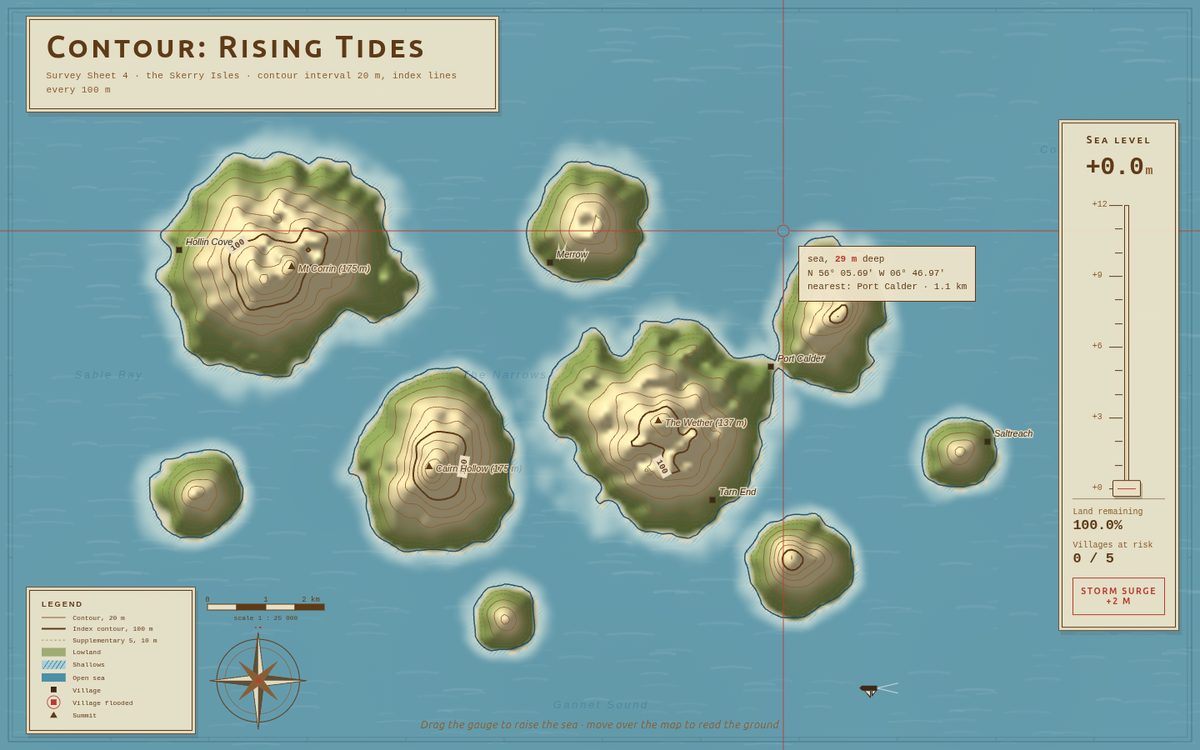
A survey sheet of the fictional Skerry Isles on aged paper with mottling, fibres and foxing. Nine seeded blobs and layered value-noise become a height field in metres; it is shaded from the north-west, tinted from lowland green to pale tan, and traced with 20 m contours, heavier 100 m index lines carrying rotated labels, and dashed 5 m and 10 m supplementary lines. Summits are marked with triangles and named, five villages sit on coasts at deliberately different heights, and a neatline with tick marks frames the sheet. On the right a tall brass-and-ink gauge sets the sea from 0 to +12 m: shoreline, translucent depth-shaded water, hatched shallows and the village markers recompute, while readouts show land remaining and villages at risk. A storm-surge button adds a pulsing +2 m. A humanist small-caps title cartouche, an SVG legend, compass rose and scale bar complete the sheet.
Open
Original prompt
Create an interactive topographic map titled "Contour: Rising Tides". Generate a fictional island archipelago from seeded layered value-noise/fbm and draw elevation contour lines with marching squares on a canvas (thin brown lines every 20 m, heavier index lines every 100 m with elevation labels along them), with subtle hillshading (light from NW) underneath and lowland flooding shown as translucent water with a wavy shoreline and hatched shallows. Palette: aged map paper #eadfc4, contour brown #8a5a2b, index contour #5e3a17, water #4b8fa8 / #a6cfd9, lowland green tint #7a8f4a, survey red #b83b2e. Type: typewriter/mono for coordinates plus a humanist small-caps title; a compass rose, scale bar and legend cartouche drawn in SVG. Control: a large vertical "Sea level" slider (0 to +12 m) — as it rises the shoreline recomputes and low areas flood; live readouts "Land remaining %" and "Villages at risk" (4–5 tiny village markers turn red when flooded); a "Storm surge" button adds a pulsing +2 m wave. Hovering shows a crosshair with elevation, coordinates and nearest place name. Include gentle animated water shimmer and a tiny ship sailing. Pre-render static layers to offscreen canvases and redraw only the water layer when the slider moves. TECHNICAL REQUIREMENTS: Deliver one completely self-contained, standalone HTML5 file with all CSS inline in a <style> tag and all JavaScript inline in a <script> tag. No external dependencies of any kind: no CDN, no external fonts (system font stacks only), no external images, no external SVG files, no libraries, no network requests. It must work by simply opening the file in a browser, fully offline. It must be responsive from 360px phones to large desktops, validate as standard HTML5, respect prefers-reduced-motion, support mouse and touch input, and run without console errors. Hand-craft it as a premium, award-worthy piece of digital art with real, evocative copy (no lorem ipsum), a disciplined palette, careful typography, polished motion and delightful details.
008-sea-level-contours.txt
009
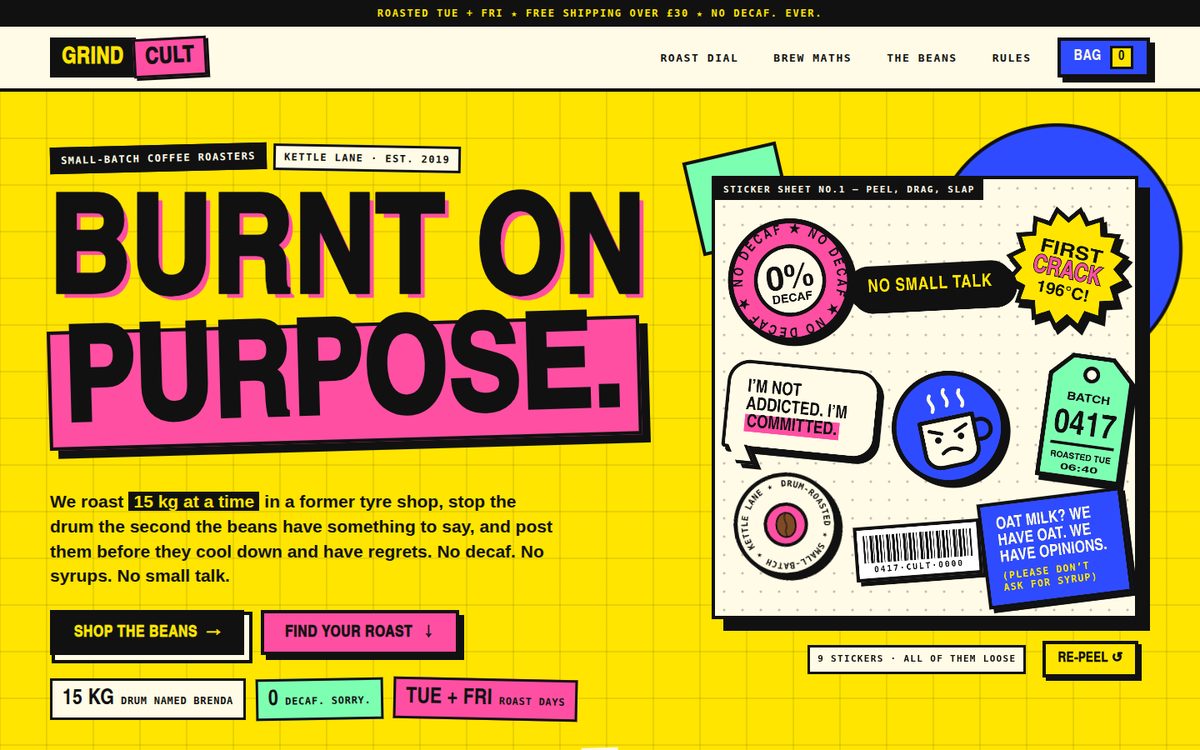
A loud, funny, fully working neo-brutalist storefront for the invented roaster GRIND CULT (a 15 kg drum named Brenda in a former tyre shop). Flat hard-yellow, hot-pink, cobalt, mint and off-white blocks sit behind 3-4px black borders and 6-14px hard offset shadows that physically press down on hover and active. The hero sets a poster-sized headline, "BURNT ON PURPOSE.", that is measured and fitted to its column whatever heavy display font the machine has (Impact / Arial Black, or a thickened Nimbus Sans Narrow fallback), beside a dotted sticker sheet holding nine hand-drawn SVG and CSS stickers that can be picked up, tilted, thrown and slapped down. Two tilted marquee bands cross under the hero. The Roast Dial section is an interactive Light-to-Dark slider with a striped roast-colour track and first/second-crack markers: it recolours a flat SVG coffee bean (wrinkles fade, oil sheen and smoke arrive, a POP! starburst fires at each crack), swaps six sets of flavour-note tags, animates four chunky cup-profile meters, updates drop temperature, roast time, weight loss and price, and adds the chosen roast to a working bag. The Brew Ratio Calculator links coffee grams, ratio and water millilitres in both directions with big steppers and preset chips, draws a filling measuring beaker, gives a mode-aware verdict, grind, temperature and time, builds a live pour plan and runs a brew clock that tells you what the scale should read. Six product bags flip in 3D on hover (or tap, or the Flip button) to reveal tasting notes and an add-to-bag button, followed by five "house rules" cards and a black footer with a fitted GRIND CULT wordmark and a newsletter form. The copy throughout is dry and specific, with real coffee vocabulary (first crack, drop temperature, natural vs washed, bloom, drawdown).
Open
Original prompt
Design a neo-brutalist website for "GRIND CULT — small-batch coffee roasters". Palette: hard yellow #ffe500, hot pink #ff4fa3, cobalt #2f4bff, mint #7dffb2, off-white #fffbe6, black #111. Visual rules: 3–4px black borders, hard offset shadows (6px 6px 0 #111) that "press down" on hover/active, oversized Impact / Arial Black type in uppercase, slightly rotated stickers and badges, a CSS marquee ticker ("FRESH ROASTED ★ NO DECAF ★ NO SMALL TALK ★"). Sections: a hero with a giant headline and a sticker area where stickers are draggable with pointer events (raise z-index on pick-up, jitter rotation); an interactive "Roast dial" slider (Light to Dark) that recolours an SVG coffee-bean illustration, changes the flavour-note tags, and updates the price; a "Brew ratio calculator" (grams of coffee to millilitres of water) with big chunky inputs and a live result; product cards that flip on hover; a cheeky footer. Copy should be funny, confident and specific (real coffee vocabulary). Responsive: cards stack on mobile; keep contrast high and focus outlines thick. TECHNICAL REQUIREMENTS: Deliver one completely self-contained, standalone HTML5 file with all CSS inline in a <style> tag and all JavaScript inline in a <script> tag. No external dependencies of any kind: no CDN, no external fonts (system font stacks only), no external images, no external SVG files, no libraries, no network requests. It must work by simply opening the file in a browser, fully offline. It must be responsive from 360px phones to large desktops, validate as standard HTML5, respect prefers-reduced-motion, support mouse and touch input, and run without console errors. Hand-craft it as a premium, award-worthy piece of digital art with real, evocative copy (no lorem ipsum), a disciplined palette, careful typography, polished motion and delightful details.
009-neo-brutalist-roastery.txt
010
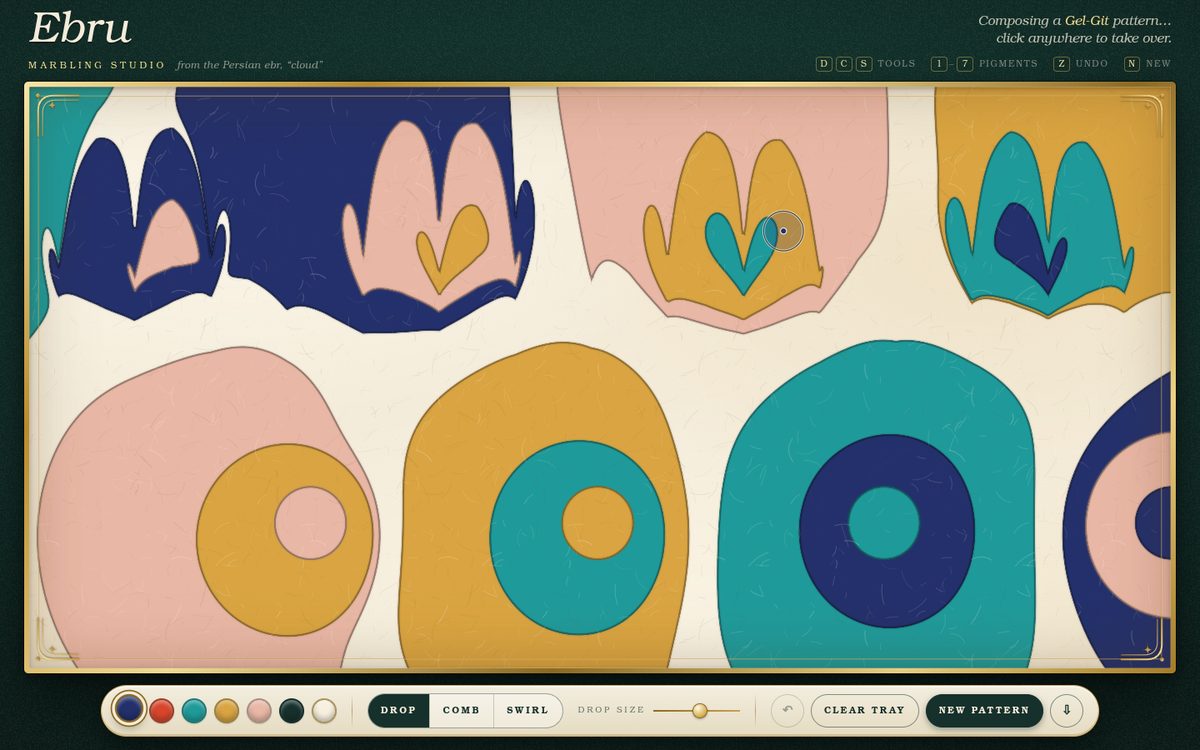
A quiet bench-top studio for paper marbling. A cream sheet with a hand-painted fibre texture sits in a thin gilded frame (double gold rim, hairline inset rule, four engraved corner ornaments) on a deep black-green desk; a small italic "Ebru" title (from the Persian ebr, "cloud") and a live hint sit above it, and a slim cream dock below carries seven pigment pots, a Drop / Comb / Swirl toggle, a size slider, Undo, Clear tray, New pattern and Save. The ink is real mathematical marbling: every drop is a polygon that starts as a 180-point circle and grows under the visitor's finger, pushing all existing ink outward with the area-preserving radial formula; a multi-tine comb drags ink along its motion with exponential falloff across the tines; a swirl twists nearby ink around the pointer. Long edges are re-subdivided with the 4-point interpolatory scheme and the total is capped near 8,000 points. On load the studio composes one of three traditional-style patterns by itself in about six seconds (Gel-Git with two combing passes, Çarkıfelek with concentric rings stirred into wheels, Battal with a scatter of stones) and then invites the visitor to take over. Everything is drawn flat with a crisp feathered outline, so the palette of indigo, vermilion, turquoise, ochre, blush, black-green and cream reads like ink on cotton paper.
Open
Original prompt
Build "Ebru — Marbling Studio", an interactive paper-marbling toy on canvas. Implementation guidance: represent each ink drop as a polygon of ~180 points; when a new drop of radius r is added at centre c, every existing point p is displaced radially by p' = c + (p − c)·sqrt(1 + r²/|p − c|²) (the classic mathematical-marbling formula), then the new circle is appended; a comb/rake stroke (drag) displaces points along the drag direction with exponential falloff, p' = p + α·exp(−d/λ)·dir; a swirl tool rotates neighbours around the pointer. Render polygons in draw order with filled colours; re-subdivide long edges to keep curves smooth and cap total points (~8k). Palette: cream paper #f4ecda, indigo #23306b, vermilion #d8452b, turquoise #1f9a9a, ochre #d9a441, blush #e9b7a5, black-green #16302b, with subtle paper fibre texture and a thin gilded border. Type: a refined old-style serif for the small title "Ebru" and tracked small-caps tool labels. UI: a slim dock at the bottom with pigment swatches, a tool toggle (Drop / Comb / Swirl), "Clear tray" and "New pattern" (seeds a beautiful preset). Click to drop ink (radius grows with hold time); drag with Comb to pull lines through the paint. An automatic demo composes a preset in ~6 s with gentle comb strokes, then invites the visitor to play. Keep it at 60 fps. TECHNICAL REQUIREMENTS: Deliver one completely self-contained, standalone HTML5 file with all CSS inline in a <style> tag and all JavaScript inline in a <script> tag. No external dependencies of any kind: no CDN, no external fonts (system font stacks only), no external images, no external SVG files, no libraries, no network requests. It must work by simply opening the file in a browser, fully offline. It must be responsive from 360px phones to large desktops, validate as standard HTML5, respect prefers-reduced-motion, support mouse and touch input, and run without console errors. Hand-craft it as a premium, award-worthy piece of digital art with real, evocative copy (no lorem ipsum), a disciplined palette, careful typography, polished motion and delightful details.
010-marbling-studio.txt
011
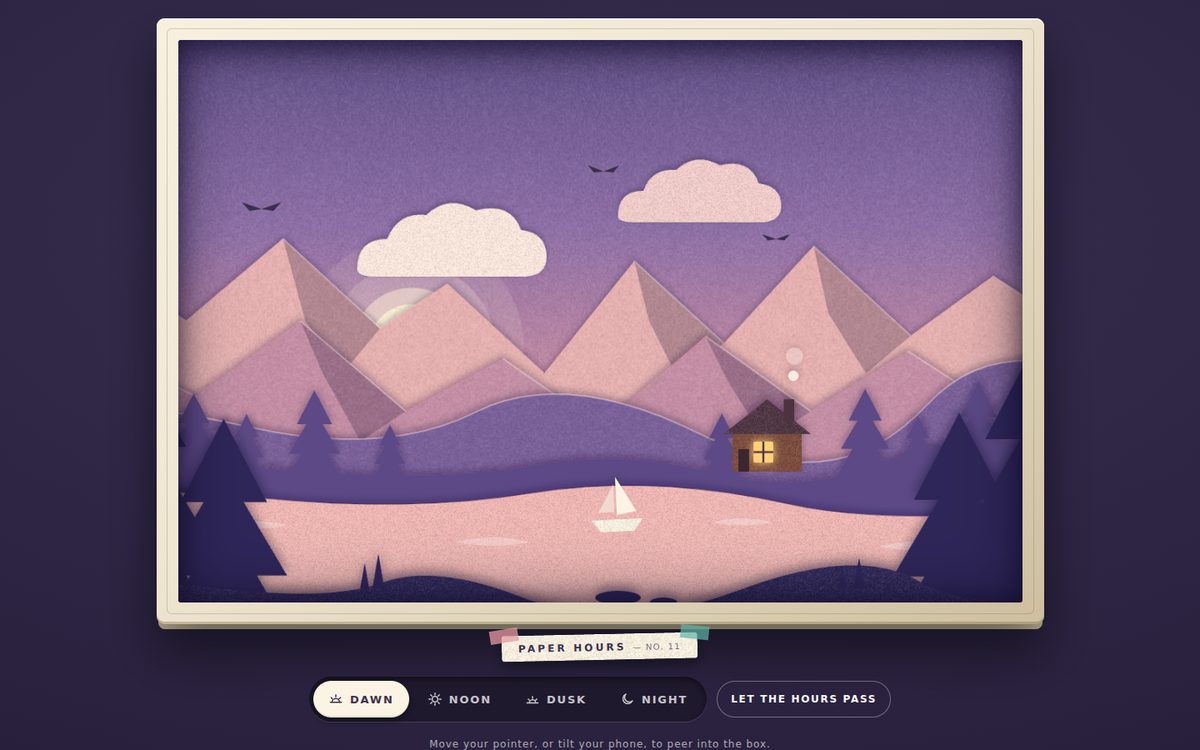
A calm, tactile paper-cut landscape sitting in a cream card shadow box (bevelled frame, hairline inset rule, deep inner shadow) on a dusky wall that changes with the hour. Ten stacked SVG sheets cut from card build the scene from far to near: a gradient sky with paper stars, a sun-and-moon layer of concentric paper discs, faceted far mountains, drifting back clouds, mid mountains with folded shading, front clouds and flapping paper birds, rolling hills, a far bank of pine cut-outs with a small log cabin (warm flickering window, curling paper smoke), a pale river with a folded paper boat that sails across, and dark foreground pines, grass and pebbles with fireflies at night. Every sheet has a soft feDropShadow, a lit top edge and a shared paper-grain tile, so the layers read as separate card stock. A segmented control (Dawn, Noon, Dusk, Night) with a sliding paper pill crossfades the whole palette and moves the sun and moon along their arcs; a "Let the hours pass" button cycles them automatically. A taped paper label reads "PAPER HOURS — No. 11".
Open
Original prompt
Craft a layered paper-cut landscape diorama titled "Paper Hours". Build 8–10 SVG layers (far mountains, hills, pine forest, river, clouds, sun/moon) as if cut from card, each with a subtle drop shadow (feDropShadow) and paper grain, tones stepping from far (light, hazy) to near (dark) with soft fog gradients between layers. The whole diorama sits inside a deep shadow-box frame with bevel and inner shadow, centred on the page, with a small paper label "PAPER HOURS — No. 11". Parallax: pointer / device tilt shifts layers by depth; a slow idle sway keeps it alive. A segmented control switches the time of day — Dawn, Noon, Dusk, Night — and crossfades the entire palette: Dawn peach #f7c6b0 / rose #e59aa0 / plum #8f6fa8 / dusk-blue #4a3f7a; Noon mint #cdeedd / teal #5fb3a7 / sky #bfe6f5; Dusk apricot #ffb27a / coral #e8735a / plum #6b3f6e; Night navy #1c2a4d / teal #2a5c6b with stars, a glowing moon and fireflies. Tiny animated details: paper birds flapping, a small cabin with a warm window and curling smoke, a paper boat drifting on the river, clouds sliding. Type: a soft rounded sans at small sizes for labels. The feeling is tactile, calm and handmade — you should almost feel the card stock. TECHNICAL REQUIREMENTS: Deliver one completely self-contained, standalone HTML5 file with all CSS inline in a <style> tag and all JavaScript inline in a <script> tag. No external dependencies of any kind: no CDN, no external fonts (system font stacks only), no external images, no external SVG files, no libraries, no network requests. It must work by simply opening the file in a browser, fully offline. It must be responsive from 360px phones to large desktops, validate as standard HTML5, respect prefers-reduced-motion, support mouse and touch input, and run without console errors. Hand-craft it as a premium, award-worthy piece of digital art with real, evocative copy (no lorem ipsum), a disciplined palette, careful typography, polished motion and delightful details.
011-papercut-dioramas.txt
012
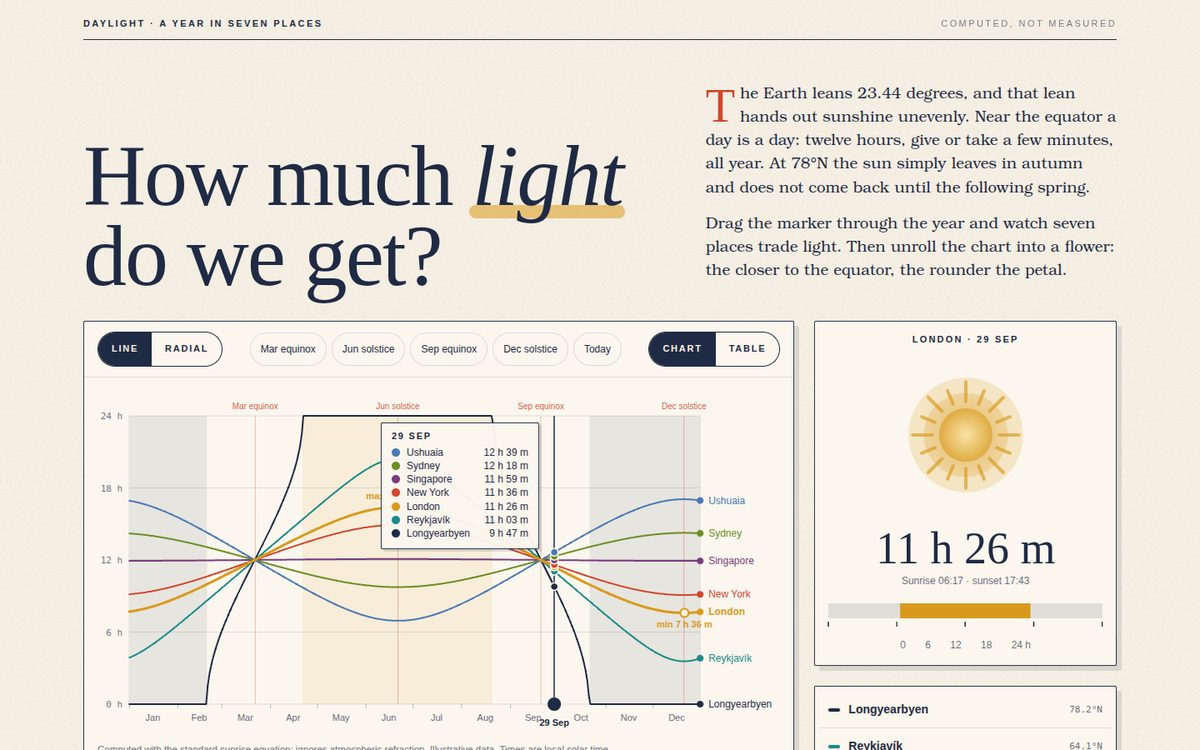
An editorial data-art page on warm cream paper with a large Didone headline, "How much light do we get?", and a short two-paragraph intro with a vermilion drop cap. The main card plots daylight hours for seven latitudes, computed live in the browser from the sunrise equation. In Line form the year runs left to right with one 0-24 h axis, 2px lines in seven earthy colours, hairline grid, month ticks, equinox and solstice markers and direct end labels; a Radial button morphs the same 365 points smoothly into polar coordinates so the lines become petals, all crossing the 12 h ring at the equinoxes and Singapore staying almost a circle. A shaded band marks Longyearbyen's polar night (and a warm one its midnight sun). A draggable scrubber (rule or spoke) carries colour dots and a tooltip listing every place's daylight for the chosen date; the side card shows a big sun glyph whose rays, glow and opacity scale with the selected place's hours, the length as text, sunrise and sunset in solar time and a 24-hour strip. A legend highlights a series on hover or focus and selects it on click; a Table toggle swaps the chart for an accessible table.
Open
Original prompt
Create a data-art page "Daylight" showing a year of daylight hours for seven latitudes. Compute daylight length per day from the standard sunrise equation: declination δ = 23.44°·sin(2π(284+N)/365), cos(H) = −tan(φ)·tan(δ), day length = 24·H/π hours, clamped for polar day/night. Places: Longyearbyen 78.2°N, Reykjavík 64.1°N, London 51.5°N, New York 40.7°N, Singapore 1.35°N, Sydney 33.9°S, Ushuaia 54.8°S. Main chart with a Line / Radial toggle: Line = day of year on x, hours of daylight on y (one y-axis, 2px lines, hairline solid recessive grid, thin end markers); Radial = angle is day of year, radius is hours, so the lines become petal-like flowers with Singapore nearly a circle. Palette: warm cream paper #f6f0e4 with ink navy #1f2a44 text, and seven distinct earthy line colours (navy #1f2a44, teal #1a8a8a, ochre #d99a1c, vermilion #d2452e, plum #7a3b7d, olive #6b8e23, slate-blue #4a78b5). A draggable date scrubber shows a vertical rule (or radial spoke) and a tooltip listing each place's daylight at that date; a big sun glyph glows in proportion to the hours; equinox and solstice markers; a shaded "polar night" band; a legend that highlights a series on hover; a small table view toggle. Editorial headline: "How much light do we get?" with a short intro. Footnote: "Computed with the standard sunrise equation; ignores atmospheric refraction." Illustrative, elegant, no clutter; label selectively (line ends and extremes only). TECHNICAL REQUIREMENTS: Deliver one completely self-contained, standalone HTML5 file with all CSS inline in a <style> tag and all JavaScript inline in a <script> tag. No external dependencies of any kind: no CDN, no external fonts (system font stacks only), no external images, no external SVG files, no libraries, no network requests. It must work by simply opening the file in a browser, fully offline. It must be responsive from 360px phones to large desktops, validate as standard HTML5, respect prefers-reduced-motion, support mouse and touch input, and run without console errors. Hand-craft it as a premium, award-worthy piece of digital art with real, evocative copy (no lorem ipsum), a disciplined palette, careful typography, polished motion and delightful details.
012-daylight-around-the-world.txt
013
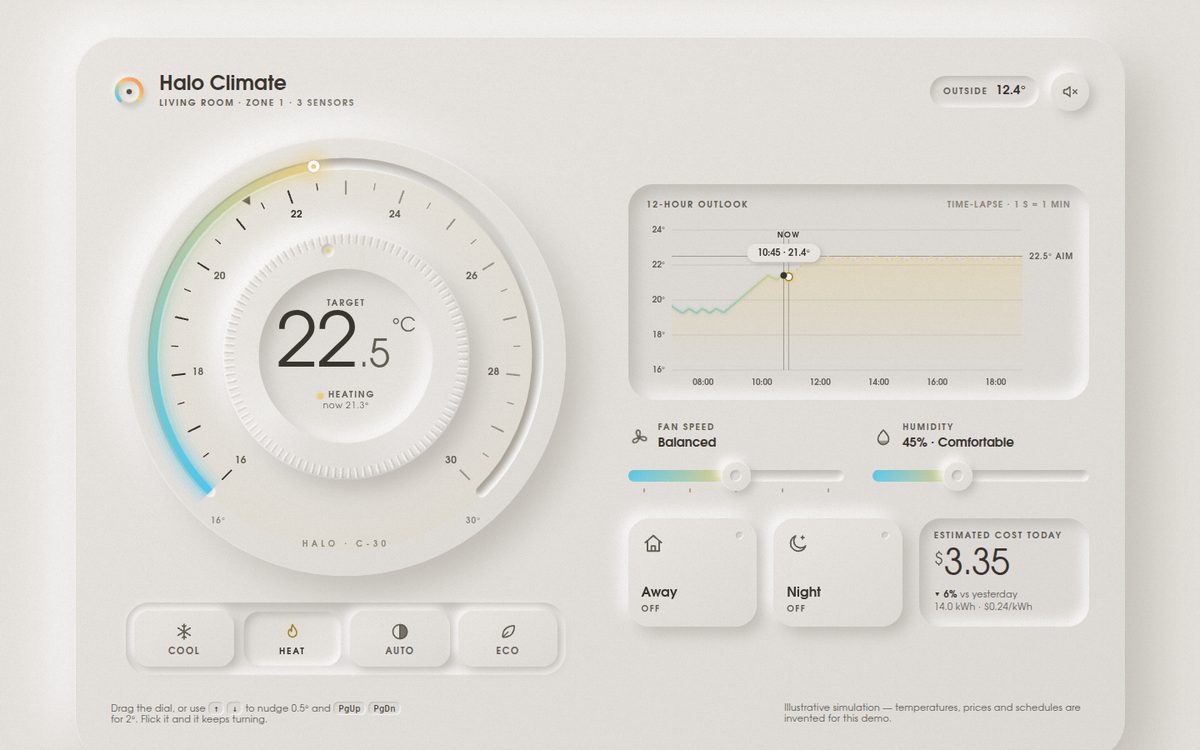
A single warm-grey control panel (#e6e2dc) in which every part, from the huge rotary dial to the smallest key, looks extruded or pressed from the same soft material with white top-left highlights and warm grey bottom-right shadows. The hero is a 540px SVG dial: an inset halo groove holds a luminous arc that fills from cool aqua through soft gold to sunrise orange as the target rises, a bead with a breathing glow rides the arc end, a 29-tick ring with numerals wraps the knurled knob, and the big number (for example 22.5 °C) sits in a carved readout well with a live "Heating / Cooling / Holding" status and the current room temperature. The whole page material drifts subtly from cool blue-grey at 16° to warm peach at 30° and dims further in Night mode. Around the dial sit a four-key Cool / Heat / Auto / Eco tray (the chosen key is pressed in), an inset twelve-hour outlook chart with a gradient temperature line, dotted forecast, aim line and hover read-out, embossed fan-speed and humidity sliders with a spinning fan and a filling droplet, Away and Night push-keys with lit LEDs, and an "Estimated cost today" figure that counts smoothly whenever any setting changes. The interface is a quiet time-lapse simulation (1 second equals 1 minute) so the room temperature actually creeps toward the setpoint.
Open
Original prompt
Design a neumorphic smart-thermostat panel called "Halo Climate". Soft-UI look: warm grey surface #e6e2dc with white highlights (#ffffff) and darker soft shadows (rgba(163,155,143,.55)), everything extruded or pressed from the same material. Centrepiece: a large SVG rotary dial with a tick ring; drag around it (pointer or keyboard arrows) to set temperature 16–30°C in 0.5° steps with inertia and subtle snapping; the ring's arc fills with a gradient from cool aqua #4cc9f0 to warm sunrise #ff8a4c, the centre shows a big number in a rounded sans, and the whole panel's ambient tint shifts subtly with temperature. Around it: a segmented mode control (Cool / Heat / Auto / Eco) with soft pressed states, two embossed sliders (fan speed, humidity), toggle switches (Away, Night) that depress like real buttons, an inset well containing a 12-hour temperature line chart, and an animated "Estimated cost today" figure that counts smoothly. Add a faint tick sound on the dial (WebAudio, opt-in). Type: ui-rounded / rounded geometric sans with tabular numerals for readouts, tiny uppercase labels. Everything should feel physical, quiet and precise — the kind of object you want to touch. TECHNICAL REQUIREMENTS: Deliver one completely self-contained, standalone HTML5 file with all CSS inline in a <style> tag and all JavaScript inline in a <script> tag. No external dependencies of any kind: no CDN, no external fonts (system font stacks only), no external images, no external SVG files, no libraries, no network requests. It must work by simply opening the file in a browser, fully offline. It must be responsive from 360px phones to large desktops, validate as standard HTML5, respect prefers-reduced-motion, support mouse and touch input, and run without console errors. Hand-craft it as a premium, award-worthy piece of digital art with real, evocative copy (no lorem ipsum), a disciplined palette, careful typography, polished motion and delightful details.
013-soft-dial-thermostat.txt
014
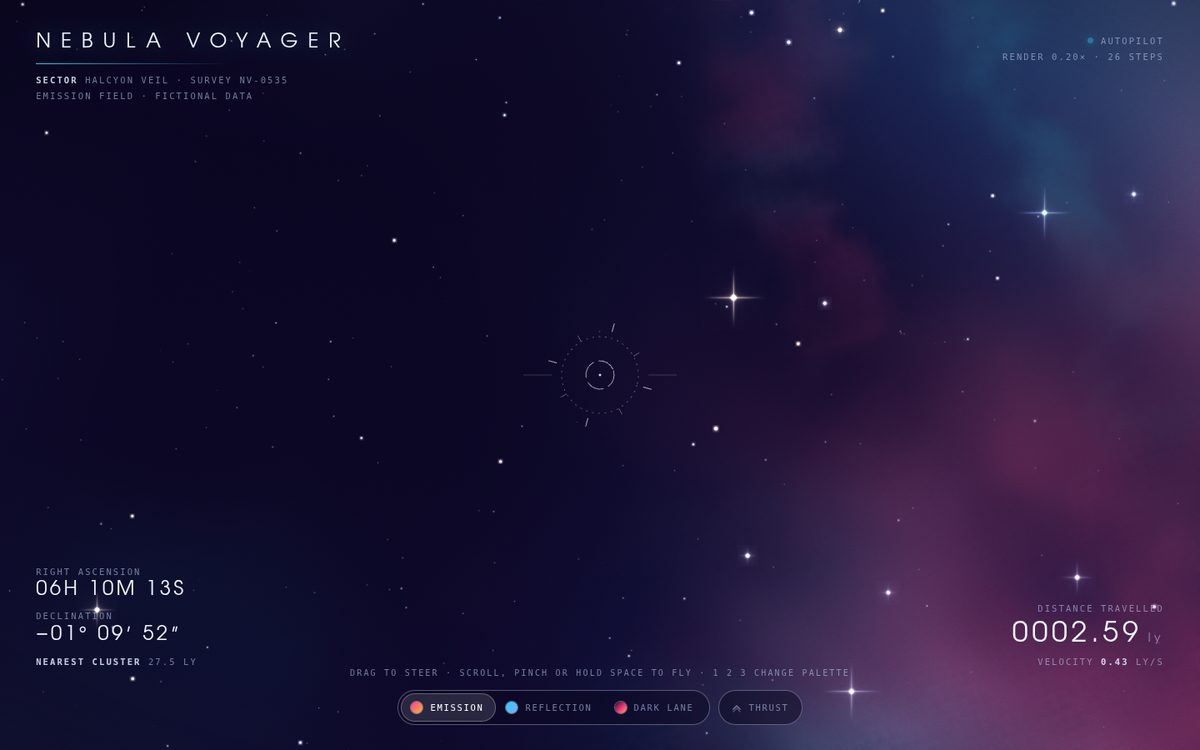
A full-screen WebGL flight through a volumetric emission nebula. A fragment shader raymarches warped, ridged fbm noise (26 to 36 adaptive steps per ray, jittered per pixel) into a low-resolution target; a second pass upscales it with a smoothing tap pattern and blue-noise-style dithering, composites it over deep indigo #0a0620, and adds soft blooms around three star clusters. Clouds shade from cyan wisps through magenta bodies to amber cores, lit by the nearest embedded clusters. Over it, thousands of far and near stars are drawn as additive point sprites with parallax, twinkle, radial streaking at speed and four-point diffraction spikes on the brightest, and each cluster carries a tight knot of blue-white stars. The interface is minimal: a wide light-tracked title card that dissolves into a small corner title, a thin-line reticle, fictional right ascension and declination that follow the view, a distance-travelled counter in light-years, a nearest-cluster range, a velocity readout, an autopilot indicator, and a pill selector for the Emission, Reflection and Dark Lane palettes plus a Thrust button. Film grain and a soft vignette finish the frame. Without WebGL a 2D canvas starfield drifts over CSS radial gradients tinted by the chosen palette.
Open
Original prompt
Build a WebGL raymarched volumetric nebula "Nebula Voyager". A fragment shader marches through fbm noise clouds (24–40 steps, rendered at reduced resolution and upscaled with dithering for smoothness) coloured magenta #ff3d81, cyan #23d0ff and amber #ffb347 over deep indigo #0a0620, with a parallax starfield of thousands of stars (some with diffraction spikes) and a bright embedded star cluster. Pointer/touch steers the camera with smooth inertial yaw and pitch; wheel/pinch/scroll flies forward through the cloud; idle mode drifts automatically. Minimal HUD: a thin-line reticle, plausible fictional coordinates ("RA 05h 35m · Dec −05° 23′"), a distance counter in light-years that increases as you fly, and a palette selector with three presets — Emission, Reflection, Dark Lane — that changes colour ramps and density. Title "Nebula Voyager" in a wide, light sans with generous letterspacing; captions in mono. Fallback without WebGL: a 2D canvas starfield over CSS radial gradients. Add subtle film grain and a soft vignette. TECHNICAL REQUIREMENTS: Deliver one completely self-contained, standalone HTML5 file with all CSS inline in a <style> tag and all JavaScript inline in a <script> tag. No external dependencies of any kind: no CDN, no external fonts (system font stacks only), no external images, no external SVG files, no libraries, no network requests. It must work by simply opening the file in a browser, fully offline. It must be responsive from 360px phones to large desktops, validate as standard HTML5, respect prefers-reduced-motion, support mouse and touch input, and run without console errors. Hand-craft it as a premium, award-worthy piece of digital art with real, evocative copy (no lorem ipsum), a disciplined palette, careful typography, polished motion and delightful details.
014-nebula-voyager.txt
015
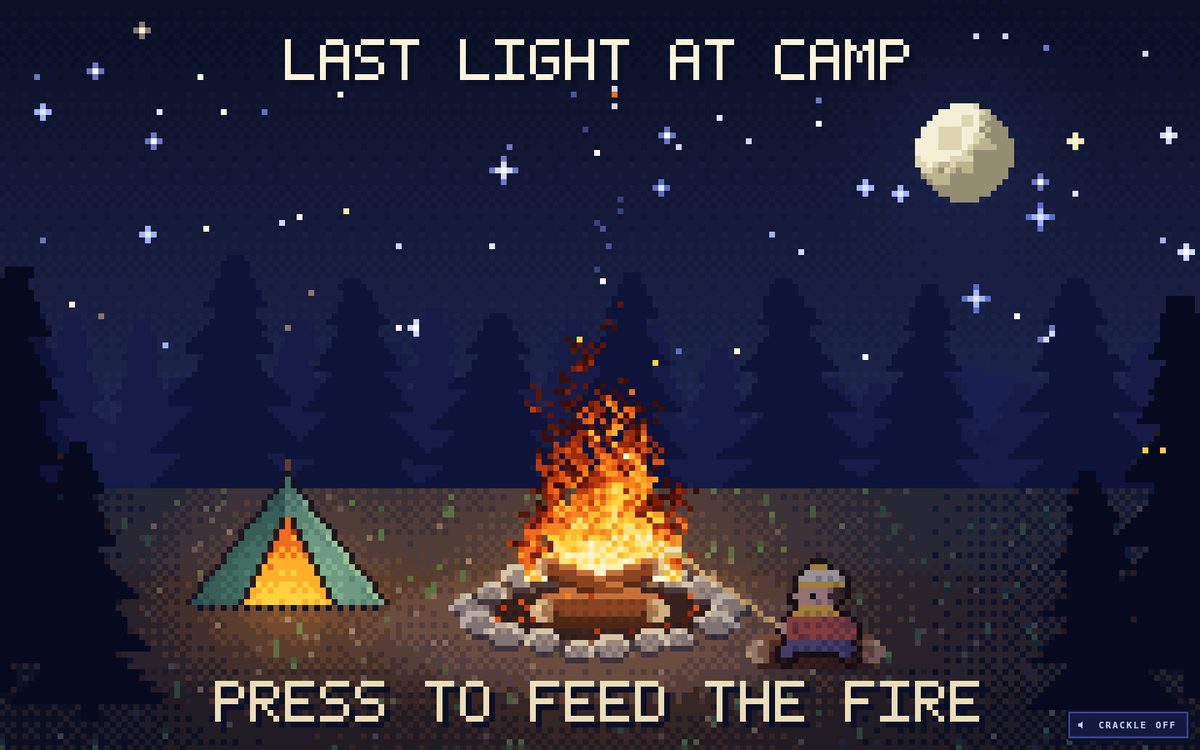
A full-screen pixel-art night scene rendered in software onto a tiny canvas (about 240×135 logical pixels on a 1080p screen, 206×129 at 1440×900, 130×282 on a phone) that is scaled by a whole-number factor so every pixel stays perfectly crisp. A shaded full moon with craters hangs in a Bayer-dithered indigo sky (#0b1026 to #232a57) full of twinkling one-pixel, plus-shaped and cross-shaped stars; two hill ridges and three layers of tiered pine silhouettes sway on the horizon while dark near-pines frame the sides, one of them hiding a pair of blinking owl eyes. In the middle a campfire built from the classic Doom-fire algorithm burns inside a hand-drawn ring of stones, over crossed logs and an ash bed with glowing embers. To its left a teal tent glows from a lantern inside; to its right a camper in a bobble hat sits on a log toasting a marshmallow that slowly goes white, golden, brown and finally catches fire before being pulled back and replaced. Every ground, log, stone, tent and character pixel is coloured from a six-step night-to-firelit ramp chosen with ordered dithering, so the light of the flickering fire falls off in crisp dithered rings. The caption LAST LIGHT AT CAMP types itself out in a hand-authored 5×7 bitmap font, and a blinking PRESS TO FEED THE FIRE invites you to throw logs, because the fire slowly burns down toward embers if you leave it.
Open
Original prompt
Make a pixel-art campfire night scene "Last Light at Camp" on a low-resolution canvas (about 240×135 logical pixels) upscaled crisply with image-rendering: pixelated to fill the screen. The fire uses the classic "Doom fire" cellular algorithm: a heat buffer where each pixel propagates upward from below with random decay and a little horizontal wind, mapped to a 16-step palette from black to deep red #7a1f0b, orange #f26b1d, yellow #ffd23f and white #fff6d5, confined to a hearth with hand-authored ASCII sprite maps for logs and stones. Sky: a dithered gradient (4×4 Bayer matrix) from #0b1026 to #232a57; twinkling stars in two or three sprite sizes; a pixel moon with craters; distant pine silhouettes with parallax sway; a tent sprite with a glowing interior; a tiny character sprite (hand-authored map) sitting toasting a marshmallow; sparks that rise and blink out. Light logic: a warm dynamic light radius from the fire modulates brightness of nearby pixels (ground, logs, tent, character) with noisy flicker. Interaction: click to throw a log (the fire surges), hold to blow (wind); a small toggle for crackle sound (WebAudio filtered noise bursts), default off. A pixel caption "LAST LIGHT AT CAMP" and tiny "PRESS TO FEED THE FIRE" drawn with a hand-authored 5×7 bitmap font on the canvas. Authentic limited palette and dithering throughout. TECHNICAL REQUIREMENTS: Deliver one completely self-contained, standalone HTML5 file with all CSS inline in a <style> tag and all JavaScript inline in a <script> tag. No external dependencies of any kind: no CDN, no external fonts (system font stacks only), no external images, no external SVG files, no libraries, no network requests. It must work by simply opening the file in a browser, fully offline. It must be responsive from 360px phones to large desktops, validate as standard HTML5, respect prefers-reduced-motion, support mouse and touch input, and run without console errors. Hand-craft it as a premium, award-worthy piece of digital art with real, evocative copy (no lorem ipsum), a disciplined palette, careful typography, polished motion and delightful details.
015-pixel-campfire.txt
016
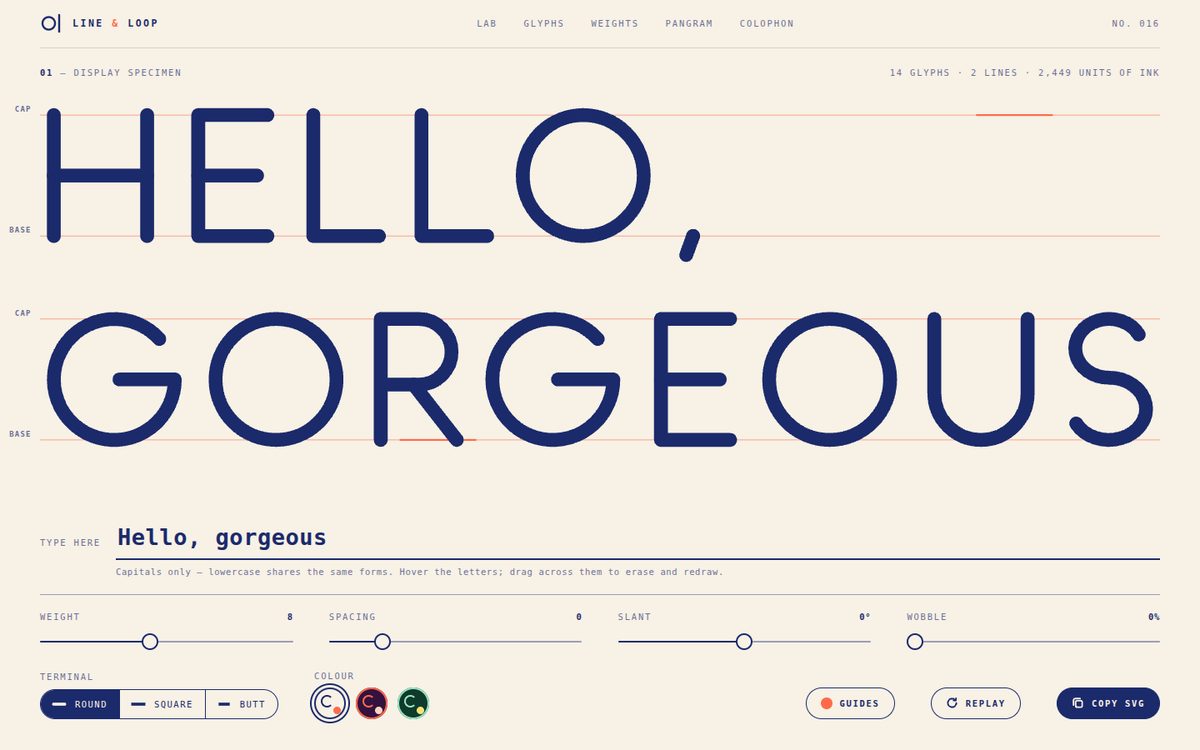
A bold editorial type specimen for a hand-built monoline alphabet. Forty-one glyphs (A–Z, 0–9 and . , ! ? -, with lowercase sharing the capitals) are written as SVG path data on a 100-unit em, capitals 70 units tall between a cap line at y 15 and a baseline at y 85, made only of straight strokes and circular or elliptical arcs. The page opens on a huge left-aligned hero line, "Hello, gorgeous" by default, whose letters draw themselves stroke by stroke while a coral ink dot rides each pen tip, over hairline cap and baseline guides that carry tiny margin labels and a slow scanning highlight. Under it sit a text field and a row of custom controls (stroke weight, spacing, slant, wobble, terminal shape, three colour schemes, guides, replay and Copy SVG). Below the lab come a seven-column glyph grid with construction circles that replays each character when you hover it, a strip of the word LOOP at six weights from hairline to heavy, an inverted colour band that sets the pangram "Sphinx of black quartz, judge my vow" while an alphabet of 26 chips lights up, and a colophon with live statistics. Section headings are themselves drawn in the face; all interface text is uppercase, tracked system monospace. The default palette is ink blue #1b2a6b on cream #f7f1e6 with coral #ff6b4a; the other schemes are coral on plum and mint on forest.
Open
Original prompt
Build "Line & Loop", a monoline alphabet lab. Hand-author stroke paths for every letter A–Z, digits 0–9 and basic punctuation (. , ! ? - space) as SVG path data on a 0–100 em grid, constructed geometrically from circles, straight strokes and arcs. A text field (default "Hello, gorgeous") renders the words in this custom typeface as SVG with round caps and joins; each glyph's strokes draw on with stagger (stroke-dashoffset). Custom-styled controls: stroke weight, letter spacing, slant, "wobble" (noise displacement of resampled stroke points), terminal shape (round / square / butt), and colour schemes (ink blue on cream #f7f1e6 / #1b2a6b with coral #ff6b4a; coral on plum; mint on forest). "Copy SVG" copies the markup (with a fallback). Layout as a bold editorial type specimen: a huge hero line, a glyph grid of all characters where hovering replays each glyph's drawing, a weights strip (thin to heavy), a pangram ("Sphinx of black quartz, judge my vow") set in the custom face, and a colophon. UI text in mono small caps. Delights: hovering the specimen makes letters bounce gently; dragging across letters erases and redraws them. The letterforms must be genuinely well designed — consistent proportions, optical balance, considered curves. TECHNICAL REQUIREMENTS: Deliver one completely self-contained, standalone HTML5 file with all CSS inline in a <style> tag and all JavaScript inline in a <script> tag. No external dependencies of any kind: no CDN, no external fonts (system font stacks only), no external images, no external SVG files, no libraries, no network requests. It must work by simply opening the file in a browser, fully offline. It must be responsive from 360px phones to large desktops, validate as standard HTML5, respect prefers-reduced-motion, support mouse and touch input, and run without console errors. Hand-craft it as a premium, award-worthy piece of digital art with real, evocative copy (no lorem ipsum), a disciplined palette, careful typography, polished motion and delightful details.
016-monoline-alphabet.txt
017
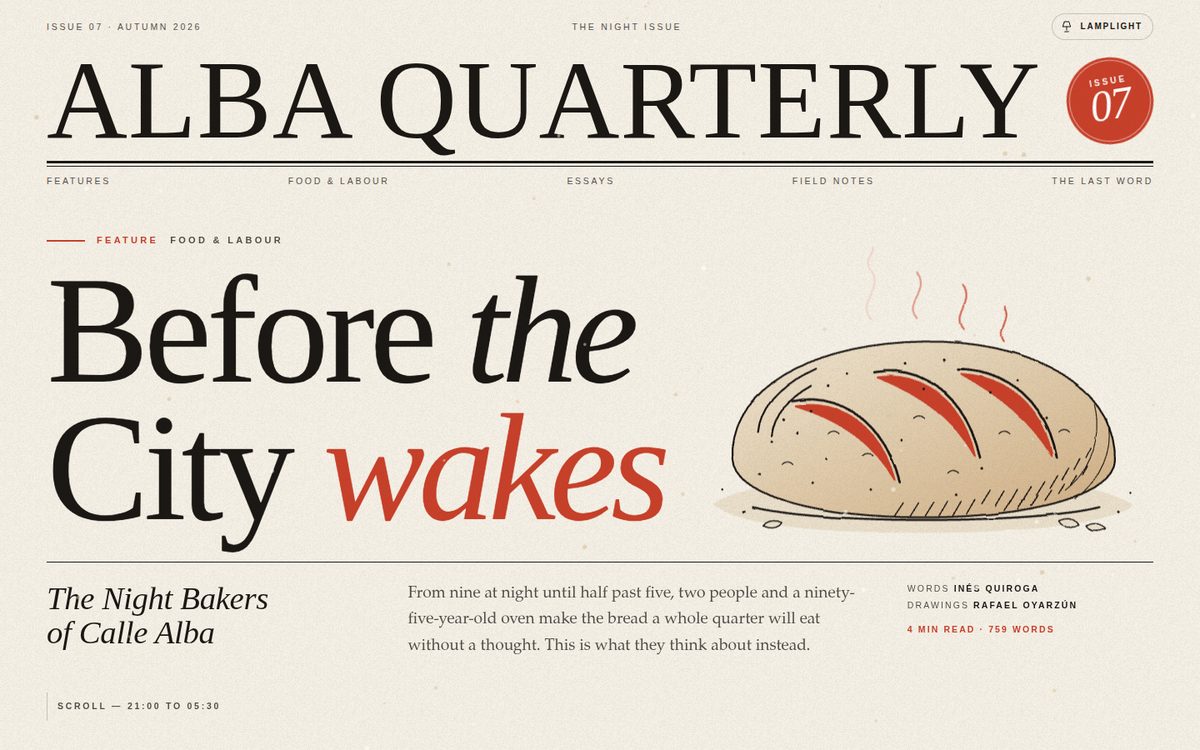
A printed-magazine feature that breathes on screen: issue 07 of the fictional "Alba Quarterly", carrying a 759-word, second-by-second account of two night bakers, Marta and Tomás, working the hearth oven of Horno Ferrer on Calle Alba from 21:00 to 05:30. The page opens on a full-width Didone wordmark with a rotated ember "Issue 07" stamp, a double rule and a spaced-grotesque section strip, then a monumental headline, "Before the City wakes", set in roman and italic with the last word in ember and a large hand-drawn boule at its right that draws itself line by line, steam curling off it. Seven timed chapters follow (21:00 the key, 22:15 flour water salt, 23:30 the fire, 01:00 shaping, 02:30 the hearth, 04:00 the singing, 05:30 the city wakes), each opened by a giant italic ember clock time over a hairline, set in justified two-column text with column rules, a drop cap with a small-caps lead-in, soft hyphenation and hanging punctuation. Four engraved line illustrations (a bearded wheat stalk, a whisk and enamel bowl, a domed brick oven with logs, flames and peel, and an annotated top view of a loaf being scored) draw themselves as they scroll into view. Three giant pull-quotes, an "At a glance" strip, a wide "A loaf by numbers" data box with tiny animated bars, and a closing recipe card that folds open in three hinged panels complete the spread. A sticky "Timeline of a night" sidebar runs a live night clock that advances from 21:00 towards 06:00 as you read, a thin ember reading-progress line and a slim sticky bar give reading time left, faint flour dust drifts across the whole page, and a "Lamplight" switch turns the paper page into a warm ink-and-cream night edition.
Open
Original prompt
Design a long-form editorial magazine article "Before the City Wakes — The Night Bakers of Calle Alba". Palette: paper #f5f0e6, ink #1a1714, ember red #c8402a, flour tint #e9dfcb. Layout: an oversized masthead "ALBA QUARTERLY — Issue 07"; a hero headline in a Didone serif at huge scale with mixed italics and an inline SVG bread illustration; a drop cap; two or three columns of text on desktop with hyphenation and hanging punctuation; giant pull-quotes; a sticky sidebar "Timeline of a night" listing times from 21:00 to 05:30 whose current item highlights as you scroll; a thin sticky reading-progress line; line illustrations (loaf scoring, whisk, wheat stalk, brick oven) that draw themselves on scroll via stroke-dashoffset; faint flour dust drifting on a canvas; a data box "A loaf by numbers" with tiny bars; small italic captions; an end-of-article recipe card that folds open. Write about 700 words of genuinely good, sensory, specific prose (characters like Marta and Tomás, the smell, the sound of the peel on the hearth) — no filler. Type: Didone/old-style serif for text, spaced grotesque capitals for labels; a reading-time estimate. The result should feel like a printed magazine spread that breathes on screen. TECHNICAL REQUIREMENTS: Deliver one completely self-contained, standalone HTML5 file with all CSS inline in a <style> tag and all JavaScript inline in a <script> tag. No external dependencies of any kind: no CDN, no external fonts (system font stacks only), no external images, no external SVG files, no libraries, no network requests. It must work by simply opening the file in a browser, fully offline. It must be responsive from 360px phones to large desktops, validate as standard HTML5, respect prefers-reduced-motion, support mouse and touch input, and run without console errors. Hand-craft it as a premium, award-worthy piece of digital art with real, evocative copy (no lorem ipsum), a disciplined palette, careful typography, polished motion and delightful details.
017-editorial-night-bakers.txt
018
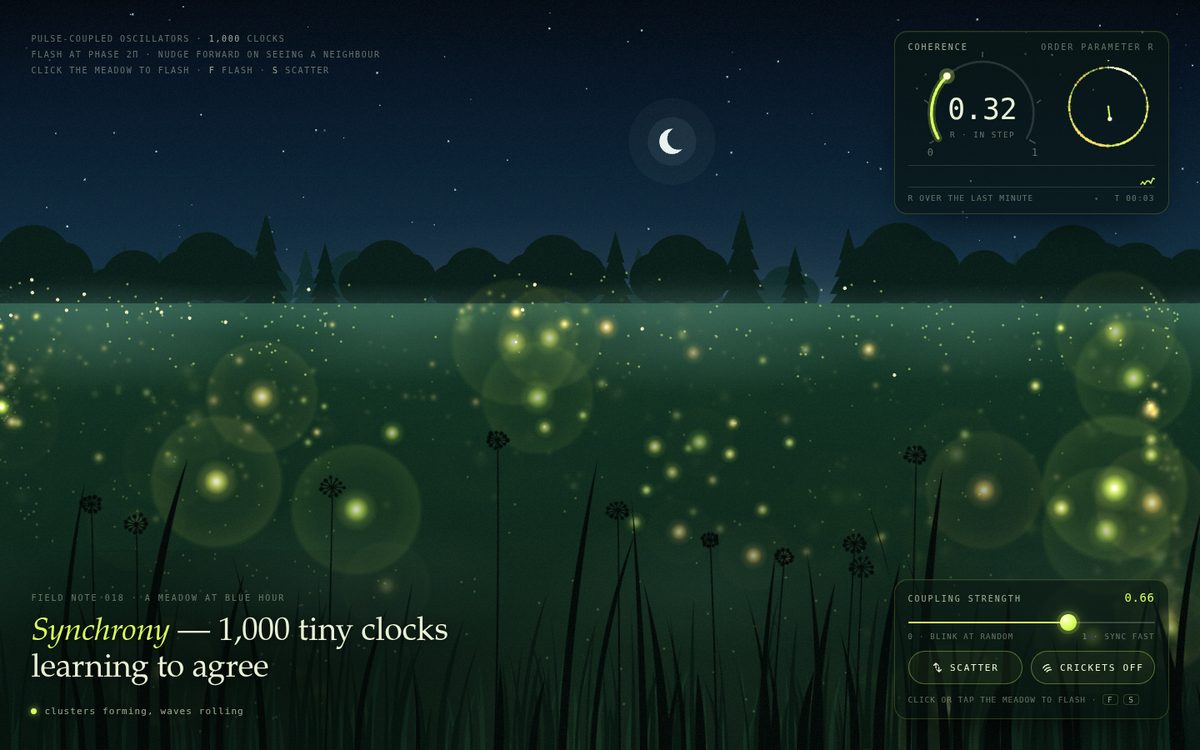
A blue-hour meadow in which 1,000 pulse-coupled fireflies (the 140 nearest drawn as large bokeh orbs, the rest as smaller and smaller glimmers towards a far tree line) slowly learn to flash together. Each firefly is an oscillator with its own natural frequency; it flashes when its phase wraps and, when it sees a neighbour flash, nudges its own phase forward, with absorption so that clusters snap into step and phase waves roll across the meadow. Glowing lime-to-amber orbs drift on curl-like flow fields over a dusk scene of gradient sky, stars, a thin crescent moon, layered conifer and crown tree lines, drifting mist and three layers of swaying grass and seed-head silhouettes, while the ground itself brightens whenever the swarm flashes in unison. A glass HUD shows the order parameter r as a thin arc gauge with live number, a unit-circle phase plot of every oscillator with the mean-field arrow, and a one-minute sparkline. A quiet serif caption reads "Synchrony — 1,000 tiny clocks learning to agree" beside a live poetic status line and tiny mono notes.
Open
Original prompt
Simulate synchronising fireflies (a pulse-coupled Kuramoto-style model) in a summer meadow at blue hour, titled "Synchrony". About 140 fireflies each have a phase θ and slightly different natural frequency ω; glow intensity is a sharp pulse of phase (flash at θ = 2π, then decay); when a firefly sees a nearby neighbour flash it nudges its phase forward, so the swarm gradually synchronises into rolling waves. Visuals: meadow gradient #0a1a14 to #123524; layered SVG/CSS grass blade silhouettes swaying in the foreground; a distant tree line; soft mist; fireflies as additive amber-lime (#d9ff5c / #ffd166) orbs with bokeh halos drifting on curl-noise paths. A "coherence" meter shows the order parameter r as a thin arc gauge with a live number, plus a small phase-circle plot of oscillators as dots on a unit circle. Interaction: click to flash near the pointer and force nearby fireflies forward; a "Coupling strength" slider (0–1) — at zero they blink randomly, at high values they sync quickly; a "Scatter" button re-randomises phases. Type: a quiet serif caption "Synchrony — 1,000 tiny clocks learning to agree" and tiny mono notes. Optional soft cricket ambience (WebAudio), default off. TECHNICAL REQUIREMENTS: Deliver one completely self-contained, standalone HTML5 file with all CSS inline in a <style> tag and all JavaScript inline in a <script> tag. No external dependencies of any kind: no CDN, no external fonts (system font stacks only), no external images, no external SVG files, no libraries, no network requests. It must work by simply opening the file in a browser, fully offline. It must be responsive from 360px phones to large desktops, validate as standard HTML5, respect prefers-reduced-motion, support mouse and touch input, and run without console errors. Hand-craft it as a premium, award-worthy piece of digital art with real, evocative copy (no lorem ipsum), a disciplined palette, careful typography, polished motion and delightful details.
018-firefly-sync.txt
019
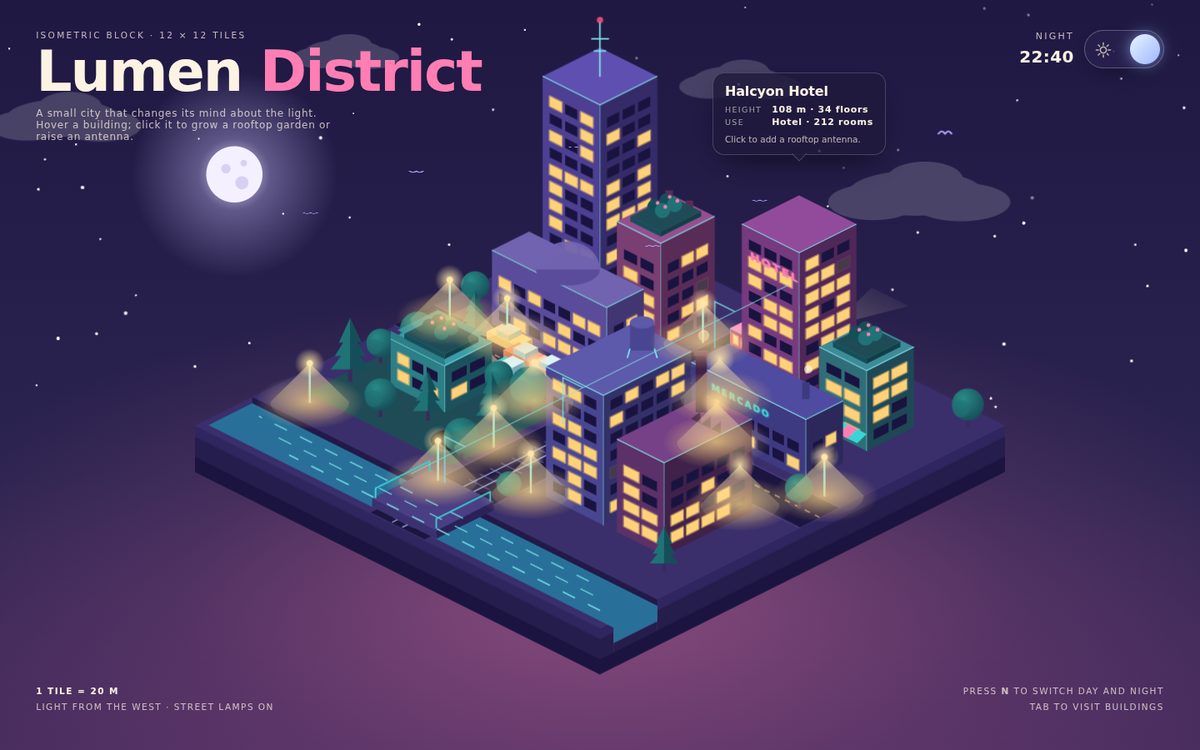
A floating 12 x 12 isometric city block drawn entirely from SVG polygons: nine extruded buildings (an office tower with antenna, terracotta housing with a rooftop garden, a domed library, a neon-signed hotel, a striped-awning cafe, a market with a steaming vent, lofts with a water tank, a ceramics works with a smoking chimney and a glass conservatory), a park of round trees and pines, a road cross with zebra crossing, a tram line with overhead wire crossing a river on a small bridge, street lamps, and cars with headlights and tail-lights. The slab shows layered ground strata and a river notch. A pill switch flips the whole scene between a violet-and-pink night, with lit windows in shifting patterns, lamp cones, headlight beams, glowing neon, stars and a rising moon, and a cream-and-sky morning with terracotta and olive materials, soft long shadows, clouds and a low sun. A hot-air balloon drifts, birds cross the sky, and steam curls from vents.
Open
Original prompt
Illustrate an SVG isometric mini-city block titled "Lumen District". Buildings: 8–12 extruded prisms with roof details, a park with trees, a road grid with small isometric cars (with head- and tail-lights) driving along paths, a tram line, a river with a bridge, glowing street lamps. A day/night toggle smoothly changes the palette: at night windows light in shifting patterns (some flicker), light cones spill on roads, a moon rises; by day it is pastel morning light with long soft shadows. Hovering a building lifts it 8px with a shadow and shows a floating info tag (name, height, use); clicking toggles a rooftop garden or antenna. Palette (night): dusk violet #2b2350, pink #ff7eb3, teal #37d5d6, warm windows #ffd27a; (day): cream #fdf3e3, sky #bfe7f2, terracotta #e07a5f, olive #81b29a. Type: a rounded sans title and micro-labels. Add tiny scene animations: birds, a hot-air balloon drifting, steam from a vent, a blinking neon sign. Draw everything as hand-authored SVG polygons using a small isometric-projection helper in JS for coordinates; the visual design must be handmade and consistent (same light direction, same edge highlights). TECHNICAL REQUIREMENTS: Deliver one completely self-contained, standalone HTML5 file with all CSS inline in a <style> tag and all JavaScript inline in a <script> tag. No external dependencies of any kind: no CDN, no external fonts (system font stacks only), no external images, no external SVG files, no libraries, no network requests. It must work by simply opening the file in a browser, fully offline. It must be responsive from 360px phones to large desktops, validate as standard HTML5, respect prefers-reduced-motion, support mouse and touch input, and run without console errors. Hand-craft it as a premium, award-worthy piece of digital art with real, evocative copy (no lorem ipsum), a disciplined palette, careful typography, polished motion and delightful details.
019-isometric-night-city.txt
020
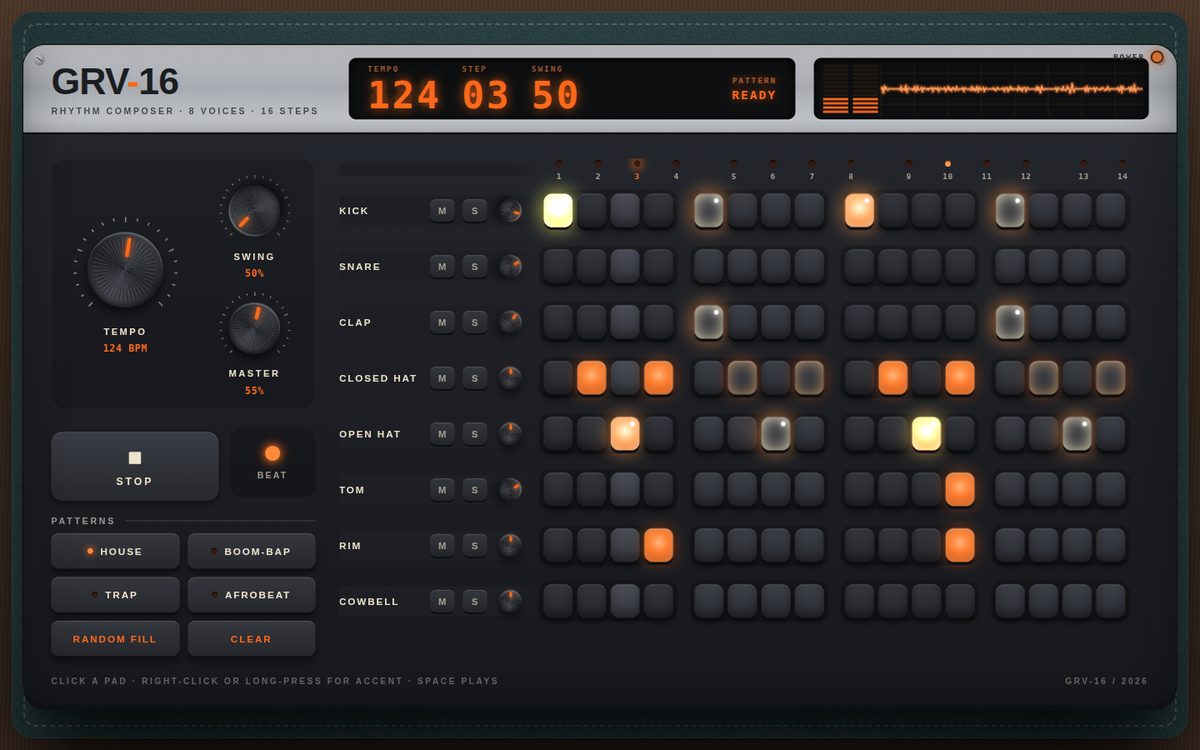
A charcoal drum machine sitting on a teal felt desk mat with a stitched border, a wooden desk edge, a soft vignette and a pencil that jumps with the kick. The device has a brushed-metal top strip with the GRV-16 wordmark, an amber LED display (tempo, step, swing, pattern name) and a phosphor oscilloscope with a segmented VU meter; below it a knob cluster (large Tempo, Swing, Master), a Play/Stop key with beat LED, four pattern keys plus Random fill and Clear, and a sequencer of eight rows (Kick to Cowbell), each with M and S buttons, a small volume knob and sixteen rubber pads grouped in fours. Active pads glow orange from within, accented steps burn hotter with a white spark, and a playhead LED strip and lit column follow the beat. All eight voices are synthesised live with WebAudio. A friendly "Tap to power on" screen unlocks audio, boots the display and starts the House pattern at a modest level.
Open
Original prompt
Design "GRV-16", a tactile hardware-style drum machine as a web instrument. Skeuomorphic device: matte charcoal body #1d1f24 with a brushed-metal top strip, orange accent #ff6a1a, cream silk-screened labels, 16 rubber-look step pads in a row (rounded squares with inner LED glow when active and a moving playhead), 8 track rows (Kick, Snare, Clap, Closed Hat, Open Hat, Tom, Rim, Cowbell) each with mute/solo mini buttons and a volume knob, big rotary knobs for Tempo (60–180), Swing and Master (drag to turn; wheel and keyboard supported), and a Play/Stop transport with LED. Sound: fully synthesised with WebAudio — kick (sine sweep + click), snare (noise + tone), clap (bursts of filtered noise), hats (high-passed noise plus metallic square oscillators), tom, rim, cowbell; precise look-ahead scheduling with audioContext.currentTime; per-step accent via right-click or long-press. Preset patterns (House, Boom-Bap, Trap, Afrobeat) and a Random fill; a small VU meter / oscilloscope on canvas. Present the device on a desk mat with soft shadows and a subtle vignette; on mobile the grid scrolls or rotates gracefully. Show a friendly "Tap to power on" overlay so audio starts on the first gesture; master volume default modest. TECHNICAL REQUIREMENTS: Deliver one completely self-contained, standalone HTML5 file with all CSS inline in a <style> tag and all JavaScript inline in a <script> tag. No external dependencies of any kind: no CDN, no external fonts (system font stacks only), no external images, no external SVG files, no libraries, no network requests. It must work by simply opening the file in a browser, fully offline. It must be responsive from 360px phones to large desktops, validate as standard HTML5, respect prefers-reduced-motion, support mouse and touch input, and run without console errors. Hand-craft it as a premium, award-worthy piece of digital art with real, evocative copy (no lorem ipsum), a disciplined palette, careful typography, polished motion and delightful details.
020-groove-box.txt
021
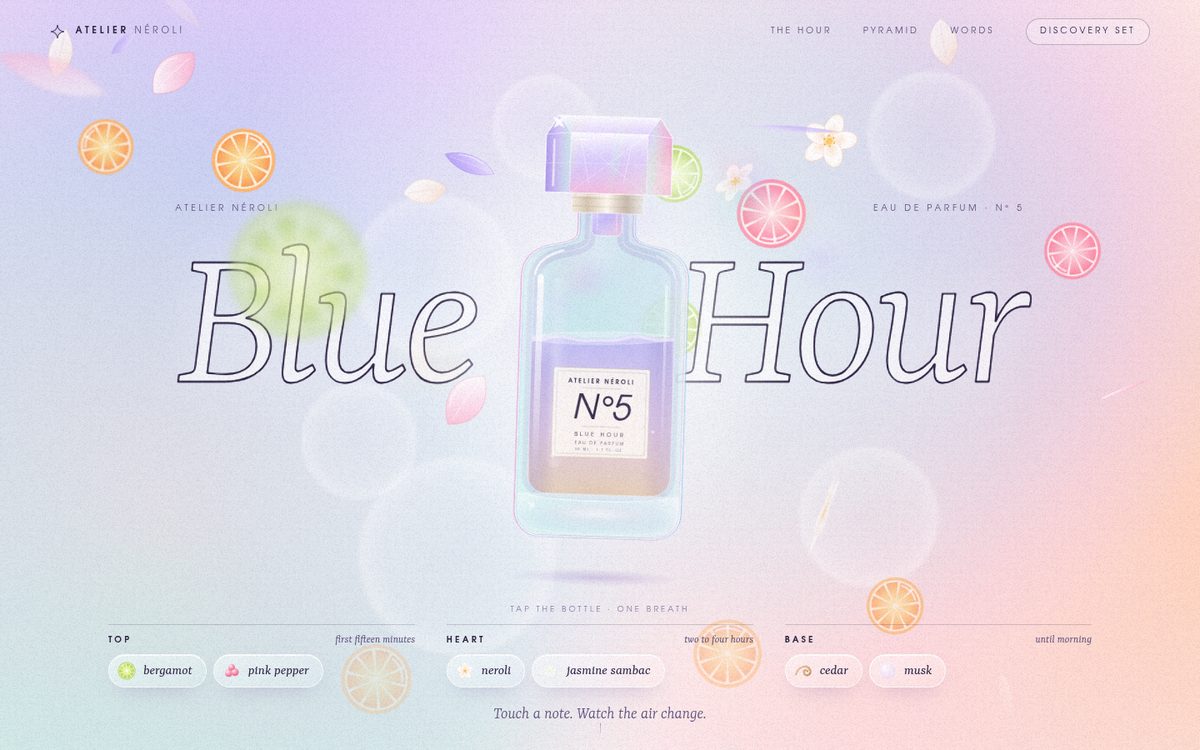
A weightless, dreamlike one-page launch for an imaginary perfume, Eau de Parfum N°5 "Blue Hour". A fixed canvas paints a soft-focus world of slowly morphing lavender, apricot, seafoam and milky-pink blobs, with drifting bokeh rings and a film-grain veil. In the hero a hand-drawn SVG flacon floats between the glass-outlined italic words "Blue" and "Hour": faceted lavender crystal cap, champagne collar, thick glass foot, a dusk-to-apricot liquid with a shimmering, counter-tilting meniscus, tiny label typography, and an inverted, magnified refraction of the live background inside the glass. SVG petals, citrus wheels, blossoms, peppercorns, wood shavings and pearls drift upward with parallax and slow rotation. Six glass note pills (Top: bergamot, pink pepper; Heart: neroli, jasmine sambac; Base: cedar, musk) re-tint the whole world and morph every floating particle into that note's motif while a sensory caption fades in. Scrolling reveals a light italic Didone story paragraph that surfaces word by word, a thin-line scent pyramid that draws itself with rising scent molecules and tier-aligned notes, three floating frosted-glass review cards with pointer-tracked sheen, and a "Discovery set" pill with a flowing pastel gradient and shimmer sweep above a row of five little vials. A faint perfume-mist trail follows the cursor. As you scroll the light deepens to dusk and closes in apricot dawn.
Open
Original prompt
Create a dreamlike premium landing page for "Atelier Néroli — Eau de Parfum No. 5, Blue Hour". Hero: a soft-focus pastel gradient world (lavender #cdb8ff, apricot #ffcfa8, seafoam #b6f0e0, milky pink #ffd9e8) as slowly morphing blurred blobs with grain; centre: a glass perfume bottle drawn in SVG (transparent gradient glass, faceted cap, liquid level with a shimmering meniscus, tiny label type) floating gently and refracting the moving background; petals and citrus slices (SVG shapes) drift with parallax and slow rotation. Hovering the note pills (Top: bergamot, pink pepper / Heart: neroli, jasmine sambac / Base: cedar, musk) shifts the background hue and changes the floating particles to that note's motif (citrus wheels, white petals, wood shavings). On scroll: a story paragraph in light italic Didone, a thin-line "scent pyramid" diagram that animates in, three reviews as glass cards, and a "Discovery set" CTA pill with a shimmering gradient. Type: ultra-light high-contrast serif for display, tiny tracked caps for labels. Micro-detail: the cursor leaves a faint perfume-mist trail (canvas particles). The mood is airy, slow and weightless, with copy that smells like something. TECHNICAL REQUIREMENTS: Deliver one completely self-contained, standalone HTML5 file with all CSS inline in a <style> tag and all JavaScript inline in a <script> tag. No external dependencies of any kind: no CDN, no external fonts (system font stacks only), no external images, no external SVG files, no libraries, no network requests. It must work by simply opening the file in a browser, fully offline. It must be responsive from 360px phones to large desktops, validate as standard HTML5, respect prefers-reduced-motion, support mouse and touch input, and run without console errors. Hand-craft it as a premium, award-worthy piece of digital art with real, evocative copy (no lorem ipsum), a disciplined palette, careful typography, polished motion and delightful details.
021-fragrance-atelier.txt
022
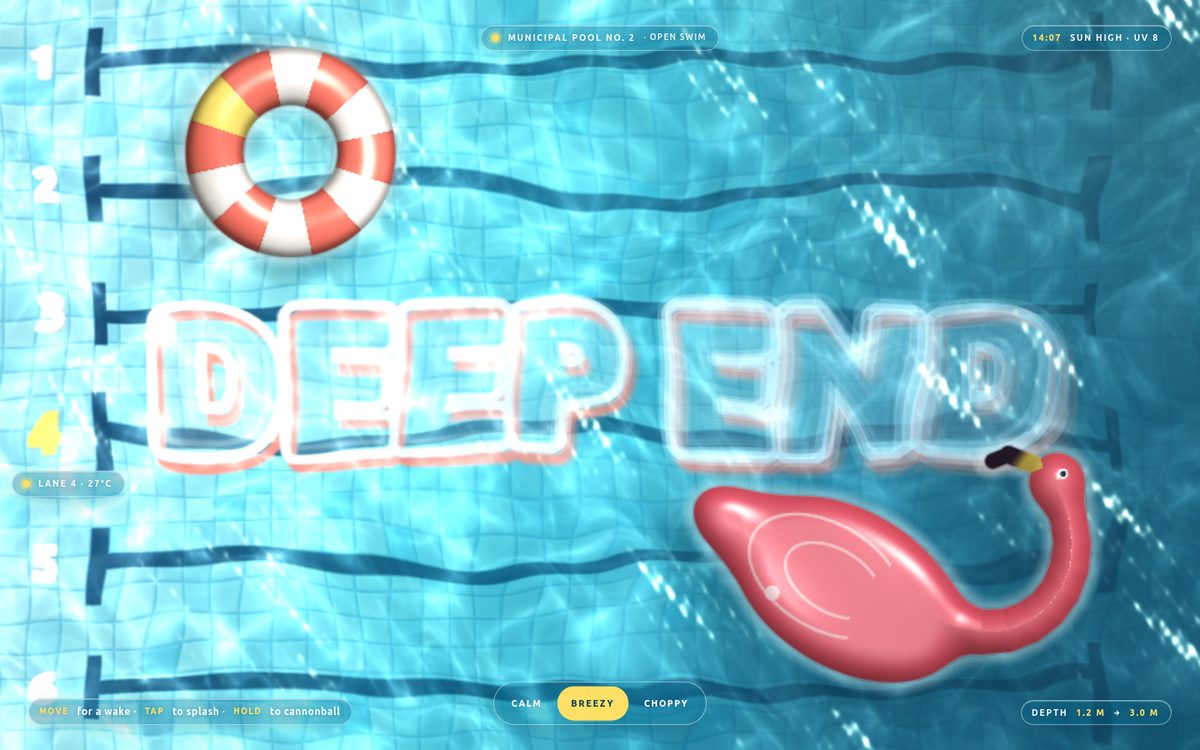
A full-screen WebGL pool seen from directly above on a bright afternoon. One fragment shader paints the whole scene: a white-and-pale-blue tile floor with grout, bevels and per-tile colour variance; six swimmer lane lines with T-marks and painted lane numbers (lane 4 in sun yellow); two layers of the classic iterative sine caustic riding on top; and a water surface whose slopes (five travelling waves, pointer wakes and click splashes) refract everything beneath it. Depth runs from a bright, pale aqua shallow end to a saturated turquoise-to-#0a6f9a deep end, with softer caustics and dimmer floor detail as it deepens. Sun glints sparkle where wave slopes match the sun, with a warm glare in the top-right corner. A giant bubble-outlined "DEEP END" (white rounded outline with a coral drop shadow, drawn in an offscreen canvas) is painted on the floor, wobbling with the same refraction and blurring and dimming as it sinks toward the deep side. A shaded inflatable coral-and-white ring and a glossy flamingo float (signed-distance shapes with rounded-volume lighting, seams, wings, beak and eye) bob, drift, bump into each other and get pushed by splashes and swimming pointers. Tiny rounded-caps signage labels ("Lane 4 · 27°C", sun and depth tags) and a Calm / Breezy / Choppy switch sit on the water. Without WebGL a CSS fallback with animated radial-gradient caustics, tile grid, lane lines, a striped ring and outlined lettering appears.
Open
Original prompt
Build a WebGL sun-drenched swimming-pool scene "Deep End" — a top-down view of a tiled pool floor with dancing caustic light patterns and a gently rippling surface. The fragment shader draws: a procedural tile grid (white-blue tiles with grout lines and slight per-tile colour variance), animated caustics (the classic iterative sin-based "tileable water caustic", layered at two scales and speeds), refraction offset of the tiles by a normal map derived from the water height (moving waves plus click ripples), specular sun glints, a soft depth gradient (deeper = more saturated turquoise #00b8c8 to #0a6f9a), swimmer lane lines (dark strips on the floor), and floating objects — an inflatable ring and a flamingo float drawn as shaded 2D shapes that bob with the waves. The pointer creates wake ripples; click/tap drops a splash with expanding rings. Type: a giant playful outlined "DEEP END" in a heavy rounded sans, partly submerged and distorted by the same refraction (render the text to an offscreen canvas used as a texture in the shader), and tiny labels "Lane 4 · 27°C". Palette: aqua, white, sun-yellow #ffe066, coral #ff7a6b. Fallback without WebGL: CSS animated radial gradients. Summery, bright, cheerful. TECHNICAL REQUIREMENTS: Deliver one completely self-contained, standalone HTML5 file with all CSS inline in a <style> tag and all JavaScript inline in a <script> tag. No external dependencies of any kind: no CDN, no external fonts (system font stacks only), no external images, no external SVG files, no libraries, no network requests. It must work by simply opening the file in a browser, fully offline. It must be responsive from 360px phones to large desktops, validate as standard HTML5, respect prefers-reduced-motion, support mouse and touch input, and run without console errors. Hand-craft it as a premium, award-worthy piece of digital art with real, evocative copy (no lorem ipsum), a disciplined palette, careful typography, polished motion and delightful details.
022-caustic-pool.txt
023
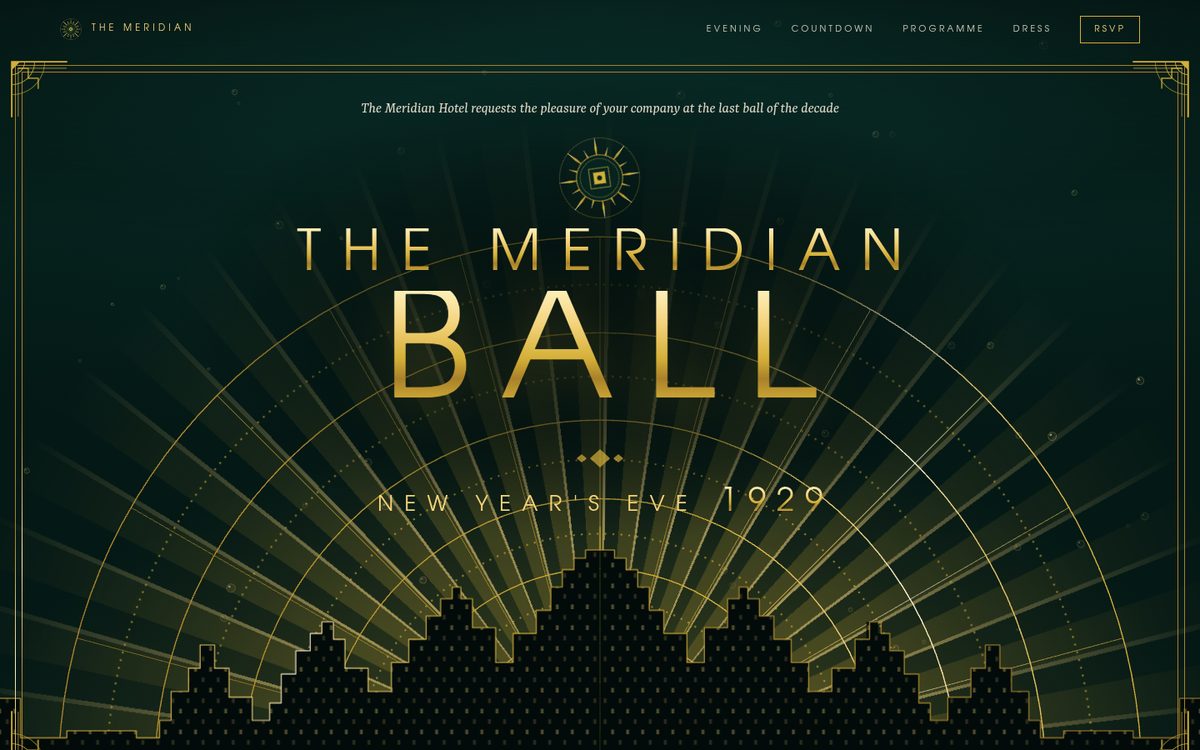
A one-page Art Deco invitation in midnight emerald and burnished gold. The hero is a poster: a huge sunburst of conic-gradient rays radiating from the bottom centre behind a stepped, lit-window skyline whose gold outline draws itself, concentric SVG fan arcs and dotted rings whose gold sheen sweeps across, a double-line gilded frame drawn clockwise with stepped-fan corner ornaments, a slowly rotating starburst, and the title THE MERIDIAN / BALL in thin geometric caps with a gold gradient and shimmer, over a deco rule and the date. Below, ziggurat, chevron and scallop-fan bands divide the sections: The Evening (italic poem, table CTA and three chamfered fact cartouches), a live countdown to the next 31 December midnight with digits in chamfered cartouches, a seven-stop programme timeline on a gold centre line with deco diamond bullets that light as you scroll, a gilded dress-code card with line icons, and an RSVP form (name, guest stepper, champagne-tower switch). Submitting bursts gold confetti and sparkles on canvas and swaps in a thank-you card with a reference number and, if chosen, an SVG champagne tower. Faint champagne bubbles rise behind everything.
Open
Original prompt
Design an Art Deco invitation website for "THE MERIDIAN BALL — New Year's Eve 1929", an entirely graphic experience for a fictional grand hotel. Palette: midnight emerald #06231f, deep teal #0d4a44, burnished gold #d4af37 / #f3d27a / #a9812a, ivory #f7f0dc, black. Elements: fan and sunburst patterns radiating from the bottom centre (repeating conic-gradients plus SVG), stepped ziggurat borders, chevrons, gilded double-line frames with corner ornaments, a slowly rotating starburst ornament, gold shimmer sweeping across lines (animated gradient masks), and gold hairlines that draw themselves in sequence at load (stroke-dashoffset). Typography: a stately geometric all-caps display (Futura / Century Gothic / Trebuchet stack) with wide tracking and thin weight, paired with an elegant italic serif for the poetry. Content: a live countdown to the next Dec 31 midnight with digits inside deco cartouches; the evening's programme as a timeline with deco bullets; a dress code card ("Black tie, jewels encouraged"); and an RSVP form (name, guests, a "champagne tower" toggle) that, on submit, bursts gold confetti on canvas and shows a thank-you card — nothing leaves the page. Delights: hovering gold ornaments sparkles them; faint champagne bubbles rise in the background. TECHNICAL REQUIREMENTS: Deliver one completely self-contained, standalone HTML5 file with all CSS inline in a <style> tag and all JavaScript inline in a <script> tag. No external dependencies of any kind: no CDN, no external fonts (system font stacks only), no external images, no external SVG files, no libraries, no network requests. It must work by simply opening the file in a browser, fully offline. It must be responsive from 360px phones to large desktops, validate as standard HTML5, respect prefers-reduced-motion, support mouse and touch input, and run without console errors. Hand-craft it as a premium, award-worthy piece of digital art with real, evocative copy (no lorem ipsum), a disciplined palette, careful typography, polished motion and delightful details.
023-art-deco-gala.txt
024
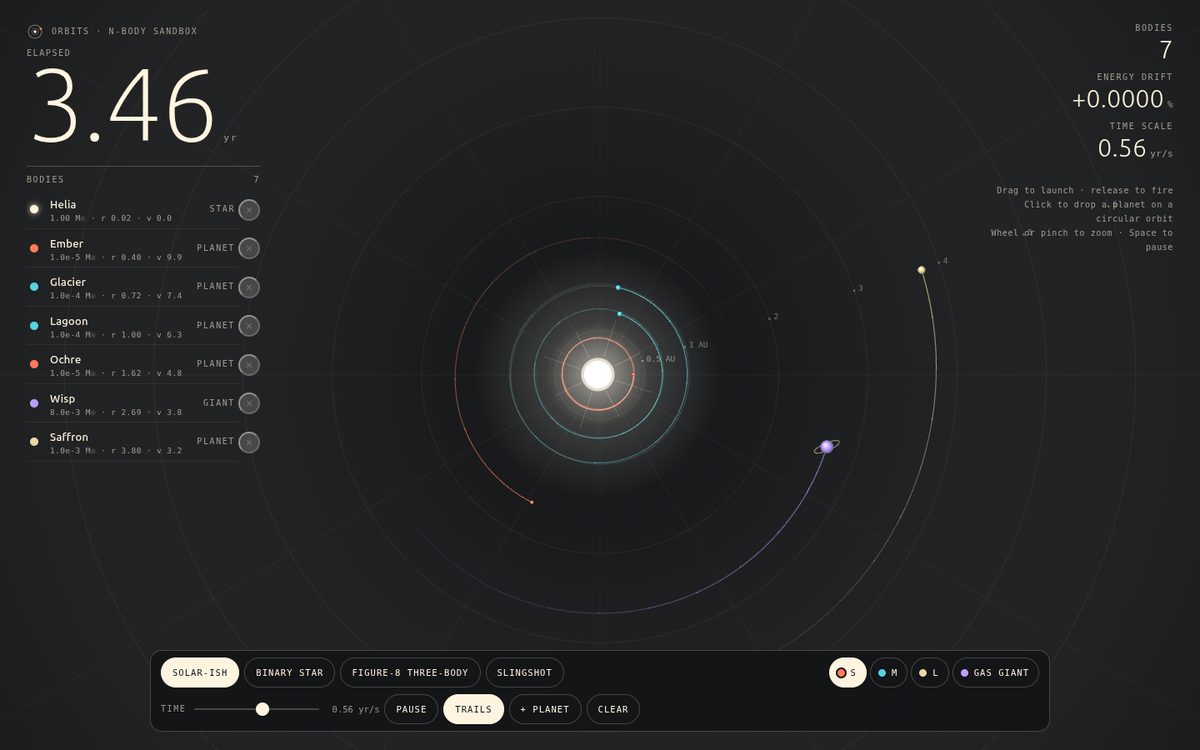
An editorial n-body sandbox on charcoal. Real units: distances in AU, time in years, G = 4 pi^2, so a planet at 1 AU with speed 2 pi AU/yr circles a one-solar-mass star in exactly a year. A warm-white star sits at the centre with a soft glow, slowly turning corona rays and a pulsing halo; faint polar rings and mono AU labels measure range from the camera focus. A huge, light-weight year counter, mono micro-labels and a slim left rail listing every body (colour dot, mass, distance, speed, focus and delete) frame the canvas; readouts show body count, energy drift and time scale; a slim bottom toolbar holds presets, planet size (S coral, M cyan, L sand, Gas giant lilac), a time slider, pause, trails, add and clear. Dragging launches a planet with a live dashed trajectory that integrates all bodies 300 steps ahead, shows speed, eccentricity and semi-major axis, and snaps to a perfect circular orbit with a cyan reference tick. Planets leave fading trails, merge on contact conserving momentum with a light flash, and are removed when they escape. Presets: Solar-ish, Binary star with circumbinary and circumstellar planets, the exact Chenciner-Montgomery figure-8 (three coloured stars) scaled to 2 AU, and a Slingshot in which five probes fly at a moving gas giant and are flung out.
Open
Original prompt
Build "Orbits", a clean N-body gravity sandbox. Canvas with a warm-white star at the centre (glow plus slow corona pulse) on charcoal #101215 with faint polar grid rings and AU tick labels. Physics: Newtonian gravity with softening, leapfrog / velocity-Verlet sub-steps, dt clamped. Press-and-drag to launch a planet — a dashed predicted trajectory (integrated forward ~300 steps live) is drawn while dragging, and releasing fires it; mass via a small size selector (S / M / L / Gas giant) with colours coral #ff7a59, cyan #56d4e0, sand #e9d8a6, lilac #b8a1ff; planets leave fading trails; collisions merge bodies (conserve momentum) with a small flash; escaping bodies are removed. Presets in a slim bottom toolbar: "Solar-ish", "Binary star", "Figure-8 three-body" (Chenciner–Montgomery: equal masses, positions (−0.97000436, 0.24308753), (0.97000436, −0.24308753), (0,0); velocities (0.4662036850, 0.4323657300), (0.4662036850, 0.4323657300), (−0.9324073700, −0.8647314600) in G=1 units, scaled to the screen), "Slingshot". Controls: time-scale slider, trails toggle, clear. Readouts: body count, energy drift, elapsed years. Layout: editorial — mono small labels, a large light-weight numeral for the year counter in a humanist sans, and a slim left rail listing bodies (click to focus or delete). Palette: charcoal, warm white #fff4e0, coral, cyan, lilac. TECHNICAL REQUIREMENTS: Deliver one completely self-contained, standalone HTML5 file with all CSS inline in a <style> tag and all JavaScript inline in a <script> tag. No external dependencies of any kind: no CDN, no external fonts (system font stacks only), no external images, no external SVG files, no libraries, no network requests. It must work by simply opening the file in a browser, fully offline. It must be responsive from 360px phones to large desktops, validate as standard HTML5, respect prefers-reduced-motion, support mouse and touch input, and run without console errors. Hand-craft it as a premium, award-worthy piece of digital art with real, evocative copy (no lorem ipsum), a disciplined palette, careful typography, polished motion and delightful details.
024-orbital-sandbox.txt
025
A single-screen, flat, razor-sharp Swiss poster for the fictional "Structure / Rhythm — Festival of Sound Design, Basel 12–15 November 2026", built on paper white (#f4f2ee), ink black (#0b0b0b), Swiss red (#e4002b) and one mid grey. Twelve visible hairline columns, numbered 01–12 like a ruler, run the full height of the sheet and draw themselves in at load. A giant heavy-grotesque "26" is cropped by the right and bottom page edges; over its upper half sits a circle system of thirteen concentric rings built from hundreds of hairline ticks (dashed SVG circles) turning at different speeds and in alternating directions, with a 60-tick seconds dial and a red disc that orbits one ring at exactly 6 degrees per real second, trailed by a thin red elapsed-seconds arc, a red "hot" tick on the dial and a live second counter at the centre. The ring block is blended with mix-blend-mode: difference, so its strokes are black on the paper and flip to paper white wherever they cross the black numerals (an x-ray overlap that also works in the inverted theme). Text is flush-left / ragged-right in exactly three sizes: a heavy "Structure/Rhythm" lockup with a red slash, a lede paragraph, and small tabular text in the meta strip, table and footnote; every line sits on a shared baseline grid (press B to see it). A rotated line of tracked capitals runs up the left edge. A ledger-style programme table (four days, seven sessions each, tabular numerals, hairline rules) has a red bar that slides to the hovered or focused row. Four presets rearrange the same blocks: 1 Grid (type left, rings and numerals right), 2 Stack (one-line title, numerals and rings in a band, lede and wide table below, a taller sheet), 3 Diagonal (title top-left, rings centre, numerals bottom-right joined by a red diagonal rule) and 4 Poster (numerals stacked "2" over "6" bleeding off the left edge, huge rings, tiny text). Clicking the red disc inverts the whole poster to black with paper-white type through a circular reveal that opens from the disc. No gradients, no shadows, no rounded corners; the disc is the only round thing.
Open
Original prompt
Compose an International Typographic Style (Swiss) interactive poster "STRUCTURE / RHYTHM — Festival of Sound Design, Basel 2026". Palette: paper white #f4f2ee, Swiss red #e4002b, black #0b0b0b, one mid grey. A strict 12-column grid whose lines are visible as hairlines; huge numerals "26" in a heavy grotesque (Helvetica Neue / Arial Black stack) cropped by the page edge; a circle system of concentric rings made from many thin black strokes rotating at different speeds (SVG) with a red disc orbiting one ring, synchronised to real seconds; text set flush-left / ragged-right in three sizes with rigorous baseline alignment; vertical rotated text along an edge; a schedule table with tabular numerals and hairline rules where a red bar slides to the hovered row. Animation: grid lines draw in at load, blocks slide into place with a mechanical ease; on mouse move the columns compress and expand slightly toward the pointer (CSS grid-template-columns transitions). Interaction: clicking the red disc toggles invert mode (black background, white type); keys 1–4 switch four preset layouts (grid, stack, diagonal, poster). Keep it razor-sharp: no gradients, no shadows, no rounded corners. Copy in the voice of a design-festival programme. TECHNICAL REQUIREMENTS: Deliver one completely self-contained, standalone HTML5 file with all CSS inline in a <style> tag and all JavaScript inline in a <script> tag. No external dependencies of any kind: no CDN, no external fonts (system font stacks only), no external images, no external SVG files, no libraries, no network requests. It must work by simply opening the file in a browser, fully offline. It must be responsive from 360px phones to large desktops, validate as standard HTML5, respect prefers-reduced-motion, support mouse and touch input, and run without console errors. Hand-craft it as a premium, award-worthy piece of digital art with real, evocative copy (no lorem ipsum), a disciplined palette, careful typography, polished motion and delightful details.
025-swiss-poster-grid.txt
026
A full-bleed, living Gray–Scott reaction–diffusion reef that the visitor can paint into. A 320x200 grid (re-proportioned to the viewport's aspect at about 64,000 cells, so portrait phones get a tall grid) of two chemicals, A and B, is integrated in Float32Array typed arrays with the classic Laplacian (centre -1, edges 0.2, corners 0.05), Da 1.0 and Db 0.5, ten steps per frame, on a wrapping torus. The B field and its gradient are rendered through the coral-reef ramp (deep teal #06303a, turquoise #17a2a2, peach #ffb590, coral #ff6f59, cream #fff1de) with pseudo-3D emboss lighting: a WebGL2 fragment shader samples the field with cubic B-spline interpolation so the low-resolution simulation is scaled up smoothly into glossy, tubular coral with a specular light that follows the pointer, cast shadows on the deep-teal sea floor, animated caustics and fine grain. A floating cream panel (#fff8ef) holds the title "Coral Lab" set in a bold, soft, rounded-looking serif (heavy Bookman/Cooper-style stack thickened with a text stroke), the field notes "Turing patterns · Gray–Scott", five icon preset chips, feed and kill sliders, a small parameter map (x = k, y = f) with coloured behaviour zones drawn from the saddle-node curve, Seed and Erase tools, brush size and tempo sliders, Pause, Reset and an Atlas mode. The reef opens as a golden-angle seeded time-lapse that is already mature at first paint and keeps evolving. The presets were verified in a numerical model and on screen; Mitosis, Worms, Mazes and Coral use the briefed values, while Spots was moved from f 0.035 / k 0.065 (which merely duplicated Mitosis) to f 0.030 / k 0.062, which gives a distinct lattice of larger, stable dots.
Open
Original prompt
Create "Coral Lab", a Gray–Scott reaction–diffusion simulation you can paint into. Grid ~320×200 (scaled up smoothly), chemicals A and B, Laplacian weights (0.05 corners, 0.2 edges, −1 centre), Da = 1.0, Db = 0.5, feed f and kill k, 8–12 steps per frame in typed arrays. Render B (plus its gradient) through a palette with pseudo-3D emboss lighting — the "coral reef" ramp: deep teal #06303a, turquoise #17a2a2, peach #ffb590, coral #ff6f59, cream #fff1de. Presets as chips: Coral (f 0.0545, k 0.062), Mitosis (0.0367, 0.0649), Worms (0.078, 0.061), Mazes (0.029, 0.057), Spots (0.035, 0.065) — verify visually and adjust so each produces its characteristic pattern. Interaction: drag to paint seeds of B; an Erase tool; sliders for f and k plus a small 2D parameter-map picker (x = k, y = f) to click between behaviours; pause and reset. Layout: full-bleed simulation with a floating light panel (#fff8ef) on the left holding sliders and preset chips; title "Coral Lab" in a bold rounded serif; tiny field notes "Turing patterns · Gray–Scott". Seed a beautiful initial pattern so it looks alive immediately. TECHNICAL REQUIREMENTS: Deliver one completely self-contained, standalone HTML5 file with all CSS inline in a <style> tag and all JavaScript inline in a <script> tag. No external dependencies of any kind: no CDN, no external fonts (system font stacks only), no external images, no external SVG files, no libraries, no network requests. It must work by simply opening the file in a browser, fully offline. It must be responsive from 360px phones to large desktops, validate as standard HTML5, respect prefers-reduced-motion, support mouse and touch input, and run without console errors. Hand-craft it as a premium, award-worthy piece of digital art with real, evocative copy (no lorem ipsum), a disciplined palette, careful typography, polished motion and delightful details.
026-reaction-diffusion-coral.txt
027
A full-screen canvas synthwave drive. The sky runs violet #1a0b3d to magenta #a4126e to hot orange #ff7b3a at the horizon, with twinkling stars, a huge yellow-to-magenta sun whose horizontal cut-out stripes grow toward the bottom and drift continuously, and two ranges of wireframe mountains (magenta far, cyan near) built from a triangle mesh, contour lines and triple-stroke glowing ridges that pan as the road bends. Below the horizon a scanline-projected highway rushes at the viewer: alternating asphalt bands, magenta/violet rumble strips with cyan edge lines, yellow dashes, plus a neon grid on both sides (magenta perspective rails, cyan cross lines). Palm silhouettes with magenta rim light and neon lamp posts scale with perspective, oncoming headlights streak past on the left lane and tail-lights recede ahead. A hand-drawn SVG sports car seen from behind (wing, louvres, slatted glowing tail-light bars, plate, exhausts with boost flames, wheels with moving tread) steers and rolls with the input. The chrome-gradient italic OUTRUN title has a pink neon glow with a cyan 1986; the HUD has a seven-segment speedometer with LED tach bars, score, distance and top speed, and a fake "Radio: Night Drive FM" cassette deck with spinning reels, a marquee and VU meters driven by a real analyser. CRT touches: scanlines with flicker, a rolling refresh bar, vignette, RGB-split chromatic aberration.
Open
Original prompt
Create "OUTRUN 1986", an animated retro synthwave driving scene with a steer-able car. Canvas (or CSS/SVG): sky gradient from violet #1a0b3d to magenta #a4126e to hot orange #ff7b3a at the horizon; a huge striped sun (horizontal cut-outs growing toward the bottom, animated); starfield; a distant mountain range in wireframe magenta/cyan with glowing edges; a perspective road with a dashed centre line rushing toward the viewer; neon grid on both sides; palm-tree silhouettes passing at the edges, scaling with perspective; a rear-view car drawn in SVG with glowing tail-lights and wheel motion that steers left/right with pointer x, arrow keys or device tilt; speed increases while holding the mouse or Space, and the road curves gently with the wheel; occasional oncoming light streaks. Title "OUTRUN 1986" in a chrome-gradient italic heavy sans with pink neon glow; a HUD with mono speedometer numerals and a fake "RADIO: NIGHT DRIVE FM" tape-deck widget. Colours: magenta #ff2e97, cyan #00e5ff, yellow #ffd319, base #12082c. Retro touches: CRT vignette, slight chromatic aberration, scanline flicker. Optional synthesised arpeggio bassline (WebAudio) toggle, default off. TECHNICAL REQUIREMENTS: Deliver one completely self-contained, standalone HTML5 file with all CSS inline in a <style> tag and all JavaScript inline in a <script> tag. No external dependencies of any kind: no CDN, no external fonts (system font stacks only), no external images, no external SVG files, no libraries, no network requests. It must work by simply opening the file in a browser, fully offline. It must be responsive from 360px phones to large desktops, validate as standard HTML5, respect prefers-reduced-motion, support mouse and touch input, and run without console errors. Hand-craft it as a premium, award-worthy piece of digital art with real, evocative copy (no lorem ipsum), a disciplined palette, careful typography, polished motion and delightful details.
027-vaporwave-outrun.txt
028
A 1970s-modernist transit diagram on off-white #f7f5f0: five coloured lines (Red, Blue, Green, Amber, Violet) built only from horizontal, vertical and 45-degree segments with rounded corners, plus a thin grey Ring line, 27 stations in total. Ordinary stations are white circles with a coloured outline, fifteen interchanges are larger white circles with black outlines and heavier labels, names are set in a Helvetica-style grotesque, horizontally or at 45 degrees so they clear the lines. Context shapes are a light-blue river band that winds under the lines, two pale-green parks, and three tinted zone bands. The header has a bold tracked "METRO LUMEN" wordmark with an SVG roundel (red ring, blue bar, white LUMEN). A legend lists the lines; hovering or focusing an entry isolates that line by fading everything else. Hovering or focusing a station opens a white card with the station name, line chips and the next two arrivals in each direction. Clicking two stations plans a journey: a Dijkstra search over station-line states with a 4-minute interchange penalty draws the route as a thick white-cased coloured glowing path with A and B pins, and the side panel shows total minutes, changes and a numbered step list. Small white train dots run along every line, easing in and out of each station with a short dwell; the Rush hour toggle doubles the trains, shortens headways, raises the interchange penalty and pulses the interchange rings.
Open
Original prompt
Design a transit-map masterpiece "Metro Lumen" — a fictional subway network in the spirit of classic 1970s modernist transit design. SVG map on off-white #f7f5f0 with five lines using only horizontal, vertical and 45° segments with rounded corners: Red #e63946, Blue #1d70b8, Green #2a9d5c, Amber #f4a300, Violet #7b3fa0, plus a thin grey ring line; about 28 stations drawn as white ticks/circles with interchanges as larger white circles with black outlines; station names in a clean grotesque, set horizontally or at 45°; a river (light blue band) and a park (pale green) as context shapes; a legend and zone bands. Interactions: hovering a line in the legend isolates it; hovering a station shows a card with name, lines and next arrivals; clicking two stations computes the shortest route (BFS/Dijkstra with interchange penalties) and draws it as a thick glowing path with a step list ("Board Red toward X · 4 stops · change at Y") and total minutes; small animated train dots travel along every line (getPointAtLength) with a subtle ease at stations; a "Rush hour" toggle adds trains and pulses. Title lockup "METRO LUMEN" with a roundel logo drawn in SVG. Keyboard-accessible station buttons. The geometry and typography should be genuinely elegant. TECHNICAL REQUIREMENTS: Deliver one completely self-contained, standalone HTML5 file with all CSS inline in a <style> tag and all JavaScript inline in a <script> tag. No external dependencies of any kind: no CDN, no external fonts (system font stacks only), no external images, no external SVG files, no libraries, no network requests. It must work by simply opening the file in a browser, fully offline. It must be responsive from 360px phones to large desktops, validate as standard HTML5, respect prefers-reduced-motion, support mouse and touch input, and run without console errors. Hand-craft it as a premium, award-worthy piece of digital art with real, evocative copy (no lorem ipsum), a disciplined palette, careful typography, polished motion and delightful details.
028-metro-lines.txt
029
A dark-velvet card table under a soft spotlight beam, with dust motes drifting in the light. A giant foil-gradient "COSMIC FAUNA" headline sits above a hand of six 5:7 collector cards fanned in an arc: Nebula Fox, Comet Whale, Prism Moth, Lantern Jelly, Void Owl and Aurora Stag. Each card has an original geometric SVG illustration, a condensed-bold name bar, HP and type badge, mono species strip, two attacks with energy pips, italic flavour text and rarity stars. Rarities use four foil styles: regular rainbow, cosmos texture, gold etched and noisy rainbow-rare. Clicking a card lifts it to the centre with a full 3D spin, flanked by field-notes and specimen-data panels; clicking it again flips it to a holo star-map back with that creature's constellation. A "Open a pack" button gathers the cards face down, riffle-shuffles, draws three at random and flips them in a cascade with particle bursts.
Open
Original prompt
Create "Cosmic Fauna — Collector Cards", a set of six holographic trading cards you can tilt and flip. Each card (5:7 ratio) has an original SVG illustration (Nebula Fox, Comet Whale, Prism Moth, Lantern Jelly, Void Owl, Aurora Stag — stylised geometric shapes and gradients), a name bar, type/HP stats, a line of flavour text and rarity marks. Holo effect: pointer move (or device orientation) rotates the card in 3D (max 15°) and updates CSS variables for the foil position; foil = layered gradients — a rainbow linear-gradient at 115°, a conic "sparkle" layer masked with tiny stars, and a glare radial-gradient following the pointer — blended with mix-blend-mode (color-dodge / overlay / soft-light); rarities have different foil styles (regular rainbow, cosmos texture, gold etched, noisy rainbow-rare). Layout: a dark velvet table (#14111f to #241a3a) under a soft spotlight; the cards fan out in an arc that spreads on hover; clicking a card lifts it to the centre, enlarges it and flips it (3D) to a star-map back design that is also holo; arrow keys cycle; a "Pack opening" button shuffles and reveals three random cards with a satisfying flip cascade. Type: condensed bold sans for names, mono for stats. Palette: violet, magenta, teal, gold. Make the cards glorious. TECHNICAL REQUIREMENTS: Deliver one completely self-contained, standalone HTML5 file with all CSS inline in a <style> tag and all JavaScript inline in a <script> tag. No external dependencies of any kind: no CDN, no external fonts (system font stacks only), no external images, no external SVG files, no libraries, no network requests. It must work by simply opening the file in a browser, fully offline. It must be responsive from 360px phones to large desktops, validate as standard HTML5, respect prefers-reduced-motion, support mouse and touch input, and run without console errors. Hand-craft it as a premium, award-worthy piece of digital art with real, evocative copy (no lorem ipsum), a disciplined palette, careful typography, polished motion and delightful details.
029-holo-cards.txt
030
A full-screen canvas Tesla globe on a near-black purple-lit table. A glass sphere with rim light, crescent and softbox reflections sits in the collar of a black lathe-turned metal pedestal with a knurled intensity knob and engraved label. From a glowing electrode ball at the centre, 6 to 14 jagged filaments reach for the glass, each drawn as a wide violet halo, magenta body and thin white core with additive blending, with side branches and a glow where each meets the glass. Touching or pressing the glass pulls the nearest filaments into a braided cluster with a spray of arcs and a glow under the finger; a phantom finger occasionally does the same when the globe is left alone. Ambient light pulses on the table and base, static sparks jump around the rim, and the palette can be switched between Violet, Blue, Ember and Emerald.
Open
Original prompt
Simulate a Tesla plasma globe on canvas, titled "Plasma". A glass sphere (radial gradients, specular highlights, faint softbox reflection) stands on a black brushed-metal base with a control knob, centred on near-black #05030a with a purple ambience. Inside: a glowing centre electrode and 6–14 lightning filaments flickering from the electrode toward the glass, each generated by recursive midpoint displacement (jagged bolts with occasional branches), redrawn at ~20–30 Hz with additive blending (globalCompositeOperation "lighter") using layered strokes — wide dim violet #7b2cff, medium magenta #ff4dd8, thin white core — with slowly wandering target angles. When the pointer touches the glass the nearest filaments cluster and converge on the touch point (rotate toward it, extra branches), the glass glows there, and a soft arc hum (optional WebAudio noise) responds; on release they disperse. Around the globe: subtle static sparks and ambient purple-pink light reflected on the table surface beneath. UI kept minimal: a title "PLASMA" in thin tracked caps, an "Intensity" knob (draggable), and a colour-scheme switch (Violet / Blue / Ember / Emerald). Crisp on high-DPR screens. TECHNICAL REQUIREMENTS: Deliver one completely self-contained, standalone HTML5 file with all CSS inline in a <style> tag and all JavaScript inline in a <script> tag. No external dependencies of any kind: no CDN, no external fonts (system font stacks only), no external images, no external SVG files, no libraries, no network requests. It must work by simply opening the file in a browser, fully offline. It must be responsive from 360px phones to large desktops, validate as standard HTML5, respect prefers-reduced-motion, support mouse and touch input, and run without console errors. Hand-craft it as a premium, award-worthy piece of digital art with real, evocative copy (no lorem ipsum), a disciplined palette, careful typography, polished motion and delightful details.
030-plasma-globe.txt
031
A warm-lit parlour scene: a brass-shaded lamp glows at the left, bokeh garland lights twinkle on a papered wall, and a burgundy cloth drapes the table edge with a gold braid. On it stands a snow globe on a carved mahogany base with a brass plaque engraved "Winter · 1924 · Val d'Argent". Inside the glass, an SVG alpine village at night: moon and stars, snowy peaks, snow-capped houses with glowing windows, a church with a swinging bell, pines, a picket fence, a lamppost with a pulsing halo, a frozen pond with a skater gliding in ovals and smoke curling from chimneys. About 400 flakes fall on two canvases, behind and in front of the village, and pile into a soft drift on the ground. A handwritten "Shake me" hint fades after the first interaction.
Open
Original prompt
Build an interactive snow globe "Winter, 1924": a glass sphere on a carved wooden base with a brass plaque, sitting on a burgundy fabric-draped table lit by a warm lamp. Inside the globe, a tiny alpine village at night is drawn in SVG — snow-covered rooftops with glowing yellow windows, a church steeple, pine trees, a lamppost with a halo, a frozen pond with a skating figure, chimney smoke. Snow: ~400 flakes on a canvas clipped to the globe circle, simulated with drag and settling; press-and-drag (or shake with pointer velocity / device motion) shakes the globe — flakes are accelerated by the globe's motion relative to the glass, swirl in vortex noise and slowly settle, accumulating as a soft drift on the village floor. The globe wobbles and tilts in 3D while dragged and returns with spring physics. Glass: highlights, rim light, slight edge magnification, and a warm caustic glow spilling on the base. Palette: night blue #16224a, frost #cfe6ff, lamp amber #ffb84d, mahogany #4a2416, brass #c69c4f, cloth burgundy #5a1d2a. Type: engraved plaque text in serif small caps "WINTER · 1924 · Val d'Argent"; a handwritten-style hint "Shake me" that fades. Clicking the church rings a bell tone (WebAudio) and there is a music-box lullaby toggle, default off. TECHNICAL REQUIREMENTS: Deliver one completely self-contained, standalone HTML5 file with all CSS inline in a <style> tag and all JavaScript inline in a <script> tag. No external dependencies of any kind: no CDN, no external fonts (system font stacks only), no external images, no external SVG files, no libraries, no network requests. It must work by simply opening the file in a browser, fully offline. It must be responsive from 360px phones to large desktops, validate as standard HTML5, respect prefers-reduced-motion, support mouse and touch input, and run without console errors. Hand-craft it as a premium, award-worthy piece of digital art with real, evocative copy (no lorem ipsum), a disciplined palette, careful typography, polished motion and delightful details.
031-snow-globe.txt
032
A pastel paper canvas on which sorting algorithms become generative art. By default a wheel of 200 slender wedges, coloured along a curated coral, apricot, sage, teal, periwinkle and lilac ramp, starts as a perfect gradient, dissolves into confetti and is then sorted by one of eight algorithms until the gradient returns. A Spectrum view shows the same data as rounded bars with soft reflections. Compares, swaps and writes bloom as small light halos (white with an ink ring, coral, teal), while live mono counters track comparisons, swaps, writes and elapsed time. At the end a band of light sweeps across and the wheel breathes. A frosted slim console holds algorithm chips, speed and size sliders, shuffle patterns, Step and a large Play pill. Until the visitor touches anything, the piece plays itself, cycling through algorithms.
Open
Original prompt
Design "Sortscape", an elegant sorting-algorithm visualiser that looks like generative art. Two views: "Spectrum" (bars of graded hues) and "Halo" (a circular wheel of ~200 slender wedges that is shuffled and then sorted until the wheel becomes a perfect gradient). Algorithms: Bubble, Insertion, Selection, Quick, Merge, Heap, Shell and Radix (LSD), each implemented as a generator yielding operations so playback can pause, step and change speed; highlight compares/swaps/writes with light halos and small counters (comparisons, swaps, elapsed). Sound (opt-in, default off): each comparison plays a short sine/triangle tone mapped to the value, quantised to a pentatonic scale, with volume ducking. Palette: soft pastel canvas #f4f1ec with muted ink #2a2a35 and a curated gradient of hues (coral, apricot, sage, teal, periwinkle, lilac) rather than raw rainbow. UI: a slim bottom console with algorithm chips, a speed slider, a size slider (32–512), "Shuffle" with pattern options (random, reversed, nearly sorted, few unique) and a big satisfying Play pill. Finale: a sweep of light passes across and the wheel gently breathes. Typography: a light geometric sans with mono numerals and generous whitespace. TECHNICAL REQUIREMENTS: Deliver one completely self-contained, standalone HTML5 file with all CSS inline in a <style> tag and all JavaScript inline in a <script> tag. No external dependencies of any kind: no CDN, no external fonts (system font stacks only), no external images, no external SVG files, no libraries, no network requests. It must work by simply opening the file in a browser, fully offline. It must be responsive from 360px phones to large desktops, validate as standard HTML5, respect prefers-reduced-motion, support mouse and touch input, and run without console errors. Hand-craft it as a premium, award-worthy piece of digital art with real, evocative copy (no lorem ipsum), a disciplined palette, careful typography, polished motion and delightful details.
032-sorting-symphony.txt
033
A four-page photocopied punk fanzine, "NOISE FLOOR #3", laid out as a dark desk with off-white sheets. Page 1 is the cover: a ten-letter ransom-note masthead (serif, heavy sans, mono, slab, outlined and Impact letters on paper, newsprint, kraft, black, orange and acid-green scraps), a xeroxed guitarist drawn from shapes and ordered-dithered on a canvas, tape strips, burst and star stickers, a Dymo label, a newspaper clipping and a coupon, with orange and acid-green multiply overprint blocks and a giant halftone sun. Page 2 lists six invented gigs on differently coloured paper tickets with a fold line, a bands-wanted ad and classifieds. Page 3 is a fake interview with the band Lung Fish beside a dithered singer portrait, pull quotes and a set list. Page 4 is a DIY guide on notebook paper with chord diagrams, a back-cover notice and a cut-out coupon. Every piece can be picked up and moved; Re-glue springs everything back.
Open
Original prompt
Create a punk-zine cut-and-paste collage page "NOISE FLOOR — issue #3". Photocopy aesthetic: high-contrast black on off-white #eeeae0 with visible toner grain, halftone dots (CSS radial-gradient patterns), torn paper edges (clip-path jagged polygons), strips of tan masking tape with slight rotation and shadow, a ransom-note headline whose letters are cut from different type styles (each in a rotated box with its own font family, weight and background: serif, slab, mono, heavy sans, outlined), hand-drawn scribbles and arrows in SVG, star and burst stickers, a xeroxed "photo" of a stylised guitarist silhouette drawn with shapes then processed by an ordered-dither filter on canvas, and fluorescent spot colours (#ff5f1f orange, #b8ff2c acid green) as multiply-blended overprint blocks. Content: gig listings, a fake interview with pull quotes, a "DIY tips" list, a fold line. Interaction: every collage piece is draggable with pointer events (raise z-index, jitter rotation and lift shadow on pick-up), double-click rotates a piece 15°, a "Re-glue" button animates all pieces back to their original layout, scrolling reveals extra pages. Type stacks: Impact / Arial Black / Courier / Georgia. Deliberately messy, but composed. TECHNICAL REQUIREMENTS: Deliver one completely self-contained, standalone HTML5 file with all CSS inline in a <style> tag and all JavaScript inline in a <script> tag. No external dependencies of any kind: no CDN, no external fonts (system font stacks only), no external images, no external SVG files, no libraries, no network requests. It must work by simply opening the file in a browser, fully offline. It must be responsive from 360px phones to large desktops, validate as standard HTML5, respect prefers-reduced-motion, support mouse and touch input, and run without console errors. Hand-craft it as a premium, award-worthy piece of digital art with real, evocative copy (no lorem ipsum), a disciplined palette, careful typography, polished motion and delightful details.
033-zine-collage.txt
034
A living slime-mould specimen presented as "Plate XIV" of a scientific atlas. About 40,000 agents (fewer on small screens) crawl a 455x285-cell trail map, sensing left, front and right, turning toward stronger trail and depositing more, while the map is blurred and decayed each step. The trail is coloured through a dark-brown to cream ramp and drawn as a crisp canvas plus a blurred additive glow, with a slow travelling pulse along the veins. Oat flakes attract, lamps repel; four presets (Web, Rings, Cells, Tokyo rail map) set the parameters, food layout and starting distribution. The interface is a serif plate: title with small caps, figure captions with leader labels drawn on the canvas, a hairline ruler frame, a parameters panel and a live readout.
Open
Original prompt
Build "Physarum", a real-time slime-mould transport-network simulation on canvas. Implementation: ~40,000 agents (scaled by screen size) each with position and heading; each step senses the trail map at three sensors (left/front/right at a set angle and distance), turns toward the higher concentration with small noise, moves forward and deposits trail; the trail map (~480×270 float array) is diffused (3×3 blur) and decayed each frame. Render the trail through a warm palette (dark brown #120a05, burnt orange #c2410c, amber #f59e0b, pale gold #fde68a, cream #fffbe6) using ImageData at low resolution, scaled up smoothly with a subtle glow (draw crisp plus blurred additive). Food: click places "oat flakes" (attractors emitting chemo-attractant) and veins form to connect them; shift-click adds repellent light. Presets: "Web" (default), "Rings", "Cells", "Tokyo" (food points laid out like a rail network). Sliders: sensor angle, sensor distance, turn speed, decay; a time-lapse toggle (2× / 4×). Title "PHYSARUM · polycephalum" in a scientific-plate serif with small caps and short captions explaining what is visible. Use typed arrays and avoid per-frame allocations. Hypnotic and performant. TECHNICAL REQUIREMENTS: Deliver one completely self-contained, standalone HTML5 file with all CSS inline in a <style> tag and all JavaScript inline in a <script> tag. No external dependencies of any kind: no CDN, no external fonts (system font stacks only), no external images, no external SVG files, no libraries, no network requests. It must work by simply opening the file in a browser, fully offline. It must be responsive from 360px phones to large desktops, validate as standard HTML5, respect prefers-reduced-motion, support mouse and touch input, and run without console errors. Hand-craft it as a premium, award-worthy piece of digital art with real, evocative copy (no lorem ipsum), a disciplined palette, careful typography, polished motion and delightful details.
034-slime-mold-network.txt
035
A single 1600x1100 SVG drawing sheet from the fictional workshop Kittiwake & Drake: side elevation (fuselage truss, recumbent pilot with pedalling legs, chain drive, pylon-head gearbox, tail), plan view with tapered twin-spar wings, ribs and fabric membrane, and Section A-A showing the counter-rotating crank gears, connecting rods and rocker levers. It carries dimension lines with arrowheads, numbered balloons, a twelve-row bill of materials, revision table, title block, zone marks, general notes, hand-written notes, a centre-of-gravity symbol, an orange revision cloud with a triangle tag, paper creases, vignette and a faint coffee ring. Lines draw themselves in stages, then the mechanism runs.
Open
Original prompt
Draw an SVG engineering blueprint "ORNITHOPTER Mk.IV — Wing linkage & fuselage, sheet 3 of 7". Blueprint blue #0c3c8c background with a faint grid (minor 10px, major 50px), line art in white/cyan (#dff3ff, #7fd0ff): a fictional human-powered flapping-wing aircraft in side view and top view — fuselage frame, crank and pedal drive, gearbox, connecting rods, twin wing spars with ribs and membranes, tail; dimension lines with arrowheads, section marks (A–A), numbered callout balloons with leaders, a bill-of-materials table, a title block bottom-right (company, scale 1:20, drawn by, date), a revision triangle, hatch patterns for section cuts, dash-dot centre-lines, handwritten-style notes, a coffee-ring stain and paper creases. Animation: lines draw themselves in stages (frame, linkages, dimensions) with stagger; then the mechanism animates — the crank rotates and the wings flap with correct crank-rocker kinematics computed from trigonometry, wing tips sweeping in the top view. Controls: a "Crank RPM" slider and Play/Pause; hovering BOM rows highlights the matching part via ids. Type: technical capitals in monospace with tight tracking. Palette: blueprint blue, white, cyan and one rare orange revision cloud #ffb36b. TECHNICAL REQUIREMENTS: Deliver one completely self-contained, standalone HTML5 file with all CSS inline in a <style> tag and all JavaScript inline in a <script> tag. No external dependencies of any kind: no CDN, no external fonts (system font stacks only), no external images, no external SVG files, no libraries, no network requests. It must work by simply opening the file in a browser, fully offline. It must be responsive from 360px phones to large desktops, validate as standard HTML5, respect prefers-reduced-motion, support mouse and touch input, and run without console errors. Hand-craft it as a premium, award-worthy piece of digital art with real, evocative copy (no lorem ipsum), a disciplined palette, careful typography, polished motion and delightful details.
035-blueprint-ornithopter.txt
036
An illustrated golden-hour desk scene: a cream-and-walnut turntable drawn in squashed perspective with a spinning record (grooves, sweeping sheen, coloured centre label with curved rotating text), a brass-and-cream tonearm, a walnut speaker whose cone pulses to the real bass of the music, a mug with steam, a swaying plant, a lamp, a curtained window with animated rain and a sunlight-through-panes patch on the desk, floating dust motes, and four record sleeves with hand-drawn covers. The lo-fi music is synthesised live: Rhodes-style chords, dusty drums, a mellow bass, occasional melody notes, vinyl crackle, tape wobble and optional filtered-noise rain, across four tracks in different keys and tempos.
Open
Original prompt
Design "Rainy Sunday Records", a cozy lo-fi turntable player. Scene: a wooden desk at golden hour with a cream-and-walnut turntable and a spinning vinyl record (fine concentric grooves, a light sheen sweeping as it rotates, a colourful centre label whose title rotates with it), a draggable tonearm you lift and place on the record (or press Play), a small speaker with a pulsing cone, a mug with steam wisps, a potted plant, a lamp glow, and a window with rain streaks in the corner. Music generated live with WebAudio: warm Rhodes-ish chords (detuned triangle/sine with soft attack and tremolo through a low-pass), a dusty drum pattern (kick/snare with noise), a mellow bassline, vinyl crackle (random short noise clicks) and tape wobble via a slow pitch LFO. Four tracks (chord progressions in different keys and tempos with names like "Umbrella Weather" and "Tea for Two AM") selectable by tapping record sleeves lined up on the desk; a volume knob and a Rain toggle mixing filtered-noise rain. Palette: brown #7b4b2a / #c98b4b, cream #f4e7cf, sage #8fa58a, tangerine #f08a3c, window blue #4b6a8a. Type: rounded friendly serif/sans plus handwritten-style labels. Audio starts on the first gesture; keep volume modest. TECHNICAL REQUIREMENTS: Deliver one completely self-contained, standalone HTML5 file with all CSS inline in a <style> tag and all JavaScript inline in a <script> tag. No external dependencies of any kind: no CDN, no external fonts (system font stacks only), no external images, no external SVG files, no libraries, no network requests. It must work by simply opening the file in a browser, fully offline. It must be responsive from 360px phones to large desktops, validate as standard HTML5, respect prefers-reduced-motion, support mouse and touch input, and run without console errors. Hand-craft it as a premium, award-worthy piece of digital art with real, evocative copy (no lorem ipsum), a disciplined palette, careful typography, polished motion and delightful details.
036-lofi-turntable.txt
037
A single-page portfolio for the fictional Oslo/Lisbon design studio Halden & Vesper, built in a strict four-colour palette (bone #ecebe6, ink #0d0d0d, electric vermilion #ff4b1f, soft grey #bdbab2) and set entirely in heavy system grotesques and mono captions. A loader counts up in giant vermilion numerals and lifts like a shutter to reveal a hero where the studio name (HALDEN / & VESPER, ampersand in vermilion) is fitted edge to edge and every letter swells, thickens and pulls its neighbours tighter as the pointer approaches, while a ghost pointer drifts across the type when nobody is touching it. Below sit a tilted vermilion marquee ("Available for select projects — 2026"), a split-text studio statement with a rotating circular badge, practice columns and counting figures, and a giant six-row project index: hovering a row fills it with ink, dims the rest and floats a canvas-drawn generative artwork on the cursor, skewing with velocity; clicking runs a vermilion curtain wipe into a full-screen case study with oversized numerals, giant title, a large live artwork, metadata, short copy, big statistics and a next-project link. A client quote, an ink footer with a magnetic "Get in touch" disc and a huge letter-rolling email-style link (hello@halden.example, fictional) close the page. An ink/bone mode toggle, a grain tile, a live Oslo clock, an auto-hiding header and a hidden dachshund named Kern add personality.
Open
Original prompt
Design an award-style portfolio site for the fictional design studio "Halden & Vesper". Palette: bone #ecebe6, ink #0d0d0d, electric vermilion #ff4b1f, soft grey #bdbab2. Hero: the studio name across the full width in a super-heavy grotesque whose letters react to pointer proximity by squeezing weight and tracking (approximate weight change with scaleX and letter-spacing per letter using distance to the pointer); a custom circular cursor with mix-blend-mode: difference that grows over links and reads "VIEW" over projects. An index list of six projects ("Nocturne — Hotel identity", "Field — Seed catalogue", "Loop — Bike share", "Tallow — Candle brand", "Pulse — Health app", "Atlas — Museum wayfinding"): hovering a row reveals a floating preview that follows the cursor with easing and skews with velocity, each showing its own generative artwork drawn on canvas (wobbly rings, dot grid, waves, stripes, blobs, noise); clicking opens a full-screen case-study overlay with a curtain wipe (clip-path animation), big numerals, short copy and a close button. Also: a marquee band ("Available for select projects — 2026"), a magnetic "Get in touch" button, a footer with a huge email-style link (no real address), split-text reveals on scroll, eased scrolling. Mobile: cursor effects off, tap opens case studies. TECHNICAL REQUIREMENTS: Deliver one completely self-contained, standalone HTML5 file with all CSS inline in a <style> tag and all JavaScript inline in a <script> tag. No external dependencies of any kind: no CDN, no external fonts (system font stacks only), no external images, no external SVG files, no libraries, no network requests. It must work by simply opening the file in a browser, fully offline. It must be responsive from 360px phones to large desktops, validate as standard HTML5, respect prefers-reduced-motion, support mouse and touch input, and run without console errors. Hand-craft it as a premium, award-worthy piece of digital art with real, evocative copy (no lorem ipsum), a disciplined palette, careful typography, polished motion and delightful details.
037-portfolio-halden.txt
038
A full-screen deep-sea fractal explorer in the colours of a nautilus shell (abyss #03122b, petrol #0b4f6c, teal #2ec4b6, cream #fff1c1, amber #ff9f1c). The Mandelbrot set opens as a glowing shape on a navy field; Mandelbrot and Julia modes, four switchable palettes (Nautilus, Ember, Orchid, Ink), a guided Tour and a corner minimap sit in a hushed glass-panel interface with an italic serif title, mono coordinates and a subtle vignette and grain. Rendering is a two-pass WebGL pipeline: the first pass iterates the escape-time equation (up to 300 iterations, cardioid/bulb shortcut) and stores the smooth iteration count plus two orbit-trap values in an RGBA8 data texture; the second pass turns that data into colour with two-term cosine palettes fitted to the brief's stops, orbit-trap glow, bilinear reconstruction, a free 2×2 supersample and film grain, so palettes morph instantly and the colours drift slowly on their own even at rest. Interaction stays fluid through dynamic resolution plus progressive strip refinement, and a friendly "Precision horizon" note appears when float32 runs out of digits, after which the view sails back home. Without WebGL the same picture is drawn by a progressive low-resolution CPU renderer.
Open
Original prompt
Build an ultra-smooth fractal explorer "Nautilus" in WebGL — Mandelbrot / Julia with smooth iteration colouring (max ~300 iterations) and orbit-trap glow. Float precision is fine: allow zoom to roughly 1e4–1e5, then show a friendly "Precision horizon" note and gently re-centre. Palette via cosine palettes tuned to #03122b, #0b4f6c, #2ec4b6, #fff1c1, #ff9f1c (Nautilus), with switchable Ember, Orchid and Ink. Modes: Mandelbrot (default) and Julia with c following the pointer/touch drag (live morph) plus a small Mandelbrot minimap in a corner marking c. Navigation: drag to pan with inertia, wheel/pinch to zoom toward the cursor, double-click to zoom in; a "Tour" button auto-travels between four beautiful coordinates (Seahorse valley near (−0.743643887037151, 0.131825904205330), Elephant valley near (0.2549, 0.0005), a mini-brot near (−1.7499, 0), and a spiral region of your choosing) with smooth exponential zoom and slow palette drift. HUD: coordinates and zoom factor in mono, a minimal top bar with title and mode toggle; subtle vignette and film grain. Fallback without WebGL: CPU canvas render at low resolution with progressive refinement. TECHNICAL REQUIREMENTS: Deliver one completely self-contained, standalone HTML5 file with all CSS inline in a <style> tag and all JavaScript inline in a <script> tag. No external dependencies of any kind: no CDN, no external fonts (system font stacks only), no external images, no external SVG files, no libraries, no network requests. It must work by simply opening the file in a browser, fully offline. It must be responsive from 360px phones to large desktops, validate as standard HTML5, respect prefers-reduced-motion, support mouse and touch input, and run without console errors. Hand-craft it as a premium, award-worthy piece of digital art with real, evocative copy (no lorem ipsum), a disciplined palette, careful typography, polished motion and delightful details.
038-julia-nautilus.txt
039
A 3:4 three-drum risograph poster for a fictional open-air jazz night in Lisbon, sitting taped to a desk-grey surface beside a cream "press room" job ticket. Yellow, pink and blue are three separate multiply-blended layers on cream stock: a striped yellow sun whose lower half turns orange as pink halftone dots grow over it, a leaning saxophonist in a hat printed in blue with a golden yellow sax and a paper-white sticker outline, blue and pink palm fronds, stars, triangles, a squiggle, musical notes, a horizon and pier, a fat condensed SUNDOWN in pink (yellow shadow, blue outline) over SESSIONS in blue (yellow shadow), a masthead, lineup, DOORS 18:00 / FREE ENTRY highlight, a decorative QR block, registration crosses, paper fibres, ink speckles, a faint roller streak and a deckled edge. The console offers a Registration slider (Alignment 92% by default), three ink toggles, a Reprint button and a draggable sun.
Open
Original prompt
Create an interactive risograph-print poster "SUNDOWN SESSIONS — open-air jazz, Lisbon, Aug 9". Simulate riso printing: three spot-colour ink layers on cream stock #f3ecd9 — fluorescent pink #ff48b0, blue #0078bf and yellow #ffe800 — each composed of shapes with halftone/grain textures (CSS radial-gradient dot patterns and SVG feTurbulence grain masks) and blended with mix-blend-mode: multiply so overlaps create new colours. Artwork: a big sun disc (yellow) with horizontal cut-out stripes, a saxophonist silhouette or a hand-built composition of circles, triangles, wavy lines and stars, palm leaves, and a fat all-caps title overprinted with slight misregistration; details "Doors 18:00 · Free entry", a lineup list, a decorative QR-like pattern, paper edge fibres, stray ink speckles, a faint roller streak. Interaction: a "Registration" slider that increases misregistration between layers from perfect to sloppy with live text ("Alignment 92%"); chips to toggle each ink layer; a "Reprint" button that replays a print animation where layers slide in one by one with a slight rotation; drag the sun to move it. Palette strictly the three inks plus paper. Type: heavy grotesque, condensed caps and small mono. The poster (3:4) sits centred on a desk-grey backdrop with a soft shadow. TECHNICAL REQUIREMENTS: Deliver one completely self-contained, standalone HTML5 file with all CSS inline in a <style> tag and all JavaScript inline in a <script> tag. No external dependencies of any kind: no CDN, no external fonts (system font stacks only), no external images, no external SVG files, no libraries, no network requests. It must work by simply opening the file in a browser, fully offline. It must be responsive from 360px phones to large desktops, validate as standard HTML5, respect prefers-reduced-motion, support mouse and touch input, and run without console errors. Hand-craft it as a premium, award-worthy piece of digital art with real, evocative copy (no lorem ipsum), a disciplined palette, careful typography, polished motion and delightful details.
039-riso-poster.txt
040
A cream-paper field guide to tea flavour built around a three-ring SVG sunburst: six tea families (White, Green, Oolong, Black, Pu-erh, Herbal) in celadon, jade, amber, brick, umber and plum; 24 flavour groups in a 34% tint; and 67 specific tasting notes such as Fresh-cut hay, Nori, Toasted chestnut and Orchid in a 60% tint. Arcs have 2px gaps and rounded corners and carry radial labels. A serif title block, search field, colour legend and a hand-drawn teapot outline sit on the left. The wheel's hub is a centre card showing the hovered name, a one-line tasting description, the tea's brew temperature and time and a small cup icon that fills with the liquor colour; a ring around it counts down a steeping timer. Clicking a family or flavour group zooms that branch to fill the whole wheel, with a Back button. Illustrative-data notes appear discreetly.
Open
Original prompt
Build an interactive sunburst infographic "The Tea Wheel". Three concentric rings: the inner ring is six tea families (White, Green, Oolong, Black, Pu-erh, Herbal), the middle ring 3–4 flavour families per tea (e.g. Green: Grassy, Marine, Nutty, Floral), the outer ring specific notes (e.g. "Fresh-cut hay", "Nori", "Toasted chestnut", "Orchid"). Draw arcs in SVG with 2px surface gaps and rounded ends; colour by tea family (jade #6fae83, celadon #b8d8be, amber #d98f3e, brick #a8442f, umber #6b4a3a, plum #8c5a86) with lighter tints for outer rings. Hover/tap a segment to highlight its lineage (dim the rest) and show a centre card with name, a one-line tasting description, brewing temperature and time (e.g. Green 75–80°C · 2 min) and a tiny animated cup icon filling with the tea's colour; click a family to zoom that branch to fill the wheel with a "Back" control; a search input highlights matching notes; a steeping-timer ring countdown for the selected tea. Palette: cream #f6f1e7 paper, ink #2b2622. Type: a refined serif for titles ("The Tea Wheel — Leaf, Liquor, Aftertaste"), a humanist sans for labels. Add subtle steam wisps rising from the centre on hover and a hand-drawn teapot outline in a corner. Note "illustrative data" discreetly. TECHNICAL REQUIREMENTS: Deliver one completely self-contained, standalone HTML5 file with all CSS inline in a <style> tag and all JavaScript inline in a <script> tag. No external dependencies of any kind: no CDN, no external fonts (system font stacks only), no external images, no external SVG files, no libraries, no network requests. It must work by simply opening the file in a browser, fully offline. It must be responsive from 360px phones to large desktops, validate as standard HTML5, respect prefers-reduced-motion, support mouse and touch input, and run without console errors. Hand-craft it as a premium, award-worthy piece of digital art with real, evocative copy (no lorem ipsum), a disciplined palette, careful typography, polished motion and delightful details.
040-tea-flavor-wheel.txt
041
A stark, monumental single-page site for a fictional brutalist architecture atelier. Five board-formed concrete slabs, each with its own tone, tie-hole grid and caption, first form a closed wall behind a "curing" counter, then lift like shutters (staggered, on a heavy ease) to reveal a giant condensed MONOLITH wordmark that stays partly masked by the hanging slabs and keeps sliding with scroll. Below it: an oversized index of eight built works whose rows expand into self-drawing, seeded generative elevation drawings (dimension strings, ghosted neighbours, a scale figure); a dark sun-angle study where a round concrete plinth carries a rotated podium, tower, cantilever and blade wall under a real solar-geometry sun (equinox, 47° N) that travels an orange sun-path arc, throwing convex-hull shadow polygons that lengthen and swing like a sundial hand while sky, walls and lit slots shift from dawn to night; a philosophy statement revealed word by word from behind slabs; a concrete numbers strip (41 built, 9 countries, 0 apologies); a thin-line architectural section that draws itself, then is "cut" by a sweeping orange plane that reveals concrete hatch, earth hatch and finally a blade of light through the roof slot; and a dark contact block with a "N°42" slab. An Exposure toggle inverts the entire page into a blue-and-white blueprint, including the sun study. Palette: concrete greys, signal orange, warm white. Type: heavy condensed grotesque with mono labels.
Open
Original prompt
Design a premium architecture-studio website "MONOLITH — Atelier for Concrete & Light" in a brutalist-architecture spirit. Palette: concrete greys (#cfcdc8, #a8a6a1, #6d6c68, #2a2a28), signal orange #ff5a1f accent, white #f7f6f2. Visual language: monumental grid, huge type in a heavy condensed grotesque, thick rules, blocks that slide like slabs, board-formed concrete texture built from CSS gradients plus SVG turbulence noise, tie-hole dot patterns. A sun-angle study diagram: a "Time of day" slider rotates a light source over a simple extruded building (SVG/CSS), casting long shadow polygons that lengthen and shorten in real time along a sun-path arc while the wall and sky tones shift. Sections: a hero with giant "MONOLITH" letters partly masked by concrete slabs that slide open at load; an oversized project index table where hovering expands a row into a generative elevation drawing; a philosophy statement in large type; a numbers strip ("41 built · 9 countries · 0 apologies"); a thin-line section drawing that animates when scrolled into view and "cuts" to reveal hatch fills; a contact block. Details: a crosshair cursor with a coordinate readout, scroll-linked parallax of slabs, and an "Exposure" toggle that inverts the page into blueprint mode. Keep it stark, monumental and intentional. TECHNICAL REQUIREMENTS: Deliver one completely self-contained, standalone HTML5 file with all CSS inline in a <style> tag and all JavaScript inline in a <script> tag. No external dependencies of any kind: no CDN, no external fonts (system font stacks only), no external images, no external SVG files, no libraries, no network requests. It must work by simply opening the file in a browser, fully offline. It must be responsive from 360px phones to large desktops, validate as standard HTML5, respect prefers-reduced-motion, support mouse and touch input, and run without console errors. Hand-craft it as a premium, award-worthy piece of digital art with real, evocative copy (no lorem ipsum), a disciplined palette, careful typography, polished motion and delightful details.
041-concrete-monolith.txt
042
A full-screen canvas portrait of a dandelion clock at golden hour. Two hundred and twenty seeds sit on a slowly rotating, gently swaying sphere; each has a filament, an achene and a starburst pappus of fine bristles, lit with a warm apricot rim and a soft halo, in front of a blurred sage-and-apricot meadow with drifting bokeh discs, slow light rays and blurred foreground grass blades. Press and hold (or sweep the pointer quickly across the head) and a gust builds: seeds on the downwind side let go first, become buoyant parachutes that tilt, spin and tumble on turbulent wind, and drift across the screen, many dissolving into out-of-focus glows. A counter of wishes released climbs, "make a wish" fades in as delicate italic serif, tiny sparkles trail each seed, and seeds that settle in the grass sometimes release a gentle phrase such as "may you find the quiet hour". When the last seed has gone the bare receptacle sways; after about six seconds (or on "Grow again") a green bud appears, opens into a golden bloom and swells into a new puffball. Palette: apricot, sage, sky, cream and seed white; type: light italic serif with tiny tracked sans.
Open
Original prompt
Create an interactive dandelion, "Make a Wish". A close-up seed-head (the puffball) drawn on canvas: ~220 seeds radiating from a central receptacle, each with a thin filament and a fan of hair-fine bristles (pappus), rendered with pseudo-3D (points on a slowly rotating sphere, depth affecting size and alpha) on a swaying stalk; behind it an out-of-focus meadow at golden hour — soft bokeh circles, a warm gradient from apricot #ffd9a8 through sage #a9c79a to sky #cfe8f2, light rays. Interaction: press-and-hold (or hover with a moving wind) to "blow" — a gust builds; seeds detach with probability based on gust strength and angle, then drift with physics: buoyant parachutes with drag, wind noise, gentle rotation and slow sinking, some travelling far across the screen and fading into depth-of-field blur; a "wishes released" counter increments and "make a wish" appears in delicate italic serif; when all seeds are gone the stalk sways and a new bud slowly regrows (a "Grow again" button, or automatic after ~6 s). Each seed leaves a tiny sparkle, and occasionally a landing seed floats up a phrase ("may you find the quiet hour"). Palette: apricot, sage, cream #fff7e6, seed white with warm rim light. Type: light italic serif and tiny sans. Optional soft wind ambience (WebAudio), default off. TECHNICAL REQUIREMENTS: Deliver one completely self-contained, standalone HTML5 file with all CSS inline in a <style> tag and all JavaScript inline in a <script> tag. No external dependencies of any kind: no CDN, no external fonts (system font stacks only), no external images, no external SVG files, no libraries, no network requests. It must work by simply opening the file in a browser, fully offline. It must be responsive from 360px phones to large desktops, validate as standard HTML5, respect prefers-reduced-motion, support mouse and touch input, and run without console errors. Hand-craft it as a premium, award-worthy piece of digital art with real, evocative copy (no lorem ipsum), a disciplined palette, careful typography, polished motion and delightful details.
042-dandelion-wish.txt
043
A single engraved parchment plate, shown on a dark walnut desk under a slanting beam of lamplight. The plate has a triple rule with gold inner line and cinnabar corner studs, a small-caps "Plate XIV" and a large italic "Coleoptera" title, and eight hand-drawn beetles in two rows: a golden dung scarab, a verdigris ground beetle, a vermilion jewel beetle, a long-horned sentinel, a stag beetle with antlers, a seven-spotted ladybird, a gilt leaf beetle and a banded sexton beetle. Each has a hand-lettered figure number, an italic Latin name with small-cap genus, its common name, a length in millimetres and a scale bar drawn to true proportion, and a brass entomology pin. A brass magnifying glass with a wooden handle drifts on its own between specimens until the visitor takes it; inside the glass the plate is magnified 2.2 times and reveals a hidden layer: cross-hatching, punctured striae, raised ridges with shadow lines, tiny hairs on legs and antennae, eye facets, an iridescent sheen and marginal notes about who collected each beetle. Clicking a specimen pins it and lays a taped paper field card on the desk with habitat, range, season, a note and a tiny beetle whose legs wiggle. A moth crosses the page now and then and dust motes glitter in the beam.
Open
Original prompt
Design an antique natural-history plate viewer, "Cabinet of Curiosities — Plate XIV: Coleoptera". Parchment #eadfc2 with foxing stains, a plate border with plate number, Latin captions in engraver's italic and hand-lettered labels. Draw eight beetle specimens in SVG (original stylised drawings: bilaterally symmetric bodies with elytra patterns — stripes, spots, metallic sheen gradients — antennae and six jointed legs), each unique in shape and pattern with a fictional Latin-style name (e.g. "Scarabaeus aurorae", "Carabus viridulus"), a scale bar and a measurement. Interaction: a round brass magnifying-glass lens follows the pointer (on touch: drag) and reveals a hidden high-detail layer (fine cross-hatching, sculpted elytra ridges, tiny hairs, iridescent gradient) inside the circle, using an SVG clipPath/mask over a duplicate layer scaled ~2.2× so the lens truly magnifies and shows detail invisible outside it, with a glass glint and rim; clicking a specimen pins it and opens a paper field card (habitat notes, size, a tiny animated leg wiggle); a Pin/Unpin toggle shows entomology pins. Palette: parchment, sepia #4a3521, verdigris #4f7f74, cinnabar #b13a2a, gold leaf #b8912f. Type: engraving-like old-style serif italics with small caps. Ambient: a moth occasionally flutters across the page; dust motes drift in a beam of light. TECHNICAL REQUIREMENTS: Deliver one completely self-contained, standalone HTML5 file with all CSS inline in a <style> tag and all JavaScript inline in a <script> tag. No external dependencies of any kind: no CDN, no external fonts (system font stacks only), no external images, no external SVG files, no libraries, no network requests. It must work by simply opening the file in a browser, fully offline. It must be responsive from 360px phones to large desktops, validate as standard HTML5, respect prefers-reduced-motion, support mouse and touch input, and run without console errors. Hand-craft it as a premium, award-worthy piece of digital art with real, evocative copy (no lorem ipsum), a disciplined palette, careful typography, polished motion and delightful details.
043-cabinet-of-curiosities.txt
044
A dark, full-screen light-painting instrument. Whatever the visitor draws is replicated in real time across 6, 8, 12, 16 or 24 rotational sectors, optionally with mirror reflection, using soft additive glow dabs whose colour drifts along the stroke through one of four palettes (Aubergine Neon, Ink and Gold, Sea Glass, Sunrise). Trails fade slowly so the mandala breathes. Before the first touch an auto-painter traces rose curves and Lissajous figures so the page is already a glowing mandala; it stops the moment a pointer arrives and resumes after a few quiet seconds. A huge tracked-caps KALEIDO title with a neon halo dissolves at the first stroke. A floating frosted-glass dock holds a sector stepper, brush and glow sliders, palette chips, Mirror, Undo, Clear and Save PNG; dashed guide lines mark the sector boundaries while dragging, and a radial vignette frames the piece.
Open
Original prompt
Build "Kaleido", a symmetry drawing instrument. A full-screen canvas with N-fold rotational symmetry (default 12; options 6 / 8 / 12 / 16 / 24) plus mirror reflection; strokes drawn with the pointer are replicated across all sectors in real time with a glowing additive brush (soft radial dabs with globalCompositeOperation "lighter"), hue cycling slowly along the stroke from the chosen palette, and trails that fade slowly so the mandala breathes. Palettes: "Aubergine Neon" (background #12061f, strokes #ff4fd8 / #7c5cff / #3ef2e0 / #ffd166), "Ink & Gold", "Sea Glass", "Sunrise". Idle mode: an auto-painter draws elegant Lissajous / rose curves so the page is beautiful before the first touch, pausing when the visitor interacts. UI: a minimal floating glass dock with a symmetry stepper, brush size, glow amount, palette chips, Mirror toggle, Clear, Undo (store strokes) and "Save PNG" (canvas.toBlob → download link). Show faint guide lines for sector boundaries while dragging and a subtle radial vignette. Typography: tiny tracked-caps labels and a fading title "KALEIDO" that disappears at the first stroke. Performance: draw only new segments each frame onto a persistent canvas, replicate via rotate transforms, cap DPR at 2. TECHNICAL REQUIREMENTS: Deliver one completely self-contained, standalone HTML5 file with all CSS inline in a <style> tag and all JavaScript inline in a <script> tag. No external dependencies of any kind: no CDN, no external fonts (system font stacks only), no external images, no external SVG files, no libraries, no network requests. It must work by simply opening the file in a browser, fully offline. It must be responsive from 360px phones to large desktops, validate as standard HTML5, respect prefers-reduced-motion, support mouse and touch input, and run without console errors. Hand-craft it as a premium, award-worthy piece of digital art with real, evocative copy (no lorem ipsum), a disciplined palette, careful typography, polished motion and delightful details.
044-kaleidoscope-draw.txt
045
A dark, cinematic landing page for a fictional space-tourism line. The hero is a floating field of five worlds painted entirely with CSS gradients: a cratered, rayed Moon; a rust Mars with polar caps, albedo seas and a canyon scar; a cracked-ice Europa with an orbiting moonlet; an amber, haze-wrapped Titan; and a banded Saturn whose ring system is built from conic and radial gradients tilted with rotateX and split into back and front halves so the globe sits inside its rings. Each world has its own slow bob and parallax depth, floating over a nebula and three depths of twinkling box-shadow stars with occasional shooting stars. The headline "Where will you wake up?" is set in a large geometric sans with pink-to-gold gradient text. A five-way planet dock swings the chosen world to the centre and enlarges it while the others recede, blur and dim; a frosted-glass card updates with count-up travel time, gravity and price, the view from the window, and a mini SVG flight arc where a tiny ship flies from Earth to the chosen world. Below the fold: three glass feature cards with animated SVG illustrations, a stats strip, a two-tone boarding pass (navy body, cream stub, dotted perforation, notched edges, hand-authored CSS barcode, holographic seal) that rewrites itself for the selected destination and can be torn, a marquee of traveller testimonials, and a horizon-arc call to action with glowing buttons and a live T-minus countdown.
Open
Original prompt
Design an animated hero section and landing page for "Wanderlight — Journeys Beyond", a fictional space-tourism booking site. Hero: a floating field of CSS-3D-shaded planets and moons rendered ONLY with CSS gradients — radial-gradient spheres with lighting, inset box-shadows for the terminator, a ring system from elliptical conic-gradients with rotateX, striped gas giants from repeating gradients clipped by border-radius, a cratered moon from several radial gradients — each floating with its own slow orbit/bob animation and parallax on mouse move / device tilt (JS sets CSS variables), over star layers (box-shadow stars) at three parallax depths with twinkle. Headline in a large elegant sans, "Where will you wake up?", with gradient text. A destination selector (Moon, Mars, Europa, Titan, Saturn's Rings): choosing one smoothly brings that planet to centre and enlarges it while the others recede, updating a glass info card with travel time, gravity, view and price ("from 2.4M cr."), plus a mini rocket-trajectory arc in SVG. Below the fold: three feature cards, a boarding-pass ticket component (dotted tear line, CSS barcode, flight details), a testimonials strip, and CTA buttons with soft glow. Palette: space #070716, ink violet #1a1147, nebula pink #ff5db1, cyan #52e5ff, gold #ffd36b; planet colours Mars rust #c1440e, Europa ice #cfe8ff, Titan amber #e0a458, Saturn cream #f0d9a0. Type: modern geometric sans plus mono labels. TECHNICAL REQUIREMENTS: Deliver one completely self-contained, standalone HTML5 file with all CSS inline in a <style> tag and all JavaScript inline in a <script> tag. No external dependencies of any kind: no CDN, no external fonts (system font stacks only), no external images, no external SVG files, no libraries, no network requests. It must work by simply opening the file in a browser, fully offline. It must be responsive from 360px phones to large desktops, validate as standard HTML5, respect prefers-reduced-motion, support mouse and touch input, and run without console errors. Hand-craft it as a premium, award-worthy piece of digital art with real, evocative copy (no lorem ipsum), a disciplined palette, careful typography, polished motion and delightful details.
045-space-tourism-planets.txt
046
A full-screen real-time ocean at sunset. One fragment shader draws an infinite sea in perspective looking toward a low sun: eight octaves of sharpened sine waves (exp(sin-1) crests) with analytic gradients give the normals, band-limited by pixel footprint so the distance stays calm while the near water keeps sharp crests. A Fresnel reflection of a procedural sky (apricot horizon, rose mid-sky, violet zenith, fbm cloud bands, soft sun with glow and disc) fills the surface, a long golden glitter pillar runs down from the sun, crests carry faint foam and haze melts the horizon. A "Sun" slider scrubs from golden light through sunset and blue hour to a moonlit night with stars, a Milky-Way haze, a shaded moon and a silver glitter path. Over the scene sits a giant light-serif quote with word-by-word blur-in, a proverb credit, tiny mono readouts and a glass control dial. Without WebGL a layered CSS sea (gradient sky, drifting wave tiles, glitter pillars, moon, stars) takes over and reacts to the same slider.
Open
Original prompt
Create a WebGL ocean at sunset, "Golden Swell". The fragment shader renders an infinite ocean plane in perspective looking toward the low sun: a heightfield of summed Gerstner/sine waves (6–8 octaves) with analytic normals; sun glitter (a long specular pillar on the water), fresnel reflection of a procedural sky (apricot #ffb36b at the horizon, rose #e6708f, deep violet #2d2350 overhead, a soft sun disc and wispy cloud bands via fbm), subtle foam on crests, atmospheric haze toward the horizon and a slight camera bob. Time of day drifts slowly (sun altitude between −2° and 12°); a "Sun" slider scrubs from golden noon-ish light through blue hour to moonlit night (moon and stars appear when the sun is below the horizon; the glitter turns silvery). Pointer moves the camera yaw/pitch slightly; click sends a big swell travelling toward the horizon. Overlay: a giant elegant quote in light serif ("The sea does not reward those who are in a hurry." — attributed to "a fisherman's proverb, invented") with text-shadow and subtle parallax, plus tiny mono readouts ("Wind 11 kn WSW · Swell 1.8 m @ 9 s"). Fallback without WebGL: a layered CSS gradient sea with animated waves. Render at 0.75 scale if DPR > 1. TECHNICAL REQUIREMENTS: Deliver one completely self-contained, standalone HTML5 file with all CSS inline in a <style> tag and all JavaScript inline in a <script> tag. No external dependencies of any kind: no CDN, no external fonts (system font stacks only), no external images, no external SVG files, no libraries, no network requests. It must work by simply opening the file in a browser, fully offline. It must be responsive from 360px phones to large desktops, validate as standard HTML5, respect prefers-reduced-motion, support mouse and touch input, and run without console errors. Hand-craft it as a premium, award-worthy piece of digital art with real, evocative copy (no lorem ipsum), a disciplined palette, careful typography, polished motion and delightful details.
046-ocean-swell-sunset.txt
047
A bone-paper poster in which a twelve-line original poem ("Still water is only a held note ... Go far. Come back ringing.") is set in huge letters, alternating heavy grotesque capitals and Didone italics line by line. Every letter is its own spring-mass object drawn on canvas: it drops in on load, rests on its home position, and reacts to the pointer field, shockwaves, a swallowing black hole and falling glyphs. Letters lean with their velocity, stretch and squash along the direction of travel, leave a faint red motion trail and shift from ink to signal red as they move. The layout is fitted to the viewport (two columns on wide screens, one on portrait, rows sized to fill their width and re-wrapped to find the largest type) and recomputes on resize. The poem also exists as visually hidden real text.
Open
Original prompt
Make a kinetic typography piece, "Elastic Words": an original 8–12 line poem about motion and stillness set in huge letters where every letter is a spring-loaded physical object. Use canvas (per-letter springs with fillText) or DOM spans with transforms. The pointer acts as a repulsive / attractive / swirling field with radius ~160px (toggle "Repel / Attract / Swirl"); letters are pushed away and spring back with damping, rotate slightly with velocity, and squash and stretch along their motion (with a hint of motion blur via a faint trail layer). Click sends a shockwave ring pushing letters radially; press-and-hold makes a black hole that pulls letters in and, on release, blows them outward. Colours: bone #efe9dd background, ink #141210 text, signal red #e63b2e for letters currently in motion (colour interpolates with speed). Type: heavy grotesque and a Didone italic alternating per line, sized with clamp() to fill the viewport. Extras: a "Stiffness" slider; pressing any letter key spawns that glyph as a bouncing physical object that falls and collides with the poem. Recompute layout on resize. Accessibility: include the poem as real text for screen readers (visually hidden or aria-label). TECHNICAL REQUIREMENTS: Deliver one completely self-contained, standalone HTML5 file with all CSS inline in a <style> tag and all JavaScript inline in a <script> tag. No external dependencies of any kind: no CDN, no external fonts (system font stacks only), no external images, no external SVG files, no libraries, no network requests. It must work by simply opening the file in a browser, fully offline. It must be responsive from 360px phones to large desktops, validate as standard HTML5, respect prefers-reduced-motion, support mouse and touch input, and run without console errors. Hand-craft it as a premium, award-worthy piece of digital art with real, evocative copy (no lorem ipsum), a disciplined palette, careful typography, polished motion and delightful details.
047-elastic-type.txt
048
A calm, ivory-and-forest-green wealth dashboard. A slim icon rail (a bottom tab bar on phones) frames a top bar with a time-aware greeting, today's date, range chips, a live search and a light/dark switch. The hero card shows the total balance in large proportional figures with a delta chip and a full-width SVG area chart (2 px line, 10% wash, hairline grid, crosshair and tooltip with date, value and day change) that draws in on load and on every range change. Below sit four KPI tiles with sparklines, an allocation donut with five 2 px-gapped segments beside a legend with bar meters, sortable holdings with arrows and 30-day sparklines, goal progress rings and a recent-activity list. All series come from a seeded PRNG anchored so each range's delta is consistent (1M = +2.4%), and a footnote marks the data as illustrative. Dark mode is a green-black palette with its own lifted tints.
Open
Original prompt
Design an elegant light-mode wealth dashboard "Lumen Wealth — Portfolio overview" (fictional). Palette: ivory #f7f4ec, card #fffdf8 with hairline borders #e6e0d2, forest green #1f5b45 (primary, with a tint ramp), terracotta #c8553d for negatives, ink #1e2421, muted #7a7f76. Layout: a slim left rail with inline-SVG icon navigation; a top bar with greeting, date and range chips (1W 1M 3M 1Y ALL) and a search field; a hero figure card — total balance in a large sans (proportional figures) with a delta chip (+2.4% this month) and a big area/line chart in SVG (2px line, ~10% opacity area wash, crosshair and tooltip on hover showing date, value and day change, animated draw-in on load and on range change); KPI tiles (Cash, Invested, Yield, Risk score) each with a sparkline; an allocation donut (max 5 segments with 2px gaps) beside a legend list with percentages and bar meters; a sortable holdings table (symbol, name, price, day change with tiny arrows, 30-day sparkline); a "Goals" card with progress rings; a recent-activity list. Generate plausible series with a seeded PRNG and add an "illustrative data" footnote. Light/dark toggle (dark = green-black #0f1a16). Type: a precise humanist grotesque with tabular numerals only in tables. Calm, refined, no neon. TECHNICAL REQUIREMENTS: Deliver one completely self-contained, standalone HTML5 file with all CSS inline in a <style> tag and all JavaScript inline in a <script> tag. No external dependencies of any kind: no CDN, no external fonts (system font stacks only), no external images, no external SVG files, no libraries, no network requests. It must work by simply opening the file in a browser, fully offline. It must be responsive from 360px phones to large desktops, validate as standard HTML5, respect prefers-reduced-motion, support mouse and touch input, and run without console errors. Hand-craft it as a premium, award-worthy piece of digital art with real, evocative copy (no lorem ipsum), a disciplined palette, careful typography, polished motion and delightful details.
048-finance-cockpit.txt
049
A single fixed dreamscape sits behind a whole scrolling page: seven soft colour fields (five ordinary, one drawn with "screen", one with "soft-light") are painted on a small canvas, stretched over an oversized element and blurred by about 60px, then bent by an SVG feTurbulence + feDisplacementMap pair whose base frequency drifts slowly, so the edges of the fields flow like liquid. Each field follows its own Lissajous path (two incommensurate frequencies) and leans gently toward the pointer. A film-grain veil made from a tiny runtime-generated noise tile dances over everything. The hero word "lucid" is set in a soft serif italic and treated as glass: inside every letter a second canvas shows the same fields magnified 2.4x, unblurred and with faint caustic ripple rings, bent by a three-pass SVG displacement (one pass per colour channel, so the edges disperse into rainbow fringes); over that sits a backdrop-filter frost, an SVG lighting filter that gives bevelled specular edges (its light follows the pointer), an inner rim shade, a tinted drop shadow that only falls outside the letters, colour-fringed hairlines and a periodic sheen sweep. A floating pill switcher crossfades four moods (Calm, Electric, Sunset, Ink) over 1.2 s — every colour, ink, glass tint and shadow on the page is interpolated in JavaScript and written to CSS custom properties. Below the hero: a big serif statement with three facts, three "Effects" cards (Drift, Refract, Grain) each with a looping pure-CSS gradient demo, and a "Make your own" lab with four live sliders (blur, grain, speed, contrast), a generated CSS recipe that mirrors the current mood and settings, a Copy CSS button and a reset. The page sheds its heaviest filters automatically on software renderers or slow machines while keeping the same look.
Open
Original prompt
Create "Lucid", a morphing mesh-gradient dreamscape landing hero. Background: 5–7 large blurred colour blobs (radial gradients) drifting on slow Lissajous paths in canvas or CSS (blur ~60px, blend modes screen / soft-light), slow organic distortion through an animated SVG feTurbulence + feDisplacementMap, plus a film-grain overlay. A floating pill switcher selects moods that crossfade smoothly over ~1.2 s: "Calm" (#a8c0ff, #d6c7ff, #ffd6e7, #c8f5ea), "Electric" (#ff3cac, #784ba0, #2b86c5, #00e5ff), "Sunset" (#ff9a8b, #ff6a88, #ffcf7a, #7b5fff), "Ink" (#0b1020, #1f2a6b, #6a5acd, #f0c27b). Foreground: a huge lowercase word "lucid" in a soft high-contrast serif italic with a glass-refraction effect (backdrop-filter plus an SVG displacement distorting the gradients behind it), a tiny subtitle "a study in how colour moves" and a scroll cue. Below: an about block, three "Effects" cards each with a mini looping gradient demo, and a "Make your own" section with four sliders (blur, grain, speed, contrast) that live-update the hero and a "Copy CSS" button. Pointer movement gently attracts nearby blobs. Type: elegant serif display with light sans. Liquid and dreamy, with restraint. TECHNICAL REQUIREMENTS: Deliver one completely self-contained, standalone HTML5 file with all CSS inline in a <style> tag and all JavaScript inline in a <script> tag. No external dependencies of any kind: no CDN, no external fonts (system font stacks only), no external images, no external SVG files, no libraries, no network requests. It must work by simply opening the file in a browser, fully offline. It must be responsive from 360px phones to large desktops, validate as standard HTML5, respect prefers-reduced-motion, support mouse and touch input, and run without console errors. Hand-craft it as a premium, award-worthy piece of digital art with real, evocative copy (no lorem ipsum), a disciplined palette, careful typography, polished motion and delightful details.
049-mesh-gradient-dream.txt
050
A vintage scientific plate: warm paper with a runtime-drawn fibre texture, a double-ruled sheet, an engraved "Plate III" masthead and a framed plate area with platemark, edge rulers and a caption line. On the plate lie up to about six thousand graphite filings on a jittered grid; each is a short round-capped stroke (5-9px) whose direction eases, with a slightly under-damped spring, toward the direction of the summed field of point poles belonging to draggable bar magnets (red north end, prussian-blue south end, letters in serif) and a horseshoe. Field strength sets both opacity and thickness so the filings darken and thicken at the poles. Five arrangements (Bar magnet, Two attract, Two repel, Horseshoe, Quadrupole) glide the magnets into place while the filings swirl after them; captions change to matching figure numbers. Instruments include RK4 streamlines with arrowheads that draw themselves in, a compass needle that follows the pointer with an inertial swing and a small readout, "Tap the card gently" which shakes the filings loose so they re-settle, plus a marginal note in italic with a drop cap. On first load the filings start scattered and align in a ripple outward from the magnet.
Open
Original prompt
Simulate magnetic field lines with iron filings, titled "Field Notes: Magnetism". Canvas on warm paper #f3efe6 (with subtle texture): ~6000 tiny iron filings (short graphite line segments, 5–9px, varied thickness, slightly transparent) laid on a jittered grid; each aligns to the local magnetic field produced by draggable magnetic poles (bar magnets: N red #d1372d and S blue #2b5fa8 drawn as clean labelled rectangles) using summed point-pole (dipole-approximation) contributions; orientation eases toward the target angle so moving a magnet makes the filings swirl into place; opacity and thickness scale with field magnitude so lines gather near the poles. Toggleable streamlines (RK4 from the poles, soft ink colour with arrowheads) and a compass-needle widget following the pointer. Interaction: drag magnets, rotate with a handle (or press R / two-finger rotate), add a magnet with "+", flip polarity on double-click; presets "Bar magnet", "Two attract", "Two repel", "Horseshoe", "Quadrupole". Text: scientific plate captions — "Fig. 3 — Iron filings around a bar magnet" in small italic serif — plus a margin note explaining field lines. Palette: paper, graphite #2b2b2b, oxide red, prussian blue. Beautiful and calm. TECHNICAL REQUIREMENTS: Deliver one completely self-contained, standalone HTML5 file with all CSS inline in a <style> tag and all JavaScript inline in a <script> tag. No external dependencies of any kind: no CDN, no external fonts (system font stacks only), no external images, no external SVG files, no libraries, no network requests. It must work by simply opening the file in a browser, fully offline. It must be responsive from 360px phones to large desktops, validate as standard HTML5, respect prefers-reduced-motion, support mouse and touch input, and run without console errors. Hand-craft it as a premium, award-worthy piece of digital art with real, evocative copy (no lorem ipsum), a disciplined palette, careful typography, polished motion and delightful details.
050-iron-filings.txt
051
A beige 1987 terminal sits in a dark, warm room. Its curved tube (heavily rounded glass, inset shadows, a lens glare arc) shows amber phosphor text on brown-black with layered glow, red/cyan fringing, scanlines, an aperture mask, flicker, a slow rolling refresh bar, vignette and runtime-drawn dust and a faint thumbprint. The plastic front carries screws, an engraved brand plate, moulded vents, a power LED, a mains rocker, an audio switch, a knurled draggable brightness knob with tick marks, a stuck-on yellow note and a serial label. The tube powers on with a collapsing-beam animation, then types a BIOS sequence (memory counter, device checks whose [ OK ] flashes, a loading bar), clears, prints a block-letter ORACLE-9 logo and asks for an operator id (it auto-logs in as "guest" if you wait). A boxed main menu follows and a real shell with a block cursor: help, about, ls, cat (six fictional poems, story fragments and logs plus a forbidden secrets.enc), whoami, date, theme amber/green/white, matrix (falling glyph rain), fortune, ask (an oracle whose answers are stable per question), calc (recursive-descent parser, no eval), history, clear, sound, bright, reboot, menu, banner and a few easter eggs. On phones the bezel shrinks to a frame, the screen fills the width, and beige keycaps type commands for you.
Open
Original prompt
Build a phosphor-amber CRT terminal experience, "ORACLE-9 — Operator Console". Visual: a curved CRT screen (barrel distortion approximated with border-radius, inner shadows and a subtle lens highlight), amber phosphor text #ffb000 on brown-black #120a00 with layered text-shadow glow, scanlines (repeating-linear-gradient), slight RGB fringing, flicker, a rolling refresh bar, vignette and dust smudges, inside a beige plastic bezel (#d9cfb8) with a power LED, an "ORACLE-9" brand plate, vents and a brightness knob (a draggable knob controlling CRT brightness). Boot sequence: typed BIOS-like lines (memory count, device checks with flashing [ OK ]) then a login prompt and a menu. A real interactive shell with a blinking block cursor supporting: help, about, ls, cat <file> (fake files containing short poems and story fragments), whoami, date (real date), theme <amber|green|white>, matrix (falling-glyph mode), fortune (original fortunes), calc <expr> (safe evaluation through a tiny parser — never eval), clear, history with arrow keys and tab completion of command names. Optional keyboard clicks and hum (WebAudio, default off). Include an ASCII-art logo and typewriter output at variable speed so it feels alive. Type: monospace at ~18px with letter spacing. Responsive: the bezel scales; on mobile the screen fills the width with a keyboard-friendly input. TECHNICAL REQUIREMENTS: Deliver one completely self-contained, standalone HTML5 file with all CSS inline in a <style> tag and all JavaScript inline in a <script> tag. No external dependencies of any kind: no CDN, no external fonts (system font stacks only), no external images, no external SVG files, no libraries, no network requests. It must work by simply opening the file in a browser, fully offline. It must be responsive from 360px phones to large desktops, validate as standard HTML5, respect prefers-reduced-motion, support mouse and touch input, and run without console errors. Hand-craft it as a premium, award-worthy piece of digital art with real, evocative copy (no lorem ipsum), a disciplined palette, careful typography, polished motion and delightful details.
051-crt-terminal.txt
052
A dark stage with warm spotlight cones, a glossy floor with faint lane lines and a brass rail hung from the ceiling. Twenty pendulums (10-30 with the slider) hang from the rail; string lengths follow the physics of their tuned frequencies, and glowing spherical bobs are coloured along a coral-amber-lime-teal-sky-violet gradient. Motion is purely analytic: the angle of pendulum i is A·cos(2π(N+i)u) with u = t/T the cycle progress, so every cycle ends in an exact re-alignment. A small 3D camera renders the row from a slight three-quarter front angle and smoothly pitches up to a top-down view where bobs become dots on a line whose vertical displacement shows the phase pattern, joined by a faint wave curve. Bobs have fading analytic trails and reflections in the floor. A timeline strip with ticks marks time within the cycle, labels the phases (travelling wave, standing wave, apparent chaos, re-alignment) and can be scrubbed; mono readouts show osc / cycle for the first and last pendulum, or full details for a hovered bob. "Drop all" holds every bob at full extension and releases them left to right with a stagger quantised to each pendulum's own period so alignment stays exact. Sound is opt-in: every centre crossing plays a soft marimba-like pentatonic note mapped to the pendulum's index.
Open
Original prompt
Create "Pendulum Wave": 20 pendulums with lengths tuned so that in 60 seconds the i-th pendulum completes (N + i) oscillations, producing evolving wave patterns (travelling wave, standing wave, apparent chaos, then re-alignment). Canvas or SVG: pendulums hang from a brass rail, each with a thin string and a glowing bob whose colour follows a curated gradient along the row (coral #ff6b6b, amber #ffb84d, lime #c8e86b, teal #4dd8c4, sky #59a6ff, violet #a78bff); bobs leave short fading trails and cast soft reflections on a glossy dark floor; a subtle vertical grid marks time. Use analytic harmonic motion (x_i(t) = A·cos(2π(N+i)t/T)) so the re-alignment is exact. Views: Front (pendulums swinging, showing the wave of bobs) and Top-down (bobs as dots in a line showing the phase patterns) with a smooth transition. Controls: "Cycle time" slider (30–120 s), "Number of pendulums" (10–30), a "Drop all" button (release with theatrical stagger), pause/step. Sound (opt-in): each time a bob crosses the centre it plays a marimba-like note from a pentatonic scale mapped to its index (sine with fast decay), producing a cascading melody. Palette: near-black #07070b with warm spotlights. Minimal mono readouts like "17.0 osc / 60 s". Hypnotic, precise and polished. TECHNICAL REQUIREMENTS: Deliver one completely self-contained, standalone HTML5 file with all CSS inline in a <style> tag and all JavaScript inline in a <script> tag. No external dependencies of any kind: no CDN, no external fonts (system font stacks only), no external images, no external SVG files, no libraries, no network requests. It must work by simply opening the file in a browser, fully offline. It must be responsive from 360px phones to large desktops, validate as standard HTML5, respect prefers-reduced-motion, support mouse and touch input, and run without console errors. Hand-craft it as a premium, award-worthy piece of digital art with real, evocative copy (no lorem ipsum), a disciplined palette, careful typography, polished motion and delightful details.
052-pendulum-wave.txt
053
A weather almanac for one invented harbour town, built as a single frosted-glass dashboard whose whole personality changes with the sky. A tall hero card holds a living canvas illustration of the current weather with a huge ultra-light temperature numeral (18°), the condition, a witty "feels like" line and a discreet hint for that scene; a floating segmented pill straddles its lower edge and switches Clear, Rain, Snow, Storm and Fog. Clear is a warm afternoon over the water with a rotating-ray sun, pointer-steered lens flare, drifting clouds, a glittering sea, sailboats, gulls and a striped lighthouse. Rain is a bokeh-lit rooftop skyline seen through a wet window: soft out-of-focus lights, angled streaks in three depths that splash on the wet quay, and droplets on the glass that act as tiny inverted lenses of the sharp scene and can be made to run. Snow is a pale blue valley with fir forests, a cabin with a warm window and smoking chimney, a glowing lamp post, ground sparkles and three depths of swirling flakes. Storm is a churning violet night with fractal cloud decks, procedurally forked lightning that floods the hero, page and glass with light, a delayed "thunder" word with flash-to-bang distance, wind-swept rain and a lighthouse whose beam sweeps the sea. Fog is a layered woodland of silhouette firs and broadleaf trees dissolving into drifting mist bands, a diffuse sun with soft shafts, out-of-focus foreground trunks and an occasional foghorn. Every colour of the interface (accent, tint, ink, glass, page gradient, shadows) glides between the five palettes through registered CSS custom properties. Beneath the hero sit a 12-hour strip with a hand-smoothed temperature curve that draws itself, a five-day forecast with temperature-coloured hi/lo range bars, a wind compass whose needle springs to a new bearing and wobbles with the gusts, a wave-filled humidity droplet, a UV scale with a sliding thumb, and a sunrise/sunset arc along which the sun glides. All data is illustrative and each sky is a different fictional day.
Open
Original prompt
Design a weather dashboard "Five Skies" with five animated weather scenes for one fictional city, "Port Marlow". A large hero card shows the current scene as a living canvas illustration; a segmented control switches Clear · Rain · Snow · Storm · Fog. Beneath: an hourly strip (12 hours with small icons and temperatures, joined by a smooth temperature curve), a wind compass with a rotating needle, a humidity droplet gauge, a UV bar, a sunrise/sunset arc with the sun's position, and a 5-day forecast with hi/lo range bars. Scenes: Clear — warm gradient sky, a sun with rotating rays and lens flare, drifting clouds; Rain — dark blue-grey sky, angled streaks with splashes, droplets on a foreground window; Snow — soft white-blue, three depths of swirling flakes, ground glow; Storm — heavy clouds, lightning (procedural bolts) with screen illumination and delayed "thunder" text flash, wind-swept rain; Fog — layered drifting fog bands with soft light and silhouette trees. The UI colours change per condition via CSS variables with smooth transitions (Clear #ffb02e / #fff4d6, Rain #4d78a8 / #d8e6f5, Snow #9ec5e8 / #f5fbff, Storm #6a5acd / #1b1b2f, Fog #9aa5a0 / #eef1ee); cards are frosted glass. Type: friendly modern sans with a large light-weight temperature numeral (e.g. 18°), a °C/°F toggle, and a witty "feels like" line per condition. Illustrative data. TECHNICAL REQUIREMENTS: Deliver one completely self-contained, standalone HTML5 file with all CSS inline in a <style> tag and all JavaScript inline in a <script> tag. No external dependencies of any kind: no CDN, no external fonts (system font stacks only), no external images, no external SVG files, no libraries, no network requests. It must work by simply opening the file in a browser, fully offline. It must be responsive from 360px phones to large desktops, validate as standard HTML5, respect prefers-reduced-motion, support mouse and touch input, and run without console errors. Hand-craft it as a premium, award-worthy piece of digital art with real, evocative copy (no lorem ipsum), a disciplined palette, careful typography, polished motion and delightful details.
053-weather-five-moods.txt
054
A dark stone transept wall holds a generative gothic rose window, ringed by a voussoir moulding with a band of small ball-flowers, above a flagstone nave floor. Each window is baked per pixel from implicit geometry: a hub, a ring of lens-shaped petals, N pointed lancet arches springing from the ribs, N roundels with segmented borders, spandrels and a rim of cut stones, all divided by 8, 10, 12 or 16 radial ribs. Inside every cell jittered Voronoi seeds cut irregular panes, coloured from one of four jewel schemes (each window is named, e.g. "Rose of the Sapphire Vigil"). Lead came has three widths, rounded profiles and a bevelled highlight; the glass carries streaks, bubbles, edge darkening and a pot-metal glow. A slow sun sweeps an arc of light across the panes with bloom, tinting from rose at Lauds to white at Sext to deep amber at Compline, spilling the window's colours onto the wall, and throwing a rippling, sheared, blurred projection onto the floor, with translucent shafts and drifting dust motes. Clicking a pane breaks it into flying shards and glass dust, leaves a hole of white light, then the pieces fly back and re-glaze with a flash.
Open
Original prompt
Create a generative gothic rose window, "Rosace" — a circular stained-glass window built from radially symmetric geometry with lead came. Construct concentric rings and 12-fold radial ribs (Gothic tracery drawn as arcs), then subdivide each cell into jewel-coloured panes (ruby #a4161a, sapphire #1e3a8a, emerald #0f766e, amber #d97706, amethyst #6d28d9, ivory #f3e7c9) with irregular Voronoi seeds inside each ring for a hand-cut look; lead lines dark grey #1a1a1f, 4–6px with subtle bevel highlights; glass texture (noise streaks, bubbles, gradients within panes). Lighting: the window is backlit by a slowly moving sun that modulates each pane's luminosity with bloom, and coloured light patches spill onto the stone floor below (a second canvas or gradient area showing distorted projections moving with the sun), with dust motes in beams. Interaction: click a pane to shatter it and re-glaze (pieces fly and reassemble); hover brightens a pane; drag to rotate the window with inertia; a "Time" slider moves the sun from dawn to dusk (hue and warmth shift); "New window" regenerates a different seeded design (8 / 10 / 12 / 16 ribs). Palette: jewel tones plus soot stone #16161a. Type: small-caps serif caption "ROSACE · Nave, north transept". Luminous and reverent. TECHNICAL REQUIREMENTS: Deliver one completely self-contained, standalone HTML5 file with all CSS inline in a <style> tag and all JavaScript inline in a <script> tag. No external dependencies of any kind: no CDN, no external fonts (system font stacks only), no external images, no external SVG files, no libraries, no network requests. It must work by simply opening the file in a browser, fully offline. It must be responsive from 360px phones to large desktops, validate as standard HTML5, respect prefers-reduced-motion, support mouse and touch input, and run without console errors. Hand-craft it as a premium, award-worthy piece of digital art with real, evocative copy (no lorem ipsum), a disciplined palette, careful typography, polished motion and delightful details.
054-stained-glass-rose.txt
055
On warm cream paper with faint fibre grain, a matte black-glaze bowl lies broken into six to nine shards that hover apart and turn slightly. As a load that stalls and bursts runs from 0 to 100% over about nine seconds, the shards slide home one by one with a soft overshoot while liquid gold fills the cracks along randomly ordered seams, each drawn as a tapered ribbon with a dark under-edge, a body gradient and a bright highlight thread, led by drifting star-shaped sparkles. Beside the bowl a large light-weight serif percentage counts up over a gold hairline, with poetic status lines that cross-fade. Every replay fractures the bowl differently. At 100% a bloom of light expands, a bright band sweeps over the gold only, the word "Restored" appears in gilded italic serif, steam curls rise from the rim and a Replay button appears; the seams keep glinting.
Open
Original prompt
Design a beautiful loading sequence, "Kintsugi" — a ceramic bowl repaired with gold. SVG: a matte black-glaze bowl (elliptical rim, subtle glaze gradient and highlights) on cream paper with a soft shadow; it starts fractured into 6–9 pieces drifting slightly apart, and pieces slide together as loading progresses (0→100% over ~9 s with uneven progress like a real load: pauses and bursts); crack lines are drawn in liquid gold (#d4a537 with highlights #ffe28a, tapered ends), filling in via stroke-dashoffset in step with progress along randomly ordered seams; sparkles at the gold's leading edge (tiny star particles). The percentage counter in a thin serif beside it, with poetic status lines ("Gathering the pieces", "Warming the lacquer", "Dusting with gold", "Wabi-sabi is not a flaw"). At 100%: a pulse of light passes over the bowl, the gold gleams (a linear-gradient sweep clipped to the seams), the title "Restored" appears in serif, steam curls from the bowl (tea implied) and a "Replay" button appears. Palette: paper #efe6d6, charcoal glaze #1d1c1a, gold #d4a537, muted clay #8c6f57. Interaction: clicking the bowl at any time speeds up loading with a small burst; key R replays. Respect reduced motion by shortening durations. TECHNICAL REQUIREMENTS: Deliver one completely self-contained, standalone HTML5 file with all CSS inline in a <style> tag and all JavaScript inline in a <script> tag. No external dependencies of any kind: no CDN, no external fonts (system font stacks only), no external images, no external SVG files, no libraries, no network requests. It must work by simply opening the file in a browser, fully offline. It must be responsive from 360px phones to large desktops, validate as standard HTML5, respect prefers-reduced-motion, support mouse and touch input, and run without console errors. Hand-craft it as a premium, award-worthy piece of digital art with real, evocative copy (no lorem ipsum), a disciplined palette, careful typography, polished motion and delightful details.
055-kintsugi-loader.txt
056
Fourteen to seventeen translucent glass rods stand in a gentle arc on a teal-black seabed, taller rods for lower notes, each with a pearl on top whose colour drifts from aqua through pearl white and rose to gold across the row. Rods are drawn as bending tubes with a gradient body, an inner glow that rises toward the pearl, refraction streaks, a soft reflection in the floor and a key hint underneath. Behind them, slow caustic networks (computed per pixel at low resolution and upscaled) glide like aurora ribbons, light bands sweep the water and plankton drifts. Plucking makes a rod sway with a decaying oscillation, blaze, throw elliptical ripple rings and release rising bubbles, while a WebAudio glass tone (four inharmonic sine partials, detuned chorus on the fundamental, long exponential decay) sounds through a generated-impulse reverb and a feedback delay. A generative player, on by default, wanders a Markov walk over the scale with rests and occasional chord tones, so the page plays itself; a scale selector retunes the rods and their heights, and delay and reverb knobs shape the space.
Open
Original prompt
Create "Glass Harp", an ambient instrument where you play glowing glass strings. A dark aquatic-teal stage (#04161c to #082a33) with 14–18 vertical crystalline rods of varying height (height maps to pitch on a pentatonic scale across three octaves) arranged in a graceful arc; each rod is a translucent glass tube with inner glow, refraction highlights and a pearl on top. Hovering/dragging the pointer across them plucks — each pluck plays a WebAudio glass-like tone (sine partials with inharmonic overtones, long exponential decay, subtle chorus), the rod vibrates (decaying sinusoidal displacement) and emits expanding ripple rings and upward-drifting light particles like bubbles; pointer velocity maps to loudness; multi-touch supports chords; keys A S D F G H J K L ; ' play the rods with visible key hints. A "Play for me" mode auto-plays a generative melody (a Markov walk with occasional rests) so the page is beautiful hands-off. Effects: reverb via ConvolverNode with a generated impulse response, a Delay knob, and a Scale selector (Pentatonic, Dorian, Whole-tone, Hirajoshi) that retunes. Background: slow caustic light bands and drifting plankton. Title "GLASS HARP" in tiny wide-tracked caps at top-left and a hint "Drag across the strings". Palette: teal-black, pearl white, aqua #6ff2e0, soft rose #ffb7d0, gold #ffd98a. Audio starts on the first pointer down. TECHNICAL REQUIREMENTS: Deliver one completely self-contained, standalone HTML5 file with all CSS inline in a <style> tag and all JavaScript inline in a <script> tag. No external dependencies of any kind: no CDN, no external fonts (system font stacks only), no external images, no external SVG files, no libraries, no network requests. It must work by simply opening the file in a browser, fully offline. It must be responsive from 360px phones to large desktops, validate as standard HTML5, respect prefers-reduced-motion, support mouse and touch input, and run without console errors. Hand-craft it as a premium, award-worthy piece of digital art with real, evocative copy (no lorem ipsum), a disciplined palette, careful typography, polished motion and delightful details.
056-glass-harp.txt
057
A single-screen boutique-hotel site whose only navigation is a brass compass at the bottom centre of a warm espresso lobby. The lobby is an engraved sundial: hairline rings, tick marks, Roman hour numerals and a soft sun beam that follows the pointer (with a live "sundial time" readout) sit behind a gold-foil "Meridiana" wordmark. Touch the compass and five large coloured discs (Rooms in terracotta, Rooftop in deep blue and gold, Spa in sage and white, Table in saffron and plum, Journal in paper and ink) spring out into a semicircular fan, each with an inline-SVG icon and a hanging tag that swings like a pendulum as the wheel turns. The fan can be dragged around its pivot like a wheel with inertia and detent snapping; a big serif name and a line of copy appear inside the arc for the focused item. Choosing a disc expands a full-screen circular clip-path from the compass, chased by a thin brass rim, into that room's own colour world: an arched-window carousel of three illustrated rooms on terracotta; a starlit rooftop with a shooting star, crescent moon, dome-and-campanile skyline, lit windows and a shimmering string of bar lights; a sage spa with a slowly breathing white orb and concentric ripples; a saffron table with a plum disc, a steaming plate of tagliolini and a four-line menu; and a paper-and-ink journal with a newspaper masthead and three unfolding article cards. In a room the compass turns into a back arrow, its ring text reads "YOU ARE HERE" with the room name, and a bezel arc rotates to that room's slot. On phones the fan becomes a tall elliptical arch of vertical arcs with larger discs.
Open
Original prompt
Create a creative-navigation experience for a fictional boutique hotel, "Hotel Meridiana". A single-screen site whose navigation is a radial menu: a round compass button at the bottom centre unfolds with spring physics into a semicircular fan of five large circular items (Rooms, Rooftop, Spa, Table, Journal) with inline-SVG icons and labels rotating into place. Selecting one triggers a full-screen circular clip-path reveal expanding from the button (transition clip-path: circle()) to a new "room" with its own colour world and composition: Rooms (terracotta #c8553d and cream, arched window shapes, a three-room carousel), Rooftop (deep blue #16305c and gold, animated stars and a skyline silhouette with shimmering bar lights), Spa (sage #a9bfa6 and white, concentric ripples, a slowly breathing circle), Table (saffron #e8a33d and plum #4a1d3f, a plate composition with animated steam and a short menu), Journal (paper and ink, three short article cards). The menu can be dragged like a wheel (angular drag rotates through items with inertia and snapping); keyboard: arrows cycle, Enter selects, Esc closes. Type: an elegant humanist serif for headings and small sans for details. Micro-animations: items subtly orbit, a "You are here" arc indicator, the compass doubles as the back button. Responsive: on mobile the fan becomes full-screen vertical arcs. TECHNICAL REQUIREMENTS: Deliver one completely self-contained, standalone HTML5 file with all CSS inline in a <style> tag and all JavaScript inline in a <script> tag. No external dependencies of any kind: no CDN, no external fonts (system font stacks only), no external images, no external SVG files, no libraries, no network requests. It must work by simply opening the file in a browser, fully offline. It must be responsive from 360px phones to large desktops, validate as standard HTML5, respect prefers-reduced-motion, support mouse and touch input, and run without console errors. Hand-craft it as a premium, award-worthy piece of digital art with real, evocative copy (no lorem ipsum), a disciplined palette, careful typography, polished motion and delightful details.
057-radial-atlas-nav.txt
058
A working ripple-tank simulator dressed as a piece of 1970s bench equipment. A 300 x 190 cell scalar wave equation is integrated with a leapfrog scheme (three sub-steps per frame, typed arrays) and drawn as a lit height field: bright phosphor amber crests (#ffb000 / #ff7a00) over deep brown-black troughs on #0a0704, upscaled smoothly inside a CRT-style tank with scanlines, glass glare, a power-on collapse animation, rulers in centimetres and corner screws. Beside it sits an engraved matte instrument rack: a preset bank, three knurled knobs (frequency, wavelength, damping) with lit tick rings, glowing phosphor readouts in recessed windows for lambda, f, c and T, a source list with per-source type, frequency multiplier, amplitude and phase, and a bench of mode, transport, slow-motion and view keys. Under the tank an oscilloscope traces the wave height at the probe (the pointer) with an edge trigger, auto scale, graticule, glow and phosphor persistence. Four presets show the classics: a plane wave through a double slit with a live intensity plot along the right edge, two in-phase point sources with calm hyperbolic nodal lines, a moving source showing the Doppler squeeze, and a parabolic mirror that focuses a plane wave onto its focus (click again to flip it into a point source at the focus). A switchable Water palette re-colours the field and the whole panel in teal and white. Copy is terse instrument-panel mono in capital letters, with the title WAVE LAB, MODEL RT-04.
Open
Original prompt
Build a scientific "Wave Interference Lab" — a ripple-tank simulation with an oscilloscope aesthetic. 2D wave equation on a grid (~300×190 cells): h_tt = c²∇²h − damping, with absorbing boundaries; render as a shaded height field where crests are bright amber and troughs deep brown/black (phosphor amber #ffb000 / #ff7a00 on #0a0704), with a switchable "Water" palette (teal/white). Sources: click to place a point source oscillating with adjustable frequency, amplitude and phase (up to 4 sources; drag to move). Presets: "Double slit" (a wall with two slits and a plane-wave source on the left showing fringes on the right, with an intensity graph along the right edge), "Two-point interference" (nodal lines visible as calm hyperbolas), "Doppler" (a moving source), "Reflection" (a parabolic mirror focusing waves). Instrument UI: an engraved matte panel with knobs (frequency, wavelength, damping), a mini oscilloscope trace of the value under the pointer (canvas line with glowing persistence), λ and f readouts and a grid overlay. Interaction: draw barriers with a "Wall" mode, erase, pause/step, slow motion. Type: mono uppercase small text; title "WAVE LAB · MODEL RT-04". Use typed arrays, ~3 iterations per frame and ImageData rendering. TECHNICAL REQUIREMENTS: Deliver one completely self-contained, standalone HTML5 file with all CSS inline in a <style> tag and all JavaScript inline in a <script> tag. No external dependencies of any kind: no CDN, no external fonts (system font stacks only), no external images, no external SVG files, no libraries, no network requests. It must work by simply opening the file in a browser, fully offline. It must be responsive from 360px phones to large desktops, validate as standard HTML5, respect prefers-reduced-motion, support mouse and touch input, and run without console errors. Hand-craft it as a premium, award-worthy piece of digital art with real, evocative copy (no lorem ipsum), a disciplined palette, careful typography, polished motion and delightful details.
058-wave-interference-lab.txt
059
A single tall glass tumbler, drawn in layered inline SVG, stands on a pale aqua table under a soft wall gradient, with a slim tap peeking in from the top edge. As a simulated, uneven 96 MB download proceeds (stalls, bursts, a long last stretch), the tap pours a thread of water that thickens in bursts, sputters into single drips when it stalls, and raises a two-layer wave: a semi-transparent turquoise front surface over a deeper teal back surface, each a sum of two sines. A damped spring "slosh" driven by pointer position, device tilt and the fill rate leans and ripples the surface. Bubbles rise and pop as rings, a lemon slice bobs and tilts with the surface slope, and a coral-striped paper straw leans in the glass (bent by refraction below the waterline). The percentage is set as large as fits in a heavy slab serif inside the glass, drawn twice and clipped by the exact water shape: ink-teal above the waterline, white below it. Microcopy under the glass reads Pouring, stall and burst lines, Almost there, and Cheers!, with a live MB counter. At 100% the waves settle, the lemon segments spin, a diagonal sheen and sparkles sweep across, the numerals become "Cheers" with an optional glass clink, and a coral "Pour again" button appears to drain the glass and start a new random download. Caustic light patches shimmer on the table and grow with the water level.
Open
Original prompt
Design a delightful loading experience, "Tide" — a tall glass filling with water as progress rises 0→100%. A refined glass tumbler (thick base, highlights, rim) stands on a pale aqua backdrop (#dff5f2 to #bfe9e7) with soft caustic light patches on the table. The water is a layered wave (two sine waves of different phase/amplitude, semi-transparent turquoise #2ec4b6 and deeper teal #1a9aa5) that sloshes in response to progress changes and pointer/device tilt (a damped spring "slosh" variable drives amplitude and lateral tilt); bubbles rise from the bottom; a lemon slice floats at the surface bobbing; a coral striped paper straw leans in the glass. The percentage is set as big as possible in a heavy serif inside the glass, drawn twice — dark above the waterline and light below it (clipped by the water shape) for a two-tone effect; microcopy below ("Pouring…", "Almost there", "Cheers!"). Progress simulates an uneven download (stalls and bursts). At 100%: waves settle, the lemon spins, a sparkle passes, the text swaps to "Cheers" with an optional clink (WebAudio) and a "Pour again" button appears. Palette: aqua, teal, lemon #ffe066, coral #ff7f6b, white. Type: heavy serif numerals and a small rounded sans. TECHNICAL REQUIREMENTS: Deliver one completely self-contained, standalone HTML5 file with all CSS inline in a <style> tag and all JavaScript inline in a <script> tag. No external dependencies of any kind: no CDN, no external fonts (system font stacks only), no external images, no external SVG files, no libraries, no network requests. It must work by simply opening the file in a browser, fully offline. It must be responsive from 360px phones to large desktops, validate as standard HTML5, respect prefers-reduced-motion, support mouse and touch input, and run without console errors. Hand-craft it as a premium, award-worthy piece of digital art with real, evocative copy (no lorem ipsum), a disciplined palette, careful typography, polished motion and delightful details.
059-tide-glass-loader.txt
060
An airy, off-white (#faf8f5) colour-harmony studio with 20px-radius cards, soft shadows and hairline gradient borders that animate on hover and take their colours from the palette. The left card holds a large OKLCH wheel painted per pixel with ImageData (hue around, chroma outward, at a lightness set by a slider; out-of-gamut colours are shown veiled toward grey) with draggable handles for the base colour and each harmony point, joined by a thin polygon. Six harmony chips (complementary, split, triadic, tetradic, analogous, monochrome) glide the handles to their new positions. The right card shows five tall swatches with hex, rgb and oklch text, a lock toggle each, and click-to-copy with a toast; Shuffle (or the space bar) composes fresh, gamut-mapped palettes while respecting locks. Below sit a live poster preview (headline, button, card, bar chart) recoloured from the palette, a WCAG 2.x contrast panel with AA, AAA and AA-large badges from computed ratios, a nine-step OKLCH shades strip for the selected swatch, three export blocks (CSS variables, JSON, SVG strip) with copy buttons, a colour-blindness simulator (protanopia, deuteranopia, tritanopia) and saved palettes kept in localStorage as small chips. The page accent (title, buttons, borders) follows the selected swatch, adjusted for legibility.
Open
Original prompt
Build "Hue Atelier", an elegant colour-harmony tool. Left: a large colour-wheel canvas (hue = angle, chroma = radius in OKLCH at an adjustable lightness, drawn per-pixel with ImageData) with draggable handles for the base colour and harmony points, joined by thin lines forming shapes: complementary, split-complementary, triadic, tetradic, analogous, monochrome; switching harmony animates the handles to new positions. Right: five tall swatch panels with hex / rgb / oklch text, a lock toggle per swatch, click-to-copy with a toast, and Shuffle (space bar) to generate pleasant new palettes. Below: a live "poster preview" mini UI (card, button, chart, headline) that recolours with the palette; a WCAG contrast panel listing text/background pairs with correctly computed AA/AAA badges; export blocks for CSS variables, JSON and an SVG palette strip (copy buttons); a "Shades" strip for the selected swatch (9 steps light to dark via OKLCH lightness); a colour-blindness simulation toggle (protanopia / deuteranopia / tritanopia via matrices); saved palettes stored in localStorage (inside try/catch) as small chips. Visual design: airy off-white UI #faf8f5 with soft shadows, 20px-radius cards, subtle animated gradient borders, and page accents that adapt to the selected base colour. Type: a modern grotesque with mono for codes. Keyboard accessible (arrow keys nudge hue). TECHNICAL REQUIREMENTS: Deliver one completely self-contained, standalone HTML5 file with all CSS inline in a <style> tag and all JavaScript inline in a <script> tag. No external dependencies of any kind: no CDN, no external fonts (system font stacks only), no external images, no external SVG files, no libraries, no network requests. It must work by simply opening the file in a browser, fully offline. It must be responsive from 360px phones to large desktops, validate as standard HTML5, respect prefers-reduced-motion, support mouse and touch input, and run without console errors. Hand-craft it as a premium, award-worthy piece of digital art with real, evocative copy (no lorem ipsum), a disciplined palette, careful typography, polished motion and delightful details.
060-palette-studio.txt
061
A tactile keyboard bench on a warm grey page. An 87-key tenkeyless board sits in a machined case with a brushed brass plate, screws, a knurled volume knob and Caps/Audio LEDs, resting on a stitched felt desk mat lit by a coloured underglow. Every keycap is built from a sculpted top face, a darker skirt, a contact shadow and a legend set in a rounded geometric sans, with homing bars on F and J. Five colourways (Botanical, 1984 Beige, Miami, Nocturne, Bento) repaint the caps in a left-to-right wave while the mat, case, tape and accents cross-fade. A paper index card under the board shows whatever you type (a self-typing greeting plays until you touch anything) and flips into a typing test with live WPM, accuracy and a best score. Switch sounds (thock, clack, creamy), a space-bar thud and an enter ding are synthesised live with WebAudio after the first key press. On phones the board becomes a compact thumb layout with the card above it.
Open
Original prompt
Design a mechanical-keyboard playground, "Keycap Lab". A compact tenkeyless-style keyboard in HTML/CSS with convincing 3D-ish keycaps (each key: a base with a slightly smaller top surface, gradient lighting, inner shadow, legend text; staggered rows with a sculpted profile via skew and box-shadows; a spring-like press animation) on a felt desk mat (gradients plus noise) with soft ambient shadows; a case with a brass plate and RGB underglow (soft coloured glow beneath the keys with selectable breathe / wave effects). Real typing: physical key events press the matching keys, and a paper card "notepad" below shows what you type; tapping virtual keys works too. Sound (starts after the first key press, with a mute toggle): synthesised "thock / clack / creamy" switch sounds via WebAudio (a short filtered noise burst plus a resonant sine drop, slight random detune per key), a space-bar thud and an enter ding. Colourway themes via swatch buttons, each restyling the keycaps with an animated transition: "Botanical" (forest green, cream, copper), "1984 Beige" (retro beige, grey, blue accents), "Miami" (pastel pink, cyan, white), "Nocturne" (black and gold), "Bento" (pastel with matcha). A "Typing test" mini mode shows a short sentence and measures WPM and accuracy live. Page chrome stays neutral warm grey #cfc9bf with theme accents. Type: rounded/geometric sans legends, mono UI. On mobile show a compact virtual layout. TECHNICAL REQUIREMENTS: Deliver one completely self-contained, standalone HTML5 file with all CSS inline in a <style> tag and all JavaScript inline in a <script> tag. No external dependencies of any kind: no CDN, no external fonts (system font stacks only), no external images, no external SVG files, no libraries, no network requests. It must work by simply opening the file in a browser, fully offline. It must be responsive from 360px phones to large desktops, validate as standard HTML5, respect prefers-reduced-motion, support mouse and touch input, and run without console errors. Hand-craft it as a premium, award-worthy piece of digital art with real, evocative copy (no lorem ipsum), a disciplined palette, careful typography, polished motion and delightful details.
061-keycap-lab.txt
062
A dark, warm observatory for the butterfly effect. Two hundred and forty exact double pendulums are released a hair's breadth apart (a spread of 1e-4 rad by default) and their outer bobs draw glowing additive threads in a plum, magenta, orange and gold gradient by index: first one narrow bright thread, then a fan, then a bloom that fills the whole reach circle. A small brass pivot with a hanger, three faint arms and countdown numerals in giant italic Didone frame the stage, and a Didone "Sensitive Dependence" title, mono readouts and italic captions sit around it. Along the bottom a log-scale chart plots the mean gap between every outer bob and pendulum 0 in real time; a least-squares fit of the exponential stretch is annotated with a brass e-fold triangle and a "Lyapunov time ≈ x s" label. Sliders, a countdown Restart, Trails, Slow motion, skip-ahead and Save controls sit beside it. The page opens by showing the finished bloom, rewinds, counts down and runs the experiment for real.
Open
Original prompt
Visualise chaos with "Butterfly Effect": 240 double pendulums released from almost identical initial angles (differences of ~1e-4 rad) to show how quickly trajectories diverge. Physics: exact double-pendulum equations integrated with RK4 at fixed sub-steps (dt = 0.004 s) in typed arrays. Render on canvas: each pendulum's outer bob traced with a thin glowing trail; colours by index along a curated gradient (plum #6a1b9a, magenta #d81b60, orange #ff8f00, gold #ffd54f) — at first they overlap in one narrow bright fan, then unfold into a bloom of colour; the pivot is a small brass disc; arms drawn faintly for only the first few pendulums. Layout: a dark warm backdrop #0d0a10 with minimal typography "Sensitive Dependence" and a live divergence chart at the bottom (log-scale mean distance between outer bobs vs pendulum 0, thin line, with a marker "Lyapunov time ≈ x s" estimated from the data). Controls: "Initial angle difference" slider (1e-6 to 1e-2, log), "Count" slider, "Restart" (drops with a countdown), Trails toggle, Slow motion. Clicking anywhere sets a new starting configuration from the pointer position (θ1, θ2 from x, y) and re-launches the fan. Include tiny educational captions. Keep FPS high by drawing trails additively onto a persistent canvas faded each frame. TECHNICAL REQUIREMENTS: Deliver one completely self-contained, standalone HTML5 file with all CSS inline in a <style> tag and all JavaScript inline in a <script> tag. No external dependencies of any kind: no CDN, no external fonts (system font stacks only), no external images, no external SVG files, no libraries, no network requests. It must work by simply opening the file in a browser, fully offline. It must be responsive from 360px phones to large desktops, validate as standard HTML5, respect prefers-reduced-motion, support mouse and touch input, and run without console errors. Hand-craft it as a premium, award-worthy piece of digital art with real, evocative copy (no lorem ipsum), a disciplined palette, careful typography, polished motion and delightful details.
062-double-pendulum-chaos.txt
063
A matte black Solari-style departure board hung from two steel rods, with a chunky bevelled frame, rivets and a printed condensed "DEPARTURES / Terminal 0" sign. Ten fictional flights (TIME, FLIGHT, DESTINATION, GATE, STATUS) are made of individual split-flap modules with a hinge line, pins and inner shadow, warm white letters on charcoal, and amber, green or red status words. A message line above the flights, a flipping local clock, a brass "Board a message" plaque and a sliding detail plate with a cross-shaped gate map and flip-digit boarding countdown complete the piece. On power-on the modules ripple into place; afterwards a random row rewrites every few seconds, each cell cycling through the drum toward its letter.
Open
Original prompt
Build a tactile split-flap departure board, "DEPARTURES · Terminal 0" (Solari style). HTML/CSS 3D: a matte black board with a chunky frame and rivets, rows of split-flap cells (each cell two halves with the mechanical flip using rotateX and perspective — the top half flips down to reveal the new character) with warm white letters #f4f1e8 on charcoal #17171a, a hinge line and inner shadow; columns TIME, FLIGHT, DESTINATION, GATE, STATUS (amber/green/red words: BOARDING, ON TIME, DELAYED, GATE CHANGE, CANCELLED, FINAL CALL). Ten rows of fictional flights to real-sounding city names (LISBON, REYKJAVIK, OSAKA…) with made-up airline codes ("NV 204"). The board updates continuously — every few seconds a random row rewrites, its cells cycling through the alphabet toward the target with staggered timing and a clacking sound synthesised with WebAudio (short noise ticks), toggled by a speaker button (default off); the clock digits top-right flip every second. Click a row to inspect it (highlight plus a sliding detail plate with a gate map and boarding countdown); a "Board a message" input styled as a brass plaque makes the top line spell any message (e.g. "HAPPY BIRTHDAY MIA") by flipping cells realistically. Accessibility: an aria-live polite summary of the board in visually hidden text. Responsive: fewer columns on mobile. Type: a condensed grotesque bold uppercase with clamp() sizes. TECHNICAL REQUIREMENTS: Deliver one completely self-contained, standalone HTML5 file with all CSS inline in a <style> tag and all JavaScript inline in a <script> tag. No external dependencies of any kind: no CDN, no external fonts (system font stacks only), no external images, no external SVG files, no libraries, no network requests. It must work by simply opening the file in a browser, fully offline. It must be responsive from 360px phones to large desktops, validate as standard HTML5, respect prefers-reduced-motion, support mouse and touch input, and run without console errors. Hand-craft it as a premium, award-worthy piece of digital art with real, evocative copy (no lorem ipsum), a disciplined palette, careful typography, polished motion and delightful details.
063-split-flap-board.txt
064
A scrolling herbarium editorial on cream laid paper with fibres and foxing. A title spread sets a huge Didone "Herbarium" beside a self-inking olive sprig; five plates follow (fern, ginkgo, olive, poppy, lavender), each a sheet with a fine double border, Roman plate numeral, italic-caps Latin name, small-caps common name, a scale bar, a short description and handwritten margin notes. The drawings are generated procedurally in SVG but read as hand-inked: tapered outlines, midribs, veins, hatching, crinkled petals, hairy stems and whorled florets. When a plate scrolls into view the strokes draw themselves, then a watercolour wash (sage, olive, poppy red, lavender, ochre) blooms outward with soft, displaced edges and a slight misregistration. A sticky index of five dots tracks progress, and an illustrated colophon shows the watercolour tin with the five pigments.
Open
Original prompt
Design a botanical herbarium editorial, "Herbarium Plates — Volume I": an elegant scroll gallery of five plants drawn in ink-line style, generated procedurally in SVG with JS (allowed as page logic; the result must look hand-inked): (1) Fern (recursive fronds with tapered pinnae), (2) Ginkgo (fan leaves with radiating veins on a sinuous branch), (3) Olive branch (lance leaves along a stem, small fruits), (4) Poppy (four crinkled petals, seed pod, hairy stem), (5) Lavender (stalks with clusters of buds). Each plate: cream paper #f4efe2 with faint fibres and foxing, a fine border, a Roman-numeral plate number, the Latin name in italic caps with a common-name subtitle, a tiny scale bar and handwritten margin notes. Drawings appear by drawing strokes (stroke-dashoffset animation when scrolled into view), followed by a watercolour wash that blooms in with soft edges (SVG filters: feTurbulence + feDisplacementMap on fill layers, multiply blend) in pale sage #b7c9a8, olive #8a8f4a, poppy red #d94b3a, lavender #9b8ac4, ochre #c9a24d. Hovering a plant part highlights it and shows a leader-line label ("pinnule", "sorus", "calyx"). A sticky side index of five dots with progress; a title spread with a big Didone "Herbarium" and an illustrated colophon at the end. Palette: paper, ink #2b2a26, watercolours. Type: old-style serif italics and small caps. TECHNICAL REQUIREMENTS: Deliver one completely self-contained, standalone HTML5 file with all CSS inline in a <style> tag and all JavaScript inline in a <script> tag. No external dependencies of any kind: no CDN, no external fonts (system font stacks only), no external images, no external SVG files, no libraries, no network requests. It must work by simply opening the file in a browser, fully offline. It must be responsive from 360px phones to large desktops, validate as standard HTML5, respect prefers-reduced-motion, support mouse and touch input, and run without console errors. Hand-craft it as a premium, award-worthy piece of digital art with real, evocative copy (no lorem ipsum), a disciplined palette, careful typography, polished motion and delightful details.
064-botanical-plates.txt
065
A sunny pastel board of twelve handmade microinteractions, each living in its own rounded tile (peach, lilac, mint, butter and sky washes over a dotted cream backdrop) with a numbered plum chip, a bold label and a one-line description. A big heavy rounded "Little Delights" headline (the second word in hot pink with a plum sticker shadow, letters that hop on hover, and a squiggle that draws itself in) sits above a "Discovered n/12" meter whose dots light up as the visitor finds each interaction. Tiles are laid out as a masonry-like grid of varying heights (three balanced columns on desktop, two on tablets, one on phones) and lift with a springy tilt on hover. The twelve tiles are: a gooey toggle, a heart burst, a ripple button, a hamburger-to-cross menu that fans out satellites, a magnetic button, an elastic rubber-band slider, a self-drawing tick with confetti, a pull-to-refresh drop that stretches and snaps, a liquid tab bar, a watchful password eye, a rolling odometer like counter, and a day/night switch that turns the whole tile into a starry night. Everything is driven by real buttons and inputs, with spring easing and overshoot throughout, visible focus rings and aria states, and a cheerful copywriting voice.
Open
Original prompt
Create "Little Delights", a curated playground of 12 handcrafted microinteractions on a soft pastel board, each in its own rounded tile with a label and one-line description: (1) a gooey toggle whose knob stretches like liquid (SVG goo filter), (2) a heart button that bursts into particles and a ring, (3) a ripple button with spring scale, (4) a hamburger ↔ close icon morph, (5) a magnetic button leaning toward the cursor, (6) an elastic slider whose rubber-band track bends under the thumb (SVG quadratic curve), (7) a checkbox that draws its tick with a stroke animation and tiny confetti, (8) a pull-to-refresh spinner that stretches then snaps, (9) a liquid tab bar where the active pill squishes between tabs, (10) a password field whose eye follows the cursor and closes when hiding, (11) a like counter with rolling odometer digits, (12) a day/night switch morphing sun to moon with stars and a cloud. Palette: peach #ffe5d9, lilac #e6dcff, mint #d6f5e3, butter #fff3c4, sky #d9ecff, deep plum ink #2d1f3d and one hot accent #ff5c8a. Type: a rounded friendly sans (ui-rounded stack) with generous sizes. Layout: a masonry-like CSS grid with tile hover lift and a tiny replay icon where applicable. Every interaction should feel physical (spring easing, overshoot) and be accessible (real buttons/inputs, keyboard operable, aria states). TECHNICAL REQUIREMENTS: Deliver one completely self-contained, standalone HTML5 file with all CSS inline in a <style> tag and all JavaScript inline in a <script> tag. No external dependencies of any kind: no CDN, no external fonts (system font stacks only), no external images, no external SVG files, no libraries, no network requests. It must work by simply opening the file in a browser, fully offline. It must be responsive from 360px phones to large desktops, validate as standard HTML5, respect prefers-reduced-motion, support mouse and touch input, and run without console errors. Hand-craft it as a premium, award-worthy piece of digital art with real, evocative copy (no lorem ipsum), a disciplined palette, careful typography, polished motion and delightful details.
065-micro-interactions-playground.txt
066
A full-screen, quietly cinematic study of nine large soap bubbles drifting through a softly blurred, sunlit room. A single WebGL fragment shader paints the whole scene: a warm cream wall (#efe7dc fading to #d9cbb8) with a slanted patch of sunlight crossed by window-frame shadows, drifting bokeh discs and an out-of-focus potted plant silhouette, then shades every bubble as an analytic sphere. Each film is physically inspired: thickness is a base value (set by the Film thickness slider) minus a gravity term that makes the top thinner and the bottom thicker, plus swirling domain-warped noise, and the reflected colour is sin-squared interference evaluated per red, green and blue wavelength on the optical path 2·n·t·cos(refracted angle). Fresnel weighting keeps the centre nearly clear and the rims bright; the front face mirrors a mullioned window soft-box and the back face mirrors an inverted twin, with tiny specular glints. Bubbles wobble into ellipses, bump into each other, and slip away from the pointer. A tiny THIN FILM caption in wide-tracked caps carries an italic physics note (Interference of light on a 500 nm film, updating with the slider) and a two-line explanation. A frosted dock at the bottom holds a Studio button (switches to a dark studio where soft-boxes and vivid irises pop) and the spectrum-coloured Film thickness slider. Without WebGL the page falls back to pastel CSS bubbles with hue-rotate animation that still pop on click.
Open
Original prompt
Render iridescent soap bubbles floating in a sunlit room, "Thin Film". A WebGL fragment shader draws ~8–12 large bubbles (analytically shaded spheres) with physically inspired thin-film interference colours: film thickness varies with swirling noise and gravity (thinner at the top, thicker at the bottom), colour from an interference palette (e.g. cosine palette on thickness × cos(angle)), fresnel-weighted transparency (mostly clear, brighter at rims), a window-shaped soft-box reflection with mullions, tiny specular highlights. Bubbles drift with buoyancy noise, wobble (elliptical shape oscillation) and collide gently. Background: a softly blurred interior — warm cream wall gradient (#efe7dc to #d9cbb8) with a slanted sunlight patch and a blurred plant silhouette — or a dark studio variant toggled by a "Studio" button where irises pop. Interaction: the pointer gently pushes bubbles away; clicking a bubble pops it with a quick ring burst and droplets (canvas overlay) and a new bubble later rises from the bottom; press-and-hold blows new bubbles from the pointer; a "Film thickness" slider shifts the colour bands. Title: a tiny "THIN FILM" caption with a physics note ("Interference of light on a 500 nm film"). Fallback without WebGL: CSS radial-gradient bubbles with hue-rotate animation. TECHNICAL REQUIREMENTS: Deliver one completely self-contained, standalone HTML5 file with all CSS inline in a <style> tag and all JavaScript inline in a <script> tag. No external dependencies of any kind: no CDN, no external fonts (system font stacks only), no external images, no external SVG files, no libraries, no network requests. It must work by simply opening the file in a browser, fully offline. It must be responsive from 360px phones to large desktops, validate as standard HTML5, respect prefers-reduced-motion, support mouse and touch input, and run without console errors. Hand-craft it as a premium, award-worthy piece of digital art with real, evocative copy (no lorem ipsum), a disciplined palette, careful typography, polished motion and delightful details.
066-soap-bubbles.txt
067
A single 4:3 letterboxed canvas frame in a near-black room plays a vintage film countdown, then a title card. The leader counts 8, 7, 6, 5, 4, 3, 2 in a high-contrast Didone numeral (one per second) framed by a double ring, a 60-tick dial, ruler-marked crosshairs, corner registration marks and printed legends (ACADEMY LEADER, 35MM 1.37:1 24 FPS, PICTURE START, SONNET SONATA). A bright arm sweeps 360 degrees every second, trailing a translucent radar wedge and lighting the dial ticks as it passes, while a clock wipe reveals the alternate tone of the field; numbers alternate between warm sepia (#f1e4c3 ink over dark brown) and a cooler silvery green, so each cut has a subtle duotone shift. Sprocket holes and edge-print scroll up both sides, and the whole picture suffers gate weave, projector flicker, grain, dust, hairs, flickering vertical scratches and a heavy vignette, all stepping at 24 frames per second. After the 2 the screen goes black for a beat, a soft white pop blip flashes, and the film cuts to the title card: a staff-in-a-circle emblem, A SONNET SONATA PRESENTS, a diamond rule and THE LAST REEL revealing letter by letter while its tracking tightens, under a slow zoom, an orange film-burn flash and drifting light-leak bands, with changeover cue dots at the end. HUD elements in projector typography sit in the corners: a typewriter REEL 1 OF 1 label with a blinking block cursor, an opt-in Sound toggle, Replay and Skip controls that arrive with the title, and a running 24 fps timecode.
Open
Original prompt
Recreate a vintage film countdown leader, "Academy Leader 8→2", as a mesmerising cinematic loader. Canvas/SVG: a full-screen 4:3 letterboxed frame with a grey-toned classic leader design — a big serif numeral in the centre (8 → 2, one per second) inside concentric circles with crosshairs, a rotating radial "clock wipe" sweep (a translucent wedge sweeping 360° each second like a radar), sprocket-hole edges scrolling vertically at the sides, film grain, dust and hairs, vertical scratches flickering, gate weave (slight random translate/rotate jitter), projector flicker and vignetting. Colour: sepia-toned monochrome (#f1e4c3 on #1a140d) with subtle duotone alternation per number (warm/cool). After "2" the screen goes black for a beat with a white "pop" blip, then cuts to a title card, "A Sonnet Sonata Presents — THE LAST REEL", with a slow zoom, a film burn (a warm orange flash) and a light-leak gradient sweep. Then "Replay" and "Skip" controls appear bottom-left in projector-typeface capitals. Audio (opt-in "Sound" toggle): tick beeps each second, a 1 kHz sine at the "2" pop, and projector whirr (filtered noise). Include a timecode readout bottom-right (00:00:03:12 style, 24 fps) and a typewriter "REEL 1 OF 1" label. Tone: nostalgic, precise, full of analogue imperfection. TECHNICAL REQUIREMENTS: Deliver one completely self-contained, standalone HTML5 file with all CSS inline in a <style> tag and all JavaScript inline in a <script> tag. No external dependencies of any kind: no CDN, no external fonts (system font stacks only), no external images, no external SVG files, no libraries, no network requests. It must work by simply opening the file in a browser, fully offline. It must be responsive from 360px phones to large desktops, validate as standard HTML5, respect prefers-reduced-motion, support mouse and touch input, and run without console errors. Hand-craft it as a premium, award-worthy piece of digital art with real, evocative copy (no lorem ipsum), a disciplined palette, careful typography, polished motion and delightful details.
067-film-leader.txt
068
A cream-paper mini-app in which a checklist card grows a garden. On the left, a wooden-framed window looks out on a rolling green landscape (meadow flowers, two hill layers, drifting clouds, a sun and moon on arcs, stars, a string of fairy lights) whose sky is computed from the visitor's real local hour: pink dawn, blue day, golden sunset, violet dusk and a deep night full of twinkling stars, glowing fairy lights and blinking fireflies. Two hanging rope shelves (one long shelf on desktop, two stacked shelves on phones) hold up to six terracotta pots, each with a cream name label. Five habits start in the garden (Drink water as a fern, Move as a sunflower, Read as a tulip, Meditate as lavender, Sleep by 11 as a flowering cactus) at different growth stages, and a sixth empty pot with a plus sign invites a new habit (a daisy bouquet is the sixth plant type). Every plant is drawn procedurally in SVG with gradient shading and grows continuously through five stages, seed, sprout, leaf, bud and bloom, then sways in the wind; a fern unfurls fiddleheads, a tulip bud opens into a cup, a sunflower turns into a seed-disc head, lavender builds floret spikes, the cactus grows arms and a pink crown. On the right, a paper card lists today's habits with big tick boxes, a leaf-shaped streak chip, a seven-dot week strip, rename and compost buttons, a progress ring, an add-habit form with six plant-type radio tiles, a Fast-forward a day button and a Start over button. Below the shelf sit summary tiles (in bloom, best streak, watered this week, thirsty) and a friendly garden log. Missed days wilt a plant by desaturating it toward straw and drooping its head, leaves and stems; ticking revives it in a shower of sparkles. A butterfly flits between blooming plants by day, and hovering a tick swaps the cursor for a watering can that drips.
Open
Original prompt
Build "Habit Garden", a small mini-app where five daily habits grow plants in an SVG garden. A checklist card of five default habits (Drink water, Move, Read, Meditate, Sleep by 11); ticking one grows that habit's plant a stage (seed → sprout → leaf → bud → bloom) with a smooth grow animation and a tiny sparkle; each habit has a unique plant (fern, sunflower, tulip, lavender, flowering cactus) drawn in SVG with gradient shading and idle swaying, planted in a terracotta pot on a wooden shelf or garden bed; the streak count is a small leaf chip; a missed day withers the plant slightly (desaturate and droop, computed from stored dates). Persistence: localStorage inside try/catch (falls back to memory), storing per-habit last date and streak; a "Fast-forward a day" button lets the visitor see growth and wilting quickly. Add and rename habits (up to six) with a small input and a choice of six plant types. Environment: a sky gradient following the real local hour (sunrise / day / sunset / night with fireflies), a butterfly that visits blooming plants, a watering-can cursor icon when hovering ticks with droplets falling, a weekly 7-day dot grid. Palette: cream #fbf6ea, leaf green #5b8c5a / #8fbf7a, terracotta #d1785c, sunflower #f2b632, tulip pink #e5748b, lavender #9b87d1, soil #4a3527. Type: soft rounded sans with friendly microcopy. Fully keyboard accessible. TECHNICAL REQUIREMENTS: Deliver one completely self-contained, standalone HTML5 file with all CSS inline in a <style> tag and all JavaScript inline in a <script> tag. No external dependencies of any kind: no CDN, no external fonts (system font stacks only), no external images, no external SVG files, no libraries, no network requests. It must work by simply opening the file in a browser, fully offline. It must be responsive from 360px phones to large desktops, validate as standard HTML5, respect prefers-reduced-motion, support mouse and touch input, and run without console errors. Hand-craft it as a premium, award-worthy piece of digital art with real, evocative copy (no lorem ipsum), a disciplined palette, careful typography, polished motion and delightful details.
068-habit-garden.txt
069
A moody 1926 speakeasy in a single page: a deep-teal damask wall, three copper pendant lamps throwing amber cones of light (with drifting dust motes), a dim back-bar of bottles standing on a brass-edged picket rail, and a polished wooden bar with a brass foot rail. On the bar stands a large SVG coupe glass that the visitor fills in four steps (Spirit, Modifier, Top, Garnish) from illustrated bottles on a little wooden shelf. Every choice runs a real pour: a bottle swings in from the upper right and tilts, a stream arcs into the glass, and the liquid climbs as separate density-sorted layers (honey sinks, spirits float, mixers sit between) with soft gradient boundaries, so the drink is a pousse-cafe until it is shaken. Choosing a fizzy top strains the drink into a highball, drops in four bobbing ice cubes with splashes and sends bubbles rising; a top of "none" gets a brass bar spoon stir instead. Garnishes (lemon twist, olives on a pick, cherries on a pick, rosemary, orange wheel) plop in with a splash and settle on the rim. A name generator titles the drink ("The Velvet Alibi", "Midnight Ledger", "Smoked Getaway & Tonic"), a parchment recipe card types itself out with proportions, method, a witty line, an ABV estimate and animated sweet / sour / bitter / strong bars, and a hand-lettered chalkboard lists tonight's specials that build themselves on click. "Shake it" jitters the glass, blends the layers into one colour and frosts the glass with sliding condensation droplets. The house pours the first drink on arrival.
Open
Original prompt
Create "The Copper Door", an interactive cocktail builder for a fictional speakeasy. A dark moody bar scene: deep teal #0c2a2c wallpaper with a subtle SVG damask pattern, warm amber pendant-light glow #ffb45a, a brass rail #b88a44, a wooden bar. Centre: a large coupe/highball glass in SVG on the bar; the visitor builds a drink in four steps — spirit (Gin, Rye, Rum, Tequila, Mezcal — each a bottle illustration with its own colour), modifier (vermouth, amaro, citrus, honey), top (soda, tonic, ginger beer, none), garnish (lemon twist, olive, cherry, rosemary, orange wheel). Each selection triggers an animated pour (liquid stream from the bottle, level rising with layered colours — soft gradient layers that mix or float pousse-café style — ice cubes bobbing, bubbles for fizzy mixers, a garnish plopping in with a splash). A name generator invents a witty cocktail name from the combination ("The Velvet Alibi", "Midnight Ledger"), a parchment recipe card writes itself with proportions (typed effect), an ABV estimate, and small flavour bars (sweet / sour / bitter / strong). A "Shake it" button jitters the glass and frosts it with sliding condensation droplets. Palette: deep teal, amber, brass, cream #f4e8d0, wine red #7a1f2b. Type: condensed serif capitals for titles, italic serif for descriptions, a small hand-lettered chalkboard "specials" board. Keyboard-accessible controls (radio groups). TECHNICAL REQUIREMENTS: Deliver one completely self-contained, standalone HTML5 file with all CSS inline in a <style> tag and all JavaScript inline in a <script> tag. No external dependencies of any kind: no CDN, no external fonts (system font stacks only), no external images, no external SVG files, no libraries, no network requests. It must work by simply opening the file in a browser, fully offline. It must be responsive from 360px phones to large desktops, validate as standard HTML5, respect prefers-reduced-motion, support mouse and touch input, and run without console errors. Hand-craft it as a premium, award-worthy piece of digital art with real, evocative copy (no lorem ipsum), a disciplined palette, careful typography, polished motion and delightful details.
069-mixology-speakeasy.txt
070
A textile swatch lit on a dark linen table inside a hairline frame. The cream cloth is a canvas grid of Truchet tiles drawn as glossy, ribbed ribbons in indigo, madder, saffron and moss: quarter-circle arcs, diamond-zigzag diagonals, and a braid tile whose two ribbons cross with a raised over-ribbon and a shadowed under-ribbon. Every strand is traced across tile edges with union-find, so each continuous strand carries one dye, and the colour follows the strand as flips reconnect it. Tiles spring a quarter turn with overshoot; a slow travelling wave plus noise keeps the cloth quietly turning. The left and right edges shed loose fringe threads coloured by the strands that exit there, the top and bottom are hemmed with running stitches, a sheen drifts across the weave, and a sewn label hangs from the corner. Below sit the label "Weave - a study in over and under", live strand and loop counts, four pattern modes, a tile-size slider and Shuffle.
Open
Original prompt
Create "Weave", an animated Truchet-tile pattern that reads like woven textile. A canvas grid of tiles (size adapts, ~48px); each tile draws one of several Truchet variants — quarter-circle arc pairs, a diagonal, or an over–under "braid" variant with thick ribbons that visually cross over and under with soft drop shadows — and each tile rotates in 90° steps; the orientation field is animated: a slow noise wave sweeps through the grid flipping tiles with an eased rotation (each tile animating over ~400 ms with spring overshoot). Colour: cream base #f4ead5 with ribbons in indigo #24356f, madder red #c13b2a, saffron #e8a33d and moss #5f7f4a, each ribbon strand taking its colour from the flow index so strands look continuous. Interaction: hover flips tiles near the pointer with a ripple; a click cycles "Pattern mode" (Arcs / Braid / Diagonals / Mixed); dragging paints orientation; a slider adjusts tile size; "Shuffle" triggers a wave; keys 1–4 choose modes. Text: a minimal label "Weave · a study in over and under" bottom-left and a hairline frame; present the piece like a textile swatch with fringe at the left and right edges (drawn threads) and a subtle fabric-noise overlay. Optimise by caching tile sprites on offscreen canvases per orientation and drawing with drawImage and rotation transforms. TECHNICAL REQUIREMENTS: Deliver one completely self-contained, standalone HTML5 file with all CSS inline in a <style> tag and all JavaScript inline in a <script> tag. No external dependencies of any kind: no CDN, no external fonts (system font stacks only), no external images, no external SVG files, no libraries, no network requests. It must work by simply opening the file in a browser, fully offline. It must be responsive from 360px phones to large desktops, validate as standard HTML5, respect prefers-reduced-motion, support mouse and touch input, and run without console errors. Hand-craft it as a premium, award-worthy piece of digital art with real, evocative copy (no lorem ipsum), a disciplined palette, careful typography, polished motion and delightful details.
070-truchet-weave.txt
071
A mint-and-teal portable typewriter, drawn in SVG and seen from the front-top, sits on a kraft-paper desk. A sheet of paper stands in the carriage; the machine types "Dear Reader, Please hold while we set the type." and then a run of progress lines ("27% - inking the ribbon...") one key at a time. Each strike presses the matching round key, swings a typebar up to the platen, turns the ribbon spools and slides the whole carriage one character left. At the end of each line the bell rings and shakes, the return lever swings, the carriage slides back with a small overshoot and the paper ratchets up a line. Two lines contain typos that the machine strikes out with a row of x's before retyping. At 100 percent it types "Yours faithfully, The Page", a wooden rubber stamp thumps a rough, bleeding red APPROVED onto the sheet with a bounce and a jolt, the sheet lifts out, and a keycap-style Continue button appears; Continue opens a small closing note with a Compose again button.
Open
Original prompt
Design a charming typewriter-themed loading sequence, "Composing…". Scene: a vintage typewriter drawn in SVG (mint-teal body, black keys with white rims, round metal key rims, a carriage with a sheet of paper, ribbon spools, a bell) seen from the front-top; text types itself letter by letter onto the paper as the carriage advances, each key striking with a small animation, a bell ding at line end and a carriage-return slide. The lines are progress messages in typewriter style, e.g. "Dear Reader, / Please hold while we set the type. / 27% — inking the ribbon…", with the percentage typed as it changes and occasional strike-over corrections ("xxxx") for charm; the paper accumulates lines and scrolls up as it fills. At 100% the last line types "Yours faithfully, The Page" and a red "APPROVED" rubber stamp thumps onto the paper with a slight bounce and ink bleed, then the sheet lifts out to reveal a "Continue" button. Palette: typewriter mint #a7d3c8 / teal #2f6f6a, paper #f8f3e6, blue-black ink #1b2a4a, stamp red #c0392b, desk kraft #d8c3a0. Type: Courier / typewriter stack for the paper plus small sans labels. Sound (opt-in): tiny key-click noise bursts and a bell ding via WebAudio. Interaction: press any key to type your own line onto the paper (fast-forward); a "Restart" button re-composes. Delightfully tactile. TECHNICAL REQUIREMENTS: Deliver one completely self-contained, standalone HTML5 file with all CSS inline in a <style> tag and all JavaScript inline in a <script> tag. No external dependencies of any kind: no CDN, no external fonts (system font stacks only), no external images, no external SVG files, no libraries, no network requests. It must work by simply opening the file in a browser, fully offline. It must be responsive from 360px phones to large desktops, validate as standard HTML5, respect prefers-reduced-motion, support mouse and touch input, and run without console errors. Hand-craft it as a premium, award-worthy piece of digital art with real, evocative copy (no lorem ipsum), a disciplined palette, careful typography, polished motion and delightful details.
071-typewriter-loader.txt
072
An editorial plate on warm paper: a brass funnel pours glossy coral, teal, mustard and sage balls onto a triangular pegboard of brass pegs; each ball bounces from peg to peg and drops into one of 13 bins (rows plus one), where it stacks in a hex-packed pile so the pile itself becomes the histogram. A thin ink line draws the theoretical normal curve for Binomial(rows, p), with a dashed coral mean marker, a shaded and dimensioned plus/minus one sigma band, and live statistics in mono type: ball count, observed mean and standard deviation next to theory, and a fit score (one minus the total-variation distance) with a chi-square readout. The Bias slider tilts the whole board and skews the odds; Rows, Speed, Pour 100, Reset and a trickle toggle complete the controls. The Distribution toggle morphs every ball in the pile into a slice of a clean teal bar chart (rounded 4px tops, 2px gaps, gridlines, y-axis) under the same curve. When a bin fills, the pile halves its resolution and each resting ball stands for more balls, so the histogram never overflows.
Open
Original prompt
Create "Bell Curve Machine", a Galton board (bean machine) with a live histogram. Canvas physics: a triangular pegboard (12 rows) with brass pegs; glossy balls (coral #e4572e, teal #1f8a8a, mustard #e0a82e, sage #8aa67a) drop from a funnel, bounce off pegs with simple elastic collisions plus a touch of randomness, and fall into 13 bins where they stack realistically inside the bin walls, so the pile itself is the histogram. A superimposed theoretical Binomial(12, p) normal curve is drawn as a thin ink line with the mean and ±1σ marked; live stats: number of balls, mean, standard deviation and a chi-square-like "fit" score. Sliders: "Bias" p (0.1–0.9), which tilts the board (pegs visibly shift), "Rows" (6–16), "Speed" (1×–8×) plus a "Pour 100" button and "Reset". A view toggle "Distribution" morphs the piled balls into a clean data-viz histogram (bars with rounded 4px tops and 2px gaps) with the normal curve overlay. Palette: warm paper #f7f1e3, ink #2a2622, brass #b8862b plus the ball colours. Type: an editorial serif title "Bell Curve Machine" with subtitle "Order, arising from chaos", mono readouts. Use fixed-step circle–circle collisions; cap active balls (~1200) with older ones merging into the histogram bars to keep performance. TECHNICAL REQUIREMENTS: Deliver one completely self-contained, standalone HTML5 file with all CSS inline in a <style> tag and all JavaScript inline in a <script> tag. No external dependencies of any kind: no CDN, no external fonts (system font stacks only), no external images, no external SVG files, no libraries, no network requests. It must work by simply opening the file in a browser, fully offline. It must be responsive from 360px phones to large desktops, validate as standard HTML5, respect prefers-reduced-motion, support mouse and touch input, and run without console errors. Hand-craft it as a premium, award-worthy piece of digital art with real, evocative copy (no lorem ipsum), a disciplined palette, careful typography, polished motion and delightful details.
072-galton-board.txt
073
A 640vh scrollytelling dive in which a sticky full-viewport canvas carries the visitor from a sunlit sea surface (sky strip, sun, glitter, god rays, a submersible just under the waves) down through five colour zones to a trench floor with glowing hydrothermal chimneys. Nine hand-drawn, procedurally animated creatures appear at their depths (green sea turtle, bluefin school, crown jellyfish with a rotating blue alarm ring, giant-squid silhouette, lanternfish with photophores, anglerfish with a face-lighting lure, gulper eel with a pink tail light, tripod fish on a rock ledge, hadal snailfish with amphipods), each with an annotated fact card carrying pressure, temperature and sunlight figures. A glass instrument panel shows depth, zone, pressure, light and a temperature profile with a moving dot; a ruler with a floating marker runs down the left edge. A light-sans title, mono numerals and a quiet closing line ("You are at the bottom.") with a "Scroll up to rise" button finish the piece.
Open
Original prompt
Build a scroll-driven scrollytelling dive, "The Descent" — from the sunlit surface to the deepest trench (0 → 10,935 m). A tall page (~600vh) with a sticky full-viewport canvas stage: as the visitor scrolls, a depth meter along the left edge (ruler with ticks and a floating marker) increases and the water colour moves through the zones — Sunlight 0–200 m (turquoise #1ec9d8 to #0e7fa5, god rays, plankton, sun glints), Twilight 200–1000 m (#0a4a7a to #061d3c, rays fading), Midnight 1000–4000 m (near-black #020817 with cyan/blue-green bioluminescent particles), Abyss 4000–6000 m, Hadal 6000–10,935 m (pure black with the faint red-orange glow of a vent, marine snow). Creatures appear at plausible depths as elegant vector illustrations (SVG or canvas): sea turtle (~50 m), tuna school (~100 m), jellyfish with pulsing bell and trailing tentacles (~600 m), giant-squid silhouette (~900 m), lanternfish with photophores (~1000 m), anglerfish with a lure light (~2000 m), gulper eel (~3000 m), tripod fish (~4000 m), snailfish/amphipod (~8000 m) — each with a fact card fading in beside it ("Pressure here: 100 atm", "Temperature: 2°C", "Sunlight: 0%"). Live readouts: depth in m, pressure in atm (depth/10 + 1), a temperature curve, light percentage. Marine snow drifts upward faster with scroll velocity; a small submersible at the top-centre carries a lamp whose light cone grows as ambient light disappears. Ending: a quiet closing line and "Scroll up to rise". Type: a light sans for facts, tabular mono for numbers; title "THE DESCENT". Smooth the scroll progress with lerp. TECHNICAL REQUIREMENTS: Deliver one completely self-contained, standalone HTML5 file with all CSS inline in a <style> tag and all JavaScript inline in a <script> tag. No external dependencies of any kind: no CDN, no external fonts (system font stacks only), no external images, no external SVG files, no libraries, no network requests. It must work by simply opening the file in a browser, fully offline. It must be responsive from 360px phones to large desktops, validate as standard HTML5, respect prefers-reduced-motion, support mouse and touch input, and run without console errors. Hand-craft it as a premium, award-worthy piece of digital art with real, evocative copy (no lorem ipsum), a disciplined palette, careful typography, polished motion and delightful details.
073-ocean-descent.txt
074
A slate-green chalkboard in a grained wooden frame with a wooden chalk tray below. Visitors draw any closed or open shape in chalk; on release the path is resampled to 256 complex points, transformed with a discrete Fourier transform, and the coefficients are sorted by amplitude to drive a chain of thin chalk-white rotating circles with radius lines. The chain's tip redraws the shape as a glowing, slowly fading chalk trail in the selected chalk colour, shedding falling dust. A circles slider (with a live "k = 41 circles" annotation and a "percent of the shape captured" figure) shows the approximation improving, and a new shape auto-ramps from one circle upward. Six authored presets (heart, treble-clef curve, spiral, π outline, star, Signature) are provided. Handwritten italic cursive annotations, a hand-lettered title and a ghost of old chalk writing complete the classroom feel.
Open
Original prompt
Build "Circles that Draw", a Fourier-epicycle drawing toy on a chalkboard. Setting: a slate-green chalkboard #1f2f2a with subtle smudges and eraser marks (noise and gradients), a wooden frame #8a5a33 and a chalk tray holding chalk sticks (white, yellow #f2d98a, rose #f2a6b5, blue #9cc9ef). The visitor draws any shape with the pointer as a chalk stroke; on release, compute the discrete Fourier transform of the path (complex points), sort by amplitude and animate a chain of rotating circles whose tip re-draws the shape in glowing chalk. Controls: number-of-circles slider (1 → N with a live label showing how the approximation improves), speed, show/hide circles, trail-fade toggle; presets (author the point lists): heart, treble-clef-like curve, spiral, a π outline, star, "Signature". Circles are thin chalk-white with radius lines; the tracing point leaves a bright chalk-yellow trail that slowly fades. Handwritten-style annotations appear ("f(t) = Σ cₖ e^{ikt}", "k = 41 circles") in a chalk-like italic cursive stack; chalk dust falls from the tip and a tiny tick sounds when a loop completes (optional WebAudio). Palette: slate green, chalk white #f3f1e7, chalk yellow, rose, blue, wood. Performance: precompute coefficients once; draw ≤ 200 circles per frame. TECHNICAL REQUIREMENTS: Deliver one completely self-contained, standalone HTML5 file with all CSS inline in a <style> tag and all JavaScript inline in a <script> tag. No external dependencies of any kind: no CDN, no external fonts (system font stacks only), no external images, no external SVG files, no libraries, no network requests. It must work by simply opening the file in a browser, fully offline. It must be responsive from 360px phones to large desktops, validate as standard HTML5, respect prefers-reduced-motion, support mouse and touch input, and run without console errors. Hand-craft it as a premium, award-worthy piece of digital art with real, evocative copy (no lorem ipsum), a disciplined palette, careful typography, polished motion and delightful details.
074-epicycles-chalkboard.txt
075
A red-and-white square sheet lies on a pale blue-grey desk and folds itself, in true 3D, into a dart-style paper airplane while a large light-weight percentage and status line count from 0 to 100. Seven phases (about 14% each) crease the sheet, fold the corners to the centre, fold the new edges in, close the spine, fold each wing, then roll the finished plane upright; polygon facets rotate about real crease axes, shade by orientation, show the vermilion or white side depending on which faces the camera, and reveal thin crease lines as they form, with a pale fibre texture and layered soft and crisp shadows. At 100% the plane lifts off, banks along a curved path with a dotted trail and small cloud puffs, and returns to hover above the desk beneath a "Ready for take-off" card with a "Fold another" button. The plane can then be dragged and thrown.
Open
Original prompt
Craft an origami-style loading animation, "Fold", where a sheet of paper folds itself into a paper airplane as progress rises 0→100%, then launches. SVG/CSS 3D: a square sheet (red #e4573d on one side, white #fbf8f1 on the other, with a crisp shadow and fibres) lies on a soft blue-grey desk #dfe6ee; 6–7 sequential folds, each drawn as polygon halves rotating around a crease axis in 3D (transform-origin at the crease, rotateX/rotateY with perspective, shading darkening folded flaps and lightening top surfaces, crease lines appearing as they form): fold in half and unfold (crease), fold the top corners to the centre, fold the new edges to the centre again, fold in half along the spine, fold the wings down. Each step advances with progress (~14% each) with easing; the red/white sides reveal colour contrast as folds happen. Percentage and status ("Creasing…", "Sharpening the nose", "Checking aerodynamics") sit below in elegant small type. At 100% the plane rises, tilts and glides off-screen along a curved path with a dotted trail line and tiny cloud puffs, then a card "Ready for take-off" with a "Fold another" replay. Interaction: click to speed up; after completion, drag the plane and release to throw it (release velocity sets a gentle glide path) — it loops around the screen and returns. Palette: paper white, vermilion, soft blue-grey, ink navy #22304a. Type: a clean geometric sans. TECHNICAL REQUIREMENTS: Deliver one completely self-contained, standalone HTML5 file with all CSS inline in a <style> tag and all JavaScript inline in a <script> tag. No external dependencies of any kind: no CDN, no external fonts (system font stacks only), no external images, no external SVG files, no libraries, no network requests. It must work by simply opening the file in a browser, fully offline. It must be responsive from 360px phones to large desktops, validate as standard HTML5, respect prefers-reduced-motion, support mouse and touch input, and run without console errors. Hand-craft it as a premium, award-worthy piece of digital art with real, evocative copy (no lorem ipsum), a disciplined palette, careful typography, polished motion and delightful details.
075-paper-plane-fold.txt
076
A square 11 by 10 matrix of letters sits on a matte charcoal slab inside a bevelled, brushed-aluminium frame. The current time is spelled in English by lighting contiguous letter ranges in warm ivory with a soft glow while every other letter stays dim graphite. The grid, authored by hand, reads IT IS HALF / QUARTER TEN / TWENTY FIVE / PAST TO ONE / FOUR FIVE TWO / SEVEN ELEVEN / EIGHT THREE / SIX NINE TEN / TWELVE / OCLOCK, with unused cells filled from a seeded random generator. Four corner dots count minutes one to four, a ring of 60 tiny LEDs around the frame fills with the seconds with a bright head and short comet tail, and a faint aura behind the letters drifts to the centre of mass of the lit words. A spaced small-caps serif date line, a soft mirrored reflection on the table and three finishes (Ivory on Graphite, Ember, Paper with letterpress emboss) complete the object.
Open
Original prompt
Design a luxurious word clock, "Hour of Words". A square matrix of 11×10 letters on a matte charcoal slab #101112 with a bevelled aluminium frame; the letters spelling the current time in English light up in warm ivory #f6ecd4 with a soft glow and slow fade transitions while the rest stay dim graphite #2a2b2d. Use a well-known word-clock arrangement (IT IS · TWENTY / HALF / QUARTER / TEN / FIVE · TO / PAST · ONE…TWELVE · O'CLOCK) — author your own letter layout and define each phrase as contiguous cell ranges, verifying that every 5-minute phrase is correct ("HALF PAST", "QUARTER TO", "TWENTY FIVE PAST", "TEN TO", etc.); fill unused cells with deterministic seeded random letters; four corner dots show minutes 1–4. Seconds appear as a thin ring of 60 tiny LEDs around the frame (or a sweeping light streak) lighting progressively; on each minute change the letters cascade with a glow wave from the changed words. Interaction: clicking the plate opens a small dial to scrub the time (drag a circular slider or use arrow keys to advance 5 minutes) so all phrases can be checked; theme toggle: "Ivory on Graphite", "Ember" (deep red glow #ff5a36 on black), "Paper" (ink on cream #efe8d8 with letterpress emboss). Details: a spaced small-caps serif date line under the clock, a faint reflection on the table, and an ambient glow behind the letters following the lit words' centre of mass. Minimal, exact, expensive. TECHNICAL REQUIREMENTS: Deliver one completely self-contained, standalone HTML5 file with all CSS inline in a <style> tag and all JavaScript inline in a <script> tag. No external dependencies of any kind: no CDN, no external fonts (system font stacks only), no external images, no external SVG files, no libraries, no network requests. It must work by simply opening the file in a browser, fully offline. It must be responsive from 360px phones to large desktops, validate as standard HTML5, respect prefers-reduced-motion, support mouse and touch input, and run without console errors. Hand-craft it as a premium, award-worthy piece of digital art with real, evocative copy (no lorem ipsum), a disciplined palette, careful typography, polished motion and delightful details.
076-word-clock.txt
077
A single-canvas walk along the Solar System drawn at true scale: the Sun is 120 px wide, 1 AU is 12,890 px, and Neptune sits 387,600 px away, so the eight planets are 0.4 to 12 px glowing dots strung along a hairline ruler in near-total darkness. A traveller marker rests at 27% of the screen width while the world slides beneath it. As a world nears, a zoom-lens callout opens above its dot: a magnified, shaded, rotating sphere (procedurally textured Earth with drifting clouds, banded Jupiter with its Great Red Spot, ringed Saturn, tipped-over Uranus with upright rings, Neptune with its dark spot) joined to the true-size dot by two thin leader lines, with a typographic fact card and honest magnification label. Live readouts show light-time from the Sun, AU, km, px, screens crossed and speed as a multiple of the speed of light. A tiny light pulse drifts beside the traveller at exactly 25.8 px/s (real light speed at this scale) and is left behind when you move faster. Warm sunlight glows from the left edge and fades with distance, three depths of parallax stars and a faint Milky Way band sit behind, poetic whispers appear in the long voids, and past Neptune a quiet hint points toward Voyager 1 and Proxima Centauri. Type is a slender light sans with tabular mono numerals on a space-black field with warm-white text and sun-gold accents.
Open
Original prompt
Create a journey across the Solar System at TRUE scale, "How Big Is Empty?". Use a canvas stage driven by a virtual position p (in px) controlled by wheel, drag, arrow keys, and a bottom minimap slider — not by a giant scrolling element. Scale: the Sun is 120 px wide, so 1 AU ≈ 12,890 px; place bodies at true relative distance (Mercury 0.387 AU, Venus 0.723, Earth 1.000, Mars 1.524, Jupiter 5.203, Saturn 9.537, Uranus 19.19, Neptune 30.07 → Neptune ≈ 387,600 px away) with true relative sizes (Earth ≈ 1.1 px, Jupiter ≈ 11.7 px, Saturn ≈ 9.8 px…). Planets therefore appear as tiny glowing dots in vast dark emptiness; as you approach each, a callout and a magnified inset circle show its true look (Mercury grey, Venus cream-yellow, Earth blue-green with cloud swirls, Mars rust with polar cap, Jupiter banded with the Great Red Spot, Saturn with rings, Uranus pale cyan, Neptune deep blue) drawn with shaded spheres. Include a light-pulse travelling beside you and a live counter of light-time from the Sun (Earth 8 min 19 s, Jupiter 43 min, Neptune 4 h 10 m), distance readouts in AU and km, a "Warp" button/key that accelerates travel with a streak effect, and a beyond-Neptune hint ("Voyager 1 is over four times farther still"). Left edge: a giant Sun partially visible whose glow fades with distance. Three-depth parallax stars. Palette: space black #05060a, warm white #f4efe6, sun gold #ffb547 plus per-planet accents. Type: a slender sans and mono numerals. A quiet, awe-inducing piece. TECHNICAL REQUIREMENTS: Deliver one completely self-contained, standalone HTML5 file with all CSS inline in a <style> tag and all JavaScript inline in a <script> tag. No external dependencies of any kind: no CDN, no external fonts (system font stacks only), no external images, no external SVG files, no libraries, no network requests. It must work by simply opening the file in a browser, fully offline. It must be responsive from 360px phones to large desktops, validate as standard HTML5, respect prefers-reduced-motion, support mouse and touch input, and run without console errors. Hand-craft it as a premium, award-worthy piece of digital art with real, evocative copy (no lorem ipsum), a disciplined palette, careful typography, polished motion and delightful details.
077-solar-scale.txt
078
An interactive op-art study that fills the whole window with fine lines and lets your eye do the rest. Two canvases are stacked: the first draws about 474 horizontal lines bent by three travelling sine waves and a lens-like Gaussian bulge; the second draws the same field with slightly different phases on an oversized canvas that is rotated by CSS between roughly 0.5 and 3 degrees and blended with difference (or multiply for Riley), so that moire bands, fingerprint rings and glinting seams evolve continuously and seem to pulse and shimmer. Two further patterns share the same engine: Checker Warp, a black-and-white checkerboard whose corners ride a sine field and the bulge, and Concentric Eyes, two offset systems of rings that interfere into radial spokes. Three colourways swap the mood: Monochrome ink on paper, Riley with alternating cobalt and vermilion lines on cream, and Acid fluorescent lime on black. The interface is deliberately Swiss and tiny: museum-label plates in a grotesque sans set in hairline frames, a caption reading "VIBRATION No. 4 — 1,024 lines" whose number is the live count of lines actually drawn, and a compact control panel with chips and hairline sliders.
Open
Original prompt
Create an optical-art composition, "Vibration", inspired by 1960s op art (original work). A canvas filled with hundreds of horizontal lines (black on white) whose vertical positions are displaced by a sum of moving sine waves and a radial bulge, producing undulating fields that appear to pulse and shimmer. A second set of lines at a slight angle (a second canvas via CSS transform with mix-blend-mode multiply/difference) creates evolving moiré bands as it rotates slowly. Additional modes: "Checker Warp" (a checkerboard warped by a sine field with black/white cells) and "Concentric Eyes" (concentric circles with offset centres). Colour modes: "Monochrome" (ink #0a0a0a on paper #f5f3ee), "Riley" (thin lines alternating cobalt #1738c8 and vermilion #e8391d on cream), "Acid" (fluorescent #b6ff00 on black). Interaction: pointer position controls the bulge centre and amplitude with smooth easing; wheel/pinch changes line frequency; click cycles modes; Space pauses; a tiny slider set (frequency, amplitude, speed, thickness). A discreet caption in tiny Swiss type: "VIBRATION No. 4 — 1,024 lines". Render efficiently (~200–400 rows, ~200 segments each, lower on mobile). It should induce genuine shimmer illusions. TECHNICAL REQUIREMENTS: Deliver one completely self-contained, standalone HTML5 file with all CSS inline in a <style> tag and all JavaScript inline in a <script> tag. No external dependencies of any kind: no CDN, no external fonts (system font stacks only), no external images, no external SVG files, no libraries, no network requests. It must work by simply opening the file in a browser, fully offline. It must be responsive from 360px phones to large desktops, validate as standard HTML5, respect prefers-reduced-motion, support mouse and touch input, and run without console errors. Hand-craft it as a premium, award-worthy piece of digital art with real, evocative copy (no lorem ipsum), a disciplined palette, careful typography, polished motion and delightful details.
078-op-art-waves.txt
079
A quiet focus timer in which the countdown is a real candle. A tall ivory pillar stands in a small brass chamberstick on a dark wooden table before a plastered wall, with a picture rail, a matchbox and a burnt match for company. It lights itself once at load, then burns down in real time: the pillar shortens linearly with the minutes left, a glossy amber pool of melted wax spreads across the top around a charred wick, and wax drips creep down the front and harden into persistent ridges with bulb-shaped ends. The flame is a canvas teardrop with a soft orange edge, yellow-white core, blue-violet base and additive glow, flickering from layered noise, whipping on a spring, and bending away from the pointer. All light comes from the flame: a low-resolution additive layer warms the wall and table, the candle body is unlit ivory that is lit warm by distance falloff, the brass picks up highlights, dust motes glitter in the glow, and when the flame goes the room falls back to cool moonlight. Old-style serif numerals such as 24:12 fade to a whisper while you work, a poetic line changes every minute, and the tab title shows the time left. At zero the flame shrinks into the pool, flares once, goes out with a bell chime and a thin curling smoke trail, and the words "Well done. Breathe." appear with a slow breathing ring and a Light another button.
Open
Original prompt
Build "Candle Hour", a focus timer designed as a real burning candle. Scene: a tall ivory pillar candle on a small brass holder in a dark room (#0b0806 with warm vignette); a lifelike flame drawn on canvas (teardrop with a blue base, yellow-orange body, additive soft glow, flicker from layered noise, sway from subtle airflow, leaning away when the pointer moves near); wax that melts — the candle's height decreases linearly with remaining time (5 / 15 / 25 / 50 minutes plus custom), drips run down the sides at times (droplets that slide and harden into persistent ridges), and a glossy translucent pool of melted wax around the wick. Light logic: the flame casts flickering warm light on the candle, holder, table and a wall behind (radial gradient with noise flicker); smoke wisps rise when extinguished. Controls: minimal glass-and-brass buttons — Light, Pause (snuff temporarily), Reset, duration chips; time left in an old-style serif numeral (e.g. "24:12") that fades to low opacity, and a poetic message that rotates each minute ("Let the noise burn down."); document.title shows the remaining time. When time is up: the flame shrinks, drowns in the wax pool with a last flare, goes out with a curling smoke trail and a soft bell chime (WebAudio, only after a user gesture), and a note "Well done. Breathe." with "Light another". Palette: ivory #f3e9d2, flame #ffb347 / #ffd98a / core #7fb5ff, brass #b88a44, near-black room. Type: elegant serif numerals. TECHNICAL REQUIREMENTS: Deliver one completely self-contained, standalone HTML5 file with all CSS inline in a <style> tag and all JavaScript inline in a <script> tag. No external dependencies of any kind: no CDN, no external fonts (system font stacks only), no external images, no external SVG files, no libraries, no network requests. It must work by simply opening the file in a browser, fully offline. It must be responsive from 360px phones to large desktops, validate as standard HTML5, respect prefers-reduced-motion, support mouse and touch input, and run without console errors. Hand-craft it as a premium, award-worthy piece of digital art with real, evocative copy (no lorem ipsum), a disciplined palette, careful typography, polished motion and delightful details.
079-candle-timer.txt
080
A full-window text-mode 3D renderer. The canvas is divided into a monospaced grid whose cell size comes from measureText (about 120 columns on desktop, fewer on phones), and every frame six procedurally computed solids are sampled into a luminance and depth buffer and printed as characters, one fillText per row. Forms: a z-buffered Lambert torus, a trefoil-knot tube, a sphere with an orbiting light, a depth-shaded icosahedron-in-cube wireframe, a flying heightfield terrain and animated metaballs. Three character ramps (classic, blocks, ink) and four colourways (amber phosphor, ice, ink on paper, rainbow with hue mapped to depth) restyle the same scene. A hand-drawn box-character title, hairline plates, live fps and glyph counters and a footer showing the maths of the current form complete the geeky terminal mood.
Open
Original prompt
Create "Glyph Forms", a real-time ASCII-art renderer of rotating 3D objects. A monospaced grid (~120×56 cells scaled to fill the viewport, drawn with canvas fillText per row or one <pre> update per frame — choose the fastest reliable method and compute cell size from measureText) renders a luminance-mapped ASCII image of a 3D scene computed in JS: (1) the classic spinning torus with a proper z-buffer and Lambert lighting, (2) a trefoil-knot tube, (3) a sphere with a moving light, (4) an icosahedron/cube wireframe with depth shading, (5) a terrain heightfield flyover, (6) animated metaballs ("Fluid"). Character ramps: classic " .:-=+*#%@", blocks " ░▒▓█", and a custom "ink" ramp. Colour modes: "Amber phosphor" (#ffb000 on #140c00), "Ice" (#bfe9ff on #050b14), "Ink on paper" (#1a1a1a on #f2eee3), "Rainbow" (per-character HSL by depth, curated). Controls: object chips, ramp chips, colour chips, sliders for rotation speed and resolution (character size); dragging over the render moves the light toward the pointer; drag with a modifier or two fingers rotates manually with inertia; Space pauses. Overlay: fps counter and characters-drawn count; a header with a hand-made ASCII title; footer math caption "x = R cos θ …". Smooth ~60 fps with a single monospace font. Playful, geeky, beautiful. TECHNICAL REQUIREMENTS: Deliver one completely self-contained, standalone HTML5 file with all CSS inline in a <style> tag and all JavaScript inline in a <script> tag. No external dependencies of any kind: no CDN, no external fonts (system font stacks only), no external images, no external SVG files, no libraries, no network requests. It must work by simply opening the file in a browser, fully offline. It must be responsive from 360px phones to large desktops, validate as standard HTML5, respect prefers-reduced-motion, support mouse and touch input, and run without console errors. Hand-craft it as a premium, award-worthy piece of digital art with real, evocative copy (no lorem ipsum), a disciplined palette, careful typography, polished motion and delightful details.
080-ascii-forms.txt
081
A walnut library wall on a dark forest-green wallpaper: a bookcase of three shelves (six on phones) holding twenty-four invented books, each dressed in one of ten binding styles (gold-foil cloth, Swiss white with a red dot, art-deco fans and chevrons, pulp paperbacks with tiny illustrations, oxblood leather with raised bands, striped cookbooks, poetry pamphlets, travel cloth with compass emblems, graph-paper science slabs, modern paperbacks). A brass rail spans the room with a rolling ladder, a swing-arm reading lamp throws a warm cone of light in which dust motes drift, and a monstera, a stack of horizontal books with an hourglass, an ivy pot, a candle, a steaming teacup, a bookend, a framed map and a borrowers' card fill the scene. Hovering draws a spine out in 3D while neighbours lean away; clicking flies the book to the centre as a turnable 3D volume with a typographic cover that opens into a two-page spread with a blurb and a first paragraph.
Open
Original prompt
Design "The Reading Room", a beautiful interactive bookshelf. A wooden wall shelf (three shelves with warm walnut grain from layered gradients and noise, shadows under each shelf, a brass rail with a small rolling ladder drawn in CSS/SVG, a reading lamp with warm glow, a plant, a stack of horizontal books) holds ~24 book spines standing upright in varied heights, widths, colours and typographic treatments — gold-foil title on deep green cloth, a Swiss-modernist white spine with a red dot, art-deco geometric patterns from gradients, a bright pulp paperback with a tiny illustration, a leather-bound volume with raised bands (repeating gradients). Fictional witty titles and authors ("A Short History of Almost", "The Cartographer's Apology", "Ninety-Nine Ways to Boil Water", "Salt & Static"…). Interaction: hovering a spine pulls it toward the viewer in 3D (translateZ plus a slight tilt) while neighbours lean apart; clicking opens a centred 3D "book cover" card (front cover with a typographic design, slowly rotating, draggable to spin; click to open a page spread with a blurb and a fake first paragraph) and "Back to shelf" returns it with animation; arrow keys move focus, Enter opens. A genre filter row (Fiction, Poetry, Science, Cook, Travel) dims non-matching spines; a "Surprise me" button pulls a random book. Palette: walnut #4a2f1d, oxblood #6b1e23, forest #1f3d2f, navy #1d2a4d, mustard #d8a63a, cream #f2e6cf, terracotta #c65d3b. Type: a mix of serif / sans / slab per spine, vertical titles via writing-mode: vertical-rl. Ambient: dust floating in the lamp light. TECHNICAL REQUIREMENTS: Deliver one completely self-contained, standalone HTML5 file with all CSS inline in a <style> tag and all JavaScript inline in a <script> tag. No external dependencies of any kind: no CDN, no external fonts (system font stacks only), no external images, no external SVG files, no libraries, no network requests. It must work by simply opening the file in a browser, fully offline. It must be responsive from 360px phones to large desktops, validate as standard HTML5, respect prefers-reduced-motion, support mouse and touch input, and run without console errors. Hand-craft it as a premium, award-worthy piece of digital art with real, evocative copy (no lorem ipsum), a disciplined palette, careful typography, polished motion and delightful details.
081-book-spines.txt
082
A full-screen Islamic star-pattern tiling that is generated, not drawn: JavaScript builds a de Bruijn multigrid rhombus tiling (a periodic 6-fold and 8-fold star-and-cross lattice, a Penrose-based 10-fold and a 12-fold dodecagonal patch), decorates every tile with polygons-in-contact rays, and renders the result as interlaced ivory bands with gold double-line edges, woven over and under, above glazed tiles in turquoise, lapis, ivory, terracotta and gold. On load the piece is built as if by compass and straightedge on a deep indigo zellige-textured ground (a ring of 8 points, then 12, then 10, with construction circles, chords and star polygons drawn in pale gold hairlines) before the bands and the colour wash spread outward from the centre. Small ornamental rosettes at the high-valence vertices turn slowly and breathe; a scalloped gold-and-indigo border frames the screen, a serif caption sits in a dark capsule at the top and a floating control bar switches family, replays the construction and cycles the Alhambra, Marrakech and Nocturne palettes.
Open
Original prompt
Create an animated Islamic geometric-pattern piece, "Girih", built as if by compass and straightedge. SVG (JS computes the geometry; the visual design is handcrafted): start with a circle, then reveal the construction — a ring of 8 (then 12, then 10) equally spaced points, construction circles and lines drawn progressively with stroke-dashoffset in pale gold hairlines #d9c27a — then the interlaced {8/3} star bands emerge with over–under weaving (bands drawn as double lines with gaps at crossings), and finally the tiles fill with colour (turquoise #1fa8a6, lapis #1c3f94, ivory #f5efdc, terracotta #c8553d, gold #d4af37) with soft glazed gradients and thin gold outlines. The pattern tiles the screen in a repeating lattice (e.g. an 8-fold star-and-cross tiling: a central rosette repeated on a square grid with offset kite/cross fillers), the rosettes slowly rotating and breathing. Controls: pattern family 6-fold, 8-fold, 10-fold, 12-fold; a "Construct" button replaying the compass-and-straightedge animation; a colour toggle cycling palettes (Alhambra: turquoise/lapis/gold; Marrakech: terracotta/saffron/cream; Nocturne: indigo/silver/rose). Typography: a subtle serif caption "Girih · the geometry of order" (Latin script only) and an ornamental border with scalloped arcs. Background: deep indigo #0b1633 with a faint zellige-tile texture. Interaction: hover a rosette to spin and glow it; click to reveal the underlying construction lines for that region; drag to pan the lattice with inertia. Precise, luminous, calming. TECHNICAL REQUIREMENTS: Deliver one completely self-contained, standalone HTML5 file with all CSS inline in a <style> tag and all JavaScript inline in a <script> tag. No external dependencies of any kind: no CDN, no external fonts (system font stacks only), no external images, no external SVG files, no libraries, no network requests. It must work by simply opening the file in a browser, fully offline. It must be responsive from 360px phones to large desktops, validate as standard HTML5, respect prefers-reduced-motion, support mouse and touch input, and run without console errors. Hand-craft it as a premium, award-worthy piece of digital art with real, evocative copy (no lorem ipsum), a disciplined palette, careful typography, polished motion and delightful details.
082-girih-alhambra.txt
083
A black-blue instrument panel for looking at four-dimensional shapes: a full-screen canvas draws the tesseract, 5-cell, 16-cell, 24-cell and a Clifford torus as hairline edges and glowing vertex dots that shift through ice-blue, magenta and amber with their depth in the fourth dimension, while the three W-plane rotations fold the object inside out. The title TESSERACT is drawn as monoline hairline lettering with a subtitle that changes with the chosen polytope, six fine-line sliders with dot handles set the speed of each rotation plane, toggles switch on additive translucent faces, cell-by-cell highlighting and manual drag mode, a faint axes gizmo and colour legend sit at the bottom, and a Shadow inset shows the fixed projection along W (cube within cube for the tesseract) with the hovered vertex ringed and its 4D coordinates read out.
Open
Original prompt
Create "Tesseract", an interactive 4D-polytope visualiser on canvas with elegant thin glowing lines. Objects: tesseract (16 vertices, 32 edges), 5-cell, 16-cell, 24-cell (vertices by permutation) and a Clifford-torus point set — each projected 4D → 3D → 2D. Rotation in six planes (XY, XZ, YZ, XW, YW, ZW): the three W-planes animate slowly by default for the mesmerising inside-out folding; sliders styled as fine lines with dot handles control each plane's angular speed, and a "Manual" drag mode (horizontal drag rotates in XW/ZW, vertical in YW, with inertia). Visual style: black-blue background #04050d, hairline edges coloured by w-depth on a curated gradient (ice-blue #7dd3fc, magenta #f0abfc, amber #fcd34d) with depth-based width/alpha, vertices as small glowing dots with halos, optional translucent faces (additive blending, "Faces" toggle) and a faint 3D axes indicator. A small "Shadow" inset shows the cube-within-cube projection with the hovered vertex's 4D coordinates labelled (nearest vertex highlighted). Title "TESSERACT" in ultra-thin wide-tracked caps with a subtitle "A cube's four-dimensional cousin — 8 cubic cells, 24 square faces, 32 edges, 16 vertices". A "Cell-by-cell" toggle highlights each of the eight cubic cells in turn. Precompute edges and avoid allocations for smooth 60 fps. TECHNICAL REQUIREMENTS: Deliver one completely self-contained, standalone HTML5 file with all CSS inline in a <style> tag and all JavaScript inline in a <script> tag. No external dependencies of any kind: no CDN, no external fonts (system font stacks only), no external images, no external SVG files, no libraries, no network requests. It must work by simply opening the file in a browser, fully offline. It must be responsive from 360px phones to large desktops, validate as standard HTML5, respect prefers-reduced-motion, support mouse and touch input, and run without console errors. Hand-craft it as a premium, award-worthy piece of digital art with real, evocative copy (no lorem ipsum), a disciplined palette, careful typography, polished motion and delightful details.
083-hypercube-rotator.txt
084
A cream-and-walnut curio cabinet with brass corner fittings and a glass front holds a large display case in which one molecule at a time turns on a brass turntable: water, methane, ethanol, benzene, caffeine and buckminsterfullerene, drawn on a canvas as softly shaded ball-and-stick models (graphite carbon, near-white hydrogen, red oxygen, blue nitrogen) with cylinder bonds, parallel double bonds and depth fog. Below the case a shelf of six glass specimen jars with cork lids and brass labels shows mini spinning previews and selects the specimen; beside it a specimen card gives the name, a subscripted formula, molar mass, atom and bond counts, a fun-fact paragraph with a drop cap and a Measure panel that reports the element, bond lengths and bond angles of any clicked atom. All coordinates are schematic, authored or computed in angstroms.
Open
Original prompt
Build "Molecule Cabinet", a beautiful interactive 3D molecule viewer on canvas (no libraries) presented as a curio cabinet. Molecules (author approximate atomic coordinates in ångströms; label "schematic"): water H₂O (bent 104.5°), methane CH₄ (tetrahedral), ethanol C₂H₅OH, benzene C₆H₆ (planar hexagon), caffeine C₈H₁₀N₄O₂ (approximate planar fused rings with slight z jitter), and buckminsterfullerene C₆₀ (compute the 60 vertices of a truncated icosahedron and bonds between nearest neighbours). Render ball-and-stick with painter's-algorithm depth sorting: spheres with radial-gradient shading and specular highlight sized by atomic radius, element colours in a softened premium palette (carbon graphite, hydrogen near-white, oxygen red #e63946, nitrogen blue #3a5bd9), bonds as shaded cylinders, double bonds as parallel lines. Interaction: drag to rotate with inertia, wheel/pinch to zoom, hover an atom to show element name and atomic number and highlight its bonds, click to select and see bond length/angle for neighbours; a Style toggle (Ball & stick / Space-filling / Wireframe); a molecule selector as a row of framed "specimen jars" with mini spinning previews; idle auto-rotate. Cabinet aesthetic: white-lacquer or light lab-wood cabinet with brass labels — cream #f7f3ea, walnut #5b4030, brass #b8862b, glass tint #dfeeee. Info card: formula with proper subscripts via <sub>, molar mass (H₂O 18.015, CH₄ 16.04, C₂H₅OH 46.07, C₆H₆ 78.11, C₈H₁₀N₄O₂ 194.19, C₆₀ 720.66 g/mol) and a fun-fact line. Type: refined serif plus mono. TECHNICAL REQUIREMENTS: Deliver one completely self-contained, standalone HTML5 file with all CSS inline in a <style> tag and all JavaScript inline in a <script> tag. No external dependencies of any kind: no CDN, no external fonts (system font stacks only), no external images, no external SVG files, no libraries, no network requests. It must work by simply opening the file in a browser, fully offline. It must be responsive from 360px phones to large desktops, validate as standard HTML5, respect prefers-reduced-motion, support mouse and touch input, and run without console errors. Hand-craft it as a premium, award-worthy piece of digital art with real, evocative copy (no lorem ipsum), a disciplined palette, careful typography, polished motion and delightful details.
084-molecule-cabinet.txt
085
A rainy cyberpunk noodle alley seen from street level. Two real CSS-3D walls (perspective planes) converge on a glowing vanishing point; their facades are canvas-painted textures of lit windows, and they carry neon blade signs (RAMEN, NOODLE PARADISE, ZEN CYBER-CLINIC, PACHINKO, 24H, SAKE BAR, DUMPLING, KARAOKE, HOTEL ORCHID) built as multi-layer text-shadow tubes, one of them broken and buzzing. Cross-alley catenary cables carry swaying lanterns; behind it all stand a hazy two-layer skyline with blinking aircraft lights, animated gradient holo-ads, a drone and passing flying cars. Below the horizon the whole stage is cloned, flipped, blurred and displaced into a wet mirror street with puddle sheen, splash rings, umbrella-carrying silhouettes with glowing umbrellas and a warm noodle stall with steam. A tall condensed neon title with a tri-colour underline hangs over the sky. Palette: teal, orange, magenta, violet on blue-black.
Open
Original prompt
Create a cyberpunk scene, "Ramen Alley 2049" — a rainy neon alley at night with a reflective wet street. Layers: (1) far skyline silhouettes with blinking aircraft lights and huge holo-ads (animated gradient billboards); (2) alley buildings in perspective (converging walls in CSS 3D or SVG) covered in stacked neon signs — vertical signs with invented Latin-letter names ("RAMEN", "NOODLE PARADISE", "ZEN CYBER-CLINIC", "PACHINKO", "24H") built as neon tubes (multi-layer text-shadow glow with flicker keyframes, one broken sign buzzing on/off), steam vents billowing (particles), hanging lanterns and sagging catenary cables; (3) foreground: a wet street plane with reflections (draw the scene mirrored below the horizon at reduced alpha with blur, ripple distortion and puddle sheen), rain streaks (canvas, diagonal lines with splash rings on the ground), umbrella-carrying silhouettes with glowing umbrellas passing by, a noodle stall with warm light and steam, a drone with a blinking light crossing the sky, a flying-car streak. Colour: teal #0fb5ae and orange #ff8a3d dominant, magenta #ff2fa5 and violet #6d28d9 neon accents on deep blue-black #070b14. Interaction: the pointer shifts the camera (parallax across layers) and controls a flashlight-like glow; clicking a neon sign toggles it or triggers flicker; a "Rain intensity" slider; a "Lights out" button kills all neon then restores it in sequence; ambient audio (opt-in): rain noise plus distant hum. Title "RAMEN ALLEY · 2049" in a tall condensed sans with neon underline. Pre-render static layers; animate only rain/steam. TECHNICAL REQUIREMENTS: Deliver one completely self-contained, standalone HTML5 file with all CSS inline in a <style> tag and all JavaScript inline in a <script> tag. No external dependencies of any kind: no CDN, no external fonts (system font stacks only), no external images, no external SVG files, no libraries, no network requests. It must work by simply opening the file in a browser, fully offline. It must be responsive from 360px phones to large desktops, validate as standard HTML5, respect prefers-reduced-motion, support mouse and touch input, and run without console errors. Hand-craft it as a premium, award-worthy piece of digital art with real, evocative copy (no lorem ipsum), a disciplined palette, careful typography, polished motion and delightful details.
085-neon-rain-alley.txt
086
A stark black, white and acid-yellow typographic page. A two-line, near full-width heavy grotesque headline SIGNAL / /NOISE is built from eight clip-path bands, each carrying a white layer plus red and cyan copies; a scheduler fires bursts that shove bands sideways, split the channels, scramble glyphs, throw difference-blend blocks and a tear line, then decay. Below sit two opposing marquee strips, ten numbered statements that decode from block glyphs as they enter the viewport (with acid-yellow highlights), a loss report with a ticking counter, a canvas data-mosh grid that copies, smears and stretches blocks, and a typing terminal that ends in SEGFAULT 0x0000DEAD. A sticky bar holds the CORRUPT slider and a large INVERT toggle; the cursor leaves horizontal pixel-smear trails.
Open
Original prompt
Create a typographic "glitch manifesto" page, "SIGNAL / NOISE", in stark black, white and acid yellow (#e6ff00). Hero: enormous text "SIGNAL/NOISE" split into horizontal slices (clip-path/inset bands) that shift left/right randomly with RGB channel offsets (red/cyan duplicates via mix-blend-mode: screen) in bursts driven by a JS scheduler (a burst every 2–5 s with decaying intensity), plus scanline tearing, block displacement and random character corruption (text scrambles to █▓▒░/\|<> then resolves). Below: a manifesto of 10 numbered statements in a bold grotesque, each line decoding as it scrolls into view; inline highlights in acid yellow with black text; marquee strips of repeating phrases running in opposite directions; a "CORRUPT" slider (0–100) that raises glitch frequency and intensity globally; a big invert toggle (white on black ↔ black on white); the cursor spawns tiny pixel-sort trails (a canvas overlay where pixels smear horizontally near the pointer). Add a "data-moshed" grid of coloured blocks that shuffle and smear (canvas), a fake terminal error dump ("SEGFAULT 0x0000DEAD") and a ticking "signals lost" counter. Type: heavy grotesque for statements, mono for meta, big sizes with clamp(). Palette: #0a0a0a, #f2f2f0, #e6ff00, with tiny #ff3b30 and #00e5ff only inside RGB-split effects. Disciplined: strong grid, sharp edges, high contrast. TECHNICAL REQUIREMENTS: Deliver one completely self-contained, standalone HTML5 file with all CSS inline in a <style> tag and all JavaScript inline in a <script> tag. No external dependencies of any kind: no CDN, no external fonts (system font stacks only), no external images, no external SVG files, no libraries, no network requests. It must work by simply opening the file in a browser, fully offline. It must be responsive from 360px phones to large desktops, validate as standard HTML5, respect prefers-reduced-motion, support mouse and touch input, and run without console errors. Hand-craft it as a premium, award-worthy piece of digital art with real, evocative copy (no lorem ipsum), a disciplined palette, careful typography, polished motion and delightful details.
086-glitch-manifesto.txt
087
A fictional holographic operations console on a space-black field with a scrolling perspective grid floor and drifting particles. A three-column grid of chamfered, bracket-framed panels surrounds a large central instrument: SVG concentric rings (tick ring, dashed rings, segmented arcs with one amber warning segment, an animated 270-degree power gauge, bearing numerals, chevrons) with a canvas radar inside it whose sweep leaves a fading wedge, lights up moving blips and leaves short trails. On the left a drag-rotatable wireframe globe with twinkling city lights, an inclined orbit and the HELIX-7 marker sits above a target data panel. On the right are three glowing oscilloscope traces, a segmented spectrum analyser, a fuel gauge and a thrust-vector compass. A top bar shows UTC, mission elapsed time, jittering latency and sector; a bottom command line offers scan, lock, jump, status, help and clear with chip autocomplete. Panels flicker on in sequence at load. On mobile everything stacks with the radar first.
Open
Original prompt
Design a futuristic holographic HUD interface, "HELIX — Orbital Operations Console" (all fictional). Space-black background #03060c with a faint perspective grid floor and drifting particles; thin-line UI in cyan #5ef0ff and white with occasional amber #ffb547 warnings. Centre: a large circular instrument of concentric rotating ring segments (SVG with dashed strokes, tick marks, arc gauges, numeric labels, chevrons) and a radar sweep with moving blips (the sweep highlights them with fading trails). Left: a rotating wireframe globe on canvas (lat/long lines with dotted city lights). Right: telemetry — three live oscilloscope traces with glow, a spectrum bar analyser, a vertical fuel gauge and a thrust-vector compass. A top status bar with UTC time, a mission clock counting up and ticking latency readouts. A bottom command line with autocomplete: "scan" (radial wave and a list of detected objects), "lock" (targeting brackets on a blip with its data), "jump" (hyperspace star-streak effect), "status" (a systems table). Panels have chamfered corners (clip-path), bracketed frames and an animated boot sequence at load (elements scan in sequentially with glitchy flicker). Optional beeps (WebAudio, default off). Type: a condensed uppercase sans (Bahnschrift / Arial Narrow stack) plus mono numerals. Interaction: hover panels for glow, drag the globe to rotate, click blips to select. Mobile: panels reflow into one column with the radar first. TECHNICAL REQUIREMENTS: Deliver one completely self-contained, standalone HTML5 file with all CSS inline in a <style> tag and all JavaScript inline in a <script> tag. No external dependencies of any kind: no CDN, no external fonts (system font stacks only), no external images, no external SVG files, no libraries, no network requests. It must work by simply opening the file in a browser, fully offline. It must be responsive from 360px phones to large desktops, validate as standard HTML5, respect prefers-reduced-motion, support mouse and touch input, and run without console errors. Hand-craft it as a premium, award-worthy piece of digital art with real, evocative copy (no lorem ipsum), a disciplined palette, careful typography, polished motion and delightful details.
087-hud-command-center.txt
088
A teal, dotted desk with a slightly tilted 4:5 poster (an inline SVG) beside a chunky white tool panel with hard black offset shadows. The poster holds a huge white headline (default HELLO WORLD, auto-split over two lines) with a nine-layer stacked extrusion in pink, yellow, teal and blue, black outlines and a wavy pink underline, surrounded by ten kinds of Memphis shapes: squiggles, zigzags, triangles, half circles, dot grids, checker tiles, bold arcs, lightning bolts, plus signs and terrazzo confetti. The starting composition is art-directed rather than random: four large anchor shapes sit in the corners, the rest are placed by rejection sampling that keeps clear of the headline and of each other, with some shapes tucked behind the headline and others in front. Everything drops in on springs. The panel offers a headline field, add-shape buttons with live icons, background pattern chips, background colour swatches, Shuffle, Save PNG, Delete and Clear.
Open
Original prompt
Create "Memphis Playground", an interactive 1980s Memphis-style poster maker. A large poster canvas (DOM/SVG) scattered with draggable shapes — squiggles, zigzags, triangles, half-circles, dotted grids, checkerboard tiles, bold arcs, lightning bolts, plus-signs, terrazzo confetti — in the Memphis palette: black and white patterns with teal #00b3a4, yellow #ffd400, pink #ff5fa2, blue #2f4bff, red #ff4b3e and lilac #b8a1ff. A huge editable headline (default "HELLO WORLD") in a heavy sans with a stacked-shadow extrusion (multiple offset text-shadows in contrasting colours) and a wavy underline; a text input changes the word live. Interaction: drag any shape (pointer events, raise z-index, spring settle); mouse wheel or a rotation handle rotates the selected shape; double-click cycles its colour; keyboard delete removes; a "Shuffle" button animates all shapes into a fresh, tasteful composition (random positions with spring physics), "Add shape" buttons for each kind, background pattern chips (dots, stripes, checker, terrazzo, plain), and "Save PNG" (render the SVG to canvas → download). Bouncy toy feel: overshoot easing, squash on pick-up, playful cursors. Type: chunky sans headline plus rounded small labels. Composition should look art-directed, not random. TECHNICAL REQUIREMENTS: Deliver one completely self-contained, standalone HTML5 file with all CSS inline in a <style> tag and all JavaScript inline in a <script> tag. No external dependencies of any kind: no CDN, no external fonts (system font stacks only), no external images, no external SVG files, no libraries, no network requests. It must work by simply opening the file in a browser, fully offline. It must be responsive from 360px phones to large desktops, validate as standard HTML5, respect prefers-reduced-motion, support mouse and touch input, and run without console errors. Hand-craft it as a premium, award-worthy piece of digital art with real, evocative copy (no lorem ipsum), a disciplined palette, careful typography, polished motion and delightful details.
088-memphis-playground.txt
089
A large inline-SVG skeleton watch movement on a bronze sunburst plate inside a gold case with an engraved Roman-numeral minute ring. A JS generator builds every wheel outline from module and tooth count (involute-like teeth, rim, hub, spoke windows), and each wheel pair is phase-aligned so teeth sit in gaps. The train runs barrel (64T) to centre wheel (60T, minute hand) to third (64T) to fourth (64T, seconds subdial) to a 15-tooth escape wheel, driven by a pallet fork with ruby pallets and a balance wheel with a pulsing blued hairspring at 4 Hz. Hands show real local time; the seconds hand ticks in quarter-second steps with an impulse bounce. Polished Geneve-striped bridges, a power-reserve subdial, slotted steel screws, ruby jewels in gold chatons, ambient shadows and a sapphire-glass highlight finish it.
Open
Original prompt
Create "Calibre 07 — Skeleton", a mechanical skeleton-watch movement in SVG whose gears actually mesh and turn. Compute gear geometry with JS (a tooth-path generator with involute-like teeth for a given module and tooth count, hub, and spoke cut-outs so the wheels look skeletonised), arranged so meshing pairs have correct ratios: mainspring barrel, centre wheel (1 rpm — minute hand), third wheel, fourth wheel (1 rpm — seconds hand), escape wheel with a pallet fork oscillating with the balance wheel (hairspring spiral pulsing, balance rocking ±250° at ~4 Hz visual), and ruby jewels (#b3122f) in gold settings. Timekeeping: the hour/minute/second hands show real local time; gears animate consistently with their ratios, the seconds gear ticking in discrete 1/4-second steps with a small impulse bounce. Aesthetic: dark bronze/gunmetal plate #15130f with radial sunburst engraving, polished brass/gold gears #c9a24d with gradient highlights and bevelled edges, steel screws with slotted heads at varied angles, blued-steel hands (#2a4a9c to sapphire), an engraved ring with minute ticks and Roman numerals, a sapphire-glass highlight over the top, ambient shadows under each gear. Interaction: hover a gear to highlight its train chain with a label ("Escape wheel · 15 teeth · 18,000 vph"); drag the crown (small knob on the right) to set time (gears spin rapidly forward/back); a "Slow-motion" toggle (0.1×) reveals the escapement; a "Wind" button charges a power-reserve indicator. Palette: bronze, brass, sapphire, ruby. Type: engraved small caps. Phase-align meshed teeth so the meshing looks plausible. TECHNICAL REQUIREMENTS: Deliver one completely self-contained, standalone HTML5 file with all CSS inline in a <style> tag and all JavaScript inline in a <script> tag. No external dependencies of any kind: no CDN, no external fonts (system font stacks only), no external images, no external SVG files, no libraries, no network requests. It must work by simply opening the file in a browser, fully offline. It must be responsive from 360px phones to large desktops, validate as standard HTML5, respect prefers-reduced-motion, support mouse and touch input, and run without console errors. Hand-craft it as a premium, award-worthy piece of digital art with real, evocative copy (no lorem ipsum), a disciplined palette, careful typography, polished motion and delightful details.
089-skeleton-gears.txt
090
A full-viewport canvas painting of a lake valley whose whole atmosphere is a function of the clock. Three procedurally generated mountain ridges, a pine ridge, a small lakeside village with a church spire, a wooden jetty, a rowing boat and swaying reeds sit beneath a sky gradient interpolated between hour-keyed palettes (pre-dawn indigo, coral sunrise, azure noon, golden hour, magenta dusk, navy night). The sun and moon follow arcs computed from a 45 degree north solar formula and today's real moon age, with a phase-correct moon disc. Stars, a Milky Way band, drifting under-lit clouds, sun rays, birds, bats, fireflies, dawn mist and a rippling mirrored lake reflection complete the scene. A large thin-serif time readout with an italic phrase, sunrise/sunset/daylight figures, and an arc-dial scrubber keyed to the sky's colours drive it.
Open
Original prompt
Build "Sky Clock", a panoramic landscape whose sky, light and life follow the time of day (real local time by default, plus a 24-hour scrubber). SVG/canvas landscape: a lake valley with layered mountains, a pine ridge, a small village with houses and a jetty, a boat, reeds. The sky gradient is keyed by hour with smooth interpolation: 04:00 pre-dawn indigo #1b2350, 06:00 sunrise coral/gold (#ffb37a to #f7d6a0 with blue above), 12:00 clear azure (#5aa9e6 to #cfe9ff), 17:30 golden hour (#ffcf8a to #ff9d6b), 19:30 dusk magenta/violet (#c2568a to #4a3a7d), 22:00 night navy #0b1030 with stars. Sun and moon travel arcs (moon with today's approximate phase), stars fade in and twinkle with a Milky Way band at night, clouds drift and take on light (under-lit pink at dawn), sun rays, lake reflections with ripples, village windows lighting at dusk, birds by day, bats at dusk, fireflies at night, mist over the lake at dawn. A large time readout in a thin serif ("17:42") with a phrase for the moment ("Golden hour", "Blue hour", "Deep night"); a scrubber shaped as an arc dial or slider to drag through 24 hours with instant scene updates; an "Auto" button to resume real time and a "Time-lapse" button that runs a whole day in ~20 s. Show approximate sunrise/sunset times for the user's date (standard solar formula at 45°N). Palette dynamic. Mobile-friendly. TECHNICAL REQUIREMENTS: Deliver one completely self-contained, standalone HTML5 file with all CSS inline in a <style> tag and all JavaScript inline in a <script> tag. No external dependencies of any kind: no CDN, no external fonts (system font stacks only), no external images, no external SVG files, no libraries, no network requests. It must work by simply opening the file in a browser, fully offline. It must be responsive from 360px phones to large desktops, validate as standard HTML5, respect prefers-reduced-motion, support mouse and touch input, and run without console errors. Hand-craft it as a premium, award-worthy piece of digital art with real, evocative copy (no lorem ipsum), a disciplined palette, careful typography, polished motion and delightful details.
090-sky-clock-day-cycle.txt
091
A three-column almanac on a midnight-indigo sky of twinkling canvas stars. In the centre a giant canvas moon (procedural maria, several hundred craters, a ray crater, limb darkening, halo, gentle libration) is shaded for the chosen date with a true terminator ellipse and faint bluish earthshine, ringed by a 30-tick lunation dial with a rust marker at the current age. The left column gives the phase name and story, an info card (moon age, illumination, next full moon, approximate distance) and the traditional full-moon name of the month. The right column is a Monday-first month grid of one accurate mini SVG moon per day with today marked, plus the approximate dates and times of the month's four primary phases. A flip-book slider scrubs the whole year. At the foot of the page a wolf silhouette sits on a pine ridge and tilts its head to howl whenever the moon is full.
Open
Original prompt
Design "Lunar Almanac", an elegant moon-phase calendar for the current month computed from real astronomy. Compute moon age with the synodic month (29.530588853 days) from a known new-moon epoch (Julian date 2451550.1, 2000-01-06 18:14 UTC); illumination fraction = (1 − cos(2π·age/29.5306))/2; draw the terminator geometry properly. Centre: a giant moon disc drawn in SVG/canvas (procedural craters from layered radial gradients, maria as soft darker blotches, subtle limb darkening) shaded correctly for the chosen date's phase (proper terminator ellipse, faint earthshine on the dark side), gently rocking (libration) with a soft halo. Around/below it: a month grid of 28–31 small moons (one per day) each with the correct phase (SVG mask) and today highlighted; the phase names (New Moon, Waxing Crescent, First Quarter, Waxing Gibbous, Full Moon, Waning Gibbous, Last Quarter, Waning Crescent) with computed dates of the primary phases for the month (approximate to the day); an info card "Moon age: 12.4 days · Illumination 88% · Next full moon in 2 days · Distance ≈ 384,000 km (approx.)" and traditional full-moon names by month ("Harvest Moon", "Wolf Moon"…). Interaction: hover/tap a day to morph the giant moon to that date (phase animating smoothly), left/right keys, a month stepper and "Today" button, and a slider to scrub a whole year like a flip-book. Palette: midnight indigo #0b1026, silver #d9dde8, warm moon cream #f2ead3, rust #b5563a accent. Type: an elegant high-contrast serif with small caps and wide tracking; mono numerals for dates. Twinkling stars on canvas; a tiny wolf silhouette on a ridge that howls (a subtle head-tilt animation) at full moon as an Easter egg. TECHNICAL REQUIREMENTS: Deliver one completely self-contained, standalone HTML5 file with all CSS inline in a <style> tag and all JavaScript inline in a <script> tag. No external dependencies of any kind: no CDN, no external fonts (system font stacks only), no external images, no external SVG files, no libraries, no network requests. It must work by simply opening the file in a browser, fully offline. It must be responsive from 360px phones to large desktops, validate as standard HTML5, respect prefers-reduced-motion, support mouse and touch input, and run without console errors. Hand-craft it as a premium, award-worthy piece of digital art with real, evocative copy (no lorem ipsum), a disciplined palette, careful typography, polished motion and delightful details.
091-moon-almanac.txt
092
A single full-screen canvas seen from a window seat on a rainy night. Behind the glass a deep blue-black city dissolves into hundreds of amber, sodium, teal, magenta and white bokeh discs, some pulsing softly, with lit-window grids and slow car-light smears along the lower third. Up to 350 raindrops act as tiny refractive lenses showing the city upside down with a dark rim, a lower-edge glow and a specular glint; tiny drops merge into larger ones, heavy ones slide down with stick-slip motion leaving wet trails and satellite droplets. A blue-white fog with condensation beads coats the inside of the glass and can be wiped clear by dragging, slowly re-fogging. A warm sill holds a steaming mug, a dark plant leaf edges the corner with amber rim light, and a faint lamp ghost floats on the glass. A glowing italic "Nocturne" and the line "Rain until morning." sit bottom-left; an opt-in rain soundscape adds distant thunder and lightning.
Open
Original prompt
Create "Nocturne — Window Seat", a rainy night-city view through a window. Canvas 2D: the background is an out-of-focus city rendered as soft bokeh discs (hundreds of circles of 20–120 px in amber #ffb454, sodium orange #ff8a3d, teal #2dd4bf, magenta #f43f9a and white, gently pulsing with slow parallax) on deep blue-black #060912, with slow horizontal smears of car lights along the lower third. In front: window glass with hundreds of raindrops — each drop a refractive lens (draw the offscreen background canvas flipped and slightly magnified inside a small clipped circle, plus a bright specular edge and darker rim); drops sit still, grow as tiny drops merge into them, and when heavy enough slide down leaving a thin wet trail (a translucent line that distorts the background slightly), wobbling and merging with drops they touch. Foreground: a fogged glass patch you wipe with the pointer (a fog layer of white-blue translucent noise erased by dragging, slowly re-fogging over time), condensation, optionally a tiny mug silhouette and a plant-leaf edge in the bottom corner with warm light and a faint lamp reflection. Rain audio (opt-in toggle: filtered noise plus occasional soft thunder), default off. Text: a small italic-serif "Nocturne" with faint glow at the bottom-left and a line like "Rain until morning." Efficiency: cap ~350 active drops, pre-render the bokeh to an offscreen canvas and animate its pulsing with an overlay layer. TECHNICAL REQUIREMENTS: Deliver one completely self-contained, standalone HTML5 file with all CSS inline in a <style> tag and all JavaScript inline in a <script> tag. No external dependencies of any kind: no CDN, no external fonts (system font stacks only), no external images, no external SVG files, no libraries, no network requests. It must work by simply opening the file in a browser, fully offline. It must be responsive from 360px phones to large desktops, validate as standard HTML5, respect prefers-reduced-motion, support mouse and touch input, and run without console errors. Hand-craft it as a premium, award-worthy piece of digital art with real, evocative copy (no lorem ipsum), a disciplined palette, careful typography, polished motion and delightful details.
092-rainy-window-bokeh.txt
093
A dusk-grey stage lit by a warm glow holds a tall hourglass built from a 160x280 cellular sand simulation. Six strata of terracotta, ochre, sand, sage, indigo and rose sit in the upper bulb and drip through a throttled neck (calibrated to roughly three minutes) into a stratified conical pile below, avalanching as it grows. The glass itself is drawn in the canvas pixels (bright rims, tinted interior, point-symmetric glints) and framed in DOM by walnut caps with brass studs and two turned brass pillars. Engraved small-caps title, a big elapsed clock, a grain gauge, poetic status lines, and a compact control panel with tools, sand swatches, flip, refill, rustle and a tilt slider complete the piece.
Open
Original prompt
Build "Sandglass", a falling-sand cellular simulation in the shape of a giant hourglass, painted in layered coloured sand. Grid ~160×280 cells on a canvas (ImageData scaled crisply), each cell empty / wall / sand with a colour index; classic rules (fall down, else diagonal down-left/right randomly) with a mask defining the glass shape (two bulbs and a narrow neck), a glassy frame with highlights, wooden caps top and bottom and brass pillars (DOM/CSS or SVG around the canvas). Sand starts in the top bulb as layered strata in a desert-dusk palette (terracotta #c8553d, ochre #e0a458, sand #f2d8a7, sage #9bb08c, indigo #34457a, rose #e6a5a1) and flows through the neck at a steady rate, forming a conical pile below with visible avalanches and stratified colours. Interaction: "flip" the hourglass (click the frame or press F) — the whole piece rotates 180° smoothly and the sand re-falls (swap the simulation orientation at the end of the rotation); paint mode: drag to pour a stream of the chosen colour anywhere inside the glass; a "Poke" tool opens a small hole in the glass so sand leaks out into a pile outside; tilt via device orientation or a pointer-drag gesture to rotate the gravity vector slightly so sand slides accordingly. A timer readout ("Elapsed 00:41") and an optional rustling sound (filtered noise, default off). Palette: sand tones on soft dusk grey #1e1b24 with warm light. Type: engraved serif small caps "SANDGLASS · 3 min". Performance: Uint8Array cells, update bottom-up with alternating scan direction. TECHNICAL REQUIREMENTS: Deliver one completely self-contained, standalone HTML5 file with all CSS inline in a <style> tag and all JavaScript inline in a <script> tag. No external dependencies of any kind: no CDN, no external fonts (system font stacks only), no external images, no external SVG files, no libraries, no network requests. It must work by simply opening the file in a browser, fully offline. It must be responsive from 360px phones to large desktops, validate as standard HTML5, respect prefers-reduced-motion, support mouse and touch input, and run without console errors. Hand-craft it as a premium, award-worthy piece of digital art with real, evocative copy (no lorem ipsum), a disciplined palette, careful typography, polished motion and delightful details.
093-falling-sand-hourglass.txt
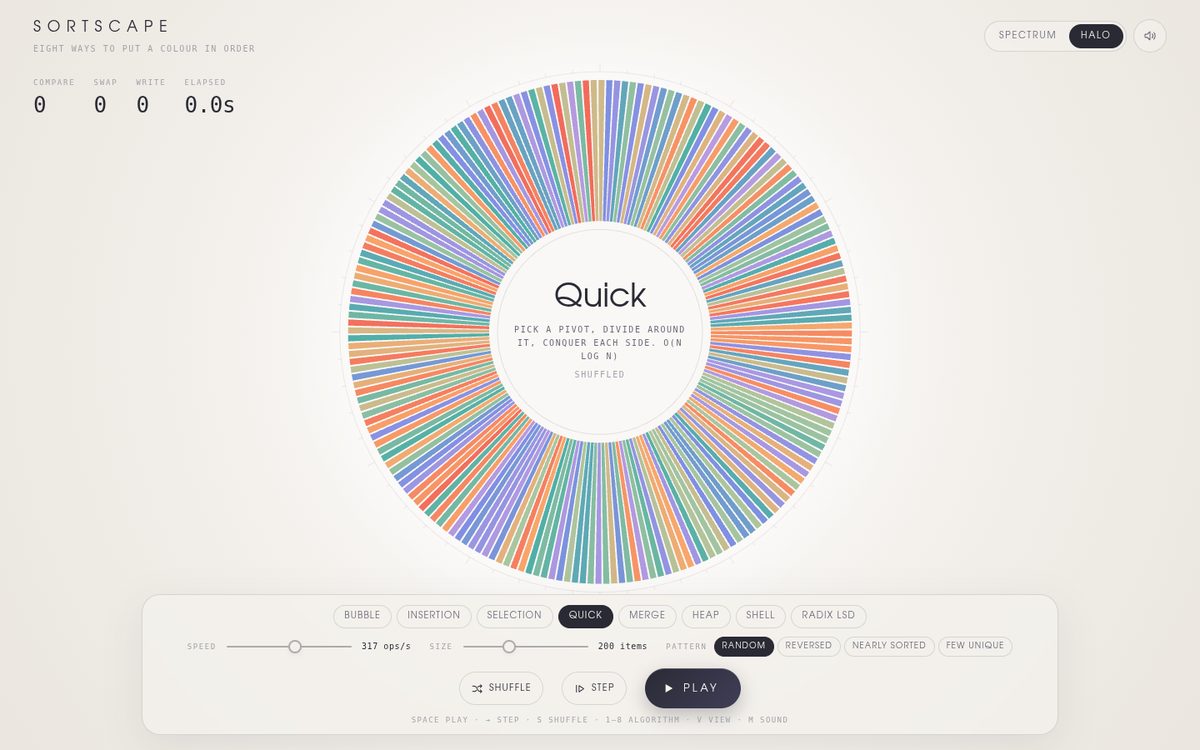
094
A thirty-second looping title sequence drawn entirely on one 1920x1080 logical canvas that is letterboxed and scaled to any viewport. Six scenes share one language of flat cream, ink, vermilion, cobalt and sun colour, heavy grotesque lettering, mono tape-label HUD chips and hard-cut rhythm: a dot becomes a ring that splits into bars that resolve into the word FORM; sixteen Bauhaus tiles drop, roll, pop and spin into a poster and kick on a 100 bpm beat; a single continuous line draws a face and then morphs through a flower into a bird over a misregistered colour disc; WHERE / IDEAS / TAKE / SHAPE punch in full-bleed with four different reveals; 48 rays burst and rotate while an odometer rolls to 100; and an end card with a rotating asterisk fades to black to loop. A hidden-when-idle control bar offers play/pause, a scene-marked scrubber, speed and sound toggles. Film grain and a vignette finish the frame.
Open
Original prompt
Create a self-playing motion-graphics title sequence, "FORM / MOTION — Showreel 2026", as a ~30-second loop choreographed in JS with easing (a small custom timeline engine on requestAnimationFrame; each scene driven by t in [0,1]; no libraries). A 16:9 stage centred and letterboxed (scales to fit). Scenes: (1) black → a white dot expands into a ring, the ring splits into bars that become the word "FORM" letter by letter (kinetic typography with overshoot); (2) geometric shapes (circles, half-circles, triangles, quarter-arcs) in a limited palette — cream #f4ecd8, ink #14110f, vermilion #ff4b2b, cobalt #2340ff, sun #ffc233 — bounce, roll and assemble into a Bauhaus-poster grid with hard-cut rhythm on a ~100 bpm beat; (3) a line-drawing scene where an SVG path draws itself into a face/character, then morphs into a flower and a bird (path morphing by resampling); (4) a typographic scale scene — "WHERE / IDEAS / TAKE / SHAPE" wiping in with masks, sliding lines and scale punches; (5) a radial burst of 48 rays with alternating colours rotating with easing while a counter rolls from 000 to 100; (6) an end card, "Made by hand, moves by code.", with a slowly rotating asterisk. A bottom control bar (auto-hides) has play/pause, a scrubber with scene markers (click to seek), scene names and a speed toggle (0.5×, 1×, 2×). Add film grain and a subtle vignette. Optional synthesised tick and whoosh at scene cuts (WebAudio, toggle, default off). Everything should feel choreographed — punchy timing, hand-implemented cubic/back/elastic eases, pixel-aligned, one consistent design language. TECHNICAL REQUIREMENTS: Deliver one completely self-contained, standalone HTML5 file with all CSS inline in a <style> tag and all JavaScript inline in a <script> tag. No external dependencies of any kind: no CDN, no external fonts (system font stacks only), no external images, no external SVG files, no libraries, no network requests. It must work by simply opening the file in a browser, fully offline. It must be responsive from 360px phones to large desktops, validate as standard HTML5, respect prefers-reduced-motion, support mouse and touch input, and run without console errors. Hand-craft it as a premium, award-worthy piece of digital art with real, evocative copy (no lorem ipsum), a disciplined palette, careful typography, polished motion and delightful details.
094-motion-reel-titles.txt
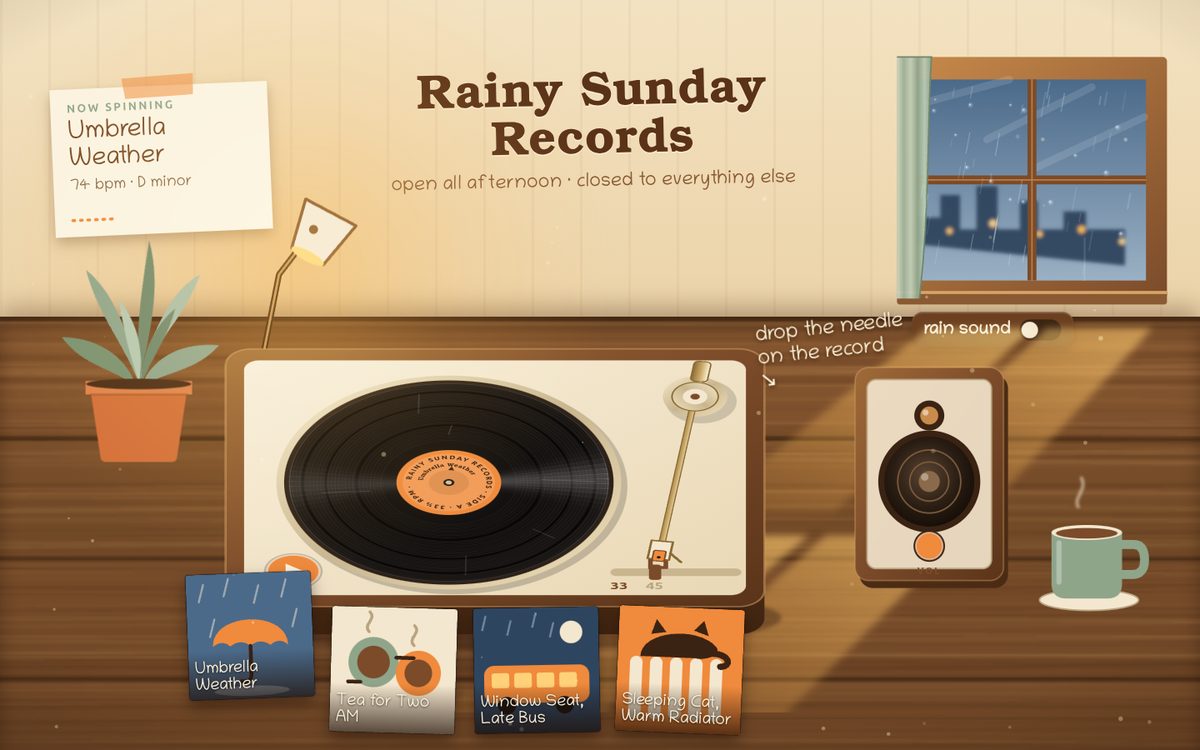
095
An editorial data-art page on warm paper. A large chord diagram shows 20 directed shorebird flows between seven regions (invented, in thousands of birds): seven earthy arcs sized by total flow, Bezier ribbons through the centre with source-to-target gradients and 2px paper gaps, and an inner ring of tick marks with month labels carrying a moving month marker. Tiny cream triangle "birds" stream along the ribbons at speeds proportional to flow. The left column holds the hand-drawn sandpiper icon, the italic-accent serif title, a context line built from the data, Season toggle, a play/scrub month slider with a seasonal-activity sparkline, an "on the wing" live figure, a Diagram/Table switch and a clickable legend.
Open
Original prompt
Create a data-art chord diagram, "Flyways" — the annual migration of shorebirds between seven regions (illustrative data): Arctic Tundra, North America, Central America, South America, Europe, Africa, Asia-Pacific. A circle of 7 arcs sized by total flow with chords whose widths encode flow magnitude (thousands of birds), drawn as smooth ribbon paths (Béziers through the centre) with gradients from source to target colour and 2px surface gaps. Palette: warm paper #f5f0e6 with seven distinct earthy hues — tundra slate #56707a, North America terracotta #c8553d, Central America saffron #e0a12b, South America moss #6b8f47, Europe indigo #2f3f8f, Africa brown #9a5a2e, Asia-Pacific teal #1f8a8a. Animation: tiny bird-shaped particles (small triangles) flow along chords from origin to destination at speeds proportional to flow; a "Season" toggle (spring north / autumn south) switches direction and highlights different chords; a month scrubber animates seasonal pulses. Interaction: hover an arc to isolate its chords and dim the others, with a tooltip of totals in/out; hover a chord for "Arctic Tundra → South America: 1.2M birds"; click to lock a selection; a table-view toggle (accessible matrix) and a legend; keyboard focus on arcs. Header: editorial title "Flyways" with a hand-drawn bird line icon and a sentence of context; footnote "Illustrative data". Type: a refined serif for the title, small-caps sans for labels. Extra polish: an inner ring of tick marks with month labels, subtle grain. TECHNICAL REQUIREMENTS: Deliver one completely self-contained, standalone HTML5 file with all CSS inline in a <style> tag and all JavaScript inline in a <script> tag. No external dependencies of any kind: no CDN, no external fonts (system font stacks only), no external images, no external SVG files, no libraries, no network requests. It must work by simply opening the file in a browser, fully offline. It must be responsive from 360px phones to large desktops, validate as standard HTML5, respect prefers-reduced-motion, support mouse and touch input, and run without console errors. Hand-craft it as a premium, award-worthy piece of digital art with real, evocative copy (no lorem ipsum), a disciplined palette, careful typography, polished motion and delightful details.
095-migration-chords.txt
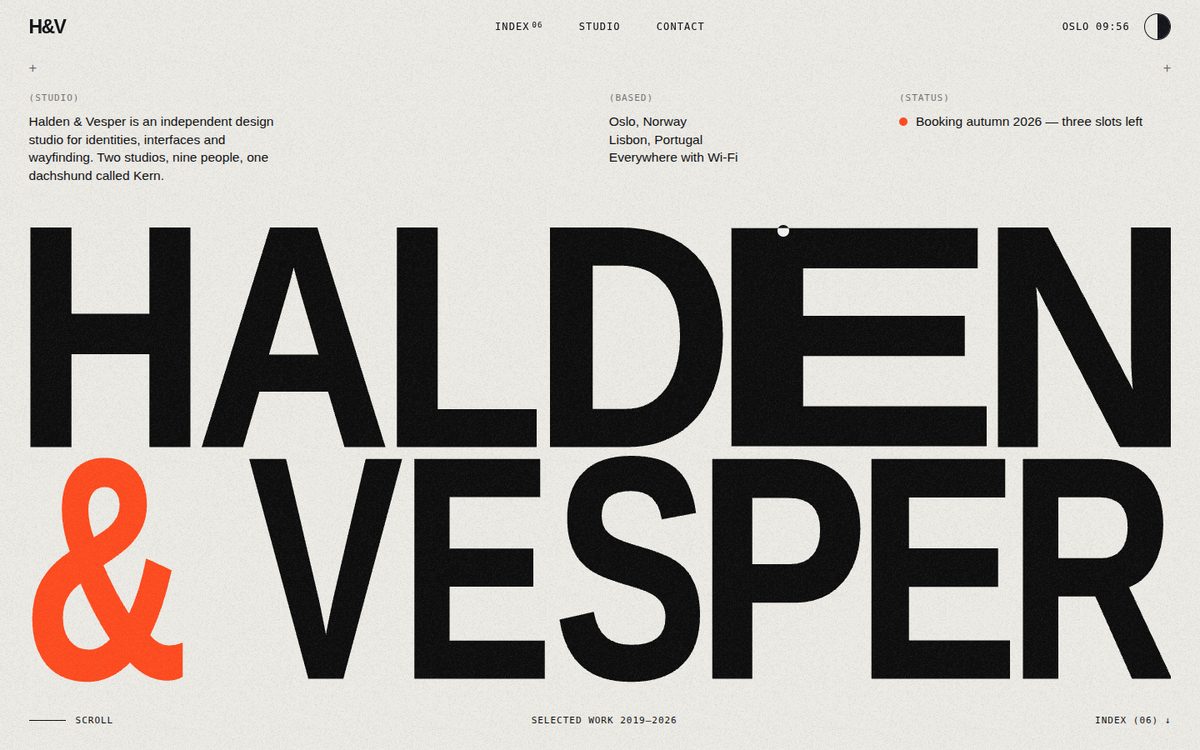
096
A linen-toned tabletop holds a sheet of cold-press cotton paper with a hand-torn deckled edge, painted in real time with blooming pigment. Beside it sits a small studio panel: a delicate Didone "Bloom" title, five tools with line icons, eight enamel-and-metal tin paint pans with their proper pigment names, a size slider, a wet-on-wet switch, and Clear paper / Save PNG buttons, all lettered in a cursive stack. On load an abstract sunset (violet and indigo sky, rose and yellow glow, a sun, four layers of hills and a few salt crystals) paints itself in about seven seconds; afterwards the visitor paints over it.
Open
Original prompt
Build "Bloom", a watercolour painting toy on cotton paper. Canvas layers: (1) paper texture (cold-press cotton: subtle grain generated on an offscreen canvas, cream #f8f4ea, deckled border), (2) a paint layer where pigments accumulate. Pressing the pointer drops pigment that blooms — a wet blob expanding over ~1.5 s with a soft feathered edge and darker rim (radial gradient plus an outline ring at lower alpha), an irregular organic outline (radius perturbed by low-frequency noise), granulation (fine speckle noise multiplied inside) and colour mixing via multiply blending; dragging paints a wet line as a series of smaller blooms, and pigment diffuses subtly for a moment after each stroke (a couple of blurred re-draws). Tools: Drop, Brush, Water (lightens/blends), Salt (sparkly crystalline starburst blooms on wet paint), Splatter (random flicks when the pointer moves quickly). Pigments with cute names shown as tin paint pans: Quinacridone Rose #d94f7c, Cerulean #2f7fb8, Hansa Yellow #f2c230, Sap Green #5d8a3a, Burnt Sienna #b85a30, Indigo #2b3a67, Payne's Grey #4c5b66, Violet #7b5aa6; a size slider, a "Wet-on-wet" toggle changing bloom radius/feathering, "Clear paper" and "Save PNG". A starting demo composition (an abstract sunset wash with hills) paints itself in ~6 s to show the medium, then the visitor paints over it. Type: hand-lettered small labels (cursive/italic stack) and a delicate serif title "Bloom". TECHNICAL REQUIREMENTS: Deliver one completely self-contained, standalone HTML5 file with all CSS inline in a <style> tag and all JavaScript inline in a <script> tag. No external dependencies of any kind: no CDN, no external fonts (system font stacks only), no external images, no external SVG files, no libraries, no network requests. It must work by simply opening the file in a browser, fully offline. It must be responsive from 360px phones to large desktops, validate as standard HTML5, respect prefers-reduced-motion, support mouse and touch input, and run without console errors. Hand-craft it as a premium, award-worthy piece of digital art with real, evocative copy (no lorem ipsum), a disciplined palette, careful typography, polished motion and delightful details.
096-watercolor-bloom.txt
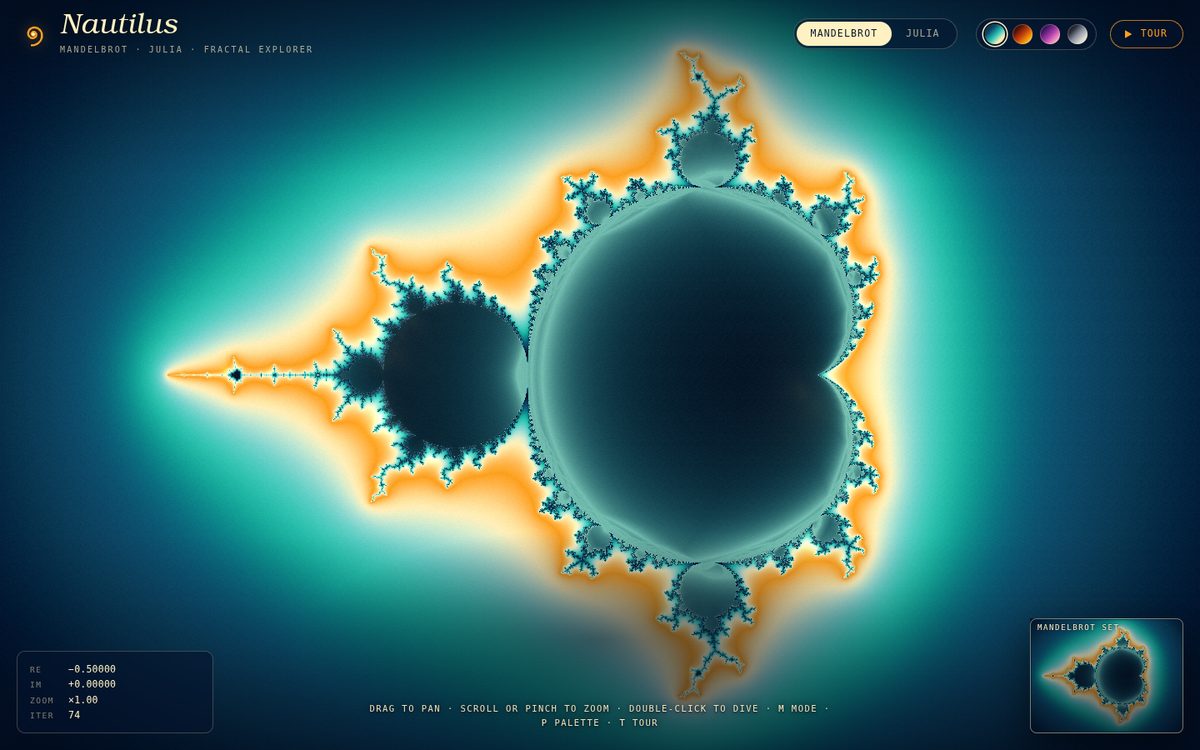
097
A single stochastic-branching tree drawn on a full-screen Canvas 2D paper-cut landscape (layered hills with paper-thickness shadows, cut-paper clouds, concentric-ring sun, grass fringe, paper grain and vignette). A continuous season value from 0 to 4 (spring, summer, autumn, winter, wrapping back to spring) blends the sky, ground, bark, leaf colours, blossoms, falling leaves, snow caps, creatures and daylight all at once. A large light italic serif season name, a ghosted month numeral, a month strip under the slider and a tiny sun/moon arc showing hours of daylight complete the almanac feel. Tapered curved limbs sway with correlated low-frequency noise that grows toward the tips; up to about 3800 pointed leaves cluster on the outer twigs.
Open
Original prompt
Create "Four Seasons Tree", a single generative tree (recursive branching or a stochastic L-system) that lives through the seasons controlled by a slider or a loop. Canvas 2D on a paper-cut-style background: sky gradient and ground change per season; the trunk and branches (tapered, slightly curved Bézier segments with bark shading) sway in wind (branch angles perturbed by low-frequency noise, growing toward the tips). Foliage: leaves as small ellipses/hearts on terminal branches (up to ~4000). Spring: bare branches bud into pale green leaves and pink-white blossoms, petals falling occasionally, sky #cfe8f5, ground #b7d99a. Summer: dense deep-green leaves #3f8f4a with dappled light, sky #8fd0ff, birds and butterflies. Autumn: leaves turn amber #e8a33d / rust #c8553d / crimson #a72d2d with variation by branch depth, detach and fall with fluttering rotation, sky peach #ffd9b0, leaves scattered on the ground. Winter: bare dark branches #3a2e2a with snow caps drawn on upward-facing segments, snowfall, cold grey-blue sky #c7d6e2, a small perched bird. The season slider (0–4 continuous, wrap-around) blends everything smoothly; "Auto" loops through a year in ~40 s; clicking the tree regrows it (branch-by-branch growth over ~4 s); a "Wind" slider; "New tree" generates another seed. Show the month names, a ghosted numeral of the month, and a tiny sun/moon arc for day length. Type: a light serif italic season name (e.g. "Autumn"). Add subtle paper grain and a soft shadow ellipse under the tree. TECHNICAL REQUIREMENTS: Deliver one completely self-contained, standalone HTML5 file with all CSS inline in a <style> tag and all JavaScript inline in a <script> tag. No external dependencies of any kind: no CDN, no external fonts (system font stacks only), no external images, no external SVG files, no libraries, no network requests. It must work by simply opening the file in a browser, fully offline. It must be responsive from 360px phones to large desktops, validate as standard HTML5, respect prefers-reduced-motion, support mouse and touch input, and run without console errors. Hand-craft it as a premium, award-worthy piece of digital art with real, evocative copy (no lorem ipsum), a disciplined palette, careful typography, polished motion and delightful details.
097-l-system-seasons.txt
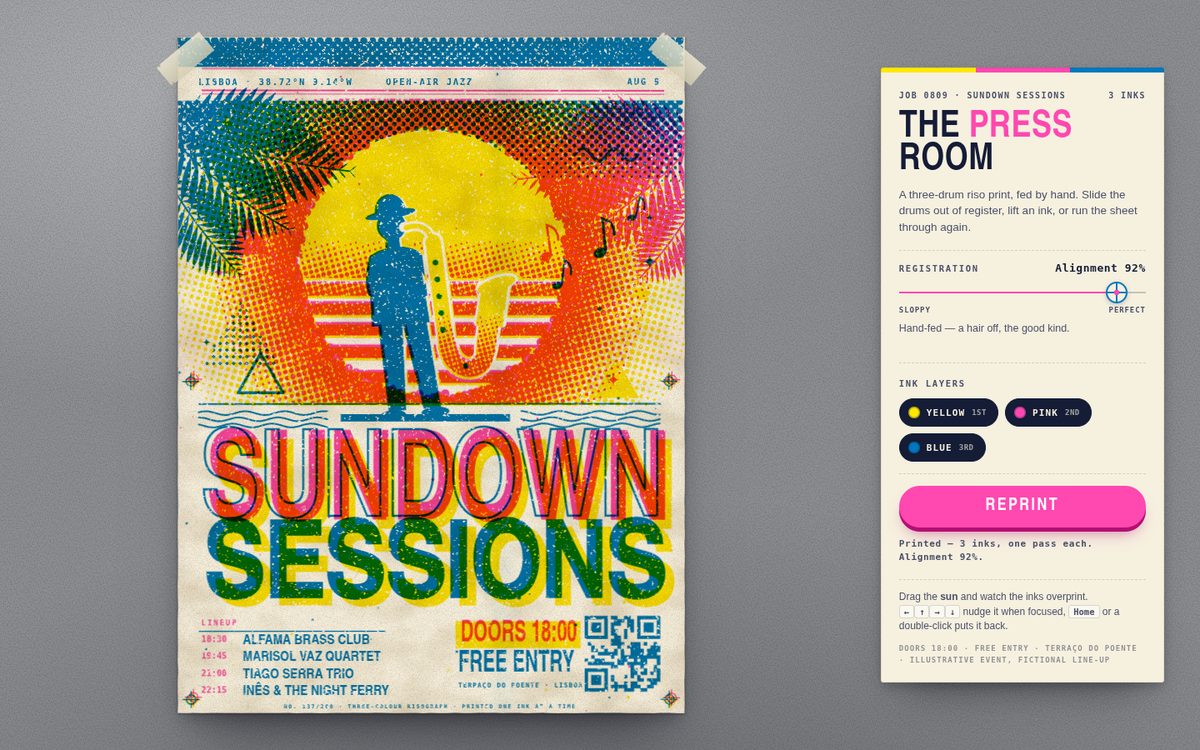
098
A square walnut board (layered grain gradients, two SVG turbulence filters, vignette and top-left light) carries a ring of brass nails with individual drop shadows and engraved numbering. Silk threads join nail i to nail i x m (mod N) using additive blending on a transparent canvas laid over the wood, so overlaps flare into luminous glints. The multiplier m sweeps continuously, morphing between cardioid, nephroid and higher epicycloids while the curve name fades in beside a live brass plaque reading "y = x . m (mod N)" and a one-line explainer. A large knurled brass dial, nail-count and opacity sliders, three palettes (Silk, Ink on Paper, Neon), a needle-and-thread winding mode and an analytic gold envelope complete the workbench.
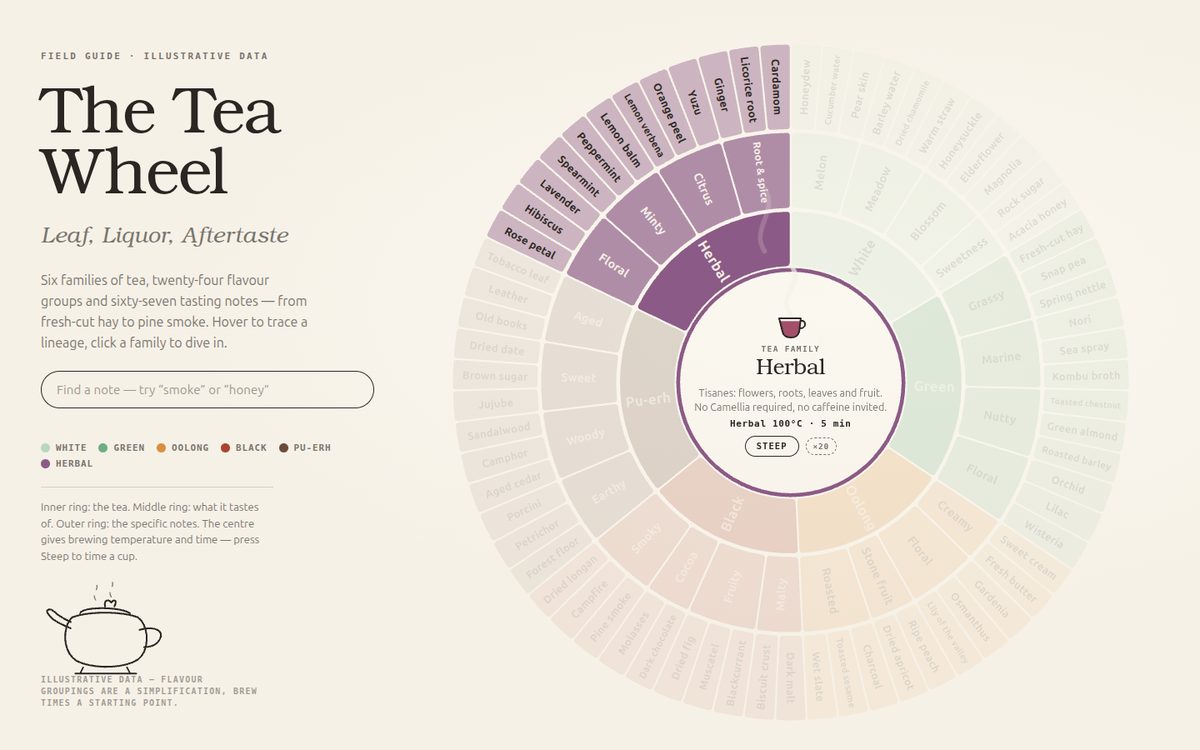
Open
Original prompt
Create "Nail & Thread", mathematical string art on a wooden board. A ring of N brass nails (N adjustable 60–360, default 200) pressed into a dark walnut board (#3a2416 with wood grain from layered gradients and SVG noise, vignette, top-left lighting, small shadows under each nail); threads connect nail i to nail (i × m mod N) for a multiplier m — the classic times-table circle producing a cardioid (m=2), nephroid (m=3) and beyond. Threads are thin (0.6–0.9px) with additive blending in coloured silk: a gradient along nail index from coral #ff6f59 through amber #ffb84d, cream #fff1c9 and teal #4dd8c4 to periwinkle #7b8cff, giving a luminous woven look with glints where threads overlap. Animation: m animates smoothly (fractional m — endpoints lerp between neighbouring integer mappings so the shape morphs continuously), sweeping from 2 toward N/2 with slow easing and pausing at pleasing integers, with the curve name appearing ("Cardioid", "Nephroid", "Trefoil-ish", "Quadrifolium"…). Controls: a beautiful large circular dial (or slider) for m, nail count, thread opacity, palette chips (Silk; Ink on Paper: black threads on cream; Neon: cyan/magenta on black), Play/Pause, a "Draw threads one by one" mode (threads appear sequentially like a maker winding them, with a needle point moving), and "Reveal envelope" overlaying the analytic envelope curve in thin gold. Arrow keys adjust m by 0.1. Type: a refined old-style serif brass plaque "y = x · m (mod N)" and a one-line explainer "The envelope of these chords is a cardioid." TECHNICAL REQUIREMENTS: Deliver one completely self-contained, standalone HTML5 file with all CSS inline in a <style> tag and all JavaScript inline in a <script> tag. No external dependencies of any kind: no CDN, no external fonts (system font stacks only), no external images, no external SVG files, no libraries, no network requests. It must work by simply opening the file in a browser, fully offline. It must be responsive from 360px phones to large desktops, validate as standard HTML5, respect prefers-reduced-motion, support mouse and touch input, and run without console errors. Hand-craft it as a premium, award-worthy piece of digital art with real, evocative copy (no lorem ipsum), a disciplined palette, careful typography, polished motion and delightful details.
098-string-art-nail-thread.txt
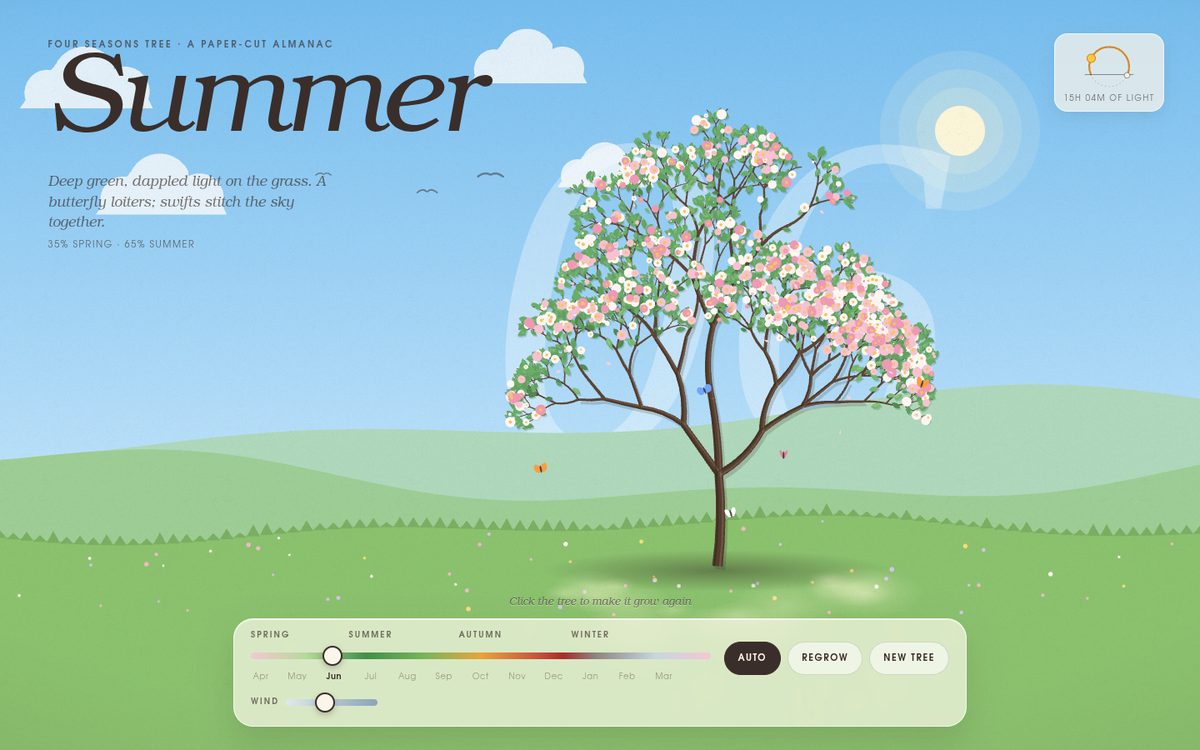
099
A 1970s living-room corner: vertically grooved wood panelling with grain, a canvas-drawn mustard shag rug with concentric retro rings, a striped "PEACE LOVE GROOVE" poster, a record-player silhouette with a slowly spinning disc on a walnut credenza, and a three-legged side table holding a tall tapered lava lamp with chrome cap and trumpet base. Eight wax blobs plus a pool at the bottom are a metaball field (sum of r^2/d^2 with a finite-support window) computed at 84x270 on a canvas, shaded with a gradient-derived normal for translucent lighter rims, under-light and a specular glint, then clipped to the glass shape. Buoyancy physics heat blobs at the bottom and cool them at the top. The bulb's wax-coloured glow washes the wall, floor and tabletop; a retro avocado control panel offers a chunky power switch, colour chips, a heat knob and a poke button.
Open
Original prompt
Create "Lava Lamp 1972", a lava-lamp object with convincing wax blobs in a 1970s room. Scene: a wood-panelled wall (#6b4226 with vertical grooves from gradients), a mustard shag-rug floor, a side table with a lamp — a tall tapered glass body with a chrome base and cap (SVG shapes with chrome gradients), lit from below by a bulb whose soft glow colours the wall. Inside: tinted liquid (translucent #ff7a1a to #ff3d81, selectable) and 7–9 wax blobs simulated as a metaball field with buoyancy physics — blobs heat at the bottom and rise, cool at the top and sink — rendered at low resolution (~90×220) by summing r²/d² per pixel on a canvas, or with the CSS/SVG gooey filter approach (blurred circles + threshold via feColorMatrix); choose whichever gives the smoothest merges and splits, clipped to the lamp silhouette. Shading: inner glass gradients and refraction highlights, a specular vertical streak, bulb glow beneath, blob translucency (lighter edges), and wax-coloured light spilling onto the wall. Controls: a chunky retro toggle switch (off: blobs cool and sink, the room darkens), colour chips ("Sunset" orange/pink, "Lagoon" green/blue, "Grape" purple/yellow), a "Heat" knob (dial) for motion speed; clicking/tapping the glass warms nearby wax so blobs rise. Extras: a psychedelic wall poster "PEACE · LOVE · GROOVE" in 70s rounded display letters with stripes, a record-player silhouette, drifting dust motes and warm film grain. Palette: burnt orange #d2691e, avocado #6b8e23, harvest gold #e3a018, brown #4a2c17, cream #f3e3c3 plus lamp glow. Type: chunky rounded 70s display (ui-rounded / Arial Rounded stack at heavy weight, tight tracking). TECHNICAL REQUIREMENTS: Deliver one completely self-contained, standalone HTML5 file with all CSS inline in a <style> tag and all JavaScript inline in a <script> tag. No external dependencies of any kind: no CDN, no external fonts (system font stacks only), no external images, no external SVG files, no libraries, no network requests. It must work by simply opening the file in a browser, fully offline. It must be responsive from 360px phones to large desktops, validate as standard HTML5, respect prefers-reduced-motion, support mouse and touch input, and run without console errors. Hand-craft it as a premium, award-worthy piece of digital art with real, evocative copy (no lorem ipsum), a disciplined palette, careful typography, polished motion and delightful details.
099-lava-lamp.txt
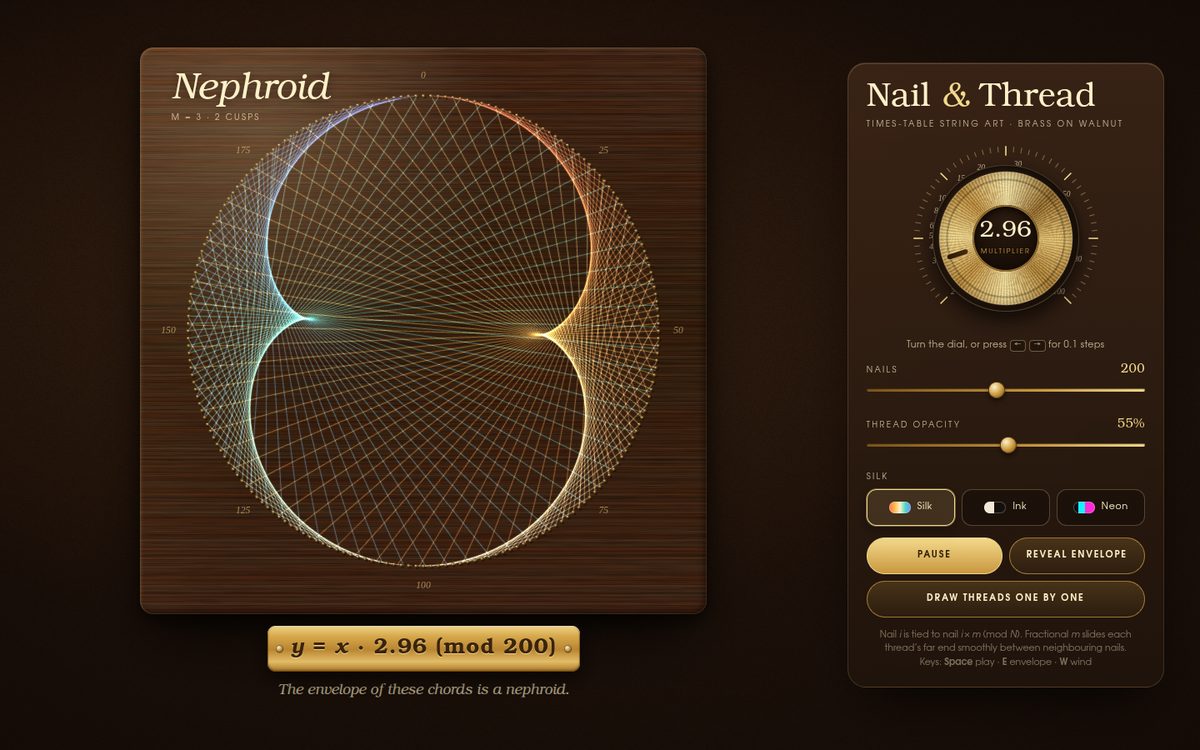
100
A soft, breathable design lab on a deep indigo (or warm cream) page whose background quietly tints toward the artwork's dominant colour under a film of grain. A large rounded stage renders live inline SVG in three modes: Blob (stacked, offset Catmull-Rom blob layers with gradient fills and screen or multiply blending), Wave (layered sinusoid bands like SVG dividers) and Rings (concentric distorted outlines). A glass control panel holds sliders for Complexity, Distortion, Speed, Layers, Blur and Grain, a seed field with dice and lock, a palette and gradient-stop editor with validated hex input, and a live code box showing the exact static SVG of the current frame with Copy and Download buttons. Up to six snapshots appear as clickable thumbnails. On mobile the panel becomes a bottom sheet.
Open
Original prompt
Build "Organic Wave Lab", a generative blob-and-wave design lab. Left: a large stage showing a smooth organic blob (a closed Catmull-Rom/Bézier spline through N points around a centre with radii from noise) filled with a gradient and slowly morphing (points moving along smooth noise so the shape flows like a living cell), stacked with 3–5 concentric offset blob layers (translucent, multiply/screen) that create ribbons of overlapping colour. A second mode, "Wave", shows layered flowing wave bands like SVG wave dividers (each layer a sum of sinusoids animated horizontally with its own phase) with adjustable layers and turbulence; a third, "Rings". Controls panel (right, glass/soft card): sliders for Complexity (3–12 points), Distortion, Speed, Layers, Blur/Grain; a Seed with a "Randomize" dice button and lock; a gradient editor with 2–4 stops from curated palettes (Sunrise #ff9a8b / #ff6a88 / #ffd166; Lagoon #0f766e / #5eead4 / #fef3c7; Orchid #6d28d9 / #c084fc / #fbcfe8; Deep #0b132b / #1c2541 / #5bc0be) with click-to-cycle and a validated custom hex input; a live "SVG code" box that outputs real static SVG (path data computed from the current points plus the gradient definition) with "Copy SVG" and "Download .svg" (Blob URL, local); Pause/Play morph; a snapshot strip of up to six saved blobs (thumbnails you can click to restore). Visual design: soft, breathable, pastel-meets-deep; the page background subtly tints to the blob's dominant colour with grain; a friendly rounded sans (ui-rounded stack) with a big light title "Organic Wave Lab". Keyboard: R randomise, Space pause, S snapshot. Responsive: the panel becomes a bottom sheet on mobile. Default palette: deep indigo #1b1a55 background with peach/coral/lilac blobs, with a light theme toggle (#fdf6ef). TECHNICAL REQUIREMENTS: Deliver one completely self-contained, standalone HTML5 file with all CSS inline in a <style> tag and all JavaScript inline in a <script> tag. No external dependencies of any kind: no CDN, no external fonts (system font stacks only), no external images, no external SVG files, no libraries, no network requests. It must work by simply opening the file in a browser, fully offline. It must be responsive from 360px phones to large desktops, validate as standard HTML5, respect prefers-reduced-motion, support mouse and touch input, and run without console errors. Hand-craft it as a premium, award-worthy piece of digital art with real, evocative copy (no lorem ipsum), a disciplined palette, careful typography, polished motion and delightful details.
100-organic-wave-lab.txt
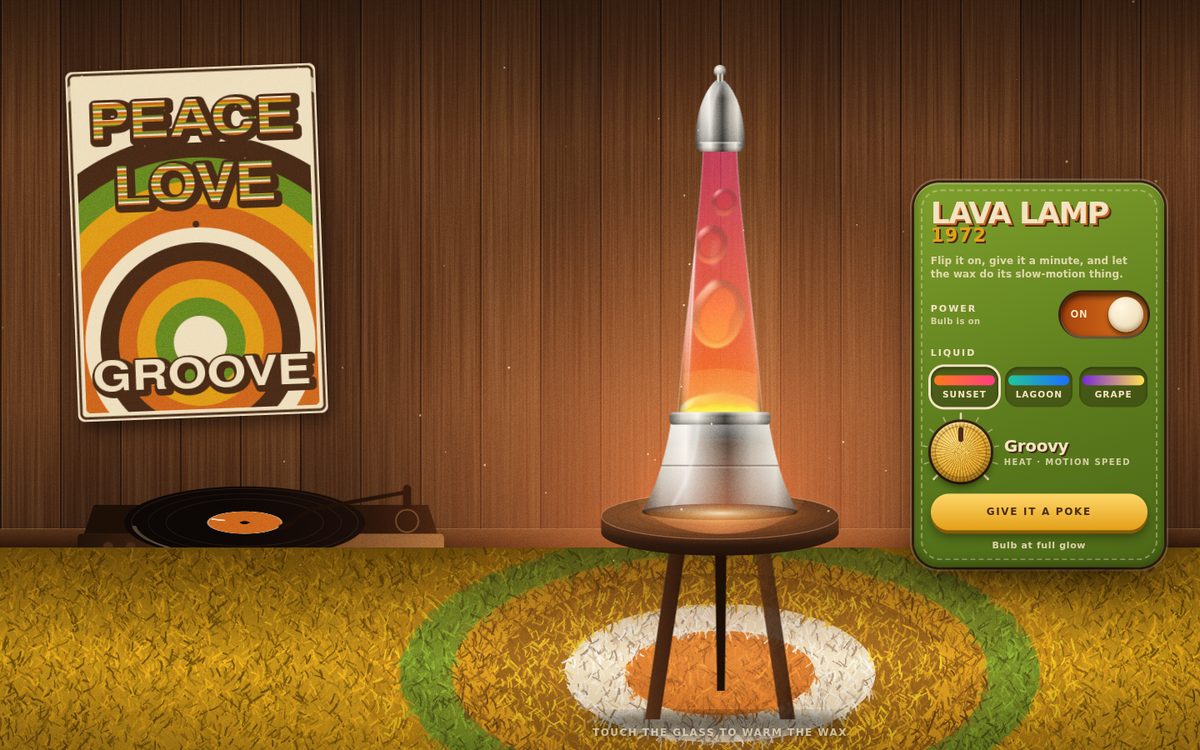
No studies match your search.