Collection · 76 studies

Claude Fable 5.2 HTML Files

76 self-contained visual studies — generative art, physics, typography, interfaces and scenes — generated with Claude Fable 5.2. Open any piece in a new tab, or expand a card to read the original generation prompt.

76 studies
Suminagashi — The Marbling Tray screenshot
001

Suminagashi — The Marbling Tray

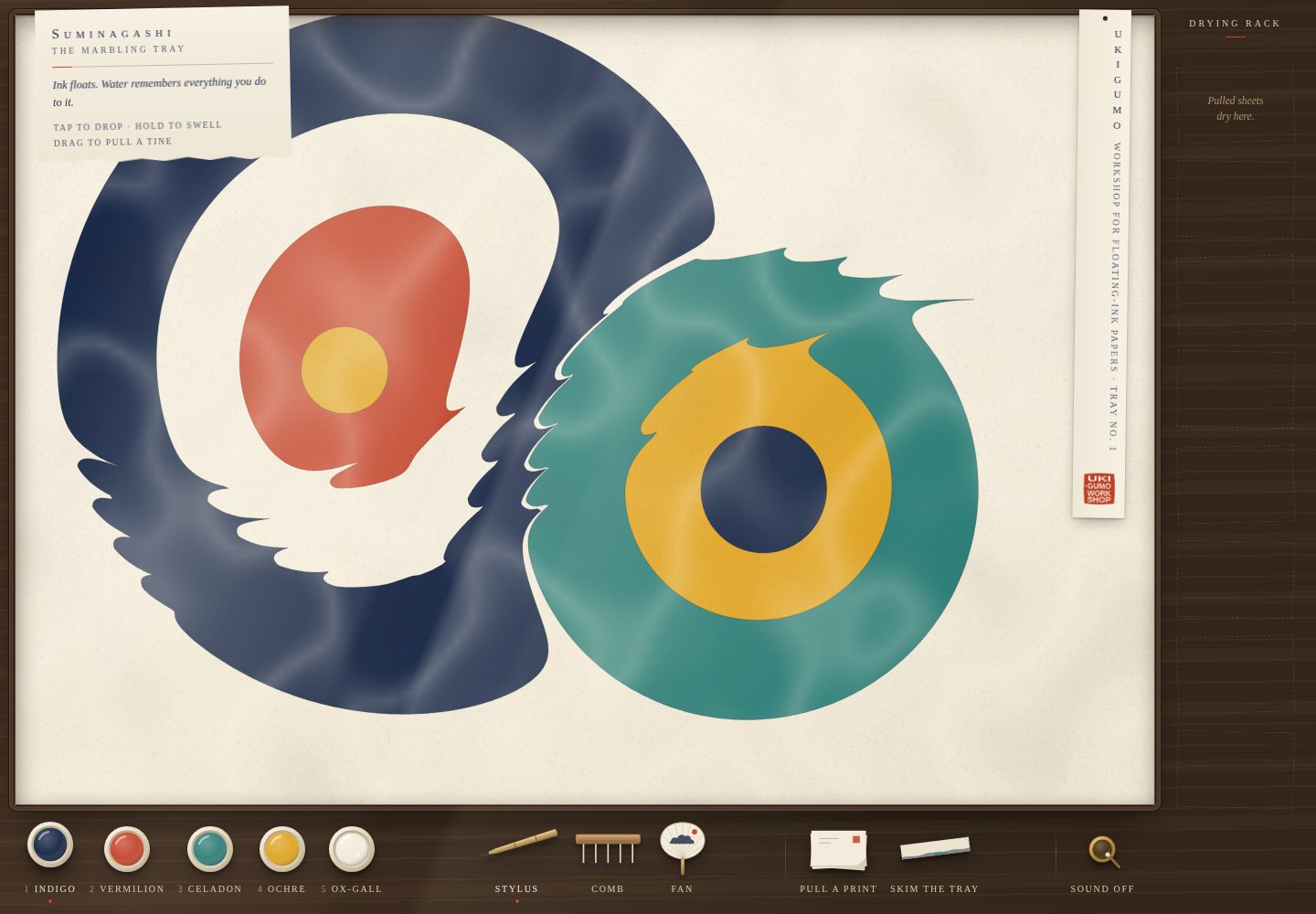
A quiet marbling bench seen from above: a shallow tray of paper-coloured water set in a dark wooden rim, lit by a soft band of morning light. On load seven drops of indigo, ox-gall, vermilion, celadon and ochre swell one after another into two sets of nested rings that press against each other, and a five-tine comb then draws itself across them, leaving feathered chevrons. The viewer keeps working the same water: every new drop shoves the existing bands outward, every drag pulls sharp feathers through them, and the fan stirs the whole surface in one slow gyre. Type stays tiny and deliberate, on a torn paper slip and a hanging vertical colophon strip stamped with the red seal of the invented Ukigumo Workshop. The tools are drawn objects resting on the wood. Pulling a print is the reward: a sheet unrolls over the water, takes the ink, turns over and flies to the drying rack, leaving a pale ghost behind for the next layer.

↗ Open
Aerodrome Lisbeth — Airship Departures screenshot
002

Aerodrome Lisbeth — Airship Departures

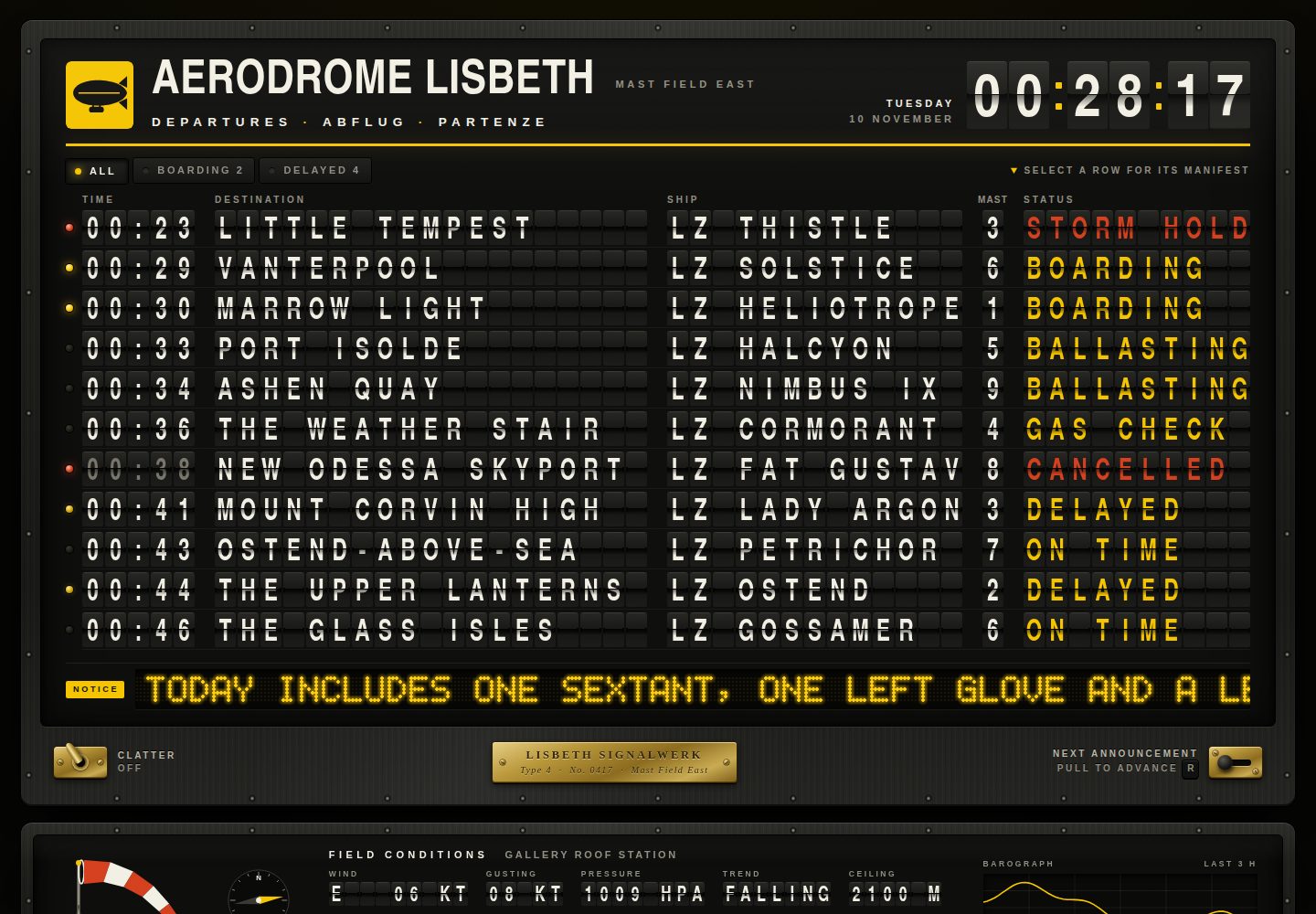
A dark terminal hall with one object in it: an enamel-framed Solari board for an airship aerodrome that never existed. The page opens on blank flaps; within three seconds a wave of clattering characters rolls from the top-left to the bottom-right and resolves into a full schedule of airships whose times are anchored to the viewer's own clock. From then on the board lives by itself: the flap clock ticks every second, statuses creep from ON TIME through GAS CHECK and BALLASTING to BOARDING and DEPARTED, rows expire and the whole board shuffles up in another cascade, a yellow dot-matrix notice crawls along the bottom with deadpan announcements, and a windsock below drifts with an invented wind. Brass hardware on the frame (a toggle switch for the clatter, a pull lever, a maker's plate) invites touching, and every row opens into a small flap-built manifest with its captain, gas and a purser's remark.

↗ Open
The Anatomy of a Croissant screenshot
003

The Anatomy of a Croissant

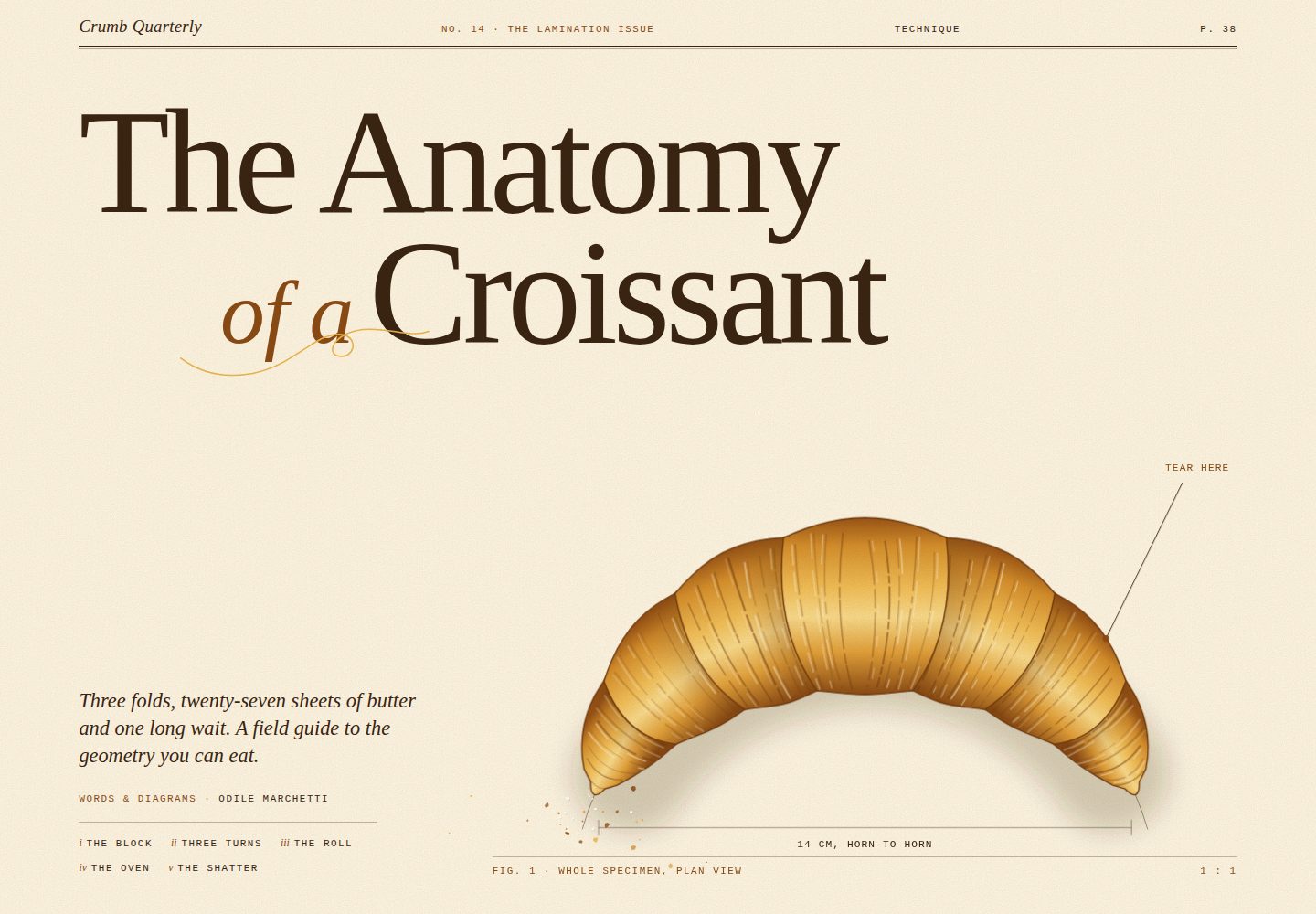
A long-read feature from the invented magazine Crumb Quarterly, No. 14, laid out like a Sunday supplement crossed with a draughtsman's sheet: flour-coloured paper with grain and stray crumbs, a towering Didone headline with a swashed italic "of a", a drop cap, small-caps captions and monospaced measurements. A hand-drawn croissant sits on the title spread; below it, five chapters pair Odile Marchetti's wry essay in the left column with a sticky technical figure on the right that is driven by the reader's scroll. Butter is posted into an envelope of dough, a slab folds in thirds while a counter ticks 1, 3, 9, 27, a triangle winds into a spiral in plan and elevation, and finally the cross-section proofs and bakes: butter lines open into a honeycomb of alveoli, the outline swells by forty percent, the crust browns, steam escapes and a thermometer climbs to 200 °C. The piece closes with tasting notes and a troubleshooting table of the author's own mistakes.

↗ Open
Night Watch at Sorrow Rock screenshot
004

Night Watch at Sorrow Rock

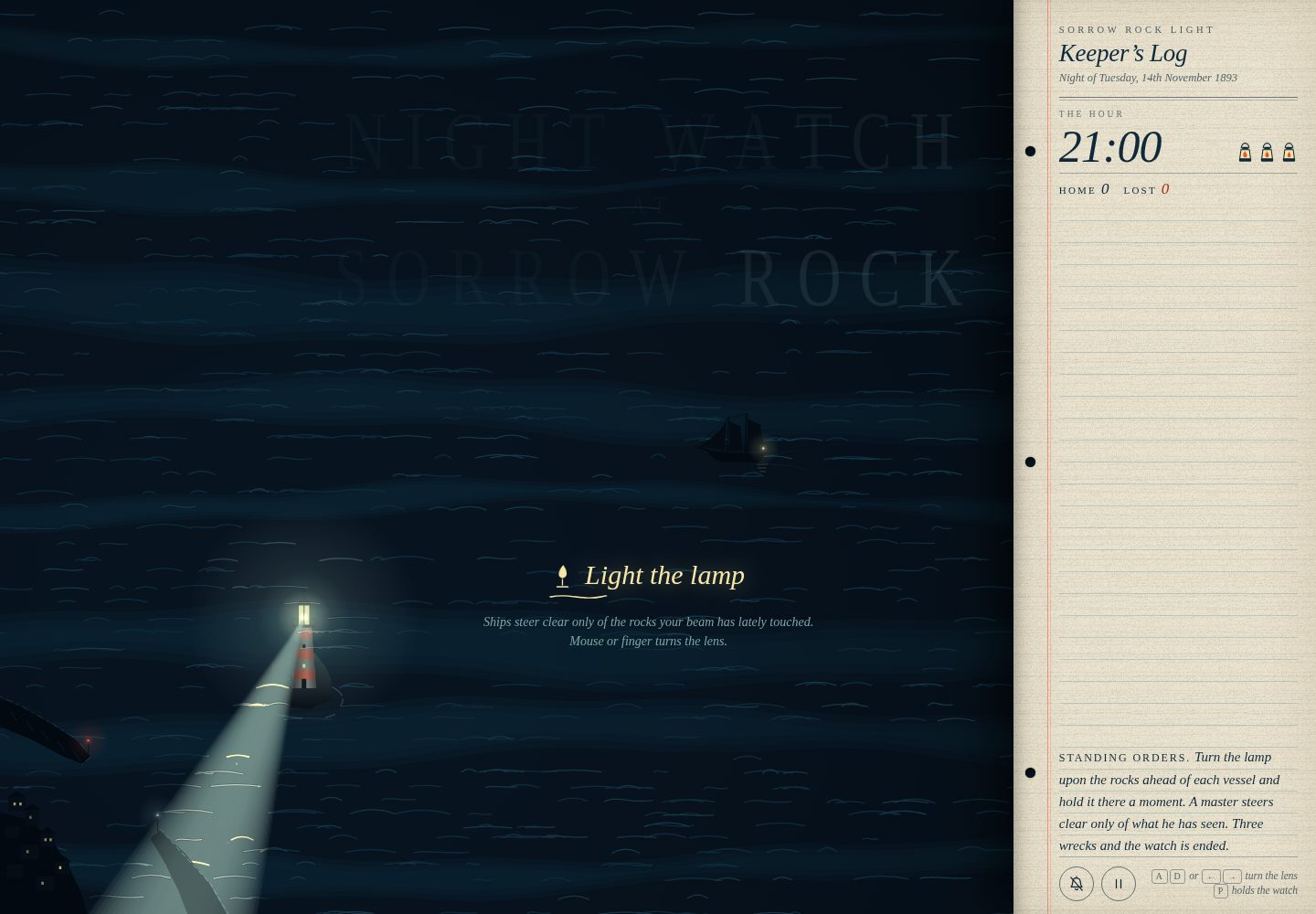
A night sea in near-black ink strokes, a red-banded lighthouse on its rock, and one heavy, warm beam that is the whole game. The page opens on darkness with the title lettered across the water in tall capitals that can only be read where the slowly turning lamp falls on them. Lighting the lamp starts a four-minute night from 21:00 to 05:00: trawlers, schooners and steamers come out of the dark edges with only a lantern to show for themselves, steering for the harbour mouth, and they will avoid only the rocks the viewer has held the beam on. Everything outside the cone is guesswork and foam glints; everything inside it turns to true colour, with gold wave-crests, sparkling motes, lit sails and long shadows thrown away from the tower. Fog banks swallow the beam, a storm brings rain and swell, and at the end the sea pales to dawn and the whole reef stands revealed. Beside the sea runs the keeper's ledger, where the hour, three lanterns for remaining chances and every arrival and wreck are written in Georgia italic as they happen; the night closes on the finished log page with the keeper's own verdict on the watch.

↗ Open
The Slide Rule screenshot
005

The Slide Rule

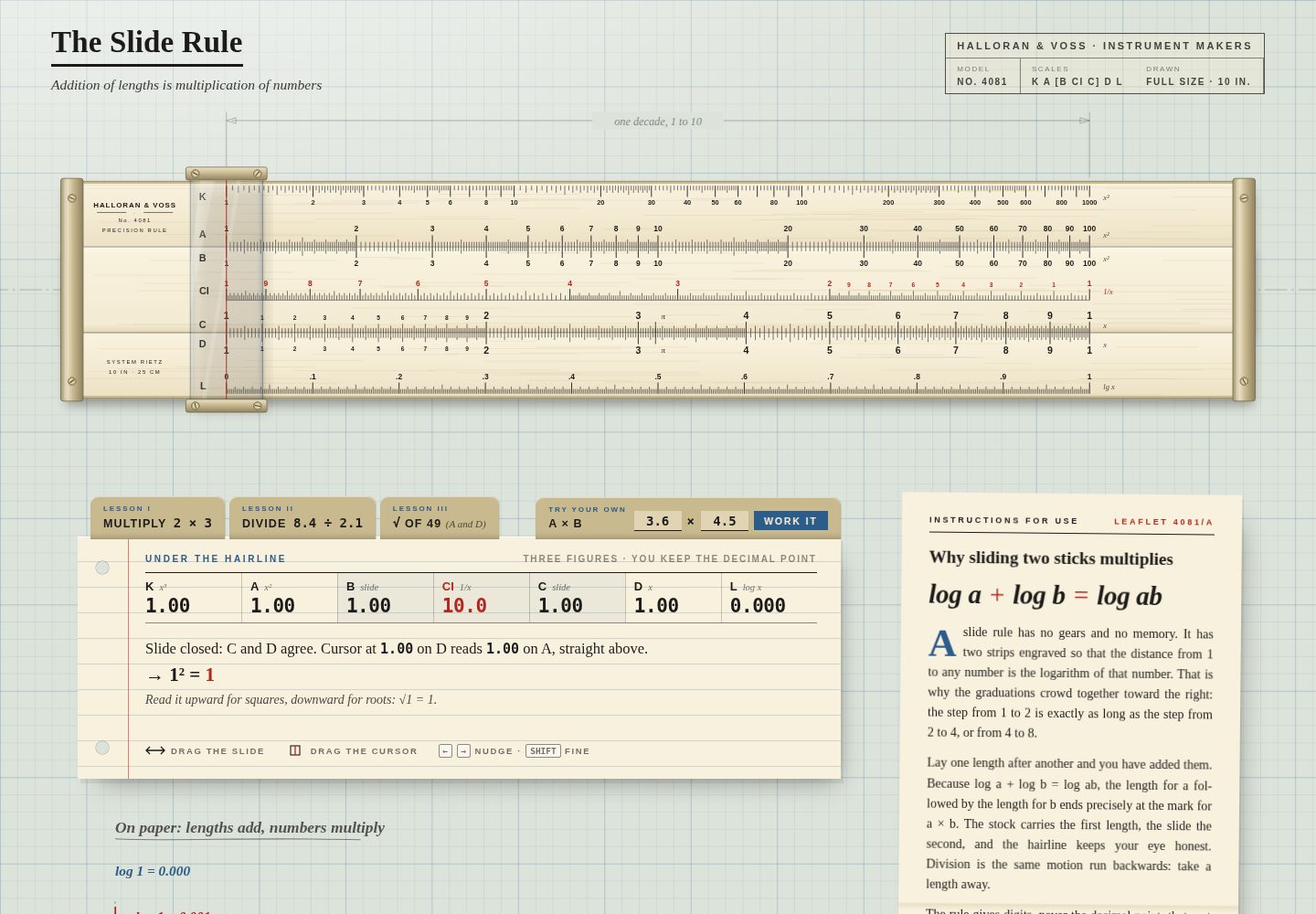
A ten-inch ivory celluloid slide rule by the fictional makers Halloran & Voss lies on pale green-grey drafting paper, pushed in from the left before its scales engrave themselves in a left-to-right wipe and the glass cursor glides to 1. Every tick on K, A, B, CI, C, D and L is placed by logarithm, so the instrument genuinely computes: drag the slide and cursor and a strip of ruled notepaper reports the seven values under the red hairline and says in plain words what the setting works out. Index tabs on the notepaper run guided lessons in which the parts move with mechanical ease while blue pencil notes and dotted arrows write themselves on and the answer is ringed in red pencil. Below, a pencil sketch on the table restates the same setting as two hatched lengths added along a logarithmic line, next to a folded instruction leaflet that explains why it works and how to read a scale.

↗ Open
Volcán Chico Hot Sauce screenshot
006

Volcán Chico Hot Sauce

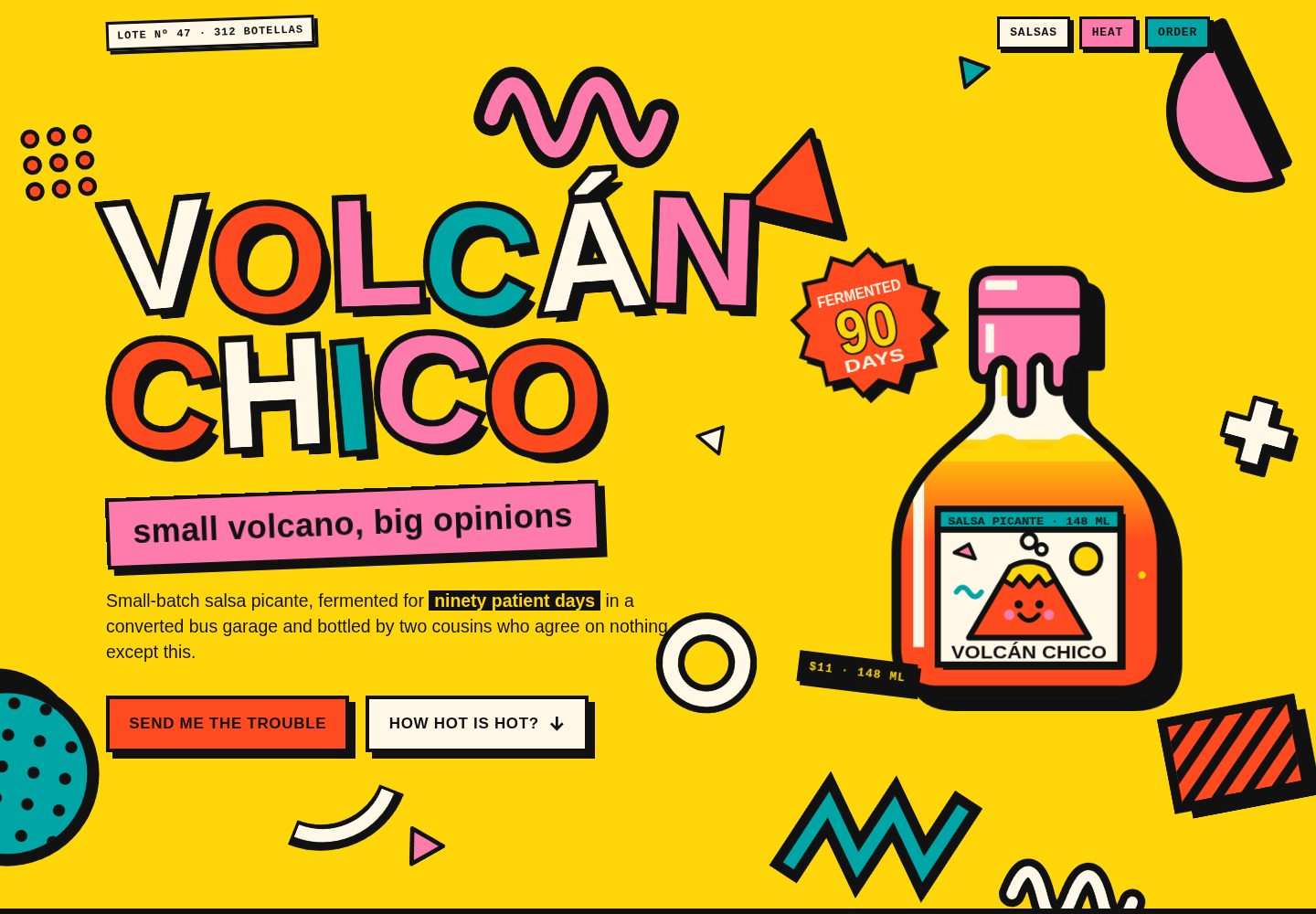
A loud, flat-colour Memphis-Milano landing page for an invented hot sauce made by two cousins in a bus garage. Six colour fields (yellow, pink, teal, terrazzo cream, lava red, yellow) are separated by thick black rules and scrolling marquee strips; every block is strewn with outlined squiggles, triangles, dotted circles and striped slabs that slap on like stickers and then jitter on stepped loops. The wordmark is set letter by letter, each glyph rotated, outlined and hard-shadowed, next to a squat wax-capped flask with a smiling volcano on its label. The centrepiece is a chili-shaped thermometer: dragging its little face from 1 to 10 heats the whole page (faster jitter, wobbling sweating headlines, a rattling cap, steam at the edges, colour fields flipping to red and black) until the bottle blows its cap, confetti-lava rains across the viewport, a starburst shouts "¡AY!" and the slider springs back down on its own. Trading-card sauces, sauce-able pairings, a wonky origin note and an order pad that gets rubber-stamped round it out, all in a funny bilingual voice.

↗ Open
Core 7B — Eight Hundred Metres of Winter screenshot
007

Core 7B — Eight Hundred Metres of Winter

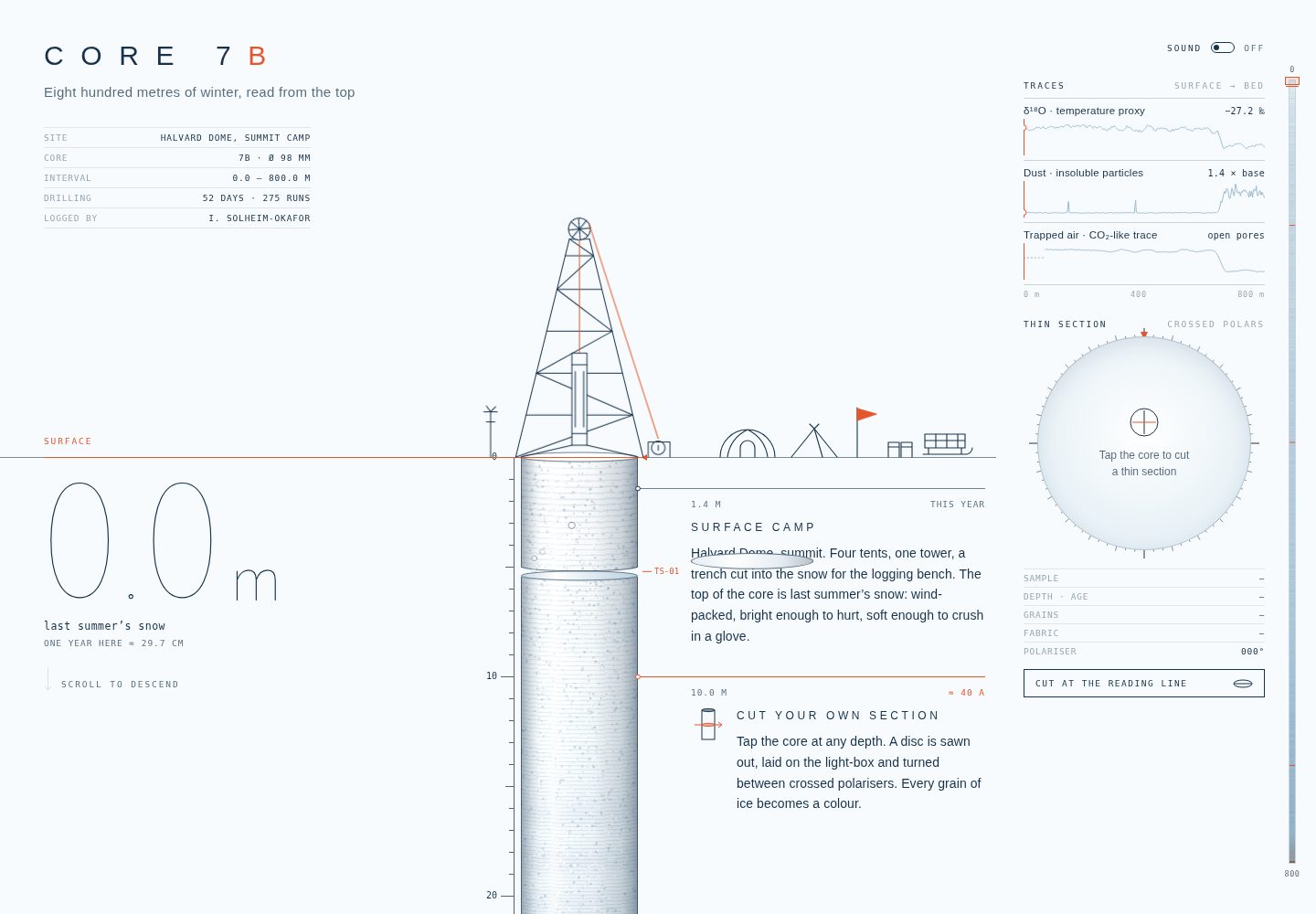
A white, laboratory-quiet logging sheet built around a single continuous ice core. The reader scrolls from a line-art drill tower and summit camp at the snow surface down through 800 metres of procedurally generated ice: snowy, visibly banded firn; bubbly ice; a fractured brittle zone; glass-clear clathrate ice; dusty ice-age ice; gravel-laden basal ice; and finally brown bedrock. An enormous hairline depth numeral in the margin counts every tenth of a metre against an orange reading line, with an estimated age beneath it, while annotation cards and field-log entries by Dr. Ingrid Solheim-Okafor are pinned to exact depths by leader lines that draw themselves. Three live traces, a thin-section light-box and a depth minimap stay in view; the page itself cools slightly with depth. Any point of the core can be cut: a disc slides out, turns face-on and lands in the light-box as a mosaic of crystal grains under rotating crossed polarisers, while the air released from the cut bubbles up the page.

↗ Open
Cabinet of Impossible Minerals screenshot
008

Cabinet of Impossible Minerals

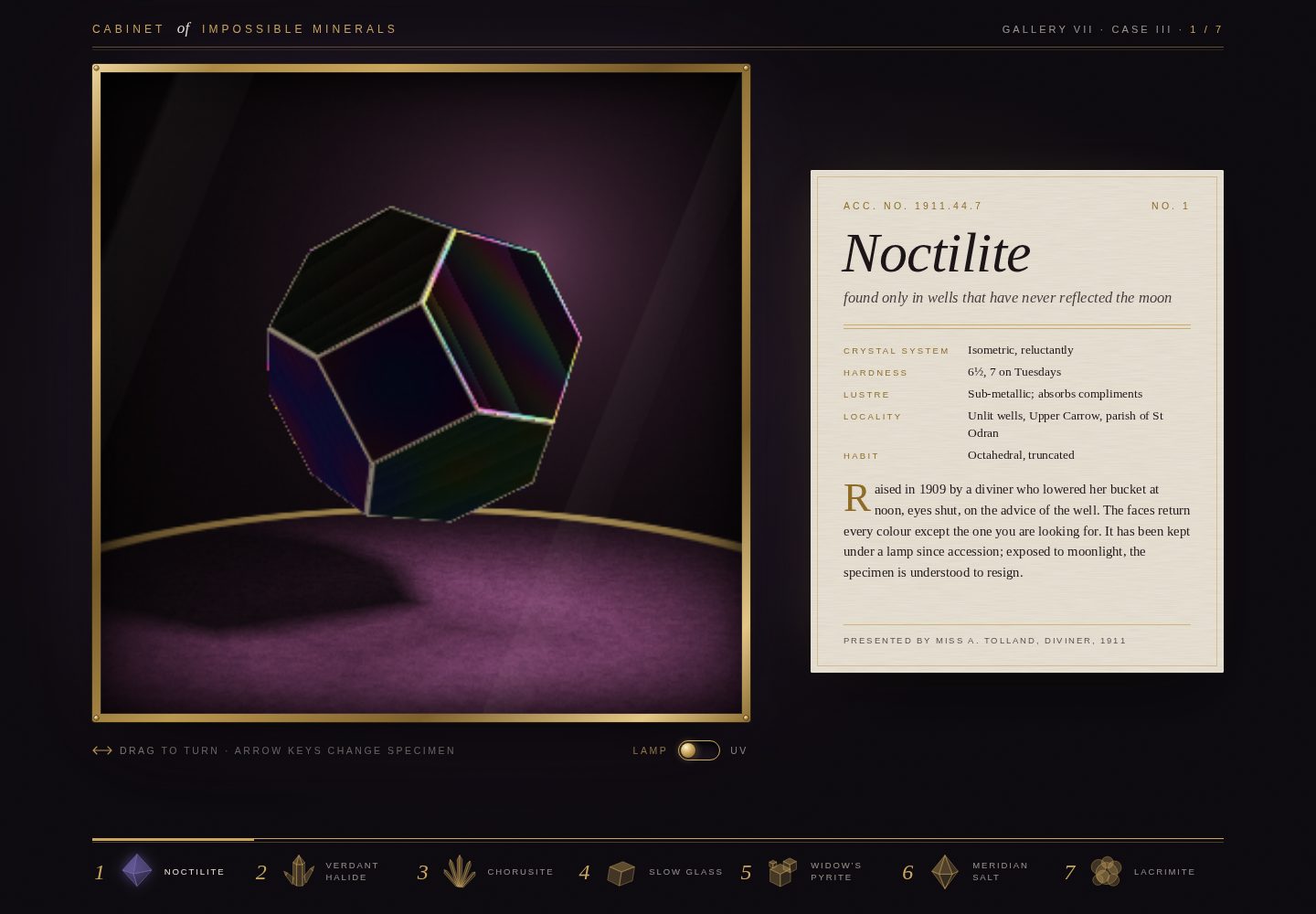
A hushed, single-lamp mineral gallery for seven specimens that cannot exist. A brass-framed vitrine holds one real-time raymarched crystal floating above a plum velvet plinth, lit by a lamp that slowly orbits so highlights slide from facet to facet; beside it hangs an ivory museum label set in Didot-style italics with a brass catalogue number, a small property table and a paragraph of deadpan curatorial fiction, and below runs a brass rail of seven numbered crystal-habit silhouettes. The page opens in darkness and the lamp warms up over a second and a half. Changing specimen dissolves the crystal facet by facet into glints while a reflection sweeps across the case glass, then the next mineral resolves as the label re-sets itself letter by letter in glowing brass. Switching the lamp to ultraviolet drops the room into violet, makes every mineral fluoresce in a colour it has no business being, and reveals one extra line on the label written in fluorescent ink.

↗ Open
Koi Pond, Noon screenshot
009

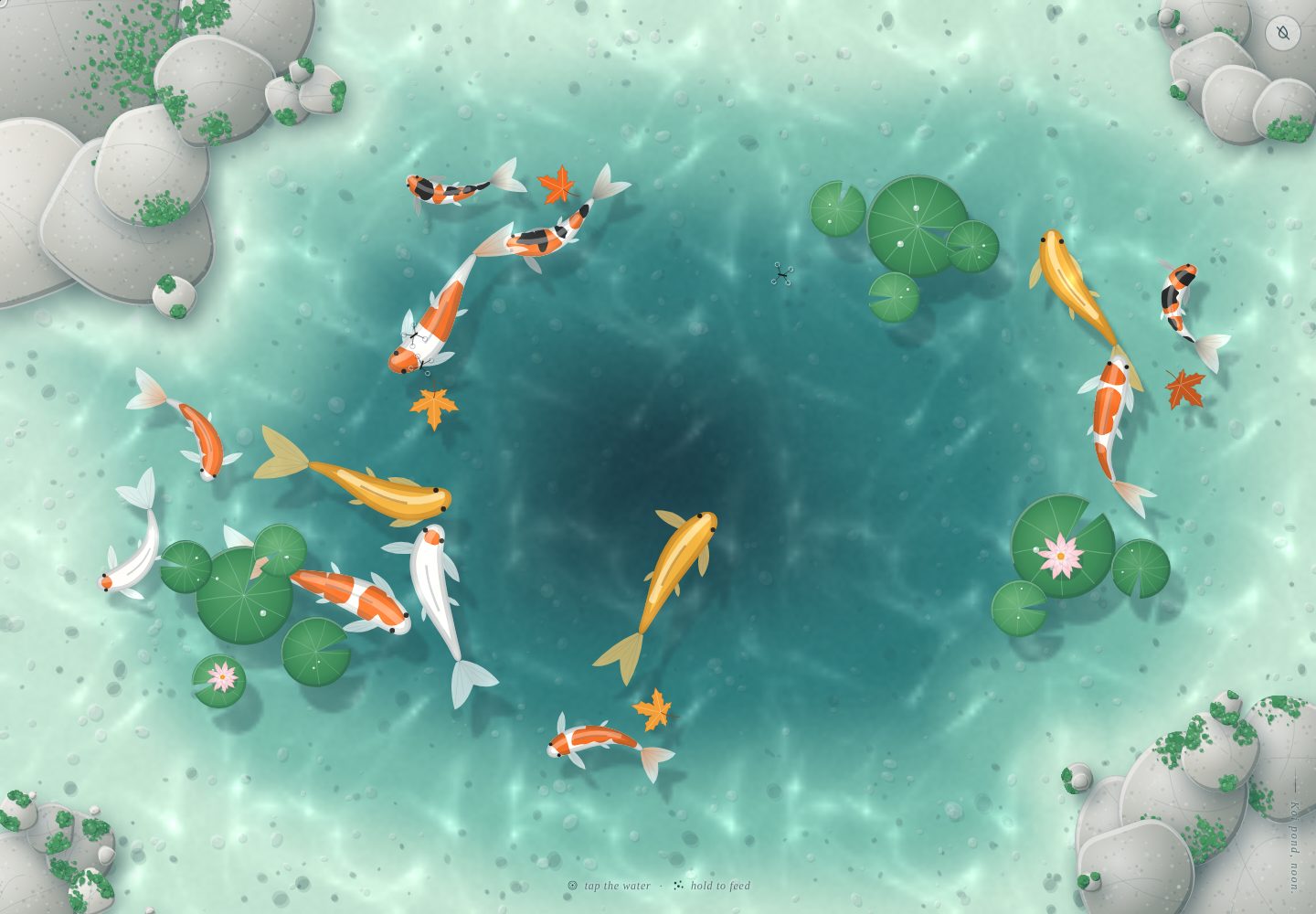
Koi Pond, Noon

A bright, full-bleed garden pond seen from directly above at midday. The water runs from pale jade shallows at the mossy corner stones through teal to a deep centre, with pebbles on the floor and a slow net of caustic light sliding over everything, fish included. Nine to thirteen koi, each a flexing spine with its own painted pattern (kohaku, showa, ogon, tancho), cruise in bursts and glides, paddle their pectoral fins and drag soft shadows across the floor that lengthen over deeper water. Lily pads drift on tethers, two lotus flowers breathe, maple leaves turn, water striders dart, and now and then a dragonfly and its shadow cross the frame. The page opens in white glare that settles like eyes adjusting to the sun while the fish swim in from the edges. There is nothing to achieve: tap for ripples, hold to feed, and watch the whole pond turn towards one spot.

↗ Open
Six Rooms of Optical Pressure screenshot
010

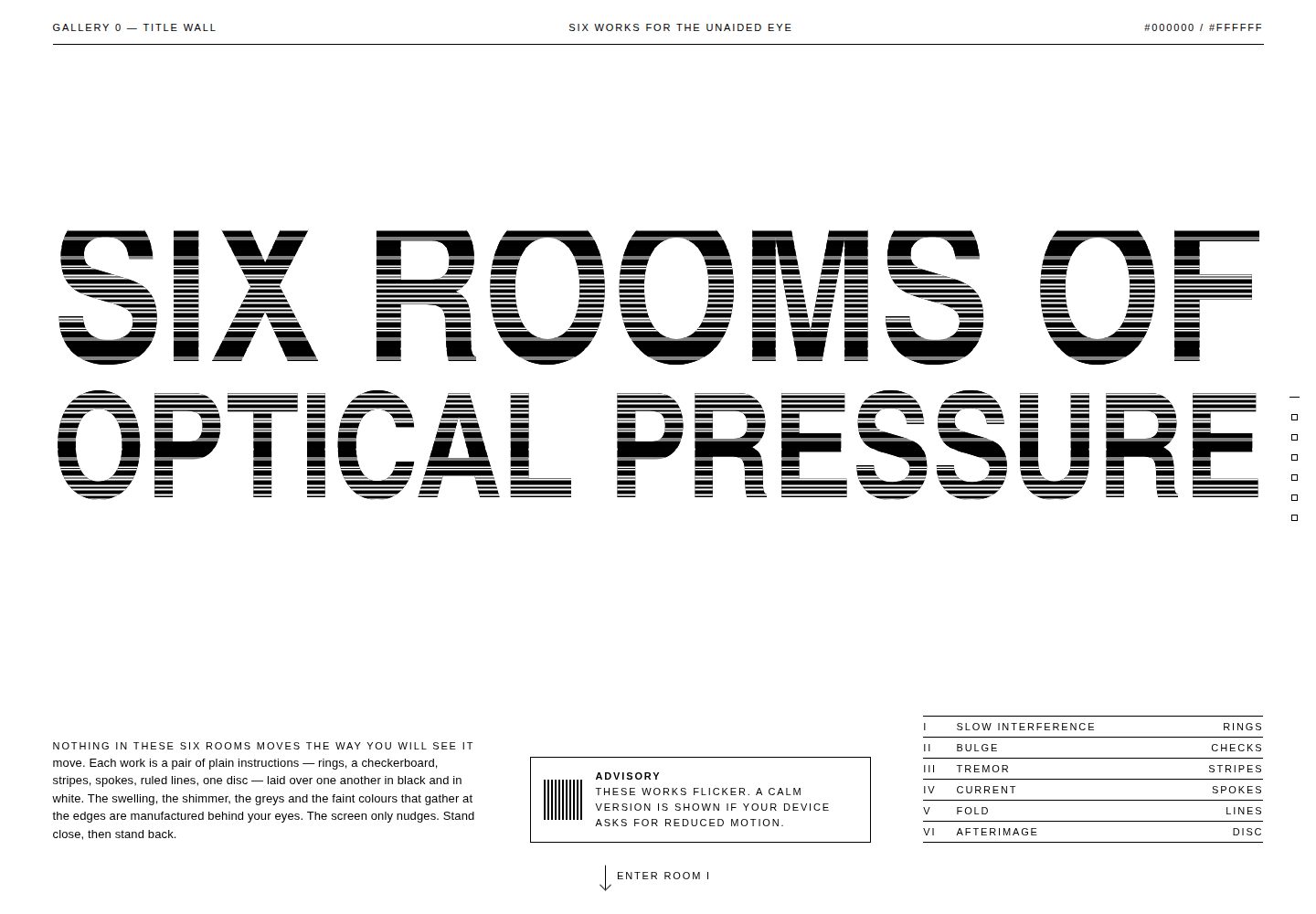
Six Rooms of Optical Pressure

A white-cube gallery reduced to two values. The visitor arrives at a title wall where enormous condensed capitals are sliced by horizontal hairlines that beat against each other, then walks down through six snap-aligned rooms that alternate between black and white. Each room holds one square work made from nothing but a repeated line, ring, check or spoke laid over a copy of itself: rings that produce sweeping hyperbolas, a checkerboard that swells into a dome, upright stripes that ripple, spokes that bloom into counter-rotating petals, ruled paper that folds into a pleated curtain, and finally a black disc that the viewer stares at until it disappears and leaves a glowing ghost on a blank wall. Signage is tiny, uppercase and widely spaced, with a large roman numeral and a dry wall note per room. The mood is exacting, quiet and slightly dizzying; everything that seems soft, grey or three-dimensional is produced by the viewer's own vision.

↗ Open
The Hours in Words screenshot
011

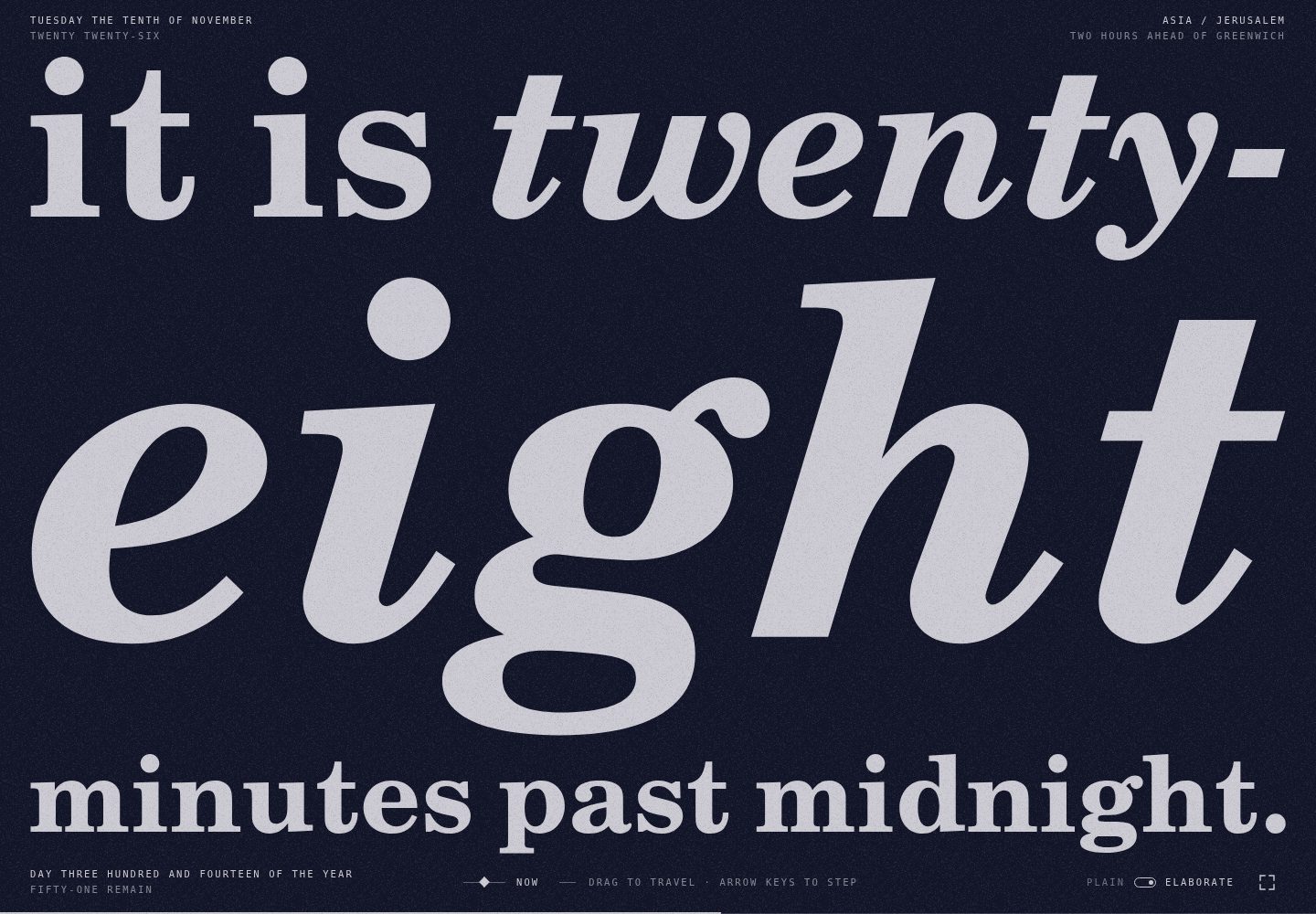
The Hours in Words

A clock that is only a sentence. The viewer's local time is written out in lowercase English and set as a wood-type broadside: every line is measured to its ink and scaled to the full width of the screen, the minute phrase in heavy italic, the whole block packed into a solid rectangle on a single flat field of colour that drifts through twenty-four hand-picked pairs across the day, from aubergine small hours through dawn peach, white-hot noon and terracotta evening back to deep blue. When the minute turns the poster re-typesets itself in place: only the letters that differ roll out and in, and the lines swell or shrink to stay flush with both margins. In the corners, tracked monospace capitals carry the date, year, time zone and day of the year, all in words, while a hairline along the bottom edge counts the seconds. The effect is of a printed sheet that happens to be alive, calm at rest and briefly mechanical once a minute.

↗ Open
Murmuration at Dusk screenshot
012

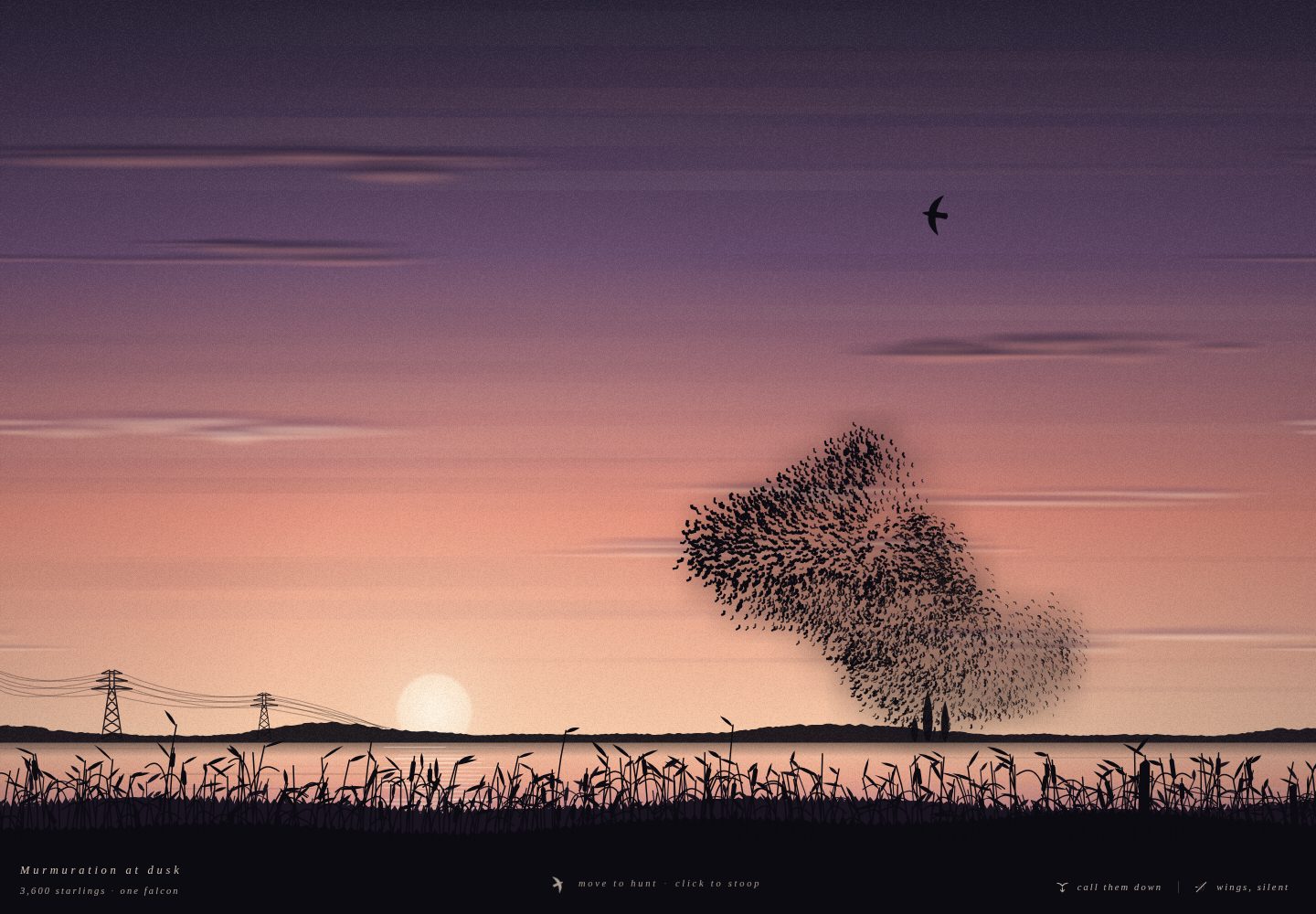
Murmuration at Dusk

A wide marsh sky in the last minutes of light: plum-ink overhead sinking through mauve and coral to a pale apricot horizon, a low sun and its broken reflection in a thin strip of water, pylons and poplars tiny on the far bank, and a black reed bed swaying along the bottom edge. Into the empty sky a long ribbon of starlings streams from the right and gathers into a single breathing shape made of thousands of tiny flapping chevrons, lighter where the birds are far and darker where the flock folds over itself, stretching into ribbons and hourglasses and rippling with sudden dark waves when it turns. The viewer's pointer is a peregrine; the flock parts around it, wraps behind it and closes again, and a click sends the falcon into a tucked dive that tears a hole straight through the birds. Left alone, the falcon hunts by itself, the light slowly fails, and the whole flock drains through a narrow neck into the reeds; after a few seconds of stillness a new evening begins. The only words are a tiny italic title, a live count of starlings, a hint that dissolves once the hunt starts, and two quiet controls.

↗ Open
Iron Filings screenshot
013

Iron Filings

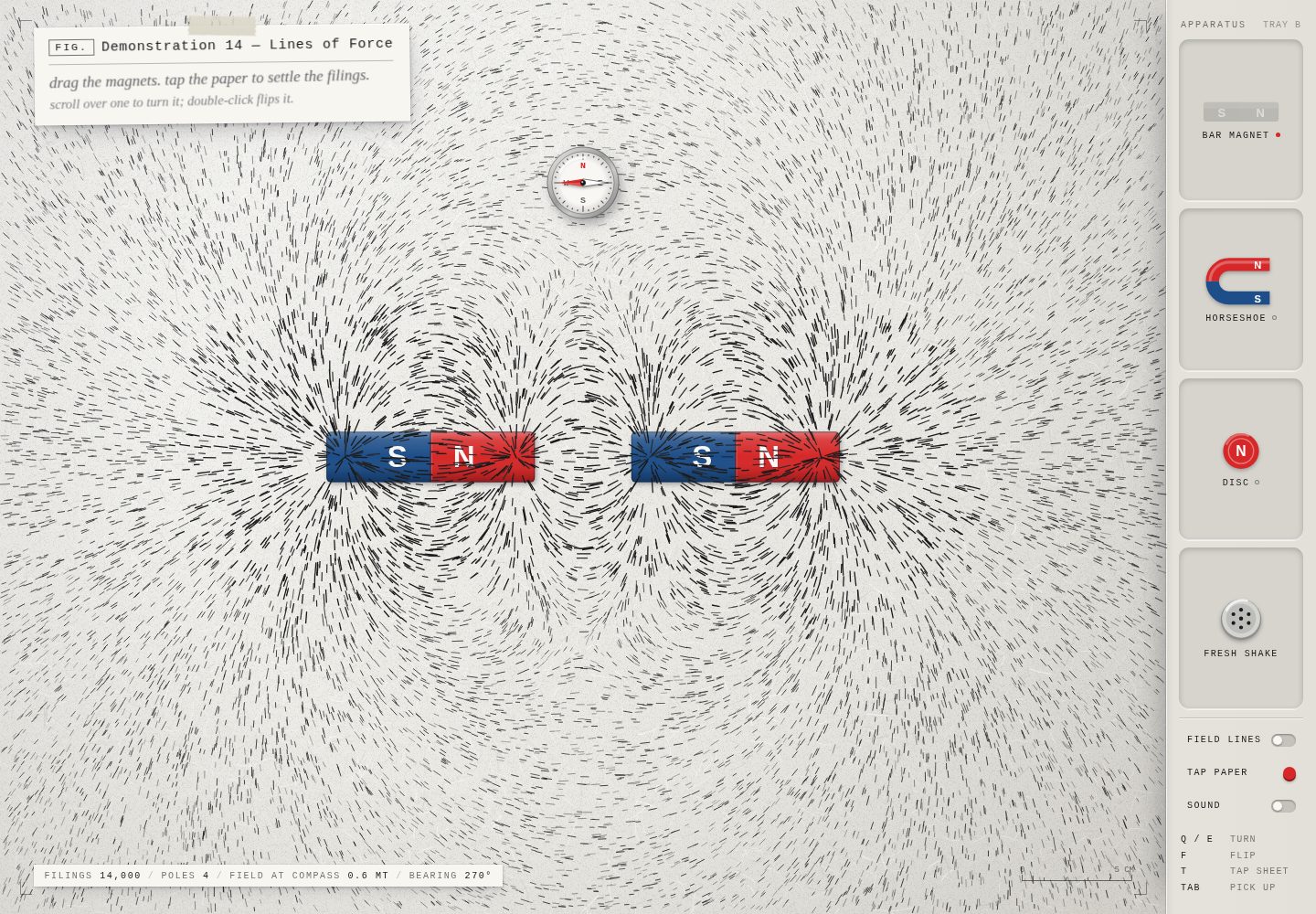
A top-down view of a classroom demonstration: a sheet of warm white paper, fibres catching soft daylight, dusted with fourteen thousand black iron slivers. Two red-and-blue bar magnets glide in from opposite edges and the random dust visibly combs itself into the textbook pattern, pulling a dense bridge of filings across the gap between north and south. From there it is a toy: slide, spin and flip the magnets and watch the alignment wave chase them, see tufts of filings cling to the poles and get dragged along leaving swept trails, flick the paper to tidy the lines, bring like poles together to find the pencil-circled null point, and drop a horseshoe or disc magnet, a compass, or a fresh shake of filings from the apparatus tray. A taped typewritten label and a pencilled note are the only words on the sheet.

↗ Open
Where the Primes Fall screenshot
014

Where the Primes Fall

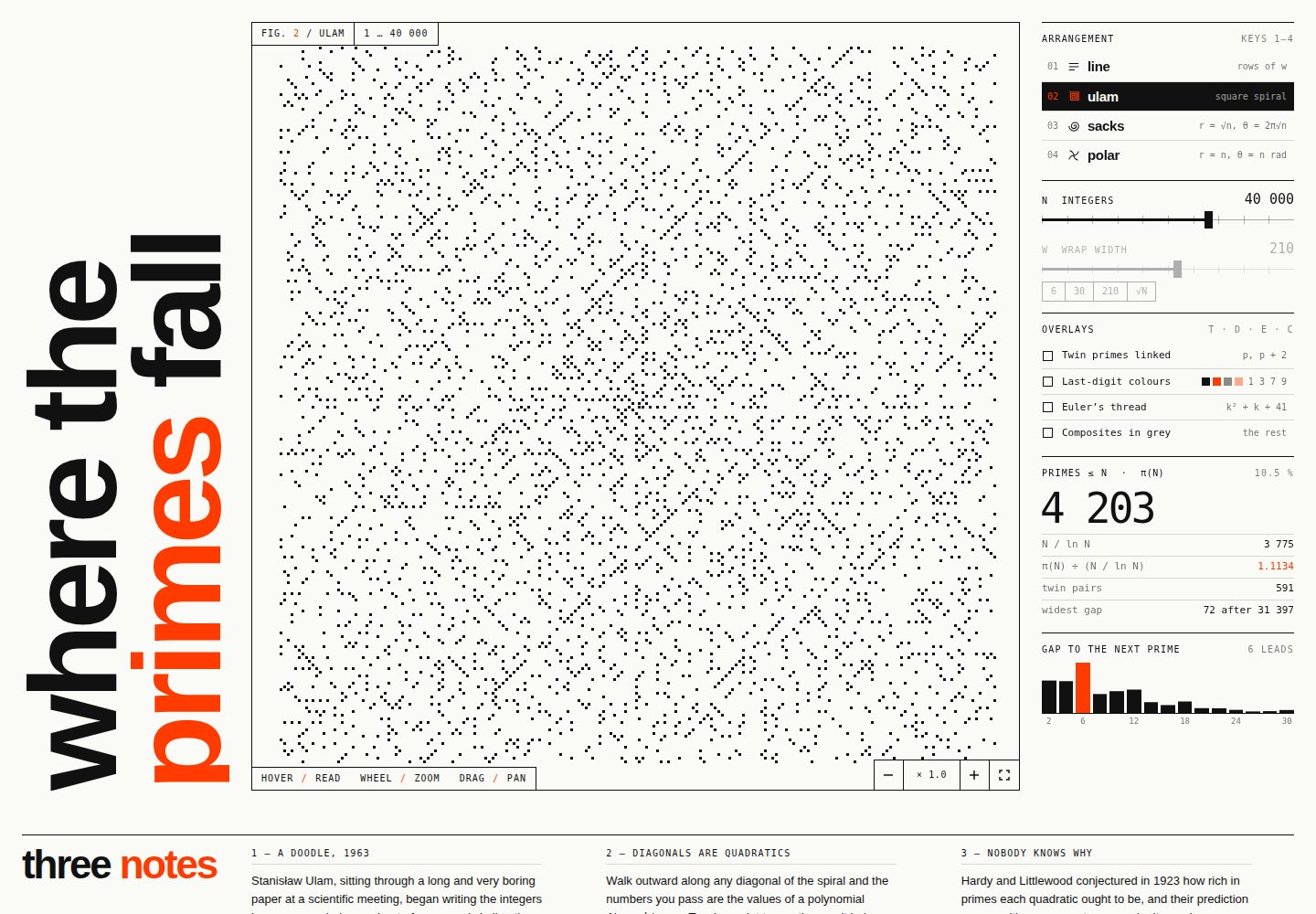
A white sheet set like a Swiss mathematics poster: an enormous lowercase grotesk headline runs up the left edge with one word in red-orange, a hairline-framed square field fills the height of the window, and a narrow monospace rail of rules, sliders and tabular figures sits to its right. The field holds every integer up to N as one small square. It opens by drawing all of them as a single black line, reeling that line into a solid black square spiral, and then sieving it from the centre outward behind a red front until only the primes remain, scattered along unmistakable diagonals. Choosing another arrangement sends every dot along its own path, centre first, so the square coils into the Sacks spiral, flares into the polar galaxy, or falls into rows whose columns stripe at widths like 30 and 210. Pointing at any dot produces a black label with its arithmetic and lights the diagonal, curve, column or arm it belongs to in red; zooming in far enough turns the dots into numbered tiles.

↗ Open
Maison Ombre — Parfums d'Intérieur screenshot
015

Maison Ombre — Parfums d'Intérieur

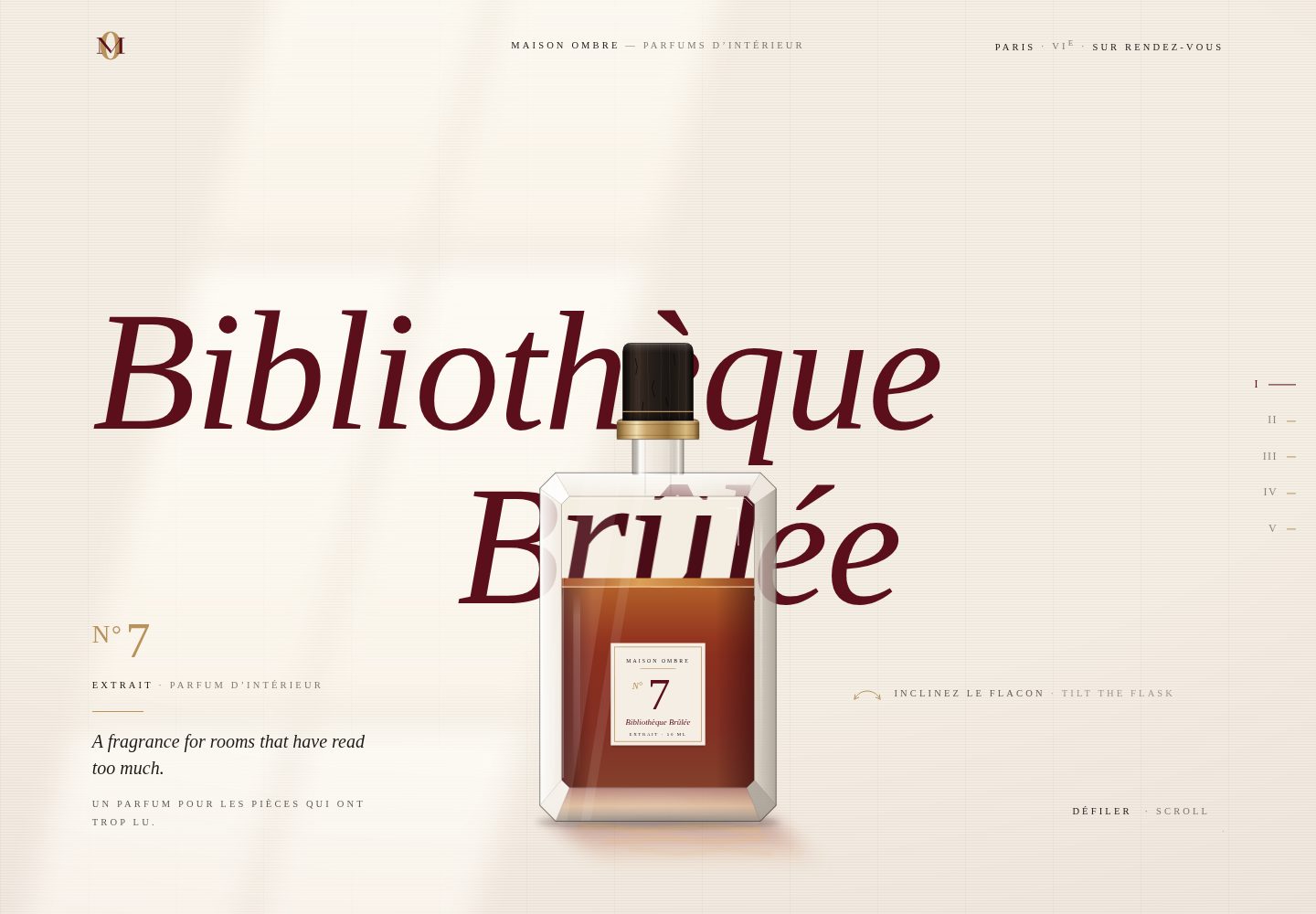
A slow, bilingual landing page for the invented Parisian house Maison Ombre and its single fragrance, No. 7 — Bibliothèque Brûlée. On warm ivory laid paper, crossed by a drifting casement of pale window-light, an enormous oxblood italic title runs behind one exquisitely drawn flask; the word seen through the glass is bent by it, and the amber-oxblood liquid inside tilts, sloshes, ripples and bubbles as the pointer passes or the flask is tipped. Scrolling carries the same flask into the olfactory pyramid, where its oak cap lifts off and the notes rise from the neck as fine wisps and then evaporate in order, top first, heart next, base lingering, before three quieter movements: a portrait of the perfumer beside a scorched, tea-ringed folio, the object's specifications with a dimensioned elevation and a discreet table of editions, and a one-line request for a sample card that is answered by an envelope closed with a wax seal.

↗ Open
Descent — A Vector Lander screenshot
016

Descent — A Vector Lander

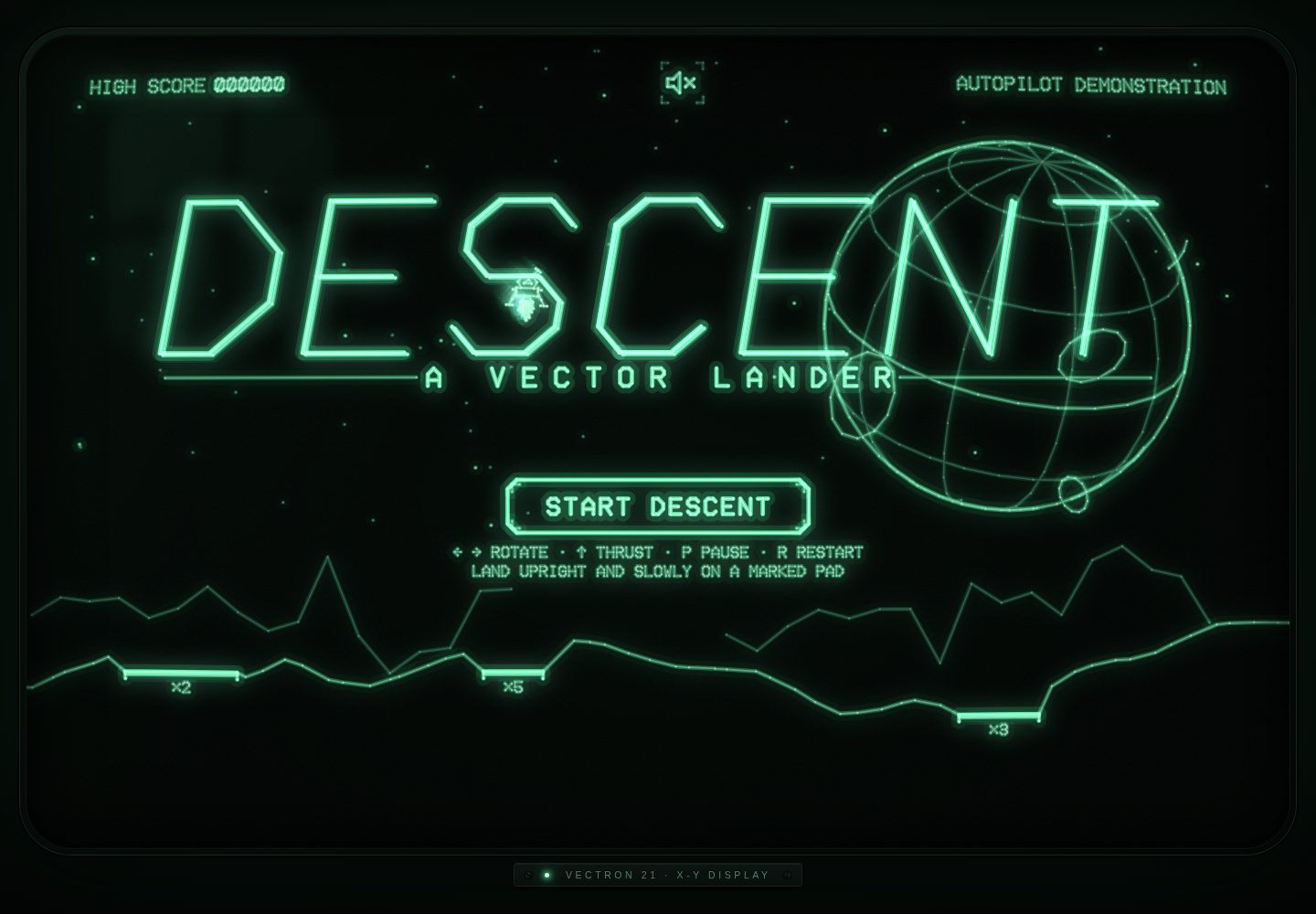
A single cathode-ray tube sits in a dark cabinet above an engraved model plate. Everything on its face is light: mint-white beam cores wrapped in green bloom, vertices that burn a little brighter where the beam pauses, and a phosphor that takes a moment to forget what it was shown. The attract screen traces the word DESCENT one stroke at a time while a cratered wireframe moon turns behind it and an autopilot quietly demonstrates a landing below. Starting a mission hands over a small legged module drifting above jagged regolith; the camera eases in to two and a half times scale as the surface approaches, the engine plume fans out and flickers, dust streaks away along the ground in short glowing lines, and the whole tube brightens with the burn. A clean touchdown earns a dry remark from mission control and a harder site; anything else scatters the lander into its component segments, which tumble, bounce and fade while the phosphor remembers their arcs.

↗ Open
Spore Print — A Two-Colour Zine screenshot
017

Spore Print — A Two-Colour Zine

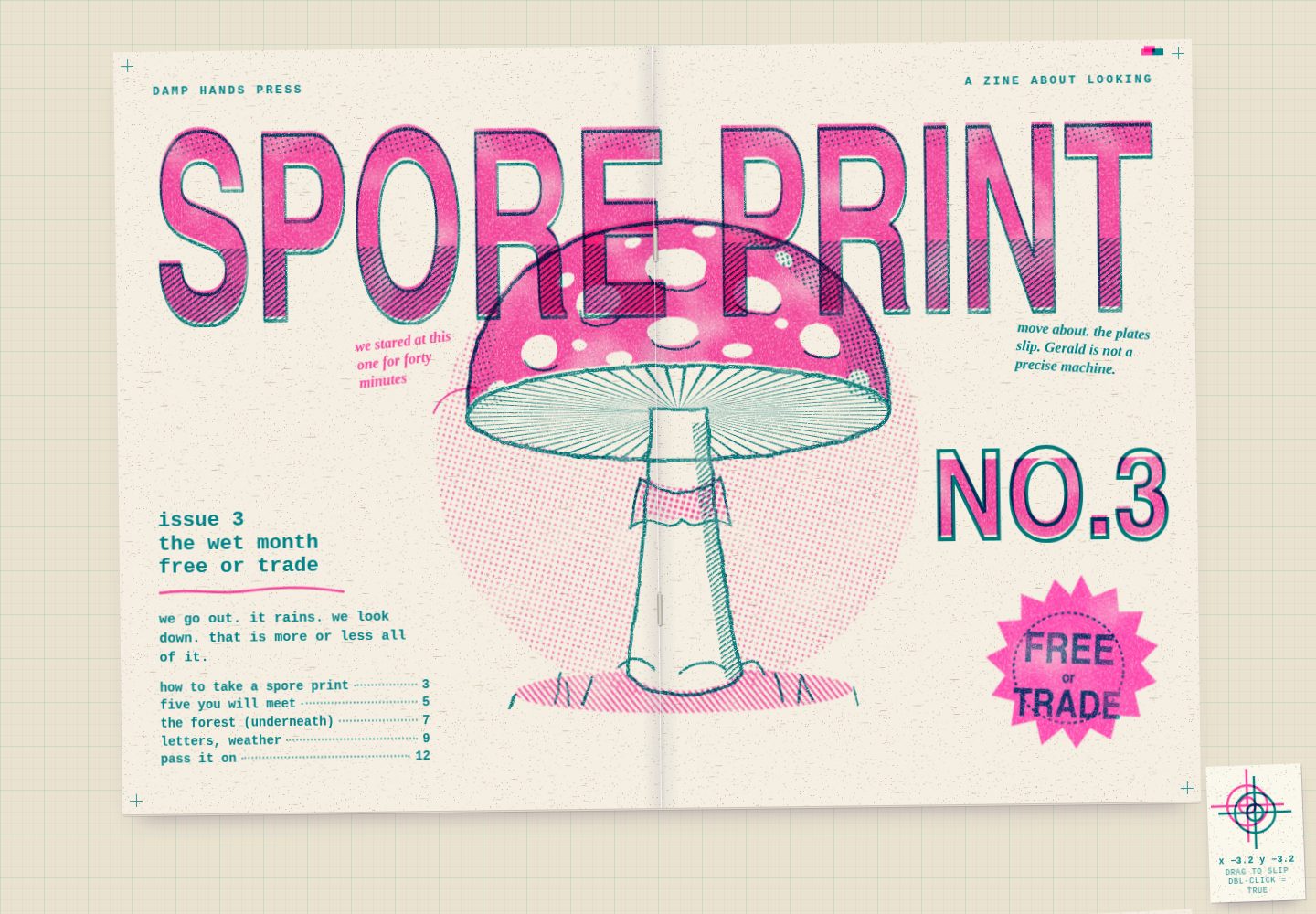
A six-spread stapled zine laid out on a cutting mat, printed in exactly two inks. Everything on the page, from the full-width cover title to the smallest weather icon, exists twice: once on a fluorescent pink plate and once on a teal plate, multiplied together over flecked recycled paper so that overlaps turn a deep violet nobody paid for. The plates never quite agree. As the viewer moves, scrolls or tilts, the pink plate slides a few pixels against the teal one with a soft spring, keylines drift off their fills, halftone screens beat against each other, and a printer's registration target in the corner reports the error and can be dragged to make it much worse or double-clicked to make it, briefly, perfect. Inside that process sits a warm, funny little publication by two damp people and a cat: instructions for taking a spore print (with a cap you can lift to watch one land), five mushrooms described like neighbours, a centrefold of roots and mycelium growing under the fold, letters, a month of rain, and a stamp telling you to pass it on.

↗ Open
Plotter No. 2 — Landscapes in One Pen screenshot
018

Plotter No. 2 — Landscapes in One Pen

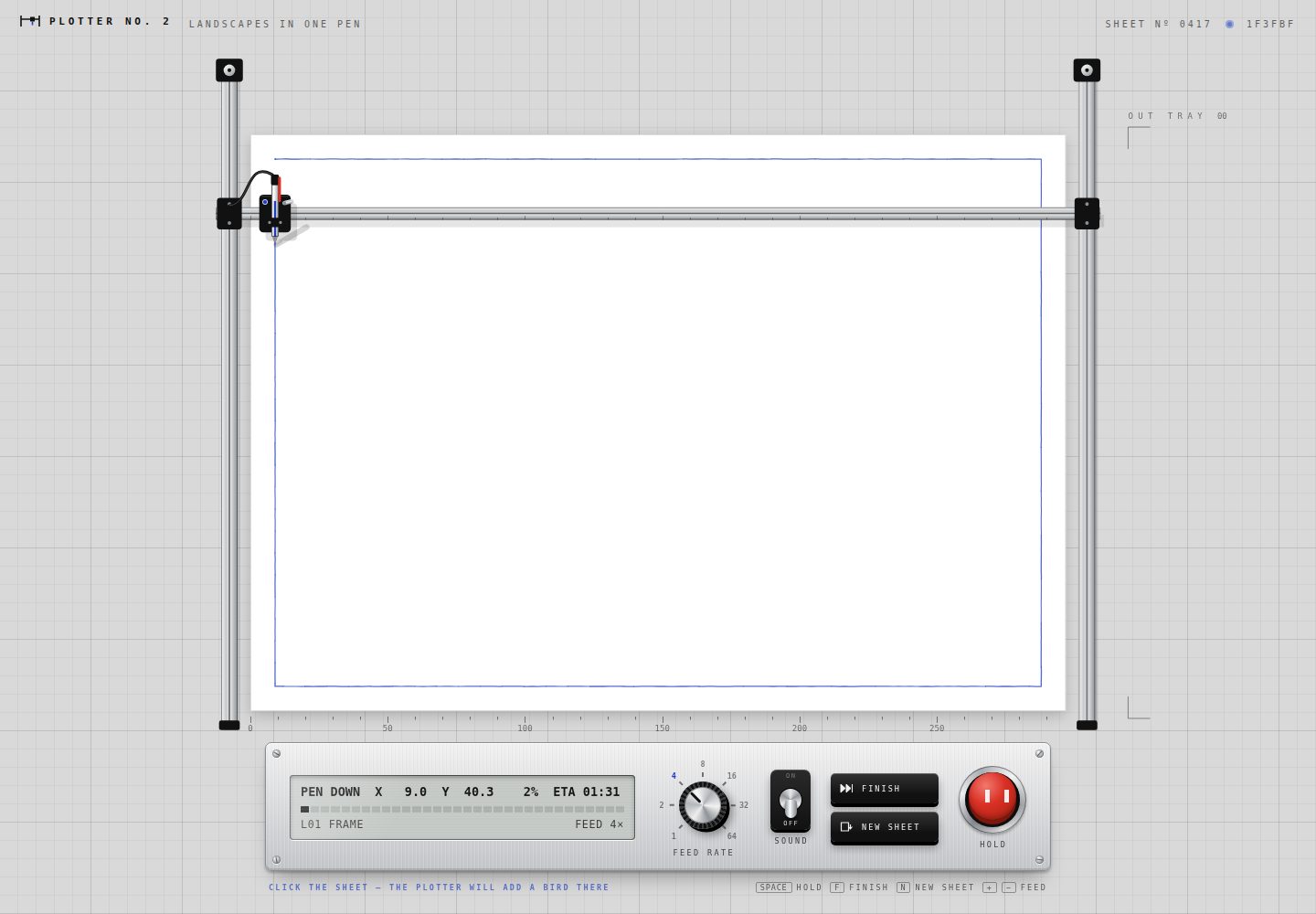
A bright, technical bench-top scene: a white A4 sheet lies on a pale grey gridded cutting mat inside a drawn pen plotter with two aluminium rails, a travelling gantry bar, a black carriage with a cable loop and a ballpoint whose red clip is the only warm colour besides the hold button. On load the carriage homes into the corner with a small bump, rules the border and registration crosses, then works through the sky, each ridge from far to near, the lake or pines, and finally letters its own title block. The landscape is a true plot file: every mark on the sheet is an ordered polyline that the pen actually travels, with travel moves, pen lifts, corner slow-downs and ink that is paler when the pen runs fast. The pleasure is in watching tone accumulate as the machine hatches a mountainside in hundreds of quick strokes, while a small LCD reports pen state, coordinates, percentage and time remaining, and a listing on the mat ticks off the layers. Every new sheet is a new seeded composition, and the finished ones pile up in the out tray.

↗ Open
Rhythmus — A Drum Machine in Primary Colours screenshot
019

Rhythmus — A Drum Machine in Primary Colours

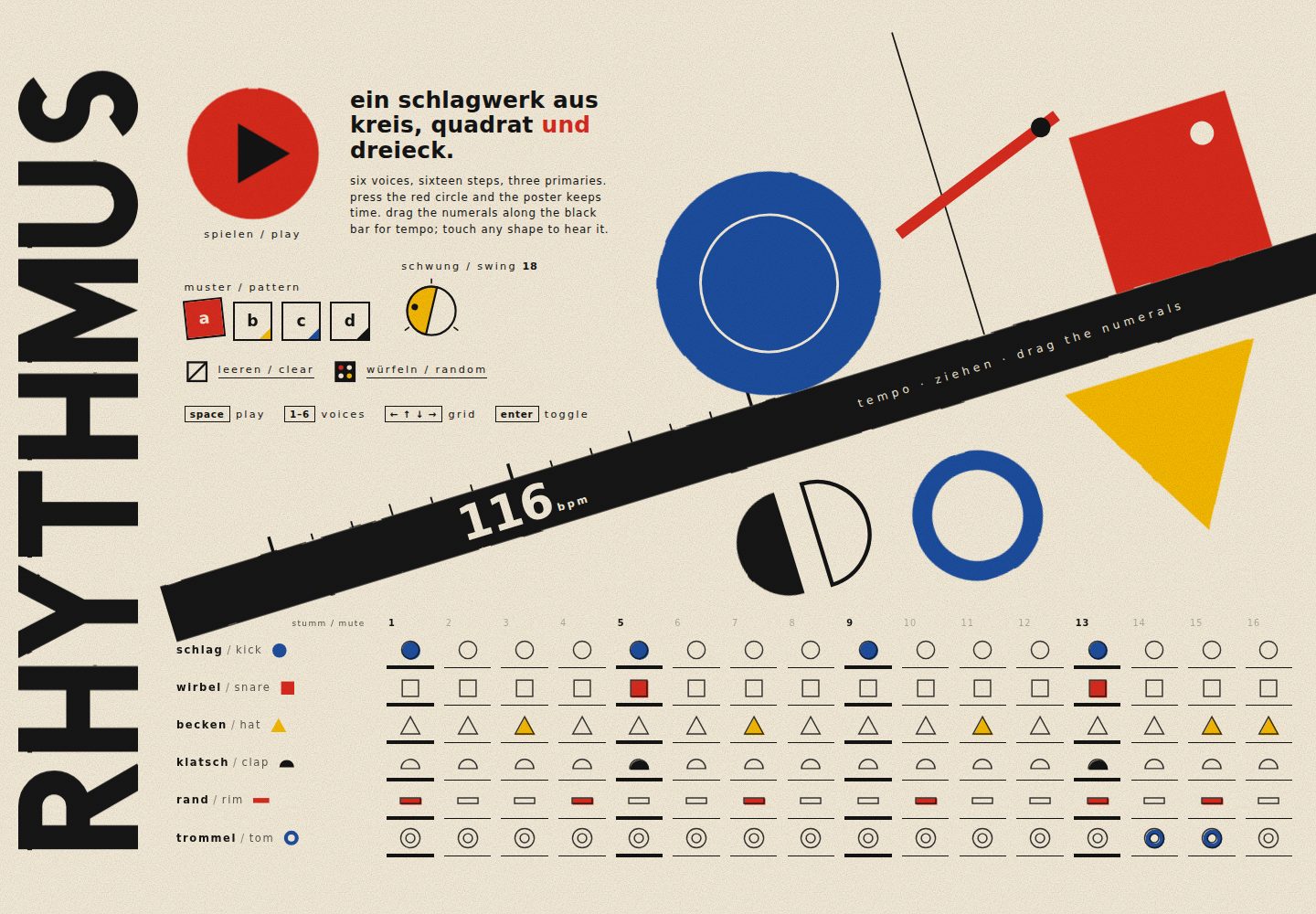
Rhythmus is a poster that happens to be an instrument. On warm, toothy paper a wall of hand-drawn geometric capitals climbs the left edge, and a heavy black bar cuts across the sheet at seventeen degrees with the tempo reversed out of it like a ruler. Six flat-colour shapes balance on and hang from that bar: a blue circle resting on the incline, a red square standing on its edge, a yellow triangle, a black half-disc facing its outlined twin, a thin red mallet on a black pivot, a blue ring. Below, a six-by-sixteen grid repeats the same shapes in miniature as the score. Press the red circle and the composition starts to move: every drum hit is performed by its shape with spring physics, the playhead sweeps the grid, the title letters step along with the bar, and the whole print keeps time. Everything is drawn in code, with slightly ragged printed edges and off-register fills, and the layout re-composes for phones with the stage above a two-page grid.

↗ Open
Aurora over Skjervøy Sound screenshot
020

Aurora over Skjervøy Sound

A silent winter night at 69°N, seen from the shore of an invented fjord. The page opens on stars, black mountains and one lit cabin window; then a green curtain of light unrolls from the left and the sky comes alive. Three aurora curtains hang in true perspective: folded ribbons with crisp, bright lower borders, tall rays that shimmer sideways, pale cores and violet upper fringes, the nearest arching overhead while the farthest lies low over the mouth of the sound. Snow on the peaks picks up the green, the water below breaks the whole sky into long trembling streaks, and a thread of smoke rises from the cabin beside a jetty and a moored boat. A small plate of type in the corner names the place and slowly turns the pages of an observer's notebook. The viewer can simply watch, or stir the solar wind and call down a substorm that floods the fjord with light.

↗ Open
Drawer 31 — Moths That Were Never Caught screenshot
021

Drawer 31 — Moths That Were Never Caught

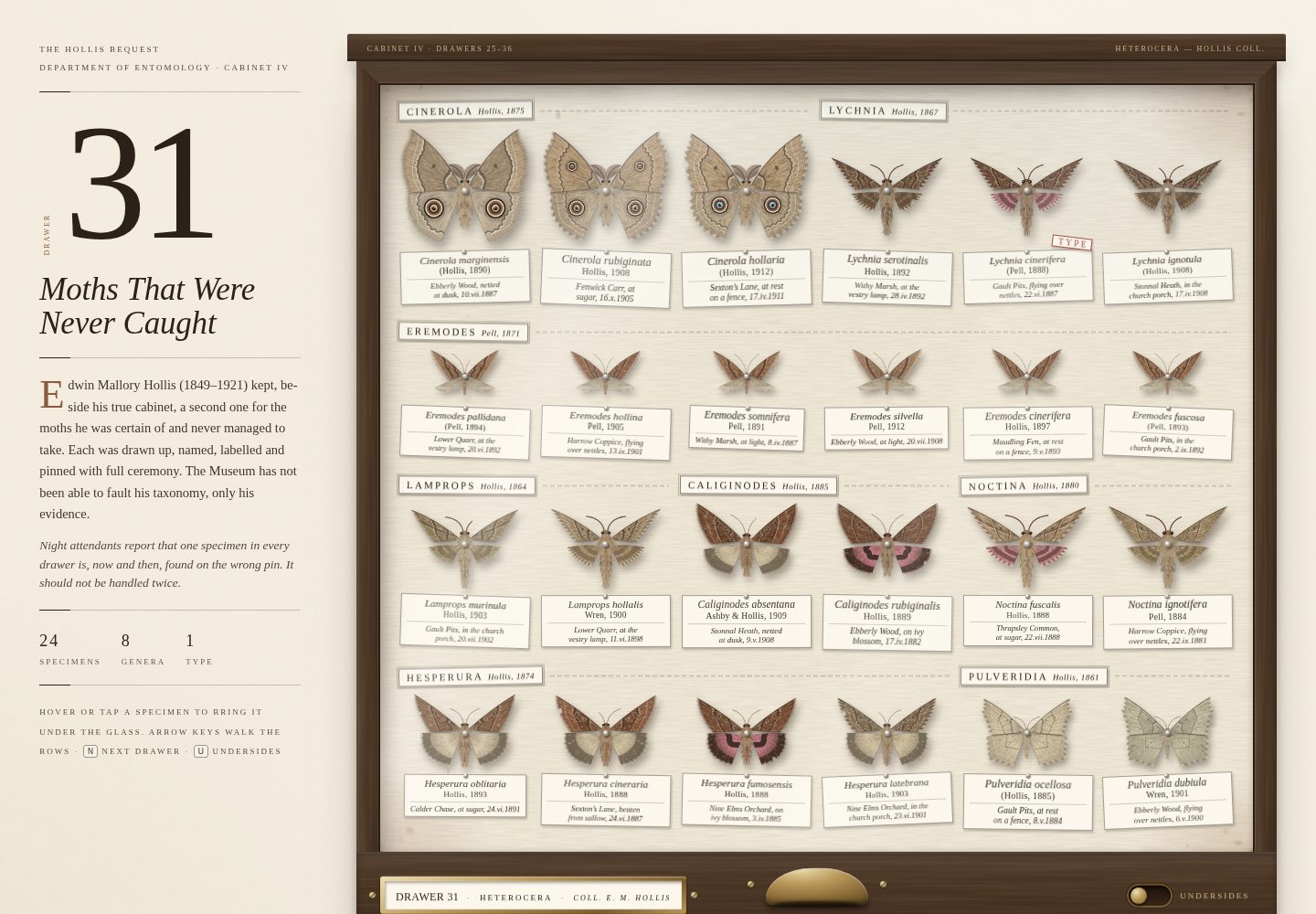
A walnut specimen drawer slides out from under a cabinet rail and fills, moth by moth, with two dozen species that never existed: emperors with ringed eyespots, swept hawk-moths with rose underwings, angular lichen-green geometers, stout owlets and tiny fringed micros, each painted procedurally from a seed, mirrored for symmetry and then slightly damaged the way real specimens are. Rows are grouped under printed genus headers, every pin in a row sits on one line, and beneath each moth is a small tilted label in uneven sepia handwriting. The lining paper is foxed at the corners, the glass carries a faint moving reflection, and the drawer front holds a brass label holder, a cup pull and a small brass switch. To one side a huge Didot numeral and a dry curatorial note explain the collection of E. M. Hollis, who pinned the moths he was sure of and never caught. The experience is quiet and studious: pass a brass magnifier over a specimen to read its scales at three times life size while its typed index card slides out, turn the whole drawer over to see the pale undersides, pull the next drawer, and eventually discover that one specimen in each drawer is still alive.

↗ Open
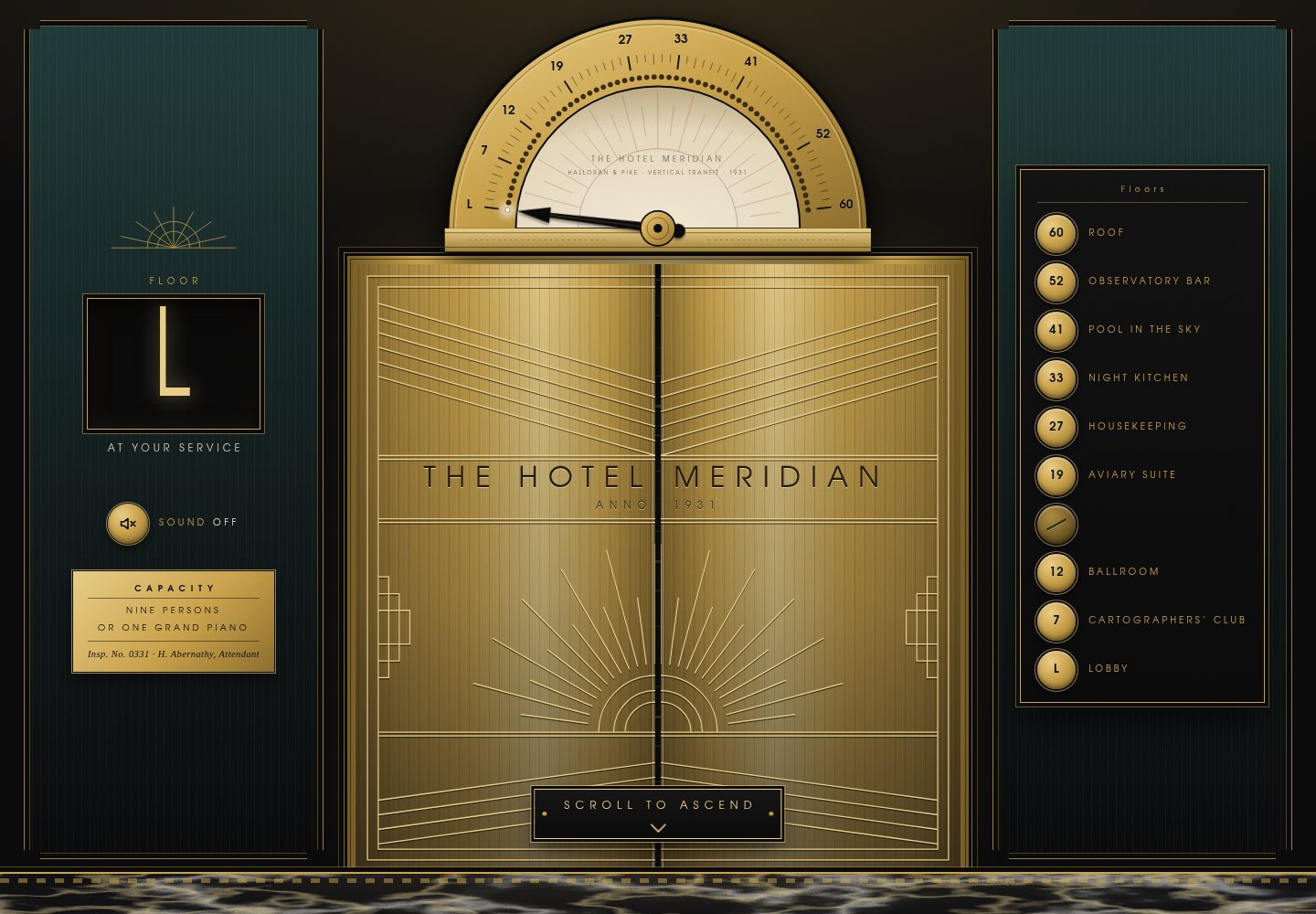
The Hotel Meridian — Going Up screenshot
022

The Hotel Meridian — Going Up

The viewer stands inside the lift car of the Hotel Meridian, a sixty-storey Art Deco hotel of 1931, and scrolling is riding. The screen is fixed: two brushed-brass doors engraved with chevrons and a rising sunburst, a semicircular brass floor indicator above them, verdigris wall panels either side, a strip of veined black marble underfoot. As the page scrolls the indicator hand springs from floor to floor, shaft lines streak through the gap between the doors, and at ten floors the car stops, sways, and the doors slide apart on a small flat Deco scene with one looping motion each: a revolving door, a spinning globe, waltzing silhouettes under a mirror ball, a swinging bulb on bare brick, parrots on perches, dripping lost umbrellas, a cake being iced at 3 a.m., a lone swimmer under the moon, a tram crossing below a telescope, and finally the roof with the hotel's neon sign seen backwards against the dawn. Each scene is captioned in the dry, discreet voice of the attendant, Mr. Abernathy. The mood is luxurious, nocturnal and slightly haunted; the whole page is lit by brass against lacquer black.

↗ Open
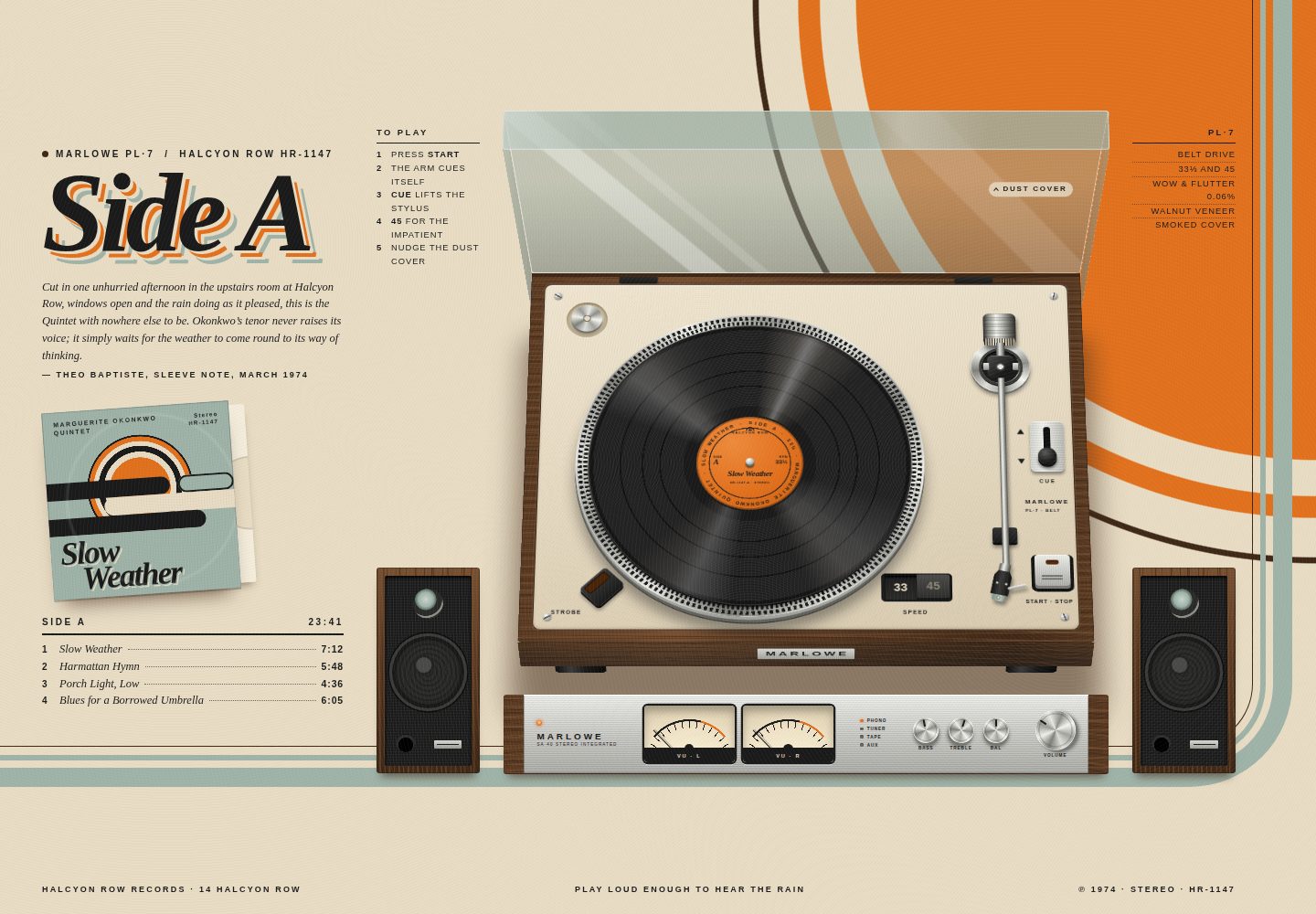
Side A — A Turntable in CSS screenshot
023

Side A — A Turntable in CSS

A catalogue-style spread for an invented 1974 turntable, the Marlowe PL·7, playing an invented jazz LP, "Slow Weather" by the Marguerite Okonkwo Quintet. A walnut plinth with a cream deck plate sits tilted in real perspective under a translucent sage dust cover, in front of a burnt-orange supergraphic sun and sage shelf stripes; a fat italic "Side A" headline, a sleeve note, a leaning record sleeve and a track list sit to the left, and a brushed-aluminium amplifier with two VU meters and a pair of walnut speakers complete the system. The page looks like a still illustration until the viewer presses START: the lamp and strobe light up, the record gathers speed, the arm rises, crosses to the lead-in groove, settles, and begins a four-minute walk toward the label while the meters dance, the speakers breathe arcs and slanted window light slowly warms the page. Everything is drawn from HTML elements and gradients and everything moves without a line of script.

↗ Open
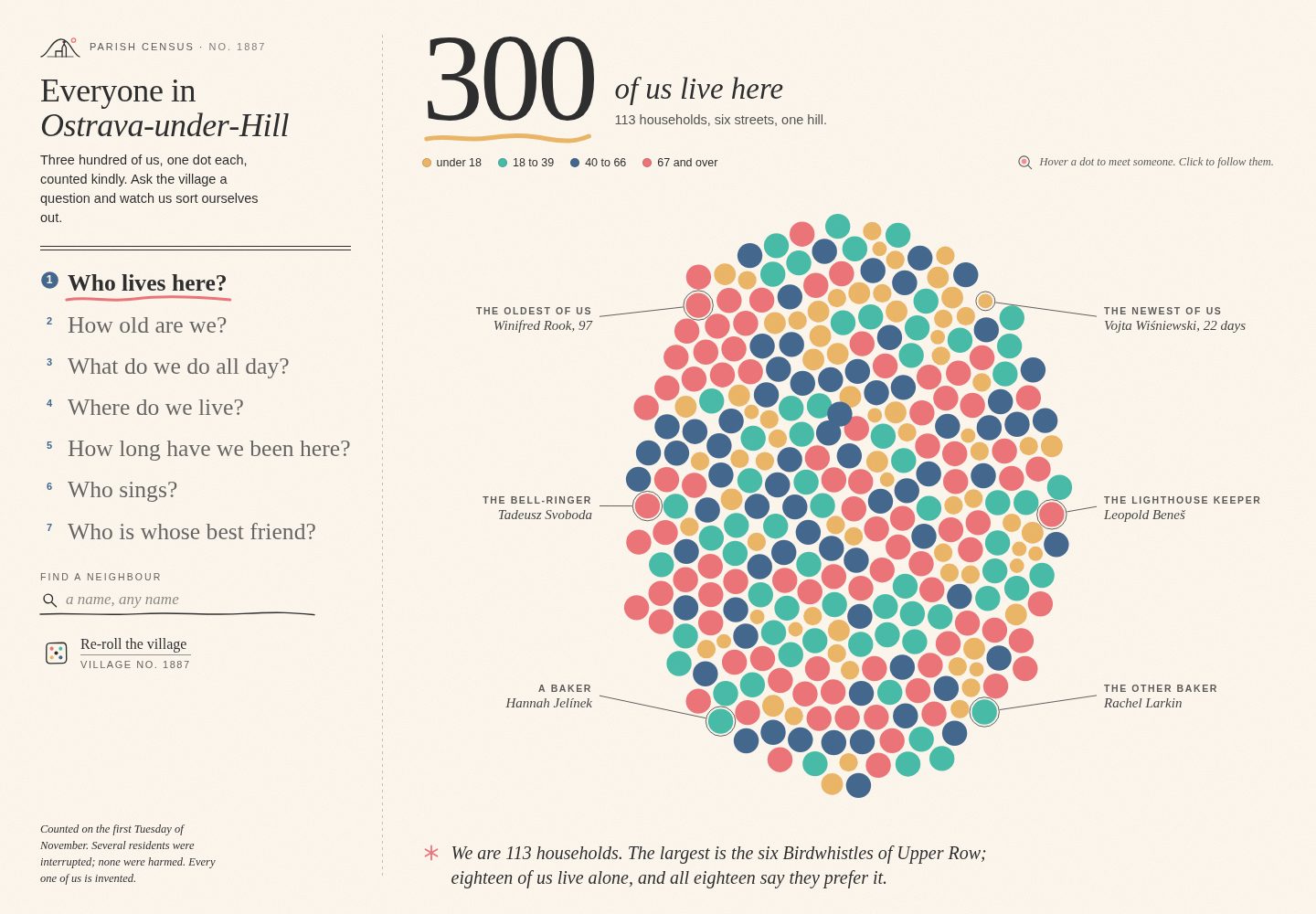
Everyone in Ostrava-under-Hill screenshot
024

Everyone in Ostrava-under-Hill

A parish census drawn as a single sheet of cream paper: on the left, a small masthead and seven questions set as large serif sentences; on the right, one enormous numeral, a phrase that completes it, and three hundred coloured dots that are, each of them, somebody. The dots rain in and settle into a packed cluster of households; ask another question and every family lifts off together, arcs across the page and springs into place as a population pyramid, nineteen clusters of occupation, a hand-ruled map of six streets under a hill, a beeswarm of arrival years, a choir on its risers above a grey audience, or a ring of friendships. The headline counts to its new value, the rules and labels draw themselves in, and a sentence written from the data sits underneath, dry and affectionate. Hovering any dot produces a little card with a name, an age and a one-line life; pinning it lets you follow one person through every statistic they belong to.

↗ Open
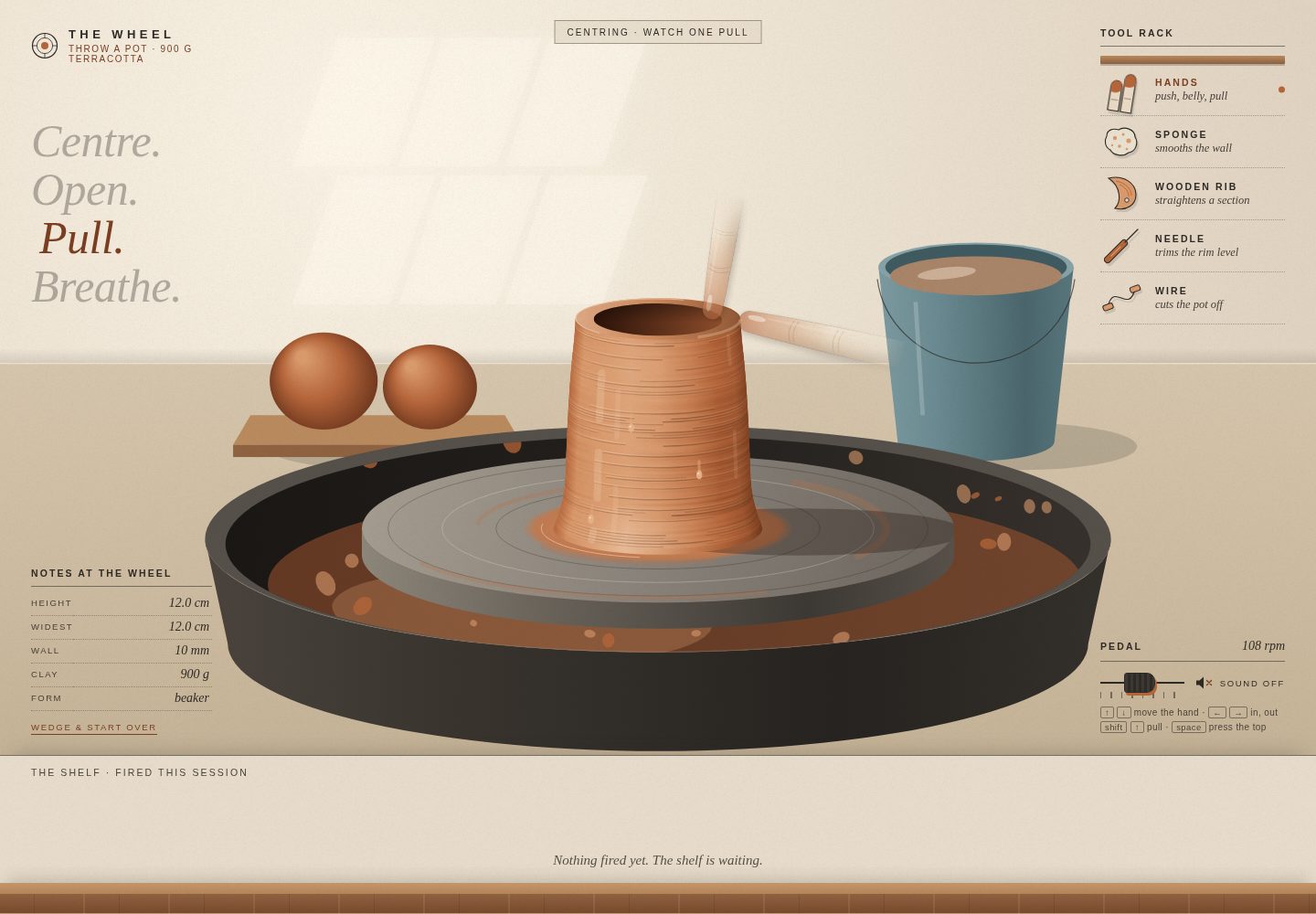
The Wheel — Throw a Pot screenshot
025

The Wheel — Throw a Pot

A quiet potter's studio on a single screen: linen wall with a patch of window light, a bench with a dusty blue water bucket and two spare balls of clay, and in the middle a charcoal splash pan with 900 g of wet terracotta turning on the wheel head. The page opens with the lump wobbling into centre and a pair of ghost fingers opening it and making one pull, so the clay rises in the first seconds; then the viewer takes over and the wall follows their fingers, getting taller as it is collared, squatter as it is bellied, thinner as it is pulled, and folding into a heap if it is rushed. Around the wheel the type is set like a craft catalogue: small-caps labels, potter's notes in tiny italic numerals, a hand-drawn tool rack and one large italic line, "Centre. Open. Pull. Breathe.", whose words light in turn. Wiring the pot off begins the second act: it is lifted on tongs, dipped into a bucket of glaze, watched through a glowing kiln peephole while the cones bend and the counter climbs to 1,240 °C, and comes out glossy to slide onto a wooden shelf that fills up over the session.
↗ Open
Frost on the Window screenshot
026

Frost on the Window

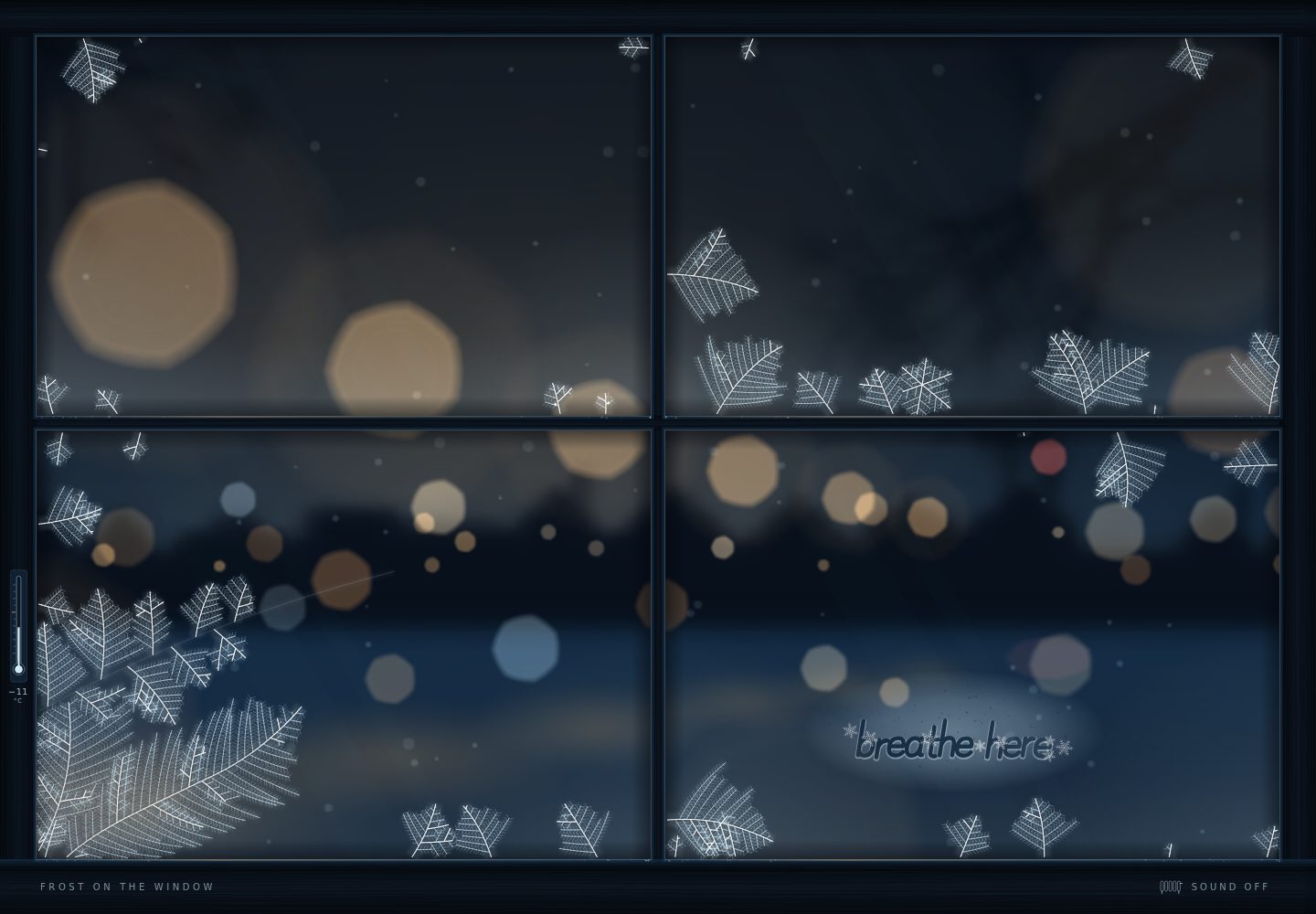
A cold room at 2 a.m., seen as one full-bleed window: four panes in a dark wooden frame, a sodium-lit street dissolved into heptagonal bokeh behind them, and frost drawing itself across the glass in real time. The first ferns shoot out of the lower-left corner, then everything slows to a patient creep: curved plumes with herringbone side branches at sixty degrees, six-armed frost flowers, lines of ice running along invisible scratches, all stopping where they meet older ice so the pane fills over about two minutes yet keeps clear islands. Where the ice is dense the street behind turns pale and diffuse, and crystals glint when a lamp or a passing car's headlights slide behind them. Hold a finger to the glass and a haze of breath blooms, the frost melts outward into beads, a few drops run down leaving clear tracks, and when you let go the patch quietly freezes over again with ferns that were never there before. The only words are "breathe here", fingertip-written in old condensation and already half frozen, a thermometer on the frame, and a tiny caption on the sill.

↗ Open
Five Calligrams screenshot
027

Five Calligrams

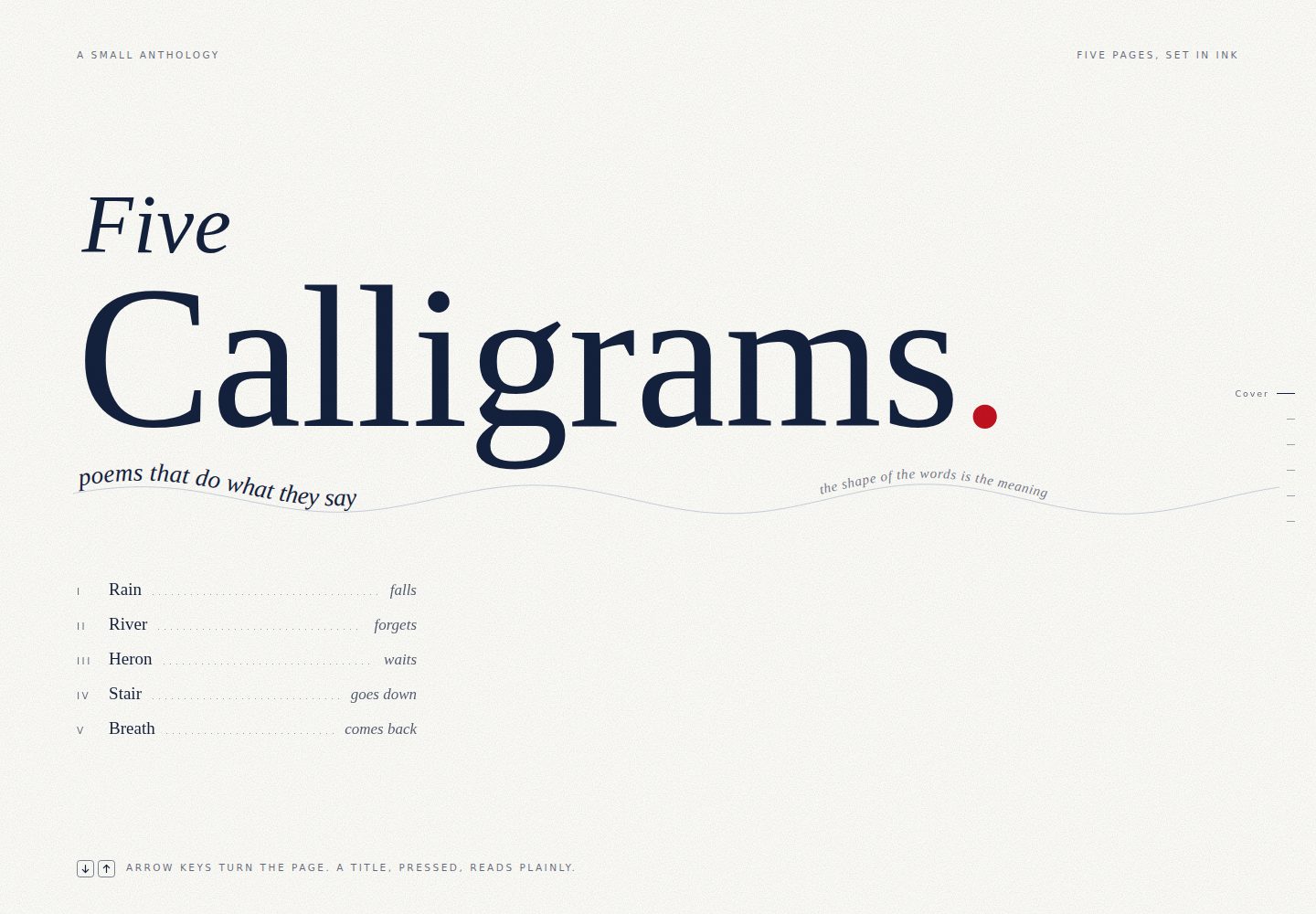
A fine-press book of five pages on warm paper, in blue-black ink with one red mark per page. The cover sets "Five" in italic over an enormous "Calligrams." and types its subtitle onto a pale wave. Each page then performs its poem: Rain falls in slanted columns of words that splash letter by letter at the ground and part around one red, dry "umbrella"; River carries a long sentence down a meander, letters springing at the source, swelling where two small tributary sentences run into it; Heron stands as a bird made of type and, when ready, lunges its neck of words at the water as "not yet" becomes "now"; Stair lets the reader's scroll bounce a red full stop down seventeen word-steps to the floor; Breath opens and closes a ring of words at four seconds in and six out. Any poem can be un-shaped into plain stanzas and shaped again, so the reader can watch form become, and stop being, meaning.

↗ Open
Conservas Maré Alta — Tinned Fish Since 1923 screenshot
028

Conservas Maré Alta — Tinned Fish Since 1923

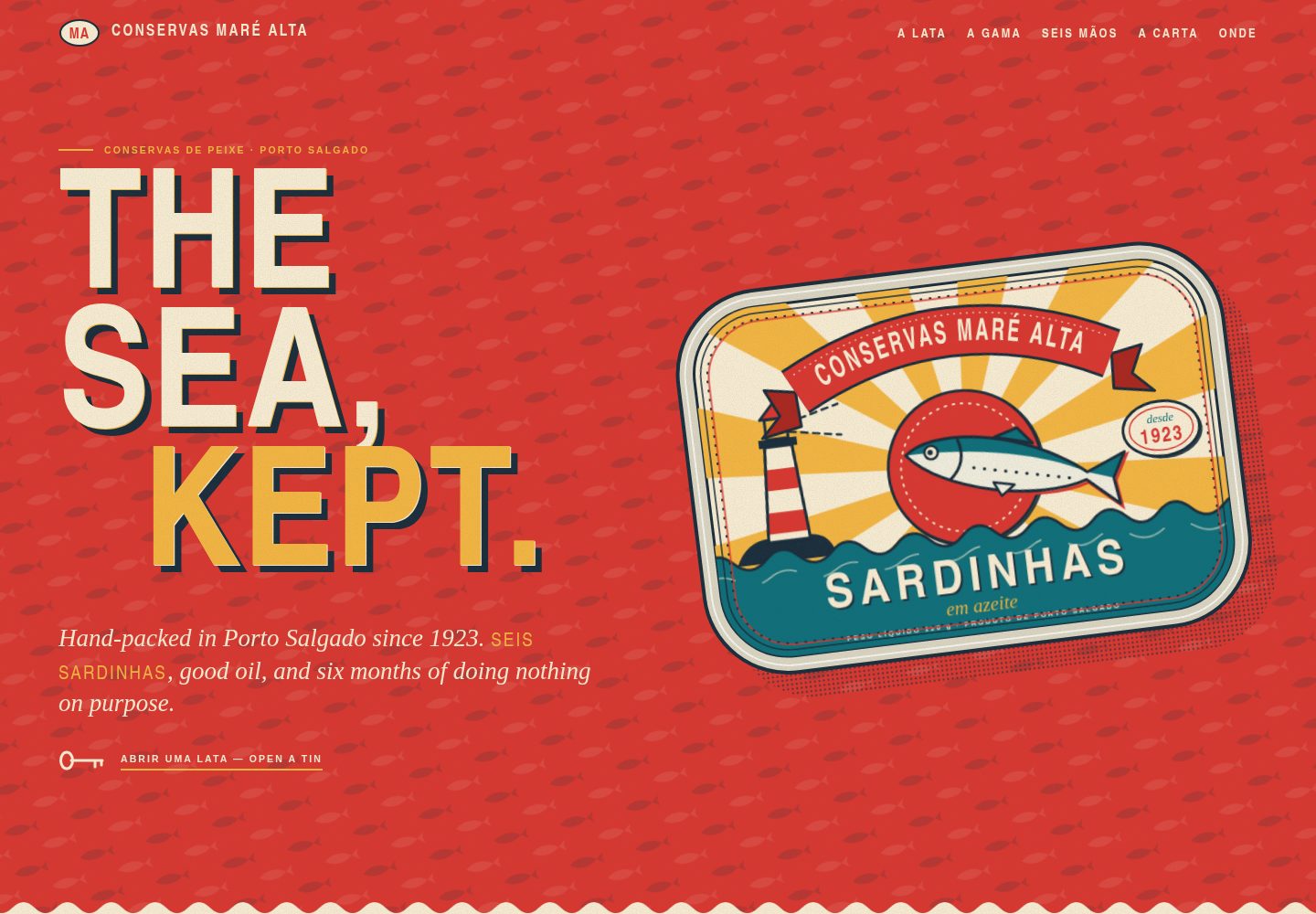
A sunny, proud landing page for the invented cannery Conservas Maré Alta of Porto Salgado, drawn entirely as mid-century tinned-fish packaging: flat inks in cream, tomato red, sea teal, sun yellow and navy, halftone-dot shadows, off-register outlines, arched banners and numerals in ovals. A red hero patterned with tiny fish carries the headline "The sea, kept." beside an oversized, tilted tin whose wrapper comes alive (sunrays turning, a sardine leaping with a splash beside a striped lighthouse). The centrepiece is "A Nossa Lata": a lithographed tin whose lid curls around its key as you scroll, drag or press Abrir, uncovering six scaled, gleaming sardines laid head-to-tail in shimmering golden oil with a bay leaf and a slice of chili. Below sit a yellow shelf of six differently designed tins that turn over to show ingredients, a one-line serving suggestion and an escudo price sticker; a teal strip of six perforated stamps telling the process; a typed letter from fourth-generation owner Inês Carvalhal with a hand-drawn signature; and a footer shaped like the embossed bottom of a tin, with stockists, factory visits and a newsletter that answers with a rubber stamp.

↗ Open
Holm Skerry Weather Station screenshot
029

Holm Skerry Weather Station

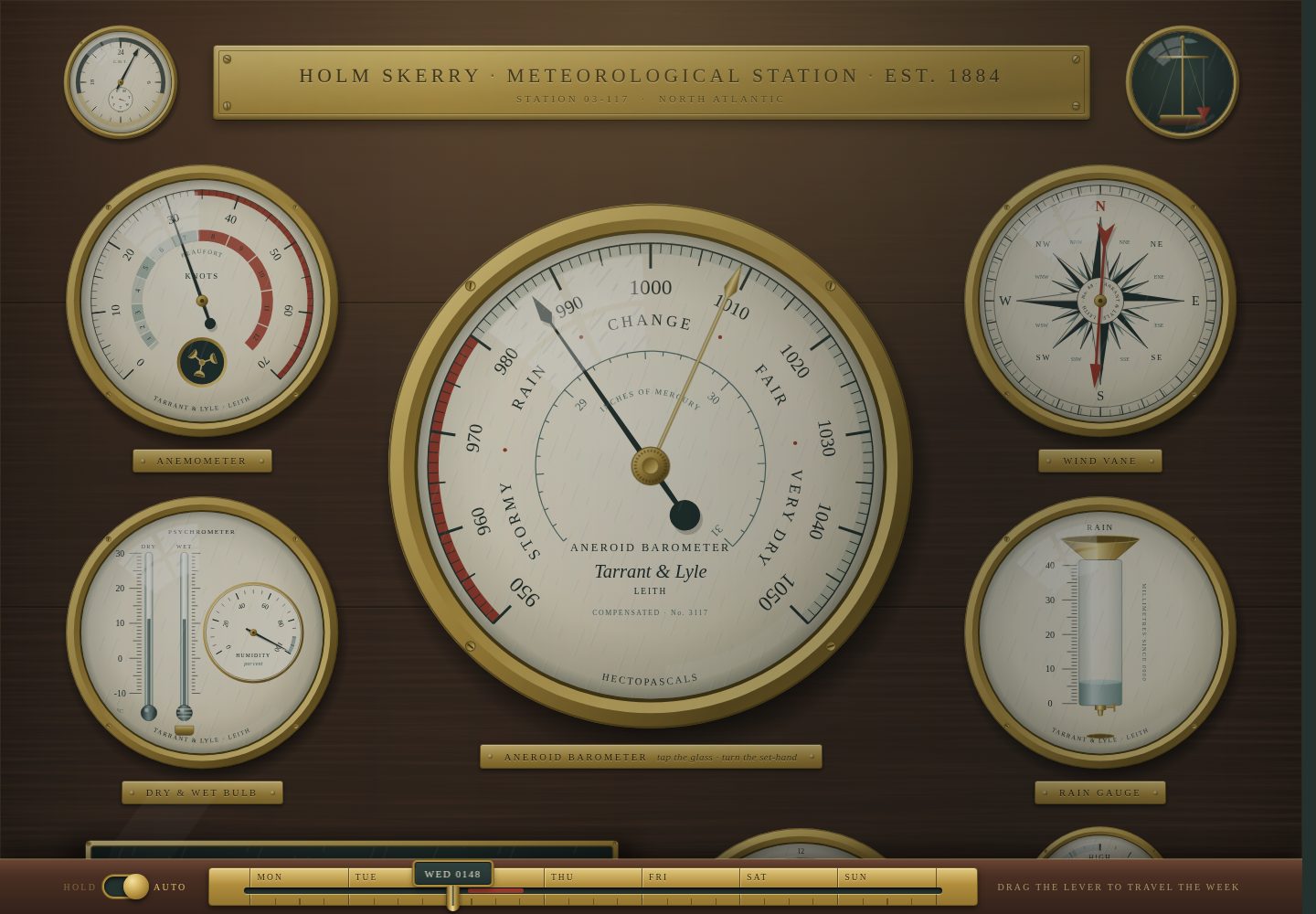
A wall of Victorian instruments mounted on grained mahogany: a great aneroid barometer at the centre, ringed by an anemometer, a 32-point wind rose, a psychrometer, a rain gauge, a clockwork barograph in a glazed case, a sunshine recorder and a cluster of small dials for tide, sea and visibility, all under a brass plaque. Nothing is a number in a box; every value is a needle, a mercury column, a water level or an ink line. A week of invented weather runs on a fast clock, and a deep Atlantic low arrives a few seconds after the page opens: the barometer needle sinks heavily into the red sector, the vane backs and twitches, the anemometer surges with each gust, rain streaks cross the window reflected in every glass, the light dims, and a red storm cone climbs the signal mast while the observer's log writes its warning in a slanting hand. Then the front goes through, the vane flies round to the north-west, and the glass leaps. The experience is meant to be calm and exact, like standing in a quiet room while the weather happens outside.

↗ Open
Rose Window screenshot
030

Rose Window

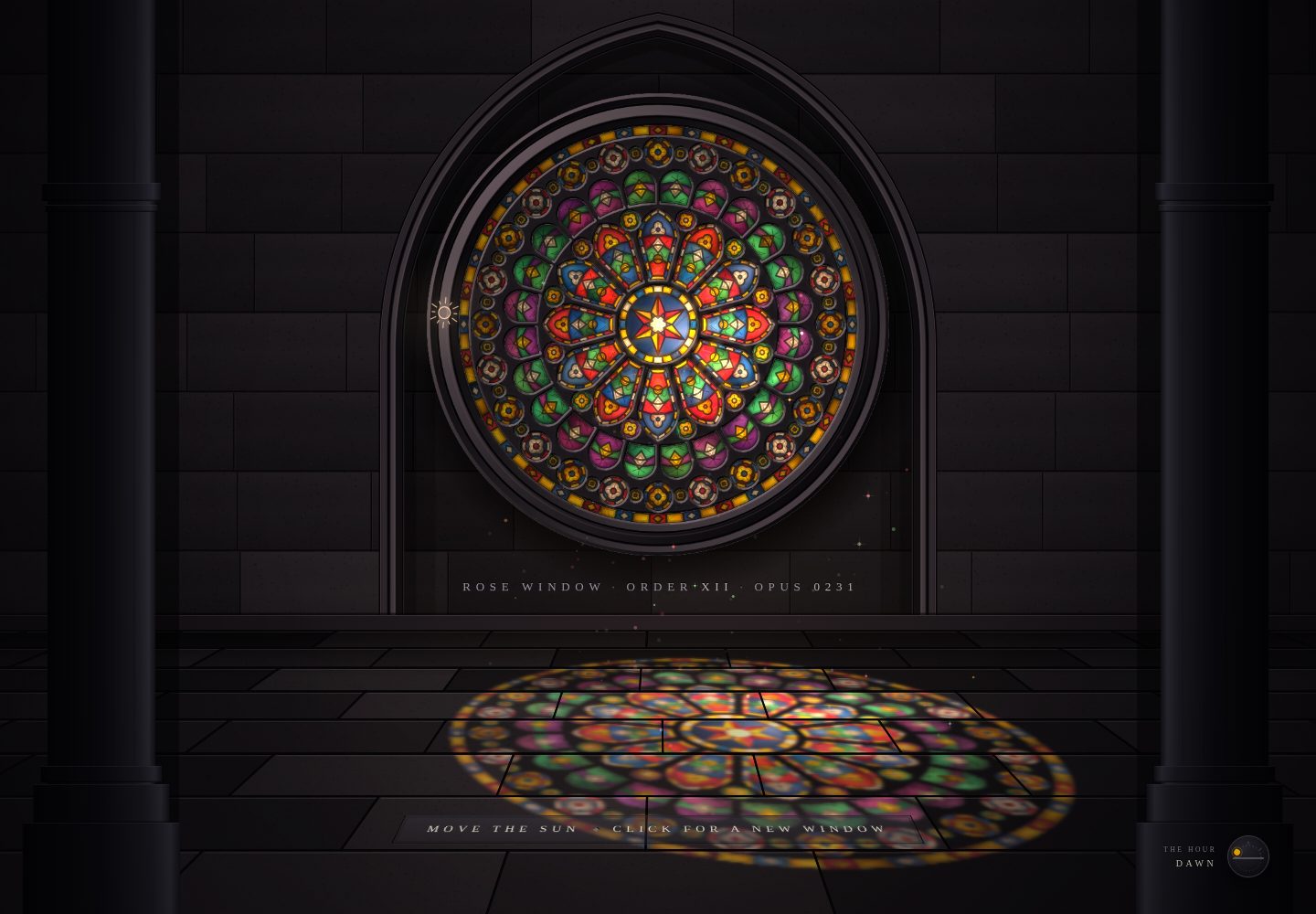
A hushed stone nave seen from the floor: a wall of ashlar blocks, a pointed arch with carved mouldings, two dark columns, and high in the wall a rose window whose several hundred pieces of ruby, cobalt, gold, emerald, amethyst and pale glass are generated afresh by gothic rules of symmetry, nested rings, lancets, foils and roundels. The viewer holds the sun. As it moves, a hotspot of brilliance travels across the glass, bright pieces bloom over their leads, and the whole window is thrown down as a long, soft, skewed pool of colour across the flagstones, with tinted dust sparkling in the shaft between. Each new commission is drawn in lead from the centre outward and then glazed ring by ring, every piece flaring as it is set, while a carved inscription records its order and opus number.

↗ Open
Tangram Menagerie screenshot
031

Tangram Menagerie

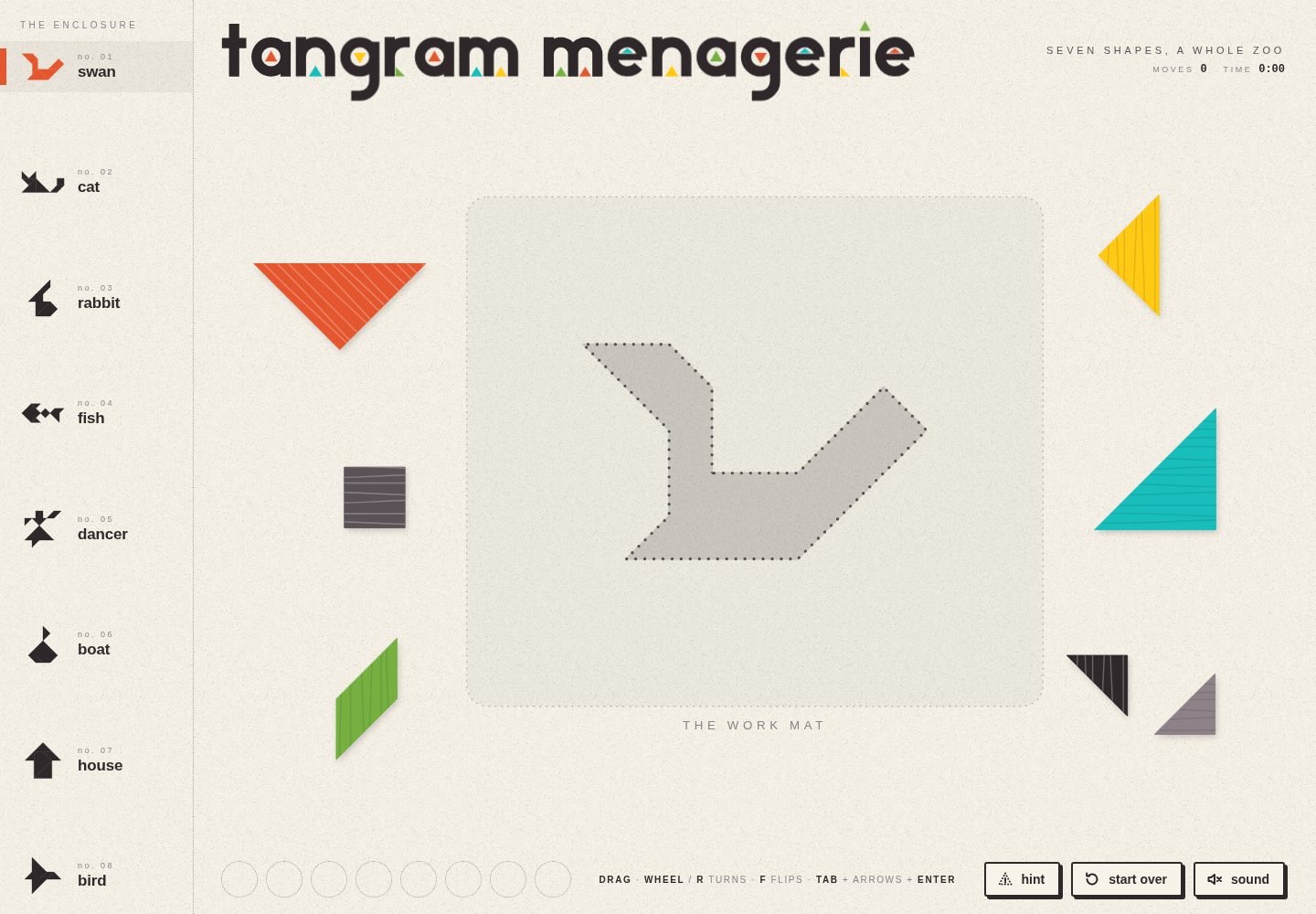
A bright, paper-coloured tangram table in the manner of a mid-century picture book. The title is drawn letter by letter in chunky geometric strokes so that every counter and arch can hold a small coloured triangle. Seven flat-coloured wooden pieces begin as the classic square, burst apart into a loose scatter, and a pale dotted silhouette draws itself onto the work mat. The viewer drags, turns and flips the pieces until the shape is covered; the seams then glow, the silhouette fades, and the finished figure wakes up while still visibly made of its seven pieces: a swan glides over ripples, a cat blinks and swishes its tail, a rabbit hops, a fish wags through bubbles, a dancer sways, a boat rocks on waves, a house puffs smoke, a bird flaps. A lettered caption reports the time, and a vermilion stamp is pressed into a row of eight.

↗ Open
The Night Typist screenshot
032

The Night Typist

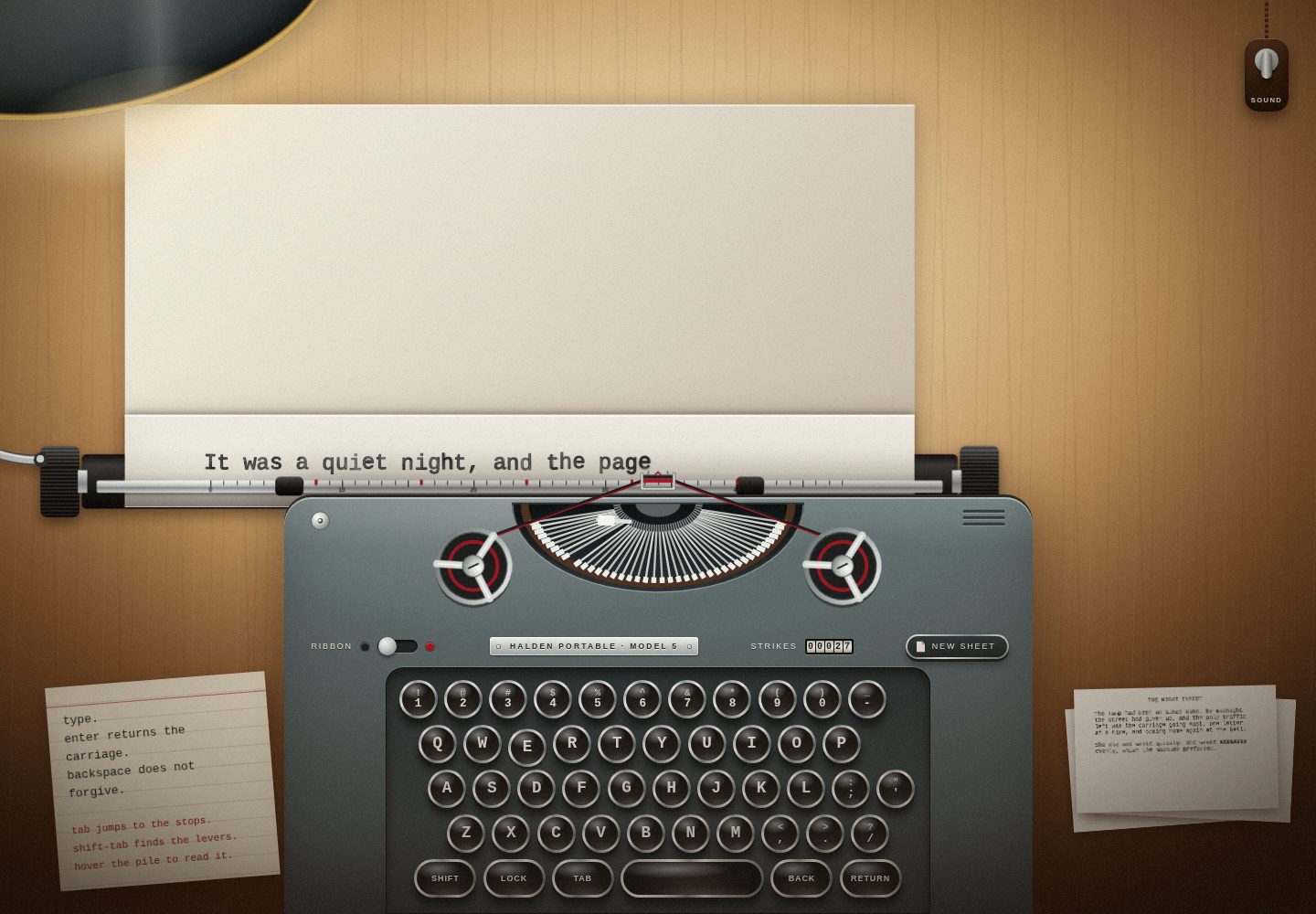
A Halden Portable, Model 5, sits on a lamp-lit wooden desk in 1958. A sheet of warm paper rises out of its black rubber platen and fills the upper part of the view; below it are the grey-green enamel deck with its fan of steel type bars, two ribbon spools, a nickel nameplate, a strike counter, and a bank of round glass-topped keys. The machine types its own first line with a human rhythm, returns the carriage, and then waits with a pulsing red caret at the printing point. From there every key the viewer presses is a physical event: the key sinks, a type bar leaps from the basket, the ribbon jumps, the paper shudders, an imperfect inked letter lands and settles, and the whole carriage steps one space to the left. Nothing can be erased, only struck over. Finished sheets are pulled out and drift onto a fanned pile that can be read again.

↗ Open
Lava Lamp, 1971 screenshot
033

Lava Lamp, 1971

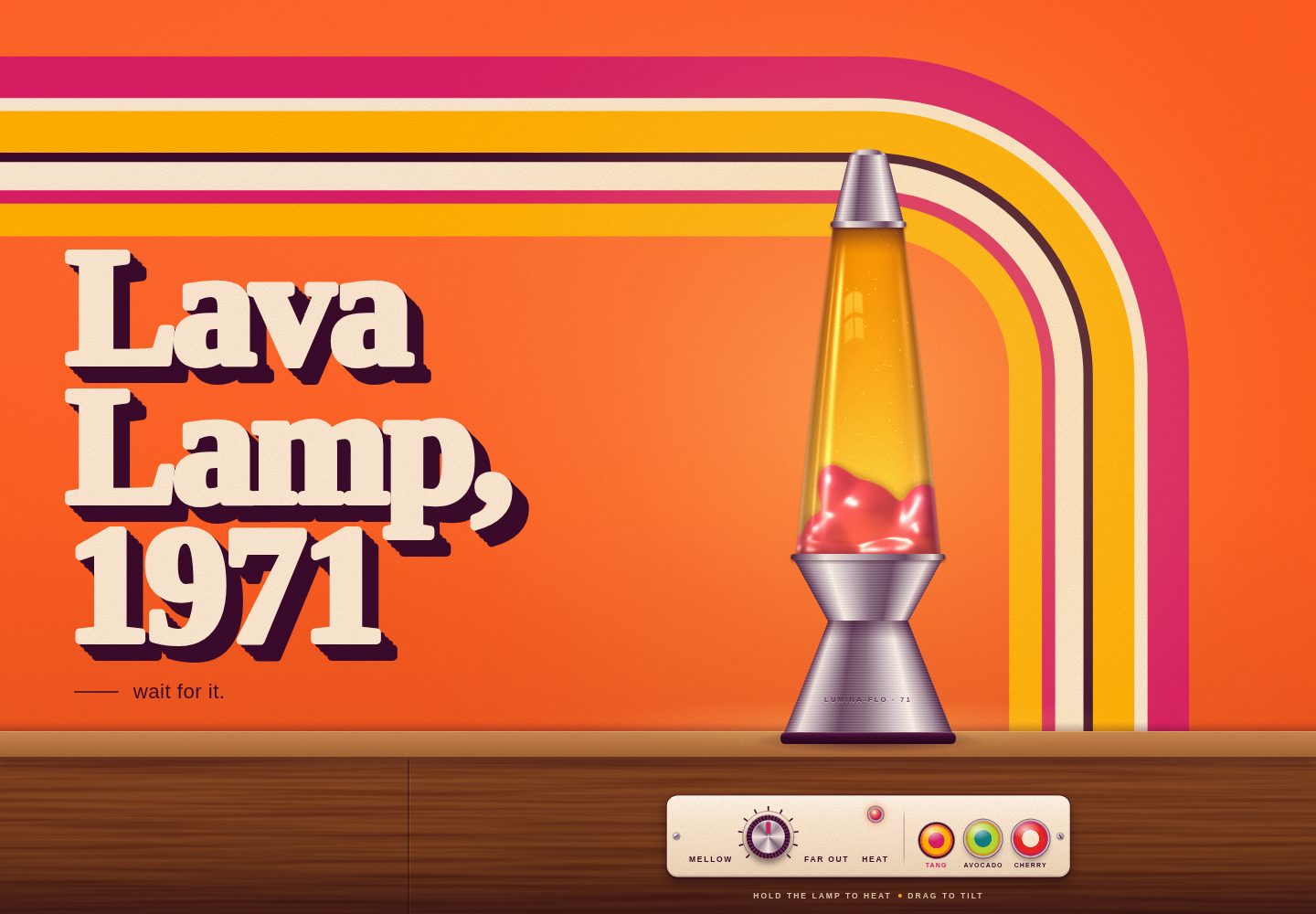
A flat, saturated tangerine living-room wall carries a supergraphic of seven concentric stripes that sweeps in from the left edge and bends down around a single rocket-shaped lava lamp standing on the edge of a teak sideboard. The lamp's spun-aluminium cap and hourglass base frame a tapered glass vessel in which glossy magenta wax lifts off a settled mound, stretches, necks to a thread, pinches in two, cools at the top and sinks again, all in amber liquid with drifting sparkle, a specular streak and a small window reflected on the glass. Fat cream Cooper-style lettering with a stepped aubergine drop-shade sits low on the wall beside it, over a quiet lowercase caption that says "wait for it." until a blob lets go. The page opens cold: the stripes draw themselves, the title springs up, the bulb flickers on, its glow spreads up the wall and the first big blob leaves the mound. The mood is warm, drowsy and unapologetically 1971.

↗ Open
The Museum of Obsolete Sounds screenshot
034

The Museum of Obsolete Sounds

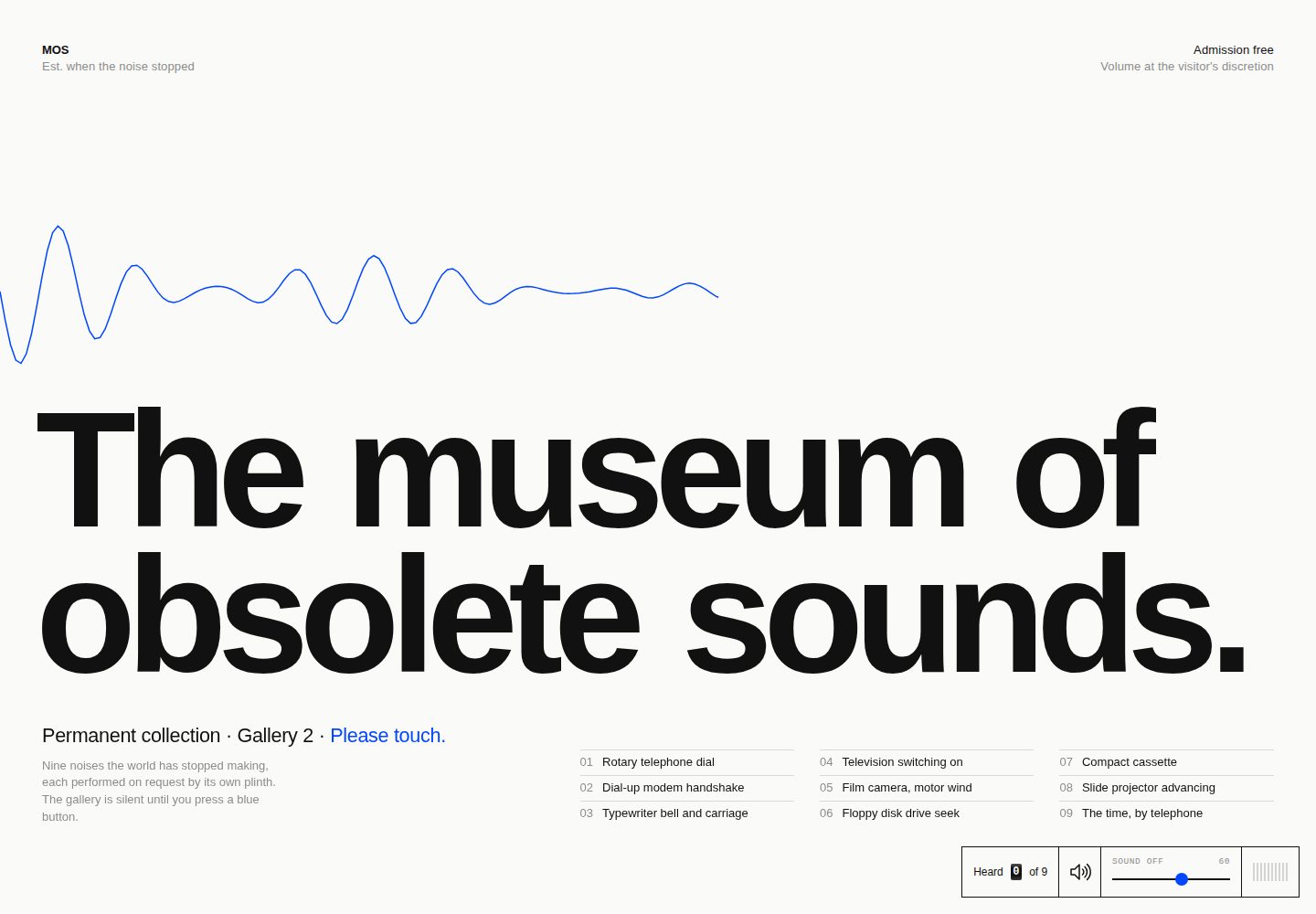
A white-cube gallery rendered as a long page: an entrance wall with the museum's name in enormous tight black grotesque under a single blue waveform that dies away into a flat line, then nine exhibit rows, each with a huge outlined catalogue number, a single-weight line drawing standing on a plinth, and a wall label written in a dry curatorial voice. The front face of every plinth is an instrument panel: a round blue button, an oscilloscope and a small spectrogram that show the sound actually being made at that moment. Nothing is recorded; a rotary dial, a modem handshake, a typewriter, a television, a camera, a floppy drive, a cassette, a slide projector and the time pips are all built from oscillators, filtered noise and envelopes, and each drawing performs one exact mechanical movement in step with its sound. The modem is the centrepiece: its plinth panel widens across the whole row and a large spectrogram writes itself out while brackets caption the conversation between the two machines. A mechanical tally counts what has been heard, and the exit wall keeps its last label in storage until all nine have played.
↗ Open
Totality screenshot
035

Totality

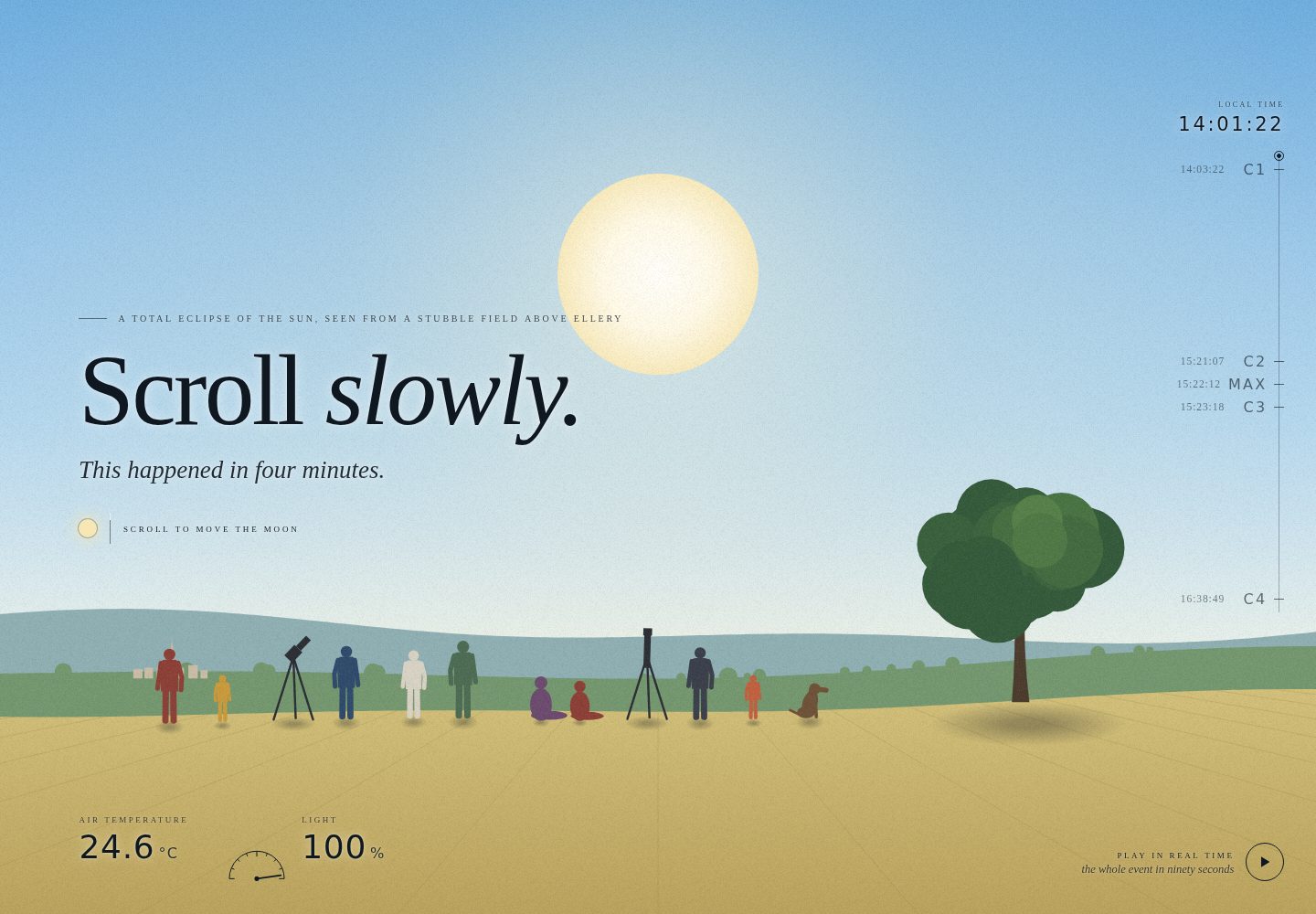
A fixed sky above a stubble field outside the invented village of Ellery, where a small crowd, two tripods, a dog and a single ash tree wait for a total eclipse. Scrolling is time: the Moon bites into a pale warm Sun, the blue sky thins to steel and then to twilight indigo, the field drains to silver, shadows harden, and an inset shows the ground under the tree covered in crescent suns. In the last minute shadow bands ripple over the field, the umbra rises from the west, the crescent breaks into Baily's beads along a jagged lunar limb and collapses into a diamond ring with bloom and diffraction spikes. Then the page goes dark: a delicate, asymmetric, shimmering corona unfurls around a black Moon, pink prominences cling to the limb, Venus and stars appear, the horizon glows orange all the way round, rooks fly to roost, the dog howls, and the word TOTALITY breathes across the sky above the quiet line "Two minutes, eleven seconds." Scrolling on plays it all in reverse on the opposite limb until daylight, colour and an ordinary afternoon return and people pack up. A clock, a contact timeline, a thermometer that falls six degrees and a needle light meter keep the facts while sparse second-person annotations keep the feeling.

↗ Open
Kestrel Frameworks — Bicycles Drawn to Measure screenshot
036

Kestrel Frameworks — Bicycles Drawn to Measure

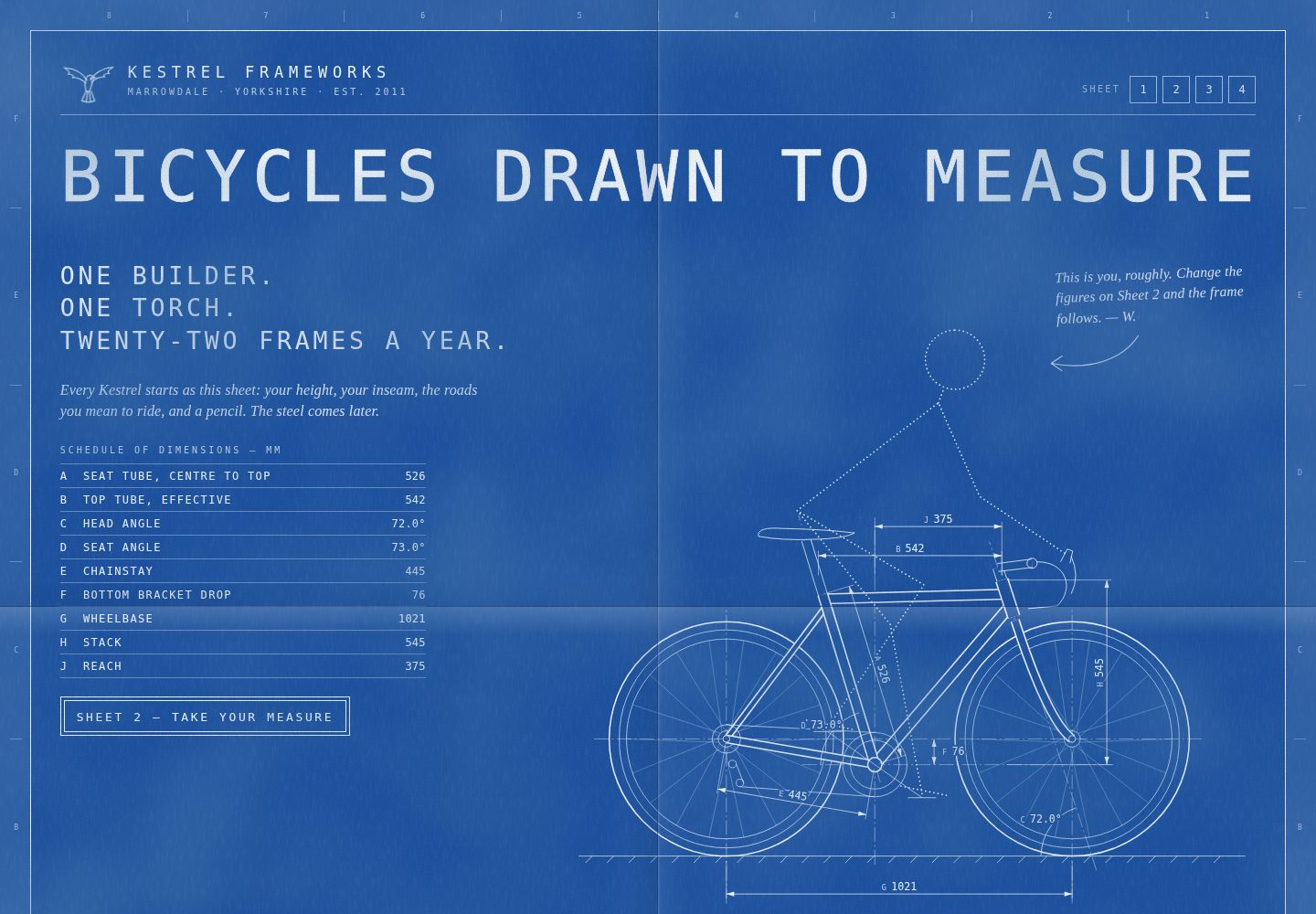
The page is four folded cyanotype sheets from the drawing office of a one-woman frame shop in an invented Calder-valley town. Sheet 1 opens by drafting a fully dimensioned side elevation of a lugged steel touring frame, fork, wheels and a dotted rider under a headline lettered across the whole width of the sheet, with a schedule of dimensions and a pencilled margin note from the builder. Sheet 2 hands the viewer four scale rules; moving any of them recalculates a real frame geometry and the drawing redraws itself tube by tube, numbers rolling and flashing marking-out yellow, construction arcs swinging through the tube ends, the rider leaning further forward or sitting up, the wheels shrinking to 650B for short legs, while every change is logged as a lettered revision that also updates the drawing number in each title block. Sheet 3 shows three circular detail views of the joinery with numbered balloons and the builder's reasons in her own hand. Sheet 4 sets out fourteen weeks of work as a hatched bar chart, plain prices, an apologetic waiting list, and a request form that carries the viewer's figures and ends with a yellow RECEIVED stamp slammed onto the title block. Everything is line work in four colours on blotchy blue paper with fold creases, masked borders and zone marks.
↗ Open
Pendulum Wave screenshot
037

Pendulum Wave

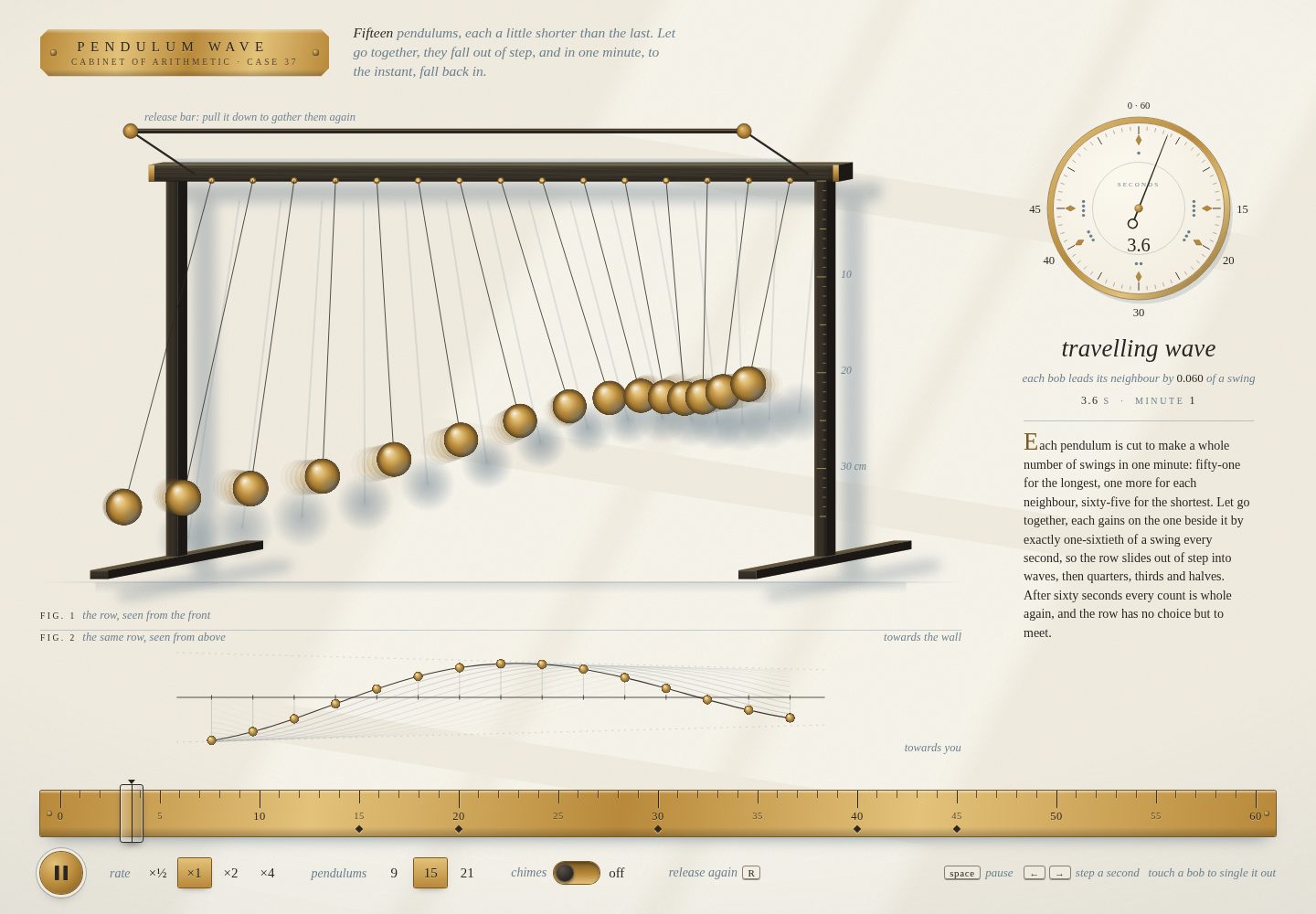
A museum-cabinet instrument on sunlit plaster: a dark walnut frame carries a row of brass bobs on fine strings, their lengths cut so that each makes one more swing per minute than its neighbour. A hinged release bar holds them to one side, lifts, and the row leaves in unison, then slides into a travelling wave, tangles, sorts itself into four, three and two interleaved groups, and at exactly sixty seconds sweeps back into one line while a brass ring spreads from the frame and the dial glows. Beneath the frame the same row is seen from above as a single undulating line with a fading wake; at the side a brass-bezelled sixty-second dial names the pattern of the moment and states the arithmetic behind it; along the bottom a brass rule lets the viewer slide to any instant. Everything is computed from the closed-form angle, so any moment can be visited exactly and the minute repeats forever without drift.

↗ Open
Instant Film screenshot
038

Instant Film

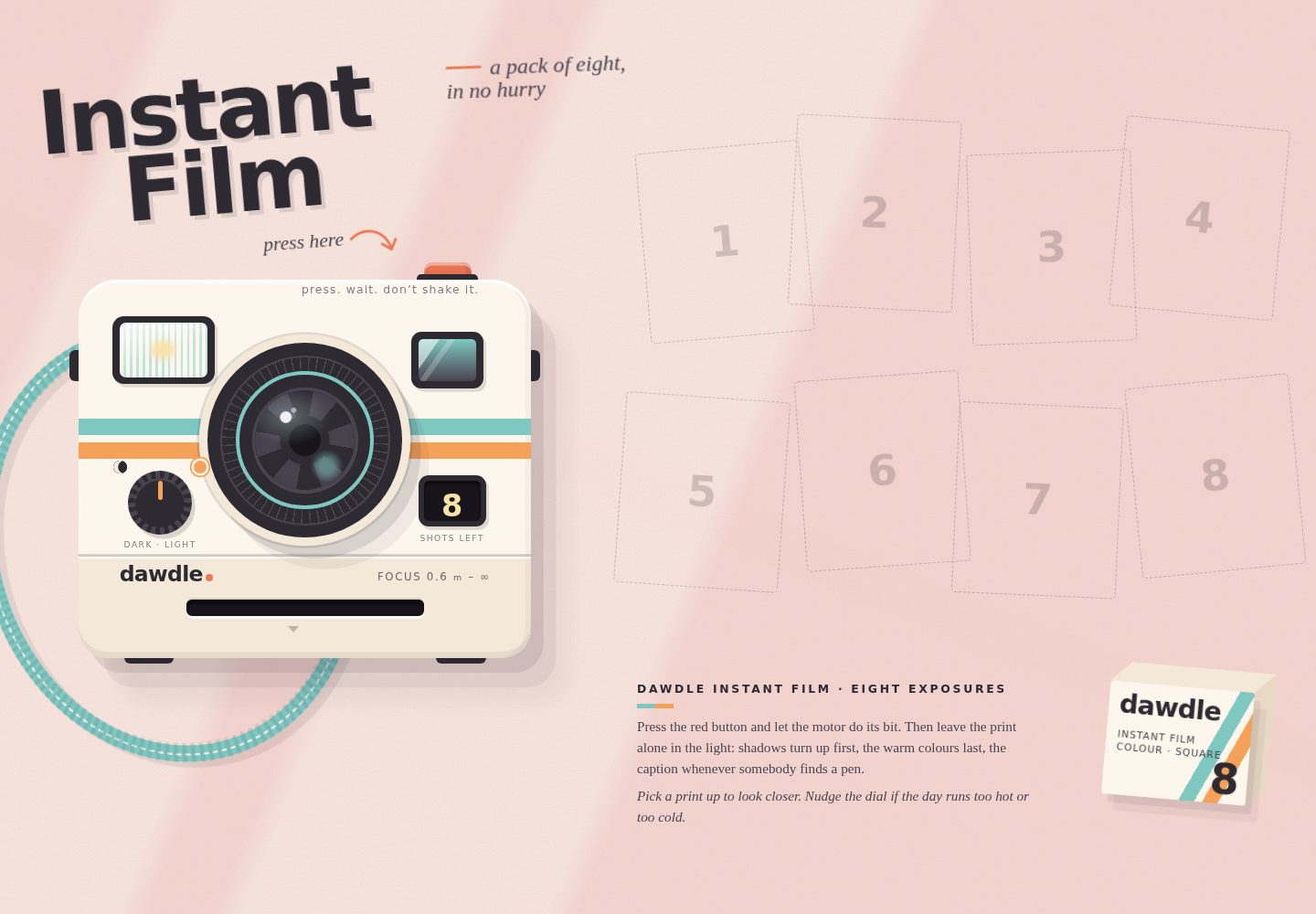
A sunlit blush tabletop with a cream toy-like instant camera called the dawdle, its teal neck strap looped off to the side, a small box of film, and eight dashed outlines waiting for pictures. Pressing the red shutter fires a white flash, the iris blinks, the camera kicks, and a square print is pushed out of the slot in motor steps, drops free and glides to its numbered place at a slight tilt. There it stays milky grey-green and then, over twelve seconds, shadows surface first, warm tones follow, and finally a handwritten caption appears on the border. Each of the eight frames is a tiny flat illustration in a faded-film palette: a striped parasol, a cat's back at a window, a boiled egg with steaming coffee, a caravan under pines, a bicycle, a lighthouse with a breathing beam, a cake with flickering candles, two feet at the end of a towel. The counter runs from 8 to 0, the shutter goes grey under an "empty" tag, and a sticker on the film box loads a fresh pack. There is not a line of script on the page.

↗ Open
ARES-HORT Console — Greenhouse B screenshot
039

ARES-HORT Console — Greenhouse B

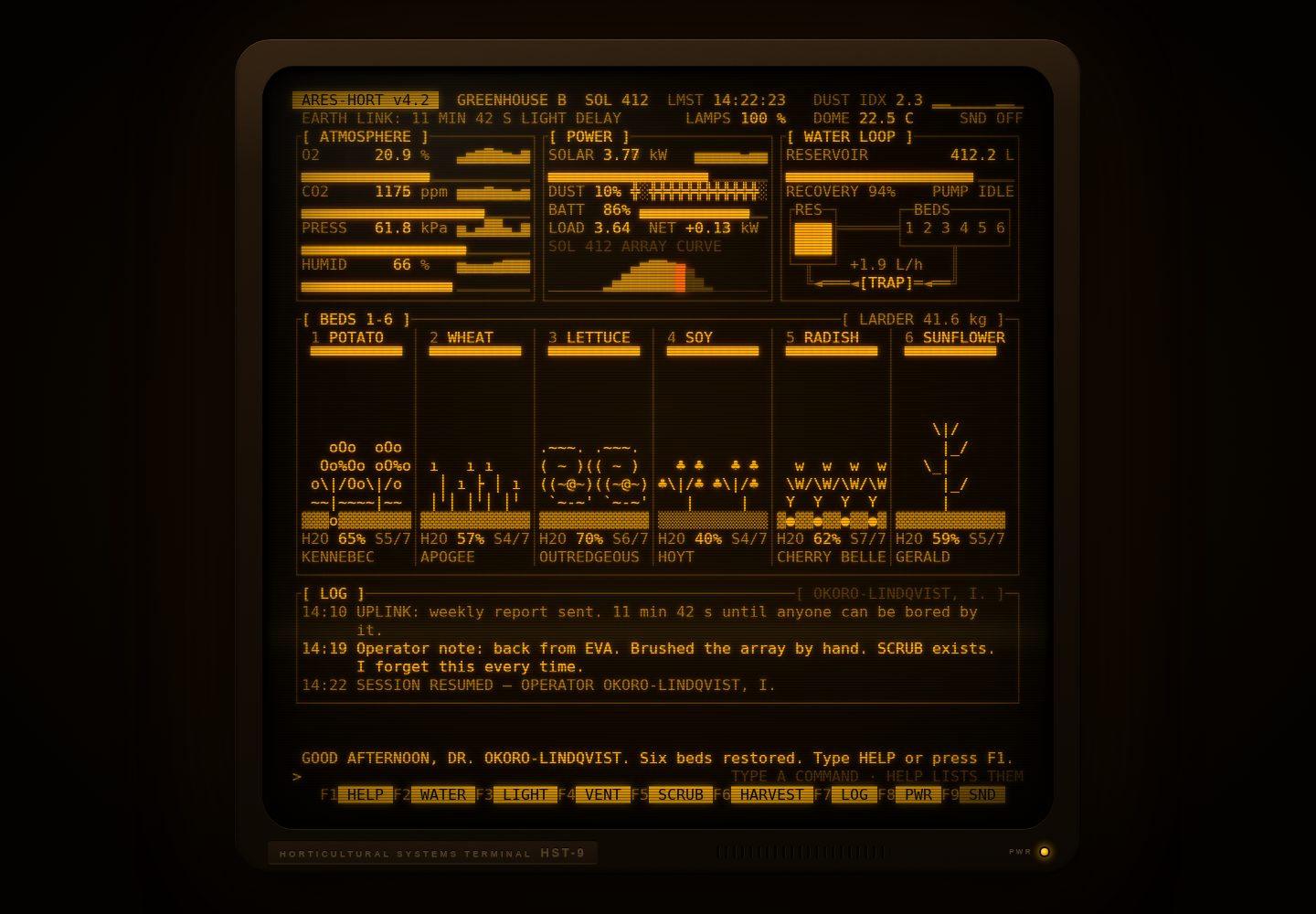
A dark room, a single moulded terminal, and an amber tube that warms from a bright line into a full raster, counts its memory, draws its own banner and then builds a greenhouse dashboard frame by frame. Everything on the glass is a character in an exact 80-column grid: bars, sparklines, a plumbing diagram with arrows creeping through the pipes, a solar array that silts up cell by cell, and six planter beds whose potatoes, wheat, lettuce, soy, radishes and one sunflower called Gerald sprout, sway, droop when thirsty and ripen while you watch. The station runs itself with a dry sense of humour until a dust storm rolls in, the screen dims, an orange alarm flashes and the machine starts switching off lamps, Gerald's first; the viewer, standing in for Dr. Imani Okoro-Lindqvist on sol 412 of a solitary posting, decides what stays lit. The log alternates terse system lines with her notes, and the wall beside the terminal quietly holds 412 tally marks.

↗ Open
The Harbour Courier — Tuesday, 9 March 1926 screenshot
040

The Harbour Courier — Tuesday, 9 March 1926

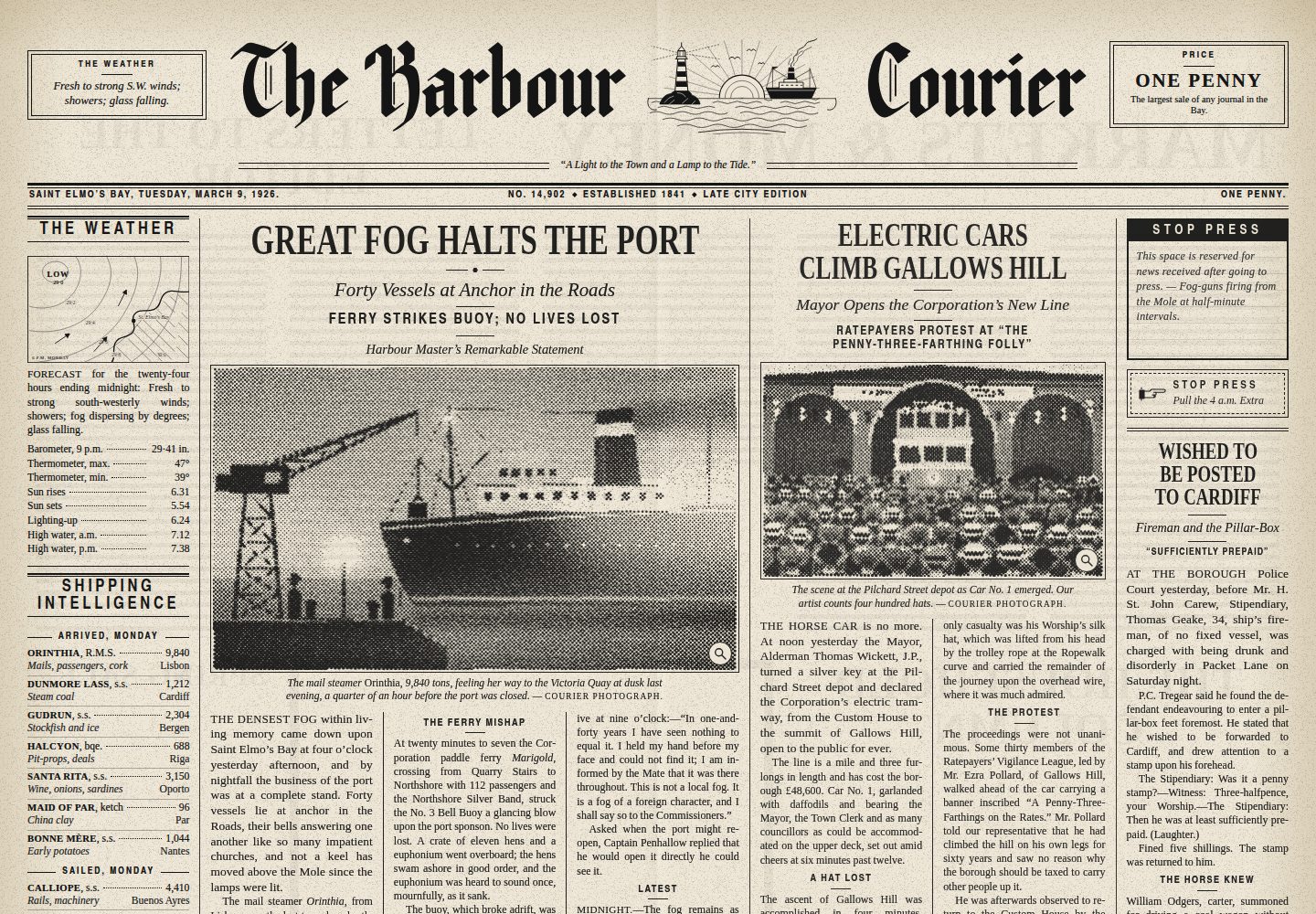
A complete broadsheet front page for an invented port city, printed in ink black on yellowing newsprint: a blackletter nameplate with an engraved harbour vignette, weather and price ears, a ruled dateline, and seven columns of period journalism about a great fog, a new electric tramway, an escaped circus sea-lion, a police court, a serial story, shipping, sport and small advertisements whose details quietly refer to one another. On arrival a press cylinder's shadow rolls down the sheet and the ink lands block by block; the three press photographs are true halftones that can be examined dot by dot under a brass loupe. The paper carries grain, a centre fold, uneven impression and the ghost of page two showing through, and it reflows to three columns on tablets and a dense single-column "late extra" on phones.

↗ Open
Jelly Alphabet screenshot
041

Jelly Alphabet

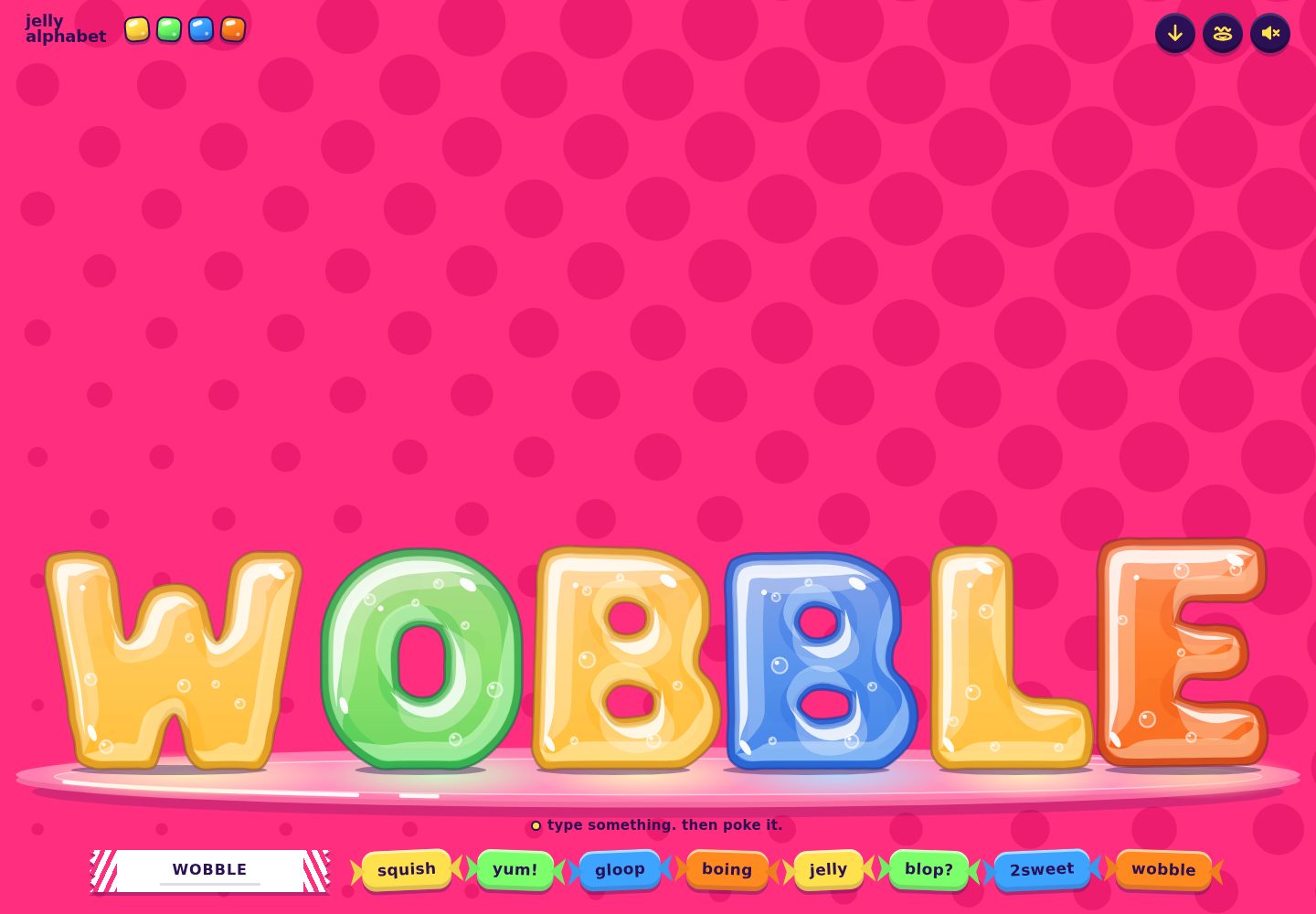
A hot-pink colour field with an oversized halftone and a glossy plate, onto which the word WOBBLE drops letter by letter as soon as the page opens: fat, translucent lemon, lime, blue-raspberry and orange jellies that squash to two-thirds of their height, bulge into each other, rebound and keep quivering. Every glyph is a hand-drawn chunky outline turned into a real soft body, so everything the viewer types, drags, pokes or flings behaves like gelatine: highlights stretch as the shape deforms, bubbles ride along inside, coloured light pools on the plate underneath. The page is a toy with almost no chrome: a tiny label, four jelly-cube flavour swatches, three round grape buttons, a candy-wrapper text field and a row of wrapped sweets that drop sample words.

↗ Open
The Dance of Venus screenshot
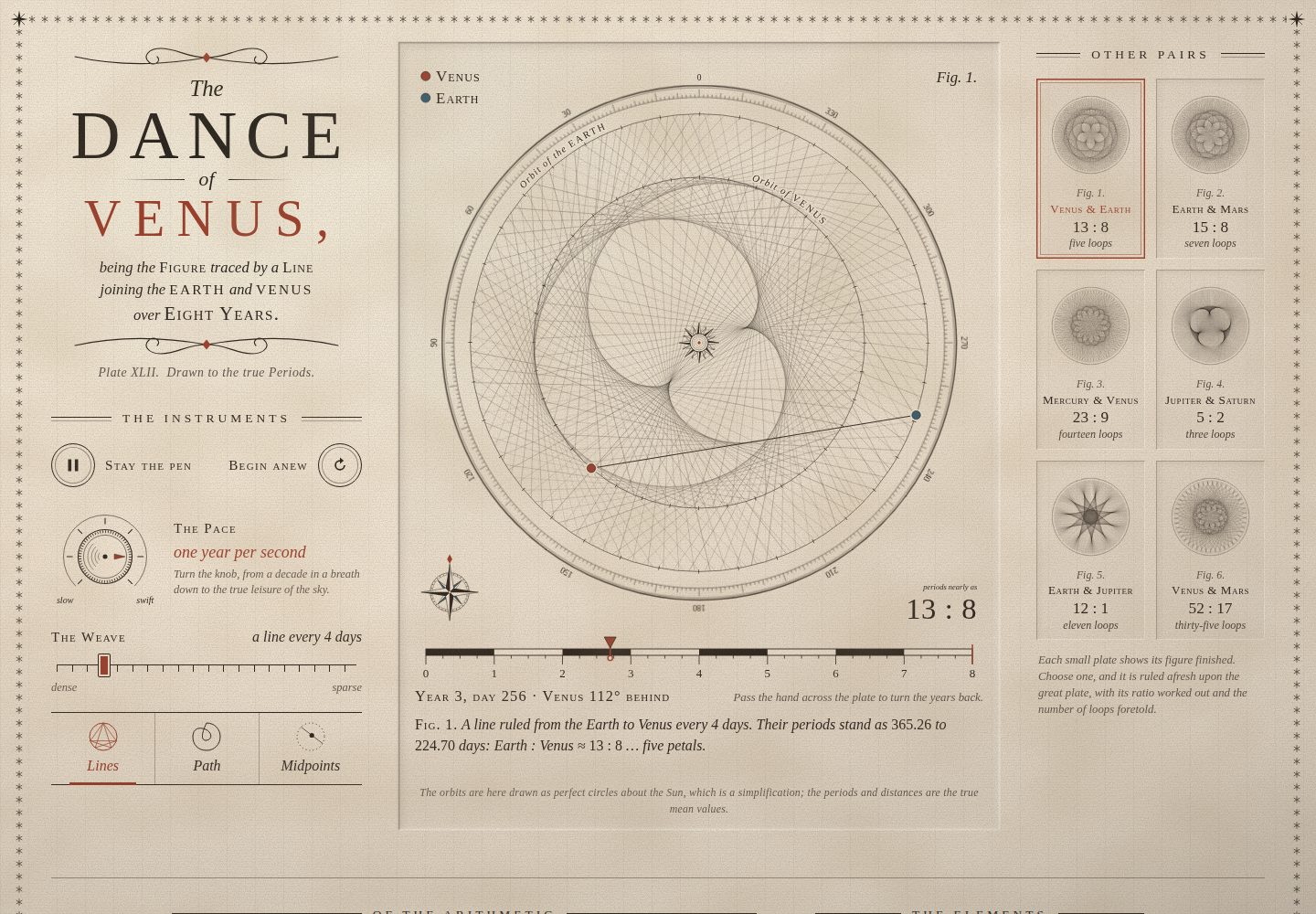
042

The Dance of Venus

A single sheet from an imagined eighteenth-century astronomical atlas, lit as if by a candle: laid paper with chain lines, grain and foxing, a border of tiny asterisks, and a title cartouche set in mixed capitals, small caps and italic. At its centre sits an embossed plate-mark holding a graduated degree circle, an engraved radiant Sun, and two small planets circling at their true relative speeds. Every few days a hair-fine line is ruled between them and left behind; within three seconds the first petal appears, and over eight simulated years the tangle resolves into the five-petalled rose of the 13 : 8 near-resonance. When the cycle closes a red flourish draws itself under the caption, asterisks mark the five conjunction points, and the caption states plainly how far the figure misses closure. Left alone, the next eight years are then ruled slowly in madder red over the first, a hair askew. The viewer can change pace, weave density and view, scrub through time, and swap in five other planetary pairs, each with its ratio and loop count worked out from the same twelve numbers. A short two-column essay insists, calmly, that it is all only division.

↗ Open
Lichen on Slate screenshot
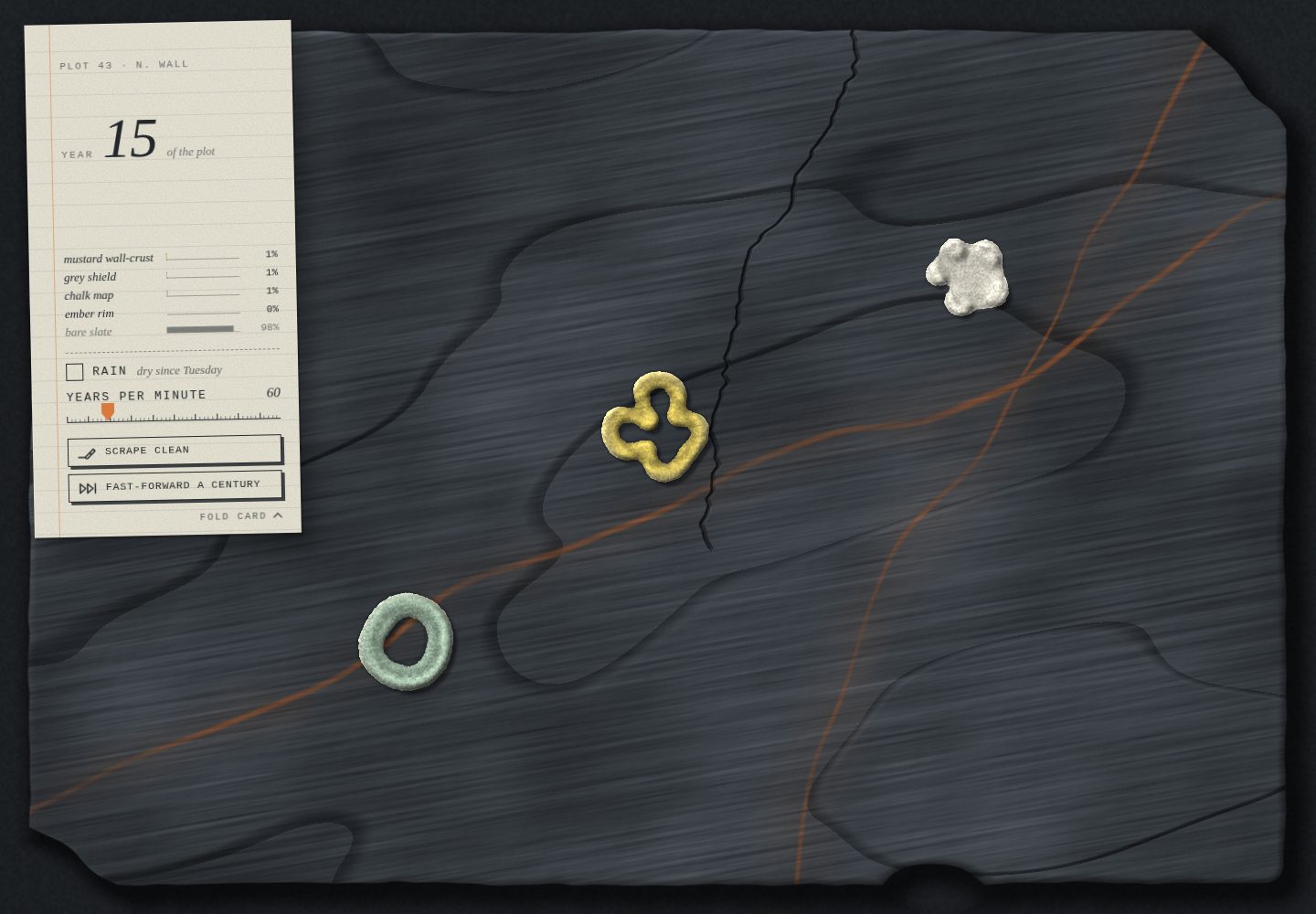
043

Lichen on Slate

A weathered slab of slate lies on dark ground, lit from the upper left, with a hairline crack, stepped cleavage and two rust veins. Three lichen colonies are already growing on it when the page opens: a mustard crust branching into coral lobes, a sage shield lichen unrolling broad leafy lobes, and a chalk-white crust budding at its edge. They grow slowly but visibly, with pale young margins, raised relief and soft shadows; their centres age, darken, crack and break out in tiny dark-rimmed fruiting discs. When colonies meet they stop and hold a thin black frontier, and over a century the slab turns into a map of territories. A pinned field card in a typewriter face and italic hand records the year and each species' share of the stone; a specimen tray offers four species to sow; a brass hand lens follows the pointer and magnifies the crust two and a half times. The mood is quiet, damp and northern.

↗ Open
Ariadne's Thread screenshot
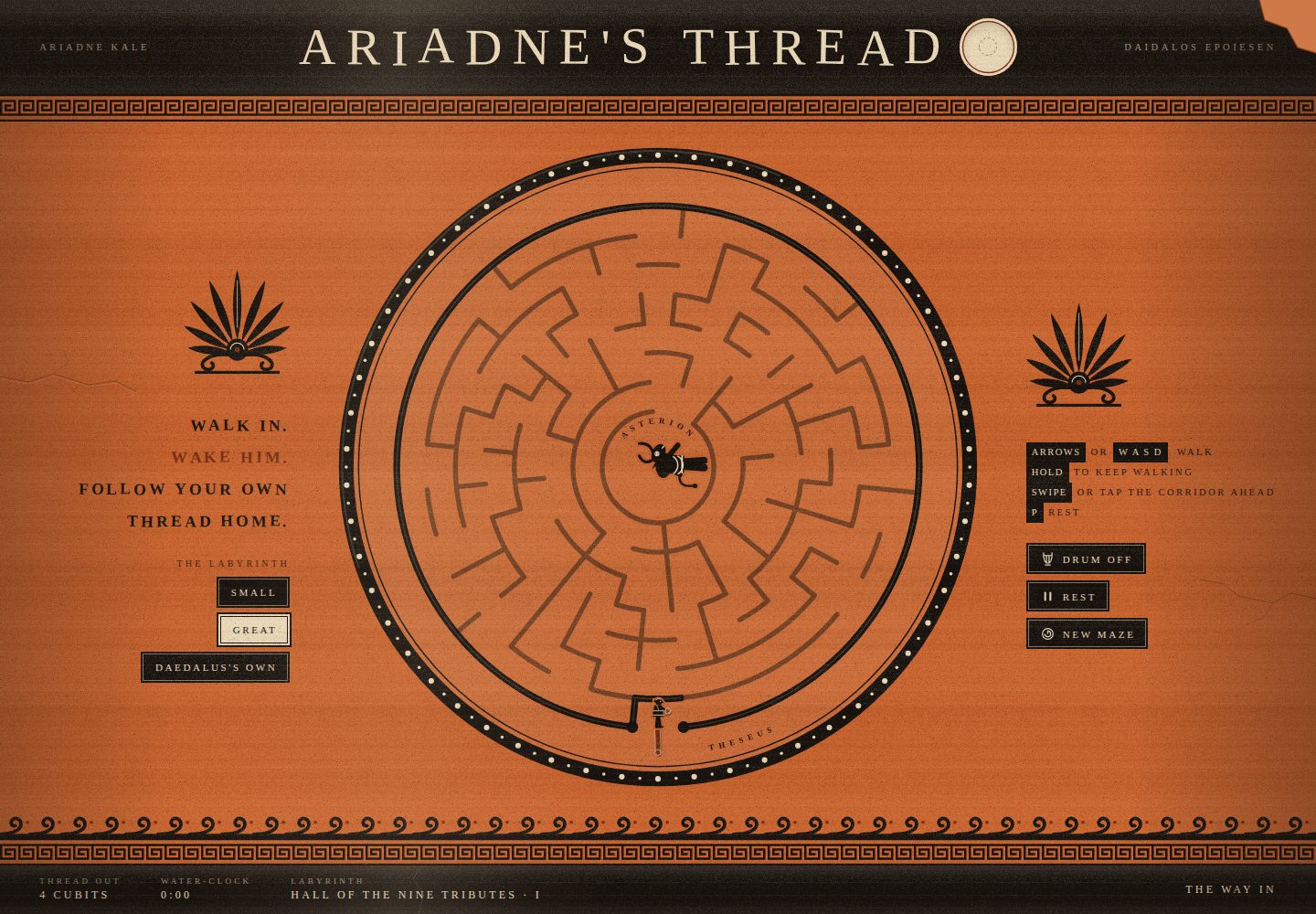
044

Ariadne's Thread

The page is the decorated surface of an Attic black-figure drinking cup: a terracotta ground with clay grain, wheel marks, hairline cracks and a chipped rim, black glaze bands carrying the title in spaced, slightly uneven cream capitals, a Greek-key meander above and below, a running-wave band, and two palmettes flanking a round tondo. Inside the tondo is a freshly generated ring labyrinth. A small black silhouette of Theseus steps in at the gate paying out an oxide-red thread that lies along the corridor floors with a little slack; Asterion sleeps in the central chamber under his own name. Reaching him wakes him, the meanders begin to scroll, and the way out is the thread itself, rewound step by step while the Minotaur pathfinds behind, stopping to sniff at junctions. Escape sends the whole thread springing back along the remembered route, pulling taut, lifting off the pot and winding into a ball on the cream roundel beside the title while the vessel makes one slow turn and a cream slip panel delivers the inscription.

↗ Open
Halden Grotesk — A Type Specimen screenshot
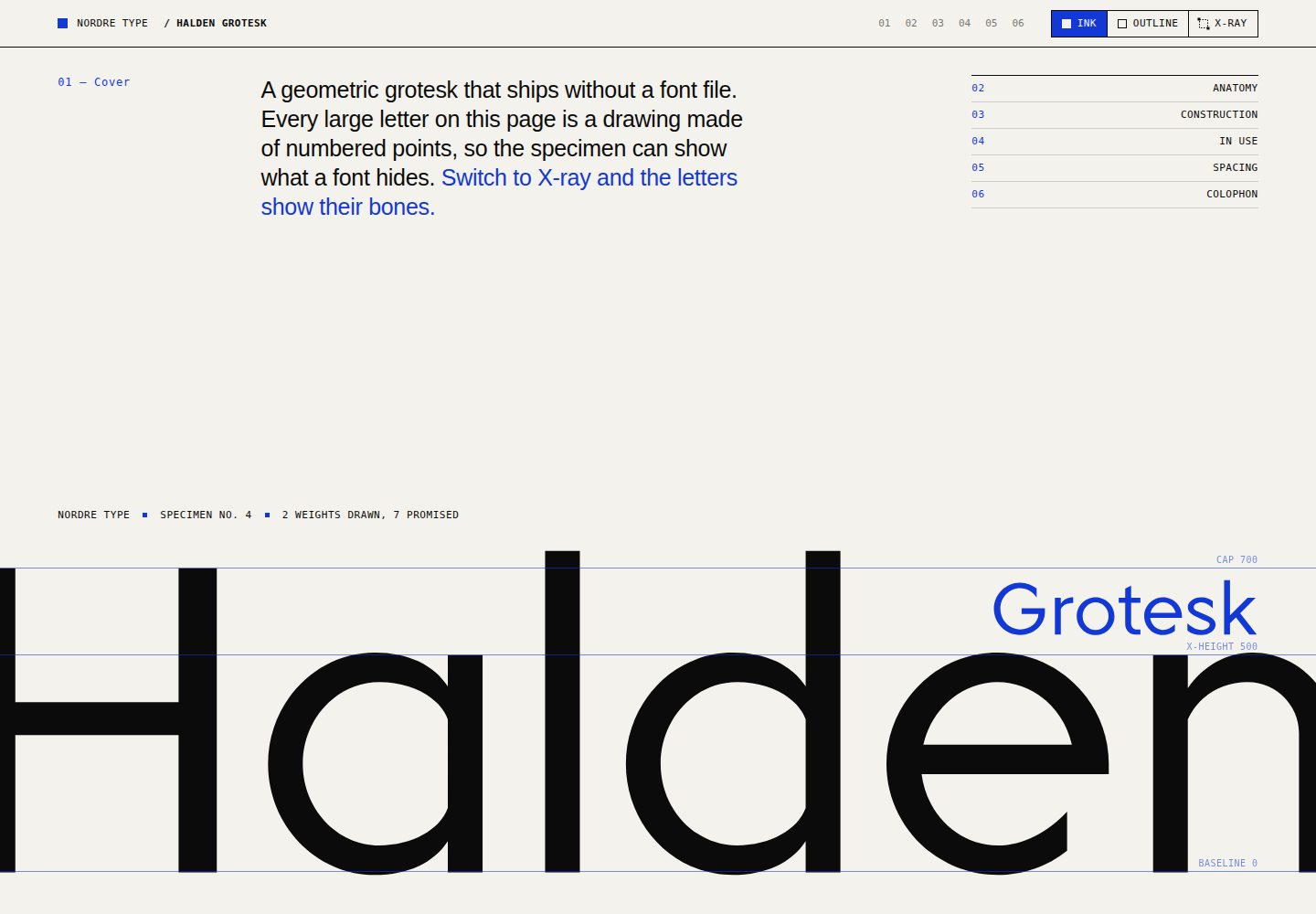
045

Halden Grotesk — A Type Specimen

A long-scroll specimen for Halden Grotesk, an invented geometric grotesk from the invented foundry Nordre Type, in which no font file exists: all 35 glyphs are stored in the page as explicit on-curve and off-curve points and drawn from that data. The page is clinical and Scandinavian: specimen-paper off-white, black, and a single cobalt used for construction lines, points and one giant letter, organised on a twelve-column grid with hairline rules and mono section numbers. The cover crops an enormous "Halden" at the viewport edges and assembles it from points, outline and a rising flood of ink. Anatomy pins one glyph out on a metrics grid with every coordinate labelled and every point draggable; because that drawing is the master, damaging the "a" damages every "a" on the page until it is reset. Construction shows the compass work behind O, G and D and an eight-times vertical exaggeration of the overshoot; In use sets a waterfall, a weight row, a poster and ferry-terminal signage from the drawn letters only; Spacing lets the viewer kern a pair by hand until it snaps to the foundry's value; the Colophon carries the designer's note, a licensing joke and the full character grid with its gaps.

↗ Open
Evening Snow at the Bridge screenshot
046

Evening Snow at the Bridge

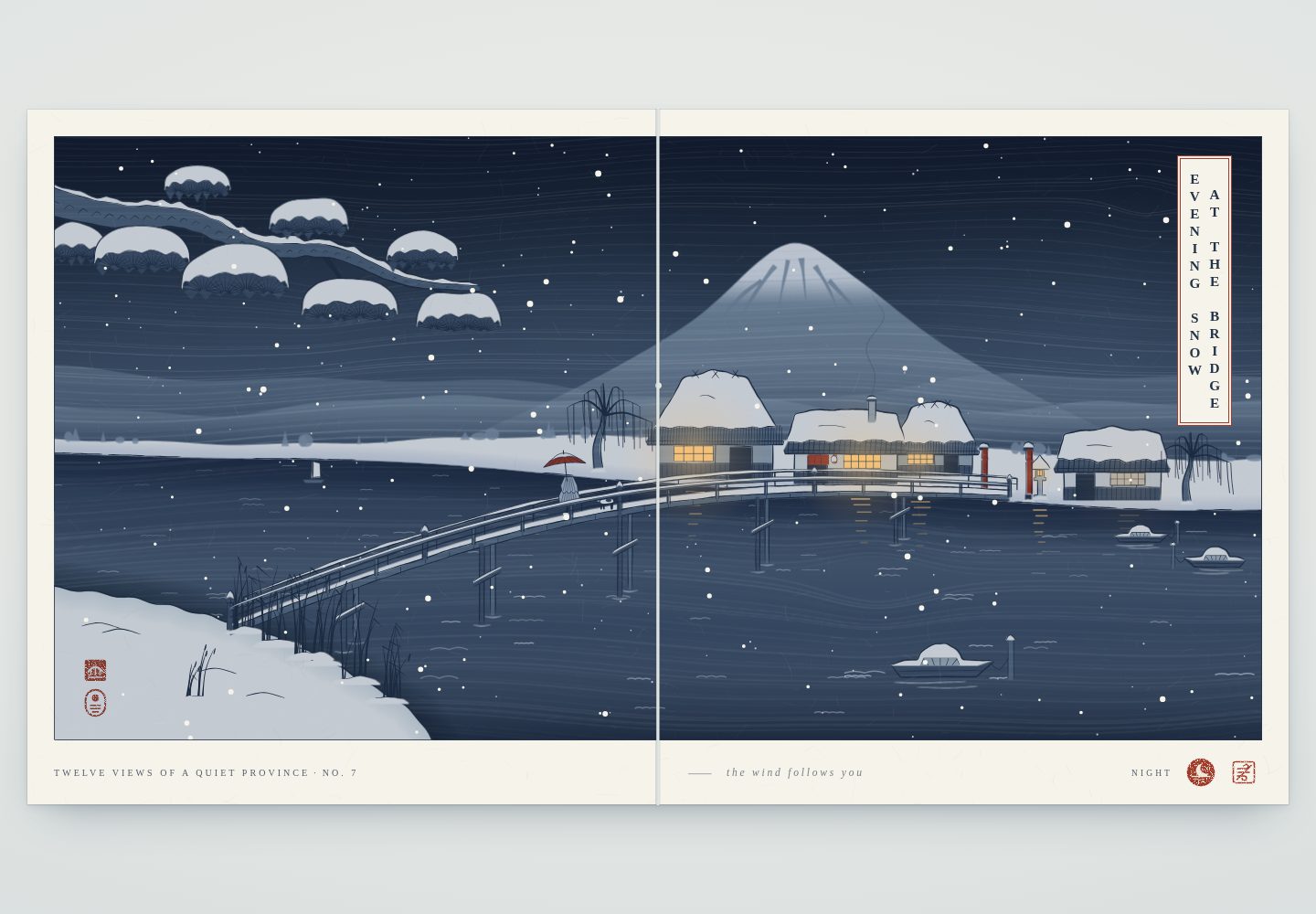
A single woodblock print hangs on a pale wall and quietly lives. An arched timber bridge runs in a long diagonal from a snowbank and its reeds to a far shore of thatched and tiled houses, a stone lantern and two cinnabar gate posts, under one snow-capped mountain that dissolves into the sky. Everything is cut as a printer would cut it: flat colour blocks with woodgrain showing through, hand-wiped bokashi at the top of the sky and along the water's edge, dark indigo keyblock lines whose width breathes, colour sitting a hair out of register, and snow that is simply unprinted paper. On arrival the sheet is pulled block by block (sky, water, greys, red, key lines), the cartouche settles and the two artist seals are stamped last. Then snow falls in three depths, wave lines drift down the river, a figure in a straw cape under a red umbrella crosses the bridge with a dog or a lantern-bearer behind, chimney smoke curls, crows pass now and then, a roof sheds its load. The hour follows the viewer's clock; pressing the round seal re-inks the sky from the top down, and at dusk the windows and lanterns come on one after another, their light laid on the river as short warm strokes. On phones the scene recomposes as a tall oban sheet; on wide screens it is a diptych.

↗ Open
Atelier Vesper — Calibre V.03 screenshot
047

Atelier Vesper — Calibre V.03

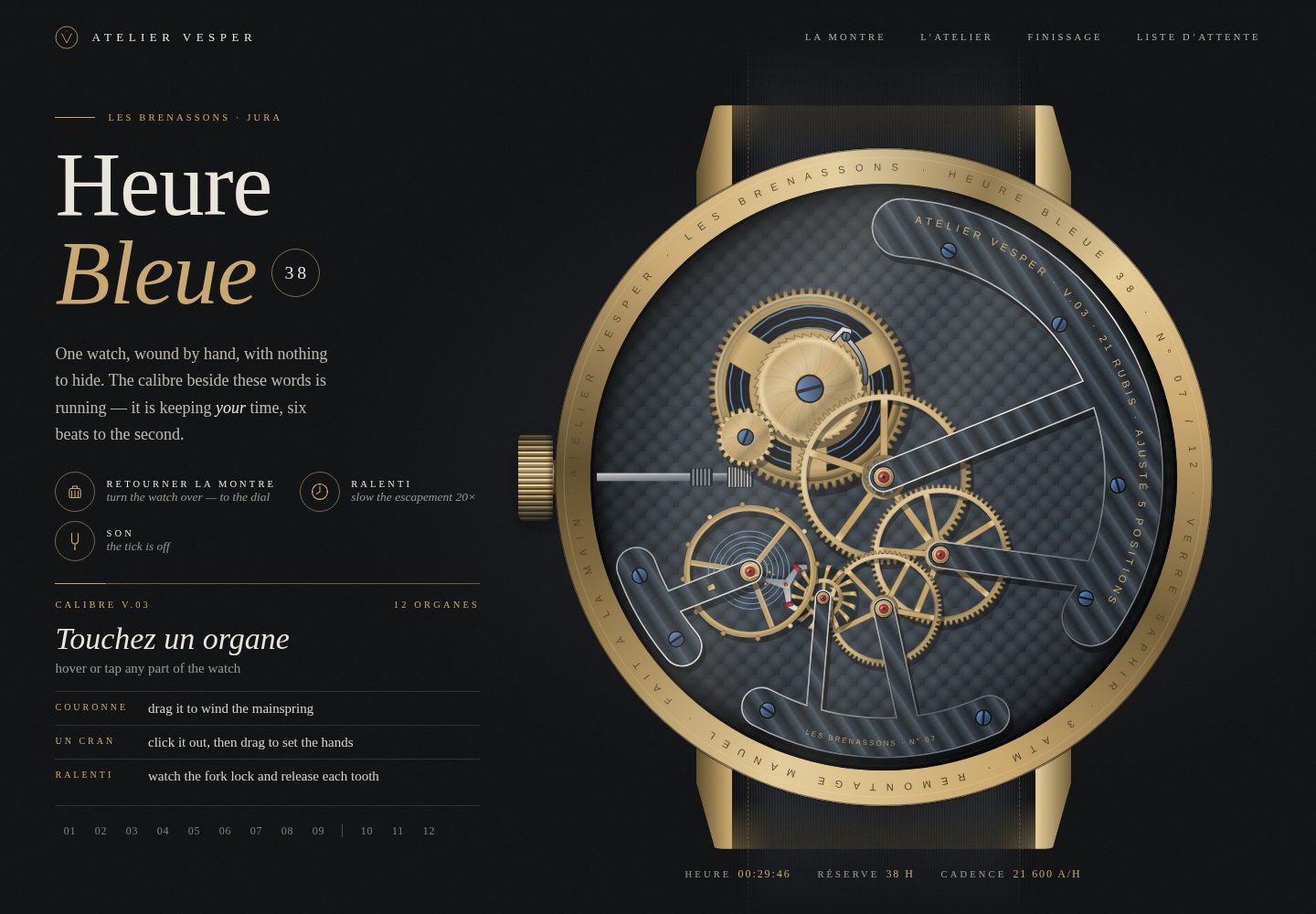
A jeweller's-black landing page whose hero is a working watch. The Heure Bleue 38 lies caseback-up beside a large Didone title: under the sapphire, a ruthenium-dark calibre with rose-gold wheels is actually running, every wheel meshing at its true ratio and the whole train stepping six times a second to the viewer's own local time. In the first three seconds the crown turns three clicks, the ratchet advances, the blued mainspring tightens in the barrel, and the balance kicks into life. Turning the watch over reveals a restrained ivory dial with applied gold indices, blued leaf hands, small seconds at six and a moon-shaped power reserve; everything on both faces is annotated in French and English on hover or tap. Below, four sparse sections ruled in thin gold give the specifications, the two-person workshop, three finishing close-ups that respond to light, and a waiting list whose confirmation is engraved letter by letter onto a caseback ring.

↗ Open
Cross-Stitch Studio screenshot
048

Cross-Stitch Studio

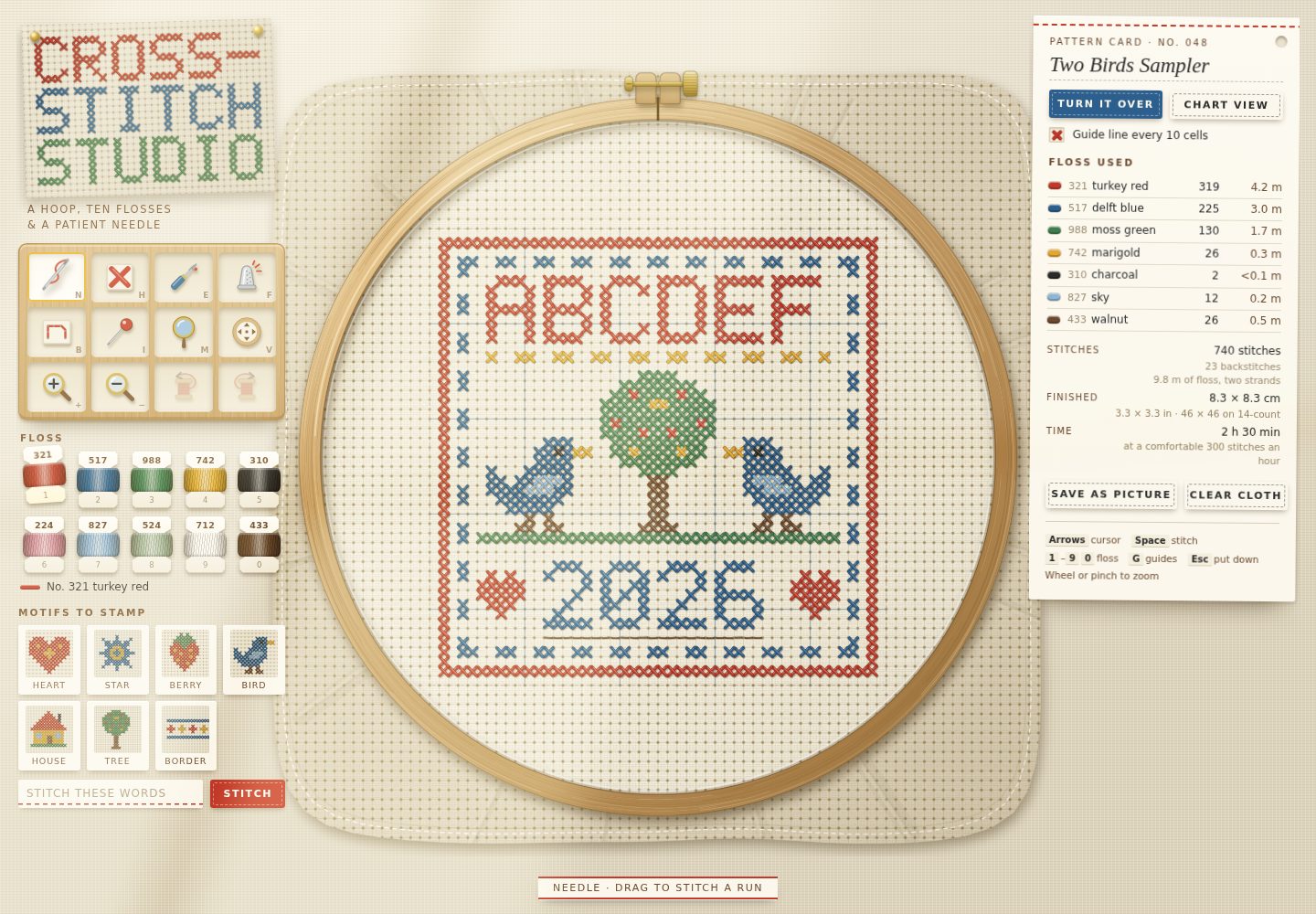
A sunlit sewing table seen from above: a beech embroidery hoop with a brass screw holds a square of cream aida cloth, and on it a small sampler stitches itself in over the first three seconds while a steel needle darts from stitch to stitch. Everything the viewer places is rendered as real thread: two crossed strands of twisted floss with sheen, shadow and hand-made irregularity, pulled from hole to hole with a little tightening bounce. To the left sit a stitched fabric title label, a wooden sewing-box tray of tools, ten bobbin cards of floss and a library of stamped motifs with a "stitch these words" field; to the right a paper pattern card keeps the project name, floss usage in metres, finished size and time. The hoop can be turned over in 3D to reveal the honest, messy back of the work, computed from the true sewing order, or swapped for a printable symbol chart with a key.

↗ Open
A Cabinet of Computed Shells screenshot
049

A Cabinet of Computed Shells

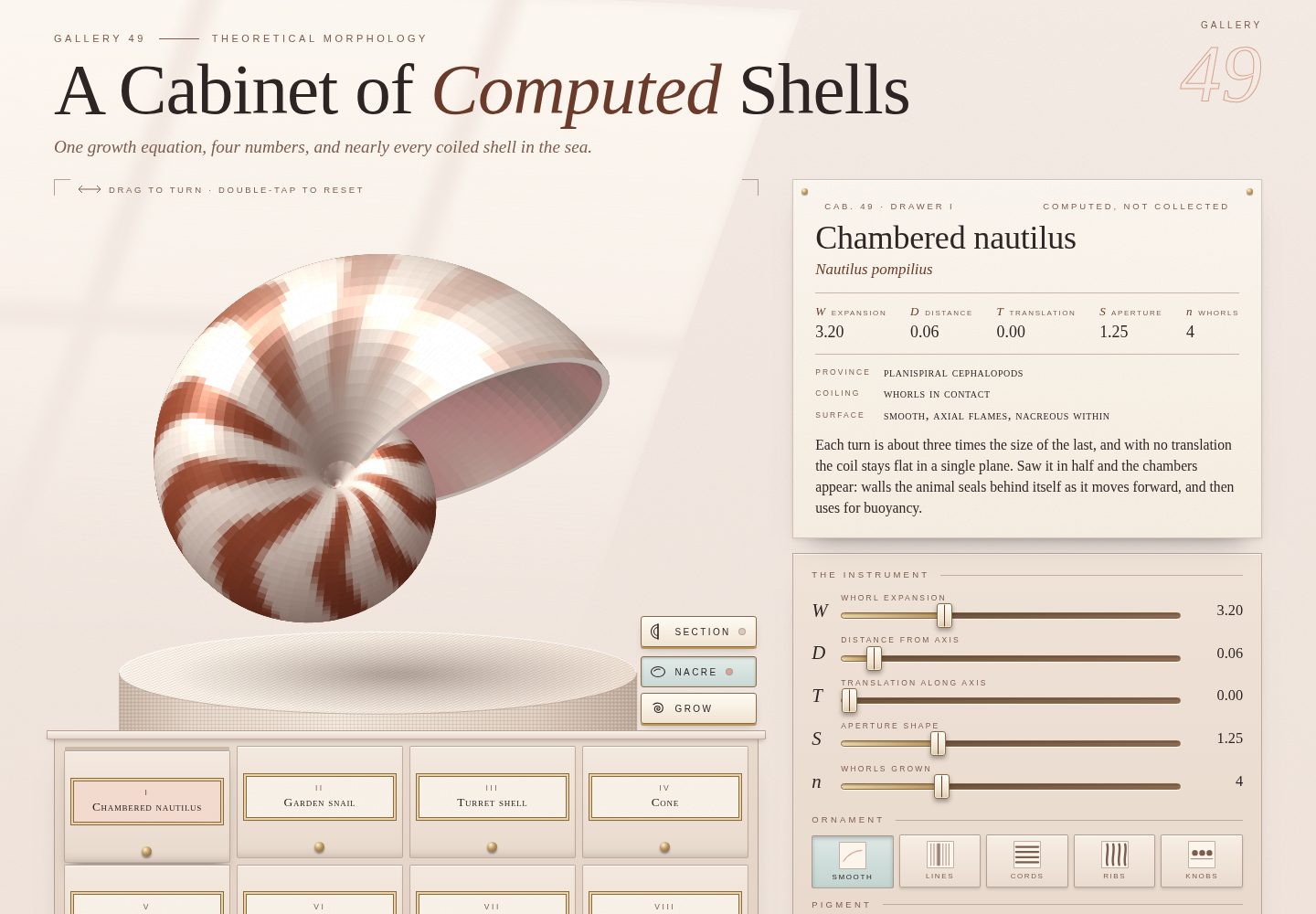
A sunlit natural-history gallery wall in shell-pink plaster. A large porcelain-white shell floats above a linen-covered drum that stands on a pale cabinet of eight brass-labelled drawers; beside it hang a paper museum label and a brass-and-ivory instrument of five sliders and two rows of small specimen trays. On arrival a chambered nautilus grows out of its own apex, whorl after whorl, flame stripes and all. Pulling a drawer makes that shell become another before the visitor's eyes: the flat coil tightens and telescopes into a turret, swells into a cone shell tiled with computed tents, or flares open into a ribbed cockle valve, while the label re-sets itself, the slider handles slide to their new places and a crosshair travels across the map of all possible shells below. Sawing the nautilus open reveals a spiral of pearly chambers. The tone is quiet scholarship: classical serif titles, tracked small-cap legends, plain accurate copy about why a shell that grows only at its edge must be a logarithmic spiral, and how David Raup found that life uses only part of the space the equation allows.

↗ Open
The Aldwyn, Source to Sea screenshot
050

The Aldwyn, Source to Sea

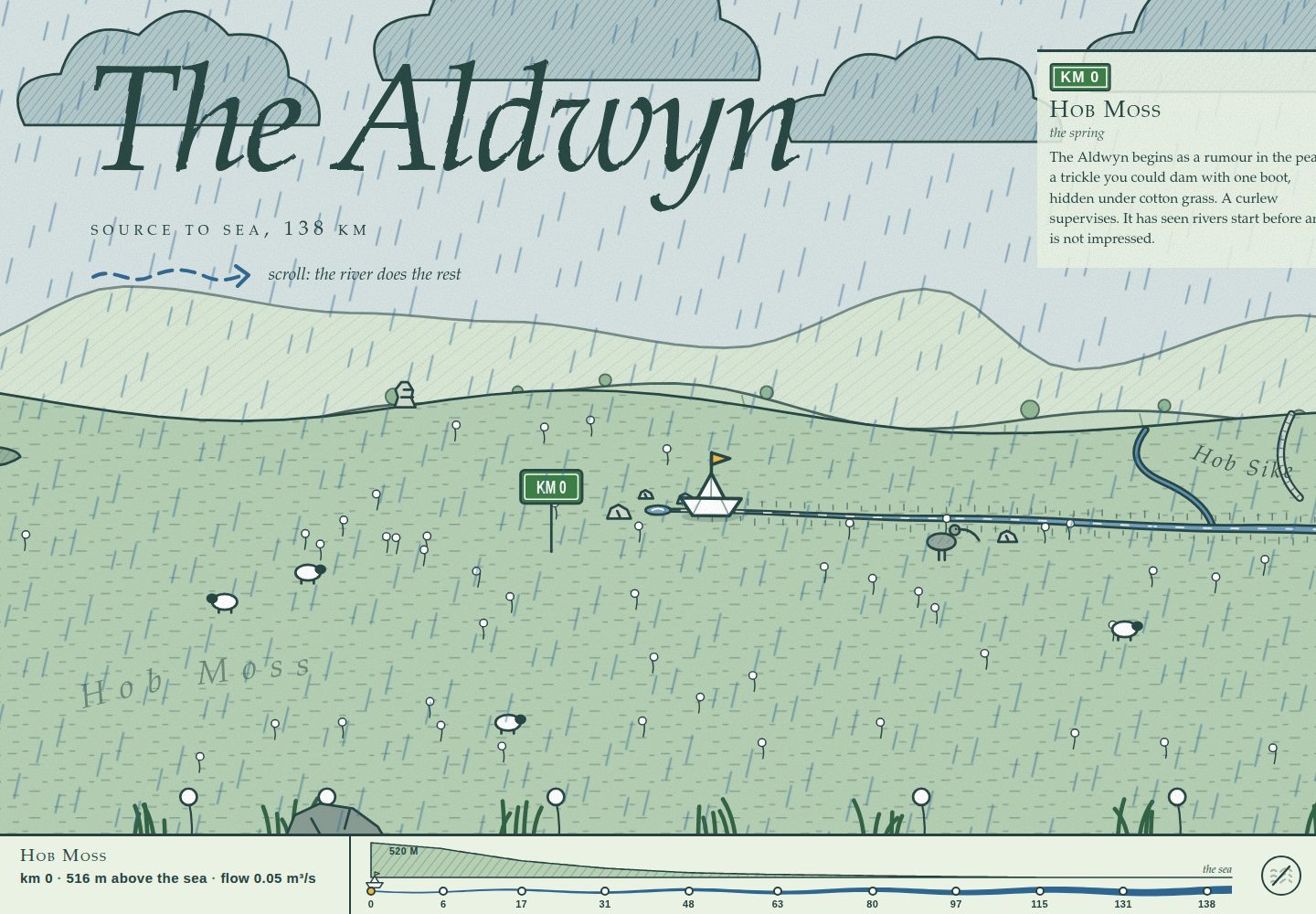
A sideways journey down an invented English river, drawn as one continuous flat-colour panorama in the manner of a children's atlas for grown-ups. The page opens in rain on a moor, with the title lettered large in rough-edged Palatino italic and a paper boat dropping into a spring no wider than a pencil line. Scrolling carries the reader 138 kilometres downstream: over a gritstone fall, under a packhorse bridge, past a turning mill wheel, through buttercup meadows, a terraced brewery town, a working lock, pylons and poplars, mudflats, docks, and finally past a lighthouse into an evening sea. The river is a single unbroken blue path that widens from a thread to the whole lower third of the stage, and the little boat rides it the entire way, behaving differently at every obstacle. Each of the eleven stations carries a white-on-green kilometre sign and a short, dry caption; a slim strip along the bottom shows the whole river in miniature with an altitude profile and a live readout of distance, height and flow.

↗ Open
Pinscreen screenshot
051

Pinscreen

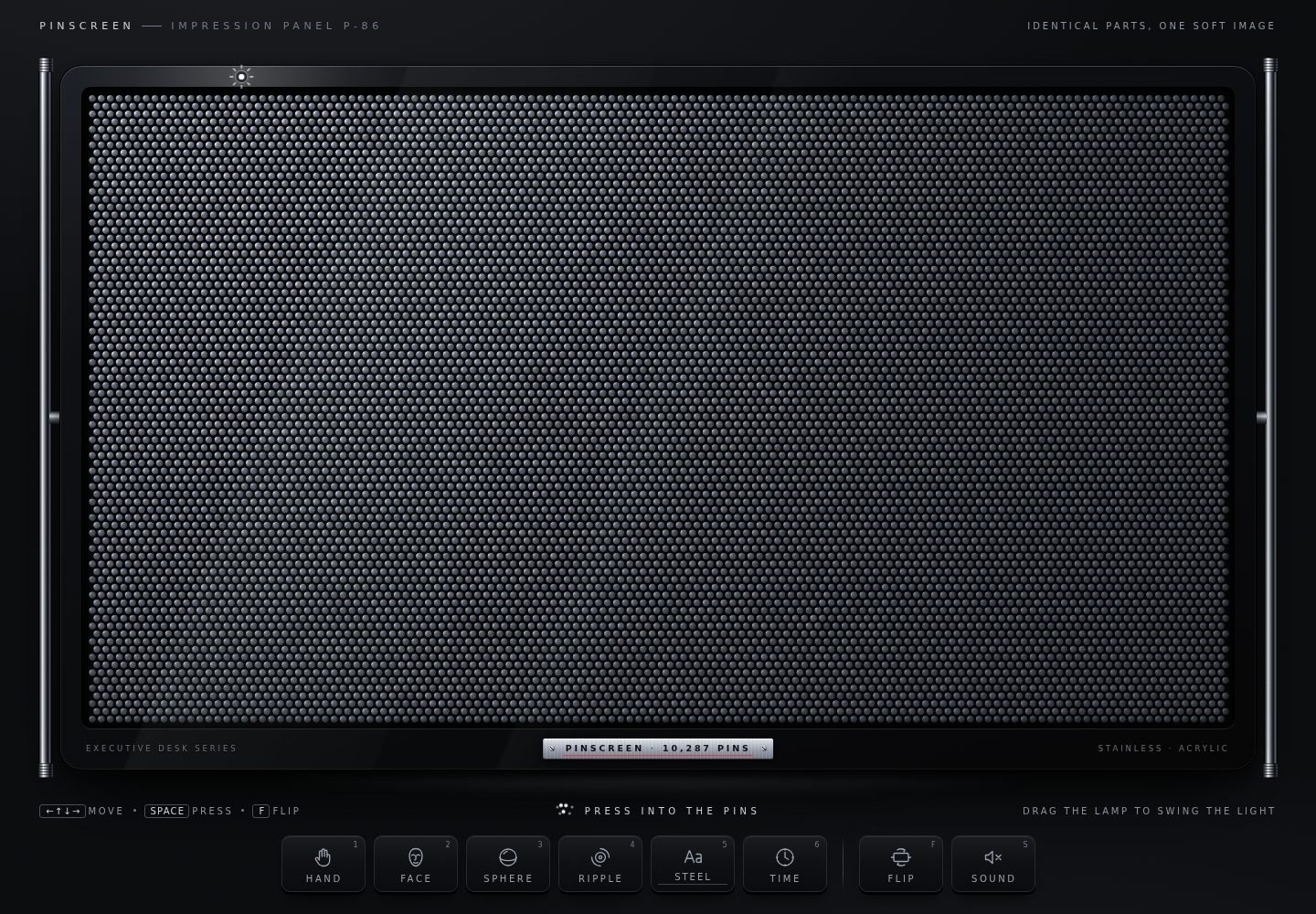
A black acrylic desk toy fills the viewport: a glossy rounded frame slung between two chrome posts, holding roughly ten thousand hexagonally packed steel pin-heads (about five thousand on a phone). On arrival a hand presses in from behind and withdraws, and its impression slowly melts back into the lattice. Every pin is a tiny domed, lathe-turned disc lit by a single raking lamp, so slopes facing the light flash white, slopes facing away drop to dark steel and raised forms throw shadows across their lower neighbours. The pointer itself becomes a hand pushing through the field; dragging leaves a subsiding trail. A tray of machined black keys presses in a hand, a mask-like face, a sphere, a travelling ripple, a typed word and the current time, and a flip key tips the frame so the whole field cascades out and back in a glittering wave. The only colour anywhere is one thin red line on the brushed-steel logo plate, which states the true pin count.

↗ Open
BÉTON BRUT — Six Buildings Nobody Asked For screenshot
052

BÉTON BRUT — Six Buildings Nobody Asked For

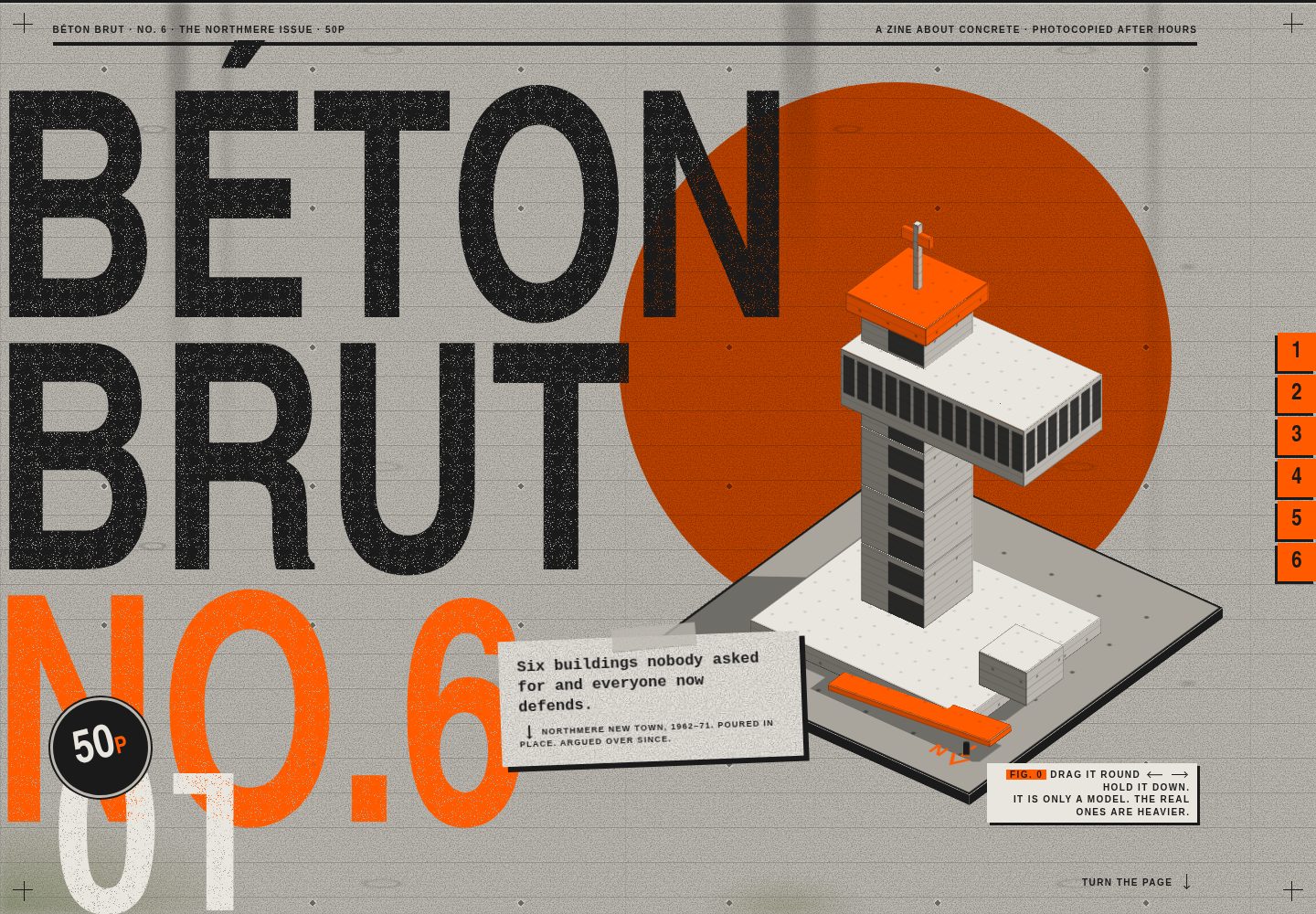
A photocopied architecture zine, issue six of BÉTON BRUT, laid out as nine full-viewport spreads on a board-marked concrete-grey ground. Colossal condensed capitals crop at the page edges and run behind six isometric concrete models of an invented new town, Northmere; typewritten essays by the zine-maker Dot Ferreira sit on taped-down pale slips with orange marginal numbering. As each spread arrives its building is poured storey by storey out of the base plate, flashing orange formwork as each lift sets, then the giant name slams in behind it, the page shakes and a rubber stamp lands. Every model can be turned, pulled apart into a labelled section and re-lit with a sun slider that throws a long shadow across the page. A charcoal manifesto spread and a back cover with a creased fold-out site plan and a cut-out subscription coupon close the issue. The tone is monumental, argumentative, affectionate and a bit funny.

↗ Open
Sandpile screenshot
053

Sandpile

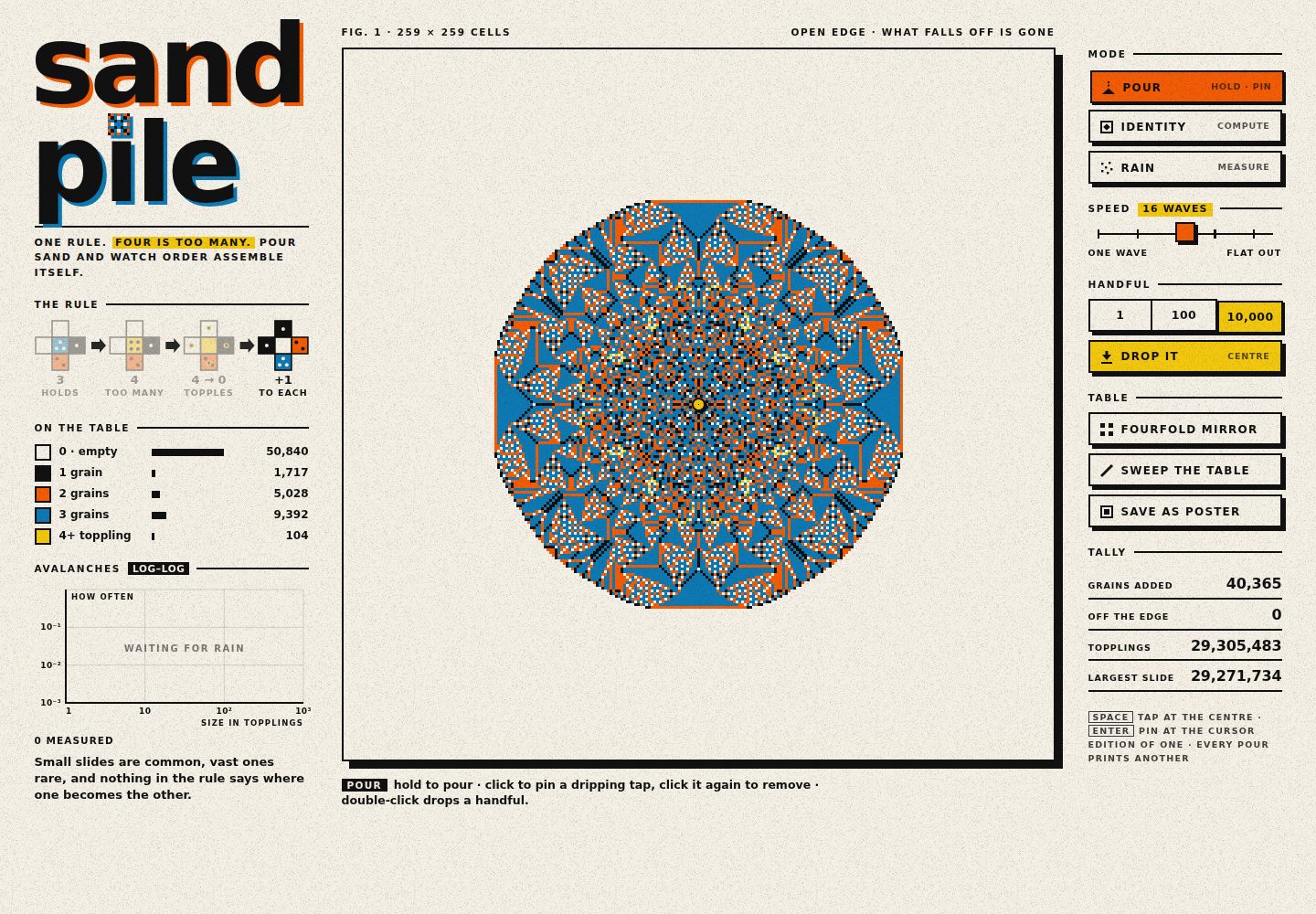
A living four-colour screenprint. A cream sheet carries a giant stacked "sand / pile" title with misregistered orange and blue shadows, and the dot of its "i" is itself a seven-by-seven sandpile that never stops toppling. Beside it a large square table with a black outline and a hard shadow sits empty for half a second, then a tap opens over the centre and a fractal medallion of ink, orange and blue blooms outward behind a ragged yellow front before settling into a slow drip. Everything else on the sheet is a readout of that one rule: a looping four-panel pictogram, a legend whose bars and counts follow the table, a tally in tabular numerals, and a log-log plot whose orange points drop into place along a blue fitted line as random rain is measured. The viewer pours, pins taps, drops handfuls of ten thousand grains, computes the group identity, sweeps the table with a diagonal wipe and saves the result as a poster.

↗ Open
Seven Sisters — A Nest of Dolls screenshot
054

Seven Sisters — A Nest of Dolls

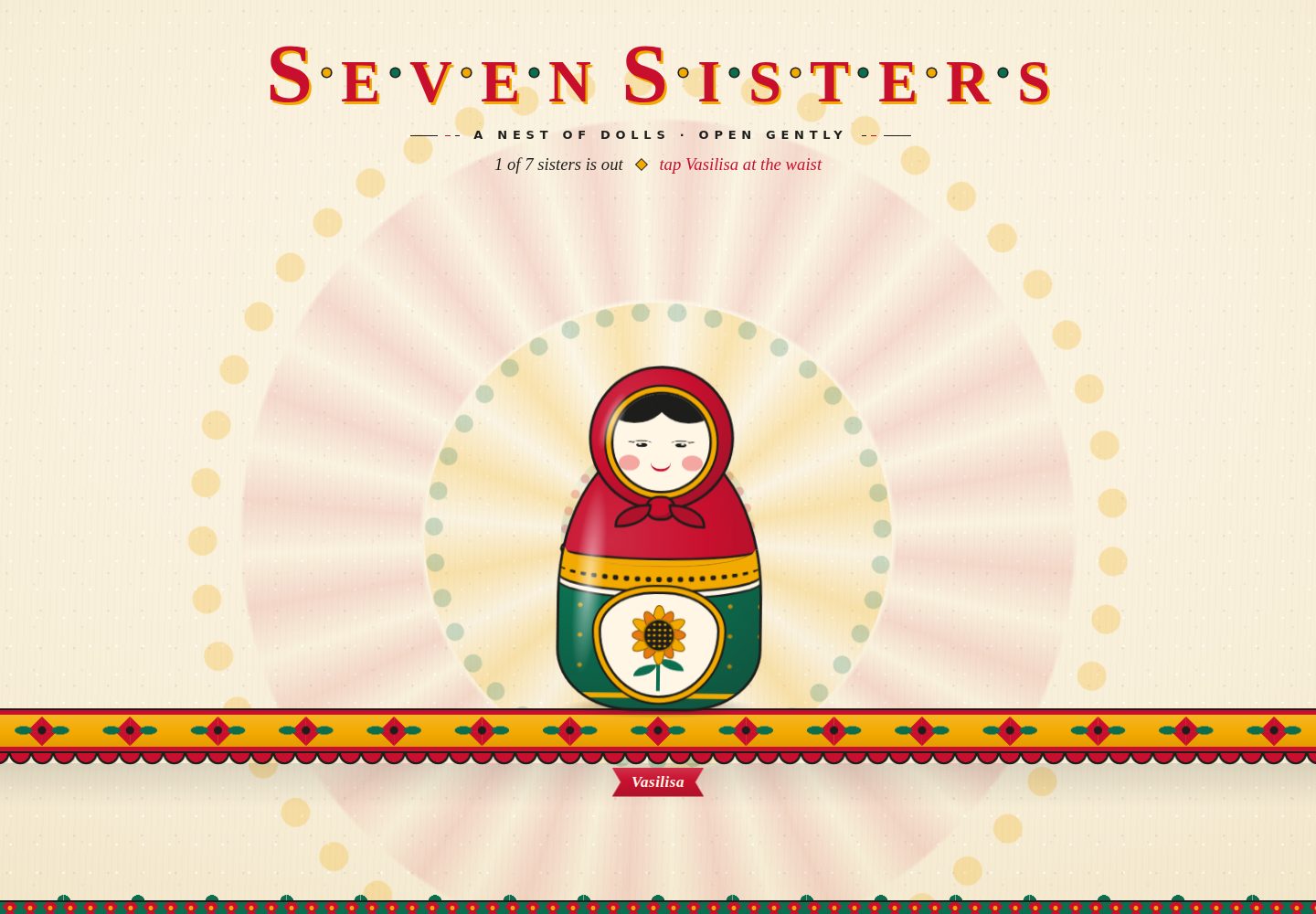
A sheet of cream paper with a folk-painted shelf across its lower third, a slowly turning floral rosette behind it, and one lacquered nesting doll standing in the middle. Tap her at the waist and her top half springs up, tips and is set down leaning on the shelf, a dark wooden hollow appears, and the next sister rises out of it, hops over the rim, lands with a squash and a wobble, and gets her name ribbon; the row slides to stay centred as the family grows. Six times this repeats, each sister smaller by a fifth and painted with her own scarf, face and apron motif (sunflower, strawberries, rooster, samovar, rowan, tulip), until Little Zoya, who is solid and asleep. Tapping Zoya wakes her: her eyes open, she blushes and jumps, the painted bird leaves her apron, grows as it climbs and circles above the sisters, and seventeen flowers bloom one by one along the bottom border. All of it runs without a single line of script.

↗ Open
Kettlewick Observatory — Seismograph No. 2 screenshot
055

Kettlewick Observatory — Seismograph No. 2

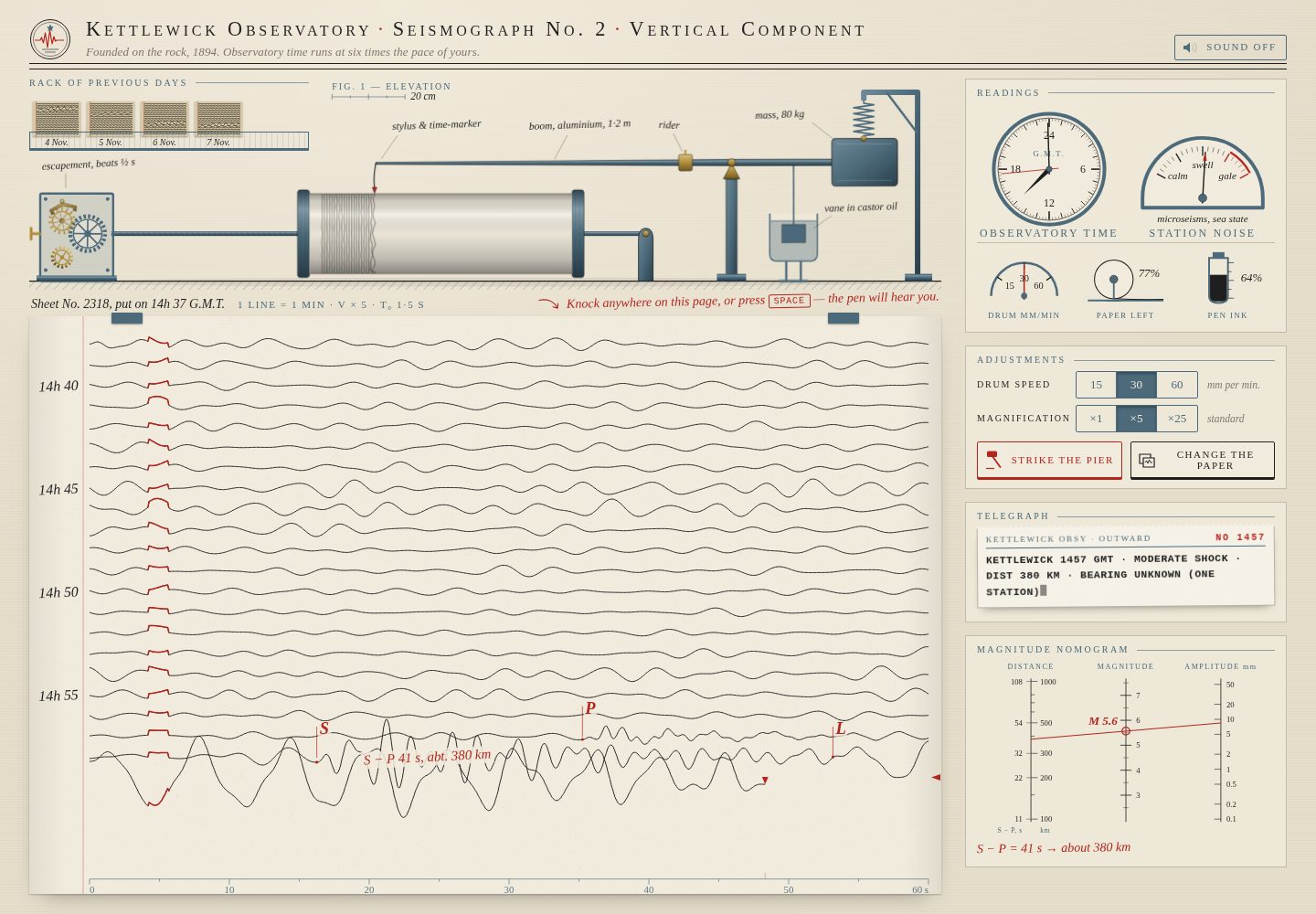
A working observatory instrument presented as a page of stationery: an engraved masthead, a slate-and-brass elevation drawing of the seismograph (clockwork gearbox with a stepping escapement, a paper-wrapped drum sliding along its lead screw, long boom, knife-edge pivot, oil damper, sprung mass) and beneath it the unrolled recording sheet, where a simulated pen draws a continuous trace line by line. The page opens with the pen dropping onto the drum in the decaying surface waves of a distant earthquake, whose P, S and L flags, distance, magnitude nomogram, telegram and ledger entry appear as the first seconds pass. Everything the visitor does to the page (knocking, shaking, striking the pier with the mallet) is recorded by the same damped pen, annotated in red ink on the sheet and entered in the ledger with a dry remark. Analog readouts, a rack of filed sheets and a framed notice complete the bench.

↗ Open
The Combination screenshot
056

The Combination

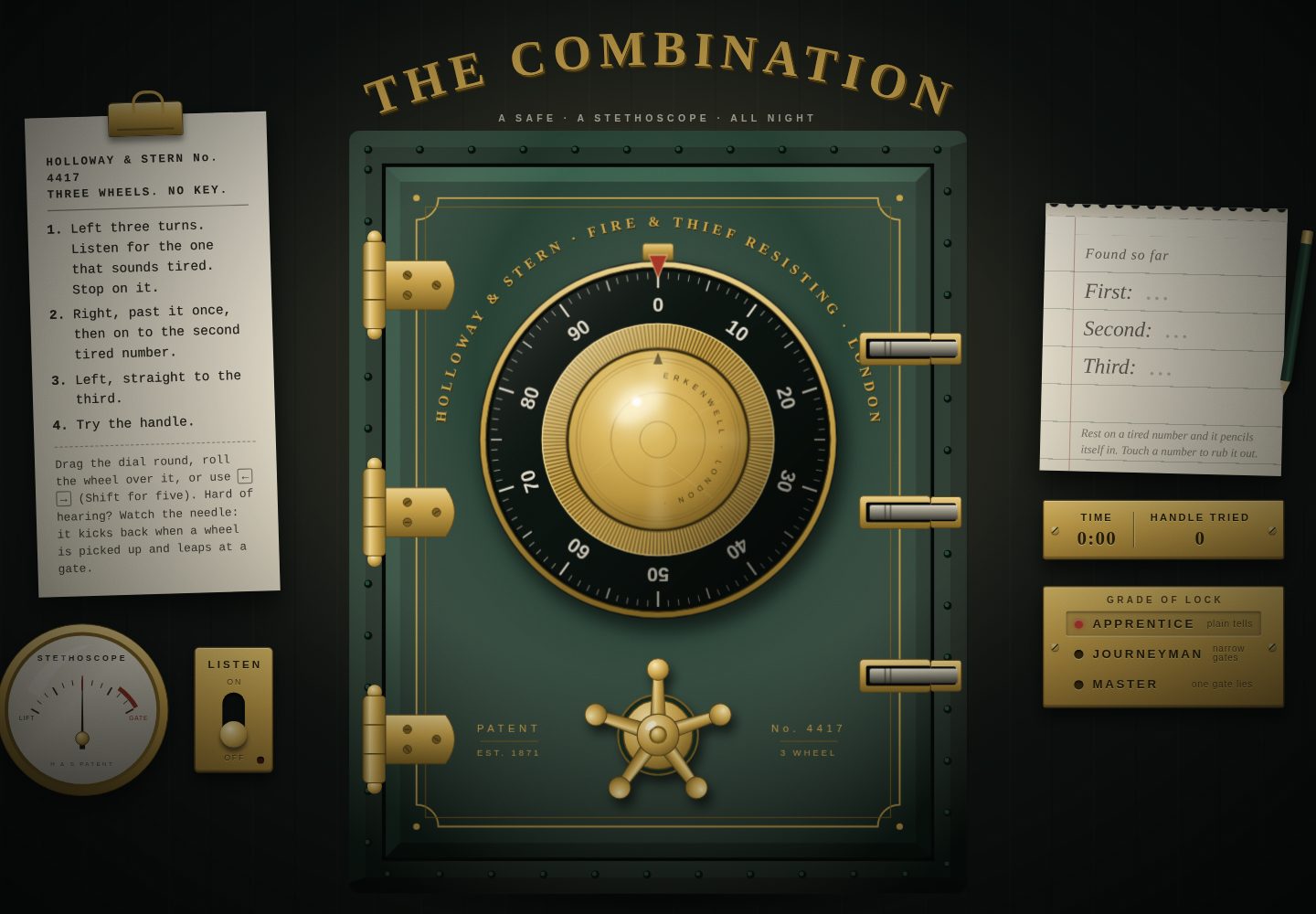
A lamplit, velvet-dark room with one object in it: a bottle-green enamelled Holloway & Stern safe with gilt pinstriping, three brass hinges, a five-spoke handle and a large combination dial. After a filament flicker the lamp comes on and the dial gives one idle spin to zero. The viewer cracks a random three-number combination by intimacy with the mechanism rather than by reading a display: every graduation clicks, but the gate of the wheel being worked sounds lower, softer and doubled, the dial drags for an instant, the red index shivers and the needle of a small stethoscope gauge leaps. A notepad quietly pencils in each number when the viewer rests on it. Throwing the handle on a wrong setting gets a clunk and a shudder; on the right one the three bolts thud back one by one, the handle spins, and the heavy door swings open in true perspective, showing its thickness and boltwork, onto felt shelves holding one of five small stories: a pearl, a bundle of letters, a ship in a bottle, a sleeping cat, or a card that says "Too late. — M."

↗ Open
A Year of Daylight screenshot
057

A Year of Daylight

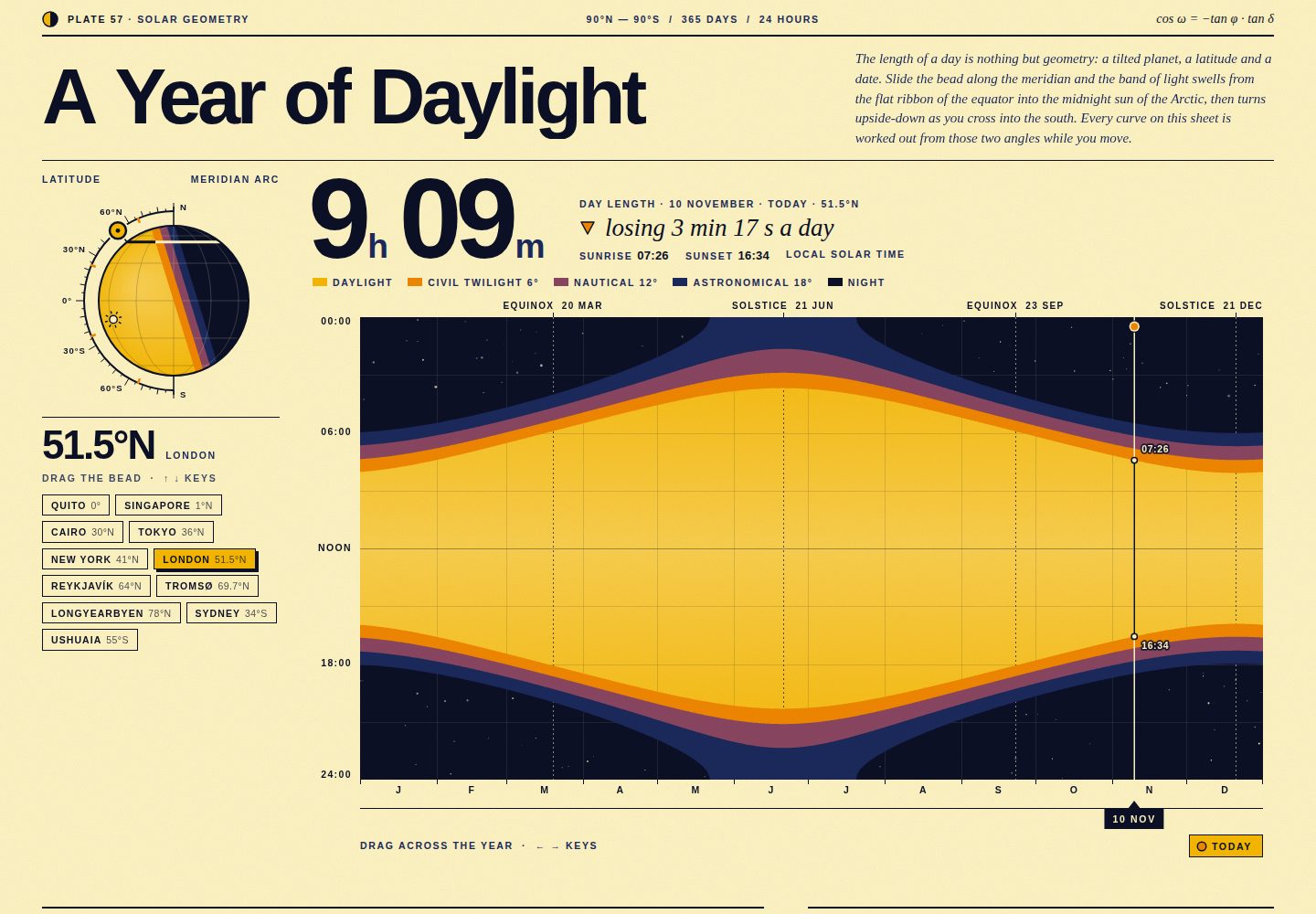
A pale sunlight-yellow museum wall chart in Swiss information-design dress: a tight navy grotesk title, a serif-italic lede, tracked-caps labels and thin navy rules. The centrepiece is the daylight hourglass, a navy block of starry night with a sun-yellow band of day running through it, edged by orange, plum and blue twilight. On load the latitude sweeps from the equator to the Arctic Circle and settles on London, so the flat ribbon visibly swells into a lens. Beside it a small desk globe with a graduated meridian arc carries the latitude bead, the selected parallel and a terminator that tilts with the date, coloured with the same twilight bands as the chart. Above the chart the day length for the chosen date is set very large with its daily gain or loss, sunrise and sunset. Below, a heat map shows every latitude and day at once with labelled contours, a ring calendar bends the year into a sun-shaped figure, and a table of superlatives recalculates live. Everything is computed in the page from latitude and date.

↗ Open
The Drawloom — Cloth from a Diagram screenshot
058

The Drawloom — Cloth from a Diagram

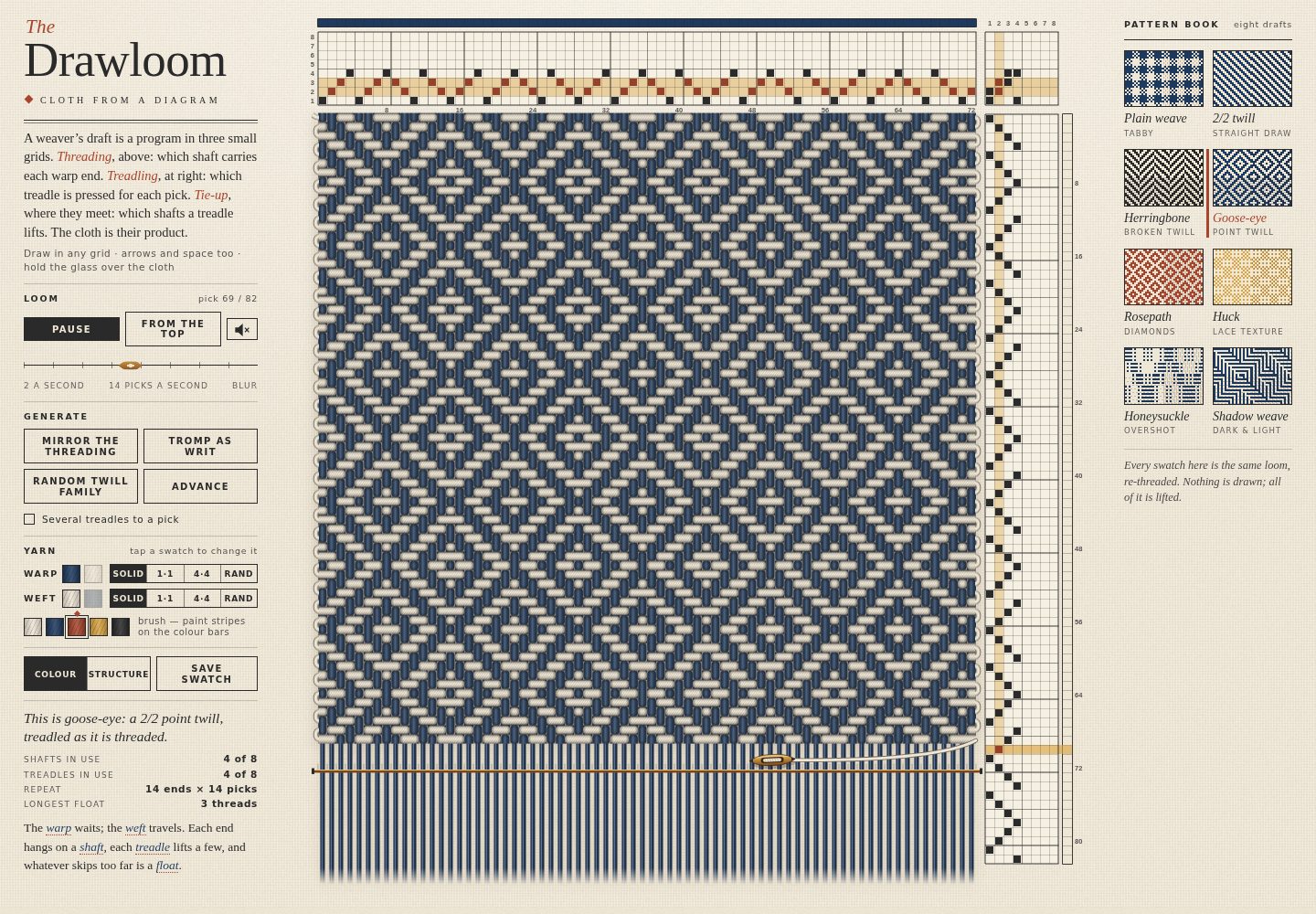
A quiet linen-paper workshop page laid out as a classical weaving draft: threading on top, tie-up in the corner, treadling down the right, and a large cloth below that is computed entirely from those three grids. On arrival a wooden shuttle is already flying across an indigo warp, laying linen picks that the reed beats into goose-eye diamonds while the pressed treadle and lifted shafts glow gold in the diagram, making the cause-and-effect of the notation visible. Every thread is rendered as rounded, twisted yarn with highlights, dive-under shadows and looped selvedges, and a brass linen-tester lens enlarges the interlacement and warns in red of floats too long to wear. The left column holds the masthead, loom transport, generators, yarn choices and a plain-language reading of the weave; the right column is a pattern book of eight historical structures, each a tiny computed swatch.

↗ Open
Pluvia & Sons — Umbrella Makers screenshot
059

Pluvia & Sons — Umbrella Makers

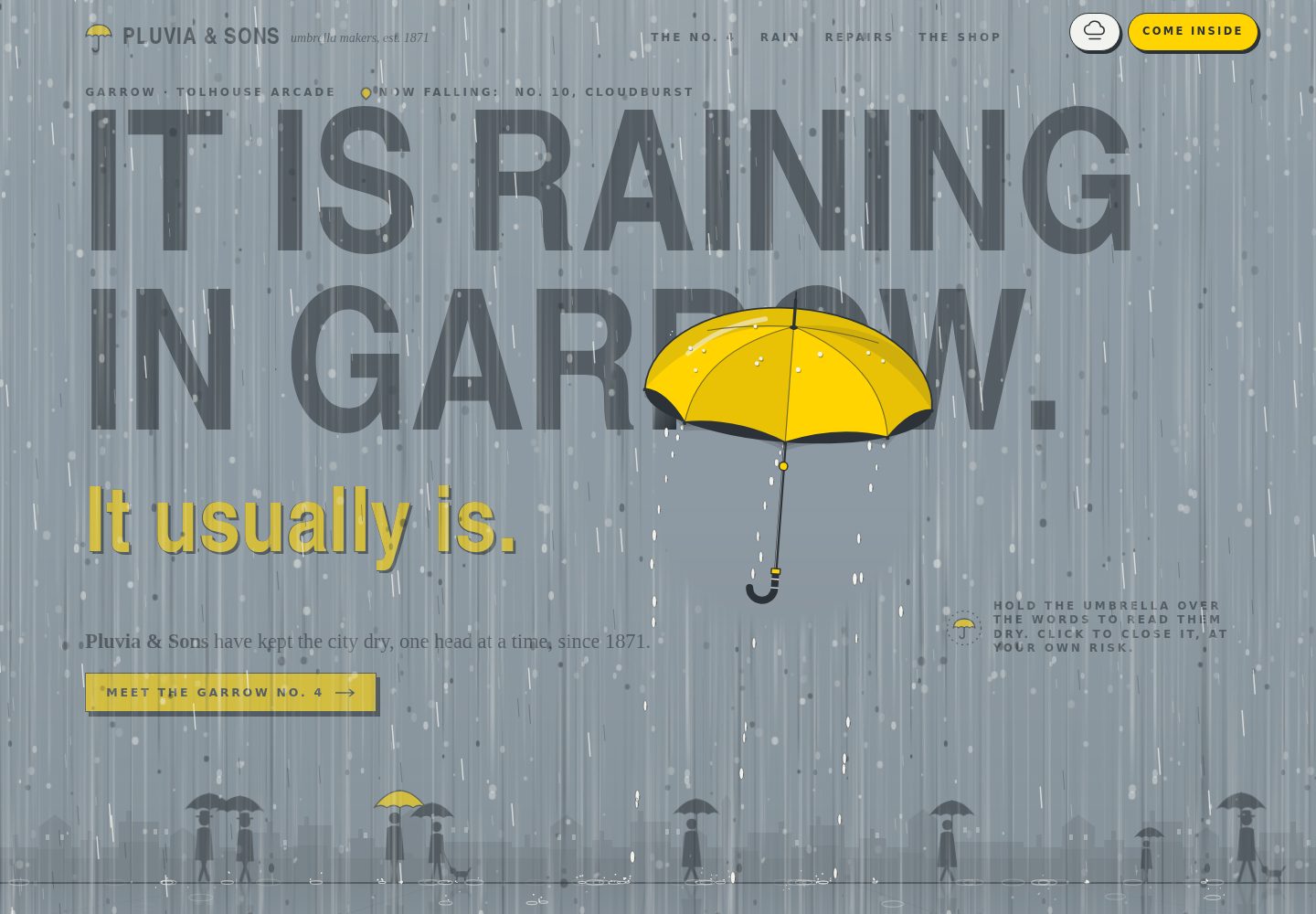
A grey, overcast landing page for a fifth-generation umbrella maker on which it is actually raining: several hundred simulated drops fall in three depth layers across the whole viewport, splash on the top edges of the paper panels and the pavement, and blur and drain the colour from everything they fall on. The viewer holds the only bright thing on the page, a canary-yellow umbrella drawn in quarter view, which replaces the cursor. Rain bursts on its canopy, beads slide down the panels to the rib tips and fall in a steady drip, and beneath it a soft circle of the page is dry: sharp, full-contrast, and in colour. Reading the page means sheltering it. The copy is dry in the other sense: a headline that says it is raining in Garrow and usually is, an exploded drawing of the Garrow No. 4 that assembles itself when scrolled into view, a house catalogue of eleven grades of rain, a ruled price list for repairs, the shop's hours ("closed on dry days, i.e. the 3rd of August"), a note from Odalys Pluvia, and a footer wordmark standing at the edge of a puddle that reflects it upside-down and ripples when drops land.

↗ Open
TIDE.TXT screenshot
060

TIDE.TXT

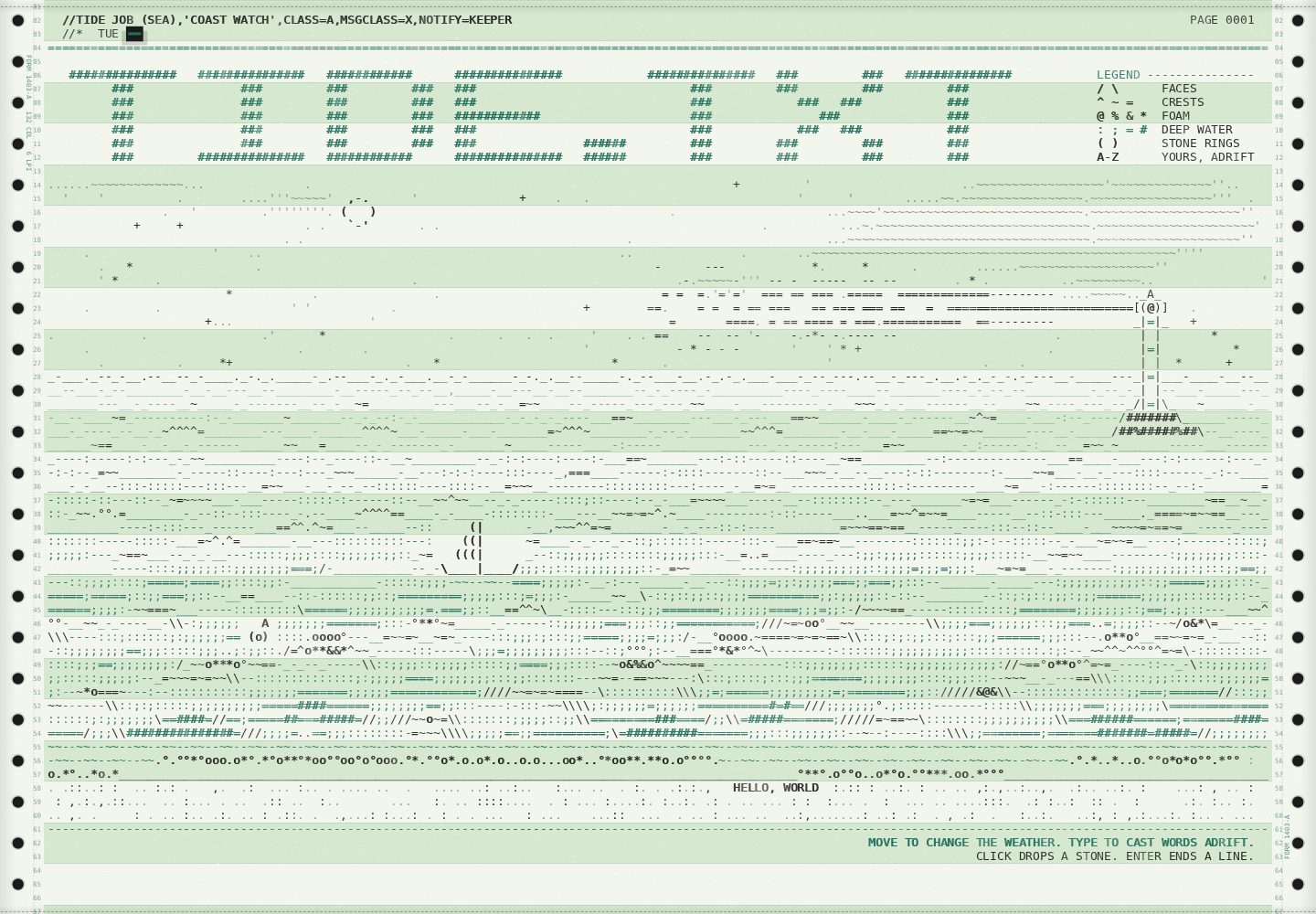
A sheet of green-bar fan-fold listing paper steps up out of a dark platen, a print head sweeps a JCL job banner and a huge "#" banner title across it, and then the rest of the sheet prints a seascape that will not hold still: a horizon, cloud wisps, a lighthouse on its rock, a little sailing boat, a bell buoy and a beach, every one of them made of typewriter characters and recomputed each frame from a perspective wave field in two ribbon colours, black for faces, crests and foam and sea-green for deep water. Moving the pointer is the weather: down for a glassy calm with mirror reflections, up for a gale with towering slashes, slanting rain, inverted-sheet lightning and a typed thunderclap, sideways for the wind. Whatever the viewer types falls from the sky into the water and rides the swell as a legible sentence, each letter on its own column of the wave, until it washes up as a tide line of their words. A footer in the voice of a shipping forecast for "Greenbar Bight" reprints itself in place as conditions change.

↗ Open
The Moon Tonight screenshot
061

The Moon Tonight

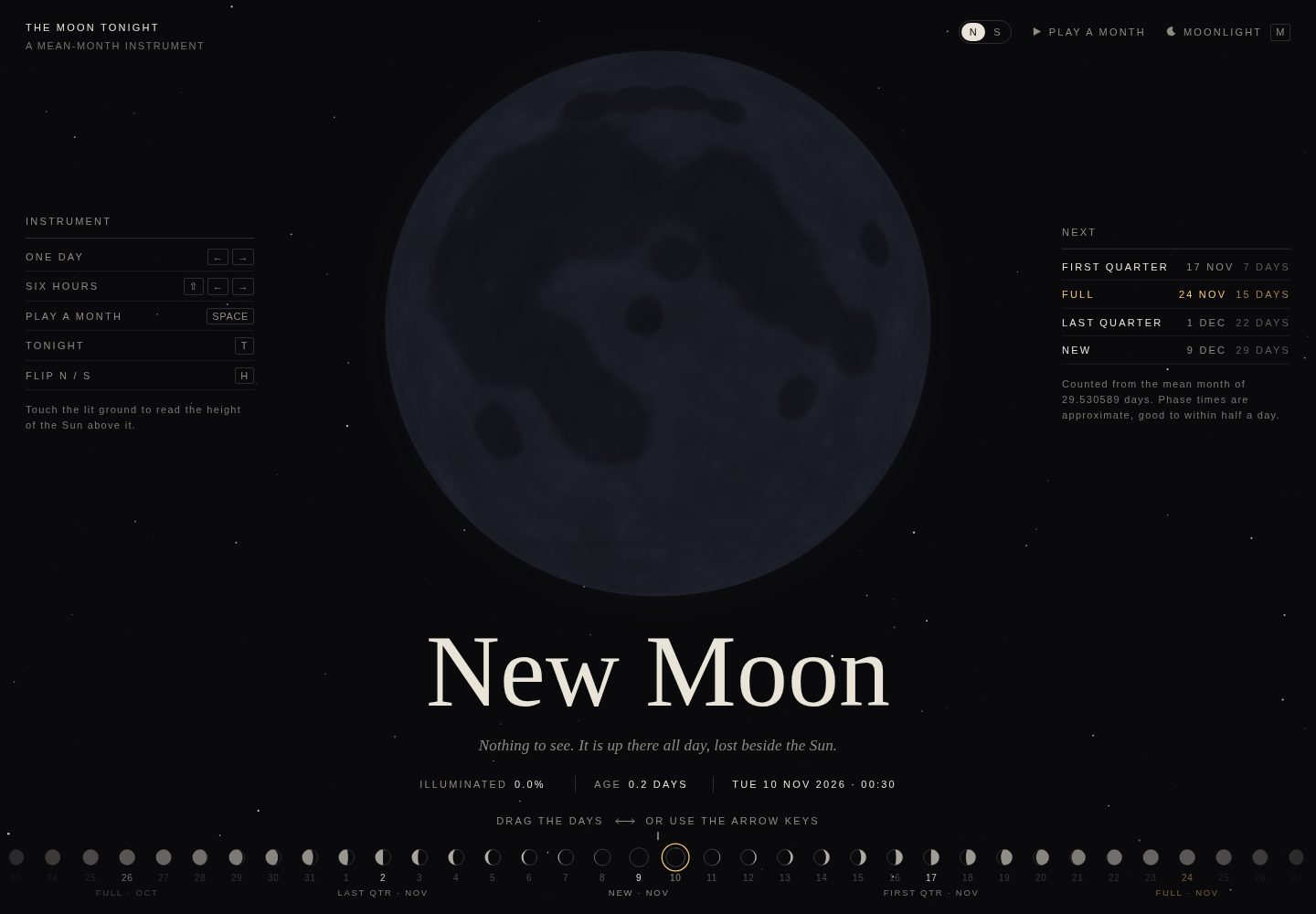
A quiet nocturnal instrument: one cratered Moon hanging in a sparse field of fixed stars on night black, shown at the phase it has at this very minute. Beneath it the phase name is set in very large, light serif type, followed by one italic line of copy written for that phase and a single ruled row of tabular data (illumination, age, date and time). A small column lists the next four principal phases, with the coming full moon in harvest gold; along the bottom edge a tape of day-by-day moon glyphs slides under a fixed index, today ringed in gold. Dragging the tape sweeps the terminator across real relief: crater rims catch the light, floors fill with shadow, the old Moon in earthshine appears around new, and every readout ticks along. The page opens in darkness, the lit limb arrives as a hairline, the light sweeps to the true phase and the title letters settle into place.

↗ Open
Wheat, Before Rain screenshot
062

Wheat, Before Rain

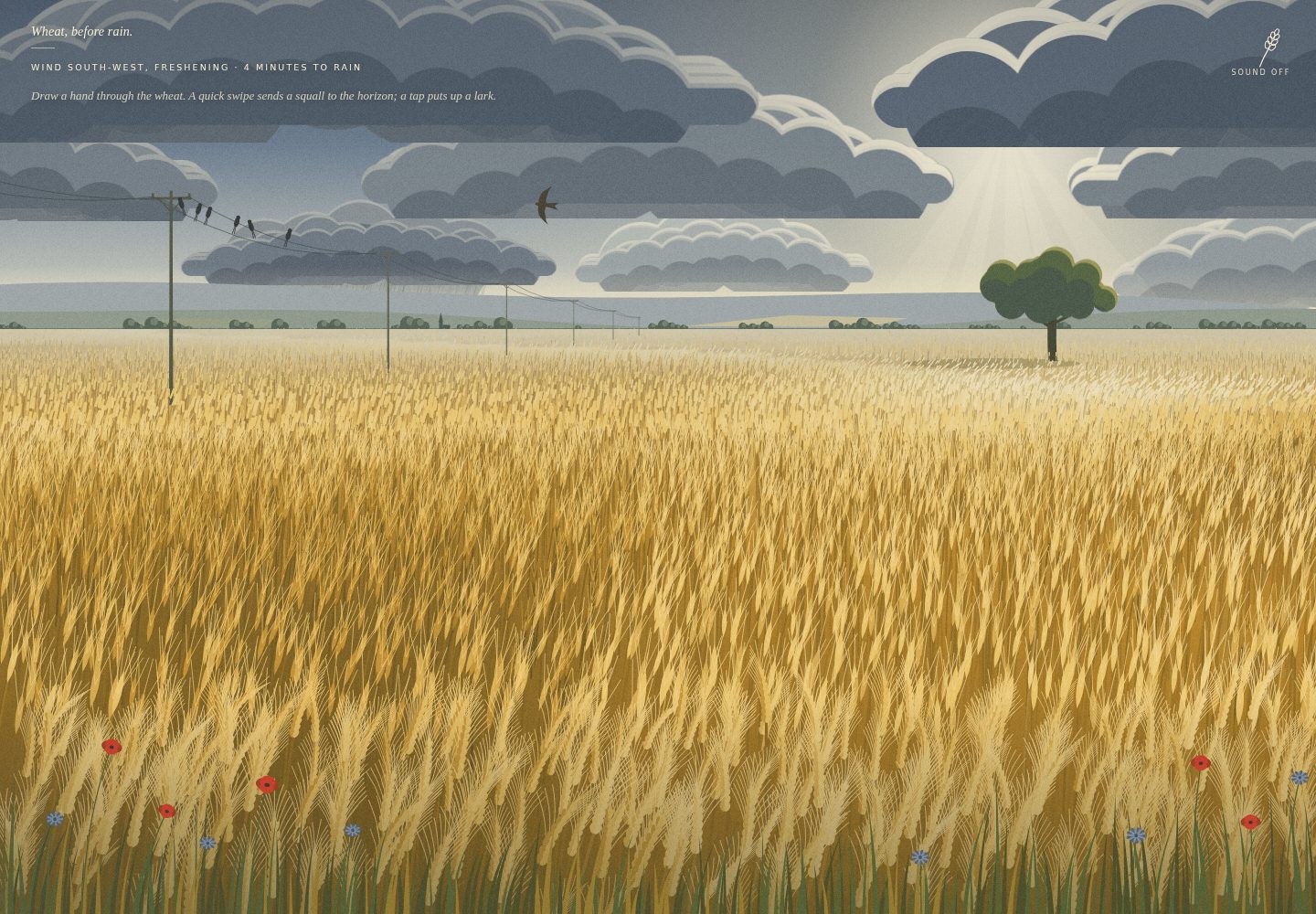
A full-bleed painted landscape in gold and slate: two-thirds of the screen is a field of ripe wheat receding to a hazy horizon of hills, hedgerow trees, a spire and a lone oak, under stacked flat-shaded storm clouds with a cream sun-break and light shafts. After one still beat a gust enters from the left and the whole field comes alive: every stalk is its own spring, leaning and overshooting as bands of wind sweep through in perspective, turning the crop silver-pale where it bends and dark just ahead, so the wind itself becomes visible as waves rolling away. In the foreground, individual ears with paired grains and trembling awns nod above olive grass, a few poppies and cornflowers; swallows scatter from a telegraph wire when a gust reaches them and a kite circles. Over four minutes a dark bank slides in, the light narrows, the caption counts down, heavy drops streak and spot the wheat, thunder mutters, and the weather eases back into bright wind to begin again. The experience is meant to feel like standing at a field margin, expectant and tender, with the option of putting a hand out into the wheat.

↗ Open
The Astrolabe screenshot
063

The Astrolabe

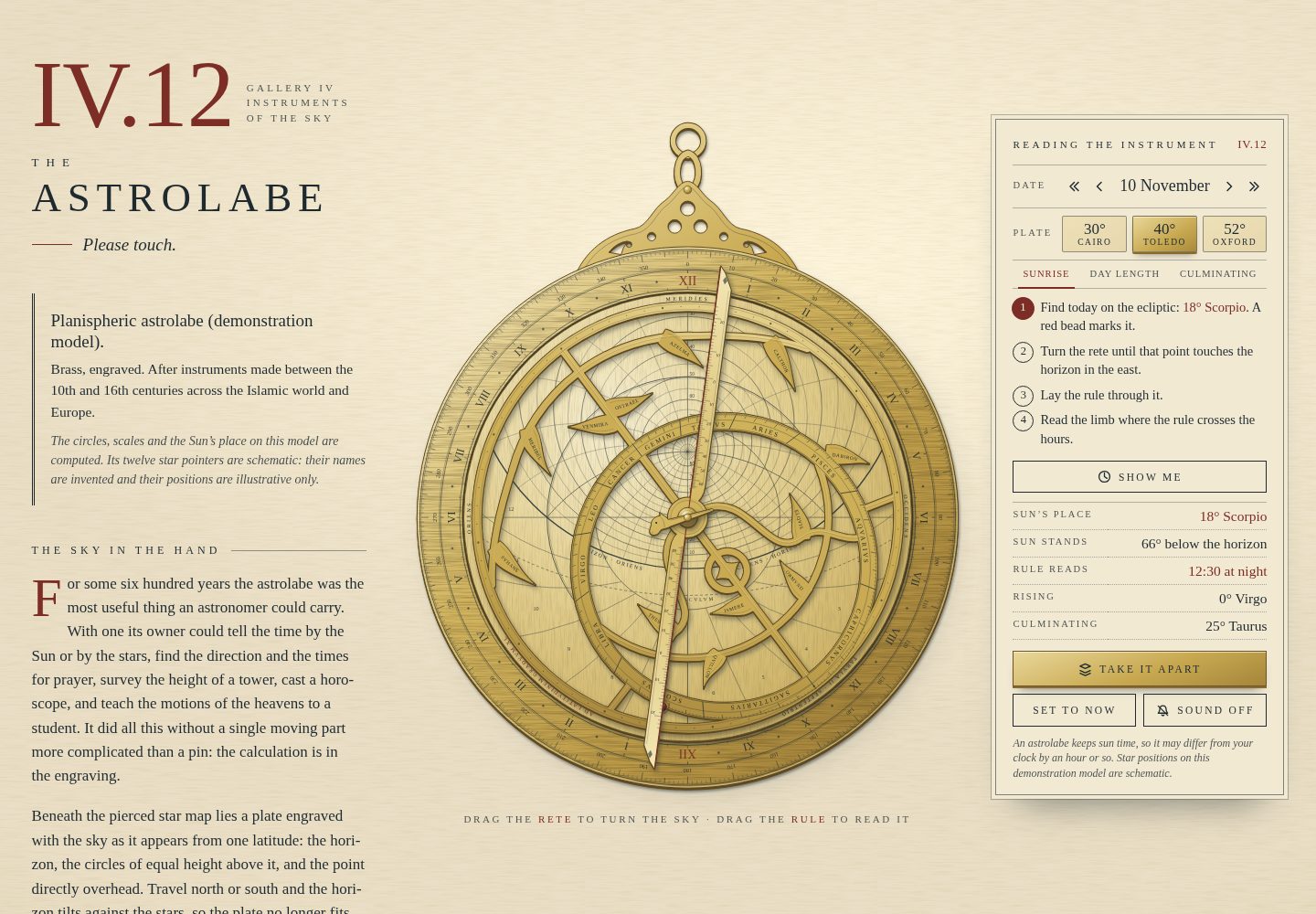
A history-of-science vitrine with the glass taken away. A large engraved brass astrolabe lies on a lamplit parchment table beside a column of museum text headed by the cinnabar exhibit number IV.12 and the invitation "Please touch." The instrument is lowered onto the table, its shackle swings, and the rete makes one slow turn before stopping at the present hour with the rule laid through the Sun's bead, so that at rest it is already telling the time. Every circle on it is real stereographic geometry for the chosen latitude, and a label-card panel reads the instrument back in plain language as the visitor turns it: the Sun's place in the zodiac, its height, the hour under the rule, the degree rising and the degree culminating. Three numbered tasks teach sunrise, day length and culmination step by step, ticking themselves off as the visitor succeeds. On request the whole instrument separates into a calm axonometric stack of pin, horse, rule, rete, plate and mater, each named and explained, and then settles back together.

↗ Open
Par Avion — The Journey of One Letter screenshot
064

Par Avion — The Journey of One Letter

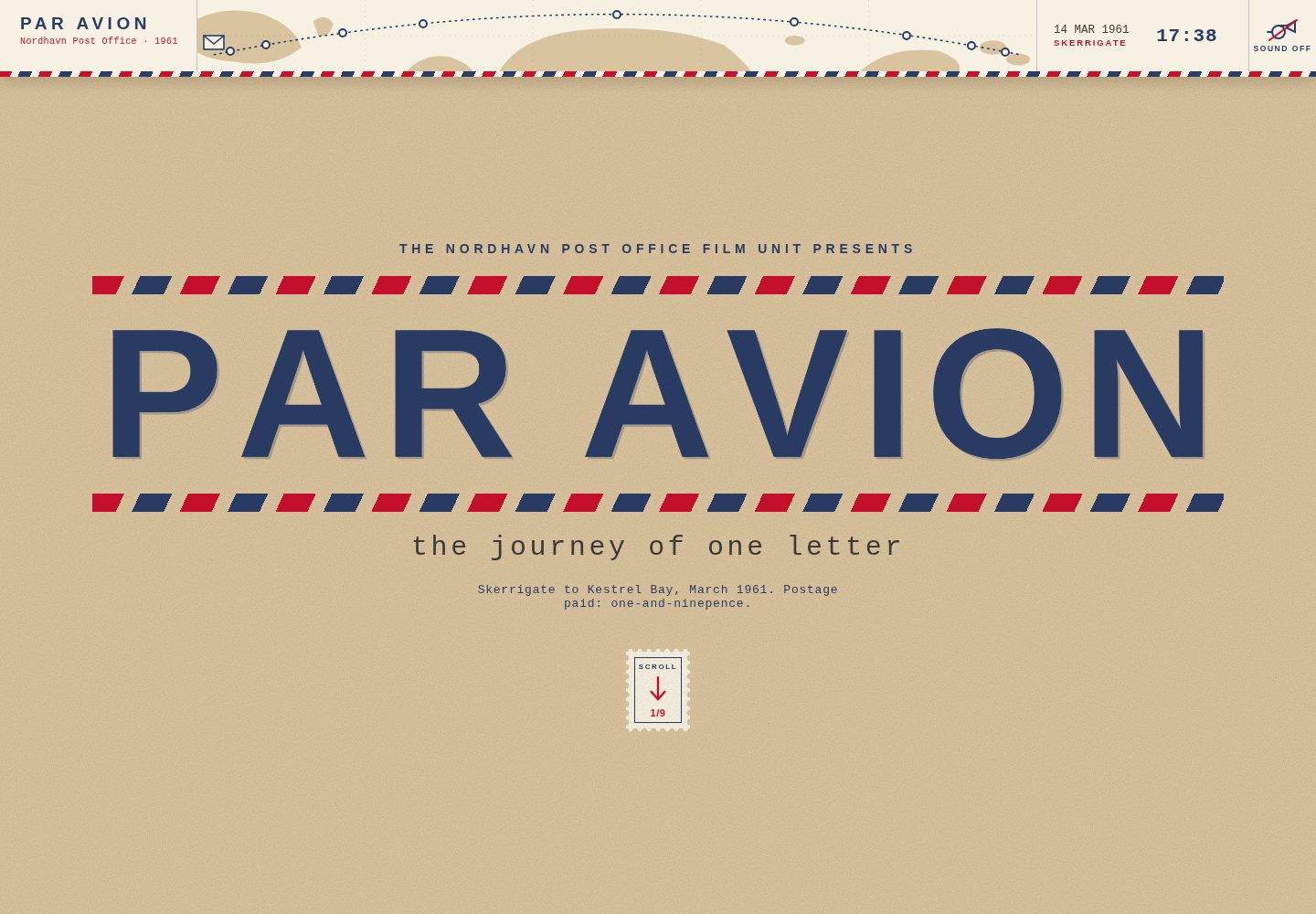
A single airmail envelope sits at the centre of a kraft-paper stage and never leaves it. As the viewer scrolls, nine flat, duotone postal scenes conveyor past behind it — a rain-streaked pillar box, a cancelling machine, the pigeonholes of a night mail train, an aerodrome, a desert stopover, a flying boat, a colonial G.P.O. counter, a mail boat and a cliff-road bicycle, a schoolhouse — while a top ribbon traces the route on an invented map and a ticker runs the local date and time. The envelope is the travelogue: each stage physically strikes, sticks, stains or creases it, with handstamps that drop in, thump and lift away leaving patchy, slightly doubled ink that dries from wet to matte. Captions on airmail-edged cards speak in the dry voice of a public-information film. At the end the envelope turns over, a paper-knife opens it, and the letter it has been carrying the whole way unfolds: a brother writing to his sister about rain, a ship's cat, an honest kettle and their mother's knee. Scrolling back up un-stamps every mark and sends the letter home.

↗ Open
Ripple Tank screenshot
065

Ripple Tank

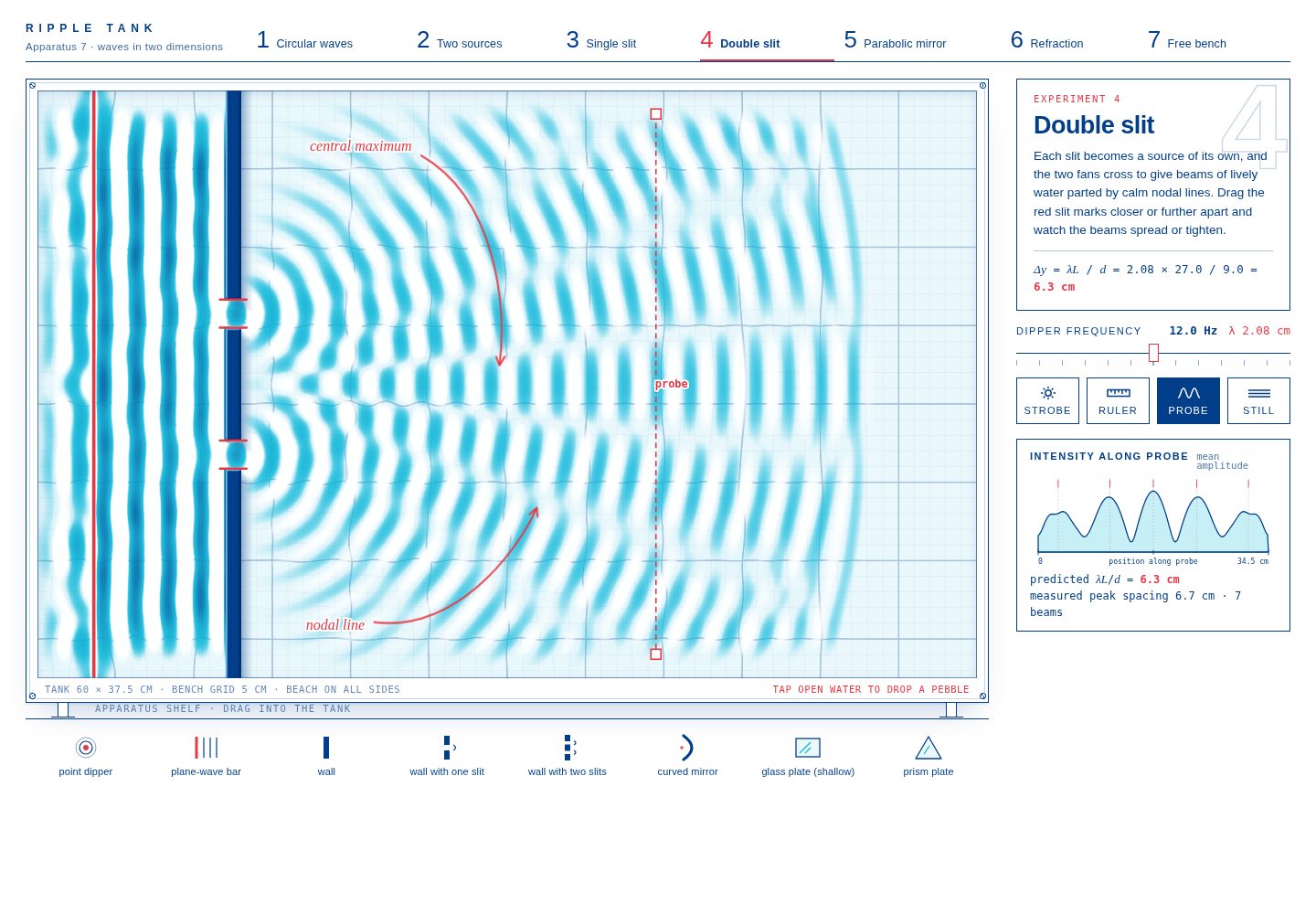
A bright, clinical lab-manual page built around a living ripple tank. A framed tray of pale aqua water sits on a white bench with corner screws, legs and an apparatus shelf beneath it; numbered experiment tabs run across the top like headings in a practical handbook, and a side column carries the experiment note, one live formula, the frequency control and the probe plot. The page opens on the double slit: a plane wave marches from a red bar, strikes a lab-blue wall, and two fans of wavelets cross into alternating beams of glittering crests and calm nodal lanes, while red hand-drawn arrows name the central maximum and a nodal line and the plot beside the tank grows a row of fringes under thin red prediction ticks. Everything in the tank can be dragged, rotated, resized or thrown out, so each textbook diagram can be bent into another one.

↗ Open
The Comet Diner, 3 A.M. screenshot
066

The Comet Diner, 3 A.M.

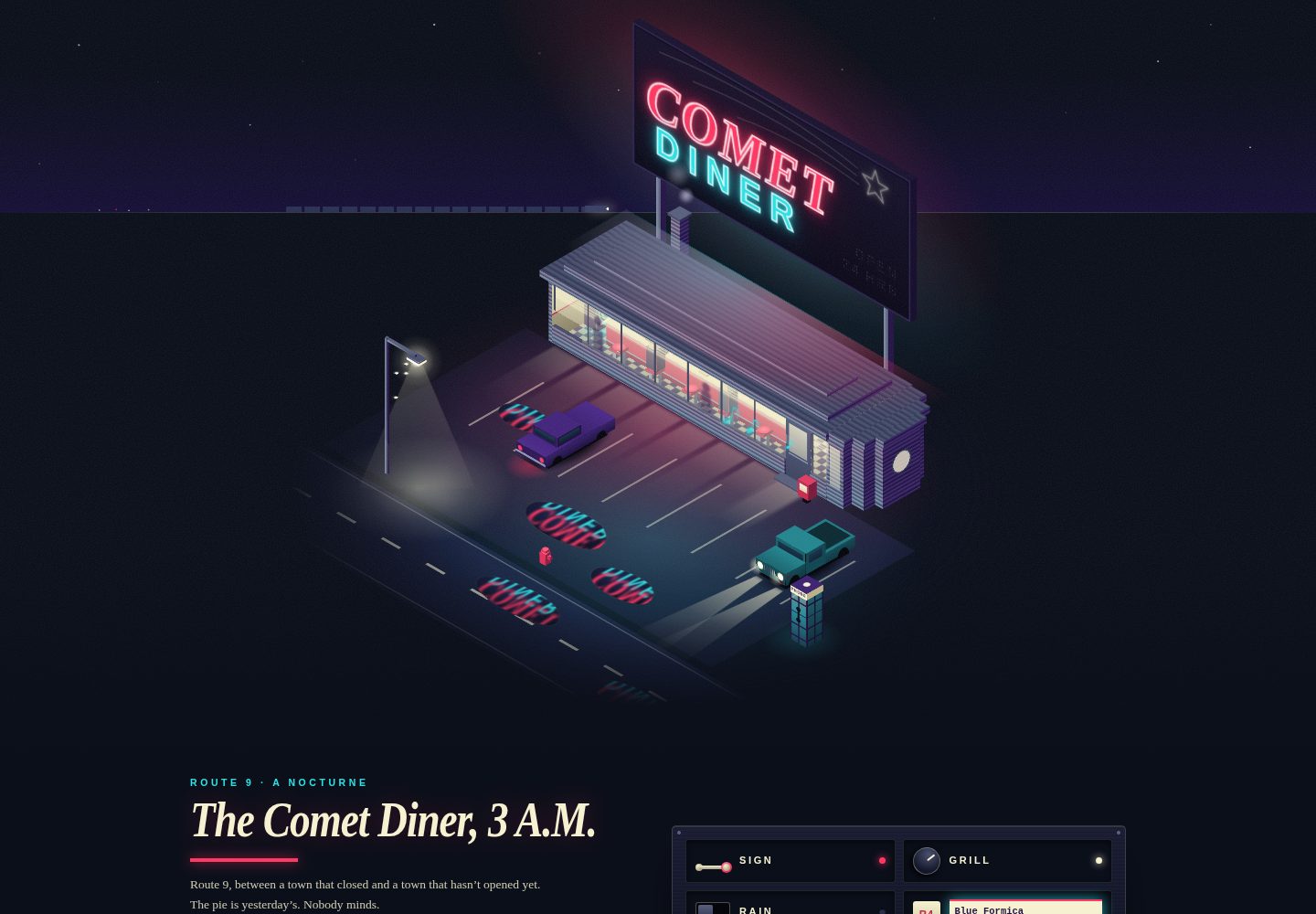
A tiny diorama of a roadside railcar diner at three in the morning, drawn entirely with HTML boxes and CSS 3D transforms and floating on a disc of asphalt that fades into the dark. Nothing is lit when the page opens except the windows and one streetlamp; then the billboard strikes, tube by tube, the M failing twice, and pink and cyan light spills over the roof, the lot and the puddles, which reflect the words themselves upside down. Inside, a cook flips, a waitress walks the counter and stops to pour, one customer stirs and another turns a page. Around it: a parked sedan, an idling pickup, a phone box, moths at the lamp, a freight train on the horizon and, now and then, a car going somewhere else. A paperback-noir title and three lines of prose frame it, with a small bakelite panel of switches and jukebox keys.

↗ Open
A Short History of Fog in Port Verrow screenshot
067

A Short History of Fog in Port Verrow

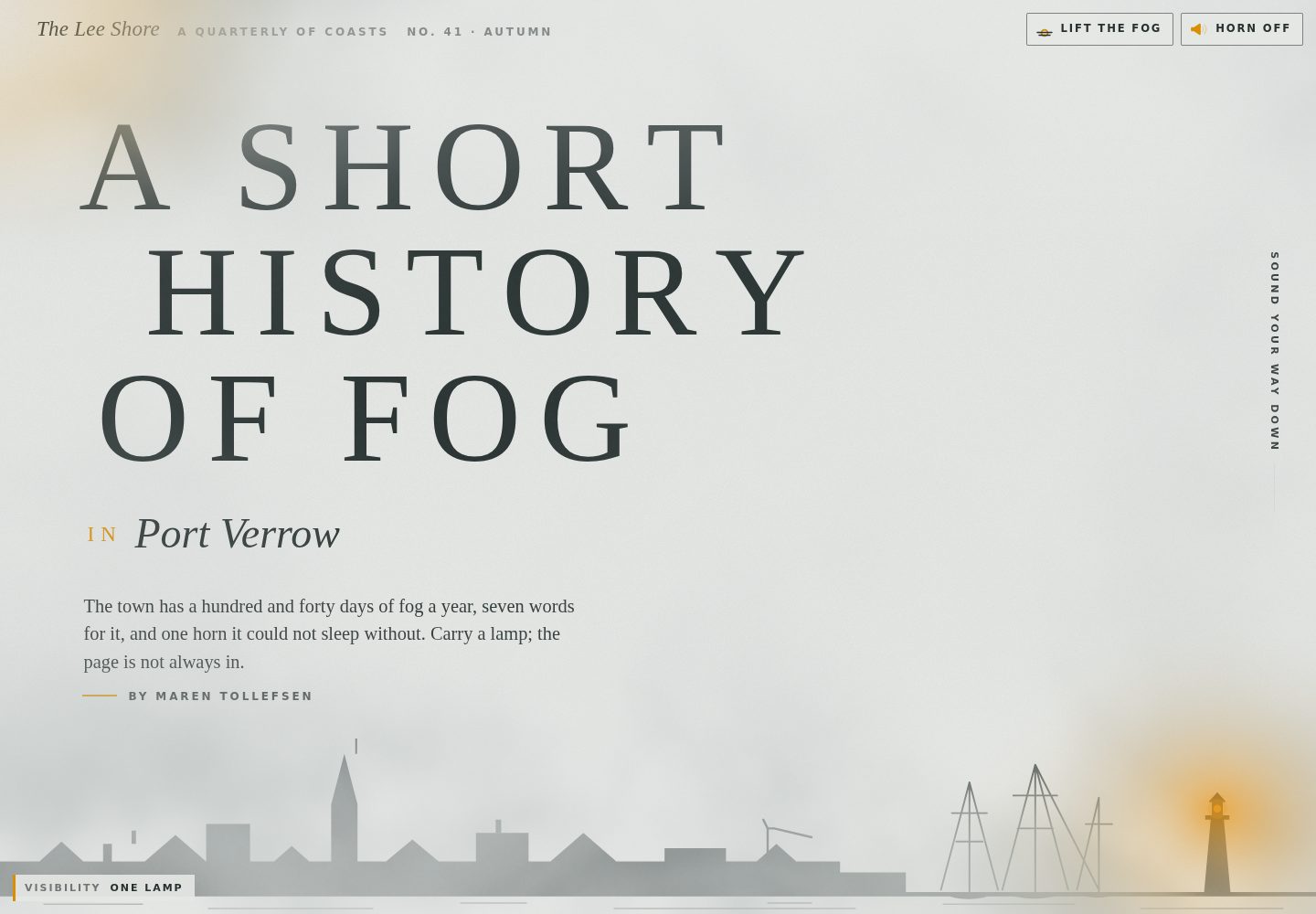
A magazine long-read from the invented quarterly "The Lee Shore" whose weather is its subject. The page opens almost blank: an amber harbour lamp glows at the end of a silhouetted mole, the letters of the huge wide-tracked title condense out of the mist one by one, and then a slow, volumetric fog settles into its drift between the reader and the essay. Text is always dark slate ink underneath; the fog is thick in the top and bottom of the window and thin in a reading band across the middle, so paragraphs come into legibility as they are scrolled to the centre and thin away again. Each of the five sections has its own weather: a light sea-fret for the vocabulary, a dense smoor for the foghorn, a near-total blanket for 1952, and a clear, sharp morning for the close. A fixed "Visibility" readout names the current conditions, the foghorn sends an amber ring through the fog every ninety seconds of story-time, and a "Lift the fog" control clears everything for anyone who simply wants to read.

↗ Open
Torre di Gelato screenshot
068

Torre di Gelato

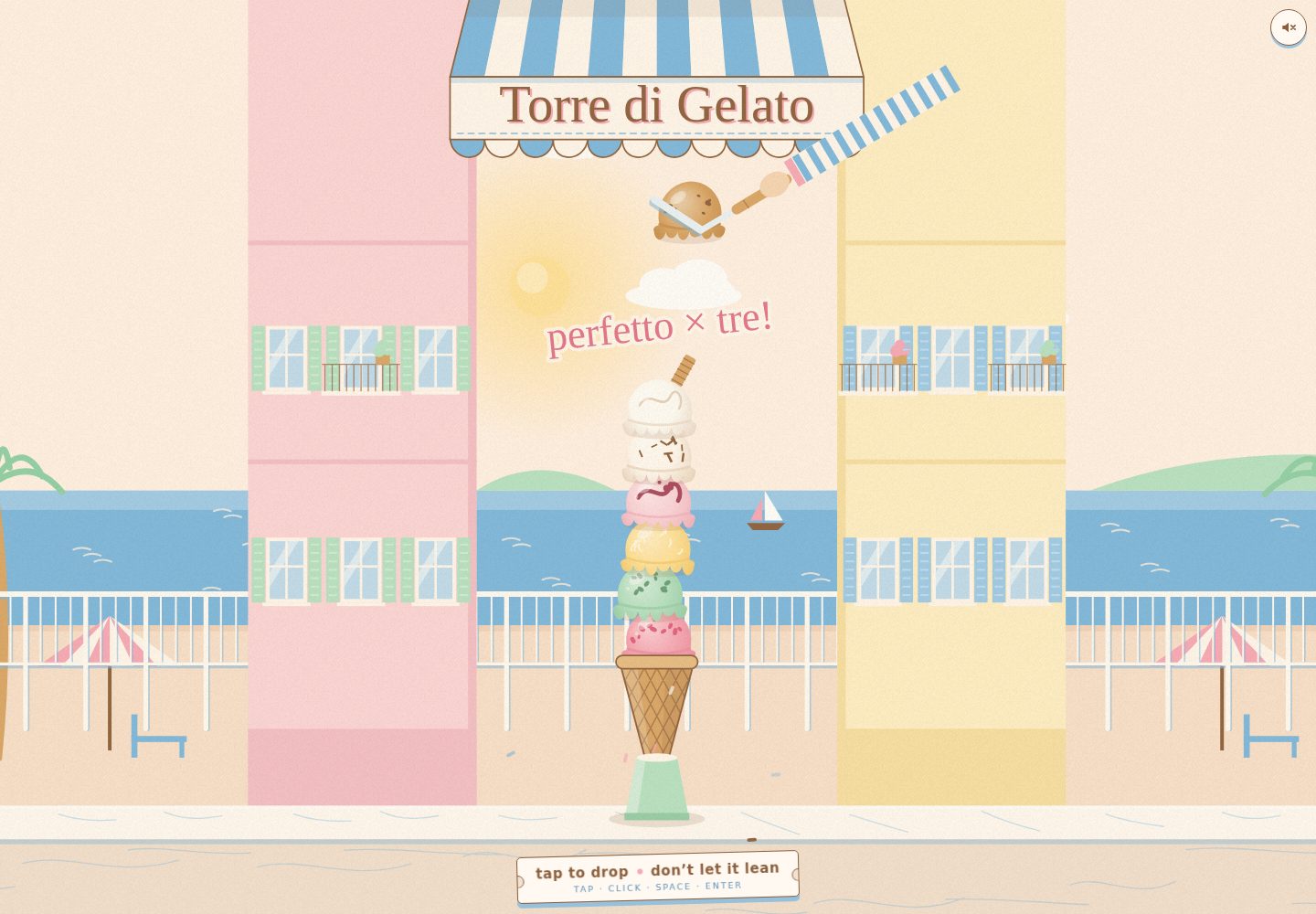
A sunny one-button arcade game set at the counter of the invented Gelateria Belmonte. A waffle cone stands in a mint holder on a marble counter beneath a blue-and-cream striped awning whose valance is lettered "Torre di Gelato"; between two pastel seaside houses lies a sliver of sea with a sailboat, a promenade railing and a gull. A server's striped sleeve swings a spade overhead, and each tap drops a soft scoop that squashes, ruffles, sticks and makes the whole tower lean, sway and overcorrect, every scoop jiggling a beat behind the one below. Dawdle and the sun melts the lower scoops into drips that run down the cone and pool on the marble. As the tower climbs, the camera leaves the awning behind and rises past washing lines, rooftop cats and aerials, a bell tower whose clock shows the viewer's own time, gulls, a kite, a hot-air balloon, thin clouds, a banner plane, a crescent moon, stars and a small satellite, each with a dashed height marker. Three dropped scoops end the round with a slow, messy cascade onto the counter and a paper receipt listing every flavour in order, with a total and a dry verdict from Signora Belmonte.

↗ Open
Strange Attractors — A Collection of Orbits screenshot
069

Strange Attractors — A Collection of Orbits

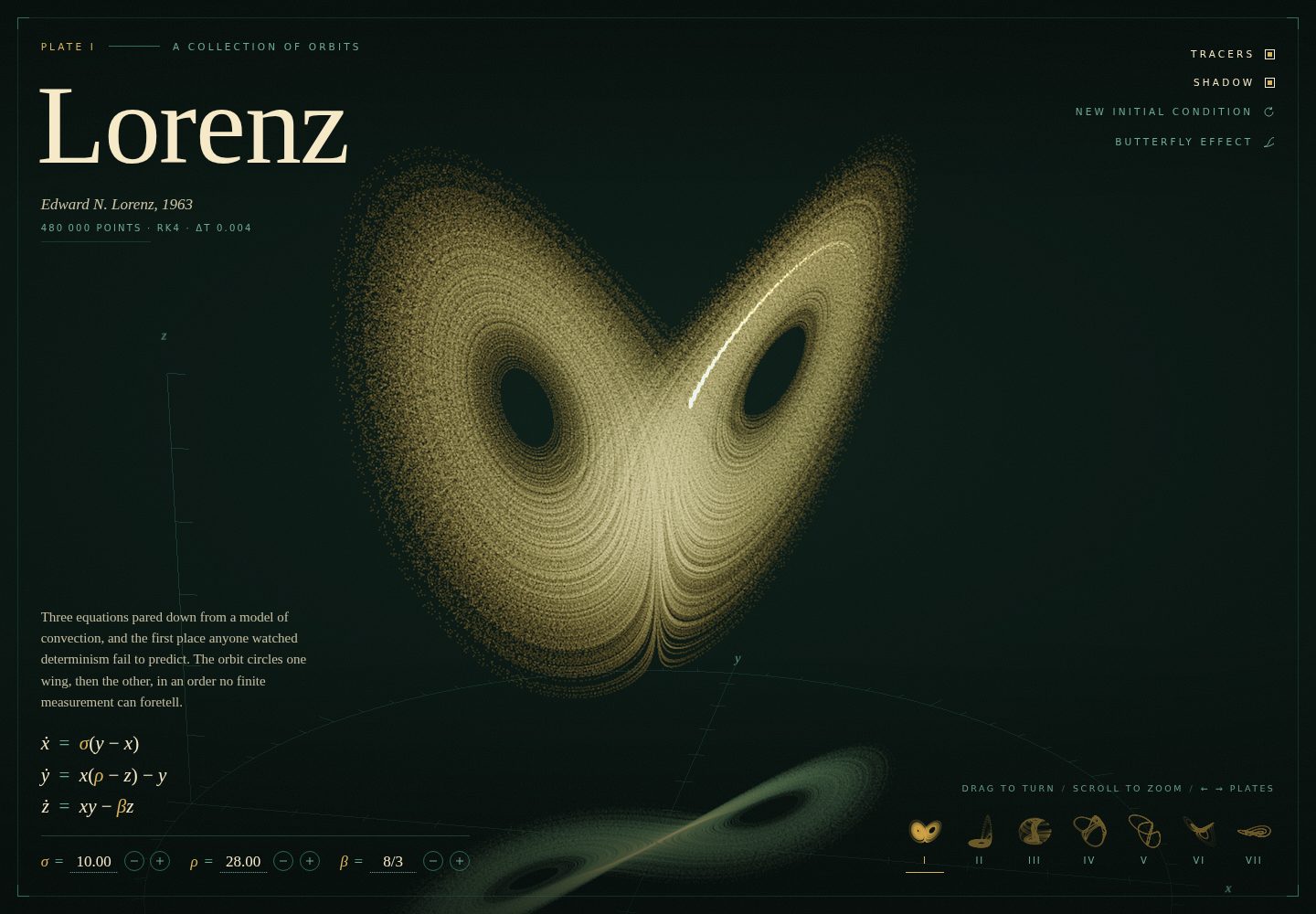
A dark viridian vitrine holds one strange attractor at a time, built from up to 480,000 points of gold dust whose overlapping density, not any drawn line, makes the form: thin outer loops are faint threads, the folded cores glow champagne, and a jade shadow of the same density lies on a graduated floor ring beneath. The page is composed like a museum label on glass: a large Didone name and plate number at top left, the governing equations set in italic serif with live, draggable constants at bottom left, a row of seven miniature specimens at bottom right. The experience is slow and tactile: the specimen turns on its own until taken in hand, a swarm of bright tracers shows which way the flow runs and how quickly neighbours part, and every change of plate or constant makes the whole cloud dissolve and re-settle into its new shape rather than cut.

↗ Open
Semaphore — Say It with Flags screenshot
070

Semaphore — Say It with Flags

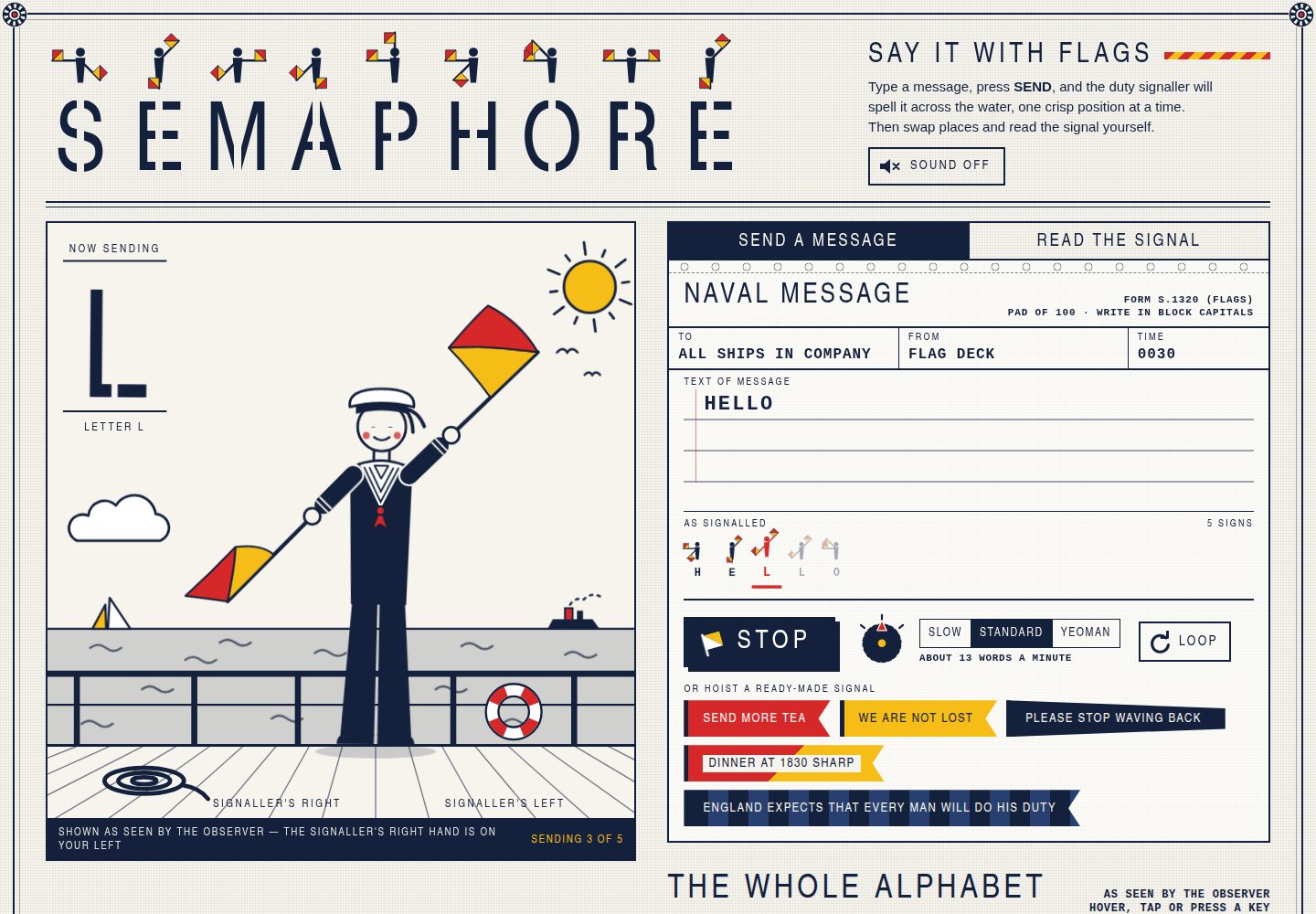
A sunny mid-century instructional poster that is also a working instrument. A flat, geometric sailor stands on a signal deck with a rail, a lifebuoy, a coil of rope, the sea horizon, a steamer and one small cloud, holding two diagonally divided red-and-yellow flags. Type a message onto an invented naval message form (S.1320, with TO / FROM / TIME boxes and ruled typewriter lines), press SEND, and the signaller spells it out in correct flag semaphore: arms snapping the shortest way round an eight-point clock with a slight wind-up and overshoot, flags folding edge-on through the move and cracking open with follow-through, the body leaning and bobbing with each position, rests between words, a quick drop between double letters, and the numerals and letters-follow signs inserted automatically. A strip of tiny static glyphs lights up in red in step with the performance while the current character stands beside the figure in huge stencil type. On load the signaller calls attention with both flags and spells HELLO unasked. A second tab turns the page into a reading trainer with a streak counter and a ship's bell, and a reference chart of thirty positions, grouped by the seven circles of the code, lets the viewer play the signaller like an instrument by hovering, tapping or pressing letter keys. Everything is shown as seen by the observer, and says so.

↗ Open
Apiary No. 9 — Hill Honey screenshot
071

Apiary No. 9 — Hill Honey

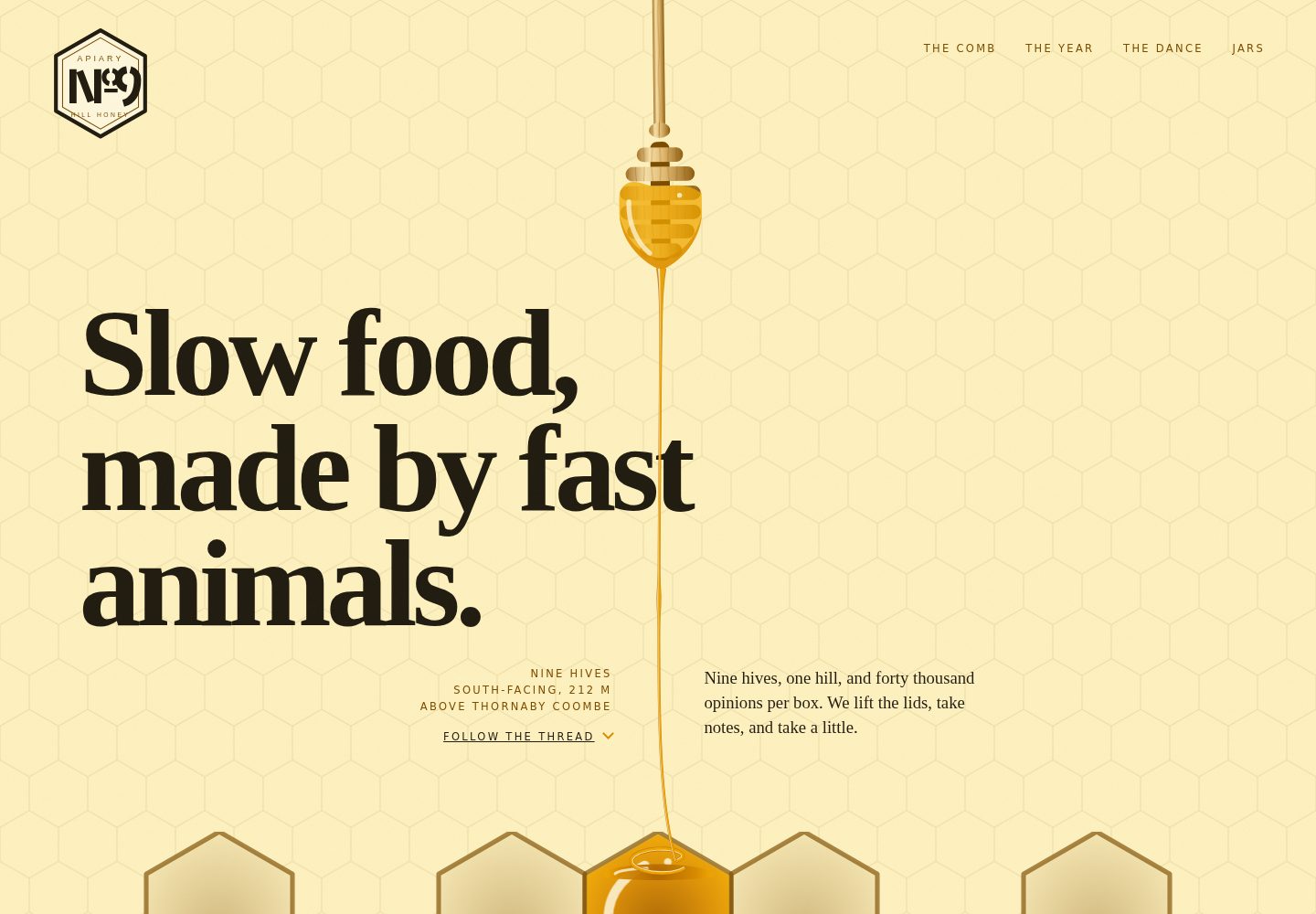
A sunlit, nearly monochrome amber landing page for a nine-hive honey producer, built from one material and one shape. A turned beech dipper lowers into the top of the page and lets go of a single thread of honey that falls through the oversized serif headline and coils like a rope onto the first cell of a full-bleed honeycomb. Scrolling makes the comb fill outward from that landing point: each cell rises with a curved meniscus, then most are sealed with a dimpled wax cap while some stay open and glossy. Three seven-cell clearings in the comb hold the three honeys with their hexagonal jars. Bees patrol the cell walls, fly off in arcs and drift toward a resting cursor. Below the comb everything remains hexagonal: a twelve-cell ring calendar, interlocking number cells, a compass and a dance floor for the waggle dance, and an order cell that ends in a pressed wax seal. The voice is first person plural, dry and fond of its bees.

↗ Open
Lumen — Municipal Power Board, Pop. 2,140 screenshot
072

Lumen — Municipal Power Board, Pop. 2,140

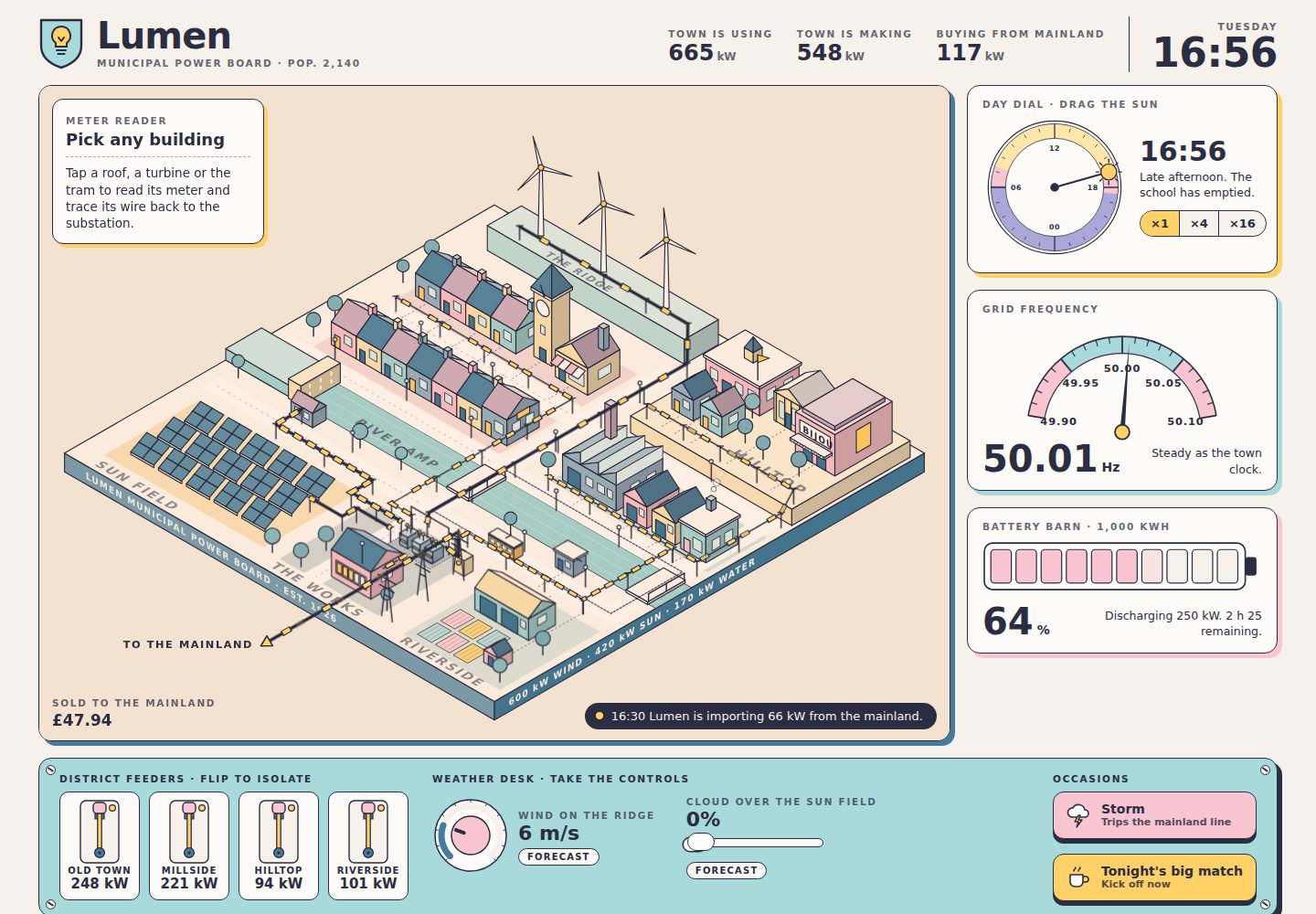
Lumen is a municipal power dashboard built as a model-railway board: an isometric pastel town of some thirty buildings on a steel-blue plinth, with a wind ridge, a sun field, a weir, a battery barn and a pylon line to the mainland, all wired to a tiny substation. One simulation of a 24-hour day drives both the model and the instruments around it. The board opens empty, buildings spring up district by district, wires string themselves between poles, and yellow dashes begin to run along them at a speed and density that match the kilowatts on each line. As dusk falls the board tints from cream through pink to a dim lavender, windows light house by house, the Bijou's marquee comes on, the wind drops, and the viewer watches the battery barn's flow turn round and the interconnector start importing. Around the model sit a day dial, frequency gauge, segmented battery, a 24-hour stacked supply chart with the demand line, today's mix ring, a carbon-free streak, the mainland account in pounds and a dryly written event log, all in the same flat navy-outlined style.

↗ Open
Zoetrope screenshot
073

Zoetrope

A darkened Victorian parlour: a brass wall lamp flares up at the upper left, throwing a warm pool over patterned wallpaper and a mahogany table on which stands a slotted drum on a turned pedestal. One automatic flick sets it spinning, and within three seconds the bright slits sliding across the near wall fuse into a cream band in which a row of small black-and-vermilion horses gallops on the spot, dimmer and narrower than the drawings on the paper band lying unrolled on the table in front. As the drum coasts down the figure flickers, breaks into sweeping bars with comet tails of drawing, and finally stands as twelve separate slivers. Nothing is faked: the picture is built each frame by sampling the far-wall strip through the moving slits into a persistence buffer that fades like the eye, so the speed, direction and failure of the illusion all follow from how the viewer spins the drum. A reading glass on a stand shows the central figure enlarged; lifting the slotted lid turns the same drawings into a grey smear; and a drawer in the table holds twelve blank frames for a strip of the viewer's own.

↗ Open
The Kelp Forest of 3n + 1 screenshot
074

The Kelp Forest of 3n + 1

A bright, sunlit aquarium tank in which the Collatz conjecture is a living plant. The reverse tree of every path from 1 to 9,000 grows out of a sea-urchin "1" on a sandy floor: thick deep-teal trunks through 2, 4, 8 and 16, thinning and paling into thousands of sea-green hairline fronds that lean and curl because even steps bend one way and odd steps the other. The whole forest sways in a slow travelling swell while garibaldi-orange and teal fish weave through it, bubbles rise and marine snow drifts. The page is set like a museum panel: a bold serif title and three plain sentences in the upper left with the rule drawn as a two-branch sprig, a cream instrument plate with a number field, famous starters and two brass dive-gauge dials, a specimen card with the hailstone plot, and a strip of statistics printed on the sand ending in "counter-examples found: 0". The signature moment is following a number home: one orange thread lighting the whole way down through the forest to 1.

↗ Open
Hell Box — Wood Type You Can Drop screenshot
075

Hell Box — Wood Type You Can Drop

A jobbing printer's back room on a cream wall: a red hand-painted HELL BOX sign, a pinned notice from the Foreman, and a steel proofing-press bed framed by wooden furniture. Keys rain end-grain maple sorts onto the bed, each carrying a mirror-reversed letter stained with old ink, and they thud, lean and stack under a small rigid-body engine. Pulling a proof plays the whole press cycle — brayer, sheet, cylinder, peel, flip — and turns the accidental pile into a right-reading letterpress poster with salty ink, slur and deboss, which then flies up to a sagging drying line of pegged, swaying proofs. Overprinting in other inks builds layered chance posters that can be enlarged and saved.

↗ Open
Formicarium — Notes on a Colony screenshot
079

Formicarium — Notes on a Colony

An open field notebook lies on a dark wooden desk. The left page is written up in a sepia italic hand: a title, two dated entries, a labelled pencil sketch of a worker ant from above, a three-step diagram of the two-scent rule, a live tally and an "Observations" log. The right page is the arena, with a pasted typewritten specimen label, a pressed lime leaf, a coffee ring, a ribbon in the gutter and a green pencil lying across the corner. Up to 1,500 ants pour from a drawn nest hole in a fan, find the waiting sugar within seconds, and stain the paper with green home-scent and rust food-scent that thickens into roads. The viewer adds sugar, draws graphite walls, rubs out roads, drops water and inspects individuals under a 4x loupe, while red-pencil notes with arrows write themselves beside notable events and are entered in the log with timestamps.

↗ Open