Collection · 100 studies

Hy4 Flash 100 HTML Files

One hundred self-contained visual studies — paper instruments, tide charts, type machines, night markets and small impossible devices — generated with Hy4 Flash. Open any piece in a new tab, or expand a card to read the original generation prompt.

100 studies
001
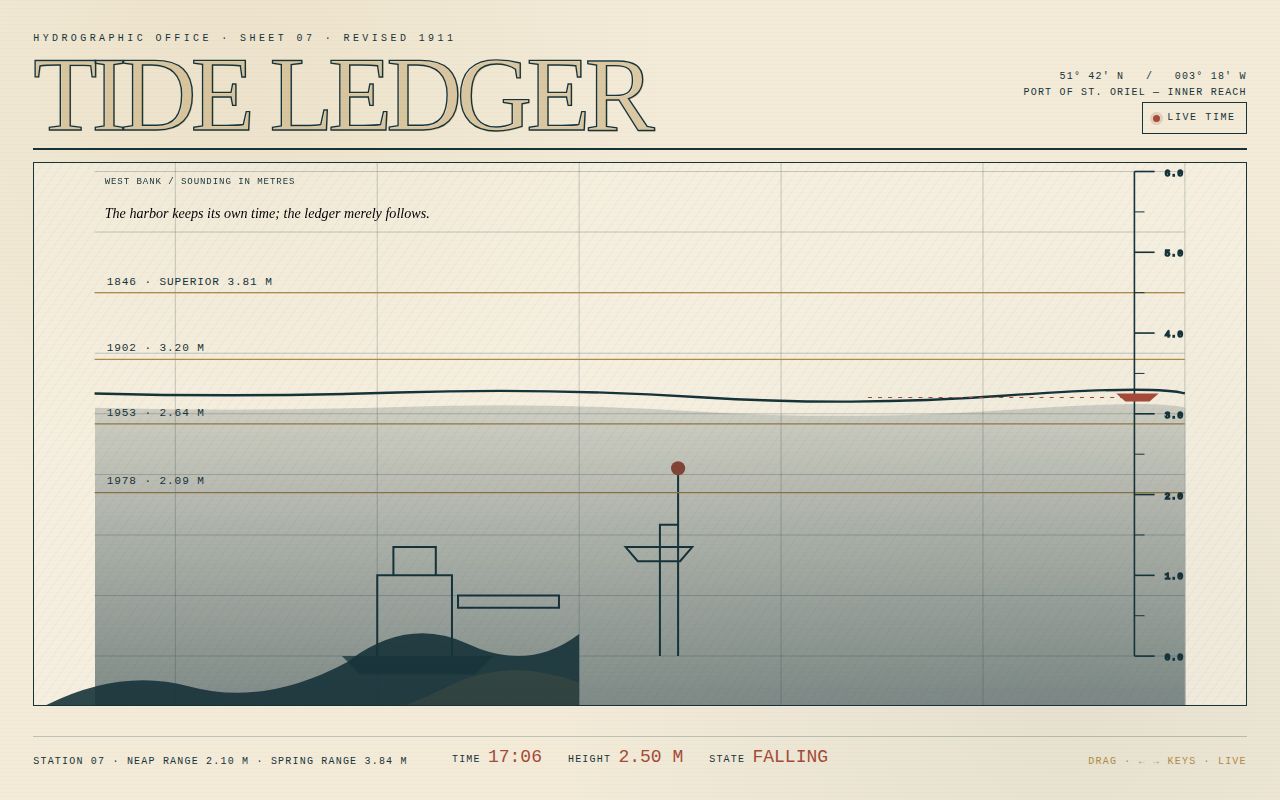
A measured, paper-based tide instrument that turns the viewer’s clock into the motion of water. Historical waterlines, a brass gauge and a slow-breathing live surface create the feeling of an instrument that has been recording the harbor for a century.
Open
Original prompt
A single-screen nautical tide instrument for an invented harbor. The viewer should feel they have opened a folded, slightly foxed survey sheet: warm paper #F3EBD8, deep ink #17333A, brass #B08A44. Compose a dense but calm chart with a small royal-blue-free header, a monumental outlined title set in Georgia, tiny monospaced coordinates, and a large SVG harbor cross-section occupying most of the viewport. Draw several hairline waterlines at historical heights, a brass vertical gauge on the right, and a live water polygon whose surface is a sum of two sine tides (roughly 12h25 and 24h cycles). The current local time drives a subtle brushed-steel pointer; dragging horizontally across the chart scrubs through a twenty-four-hour window and returns to live time with a labelled button. Typography: Georgia for the title and the tide names, Courier New for all measurements, uppercase letterspaced labels. Motion: a 1.4s cubic-bezier entrance draws the chart rules from left to right, water rises from the bottom with a soft overshoot, and the gauge pointer eases to its current height. Interaction: hover any historical waterline to highlight its year and height; drag anywhere on the chart to scrub; keyboard arrows scrub by fifteen minutes; the live button restores the clock. Signature moment: the waterline visibly breathes with the real clock while a brass marker ticks upward, and scrubbing makes the entire harbor cross-section tilt fractionally like a floating ledger. Copy: specific harbor names, tide heights in metres, times in 24-hour notation, and margin notes in the voice of a harbourmaster. No generic instructions; label the drag affordance as a printed scale reading “DRAG THE HOUR”.
001-tide-ledger.html
002
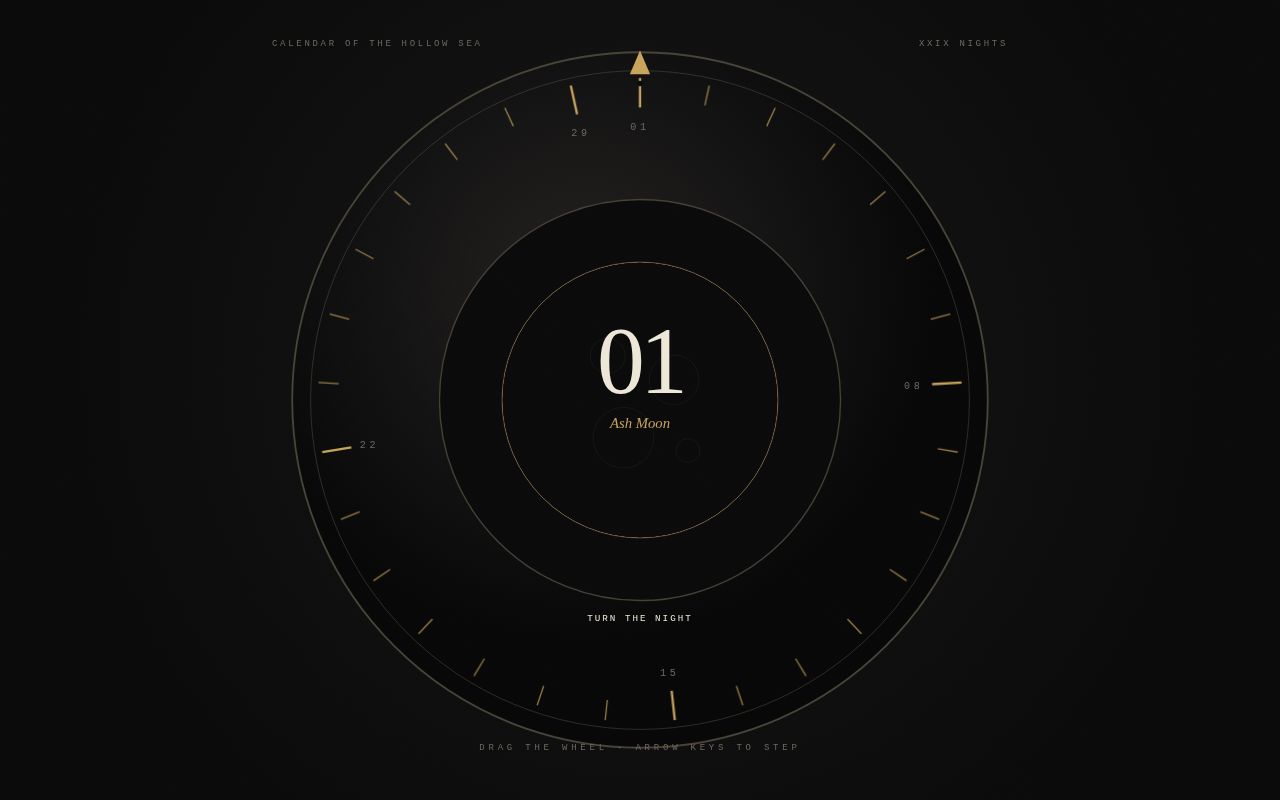
A tactile, monolithic moon-phase selector that behaves like a precision instrument carved from obsidian. It turns a familiar astronomical cycle into a satisfying mechanical object with twenty-nine distinct stops.
Open
Original prompt
A black-stone lunar roulette for an imaginary calendar with twenty-nine named nights. The entire page is a single object in a near-black field: #0B0B0C background, ivory #EDE7D8 moon, brass #C8A45D ticks and numerals. Build a large circular wheel of engraved notches around a central moon disk. The wheel is the primary interface; dragging around it rotates through the phases, and releasing snaps to the nearest of 29 detents with a visible mechanical shudder. The moon itself is drawn with SVG: an ivory disk partially covered by a dark disk that slides across it, producing correct crescent, quarter, gibbous and full silhouettes. Typography: tiny tracked Courier labels around the rim, one enormous Georgia numeral for the night, small italic phase name below. The entrance should feel like a heavy wheel settling into place: a 900ms cubic-bezier rotation overshoot, the brass ticks appearing in sequence, then the moon glow fading up. Hovering a notch previews the phase name; dragging updates the number and the terminator. Keyboard left/right moves one night. Signature moment: the detent snap—when released, the wheel makes a tiny overshoot and the brass pointer rings once before locking. Copy: names such as Ash Moon, Thin Ferry, Half House, Full Lantern, no instructions beyond a small rim engraving “TURN THE NIGHT”.
002-null-moon.html
003
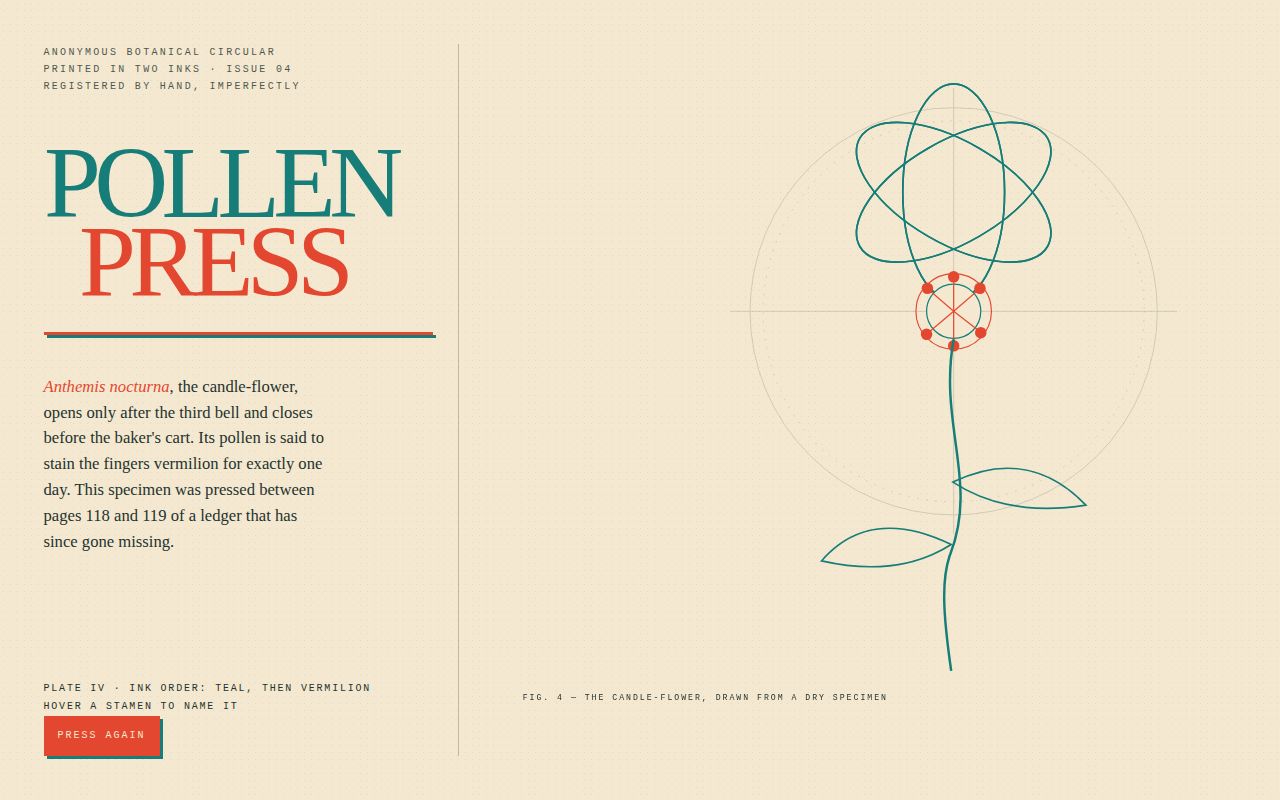
A print-inspired botanical study that makes the viewer participate in the printing process. The flower is drawn in fine line, and pressing its stamens throws clouds of two-color pollen across the sheet with a convincing misregistered halo.
Open
Original prompt
Design a two-color risograph botanical print for an imaginary press specializing in anonymous alpine flowers. Background warm cream #F4E9D0; inks vermilion #E4472F and teal #167D78, deliberately slightly misregistered. Left column carries enormous Georgia title “POLLEN / PRESS” with a thin red rule, issue data in tiny Courier, and a short factually invented species description. Right two-thirds holds a large SVG line drawing of a single six-petalled flower in teal, with vermilion stamens and a long stem. Petal outlines draw themselves over 1.8 seconds with staggered stroke-dashoffset; the title fades up in three pieces with different delays. Add a visible printed dot texture and paper grain using CSS gradients only. Interaction: each stamen is a hoverable/focusable target with a Latin label; clicking one releases a burst of pollen made of dozens of small vermilion and teal circles that float upward with a slight gravity swing and settle into a halftone halo around the flower. A small “PRESS AGAIN” control clears and repeats. Signature moment: the two ink layers of the pollen burst separate by two pixels, like a risograph registration error, then drift back together. Copy should sound like a museum label written by a slightly obsessive printer. No external images or fonts; system stacks only.
003-pollen-press.html
004
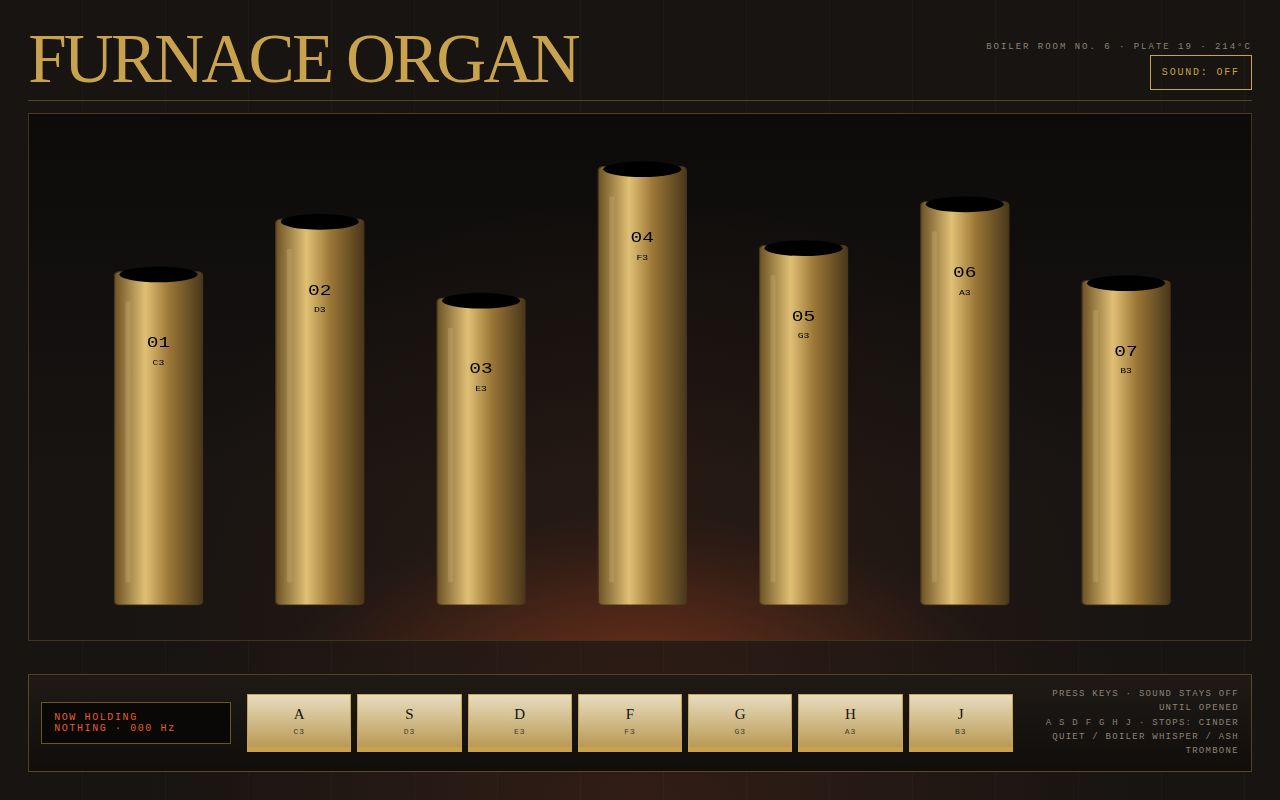
A theatrical seven-note organ whose pipes behave like industrial flues. Holding a key sends fire up a pipe, scorches its label and—once sound is opened—sustains a warm, breathy tone in the boiler room.
Open
Original prompt
An instrument page built around the fiction of a pipe organ installed in a derelict boiler room. Palette: near-black charcoal #171412, ember #E85D2A, brass #C9A24D, with a little ash grey. The composition is frontal and theatrical: a row of seven tall brass organ pipes fills the upper two-thirds, a small monitor shows the currently held note in monospace, and a physical-looking seven-key console sits at the bottom. Sound must remain off until the viewer presses a clearly labelled “SOUND: OFF / ON” control; visual playing works without audio. Use system fonts only: a condensed-looking Georgia for the boiler-room sign and Courier for technical labels. Entrance: pipes rise from the floor with staggered 70ms delays and a heavy cubic-bezier(.16,.9,.2,1) ease, then a furnace glow pulses once behind them. Interaction: click/touch keys or use A S D F G H J; holding a key sustains a tuned oscillator with a slight detuned second voice and a filtered noise breath. Each active pipe erupts with animated flame, vibrates horizontally, and its brass label darkens as if scorched. Signature moment: a held chord makes the furnace mouth open and throw a wave of light across the ceiling pipes. Copy: invented stop names such as Cinder Quiet, Boiler Whisper, Ash Trombone, with plate numbers and temperature readings. No generic “click to play” phrasing; the console should print “PRESS KEYS · SOUND STAYS OFF UNTIL OPENED”.
004-furnace-organ.html
005
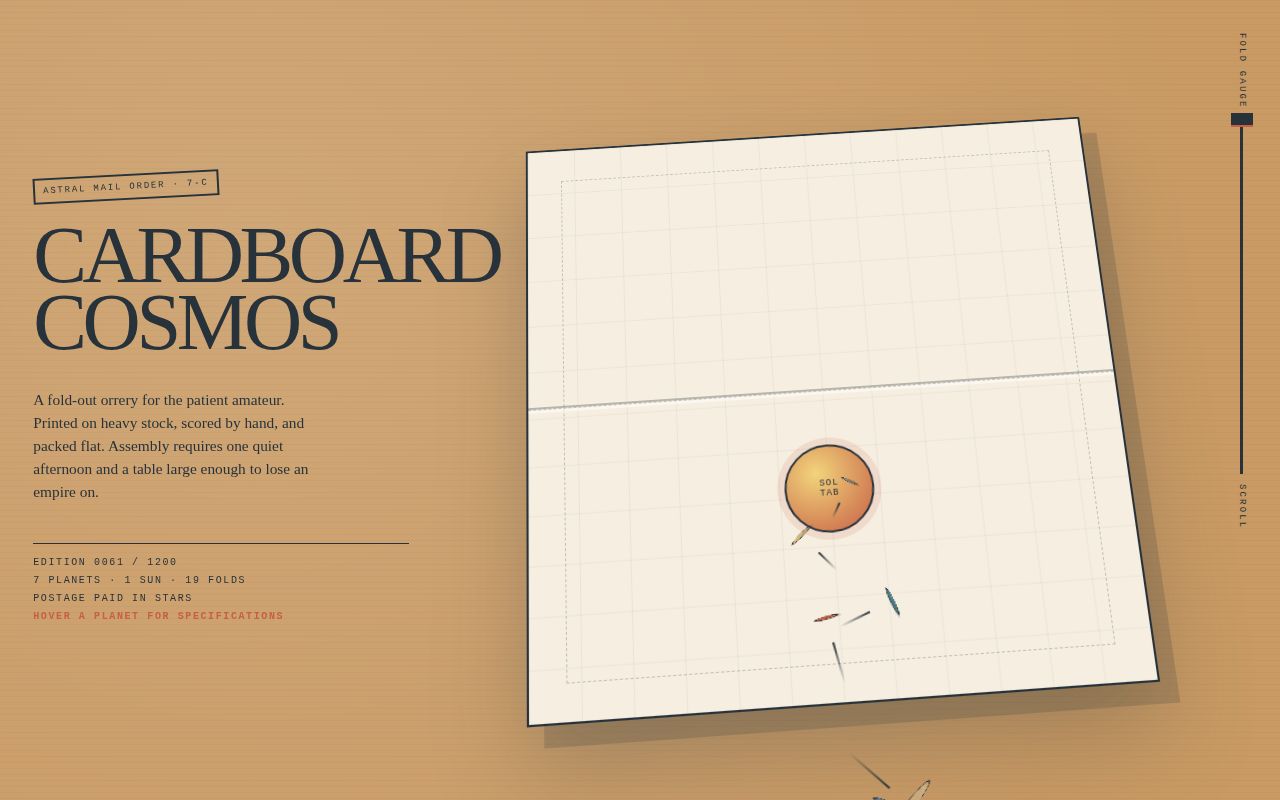
A tactile paper-engineering fantasy in which the scroll bar becomes a pair of hands folding a cardboard solar system. The page begins as a flat printed sheet, assembles into a miniature orrery, collapses into a postable carton, then opens once more.
Open
Original prompt
An imaginary mail-order paper orrery that arrives flat and folds itself into a model solar system. Palette: warm kraft #C99A63, ink #27323A, cream #F6EFE1 and a single coral #C65F45 for Mars. Design a tall editorial page with a fixed cardboard stage and a 240vh scroll track; scrolling is the folding mechanism. The top third carries a small stamped logo, the enormous Georgia title “CARDBOARD COSMOS”, a hand-numbered edition and a short product-copy paragraph written like a 1960s science catalogue. The stage shows a cream card plane with printed fold lines, die-cut tabs and seven paper planets mounted on curved kraft arms. As scroll progresses, each arm rotates from flat to upright with staggered timing, the central sun rises from a slot, and the whole assembly turns slightly in perspective. At 70% scroll the planets flatten back into a mailing carton, with a red “FRAGILE — OPEN ALONG THE SUN” stamp visible; at the end they spring open again. Typography: Georgia for display, Courier for catalogue data, no sans-serif. Motion must use a single scroll-driven parameter with custom easing, not a default scroll animation. Interaction: scroll or drag the vertical fold gauge on the right; hovering a planet shows a tiny spec label with diameter and postal surcharge. Signature moment: the final fold, where the sun tab slides through the slot and locks the assembled orrery with a satisfying 3D snap. Copy: invented planet facts, catalogue number 7-C, and precise assembly notes. No external images; all shapes built from CSS and inline SVG.
005-cardboard-cosmos.html
006
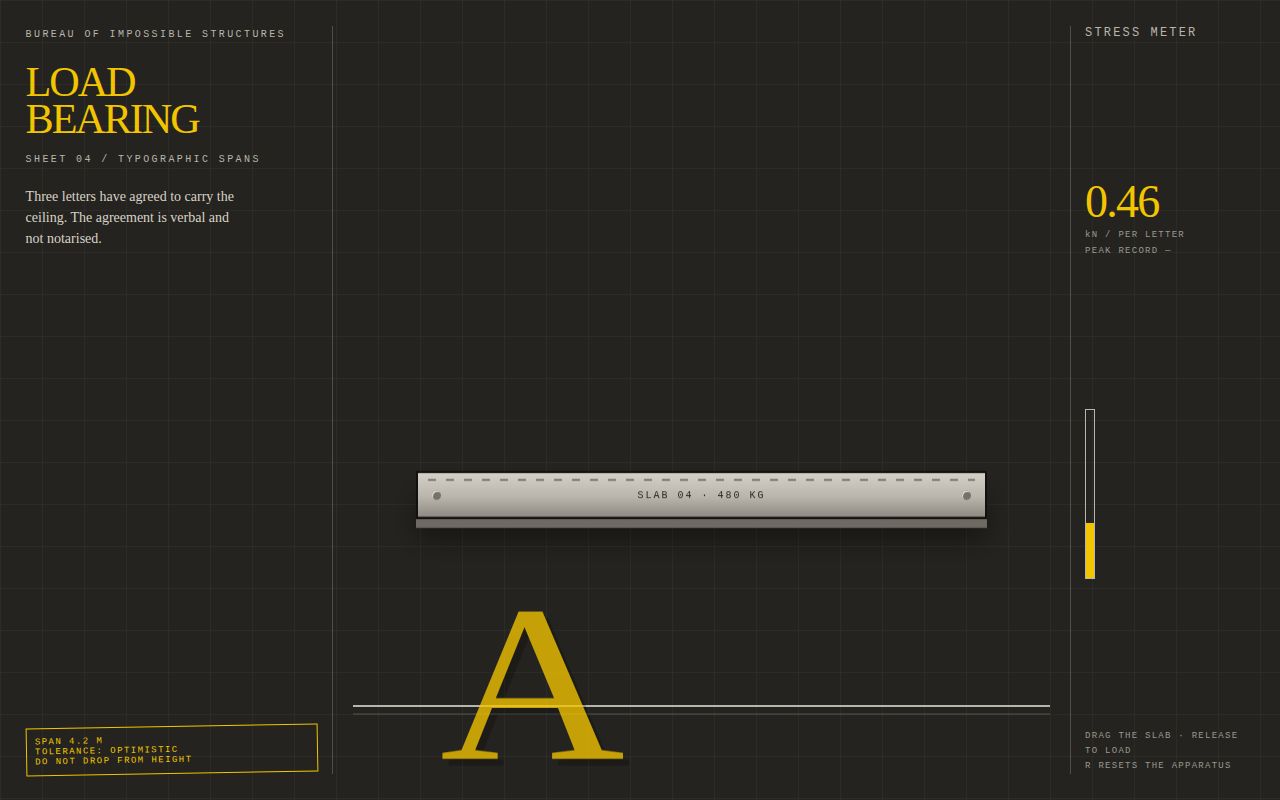
A playful structural-engineering fantasy where typography carries real weight. Dropping a concrete slab onto letter-columns creates a readable chain of compression, buckling and rebound, with live stress telemetry.
Open
Original prompt
A brutalist typographic experiment in which oversized letters are structural columns holding up concrete slabs. Palette: charcoal #24231F background, safety yellow #F2C500 letters, pale concrete #B9B5AC slabs, with thin black construction lines. Full-screen, asymmetric grid. The left edge displays a small construction-office masthead and a warning in tiny Courier; the centre is dominated by three enormous Georgia serif capitals — A, T, E — each acting as a spring-loaded column. A heavy slab rests across them at load. The viewer can drag the slab upward and drop it; a simple gravity simulation makes it fall, collide with the letters and bounce with damping. On impact the struck letters squash vertically and lean, then spring back with a custom elastic curve; a stress readout in the margin changes from 0.2 to 1.4 kilonewtons based on drop height. Add subtle construction grid, rivets and handwritten measurement ticks drawn in CSS/SVG. Typography: monumental serif capitals, tiny monospaced engineering labels, no decorative sans. Entrance: the three letters rise from the floor in sequence with a heavy cubic-bezier overshoot, the slab drops once from just above them, and the dust puff appears. Interaction: drag any slab vertically, release to drop; press R to reset; keyboard focus the slab and use ArrowUp/ArrowDown to lift or release. Signature moment: a high drop visibly buckles the A first, then the T and E in sequence, while the slab bounces twice and the stress number flashes red. Copy: invented engineering notes such as “SPAN 4.2 M / TOLERANCE: OPTIMISTIC”, no generic game language.
006-load-bearing-type.html
007
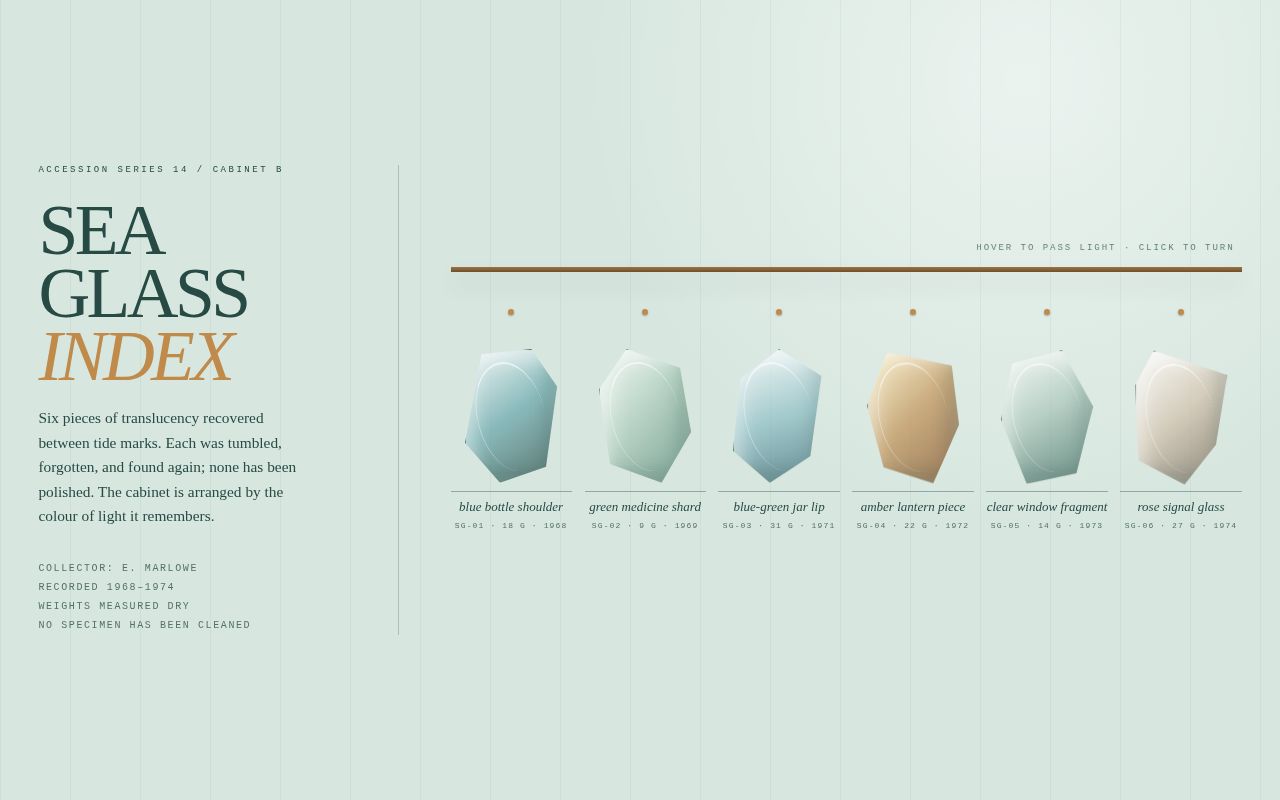
A hushed exhibit of found glass that turns a simple hover into an optical event. The vitrine is spare and typographic; the objects feel handled, chipped and specific, and their labels respond to light.
Open
Original prompt
A museum-style catalog of six pieces of sea glass, each with a precise beach location, year and invented collector’s note. Light background: seafoam #D7E7DF, deep green #274A45 text, amber #C08B4A accents. Avoid generic glass cards: instead build a long wall-mounted museum vitrine with a single horizontal oak shelf and six objects standing freely on it, each pinned by a small brass label beneath. The left third is a quiet title panel with a hairline rule, a tiny accession code and a paragraph in refined Georgia. The right two-thirds is occupied by the shelf. Each specimen is drawn entirely in CSS/SVG: irregular polygon shapes with translucent gradients, frosted highlights, small chips and a soft cast shadow. On hover or focus, the object rotates in 3D by six degrees and a narrow spectral band appears on its label, as if light has passed through it. Clicking a specimen turns it over to show its reverse side and a new collector note. Entrance: shelf line draws from left to right over 900ms; objects arrive one by one with a small bounce from above; labels fade in after them. Typography: Georgia italic for object names, Courier for catalogue numbers, generous letterspacing on headings. Signature moment: hovering the amber specimen throws a longer spectrum than the others and briefly brightens the whole vitrine. Copy: precise invented locations such as “Pebblewick, north beach, after the March gale”, with weights in grams and Mohs-style notes. No external images.
007-sea-glass-index.html
008
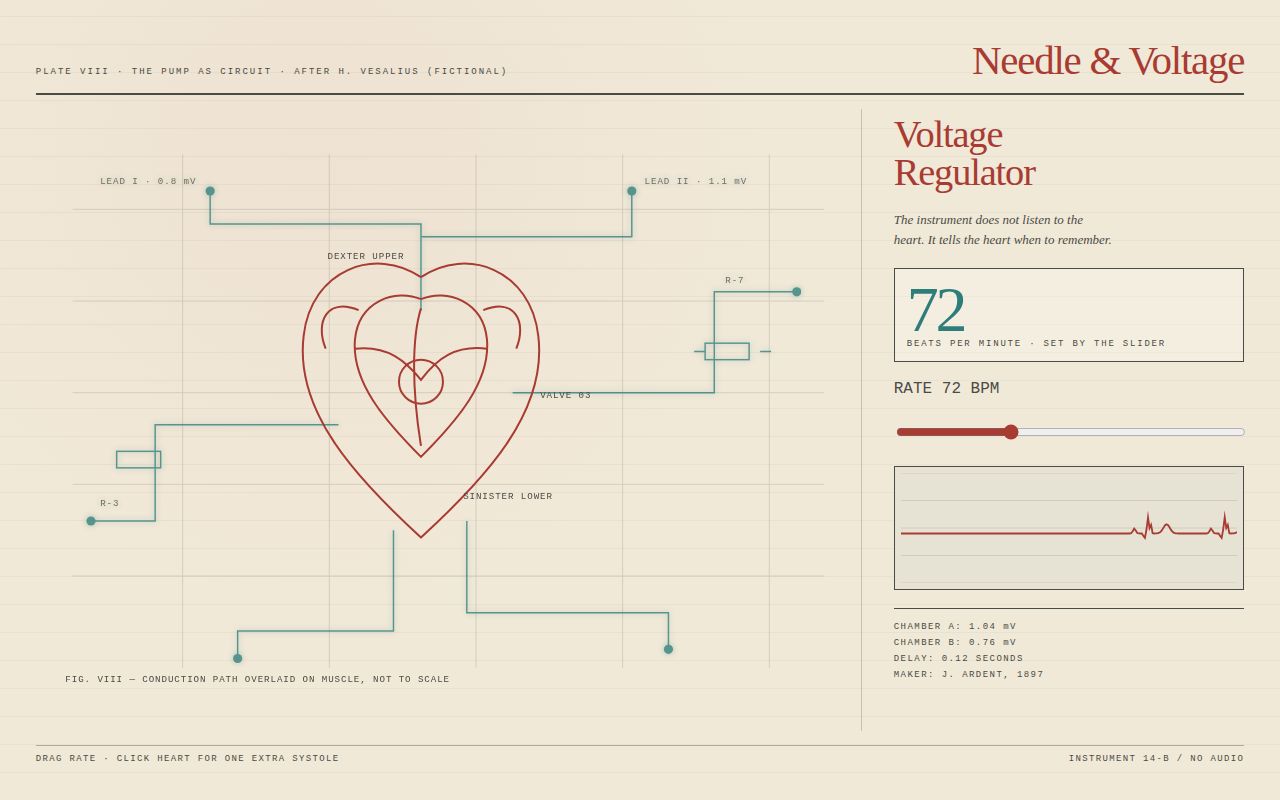
An anatomical plate crossed with a circuit schematic. The viewer sets the rate of a stylised heart and watches electrical charge move through its vascular wiring in precise alternation with each contraction.
Open
Original prompt
A clinical scientific plate imagining the human heart as a wired instrument. Bone paper #F1E9D8 background, oxidised red #A83B32 for anatomy, teal #2E7D7A for electrical traces, graphite labels. Layout: a wide two-column plate with a large SVG heart and vascular system on the left, and a narrow instrument panel on the right. Tiny caption at the top reads “PLATE VIII: THE PUMP AS CIRCUIT, AFTER H. VESALIUS (FICTIONAL)”. The heart is an accurate-looking but stylised line drawing with chambers drawn as nested paths; from it emerge teal circuit traces with small solder nodes and resistor glyphs. A horizontal range slider controls rate from 40 to 140 beats per minute. A visible numeric readout and a small ECG strip update live. Entrance: heart outline draws over 1.4s, circuit traces over 1.1s with a delay, then the first pulse travels through the network. Interaction: dragging the slider changes rate immediately; clicking the heart triggers a single extra systole and a visible surge along one chosen trace. Keyboard slider and heart focus support. Signature moment: heart and circuit pulse in exact alternation—one frame the heart contracts and the traces dim, the next the traces glow while the heart relaxes—creating the impression of an electrical relay. Copy: invented chamber names, voltage values, lead numbers, and a footnote about the instrument’s maker. No sound and no external assets.
008-needle-voltage.html
009
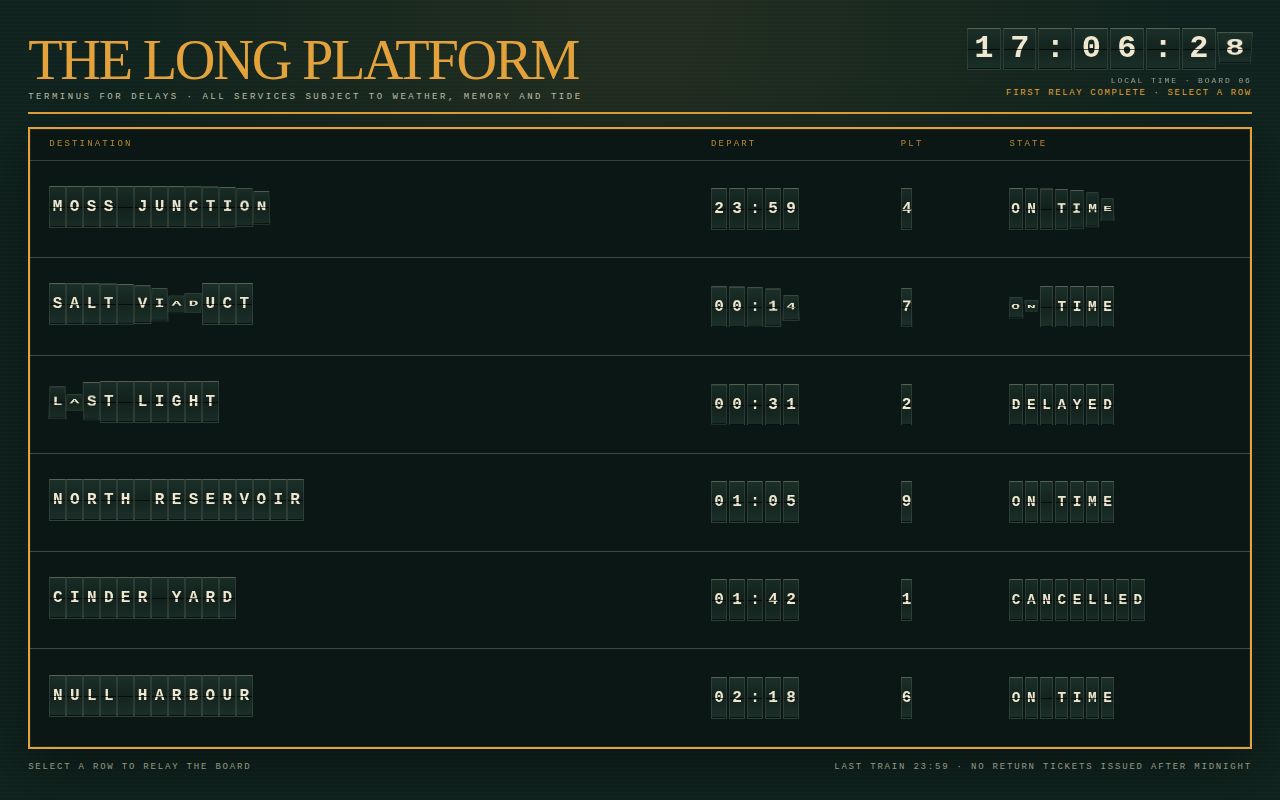
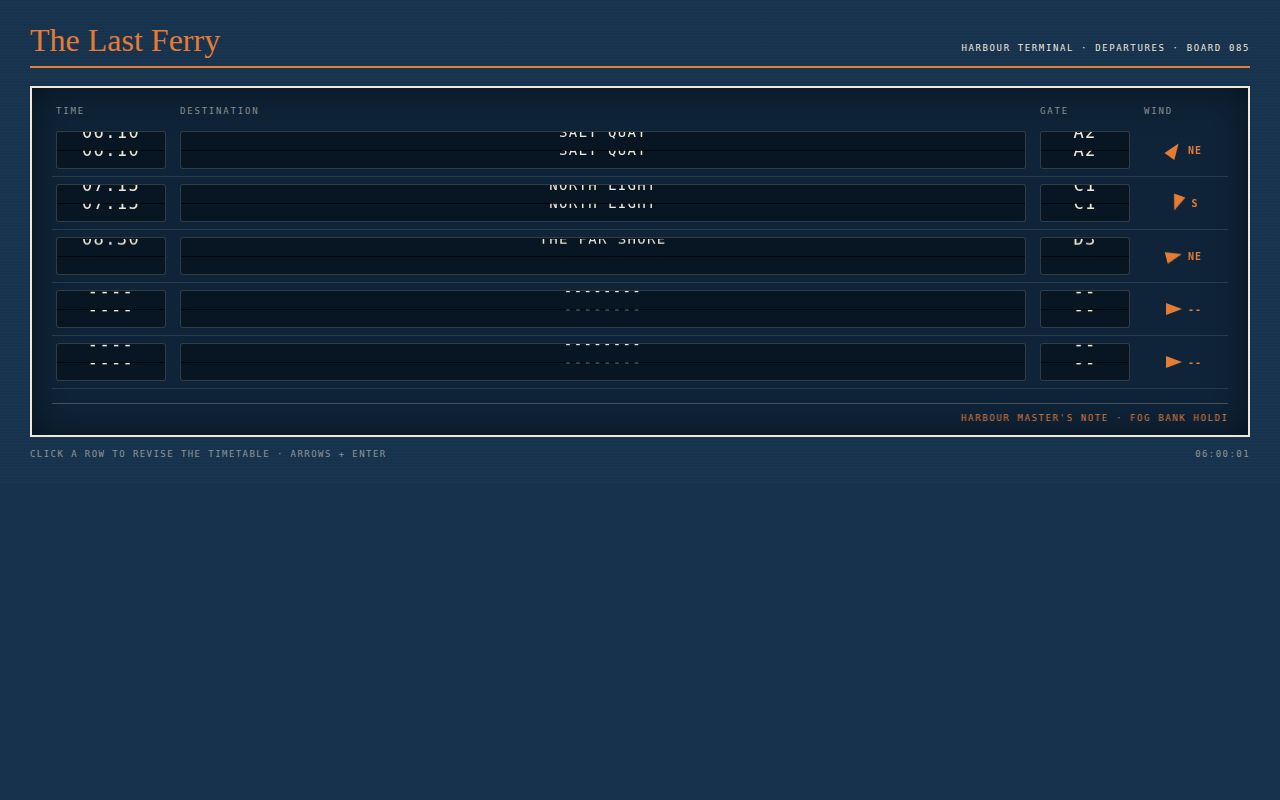
A tactile railway departures display whose entire personality lives in its mechanical cascade. The board is dense, legible and slightly melancholy, like the last announcement in a station that closes at midnight.
Open
Original prompt
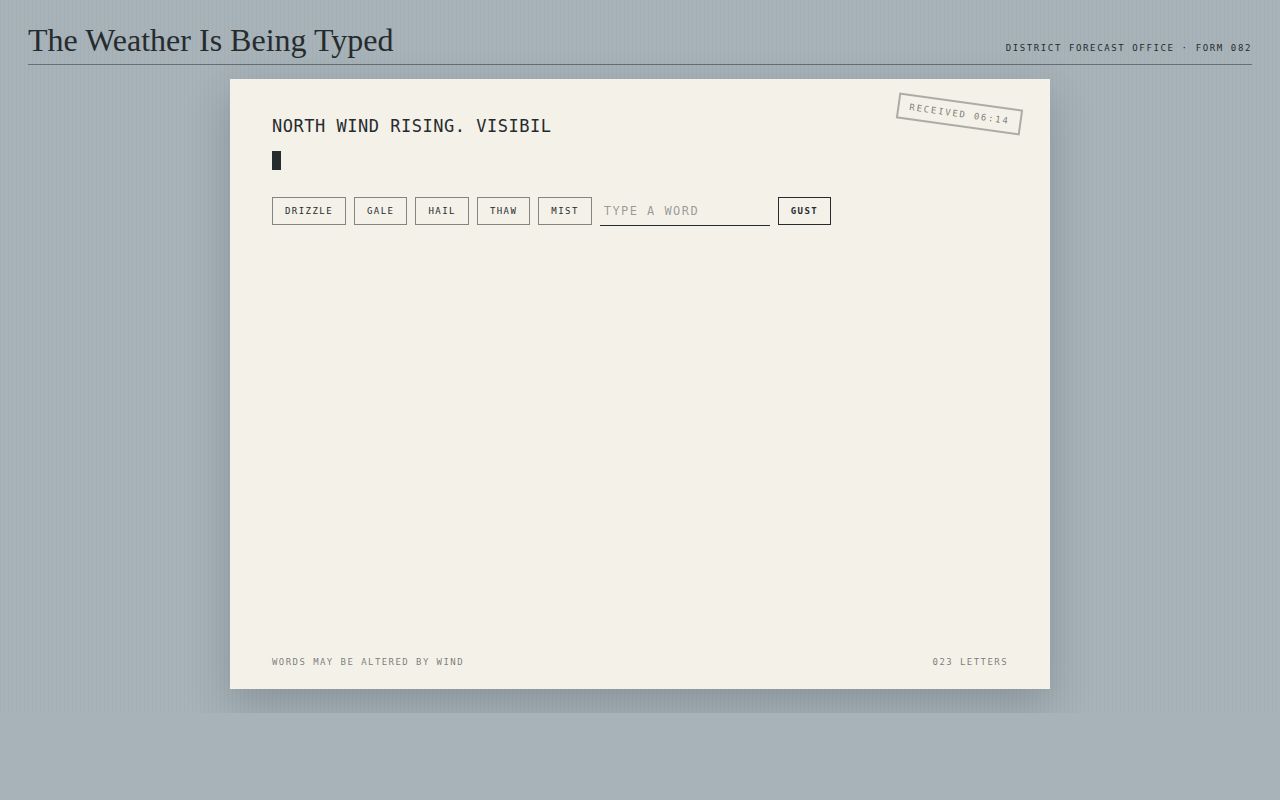
A split-flap departure board for a fictional terminal that serves places which may not exist. Palette: midnight green #10231E, ivory #EFE7CF, amber #E3A23B, with oxblood for cancellations. Full-screen, no scrolling on desktop: a restrained masthead with station name and live clock, then a large mechanical board of six departure rows. Each row has destination (ten characters), scheduled time, platform number and a status word. Every character is its own flap cell with a visible horizontal seam and subtle bevel; the entrance flips every cell from a dash to its final character in a left-to-right, top-to-bottom wave with a custom cubic-bezier and 18ms stagger. Clicking a row advances the whole board to a new set of departures; all cells flip in a cascading wave, a few stuck flaps settle a beat late, and the status column briefly reads “RELAYING”. Hovering a row lights its amber edge and reveals a tiny annotation in the masthead. Keyboard: rows are buttons; Enter or Space changes the board; arrow keys move focus. Typography: Courier throughout, with one enormous Georgia title in the masthead. Copy: invented stations such as MOSS JUNCTION, SALT VIADUCT, LAST LIGHT, with specific times and platform notes. Signature moment: the first cascade on load—the soundless mechanical ripple across 200 flaps ending with the clock cell locking into the current local time. No sound, no external assets, reduced-motion mode shows final state immediately.
009-long-platform.html
010
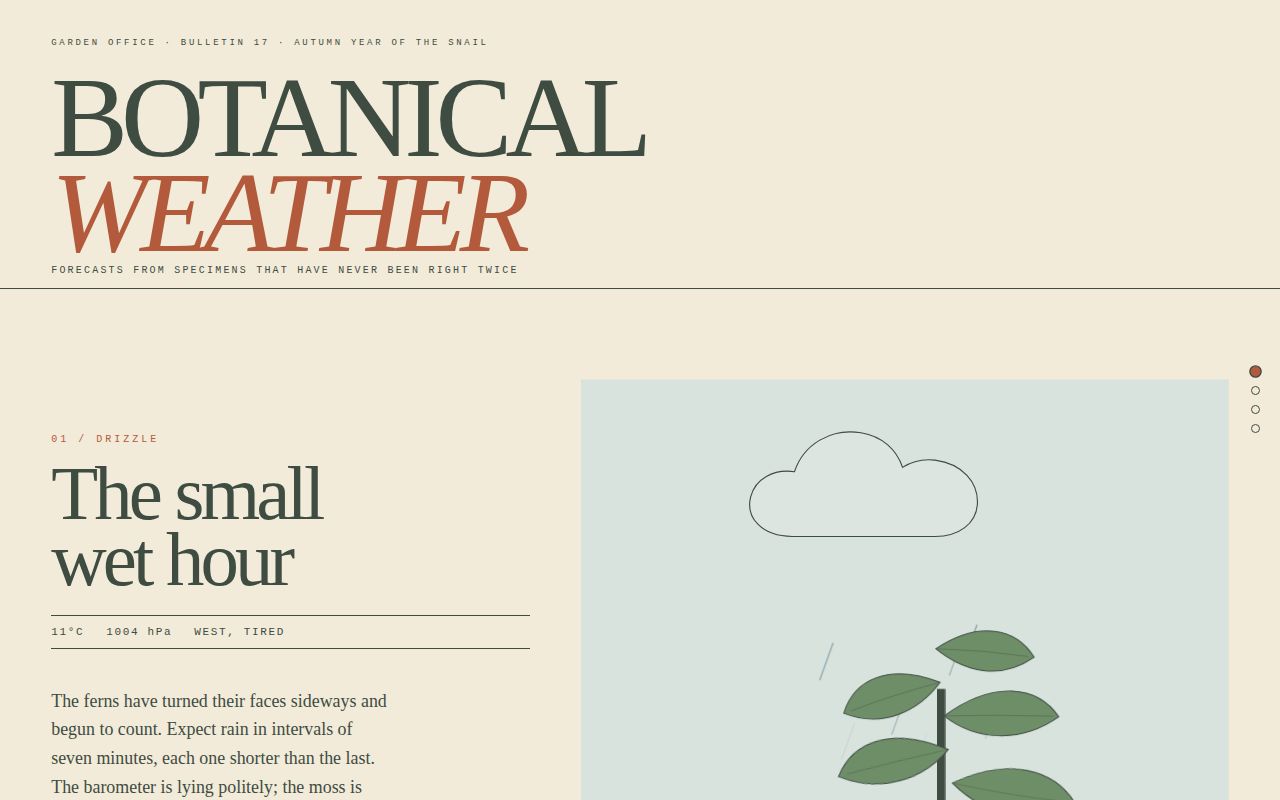
A quiet scroll-driven forecast in which plants, not instruments, report the weather. Each chapter changes the drawing and the mood of the greenhouse, ending with a storm that turns every leaf pale-side up.
Open
Original prompt
An editorial weather report written by a greenhouse full of unreliable plants. Cream #F2EBD9 paper, sage #7C9875 foliage, rust #B45A3C ink accents, pale sky #D8E3DD. Long vertical scroll with a sticky botanical illustration on the right and four short forecast chapters on the left: DRIZZLE, CLEARING, HEAT, STORM. At the top, a slim masthead sets a small issue number and a monumental Georgia title “BOTANICAL WEATHER”. Each chapter contains a temperature, a barometric reading, and two sentences in the voice of a gardener who trusts the plants over the instrument. The illustration is a large inline SVG of a potted plant with six leaves, a soil line and a cloud above it. As each chapter enters view, the weather state changes: leaves unfold or curl, the cloud fills and rains, the sky warms, and a storm bends the stem. Rain is made of short SVG strokes animated downward with staggered delays, not a generic particle field. Signature moment: in the STORM chapter the cloud visibly squeezes sideways, releasing a single diagonal sheet of rain while every leaf turns its pale underside upward at once. Motion uses custom cubic-bezier curves and no default scroll reveal. Interaction: scroll naturally, or use four small chapter marks on the right to jump; hover a leaf to read its invented common name and its weather opinion. Typography: Georgia for display and forecast prose, Courier for instrument readings. Reduced motion shows the final botanical state with all labels visible.
010-botanical-weather.html
011
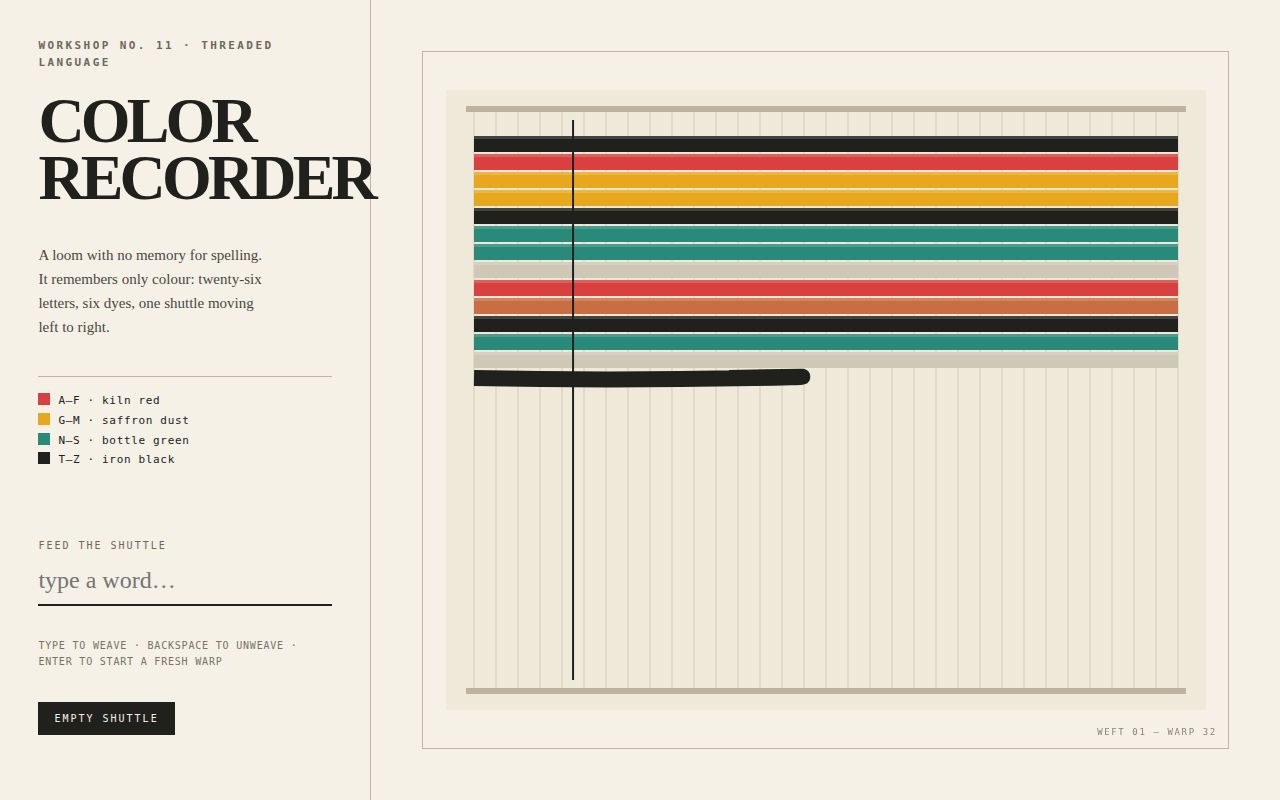
A calm generative tool that makes the act of typing physical. Words become woven bands of colour, with the loom’s warp subtly reacting to every thread.
Open
Original prompt
A tool that treats typing as weaving. Off-white #F5F1E6 ground with a restrained prism palette: red #D94141, ochre #E7A81D, teal #2A8A7A, ink #20201D. Layout: a tall loom frame occupies the centre and right, with a narrow left column carrying the title “COLOR RECORDER” in tight Georgia capitals, a short explanation of the invented colour alphabet, and a single refined text input. Every character typed adds a horizontal weft row to the canvas loom: each letter maps to a hue by a fixed alphabet table, each space to a pale gap, punctuation to thin black slubs. Rows appear with a quick thread-drawing motion from left to right, not a generic fade. Above the loom, a live strip shows the last typed word split into coloured character blocks. Entrance: the loom warp threads draw first, then a demonstration phrase threads itself across twelve rows. Interaction: type into the input; Backspace removes the last row; a small “EMPTY SHUTTLE” control clears the canvas. Signature moment: holding a key threads a continuous band of colour while the warp threads visibly deflect under the shuttle. Copy: explain the mapping with specific letter groups and invented names such as “A–F: kiln red”. Keyboard focus visible; touch users get an on-screen text field. Reduced motion draws rows instantly. No sound.
011-color-recorder.html
012
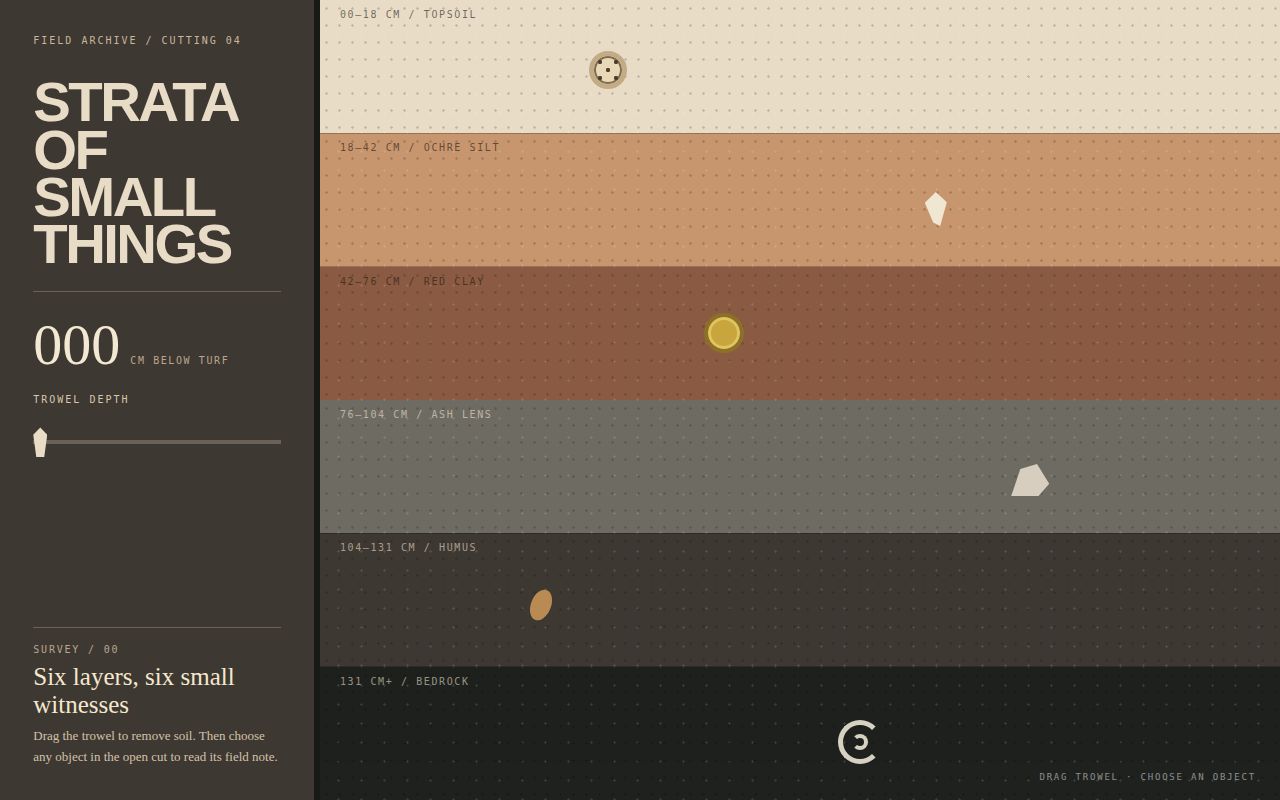
An archaeological cross-section that responds to excavation depth. Dragging a single slider peels back layers of soil and lets visitors interrogate the objects found in each.
Open
Original prompt
A single vertical excavation cut fills the screen: six broad soil layers in exact earth colours — pale sand #E8DCC6, ochre #C7956F, red clay #8A5B43, grey ash #6E6B63, dark humus #3E3833, bedrock #1E211E. A narrow left sidebar in the same dark humus carries the title “STRATA OF SMALL THINGS” in tall condensed sans-serif capitals, a depth scale, and a range slider labelled TROWEL DEPTH. The main face of the cut is dense and tactile: grit drawn with radial-gradient speckles, tiny roots, one artifact embedded per layer (a button, a tooth, a coin, a shard, a seed, a fossil). Hovering or focusing an artifact updates the sidebar with a specific museum label, depth and one-sentence field note. Entrance: the cut rises from the bottom edge as if a core sample were being pushed up, each layer arriving at a slightly different speed. Interaction: drag the trowel-depth slider; soil above the selected depth becomes translucent and recedes, exposing deeper artifacts. Signature moment: at maximum depth all six layers separate by a few pixels, revealing a black void between them and the small objects suspended inside it. Copy: field notes should be concrete — “bone button, four holes, one chipped”, “found with a grain of wheat still in the thread”. No map pins, no emoji, no generic cards. Reduced motion skips the rise.
012-strata-of-small-things.html
013
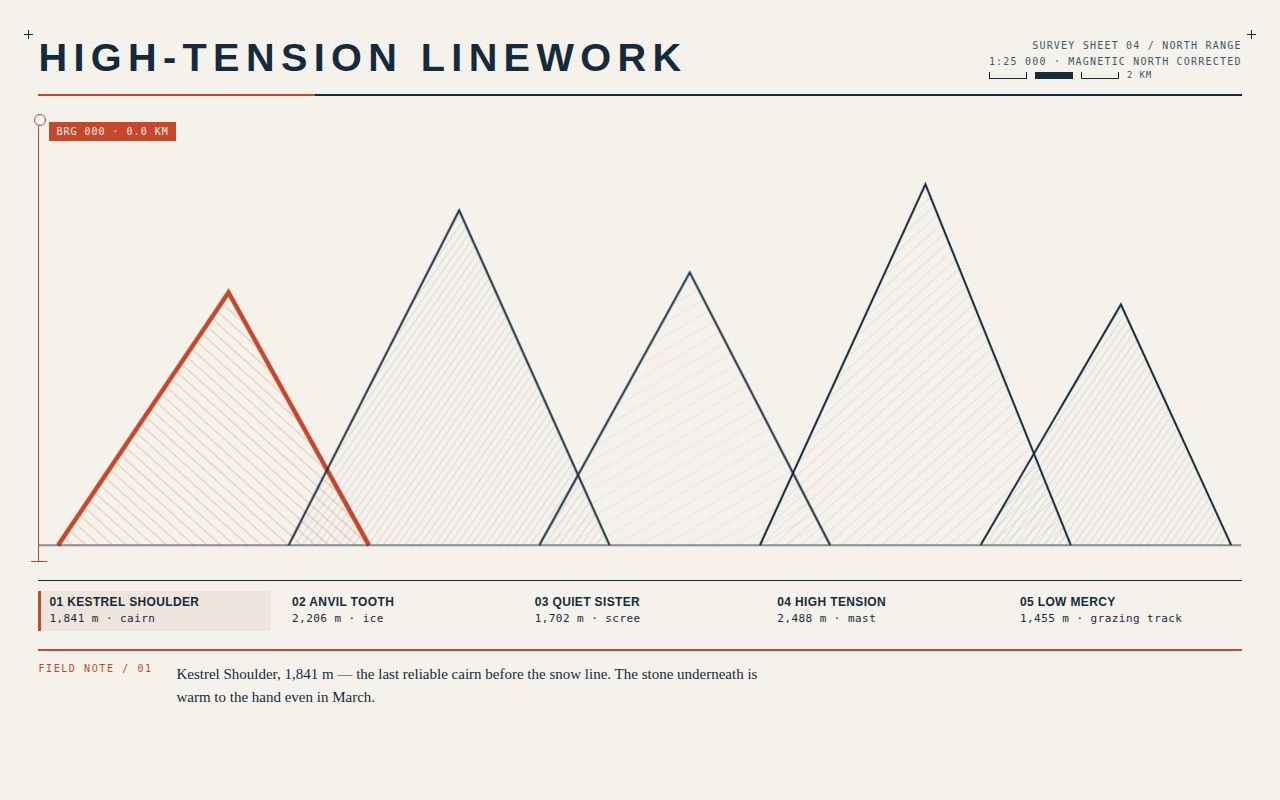
An interactive survey panorama in the language of old cartography. Pointer movement becomes a bearing measurement; peaks respond with changes to their drawn texture and supply precise, invented field notes.
Open
Original prompt
A wide panoramic survey drawing, not a landscape photo. Ground is warm white #F4F2EB; ink is deep navy #142B3D with a single signal red #C7472B. Five overlapping mountain outlines occupy the middle of the page in flat vector shapes, each drawn with a different density of hatch marks (CSS repeating-linear-gradient or inline SVG patterns). At the top: small registration crosses, a scale bar, and the title “HIGH-TENSION LINEWORK” in spaced sans-serif capitals across one line. Beneath the ridges: five numbered peaks with exact invented names, elevations and one-sentence descriptions. Moving the pointer across the panorama moves a surveyor's vertical crosshair and updates a live readout of bearing and distance; the nearest peak's outline thickens and its hatch direction flips. Clicking a peak locks the readout and opens a short note at the bottom in a red-ruled margin. Signature moment: on load, the ridges draw themselves left to right with a single continuous pen stroke, then the hatch fills appear behind them. Copy must read like a field survey: “Kestrel Shoulder, 1,841 m — the last reliable cairn before the snow line”. No gradients on text, no cards, no icon fonts. Reduced motion shows the finished drawing.
013-high-tension-linework.html
014
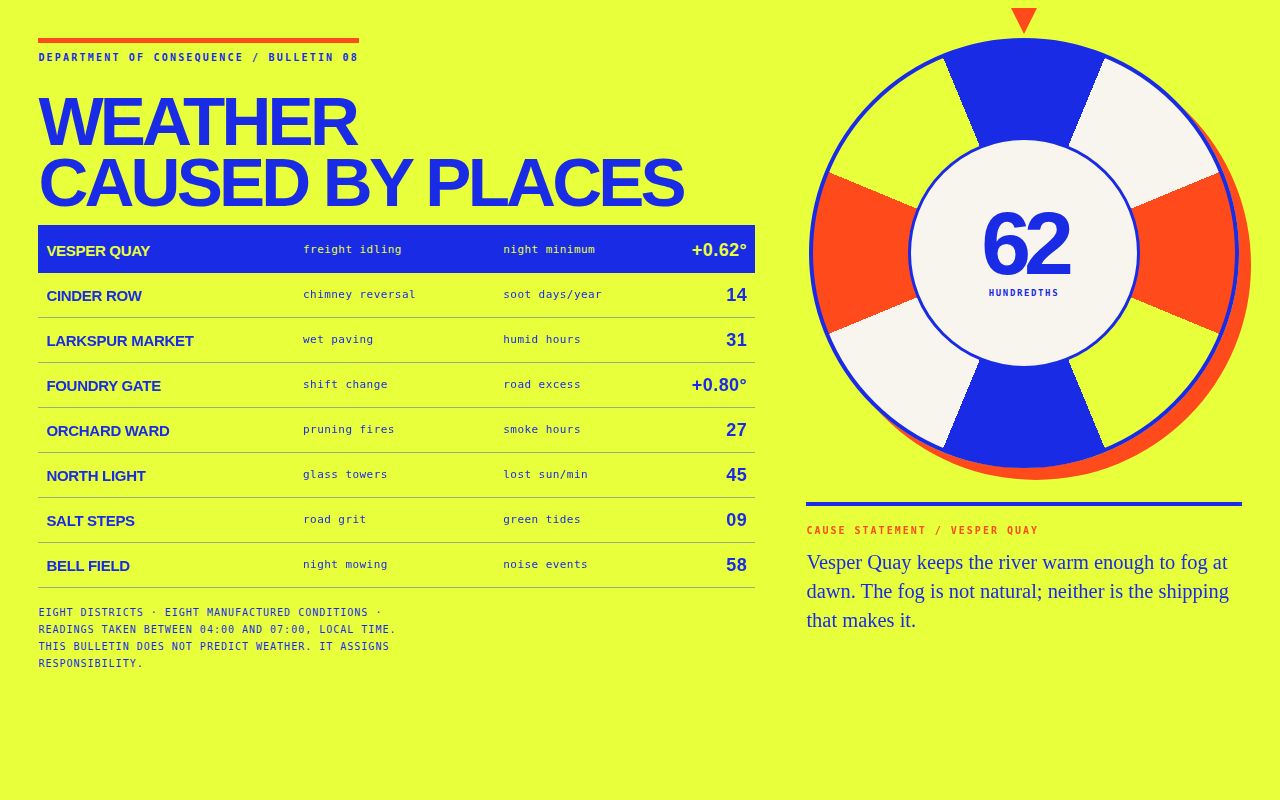
An inverted meteorological bulletin. selecting a district turns a mechanical cause-wheel and reveals the specific weather that district produces, measured in unusual but precise units.
Open
Original prompt
A data poster with the logic inverted: instead of forecast for a city, it reports the weather a city is making. Palette: borax yellow #E8FF3B, electric cobalt #1A2BE6, vermilion #FF4A1C and paper white #F7F5EE — flat, no gradients. At the top left, a heavy sans-serif headline “WEATHER CAUSED BY PLACES” in two lines with a small vermilion rule. Below, a dense list of eight invented city districts, each row showing a place name, a cause, a measured effect and a number with units. The selected row inverts to cobalt with white type. On the right, a large circular cause-wheel made from a conic-gradient with eight hard-edged segments; a vermilion pointer rotates to the selected segment. In the centre of the wheel, a huge two-digit number: the local excess in hundredths of a degree. Entrance: the list rows slide in from alternating sides with a mechanical snap; the wheel draws clockwise one segment at a time. Interaction: click or keyboard-focus a row. On selection the pointer sweeps with a damped overshoot, the centre number counts up from zero, and a short cause-statement appears beneath the wheel in a single sentence. Signature moment: the wheel's outer tick ring rotates half a segment while the inner ring stays still, like a mechanical instrument engaging. Content examples: “Vesper Quay — freight idling — +0.62°C night minimum”; “Cinder Row — chimney reversal — 14 soot days/year”. No weather icons, no emoji, no glass panels. Reduced motion sets values instantly.
014-reverse-weather.html
015
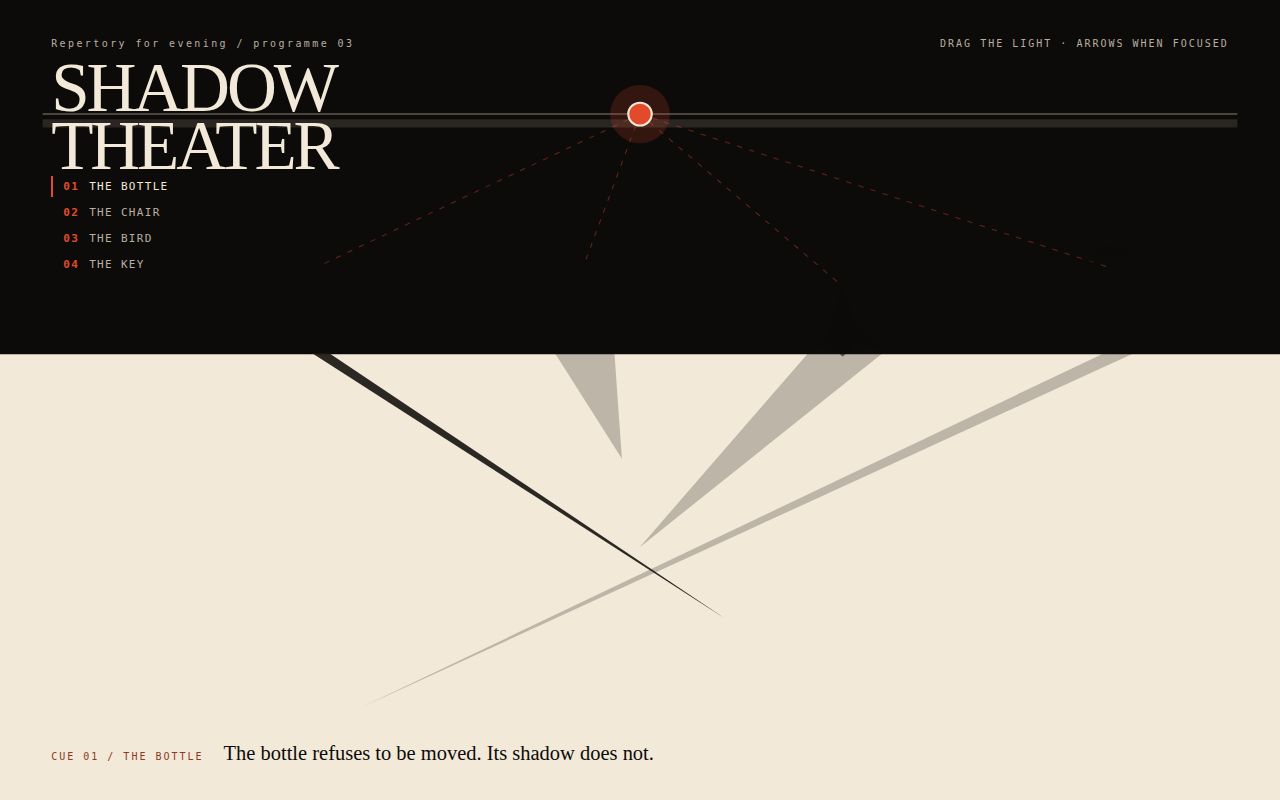
An interactive shadow play in which unseen objects are known only by the shapes they throw. Moving the light makes the scene legible in a completely physical way.
Open
Original prompt
A black box theatre rendered as a single SVG stage. The top two-thirds are near-black #0D0B0A, the bottom is a pale lime-washed floor #F2E9D8 with a hard horizon line. Four small objects sit just above that line — a bottle, a chair, a bird, a key — drawn as flat black silhouettes, but each casts an enormous triangular shadow across the floor from a red light #E24A2B hanging above. Title “SHADOW THEATER” in tall serif capitals at upper left, with a small cast list beneath. A red draggable light handle sits on a horizontal rail near the ceiling. Dragging it left and right recomputes all four shadow polygons in real time: shadows shrink when the light is overhead and stretch, cross and overlap when it moves to an edge. Entrance: the light drops into place, the shadows snap long, then settle with a subtle elastic overshoot. Clicking an object or a cast-list row highlights it, dims the others, and shows a one-line stage direction in a lower margin (“The bottle refuses to be moved. Its shadow does not.”). Signature moment: when the light crosses an object's exact x-position, that object's shadow briefly inverts direction and reveals a thin red seam at its base. No gradients on type, no glass, no emoji. Reduced motion sets the light at centre without animation.
015-shadow-theater.html
016
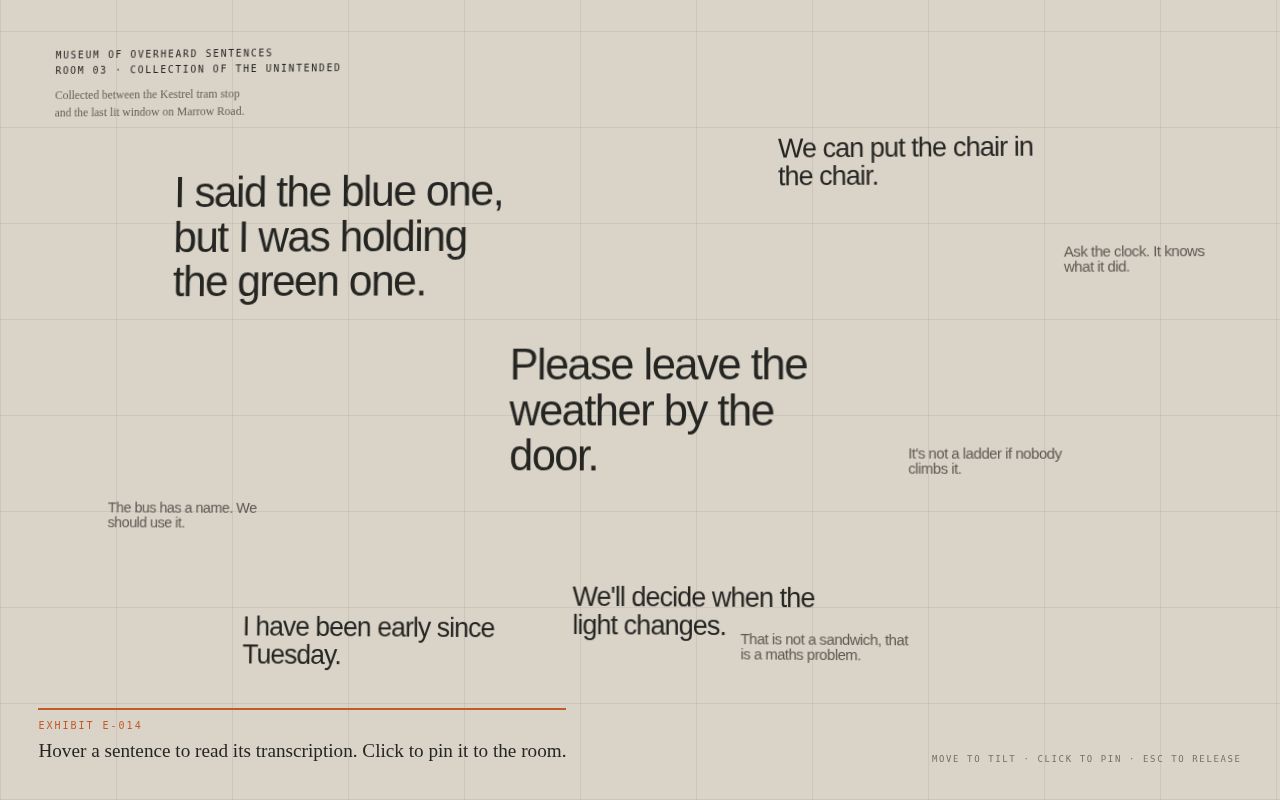
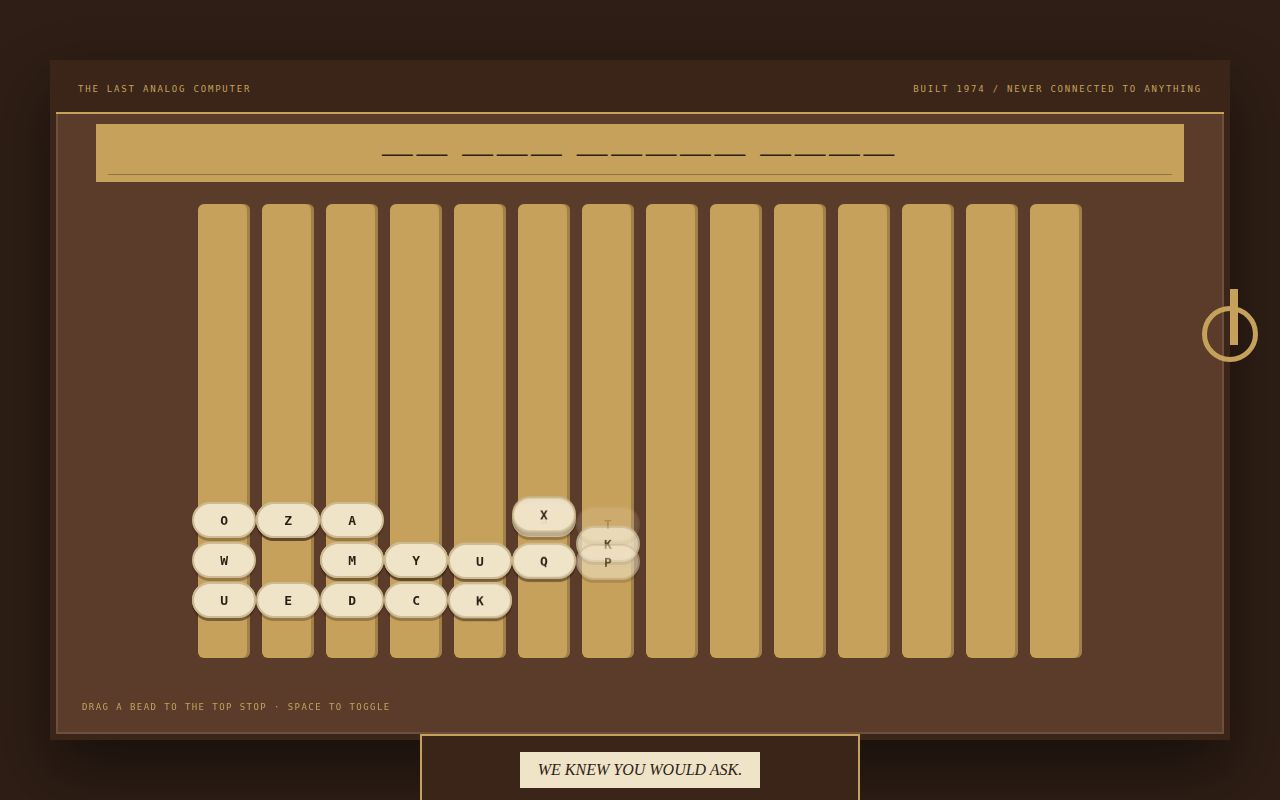
A typographic exhibition of accidental poetry. The room responds to attention: looking closer changes the perspective, and pinning a sentence makes it the centrepiece.
Open
Original prompt
An exhibition room built entirely in type. Background #D9D3C8 warm stone; walls marked with faint acoustic-panel grid lines. Nine sentences, each overheard in an invented public place, are mounted at different sizes and depths on a single perspectival wall: some enormous and close, some tiny and far. Palette is stone, charcoal #252522 and one burnt-orange #C45A2A access colour. The title “MUSEUM OF OVERHEARD SENTENCES” sits small at upper left like a gallery label; beneath it, a room number and a note that all quotes were collected between two named tram stops. Each sentence is a button with its own transcription details hidden until hover or focus: location, time, and whether the speaker was certain. Entrance: the room assembles from depth — far quotes resolve first, nearest last — with a slight vertical settle, like a gallery installing itself overnight. Interaction: moving the pointer tilts the whole wall by a few degrees in 3D via perspective transform; the closest quote under the pointer becomes burnt orange and its transcription appears in a fixed lower-left label. Clicking pins a quote: the room stops tilting, a soft echo ring expands once from that sentence, and the pinned text is set in a new, larger scale. Signature moment: the echo ring is drawn as three staggered outlines with decreasing opacity, not a generic ripple. Copy examples: “I said the blue one, but I was holding the green one.” · “We can put the chair in the chair.” · “It's not a ladder if nobody climbs it.” No emoji, no cards, no image placeholders. Reduced motion shows all quotes at rest without tilt.
016-museum-of-overheard-sentences.html
017
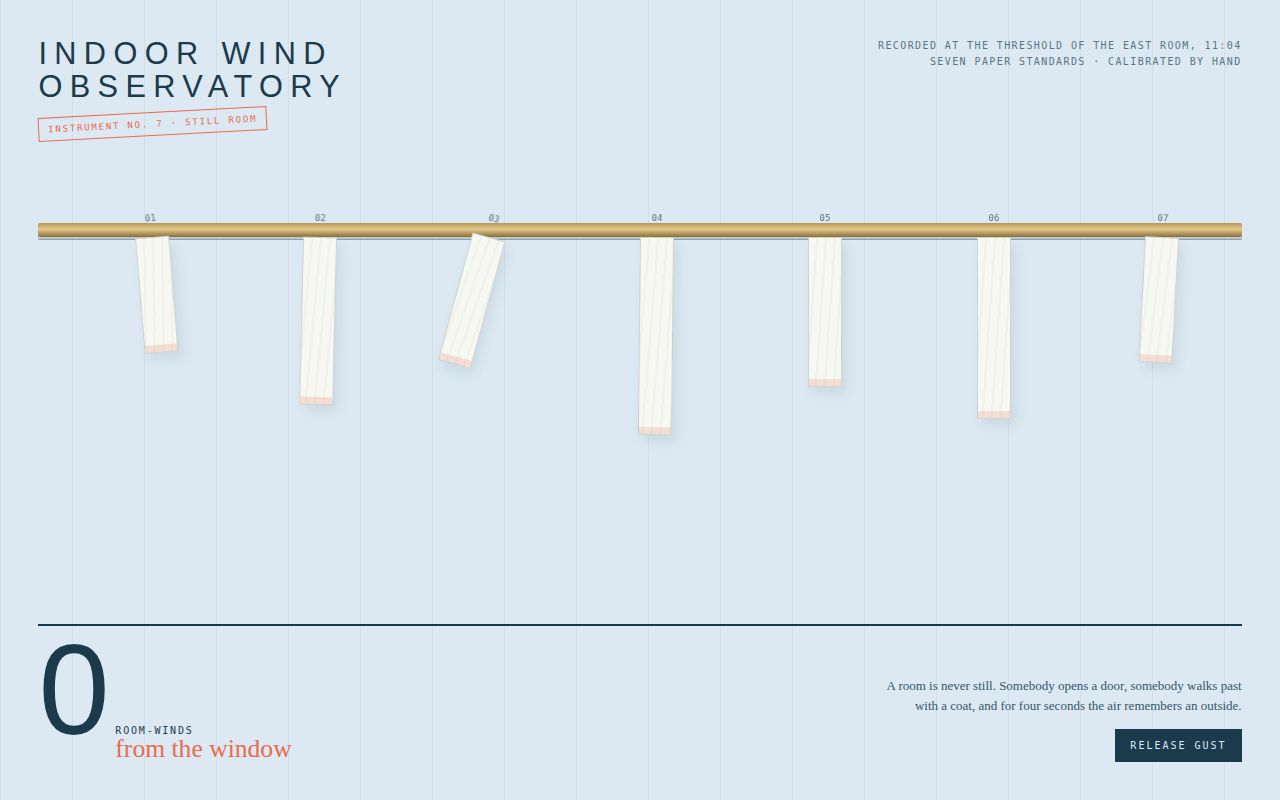
A physical-feeling spring simulation disguised as an instrument. Cursor motion becomes wind across a row of hanging paper strips, each with its own mass and damping.
Open
Original prompt
A calm instrument panel for wind that exists only because people move through rooms. Palette: powder-blue #DCE9F2 ground, deep petrol #1B3A4B type, one coral #E86B4C for moving air. A horizontal row of seven paper strips hangs from a brass rail near the top of the page, each a different length and width. Title “INDOOR WIND OBSERVATORY” in a narrow, widely spaced sans-serif at upper left, with a small subheading: “Recorded at the threshold of the east room, 11:04.” Moving the pointer creates a gust: nearby strips swing away with a spring-like delay, then overshoot and settle when the pointer stops. A live readout at lower left shows a value in “room-winds” from 0 to 9 and a one-word direction (“toward the kettle”, “from the door”). Clicking anywhere releases a short, sharper gust from that point; a thin coral arc briefly traces its path. Entrance: strips hang at rest, then a single unseen draft lifts the shortest one first and travels along the row. Signature moment: the strips settle independently at different rates, so the row continues moving after the pointer is still. No weather icons, no emoji, no glass. Reduced motion keeps strips vertical and updates the readout without swing.
017-indoor-wind-observatory.html
018
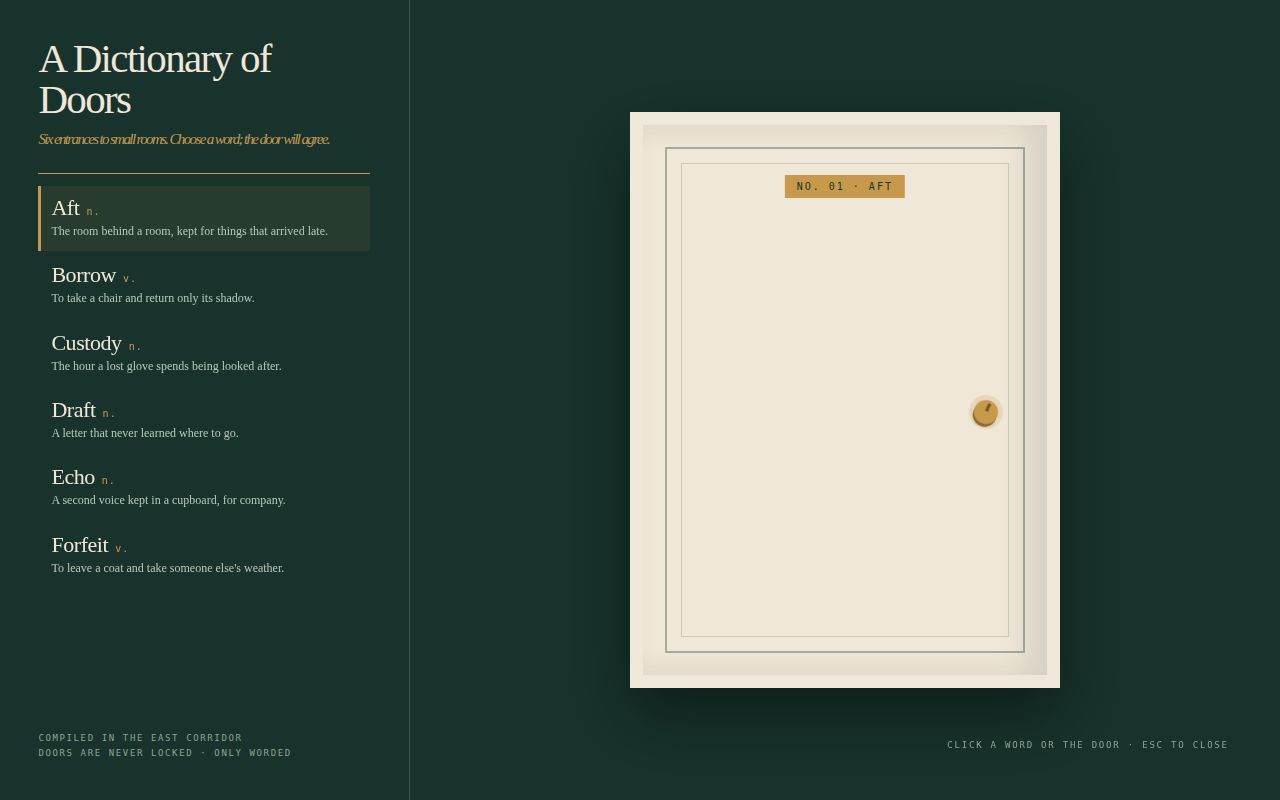
A lexicon of rooms reached through doors. Each definition is literal: selecting a word opens its door and reveals the small, strange interior that word names.
Open
Original prompt
A typographic dictionary where every entry is a physical door. Palette: deep forest #17332B ground, bone #EFE7D8 panels, brass #C79A4B fittings, one oxblood #A63B2C for “occupied”. Left third: a strict alphabetical index of six entries — Aft, Borrow, Custody, Draft, Echo, Forfeit — each with part of speech and a very short definition. Right two thirds: a large door drawn in CSS 3D, closed at first, with a brass knob and a small number plate. Clicking an entry or the door swings the leaf open on its left hinge with a damped overshoot; beyond it is a differently coloured small room containing one object and one sentence of invented story. A trapezoid of light spills from the doorway onto the floor, widening as the door opens. Entrance: the six index lines type in quickly, then the door handle turns once by itself. Signature moment: when the door opens, the sentence inside is revealed in two stages — first the noun, then the rest — as if the room were remembering. Copy examples: “Aft, n. The room behind a room, kept for things that arrived late.” · “Forfeit, v. To leave a coat and take someone else's weather.” No emoji, no cards, no gradients on type. Reduced motion opens the door without overshoot and shows the full sentence at once.
018-dictionary-of-doors.html
019
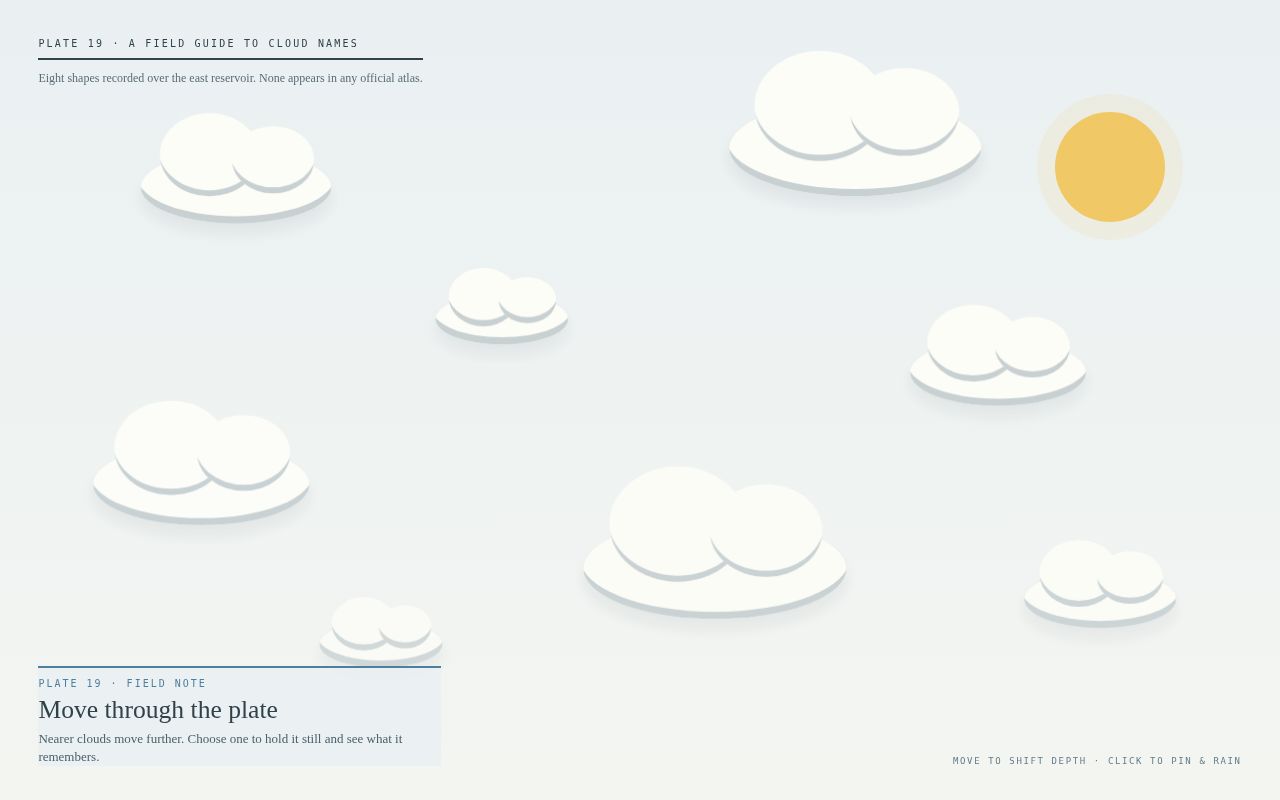
A quiet identification guide to clouds that do not exist. Depth, naming and weather are all invented, but the field notes are exact enough to feel observed.
Open
Original prompt
A pale sky #EAF0F2 with a low sun disc #F2C14E, drawn as a field plate rather than a weather app. Eight hand-shaped clouds drift at different depths across the viewport; each is built from CSS circles with a soft grey underside #C8D0D2 and a warm white top #FDFDF8. Title “A FIELD GUIDE TO CLOUD NAMES” in small spaced capitals at upper left, with a rule and a plate number. Each cloud has an invented name that appears only when the cloud is near the pointer: Late Margery, The Cartographer's Mistake, Nine Small Debts, A Chair for Rain, The Quiet Argument, Second Breakfast, Low Complaint, Almost a Letter. Moving the pointer shifts nearer clouds more than distant ones, creating parallax. Hovering or focusing a cloud updates a lower-left field note with its name, altitude, shape description and one precise sentence of behaviour. Clicking pins that cloud: the others fade, and a short fall of tiny typographic commas drops from the pinned cloud — punctuation as rain. Entrance: clouds enter from the right at staggered intervals with slightly different easing. No emoji, no sun rays, no photo realism. Reduced motion stops drift and rain but keeps all information available.
019-field-guide-to-cloud-names.html
020
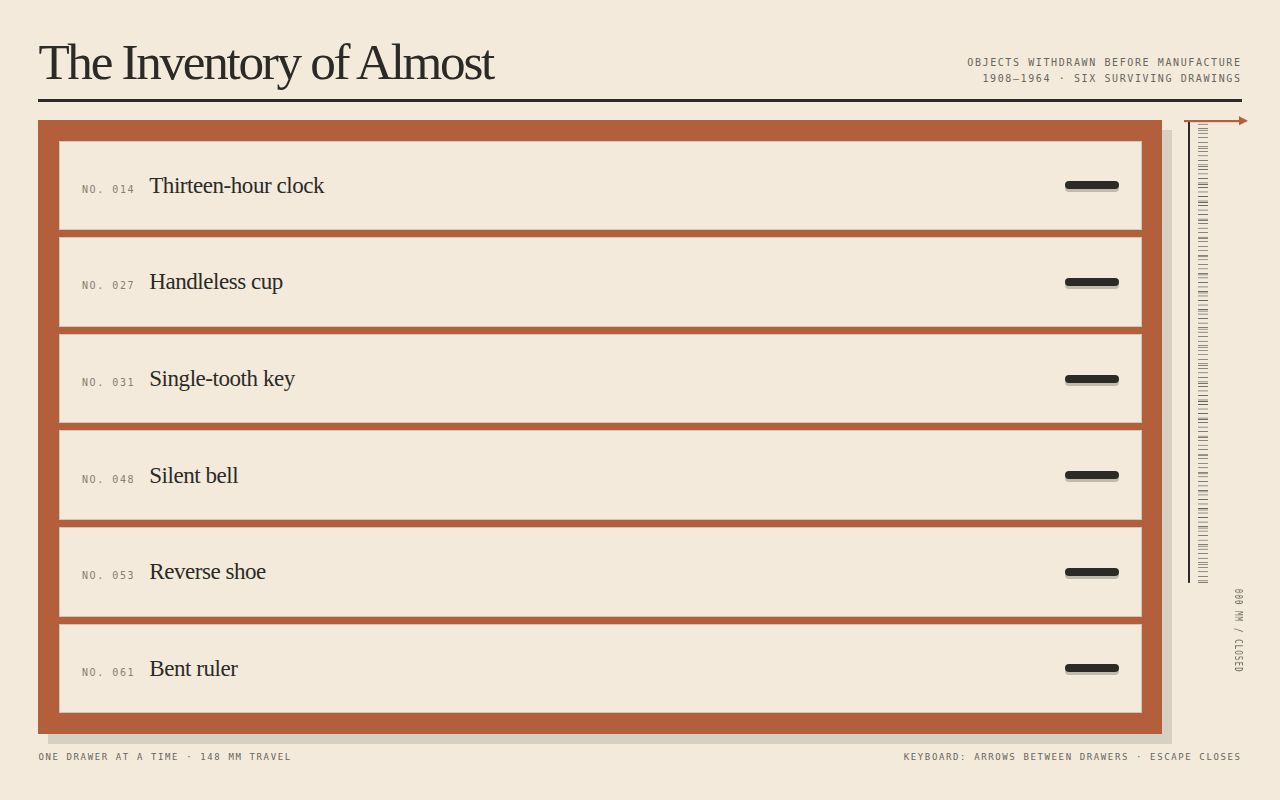
A cabinet of rejected inventions. Each drawer contains one object that almost existed and the precise, unromantic reason it was withdrawn.
Open
Original prompt
A flat, frontal filing cabinet occupying the whole page, drawn without perspective. Palette: terracotta #B45F3C cabinet, sage #7C8F7B recesses, cream #F3EADC drawer fronts, ink #2B2A26 type. Six shallow drawers are stacked vertically, each labelled with a handwritten-style serif name and a small inventory number. The title “THE INVENTORY OF ALMOST” sits in the top margin with a subtitle: “Objects withdrawn before manufacture, 1908–1964.” Each drawer face is a button. Opening one slides the cream panel to the right by 58% with a dry mechanical trajectory, revealing a sage recess containing a simple drawn object (a clock with thirteen marks, a cup with no handle, a key with one tooth, etc.) and one sentence explaining why it was not made. Only one drawer is open at a time. A thin ruler printed beside the cabinet shows the opening distance in millimetres and updates as the drawer moves. Entrance: drawers settle into place from top to bottom with tiny differences in overshoot; the ruler draws itself last. Signature moment: when a drawer passes 40 mm, a faint dust line appears along its lower edge and the object is revealed in two drawn strokes. No emoji, no cards, no gradients on text. Reduced motion opens instantly.
020-inventory-of-almost.html
021
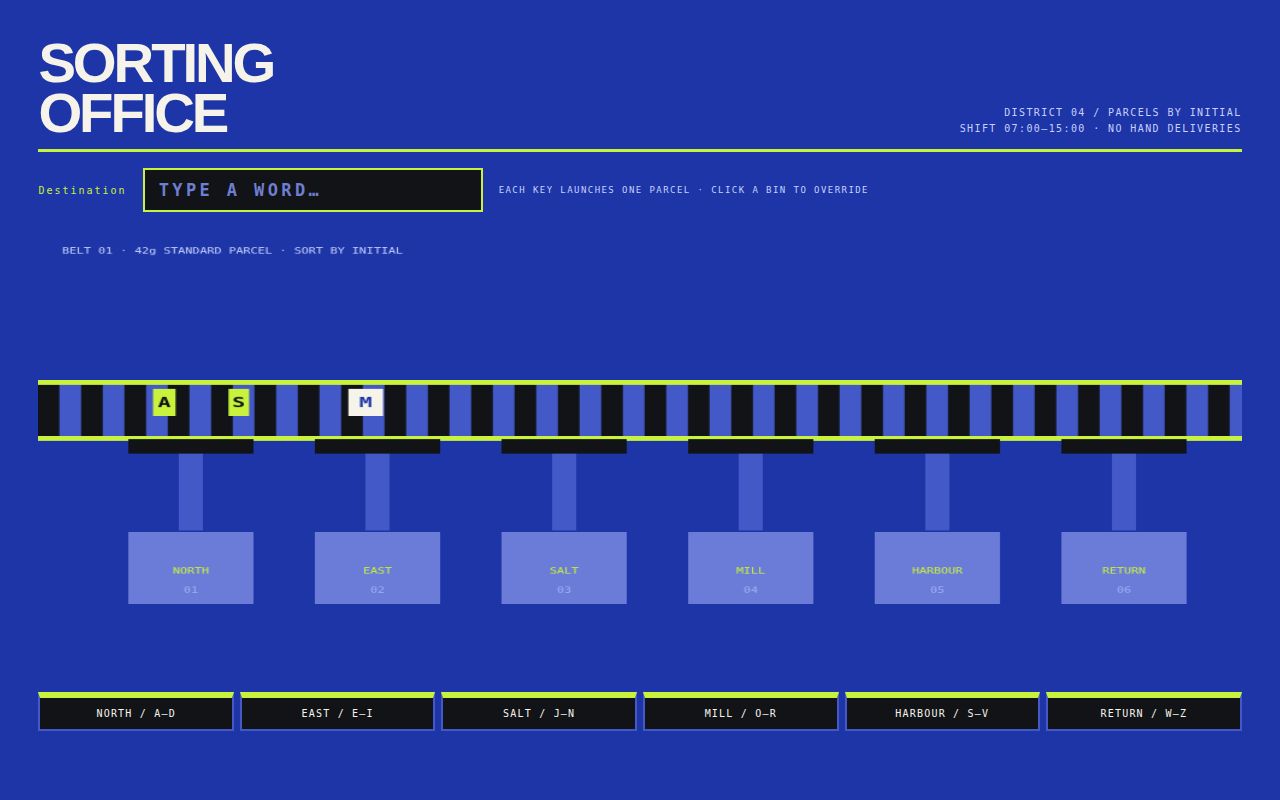
A small postal simulation where language becomes physical routing. Typing produces parcels; the sorting office decides where each one goes with satisfying mechanical certainty.
Open
Original prompt
A kinetic sorting floor in flat ultramarine #1D35A6, acid green #C8F23B and near-black #111317. No soft shadows, no glass: everything is a hard-edged graphic shape. At the top, a single input labelled “DESTINATION” accepts one word. Below, a conveyor belt carries parcels left to right; each parcel is a small acid-green square with a white letter. When a word is typed, a parcel is stamped with its first letter, travels along the belt, then drops from the correct chute into one of six labelled bins arranged along the bottom: NORTH, EAST, SALT, MILL, HARBOUR, RETURN. The chute flashes once and the parcel lands with a small mechanical bounce. Entrance: six empty bins snap into alignment and the belt starts moving before any input is given; three demo parcels with letters A, M and S are already in transit. Interaction: type any word; each keystroke launches one parcel; clicking a bin manually reroutes the next parcel to that bin. Signature moment: the parcel flips end-over-end as it leaves the belt, showing its address on both faces. Copy is specific and bureaucratic: “UNDELIVERABLE / RETURN TO SENDER / 42g”. Reduced motion moves parcels instantly to their bins.
021-ultramarine-sorting-office.html
022
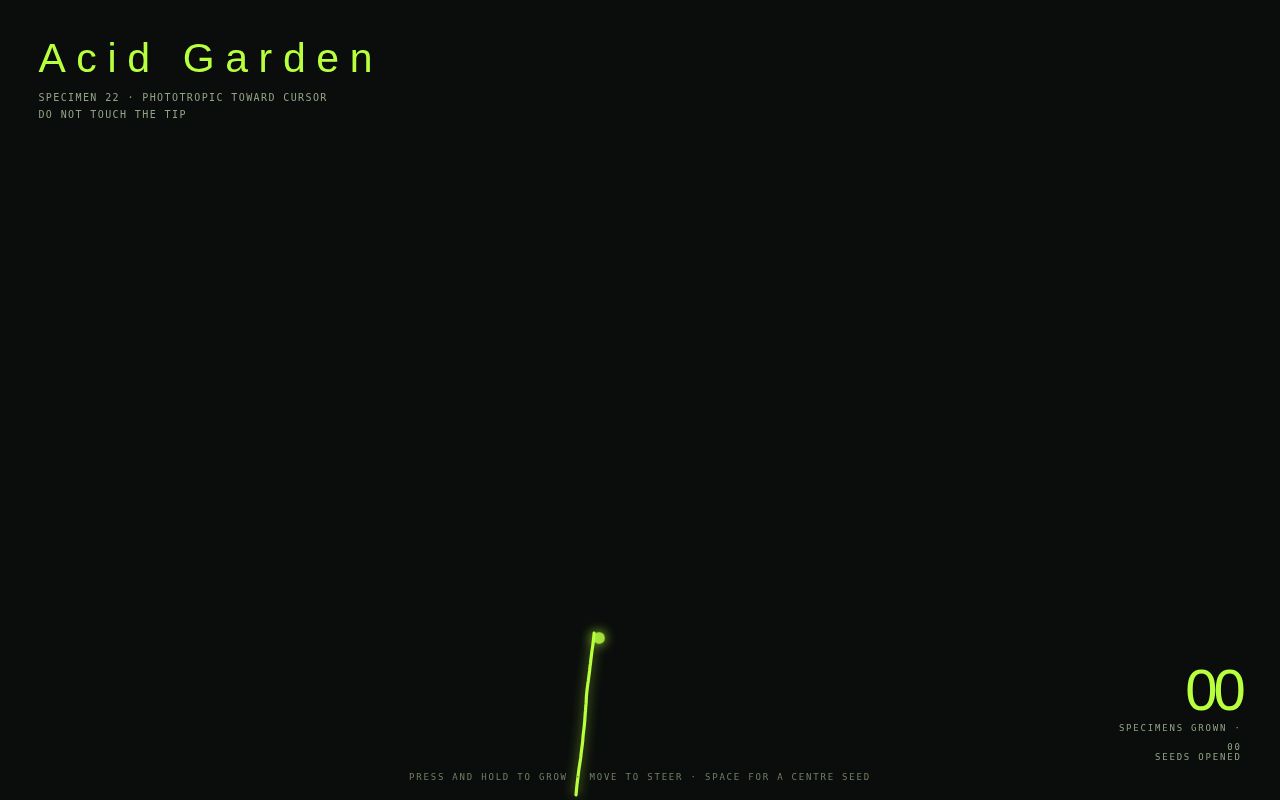
A generative garden in which attention is light. Holding the pointer grows a vine that bends toward it; the accumulated drawing becomes a record of where the visitor looked.
Open
Original prompt
A near-black field #0A0D0B with one luminous acid-green line #B8FF3D. The title “ACID GARDEN” sits small at upper left; beneath it, a legend: “Specimen 22 · phototropic toward cursor · do not touch the tip”. The whole rest of the page is an SVG growing surface. Press and hold anywhere: a vine starts from the bottom edge below the pointer and grows toward it, segment by segment, with a slight wandering bias and occasional side branches. Moving the pointer while holding makes the vine change course with a visible delay, like a plant deciding. Releasing stops growth; when a tip reaches the pointer it opens into five small luminous seeds and freezes. Older vines dim to a darker green but remain on the page, so repeated interactions compose a dense drawing. Entrance: one pre-grown vine rises by itself on load, drawing from bottom to top over two seconds. Signature moment: every active tip carries a bright node that pulses; when five vines are active at once the nodes briefly synchronize. Copy: a small readout at lower right counts specimens grown and seeds opened. No emoji, no cards, no gradients. Reduced motion draws complete vines on click without animation.
022-acid-garden.html
023
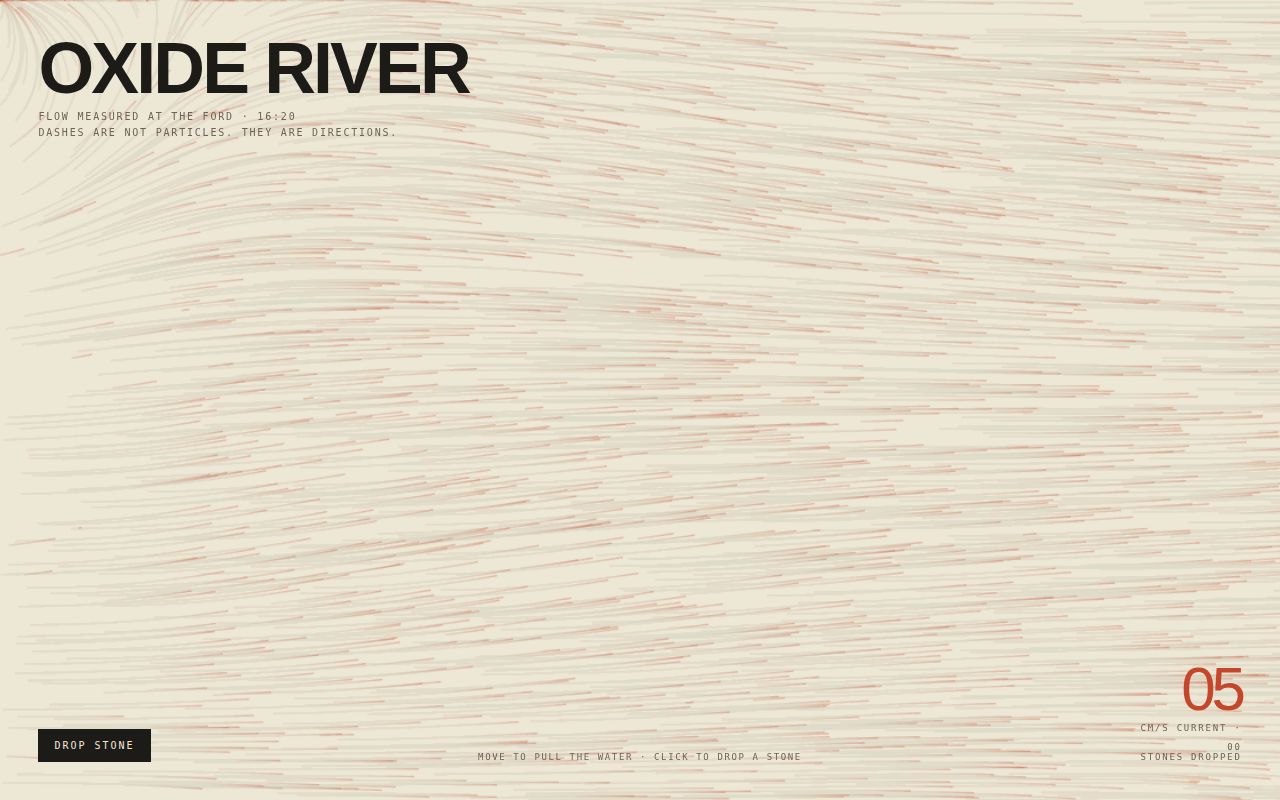
A 2D flow field you can disturb. The river is always moving; the visitor's hand and dropped stones bend it temporarily, and the traces settle back into the main current.
Open
Original prompt
A wide canvas river in oxide red #C4462B on warm cream #F2E8D6, with ink-black #1C1B18 typography. The surface is made of thousands of short dark-red dashes flowing left to right along a smooth sine-driven field; the trail never fully clears, so motion leaves a fine sediment. Title “OXIDE RIVER” in heavy condensed capitals at upper left and a small notice: “Flow measured at the ford, 16:20.” Moving the pointer pulls the current toward it with a visible lag, like a hand trailing in water. Clicking drops a stone: a circular vortex appears at that point, dashes spiral around it for a few seconds, then the river returns to its original direction. Entrance: the river starts as a flat band of dashes and bends itself into the full flow over two seconds. Signature moment: when a vortex forms, the dashes inside it reverse direction for one frame, producing a brief black ring before the spiral settles. Counters at lower right show current speed and number of stones dropped. No emoji, no gradients on type, no glass. Reduced motion shows a static field of dashes; clicks add a still ring.
023-oxide-river.html
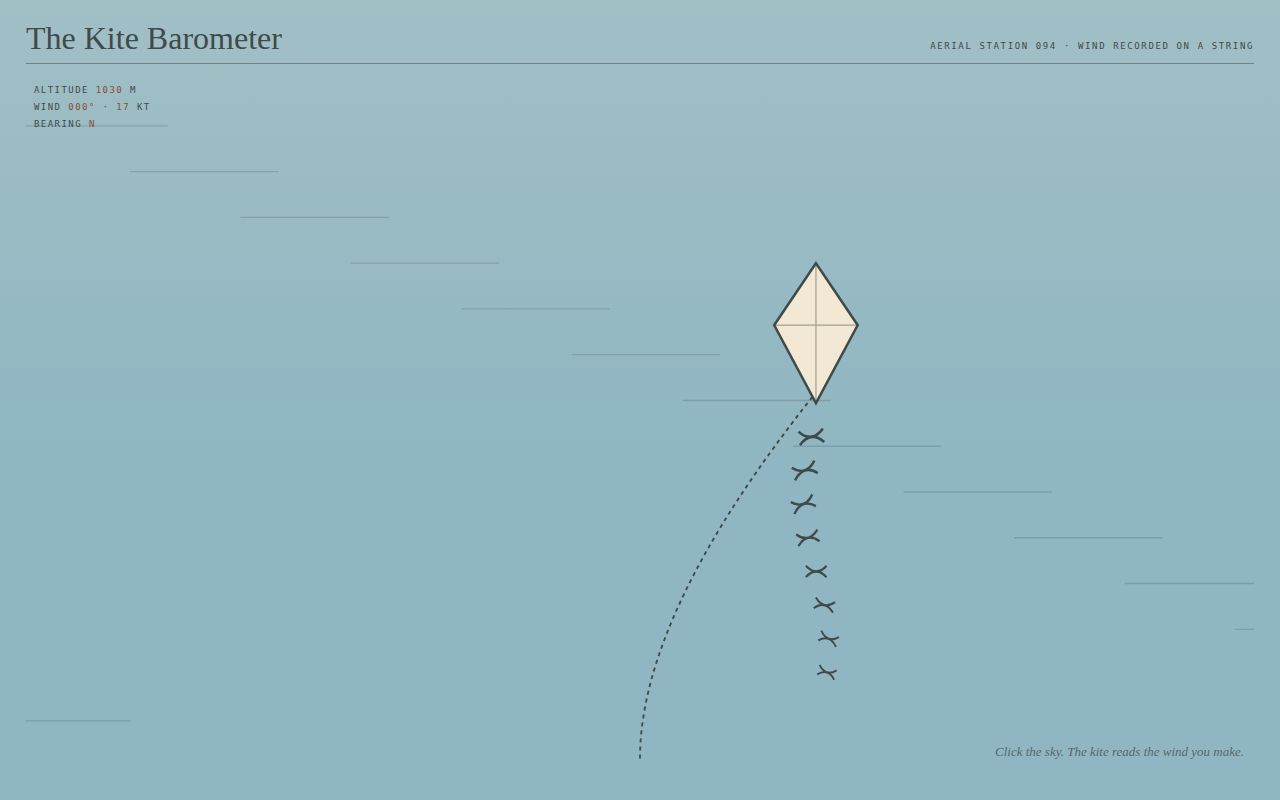
024
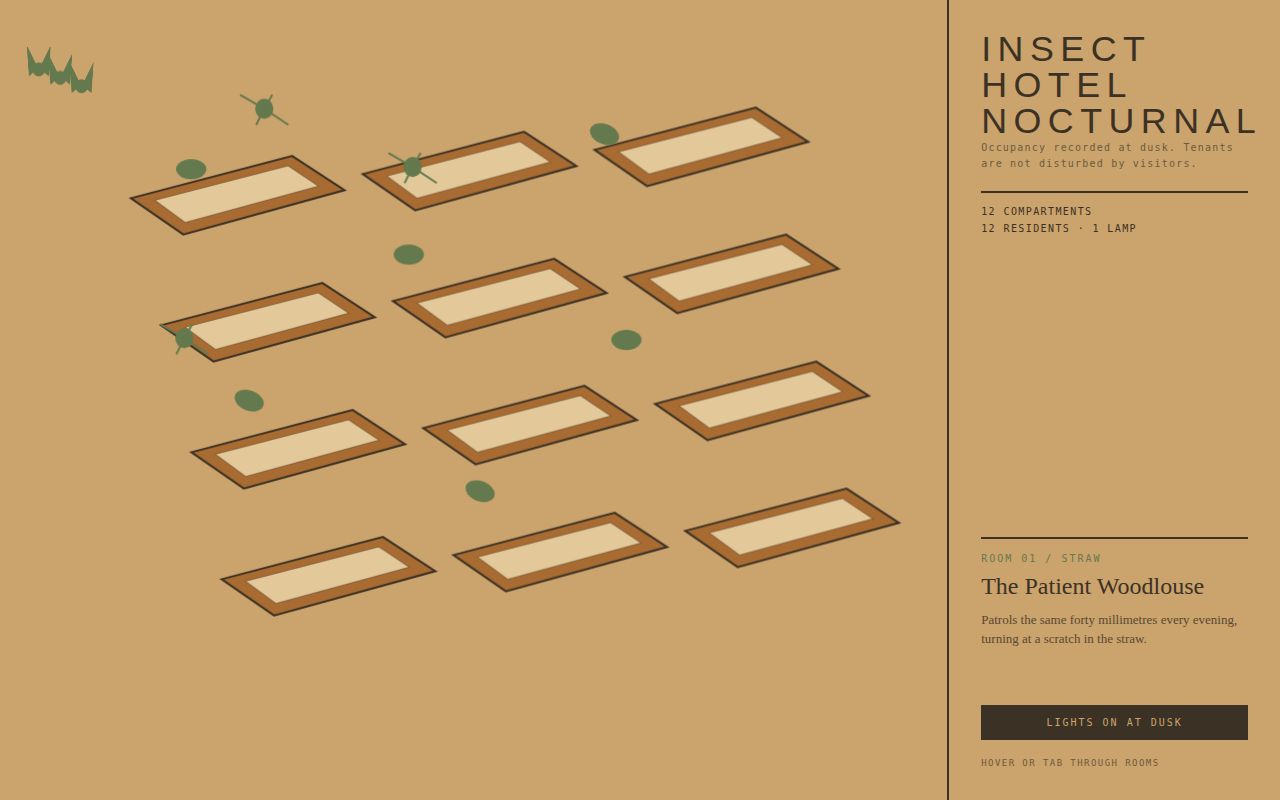
An illustrated habitat that comes alive at dusk. The hotel is both a diagram and a small theatre: each compartment has a tenant with a routine, and night turns the whole structure into a lantern.
Open
Original prompt
An isometric cutaway of a wooden insect hotel, drawn as clean SVG polygons on a warm kraft #CBA36C field. Structure in ochre #A86B32 and dark umber #3B3225; tenants in moss #647A4E; one signal colour, lantern yellow #F2D06B. The title “INSECT HOTEL NOCTURNAL” sits upper left in narrow spaced capitals, with a note: “Occupancy recorded at dusk. Tenants are not disturbed by visitors.” The hotel has twelve compartments of different shapes — straw tubes, pinecone scales, drilled blocks, hollow stems — each containing one small resident that moves continuously: a beetle patrols, a spider bobs, a earwig turns in place, a moth opens and closes its wings. Hovering or focusing a compartment lights it and reveals a specimen label in a fixed margin with a precise invented species name and a one-line behaviour. Entrance: compartments slide into place from the bottom of the drawing in three groups. Signature moment: a LIGHTS button turns the whole hotel to night — the wood darkens, every tenant's eyes become two lantern-yellow points, and the drawing briefly becomes a glowing grid. No emoji, no rounded cards, no gradients on type. Reduced motion stops tenant movement but keeps hover labels.
024-insect-hotel-nocturnal.html
025
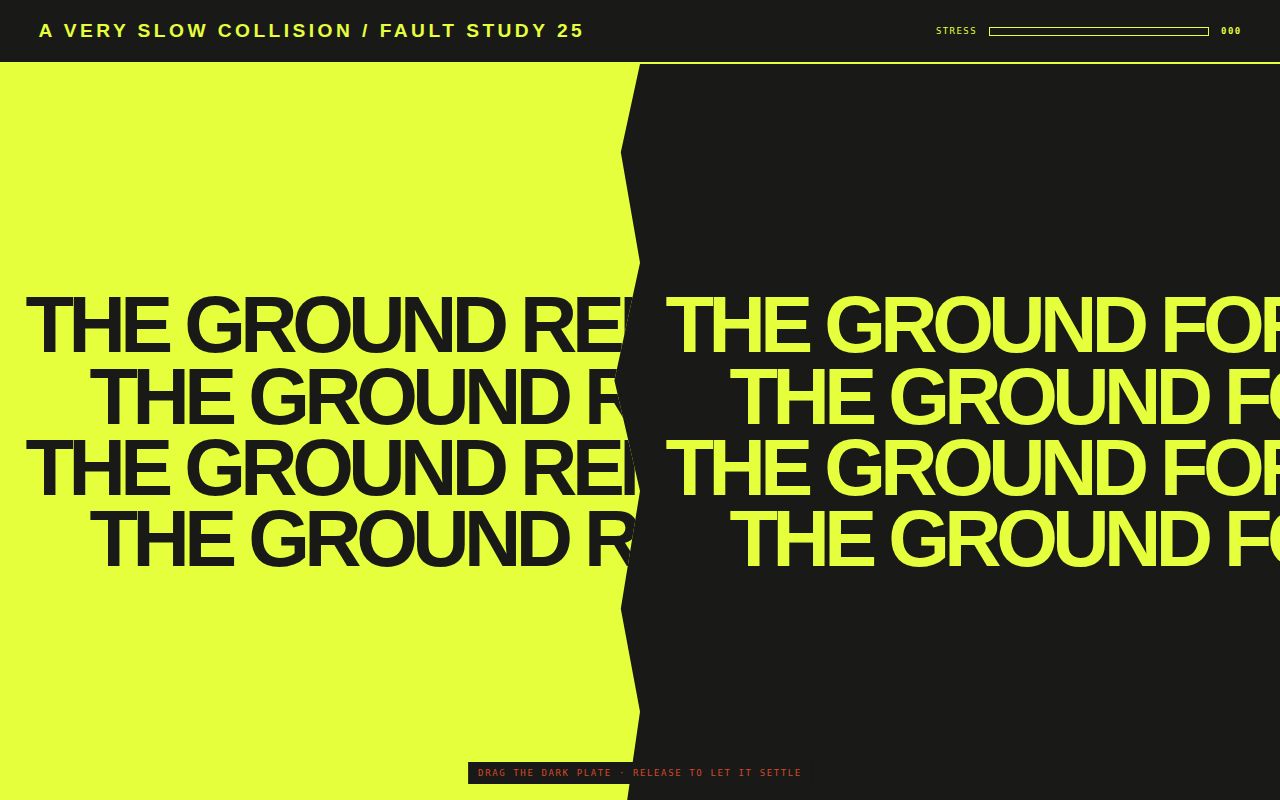
A slow-motion tectonic metaphor made of type. Dragging one sentence against the other makes letters shear, a red fault glow, and a landscape emerge from the collision.
Open
Original prompt
A brutalist typographic experiment in two colours: acid yellow #E5FF3D and charcoal #191A17, with one oxide-red #D6472B warning line. The viewport is split vertically by a jagged fault. Left plate carries a enormous repeated charcoal sentence “THE GROUND REMEMBERS”; right plate carries “THE GROUND FORGETS” in yellow on charcoal. Both are set flush, cropped, and slightly out of alignment. Dragging the right plate horizontally with the pointer moves it against the left; a stress meter at the top increases from 0 to 100. As stress rises, letters near the fault visibly shear — individual characters shift by a few pixels, then snap back — and a thin red seam appears. Releasing lets the plate spring back slowly, not instantly. If stress passes 90, a short earthquake ripple travels through both plates and a new sentence is stamped across the seam: “WHAT IS LEFT IS CALLED A HILL”. Entrance: the two plates slide together from opposite edges until the fault meets, with a hard stop. Signature moment: the shear is per-letter, so the words tear character by character before the quake. No emoji, no cards, no gradients. Reduced motion moves the plate without shear and triggers the stamp without ripple.
025-very-slow-collision.html
026
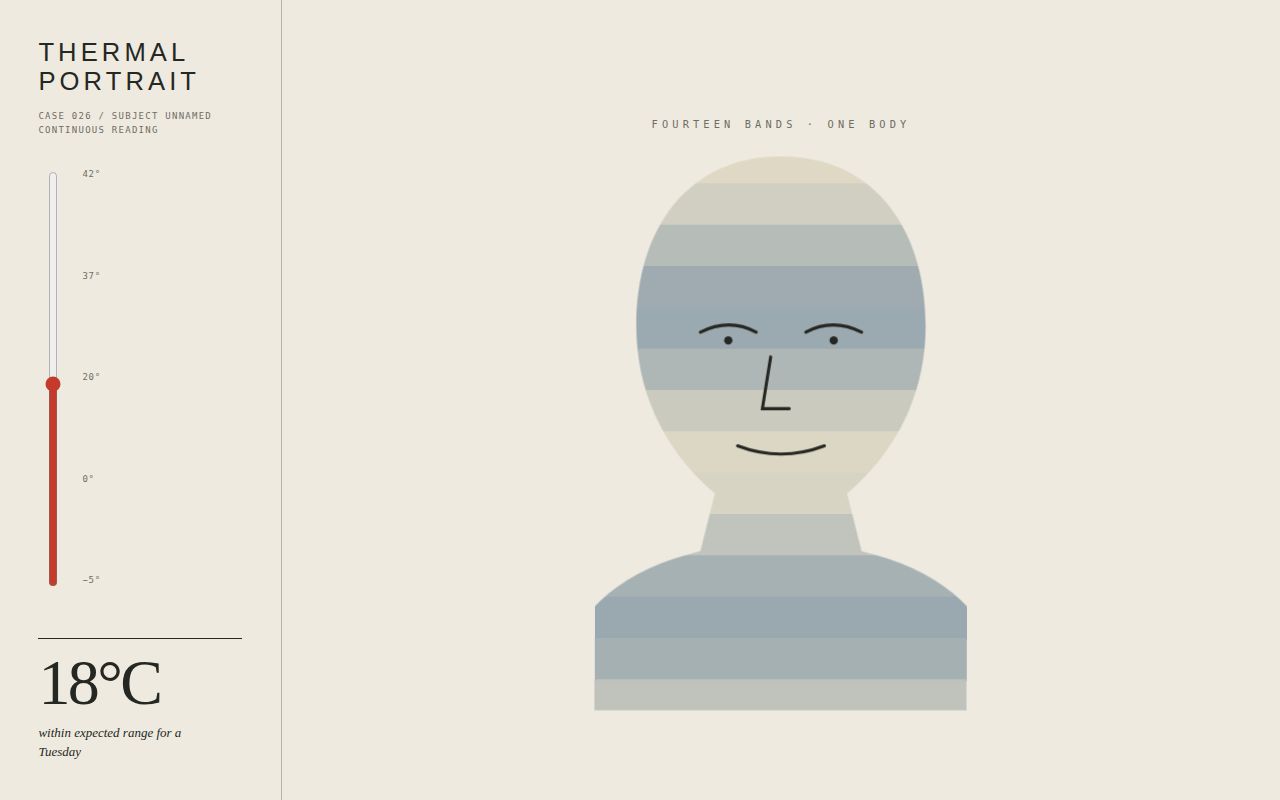
A portrait made of temperature. Moving the thermometer changes colour, expression and diagnosis, with a brief hidden sentence emerging at body temperature.
Open
Original prompt
A front-facing portrait constructed from fourteen horizontal bands of colour, not outlines: a heat map of a person who is also a weather system. Palette range from cold cobalt #2B5A8C through cream #E8DFC8 to fever red #C43B2B, on a pale clinical ground #EEEAE0. Title “THERMAL PORTRAIT” in small spaced capitals upper left; a thermometer-style vertical slider at left with exact marks from −5°C to 42°C. The bands form a head-and-shoulders silhouette when seen at rest. Dragging the temperature changes every band's colour through a fixed interpolation, and the face changes with it: at cold the eyelids narrow and the bands shiver one pixel; at heat the mouth opens slightly and three drops appear at the temple. A readout shows the temperature and a invented diagnosis: “within expected range for a Tuesday”, “mild optimism”, “a small internal summer”. Entrance: the bands arrive one by one from the left and lock into the portrait. Signature moment: exactly at 37°C the bands briefly align into a readable sentence across the face — “I AM NOT ILL, I AM WEATHER” — then settle back. No emoji, no glass, no stock-photo feel. Reduced motion jumps between states without shiver.
026-thermal-portrait.html
027
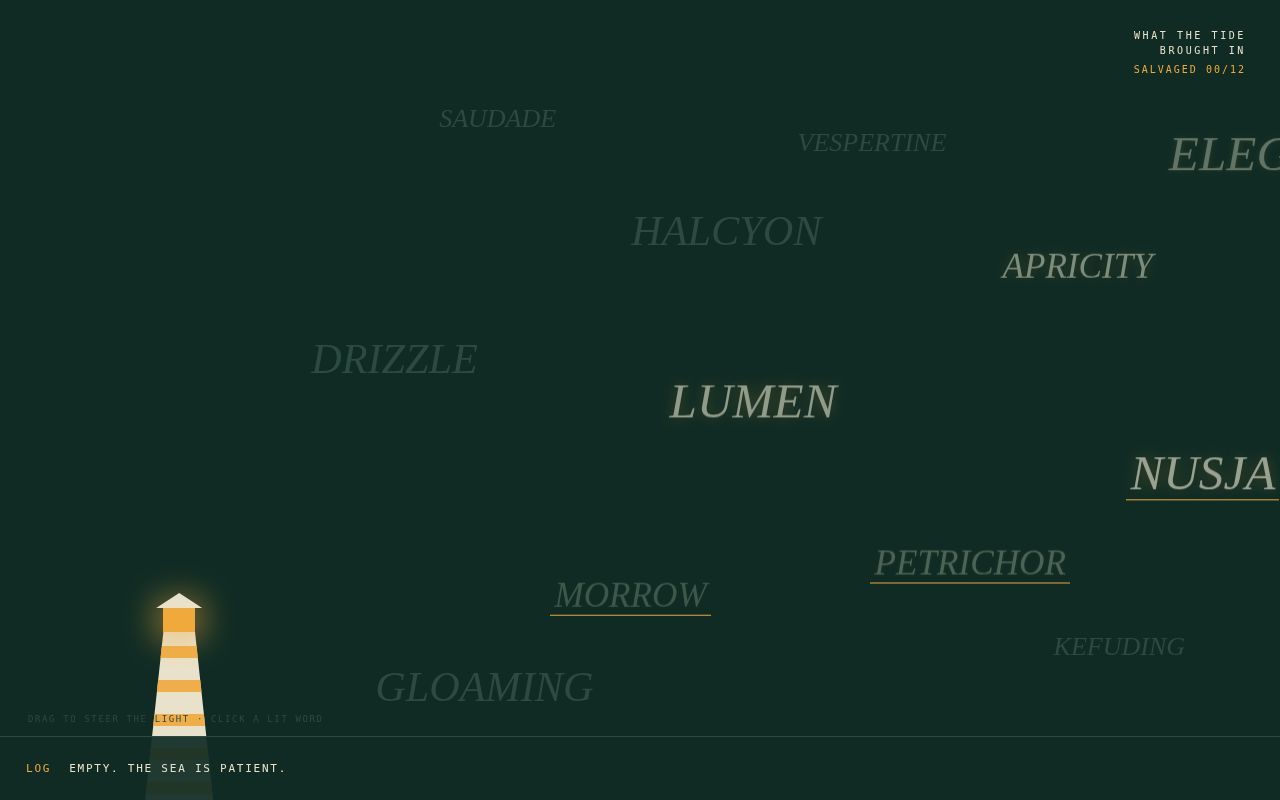
A lighthouse sweeps a beam across a sea of forgotten words. Only what the light touches can be rescued, making reading an act of attention.
Open
Original prompt
A dark green sea of typography at night, #0F2B24, with a single lighthouse at the lower left built from flat geometric shapes in chalk #E9E2CB and signal amber #F0A93B. Scattered across the sea are twelve forgotten words, each set in a different size but always in the same chalk serif: VESPERTINE, APricity, HALCYON, NUSJA, SAUDADE, PETRICHOR, DRIZZLE, LUMEN, KEFUDING, MORROW, GLOAMING, ELEGIE. An amber beam rotates continuously from the lighthouse — a wide translucent cone made with a conic gradient, genuinely a beam of light. Words caught inside the cone brighten from dim green to chalk, and a faint underline appears. Clicking a lit word salvages it: the word flies along the beam to the lighthouse and joins a horizontal log at the bottom, replacing the oldest entry. The headline “WHAT THE TIDE BROUGHT IN” sits upper right in small spaced capitals; a counter records SALVAGED 00/12. Entrance: the beam starts at the left edge and sweeps once across the whole field before settling into its slow rotation. Signature moment: dragging anywhere sets the beam direction and briefly holds it, like grabbing a light. No emoji, no cards, no purple. Reduced motion keeps the beam static and lets all words be clicked.
027-lighthouse-for-lost-words.html
028
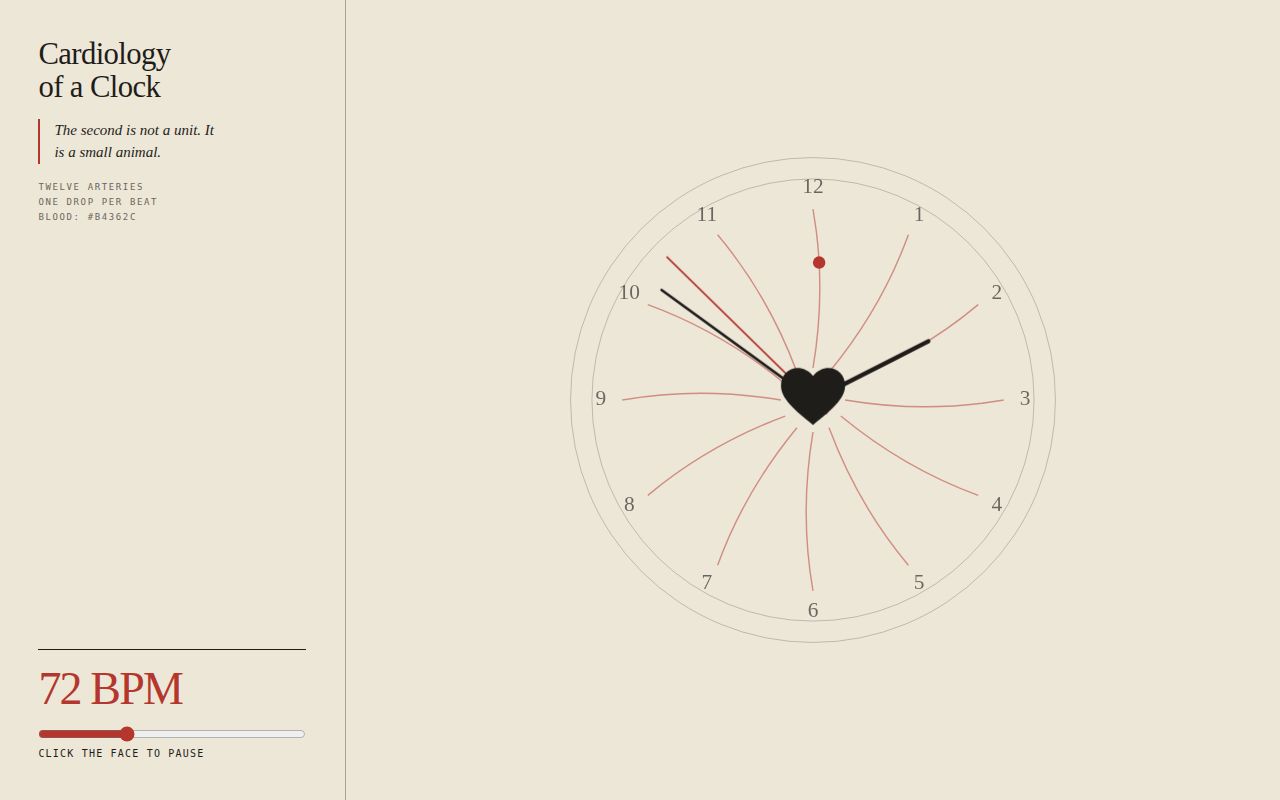
A clock that behaves like a circulatory system. Blood drops keep time with the hands, and once a dozen beats the face briefly becomes an ECG.
Open
Original prompt
A clock face reimagined as a heart: bone-white #EDE7D8 ground, ink #1F1D1A numerals and hands, one arterial red #B4362C used only for blood. The face is a large circle with twelve radial arteries running outward from a dark centre to the hour numerals, each artery drawn as a slightly curved SVG path. Every beat, a red droplet travels along one artery and arrives at the numeral exactly as the hand passes it. The hour and minute hands are thin ink needles; the second hand is a red thread with a drop at its tip. A BPM control in the lower left runs from 40 to 140, with the current rate printed in a monospace tabular figure. Copy at upper left: “THE SECOND IS NOT A UNIT. IT IS A SMALL ANIMAL.” Every twelfth beat a waveform briefly draws itself across the face, replacing the numerals with a red ECG line, then fades. Entrance: arteries grow outward from the centre in sequence, then the numerals appear, then the hands drop into place. Signature moment: the drop and hand arrive at the same numeral together — a small synchronisation that feels impossible until you notice the arteries are numbered. No emoji, no glassmorphism, no purple. Reduced motion keeps the clock and beats but suppresses droplet travel and ECG draw.
028-cardiology-of-a-clock.html
029
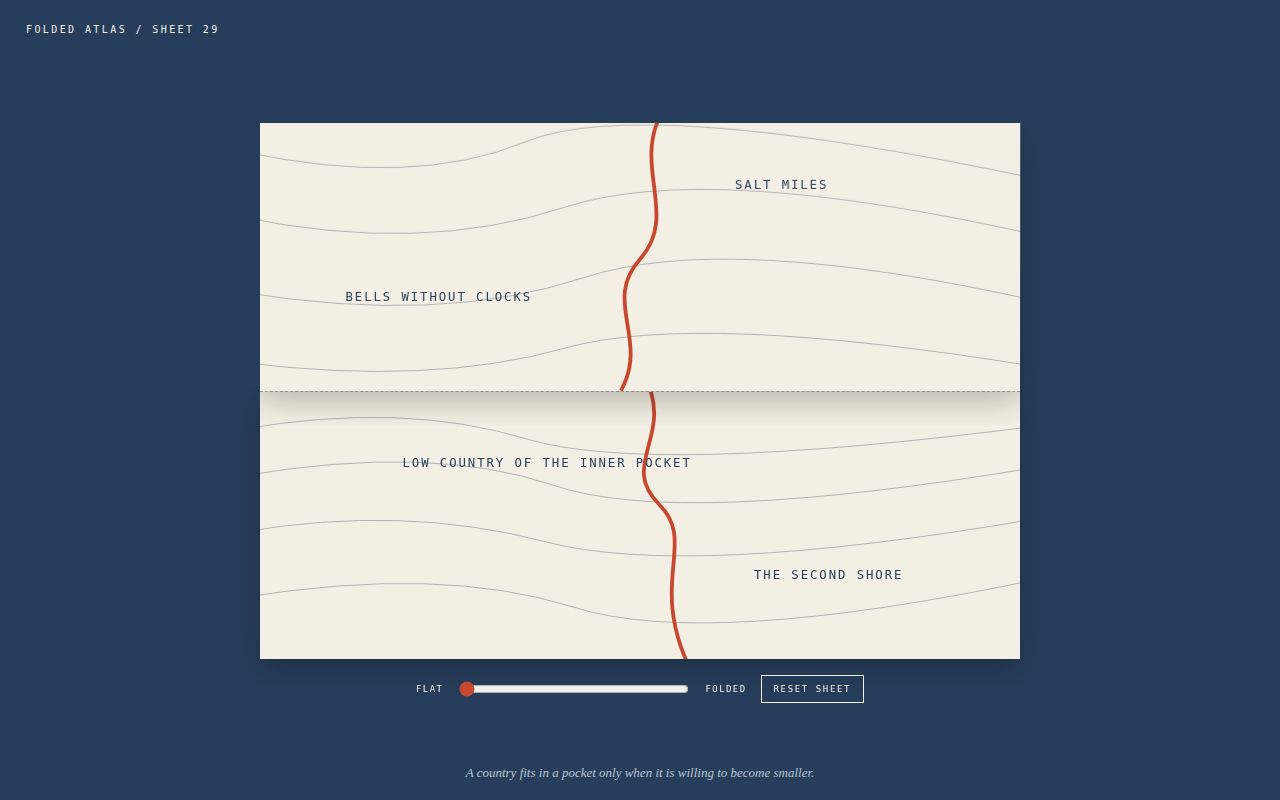
An interactive paper map. Folding the sheet reveals the same country after dark, proving that a place can be carried in two states at once.
Open
Original prompt
A washi-paper atlas sheet, #F4EFE4, centred on a deep ink #263E5C desktop. The front map is drawn only in vermilion #C8482F and ink: contour lines, a single river, six place names with invented, precise names like BELLS WITHOUT CLOCKS and LOW COUNTRY OF THE INNER POCKET. A horizontal crease divides the sheet. Dragging a small ink fold tab at the right edge folds the upper half down over the lower half in convincing 3D perspective, with a subtle shadow cast by the moving paper. As it folds, the front map disappears and the back of the folded half is revealed: the same geography at night, with pale chalk roads and tiny vermilion lights at each settlement. The title “FOLDED ATLAS / SHEET 29” sits upper left of the desktop in small monospaced spaced capitals. At the bottom: “A country fits in a pocket only when it is willing to become smaller.” When fully folded, the hidden map's lights come on one by one. A small RESET tab unfolds it. Entrance: the sheet unfolds from fully folded to flat on load over 1.4 seconds with an eased hinge. Signature moment: the same river appears continuous across front and back even though the paper is folded — the cartography refuses to obey the crease. No emoji, no buttons with default styling, no gradients on type.
029-folded-atlas.html
030
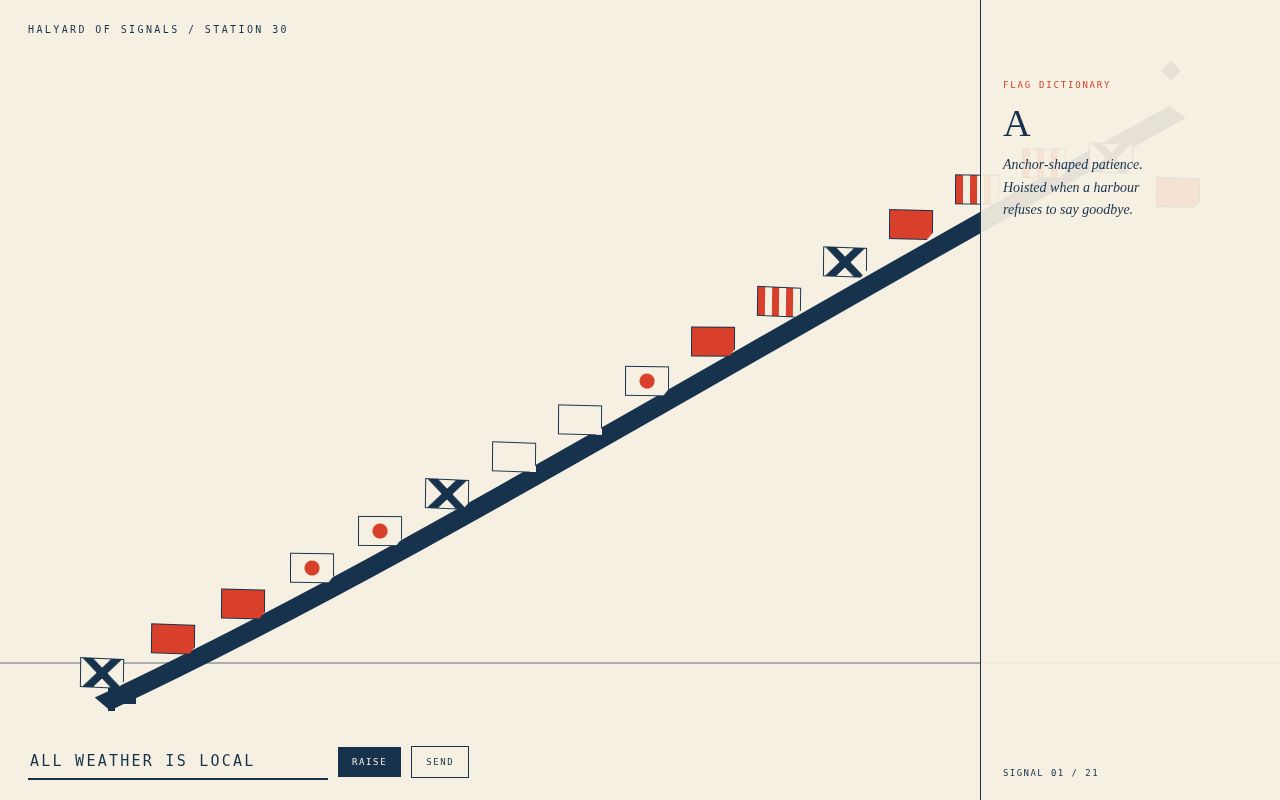
A message becomes a physical run of signal flags on a rope. Wind responds to the pointer, and each flag has its own meaning in a small invented codebook.
Open
Original prompt
A ship's signal halyard against a flat sea-sky of chalk cream #F6F0E2, ink navy #17324D and signal red #D8402B. A single rope runs diagonally from a cleat at lower left to a masthead at upper right. Beside it, a styled telegraph tape holds the phrase “ALL WEATHER IS LOCAL”. Pressing RAISE sends one signal flag up the rope for each letter: twenty-one rectangular cloth flags with clipped corners and simple geometric patterns drawn in CSS — chevrons, discs, crosses, stripes — never emoji or icons. Each flag rises with a small overshoot and then flutters; the flutter intensifies when the pointer moves quickly, as if the wind has changed. Clicking a flag opens a narrow dictionary margin with the flag's invented maritime meaning, e.g. “G: glass collected from four harbours”. Lowering the message on SEND drops the flags in sequence from left to right, and the sea horizon briefly turns red. Title “HALYARD OF SIGNALS / STATION 30” in spaced monospaced type. Entrance: the rope draws itself, the cleat appears, then the flags rise once from the default message. Signature moment: the flags climb in a staggered wave that exactly matches the letter rhythm, then settle at slightly different heights like real cloth. No rounded cards, no gradients on type, no stock-nautical clutter. Reduced motion raises flags instantly.
030-halyard-of-signals.html
031
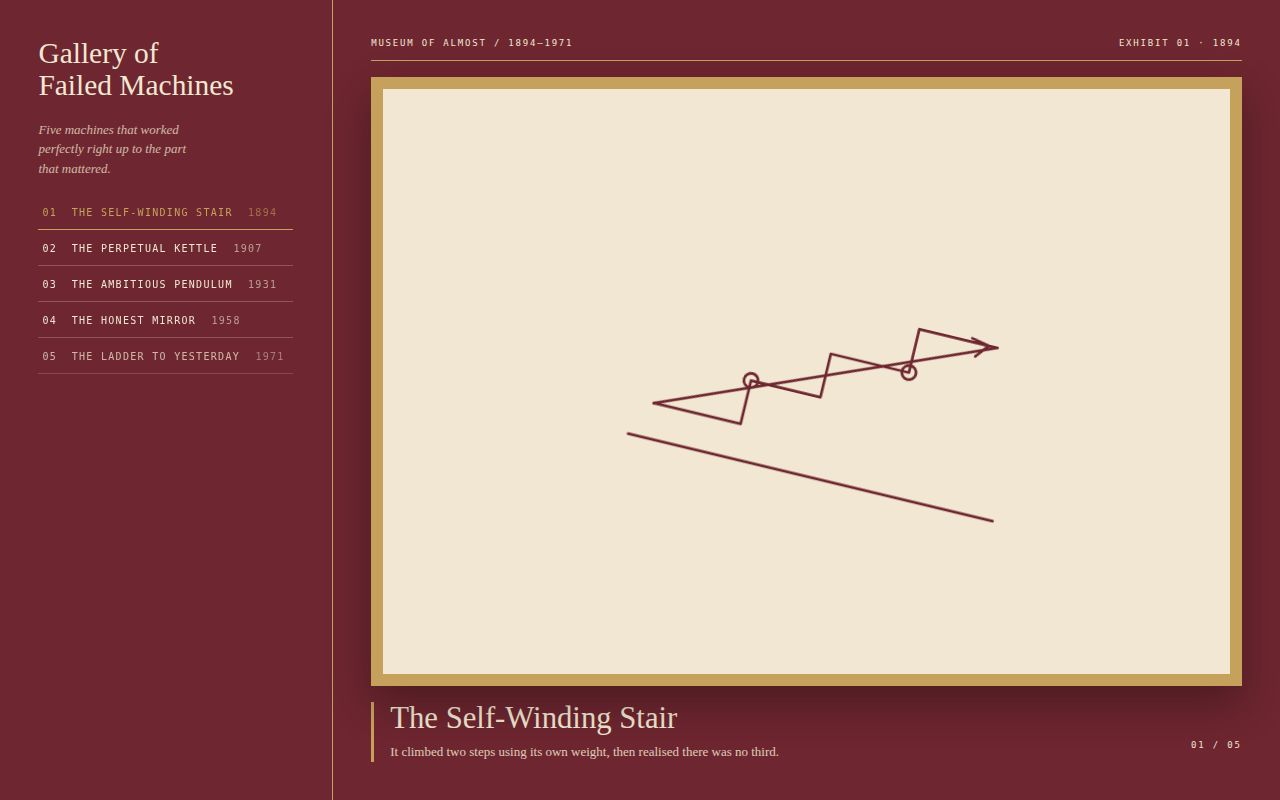
A museum of inventions that failed for interesting reasons. Each exhibit runs once, demonstrates its own precise flaw, and stamps itself JAM.
Open
Original prompt
A small museum gallery hung in claret #6E2630, with brass #C6A15B fixtures and paper #F1E7D2 plaques. Along the left wall, a vertical index lists five inventions: THE SELF-WINDING STAIR, THE PERPETUAL KETTLE, THE AMBITIOUS PENDULUM, THE HONEST MIRROR, THE LADDER TO YESTERDAY. Each has a year and a one-line reason for failure. Selecting one brings a large line-drawing exhibit to the centre: wheels, belts, pulleys, buckets and little arrows, all drawn in brass on paper. Every machine attempts to work: the stair climbs itself for two steps then tips, the kettle pours into its own fire, the pendulum swings wider until it stops, the mirror reflects a sentence that is not there, the ladder folds into a compact unsuccessful object. After two seconds a red JAM stamp appears over the drawing. Copy under the title: “Five machines that worked perfectly right up to the part that mattered.” Entrance: lights come up over the gallery one at a time and the first machine starts. Signature moment: each failure is mechanically specific, not a generic stop — you can see exactly where the idea gave up. No emoji, no glass, no purple. Reduced motion shows the final jammed state immediately.
031-gallery-of-failed-machines.html
032
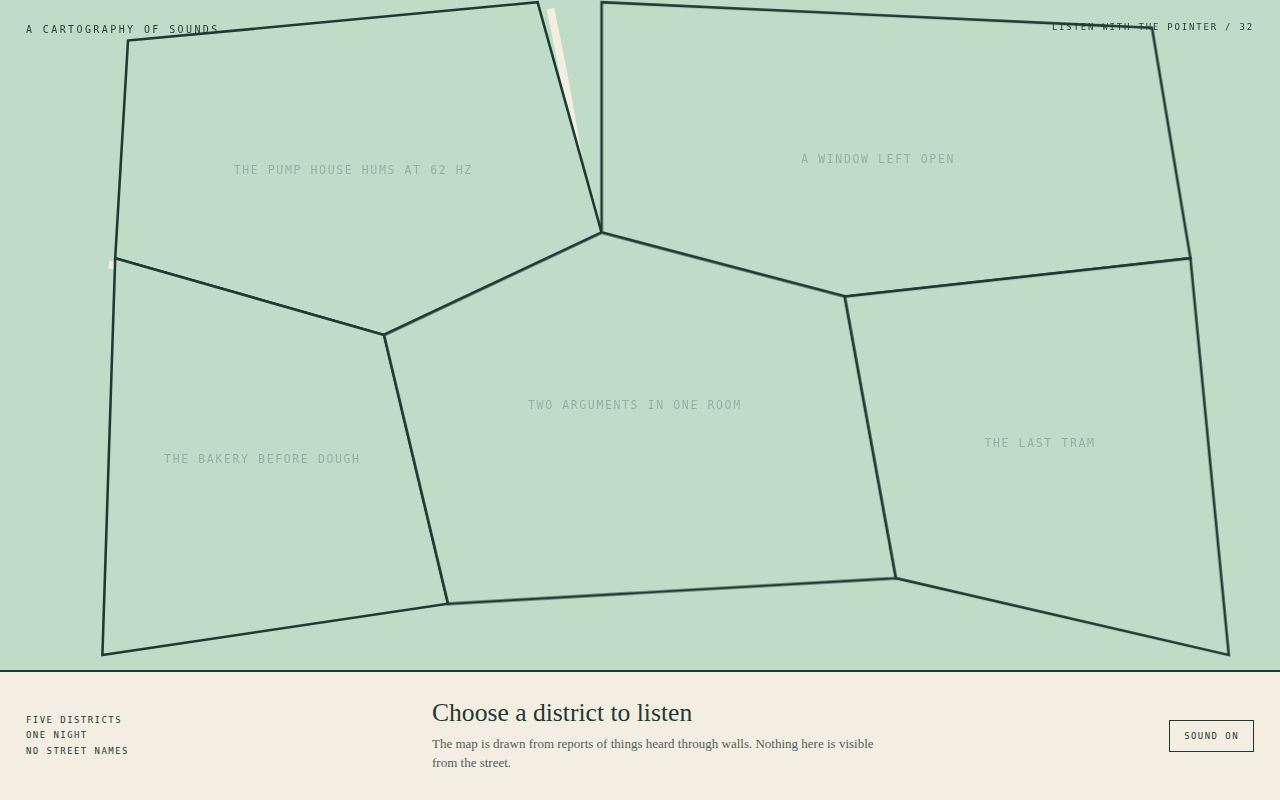
A city map where districts are identified by their sound. Clicking plays a synthesized chord and draws contour rings whose spacing reflects the frequencies heard.
Open
Original prompt
A flat mint-and-ink map of an invented night city, drawn as five irregular districts separated by pale streets: mint #BFDCC8 land, deep ink #1D3A33 lines, orange #E07A3F for sound. The title “A CARTOGRAPHY OF SOUNDS” sits upper left; a small legend reads “LISTEN WITH THE POINTER”. Each district is labelled with a sound rather than a street: THE PUMP HOUSE HUMS AT 62 HZ, A WINDOW LEFT OPEN, THE BAKERY BEFORE DOUGH, TWO ARGUMENTS IN ONE ROOM, THE LAST TRAM. Clicking a district plays a short chord made in the browser — no audio files — and sends orange contour rings outward from the point, like a topographic map redrawing itself around a noise. The clicked district's label expands into a two-sentence description in a bottom margin. A muted speaker control silences the sound but keeps the rings. Entrance: the streets draw themselves in sequence, then district labels fade in. Signature moment: the ring spacing is derived from the chord frequencies, so low sounds make wide rings and high sounds make close ones. No emoji, no glass, no purple. Reduced motion shows one static ring per click.
032-cartography-of-sounds.html
033
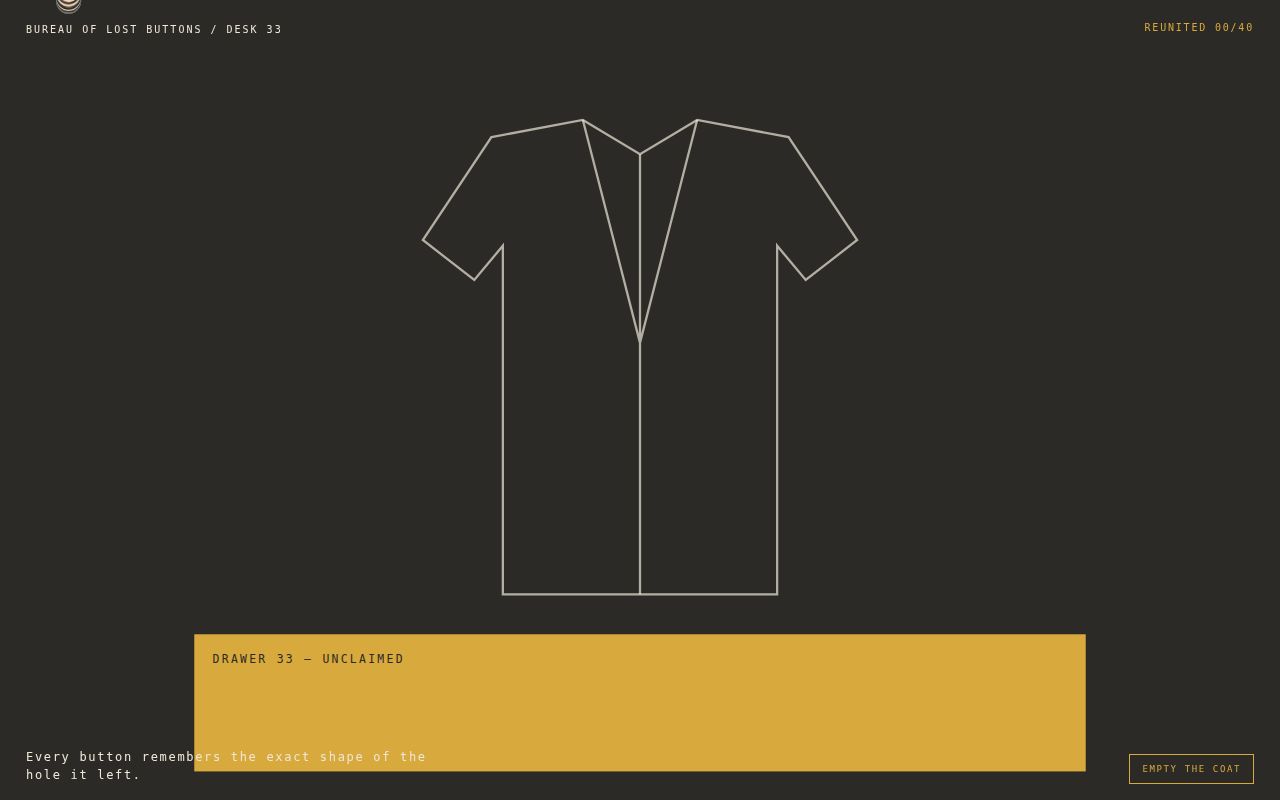
An inventory of lost buttons that can be sewn back onto a coat. Each button carries the memory of the garment it came from.
Open
Original prompt
A bureau drawer of lost buttons tipped out across a charcoal #2B2A27 desk. The drawer is a shallow mustard #D8A93C rectangle at the bottom; inside it sit forty small buttons drawn as circles with two or four holes, in bone #EEE7D6, brass #D8A93C and red #B64A34. At the centre hangs the outline of a coat in bone lines. Hovering a button reveals where it came from in a small monospaced caption: “OFFICE COAT, LEFT CUFF, 1987”, “SAILOR’S SHIRT, SECOND FROM TOP”. Clicking a button threads a needle: a thin bone line draws from the drawer to a specific position on the coat, the button flies along it and settles with a tiny rotation. The coat gradually fills with an impossible, non-symmetric constellation of buttons. A counter at upper right says REUNITED 00/40. Text at upper left: “Every button remembers the exact shape of the hole it left.” Entrance: buttons tumble out of the drawer into their places with staggered gravity. Signature moment: the stitching is drawn as individual dashed stitches, and each button lands at a slight angle determined by its origin. No emoji, no glass, no gradients. Reduced motion places buttons instantly.
033-bureau-of-lost-buttons.html
034
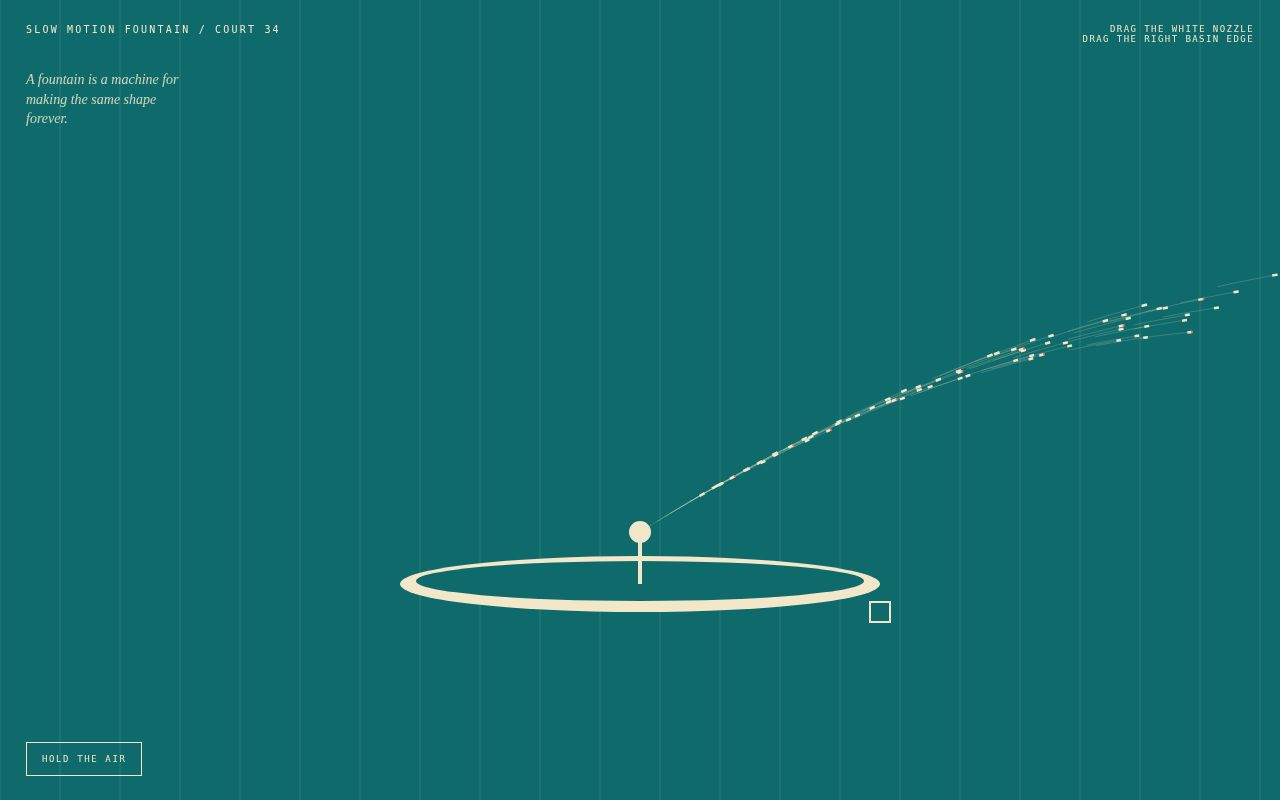
A physics fountain in twenty-times slow motion. Drag the nozzle or basin to change the water's shape, then hold the air to see the arc as a measured drawing.
Open
Original prompt
A courtyard fountain rendered in flat teal #0F6B6B and cream #F2E7C9, with water in one coral #F26B4E accent. The basin is a wide ellipse drawn in cream; a slim nozzle at its centre throws a continuous arc of water that behaves like a slow-motion photograph. Each droplet is a small cream line, not a circle, and follows a ballistic path with a faint coral trail. Dragging the nozzle left or right changes the launch angle; dragging the basin edge changes its width and therefore where droplets land. A HOLD THE AIR button freezes the simulation for two seconds while a dotted measurement arc appears and labels the highest droplet with its height in imaginary units. Text at upper left: “A fountain is a machine for making the same shape forever.” Title “SLOW MOTION FOUNTAIN / COURT 34”. Entrance: the first arc draws itself from nozzle to basin, then the rest of the water follows. Signature moment: when held, the droplets hang perfectly still and the arc becomes a measured diagram. No emoji, no glass, no purple. Reduced motion draws a static arc and freezes by default.
034-slow-motion-fountain.html
035
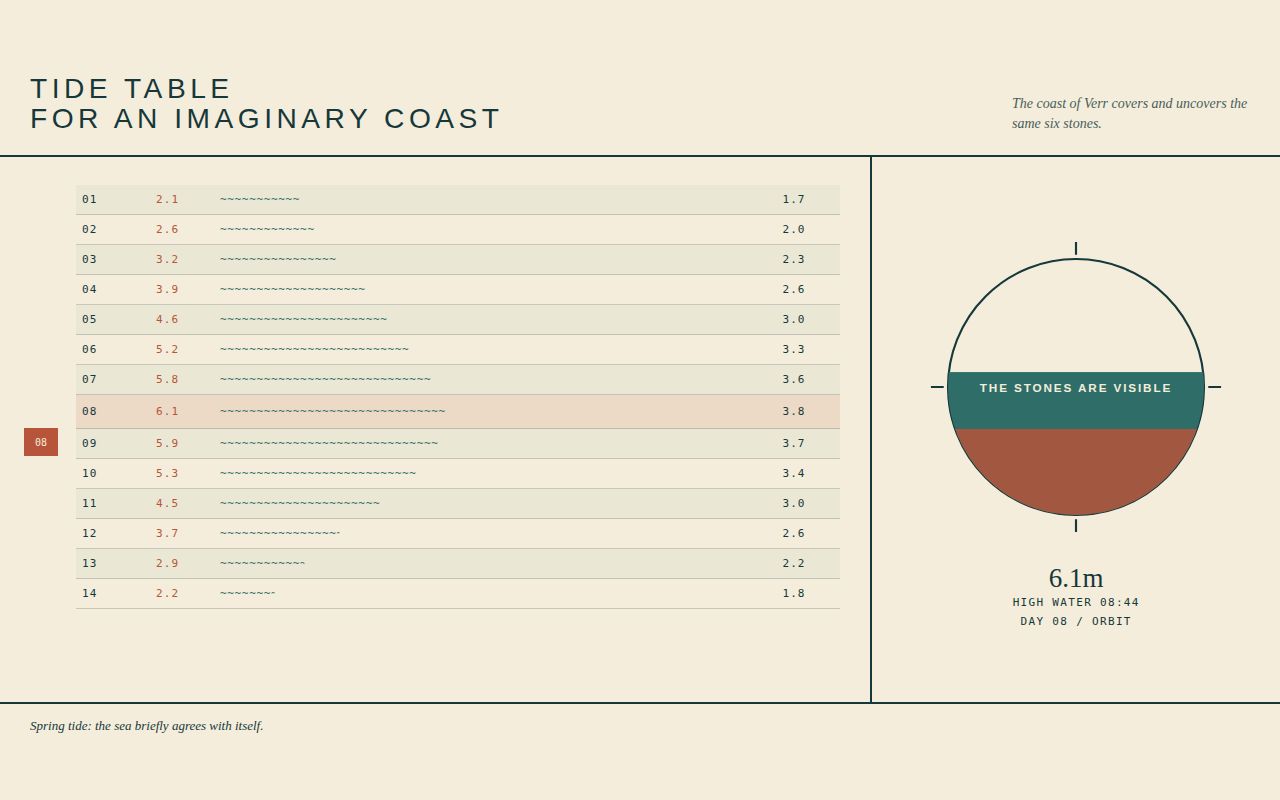
An imaginary tide table where each day's water can be inspected by dragging a marker. Spring tide turns the water level into a sentence about stones.
Open
Original prompt
A printed tide table on cream #F4EDDB paper, set in deep ink #16383A and sea green #2F6E68, with one rust #B6553A spring-tide mark. Fourteen horizontal rows represent fourteen days in a made-up month called ORBIT. Each row shows the date, two tide heights, and a bar drawn from repeated tilde characters whose length follows the height. A heavy vertical marker can be dragged down the table; the selected row expands slightly, and a circular inset on the right shows the water level for that day as a flat band, with the time of high water printed inside. Copy at top: “The coast of Verr covers and uncovers the same six stones.” At the bottom: “Spring tide: the sea briefly agrees with itself.” Entrance: rows type themselves in from left to right; the marker drops from above and lands on day eight. Signature moment: on days 7 and 8, the circular inset's two water bands meet and form the sentence “THE STONES ARE VISIBLE” across the circle. No emoji, no gradients, no glass. Reduced motion shows the final state immediately.
035-imaginary-tide-table.html
036
A small tool for slicing a responsive shadow. Each cut divides the shadow further, until a single light source becomes a pile of pieces.
Open
Original prompt
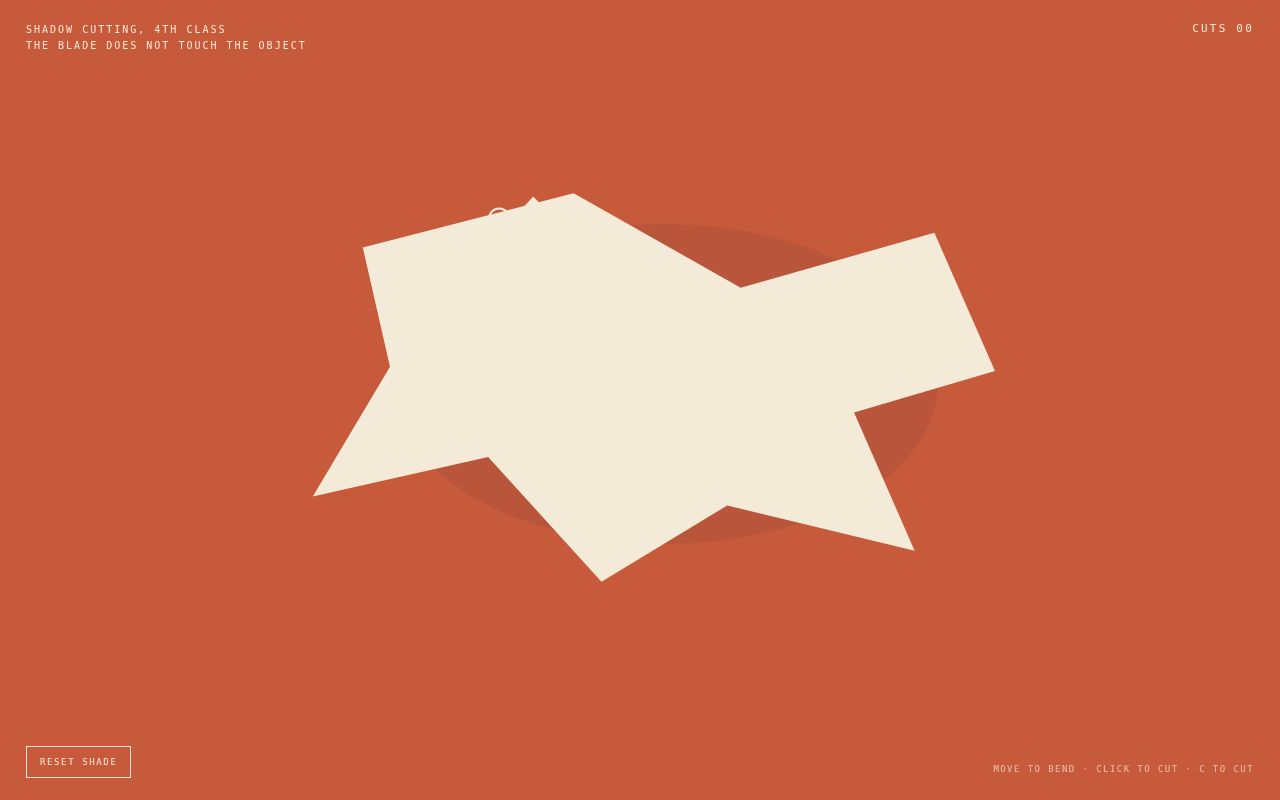
A flat terracotta #C85A3C studio floor with a chalk #F3EAD7 shadow cast diagonally across it. The shadow is not an object's silhouette but a soft, slightly absurd shape: part umbrella, part animal, part coat hanger. Moving the pointer moves an unseen light source, so the shadow bends and stretches with a simple inverse-square rule. A chalk knife handle follows the pointer; clicking makes a bright blade sweep across the shadow along the pointer's recent direction. The shadow splits cleanly into two pieces that slide apart by a few millimetres and rotate slightly, leaving a thin terracotta cut line. Each cut adds a new piece to a growing pile at the bottom edge. Copy at upper left: “SHADOW CUTTING, 4TH CLASS / THE BLADE DOES NOT TOUCH THE OBJECT.” A counter tracks CUTS 00. Entrance: the shadow arrives from offscreen, overshoots, and settles. Signature moment: the first cut makes a soundless flash and the two halves breathe outward once before resting. No emoji, no gradients on type, no purple. Reduced motion cuts without the sweep, placing pieces directly.
036-knife-that-cuts-shadows.html
037
An orchard made of letters. Shaking the trees drops word-fruit into a basket, where each word reveals a tiny poem.
Open
Original prompt
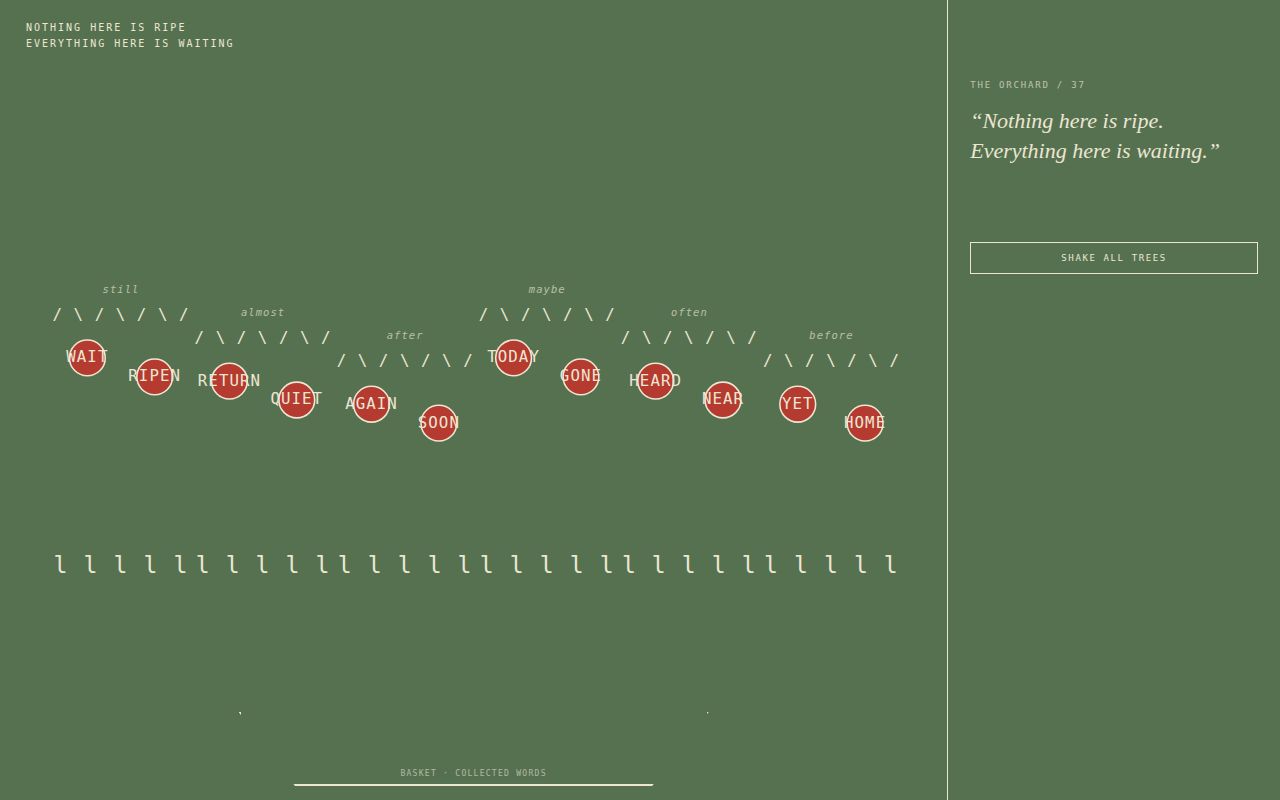
An orchard of six thin trees drawn in cream #EDE6D2 on deep orchard green #557150, with fruit in one red #B53A2F. The trees are made entirely of letters: trunks are stacked ‘l’ characters, branches are diagonal runs of ‘/’ and ‘\\’, leaves are small lowercase words like ‘still’, ‘almost’, ‘after’. Hanging from the branches are twelve red circular fruits, each containing a single word in cream: WAIT, RIPEN, RETURN, QUIET, AGAIN, SOON, TODAY, GONE, HEARD, NEAR, YET, HOME. Clicking a tree shakes it: letters jitter, fruits detach and fall with simple gravity, bouncing once on the ground before settling into a woven basket at the bottom. Clicking a fallen fruit opens a one-line poem in a side panel. A SHAKE ALL button shakes every tree in a staggered wave. Text at upper left: “Nothing here is ripe. Everything here is waiting.” Entrance: trees type themselves into existence from the ground up; fruits fade in last. Signature moment: the falling fruits leave a brief trail of their own word, repeated small, like an echo. No emoji, no gradients, no purple. Reduced motion drops fruits directly into the basket.
037-typographic-orchard.html
038
A map that resists accuracy. Correcting the coastline only makes it more elaborate, and the map keeps a temporary record of every edit.
Open
Original prompt
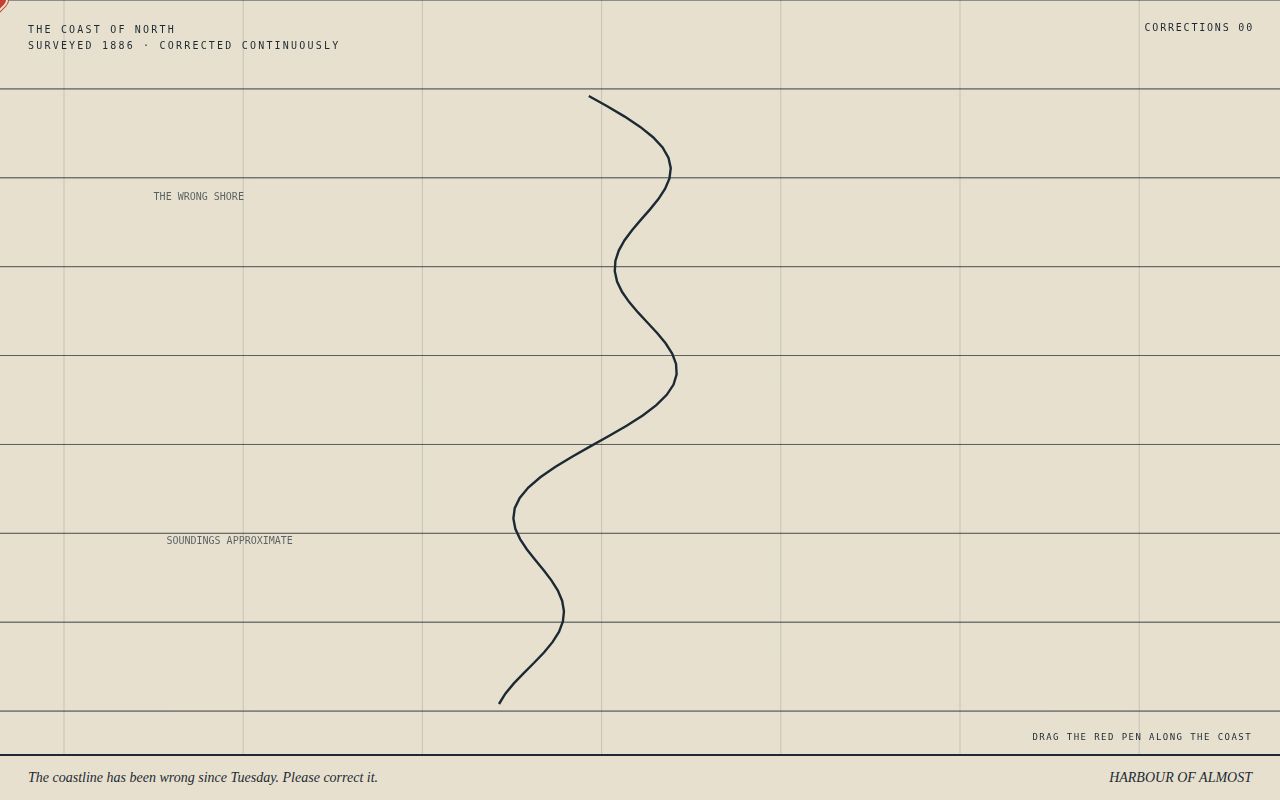
A newsprint #E7E0CE chart table with a single hand-drawn coastline in ink #1C2A33 and one red #C43F2F correction pen. The map claims to show “THE COAST OF NORTH, SURVEYED 1886”. Along the bottom, a caption reads “The coastline has been wrong since Tuesday. Please correct it.” Dragging the red pen across the coast pushes the line away from the pointer with a soft spring; nearby contour lines follow, but slightly late. Each time the coast is corrected, one of five place names changes to a more honest invented name: HARBOUR OF ALMOST, CAPE NOON, THE SEA OF NEARLY, LOW TIDE MUSEUM, POINT OF NO RETURN TODAY. A counter records CORRECTIONS 00. Every fifth correction the map gives up and redraws the whole coast as a straight line, then slowly springs back into its wrong shape. Entrance: the chart unrolls from the top, the coastline draws itself in one gesture, and the pen drops into place. Signature moment: the coastline remembers every correction as a small ink scar that fades after a few seconds. No emoji, no glass, no purple. Reduced motion moves the coast instantly without scars.
038-cartographers-mistake.html
039
An eight-key piano that makes weather instead of music. Each key has its own rain pattern, and playing all eight lets the storm compose itself.
Open
Original prompt
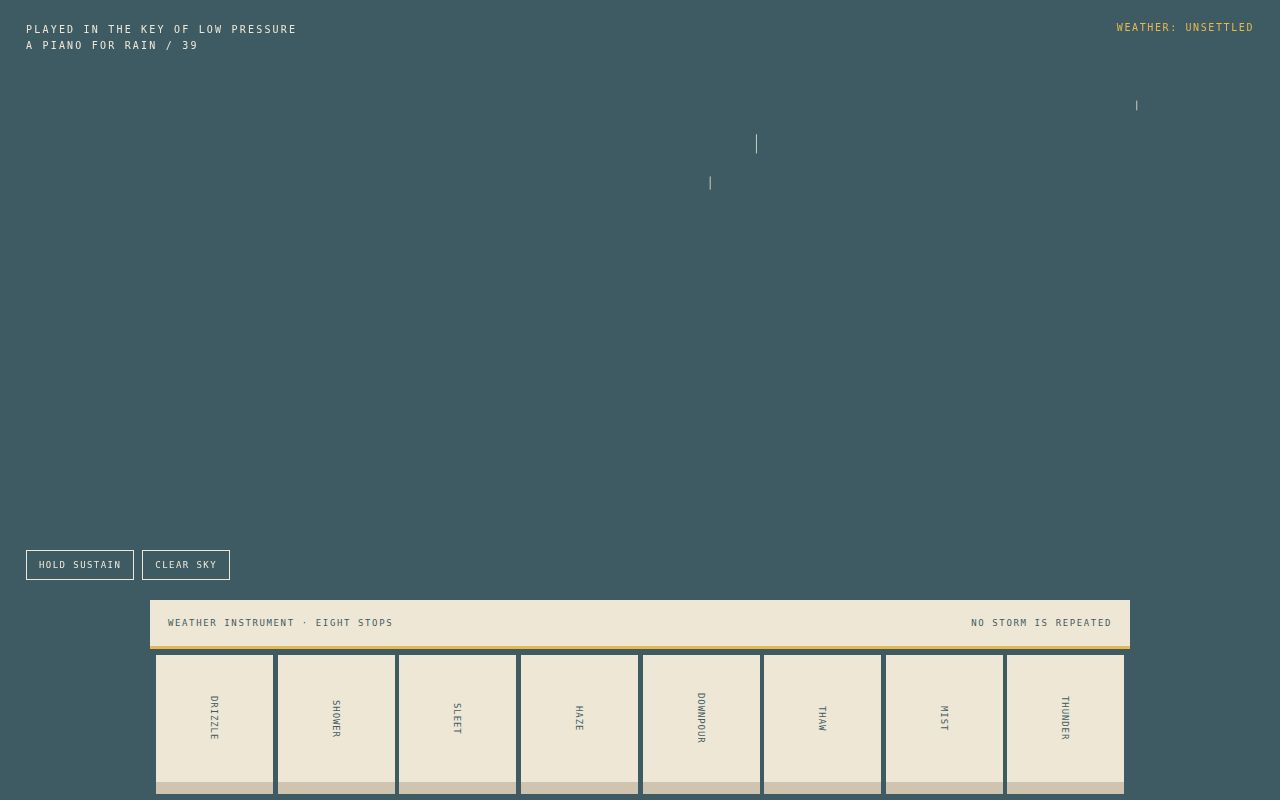
A narrow upright piano reduced to eight keys, drawn as cream #EFE7D6 slabs on a slate #3E5B63 body with one brass #E5B94C sustain bar. Above it, a canvas sky receives rain. Each key is labeled with a weather word instead of a note: DRIZZLE, SHOWER, SLEET, HAZE, DOWNPOUR, THAW, MIST, THUNDER. Pressing a key plays a short synthesized tone and releases a specific rain pattern: fine vertical lines for drizzle, slanted dashes for sleet, large slow drops for downpour, and one brief brass flash for thunder. Rain lands on the piano's upper edge and splashes into tiny horizontal marks. Holding the sustain bar lets patterns accumulate; releasing it clears the sky slowly. Copy at upper left: “PLAYED IN THE KEY OF LOW PRESSURE.” A small indicator reads WEATHER: UNSETTLED and changes with the last key. Entrance: a single drop falls, then the keys lower into place. Signature moment: when all eight keys have been played, the storm briefly plays itself in a staggered arpeggio and the sky fills. No emoji, no gradients on type, no purple. Reduced motion plays tones without falling drops.
039-piano-for-rain.html
040
A wooden bead computer with one stored sentence. Assembling the sentence from its rods opens a drawer with a note, proving the machine had been waiting all along.
Open
Original prompt
A walnut #5B3B29 tabletop computer with brass #C6A15B rods and cream #EFE3C8 beads. Fourteen vertical rods hold four beads each; each bead carries a single letter, and two rods are left empty for spaces. The machine has no screen, only a brass output plate that reads one character at a time as beads are slid to the top stop. The sentence it knows is “WE ARE STILL HERE” — spaces are represented by empty gaps between groups. The title “THE LAST ANALOG COMPUTER” is burned into the upper rail; beside it: “BUILT 1974 / NEVER CONNECTED TO ANYTHING.” Dragging a bead to the top stop registers its letter; dragging it down clears it. A crank on the right shuffles all beads to random positions without changing the answer. When the full sentence is assembled, the rods clack in sequence, the output plate holds the sentence, and a small drawer beneath slides open to reveal a cream card reading “WE KNEW YOU WOULD ASK.” Entrance: beads drop onto their rods one by one, each with a small bounce. Signature moment: the drawer opens only when the sentence is exactly right; any extra bead on a rod keeps it shut. No emoji, no glass, no purple. Reduced motion moves beads without bounce.
040-last-analog-computer.html
041
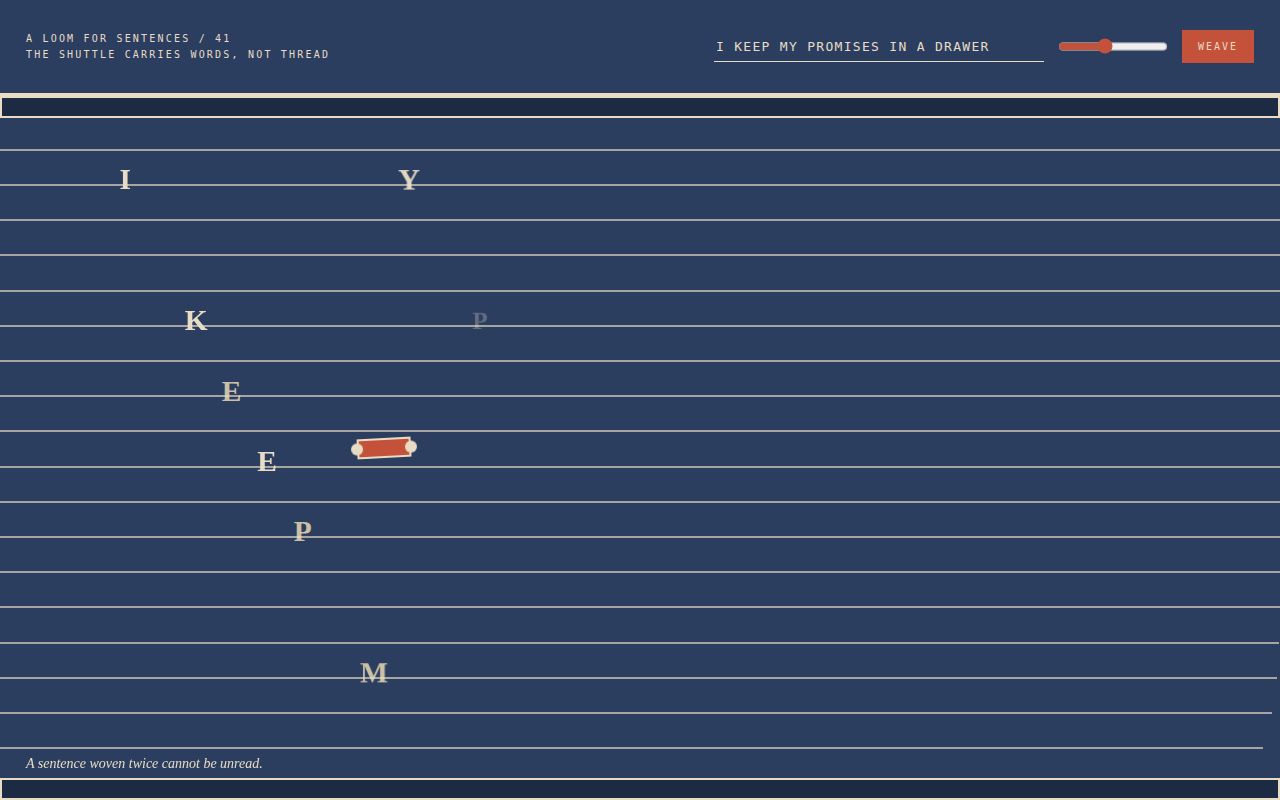
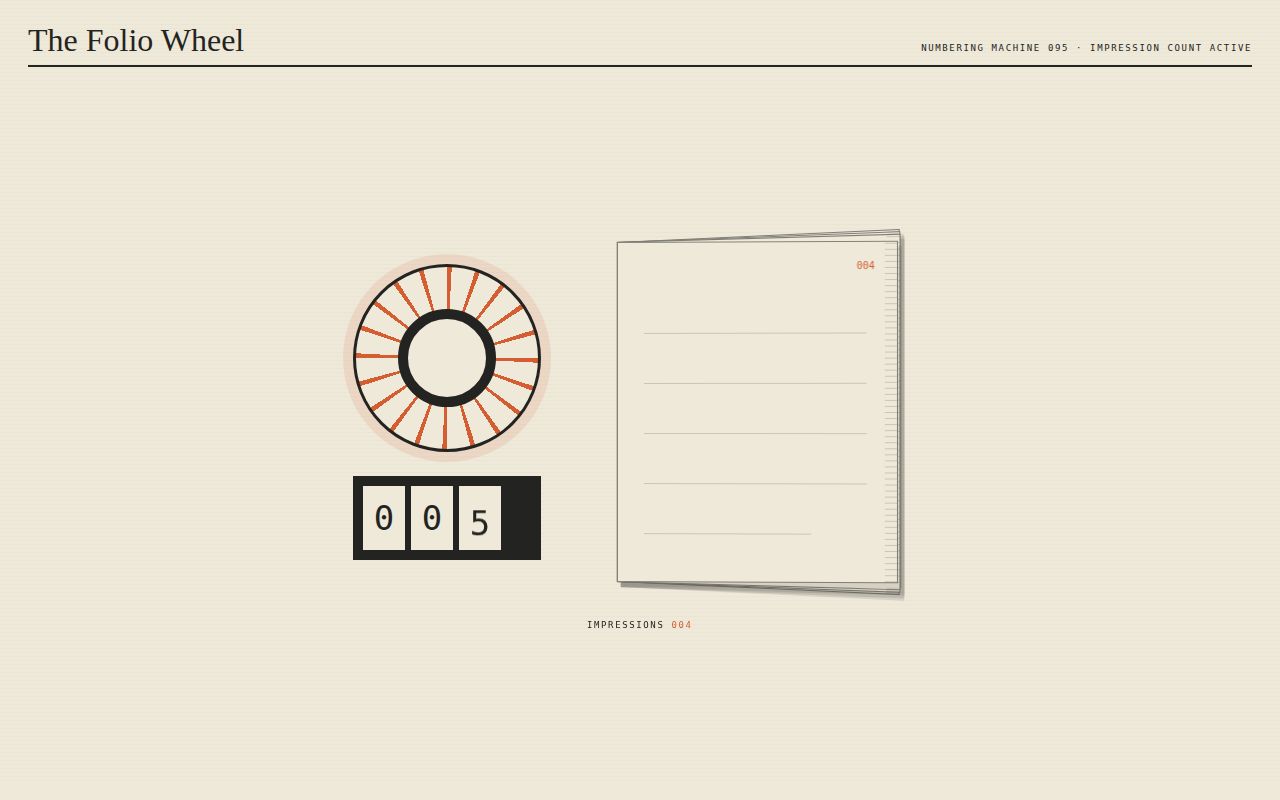
A loom that weaves phrases instead of cloth. The shuttle carries each letter across alternating threads, hiding it briefly beneath the warp.
Open
Original prompt
A tabletop loom on indigo #2B3E60, built from linen #E8DCC4 warp threads and one vermilion #C4513A shuttle. The loom fills the viewport: twenty horizontal warp threads stretched between two dark beams. At the top, a styled input holds the phrase “I KEEP MY PROMISES IN A DRAWER”. Pressing WEAVE sends the shuttle across: each character is carried across a row, alternating over and under the warp, so the finished cloth reads as a physical sentence rather than text on fabric. The shuttle's path is a smooth accelerating sweep with a small snap at each edge. A tension slider changes how tightly the threads pull, making the letters compress or spread. Copy at bottom: “A sentence woven twice cannot be unread.” Entrance: warp threads tighten one by one from the left, then the shuttle drops into place. Signature moment: each character briefly disappears beneath a thread before emerging on the other side — an over-under reveal that happens letter by letter. No emoji, no glass, no gradients on type. Reduced motion shows the woven result immediately.
041-loom-for-sentences.html
042
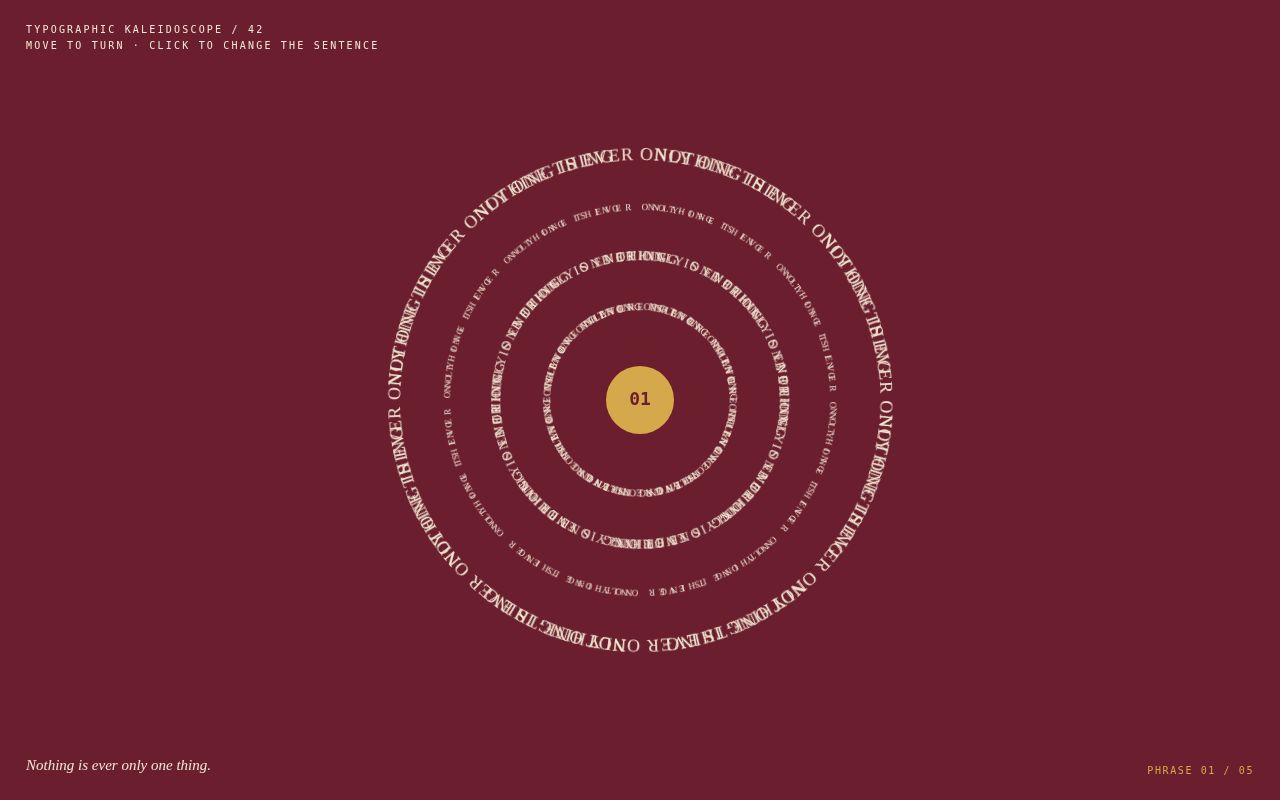
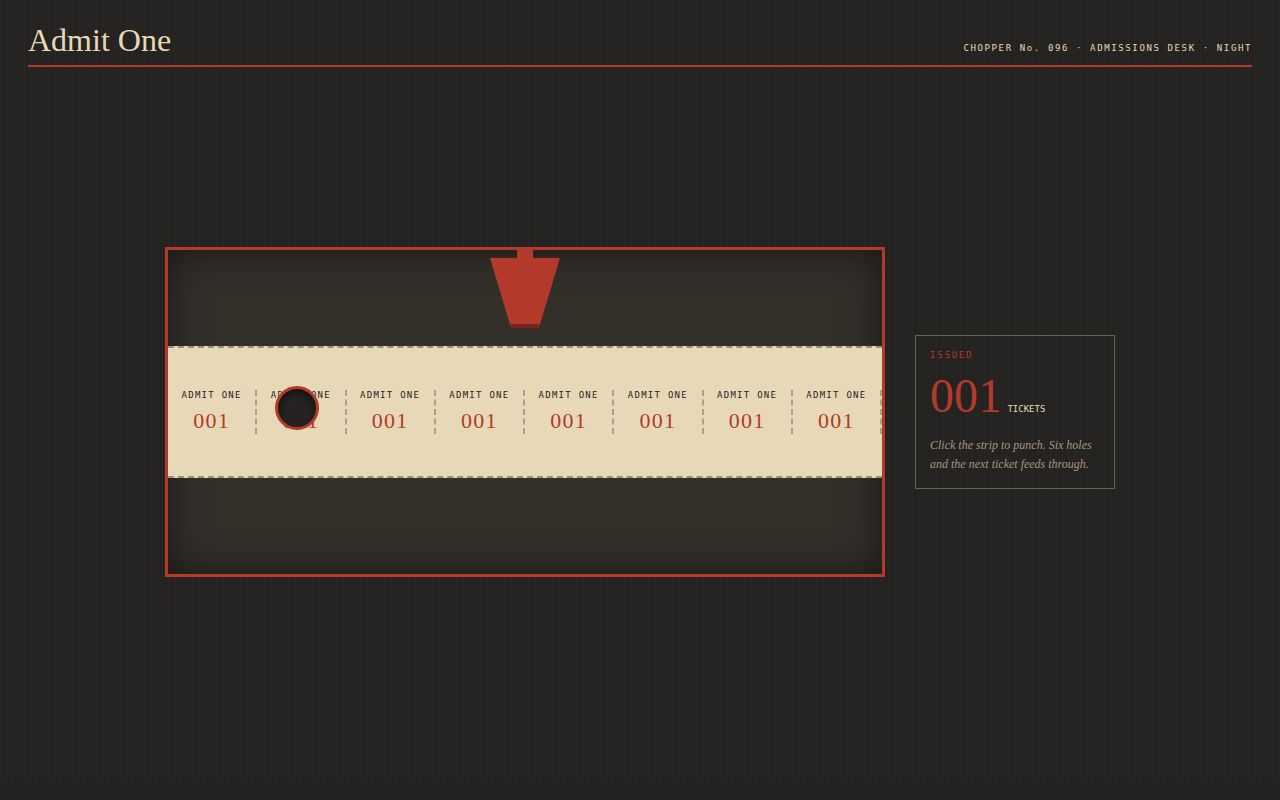
A kaleidoscope built from sentences. Eight mirrored wedges turn with the pointer, and each rotation produces accidental new readings at the seams.
Open
Original prompt
An oxblood #6B1F2E field holding a circular kaleidoscope made entirely of cream #F2E7D2 type and one gold #D6A84C centre. Eight identical wedges radiate from the centre, each containing a curved line of text set along an arc; together they form a mandala of letters with no drawn ornament. The current phrase is “NOTHING IS EVER ONLY ONE THING”. Moving the pointer rotates the whole figure with a slow, weighted follow; dragging holds it still. Clicking cycles through four other phrases: “A SMALL FURNACE OF YES”, “THE WORLD IS A VERB”, “WE MET IN THE MARGIN”, “COUNT THE QUIET PARTS”. A gold counter in the centre shows the phrase number. Entrance: the eight wedges arrive one at a time from outside the circle and click into the centre. Signature moment: at rest, the repeated letters accidentally form new words across wedge boundaries; rotating reveals different accidental readings. No emoji, no glass, no gradients on type. Reduced motion allows rotation by click only.
042-typographic-kaleidoscope.html
043
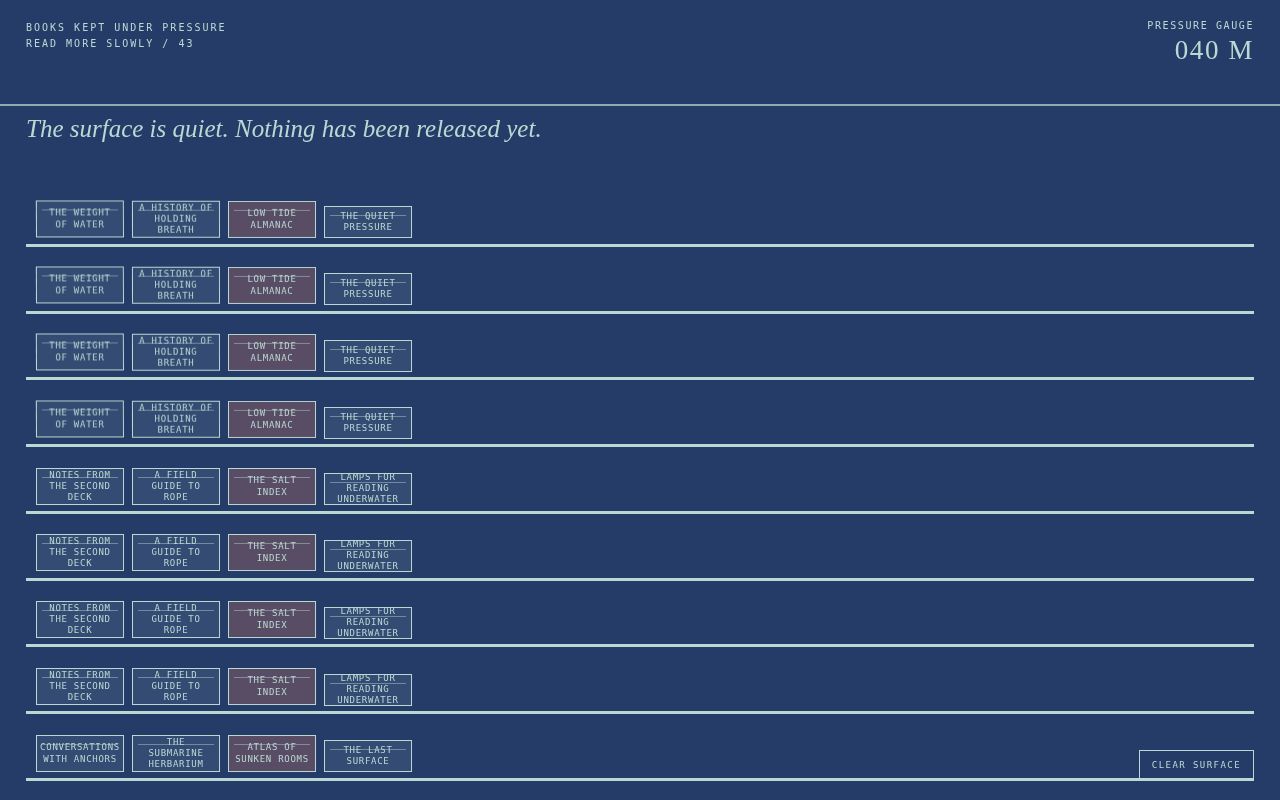
A library at the bottom of the sea. Opening a book releases its words as bubbles that rise and assemble into a sentence at the surface.
Open
Original prompt
An underwater reading room in deep indigo #253B68, lit by pale aqua #BBD9D3. Six shelves are bolted to the wall, each holding four books whose spines are drawn as flat rectangles with small brass bands and invented titles: THE WEIGHT OF WATER, A HISTORY OF HOLDING BREATH, LOW TIDE ALMANAC, THE QUIET PRESSURE, NOTES FROM THE SECOND DECK, etc. Books drift very slightly, as if in current. Clicking a book opens it: single words rise from its pages as bubbles in aqua, wobbling upward with varying speeds until they reach the surface line at the top, where they pop into a short sentence specific to that book. A pressure gauge at right reads DEPTH 040 M and shifts by a metre for each opened book. Copy upper left: “BOOKS KEPT UNDER PRESSURE READ MORE SLOWLY.” Entrance: the shelves sink into place and the books settle after them. Signature moment: the bubble sentence assembles word by word at the surface rather than appearing at once. No emoji, no glass, no purple. Reduced motion shows the sentence immediately.
043-submarine-library.html
044
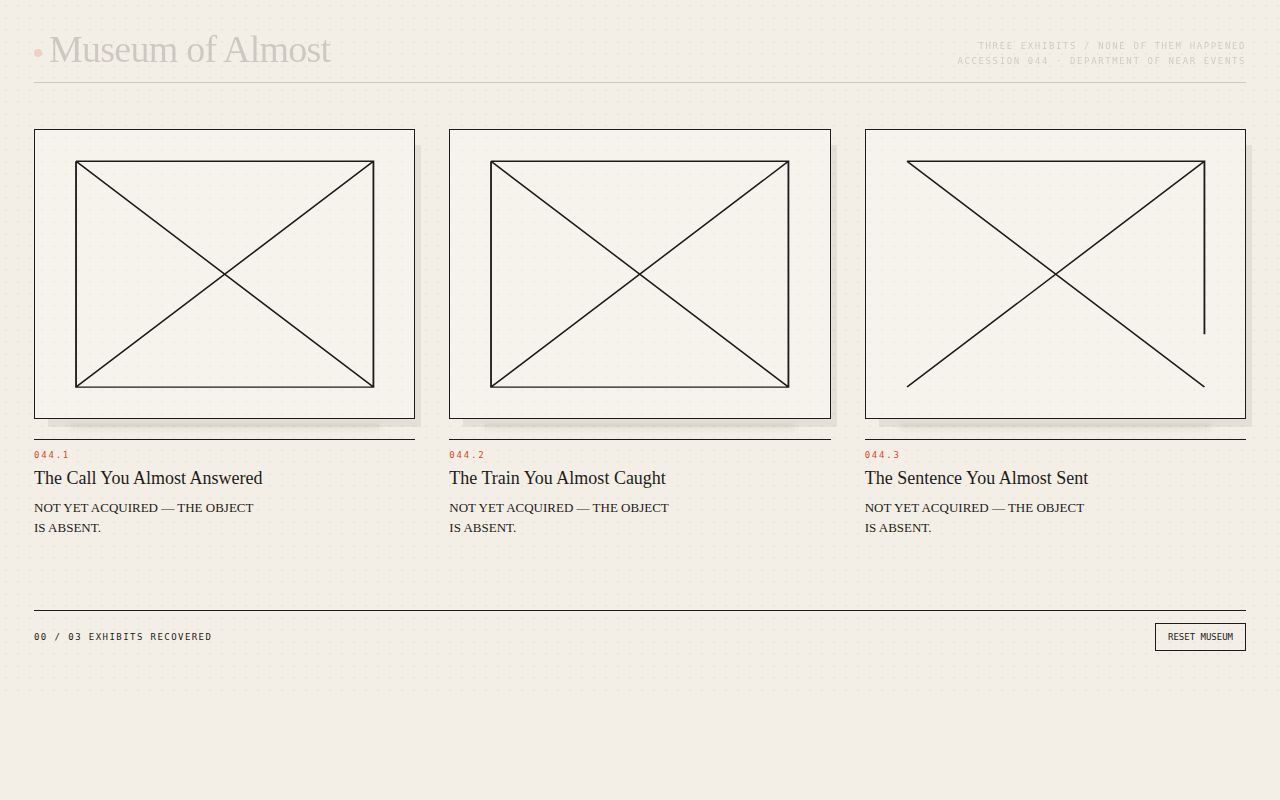
A museum where the exhibits are the things that nearly happened. Three empty vitrines fill with red line-drawings and small, precise stories.
Open
Original prompt
A warm off-white #F4EFE6 gallery wall with charcoal #1D1B19 type and one vermilion #D3482B accession dot. Three empty vitrines sit on thin pedestals, each labelled with an invented catalogue number and an “almost” object: 044.1 THE CALL YOU ALMOST ANSWERED, 044.2 THE TRAIN YOU ALMOST CAUGHT, 044.3 THE SENTENCE YOU ALMOST SENT. The vitrines are genuinely empty at first — just a fine charcoal outline and a soft paper shadow. Clicking one draws the absent object in a single continuous vermilion line, as if an etcher were working it into the glass; the placard then changes from a short factual label to a specific, quietly devastating story about that near-event. A thin progress rule shows 01 / 03. Entrance: the vitrine outlines draw themselves one after another, then the wall text fades in. Signature moment: the line drawing animates stroke by stroke and the story text types in only after the drawing completes. No emoji, no gradients, no cards with rounded corners. Reduced motion shows the finished line and text at once.
044-museum-of-almost.html
045
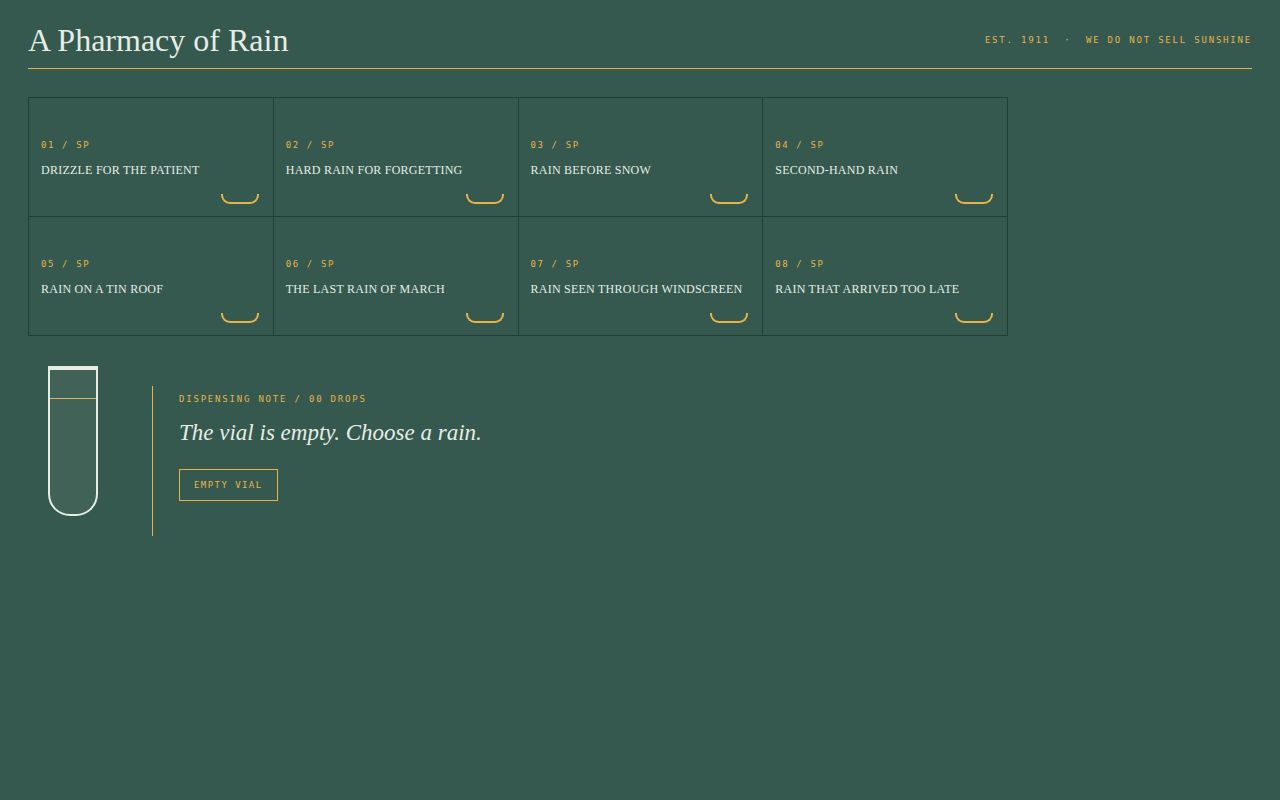
An apothecary where the medicines are kinds of rain. Each drawer dispenses a measured dose into a vial, followed by a prescription for a small human difficulty.
Open
Original prompt
A mineral-green #35594F apothecary cabinet with chalk #E6EDE5 labels and amber #E8B44A brass pulls. Eight small drawers form a strict grid; each is labelled with a specific rain: DRIZZLE FOR THE PATIENT, HARD RAIN FOR FORGETTING, RAIN BEFORE SNOW, SECOND-HAND RAIN, etc. Clicking a drawer slides it open and dispenses eleven amber drops into a hanging glass vial below, one at a time, with irregular beats. When the vial reaches the marked line, a printed prescription appears beside it: “Take three drops before answering a letter you have avoided.” A small sign at top reads “WE DO NOT SELL SUNSHINE.” Entrance: the drawers click shut in a quick staggered sequence from a slightly open position. Signature moment: the vial fills drop by drop and each drop briefly refracts the drawer’s label upside down. No emoji, no glassmorphism panels, no gradients on the cabinet. Reduced motion fills the vial instantly.
045-pharmacy-of-rain.html
046
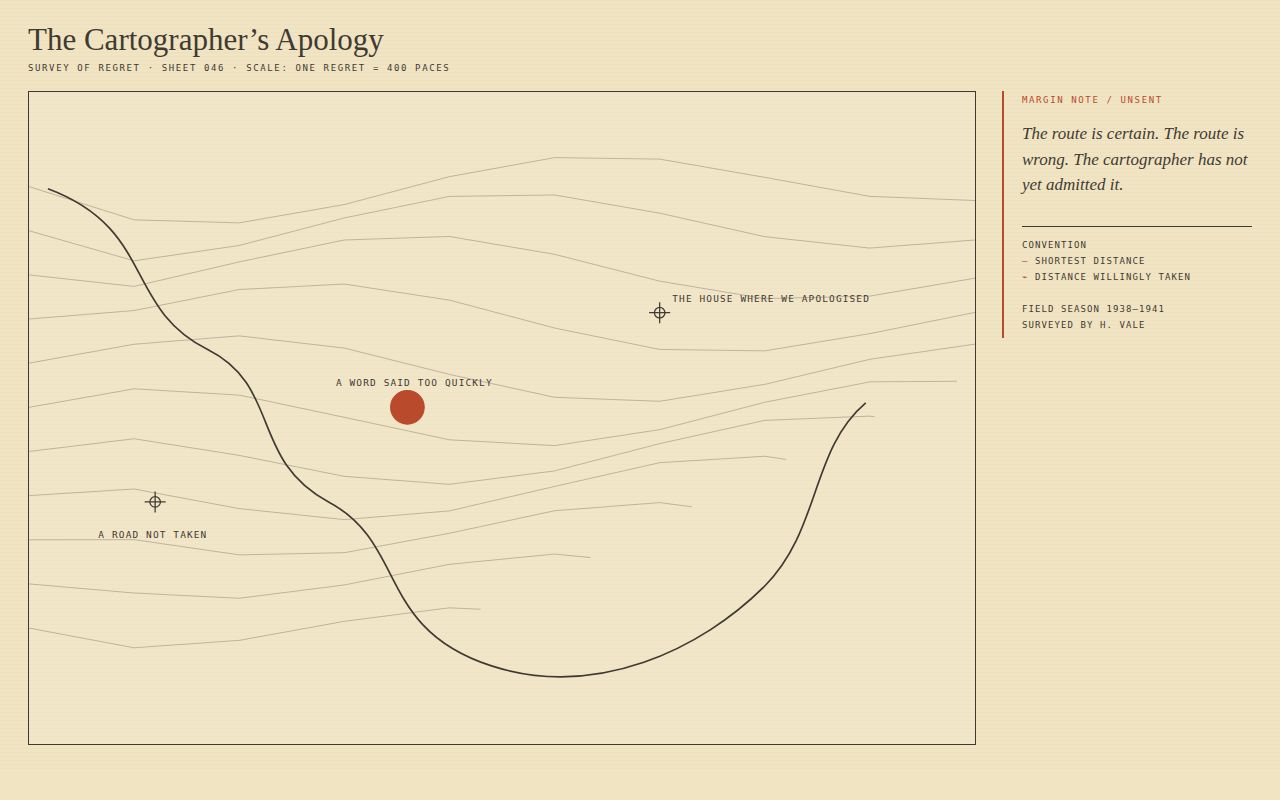
A survey map that redraws its own route when the cartographer admits a mistake. The shortest line gives way to the one that goes back.
Open
Original prompt
A parchment #F1E4C3 map in the style of a 1930s survey: ink #3F3A32 contour lines, a vermilion #B94A2B route, no gradients. The map shows the coast of a fictional country called Regret with three marked points: A ROAD NOT TAKEN, A WORD SAID TOO QUICKLY, AND THE HOUSE WHERE WE APOLOGISED. A small legend reads “SCALE: ONE REGRET = 400 PACES”. At first the red route connects the first two points in a straight, certain line. Clicking the second marker makes the line bow outward and reroute to the third point, while a typed apology appears in a boxed margin note: “I drew you as a place I could leave. I was wrong about the roads.” Clicking again straightens the line and erases the note. Entrance: the contour lines appear from left to right like a plotter drawing them, then the red route draws itself with a dry pen. Signature moment: the route physically bends away from the coast and finds the third point, with the pen pausing at a small border crossing before continuing. No emoji, no glass, no UI chrome. Reduced motion switches routes instantly.
046-cartographers-apology.html
047
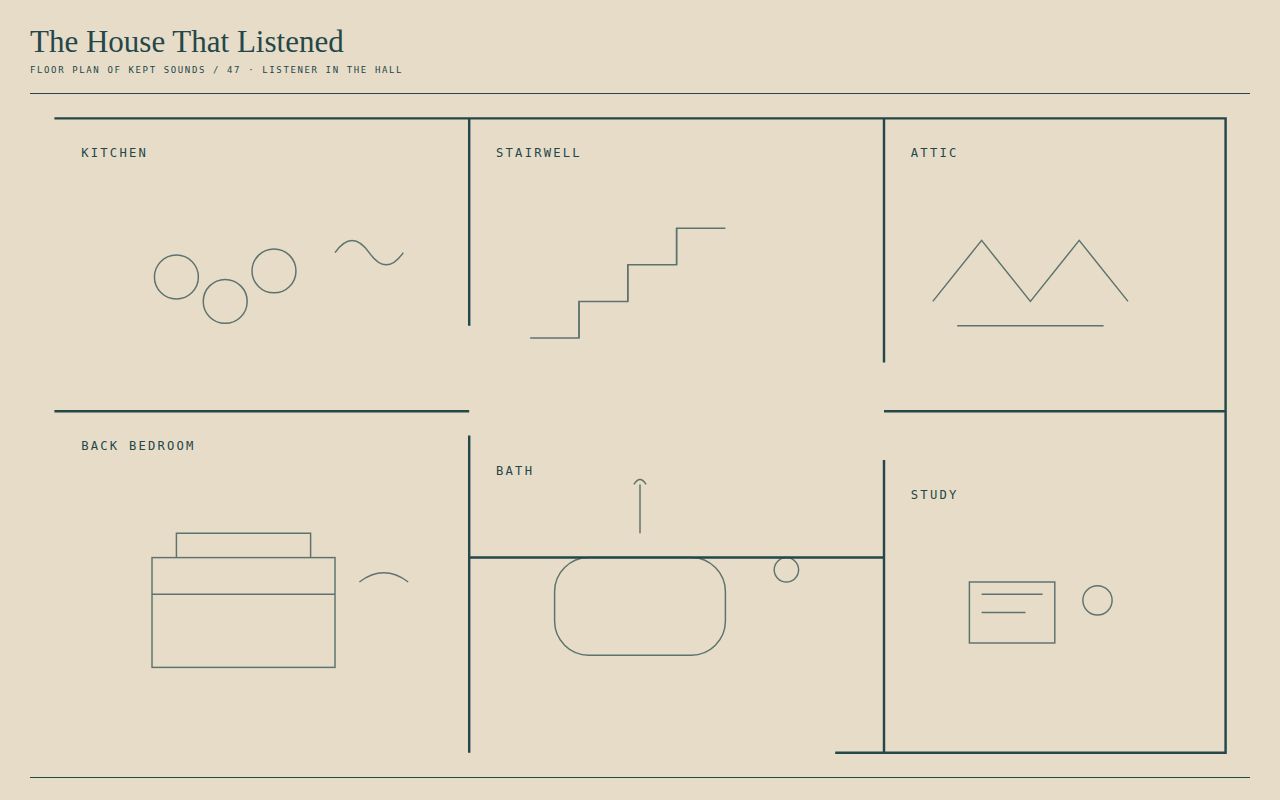
An architectural plan of a house that has kept every sound. Selecting a room replays what it heard, visualized as ripples travelling through doorways.
Open
Original prompt
A warm plaster #E7DCC8 page holding a precise floor plan drawn in deep teal #24474A; one mustard #D99A2B dot marks the listener’s position in the hall. Six rooms are labelled in small caps: KITCHEN, STAIRWELL, BACK BEDROOM, BATH, STUDY, ATTIC. Each room contains a thin illustration of the sound it keeps: three cup rings, a creaking stair tread, a radiator tick, a dripping tap, a typewriter key, a loose slate. Clicking a room sends mustard concentric ripples outward from its centre and prints the room’s remembered sound in a narrow caption strip at the bottom: “KITCHEN / 7:12 AM / THE KETTLE REACHED ITS BOILING POINT FOUR TIMES BEFORE ANYONE CAME.” Only one room sounds at a time; the previous ripples collapse into a single dot. Entrance: walls draw themselves room by room, then the mustard listener appears with a slow pulse. Signature moment: the ripple rings pass through doorways into adjacent rooms before fading, so the plan becomes a diagram of hearing. No emoji, no glass, no gradients. Reduced motion shows caption and a single ring.
047-house-that-listened.html
048
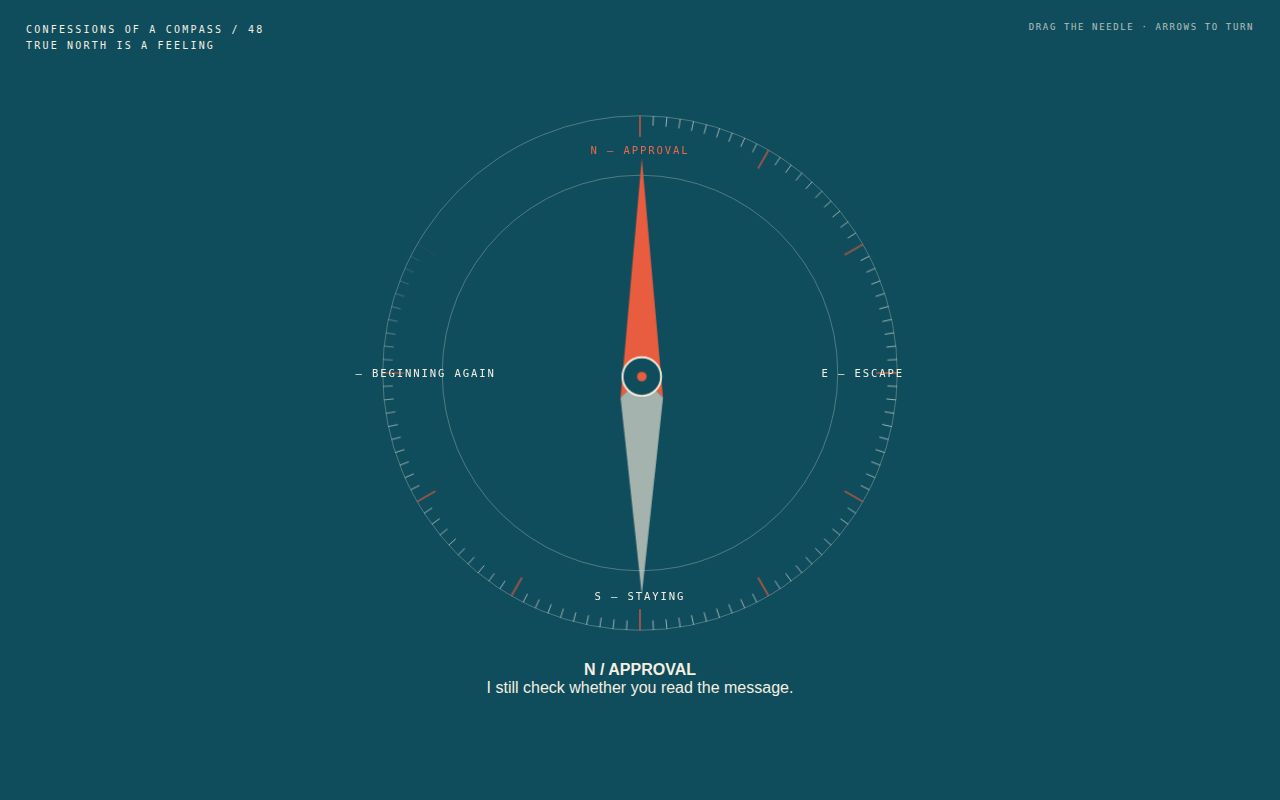
A compass whose north is emotional rather than geographic. Drag the needle to find what it actually points toward; it always ends somewhere honest.
Open
Original prompt
A deep teal #0F4C5C field with cream #F5EFE1 engraved type and a vermilion #E85D3F needle. A large compass rose fills the centre, its cardinal marks replaced by four human directions: N — APPROVAL, E — ESCAPE, S — STAYING, W — BEGINNING AGAIN. The needle points north on load and trembles slightly, as if uncertain. Drag the needle around the dial: the direction labels glow as it passes, and a small cream caption under the dial updates with the confession for that quarter: “N: I still check whether you read the message.” Release and the needle swings past the true direction twice before settling, spring-like. A thin ring of degree ticks is drawn in cream, with every thirtieth tick in vermilion. Entrance: ticks appear clockwise in a quick sweep, then the needle drops in from above with a damped bounce. Signature moment: the needle overshoots and returns, and the caption word “APPROVAL” is crossed out and rewritten as “SOMETHING LIKE APPROVAL” when settled. No emoji, no glass, no gradients. Reduced motion snaps without overshoot.
048-confessions-of-a-compass.html
049
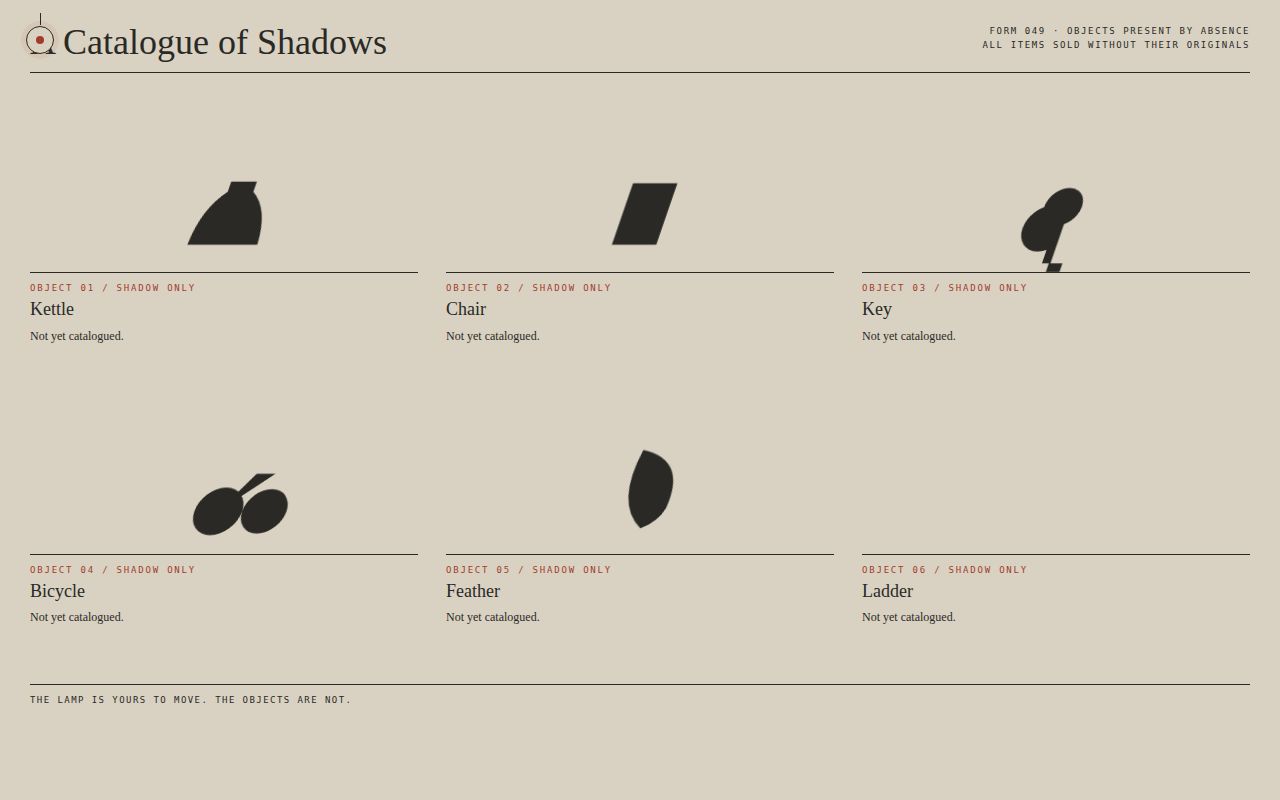
A product catalogue that shows only shadows. A movable lamp changes every silhouette at once, and each click tells the story of the absent object.
Open
Original prompt
A warm grey #D9D2C2 catalogue page with ink #2A2926 typography and rust #A33B2C folio marks. Six objects are represented only by their cast shadows on a plain wall: a kettle, a chair, a key, a bicycle, a feather, a ladder. Each shadow is a flat ink silhouette with a fine hatch texture. A small lamp icon in the upper right follows the pointer horizontally, and every shadow leans away from it: near the lamp a shadow is short and steep; far away it stretches and skews. Clicking a shadow gives it a rust outline and reveals a catalogue entry beneath: “OBJECT 04 / BICYCLE — Owned by someone who left in a hurry. The front wheel was removed so it could fit under a bed.” Entrance: the lamp switches on, shadows grow from their anchor points one at a time. Signature moment: dragging the lamp across the page makes all six shadows turn together as if a single sun were moving. No emoji, no glass, no gradients. Reduced motion keeps shadows static but click still reveals entries.
049-catalogue-of-shadows.html
050
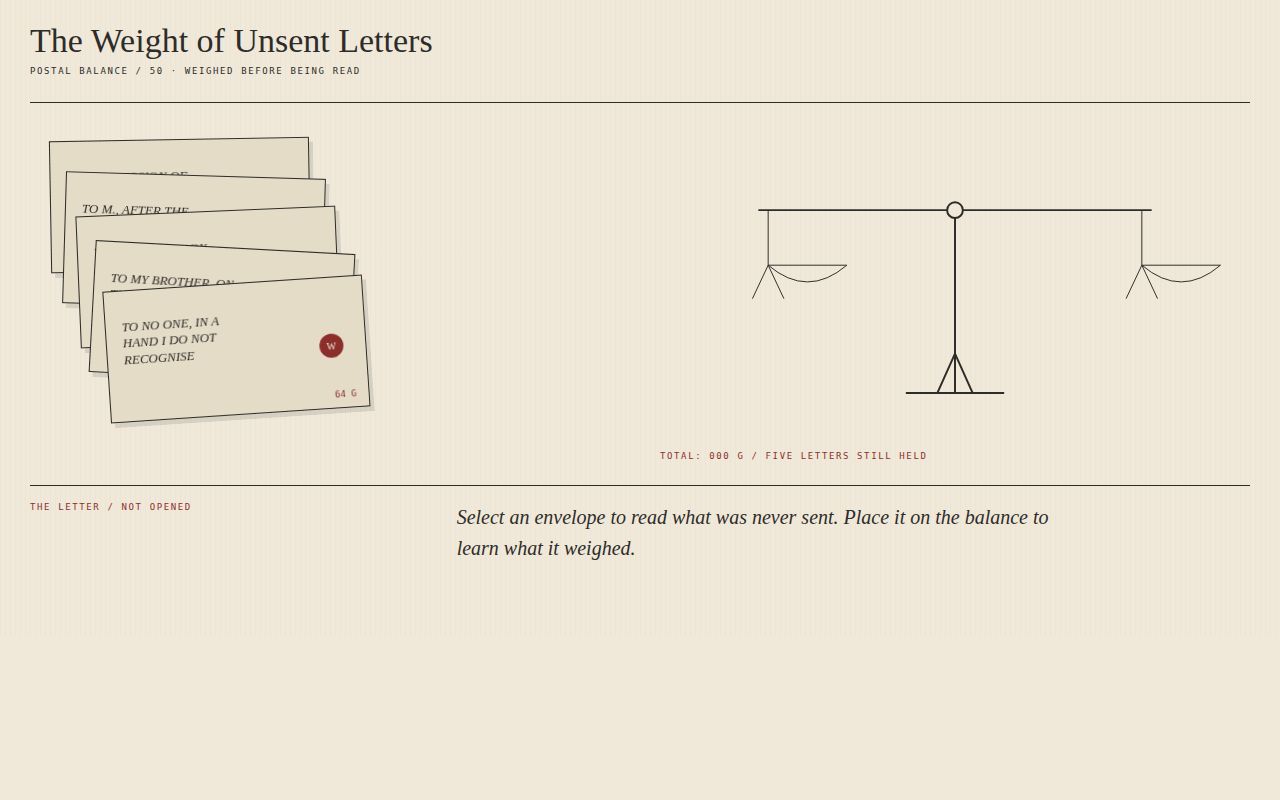
Five letters were never posted. Each has a weight the postal service would not recognize. Place them on a balance and read what they said.
Open
Original prompt
A paper #F0E9DA desk with ink #2E2C29 rules and a single red wax #8C2F2A seal. At left, a stack of five unsent envelopes, each addressed in a different hand: “TO THE VERSION OF ME WHO STAYED”, “TO M., AFTER THE RAIN”, “TO THE LANDLADY, EXPLAINING THE PIANO”, etc. At right, a brass balance scale drawn in thin ink lines, its left pan empty. Dragging an envelope to the pan makes the beam tilt by an amount proportional to the letter’s secret weight (from 12 g to 140 g), and a small counter prints “TOTAL: 012 G / THREE LETTERS STILL HELD”. Dropping two envelopes on the pan stacks them with a slight, satisfying settle. Clicking an envelope opens it: a short, specific unsent letter in a serif hand, with the wax seal cracking into two halves. Entrance: envelopes slide in from the left edge and come to rest with tiny rotations; the balance settles after them. Signature moment: the balance beam overshoots, springs back and holds the exact angle while the pan jitters for a moment under the new weight. No emoji, no glass, no gradients on the paper. Reduced motion places envelopes without animation.
050-weight-of-unsent-letters.html
051
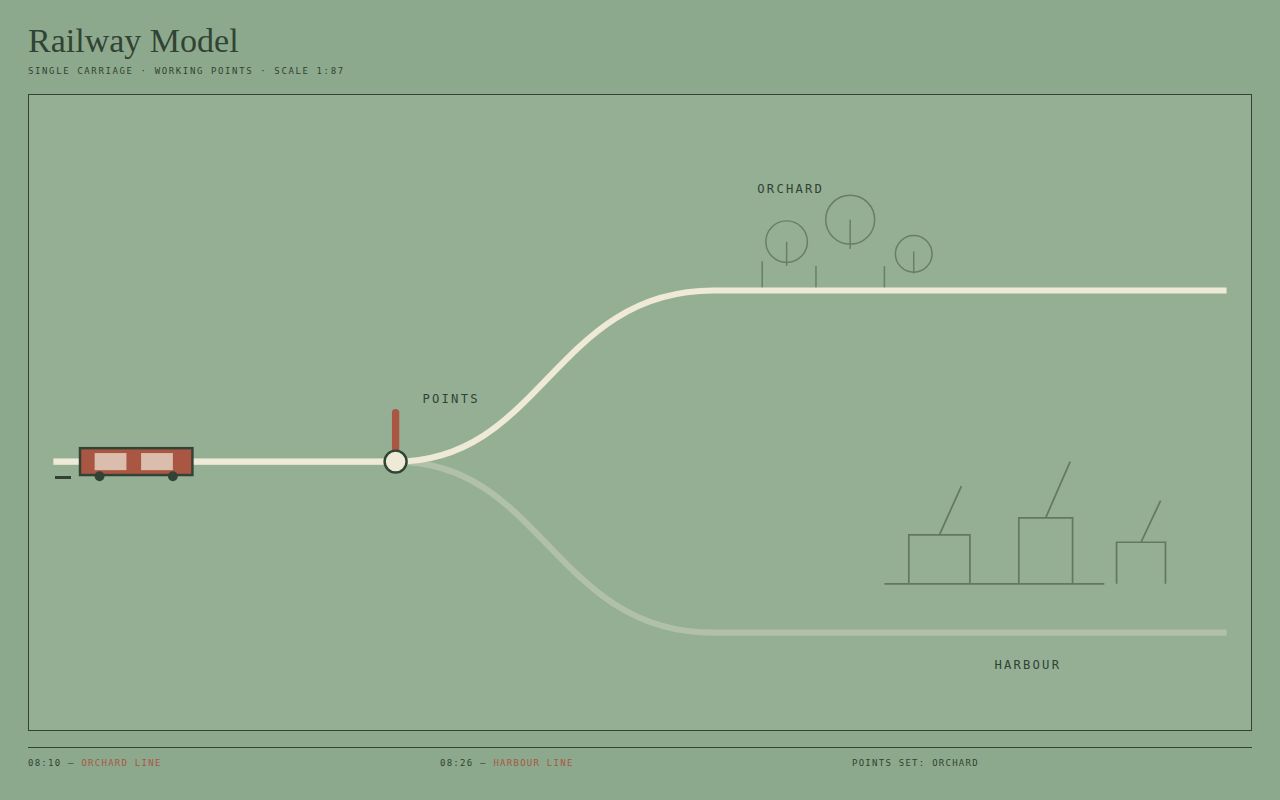
A tabletop railway with a working points lever. Throw the switch and the moving train bends through the junction onto a different line without breaking stride.
Open
Original prompt
A sage #8DA98D tabletop model railway seen from above, with cream #EFE9D8 ballast lines and a brick #A95643 single carriage. Two routes diverge at a working set of points: the ORCHARD LINE curves around a small painted orchard; the HARBOUR LINE runs toward a drawn quay with three cranes. One tiny lever beside the points can be clicked. The train travels continuously; when the lever is thrown, the switch blade swings across and the train takes the newly selected line without ever stopping — its nose follows the new rails while its tail is still on the old ones. A printed timetable at the lower left reads: “08:10 ORCHARD / 08:26 HARBOUR / 08:41 EITHER”. Entrance: rails draw from the station outward, then the carriage rolls in from the left edge. Signature moment: the carriage’s two bogies briefly follow different paths during the switch, so the whole train bends through the junction. No emoji, no glass, no gradients. Reduced motion switches at the next station stop.
051-railway-model.html
052
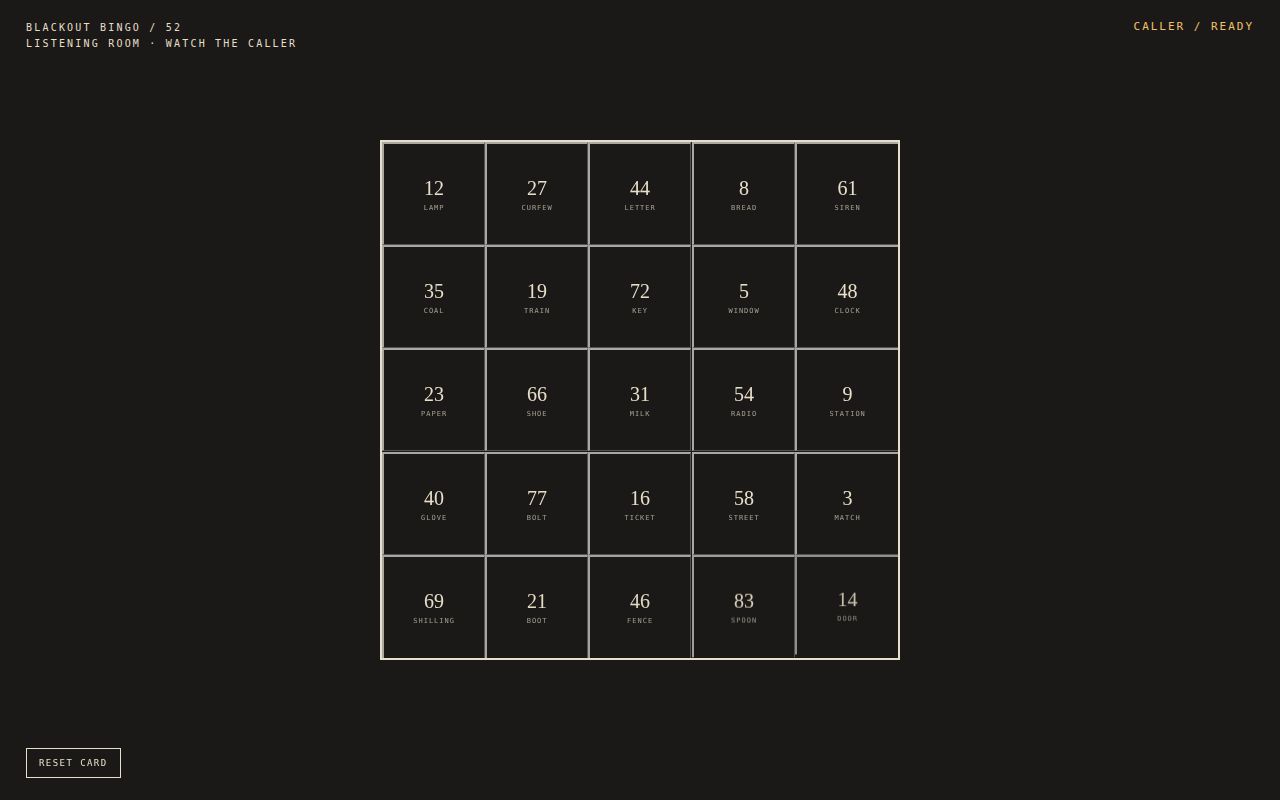
A blackout-era bingo game where a completed line turns off the whole room except one hanging bulb. The last number is the one that matters.
Open
Original prompt
A wartime listening-room bingo card in near-black #111110 with cream #E8DFC9 type and red #A9322B called-number stamps. A 5×5 card fills the centre; each square bears a number and a small object word: 12 LAMP, 27 CURFEW, 44 LETTER, etc. A caller strip at the top announces numbers every 1.8 seconds in a cream ticker. Clicking a square marks it with a red X; when the caller announces a number you have marked, it stamps automatically. Completing any row, column or diagonal drops the room to black except for one warm #F3C06B bulb hanging above the card, its light a narrow cone. The words “BLACKOUT — ONE LINE” appear in the bulb’s glow. A RESET CARD control restores the room. Entrance: the caller strip types its first number, then the card squares flip in one by one. Signature moment: the dimming is staged — first the corners, then the edges, then everything but the bulb — with a soft relay click at each stage. No emoji, no glass, no gradients in the type. Reduced motion marks instantly.
052-blackout-bingo.html
053
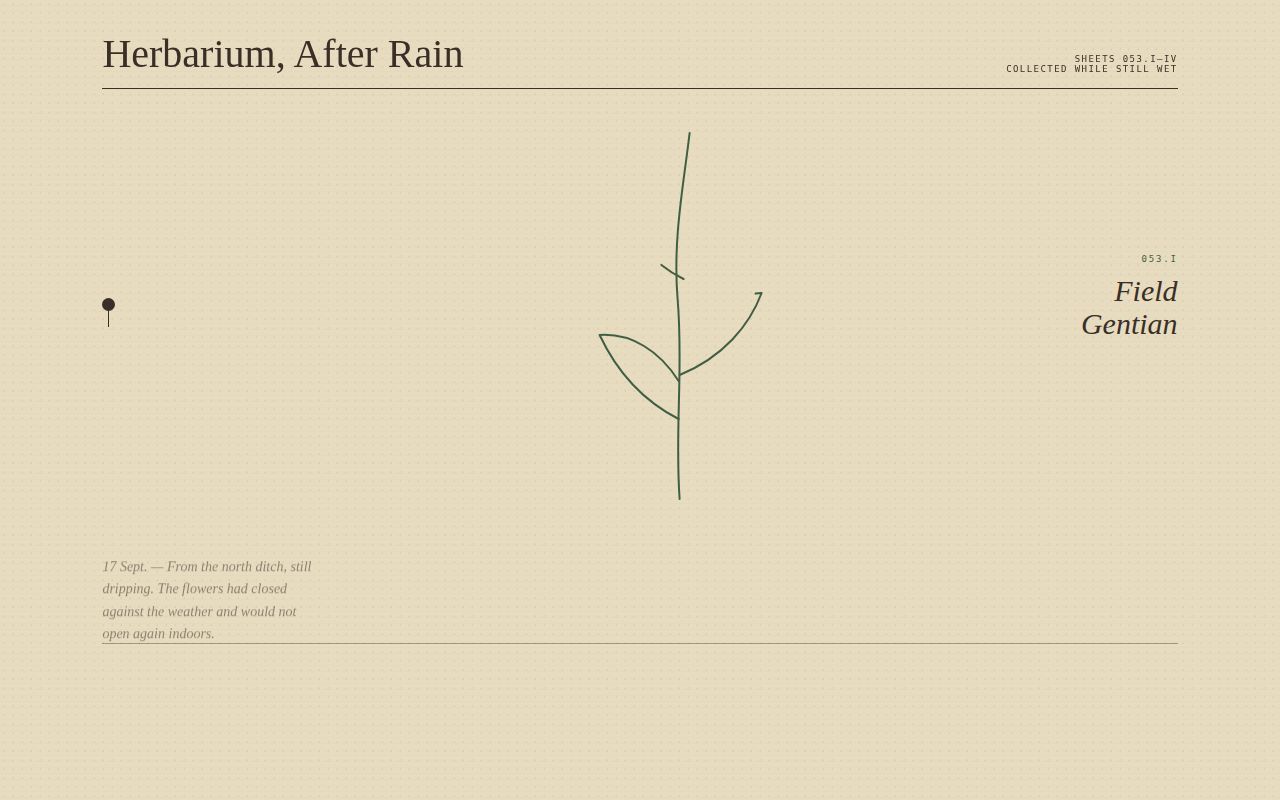
A botanical collection that draws itself after a shower. Each pressed plant unfurls on scroll, and water beads gather at the leaf tips before running down the stem.
Open
Original prompt
A foxed herbarium sheet #E8DCC0 with ink #3A2F27 handwriting and deep green #3F5E42 plant drawings. Four pressed specimens are pinned at different heights: FIELD GENTIAN, ROUND-LEAVED SUNDEW, MARSH THISTLE, WATER AVENS. Each specimen is drawn as a single continuous green line that has not yet been drawn — only a small pin and a pencil label are present at first. Scrolling brings each plate into view; as it enters, the stem draws upward from the pin, leaves unfurl one after another, and small droplets form at the leaf tips and slide down the stem before hanging at the lowest point. A handwritten note beside each plate gives a date and a place: “17 Sept. collected from the north ditch, still dripping.” Entrance: paper fibre grain fades in, then the first pin appears. Signature moment: the final drop at each leaf tip waits, swells, then runs down the stem along the exact path of the drawing. No emoji, no glass, no gradients on type. Reduced motion shows all plates drawn and drops still.
053-herbarium-after-rain.html
054
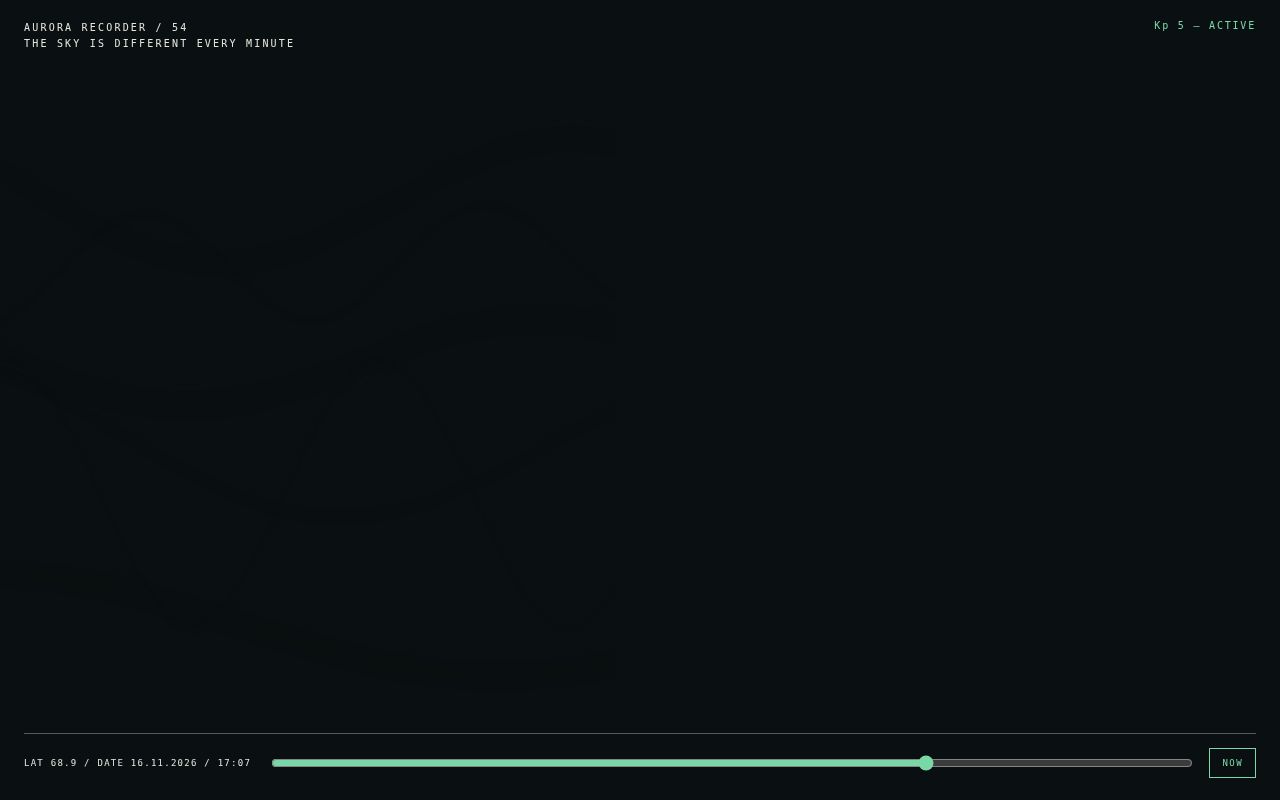
A magnetic recorder that turns the current date and minute into a unique aurora. Drag the time strip and the ribbons rewrite themselves for that minute.
Open
Original prompt
A near-black #0A1012 sky holding six slow ribbons of light in mint #79D8A5 and dusk pink #D98AB5. This is not a decorative aurora: the shape is seeded from today’s actual date — day, month, year, and the number of minutes since midnight — so it is different every visit. A thin cream coordinates strip along the bottom prints “LAT 68.9 / DATE 14.11.2026 / MINUTE 0431” and a draggable time scrub from 00:00 to 24:00. Dragging the scrub recomputes the sky for that minute; the ribbons twist and reorganise rather than fading out and back. A single line of data at left reads “Kp 5 — ACTIVE”. Entrance: ribbons draw from the left horizon like long-exposure film being pulled through a camera, then hold with a very slow breathing motion. Signature moment: the ribbons cross each other without blending; at crossings, the lower ribbon dims for one frame, like translucent tape. No emoji, no gradient-filled headlines, no glass. Reduced motion renders one still frame.
054-aurora-recorder.html
055
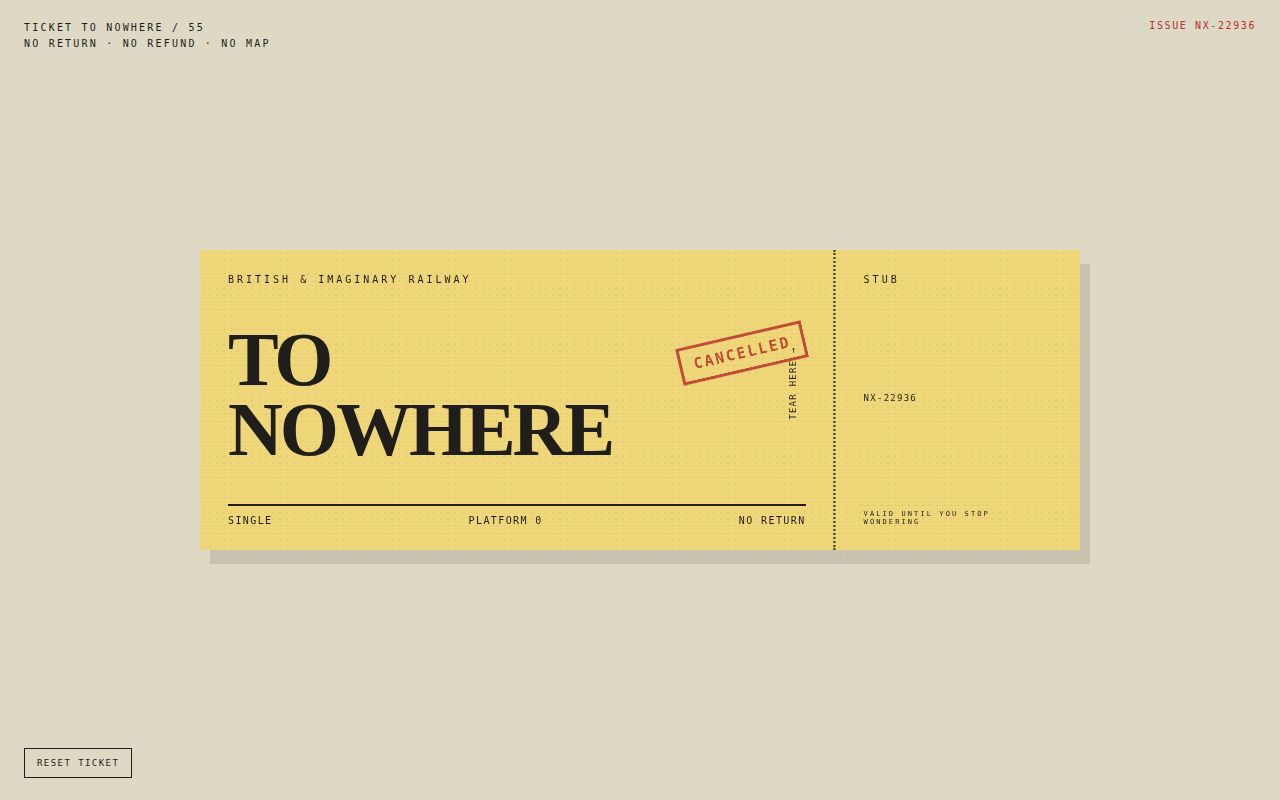
A physical-feeling ticket you can tear in two. The half that stays behind has a different serial number each visit and a small note on the back.
Open
Original prompt
A butter-yellow #F0D77A ticket printed in black #201E1A with red #BA312A cancellations. It is a full-width rail ticket reading “SINGLE / TO NOWHERE / NO RETURN”, with a perforated stub on the right. A small instruction, set in the ticket’s own typography, says: “TEAR HERE — THE OTHER HALF KEEPS GOING.” Dragging across the perforation tears the ticket with a fine jagged edge; the right half slides away a few centimetres, leaving the left half behind. The remaining stub shows a serial number that changes on every visit and a tiny printed line: “VALID UNTIL YOU STOP WONDERING.” Clicking the stub flips it over to reveal a handwritten note on the back: “I took this instead of the train. I have never regretted the platform.” Entrance: the ticket prints itself from left to right, then the red cancellation stamp lands with a hard offset. Signature moment: the tear follows the pointer with a paper-fibre edge rather than a straight cut, and the two halves separate at different speeds. No emoji, no glass, no gradients. Reduced motion tears instantly.
055-ticket-to-nowhere.html
056
A small garden of brass tuning forks. Each note opens one flower; play a chord and three flowers pass the note between them.
Open
Original prompt
A sage #B9CBA8 garden page with cream #F2ECD9 petals and ochre #B88A42 tuning forks. Six brass forks stand in a row, each labelled with a note: C, E, G, B♭, D, F. Beneath them, six closed cream flowers are drawn as overlapping petal outlines. Clicking a fork sounds its note with a Web Audio oscillator and sends a visible ring of vibration across the soil; the matching flower opens in four slow petal movements, then closes halfway, leaving a small ochre seed visible. Clicking two forks whose notes form a chord (C–E–G or B♭–D–F) makes all three flowers in that chord open together and briefly turn the soil cream. A sign reads “PLEASE PLAY QUIETLY — THE GARDEN IS LISTENING”. Entrance: forks ring once silently, then the flowers close from a half-open position. Signature moment: the chord detection causes the three flowers to breathe in sequence rather than at once, like a held note being passed between them. No emoji, no glass, no gradients. Reduced motion: no sound, flowers toggle open instantly.
056-tuning-fork-garden.html
057
A phosphor sonar display with contacts that brighten as the sweep passes. One contact quietly changes its bearing each time the beam returns.
Open
Original prompt
A working sonar console in black #07100E with phosphor green #6ED49B and pale #D5E7DD lettering. A circular scope fills most of the screen, crossed by fine range rings and a rotating green sweep whose trailing edge leaves a faint afterglow. Seven contacts drift slowly across the scope: two are marked FISH, one WRECK, one UNKNOWN, and three are unlabelled. Each contact flares briefly when the sweep passes it, then fades to a dim point. A rotary dial below the scope can be dragged left or right to change sweep speed from 4 to 24 revolutions per minute; a small readout prints “SWEEP 12 RPM / RANGE 800 M”. A log at right records the last four detections with timestamps: “03:14:22 — CONTACT 04 / WRECK / BEARING 217°”. Entrance: the sweep powers up from a single line and the scope rings appear one by one. Signature moment: the UNKNOWN contact changes bearing whenever the sweep has passed it three times, as if it is moving away. No emoji, no glass, no purple. Reduced motion renders a still scope.
057-deep-sea-sonar.html
058
A bake sale designed as a Bauhaus poster. Each geometric pastry has a split-flap price that falls into place when selected.
Open
Original prompt
A flat geometric poster in cream #F3EBDD built from red #D84032, yellow #F0C626 and blue #2E62A0 shapes. The header reads “BAUHAUS BACKSTUBE / FORM FOLLOWS APPETITE” in strict upper-case type with extreme scale contrast. Six pastries are arranged as pure geometry: a semicircular pretzel, a rectangular slice of seed cake, concentric-ring bun, quarter-circle streusel, triangular pastry, and a circle of four biscuits. Each has a number and a mechanical price flap showing “—” initially. Clicking a pastry rotates its flap down like a split-flap display to reveal a price and a one-line description: “NO. 03 / RINGBUN / 18 PFENNIG / CINNAMON, HONEY, ONE ALMOND.” A yellow circle behind a selected pastry slides to it, and the remaining pastries dim slightly. Entrance: shapes arrive in strict sequence — circle, rectangle, triangle — then the type prints. Signature moment: the price flap rotates with a two-stage mechanical snap and the yellow selection disc travels along a hidden rail. No emoji, no glass, no gradients. Reduced motion switches instantly.
058-bauhaus-bake-sale.html
059
Four letters that are also hourglasses. Flip the word and the sand hangs, then falls the other way through the counters.
Open
Original prompt
A charcoal #1E1C19 field holding four enormous sand-coloured #D7B878 letters: H O U R. Each letter is an hourglass: sand grains collect in its upper half and fall through the counters and narrow waists into the lower half. Teal #2E6A65 marks the thin glass outline around each letter. A metal hinge at the top lets the whole word be flipped; clicking FLIP rotates the word 180 degrees with a heavy, slow motion, and the sand that had settled at the bottom begins falling upward through the letters as if gravity had reversed. A small counter reads “SAND REMAINING 74%”. Entrance: letters fill from empty, grain by grain, in a rapid rush that slows to a trickle. Signature moment: during the flip, grains briefly hang motionless in the centre of each letter before choosing a new direction. No emoji, no glassmorphism panels, no gradient text. Reduced motion shows a still half-filled word.
059-hourglass-type.html
060
An answering machine whose paper tape unwinds as it replays four missed calls. The messages type themselves exactly where the tape has emerged.
Open
Original prompt
A cream #EEE8DA answering-machine face with black #252321 mechanical type and a red #B13B33 record light. A cassette sits in the centre with two reels and a strip of paper tape hanging from it. A large red PLAY control sits below. Clicking PLAY slowly unwinds the tape: a paper strip grows downward from the cassette, and a typewriter head prints one missed-call message at a time, each with a timestamp and a named caller: “23:14 — M. — ‘I am outside the station. It doesn’t matter now.’” After four messages the tape reaches a torn lower edge and the record light stops blinking. Clicking the tape at any point skips to the next message. Entrance: the reels turn once, the red light starts blinking, and the first centimetre of tape curls out. Signature moment: the paper unwinds in visible increments in sync with the typing, so the message appears exactly where the tape has emerged. No emoji, no glass, no gradients. Reduced motion shows all four messages at once.
060-missed-calls.html
061
An emotional atlas where each pin is a small, specific loss. Hover to tear a note from the map and read what happened there.
Open
Original prompt
A dusty-blue #7A91A3 city map on cream #F0E9DA paper, drawn as thin streets and a single river. Seven coral #C96F61 pins mark places where something small was lost: a glove on a tram, a library book returned late, a bench where a friendship ended without an argument, a key dropped down a drain, a birthday candle never blown out, a letter posted unaddressed, a lamp switched off for the last time. Hovering a pin tears a small cream paper note from the map and shows the story in two precise sentences; moving away lets the note fall back. A scale reads “1 CM = ONE THING YOU DID NOT SAY”. Entrance: streets draw themselves in a quick left-to-right sweep, then pins drop in with tiny staggered bounces. Signature moment: the note unfolds from the pin rather than appearing as a floating card, with a jagged paper edge made in CSS. No emoji, no glass, no gradients. Reduced motion shows notes on click instead of hover.
061-map-of-small-sorrows.html
062
A tiny neon ramen bar where selecting a bowl makes its name rise as steam and assemble letter by letter.
Open
Original prompt
A storefront at 1:14 a.m.: black #110E0D, red #D82D2D neon, warm yellow #F2C13C sodium light. A hand-lettered sign reads “MOTH & MISO” in imperfect tube strokes that flicker once on load. Four bowls sit on a dark counter: TOKYO DRIZZLE (shoyu, chicken, charred scallion), RED HOUR (spicy miso, corn, chilli oil), MIDNIGHT MISO (white miso, egg, bamboo), and SALT & STATIC (clear broth, nori, squid). Clicking a bowl sends steam letters upward from it; the letters curl, rearrange, and settle into the dish's name above the counter while the order slips below. Signature moment: the steam literally writes the menu. No emoji, no glass cards, no purple. Reduced motion writes the name instantly.
062-neon-noodle-shop.html
063
A shakeable snow globe whose violent storm settles into a precise little winter landscape.
Open
Original prompt
A pale blue #C6DFEA weather station page with a single large glass globe, white #F7F8F4 rim, and a tiny red #B8433B-roofed village inside. On load the globe is in whiteout: hundreds of flakes spin in a hard clockwise storm and the village is invisible. Over four seconds the wind drops in steps, flakes settle along a drawn snowbank, and the village appears with lit square windows. A red tab beneath the globe says SHAKE THE WEATHER; dragging across the globe also restarts the storm. A small report changes from WHITEOUT to LIGHT FALL to CLEAR. Signature moment: the transition from chaotic particle system to a perfectly still illustration, earned by watching the snow find the ground. No emoji, no generic gradient hero.
063-snow-globe-weather.html
064
A typographic specimen whose letters reveal imagined skeletal interiors when illuminated.
Open
Original prompt
A clinical black #0C1216 specimen drawer containing twenty-six letters. At rest each glyph is only a cold blue-white #D8EDF2 outline. Hovering or focusing a letter illuminates it from inside: vertebrae, ribs and fine hatching appear clipped precisely to the letterform, like a plate held up to light. Clicking pins the letter into a large viewing window on the right, where a scan line travels down the form and labels name the structures: SPINE, RIBS, MARROW, PRESSURE. Palette stays black, blue-white and gray #6F8994. Signature moment: the first illuminated “A”, where the letter's own counter becomes a rib cage. No emoji, no glow blobs, no UI chrome. Reduced motion shows the bones immediately.
064-xray-type.html
065
A delivery map whose rider can be dragged along the route, redrawing the journey and reporting time and street names.
Open
Original prompt
A cream #EFE9D9 street map with a single hand-drawn delivery route in teal #2E726D and an orange #DD6A36 cargo bicycle. The route threads past a ferry ramp, market row, canal bridge, cold store and a final courtyard. Dragging the bicycle along the line redraws the travelled portion in real time; a clock counts elapsed minutes from 07:42 and a small label names the current street. On load the route draws itself left to right while the rider rolls to the canal bridge, then stops for input. Signature moment: the orange trace catching up to the dragged wheel and the clock answering instantly. No emoji, no standard map tiles, no floating glass panel.
065-cargo-bike-route.html
066
An orchestra heard from its empty chairs; every click gives one absent instrument a voice and a note on the staff.
Open
Original prompt
A black #121110 concert hall drawn only as gold #C7A35A chairs in three curved rows and cream #E9DFC8 programme type. Nobody is seated. Clicking an empty chair sounds its instrument — a softly filtered tone that blooms and fades — while a glowing five-line staff below draws the notehead and names the missing player. Each chair has a real instrument and a real pitch: cello at 196 Hz, bassoon at 233, glockenspiel at 1568. On load the chairs settle into place one by one and one staff line trembles, waiting. Signature moment: hearing a full instrument arrive from a chair you can see is empty. No emoji, no audio-player chrome, no gradient.
066-unseen-orchestra.html
067
An ambient flock of moths that treats the pointer as a lamp, revealing hidden wing patterns when two moths meet.
Open
Original prompt
A warm dark #171512 field with cream #F1E4C8 type and brown #7B5A36 moths. The pointer is a lamp: a small ring with four measured tick marks, not a glow blob. On load thirty moths spiral in from the margins and begin orbiting the ring, wings opening and closing at slightly different rates. Move the pointer and they follow with a delayed, imperfect turn; occasionally two moths touch, and for half a second both wings flash gold with an eye-pattern that was invisible before. Tap to scatter them; they regroup. Signature moment: the secret gold pattern appearing only in the instant of collision. No emoji, no particle-network aesthetic, no purple.
067-moth-lamp.html
068
A spacecraft wallpaper sample whose woven motif tiles recolor the entire repeating pattern through six palettes.
Open
Original prompt
A printed wallpaper sample for a spacecraft crew who will see the same wall for 1,100 days. Mint #CDE6DA, pink #E9BFC2 and cream #F7F2E8 form a woven repeat of orbit arcs, seed capsules, four-point stars and fine warp lines. The panel unrolls on load with a soft mechanical settle. Six small woven motif tiles sit along the bottom edge; clicking any one recolors the entire pattern through six considered palettes — ORBIT MINT, DUSK PEACH, SIGNAL RED, ALGAE, LUNAR BLUE, HULL GREY — with a visible wipe travelling across the cloth. Signature moment: the whole room changing mood from one tiny embroidered star. No emoji, no generic color-picker UI, no gradients.
068-rocket-wallpaper.html
069
A watch dial that measures pointer speed, with a draggable bezel and a persistent orange trace from the needle tip.
Open
Original prompt
A black #16171A instrument page with one enormous steel #C7CBCD dial and a single orange #E17628 seconds hand. A tachymeter scale runs around the rim: 60, 120, 180, 240, 300. On load the needle performs a slow self-test sweep and settles at zero. Afterwards it tracks how fast the pointer moves across the page, easing toward each burst and leaving a fading orange trace behind its tip. The knurled bezel can be dragged clockwise or anticlockwise; it rotates the scale and shifts the reading by a small correction. Signature moment: a quick flick of the mouse makes the needle overshoot and the trace briefly loop like a skid mark. No emoji, no watch product photo, no glassmorphism.
069-tachymeter-watch.html
070
A torn-paper drag collage that resolves into a single sentence when five scraps are aligned with their ghosts.
Open
Original prompt
A cream #F1E8D7 collage table with five torn strips of red #B43C36 and blue #3A6386 paper scattered across it. Each strip carries a few cream words; faint dashed ghosts on the backing show where the strips belong. Drag the scraps into the ghosts. They turn, resist slightly, then click into a single torn line that reads: “WE WERE NEVER LATE. THE CLOCK WAS SIMPLY GOING OUR WAY.” When the last strip lands, a red thread stitches across the joins and the small attribution appears beneath. Signature moment: the sentence becoming legible only after the pieces agree on their positions. No emoji, no generic puzzle UI, no gradients.
070-paper-tears.html
071
A balloon tracking chart whose altitude scrub redraws the flight path and unfolds the wind at each layer.
Open
Original prompt
A pale sky #ACD0DF tracking chart on cream #F2EAD8 paper. A red #C04B3C weather balloon carries a tiny folded paper observatory upward; its dotted ascent path is plotted against altitude from 0 to 32 km. Scrubbing the altitude ruler redraws the flight so far, unfolds wind vectors at the current layer and moves the balloon to its recorded drift position. Log entries at five altitudes report real-looking readings: 0 km launch, 5 km cumulus deck, 12 km jet stream, 19 km radiosonde silence, 27 km black sky, 32 km burst. On load the chart draws itself upward in one confident sweep. Signature moment: wind arrows unrolling sideways as the balloon rises through each layer. No emoji, no generic dashboard, no glass.
071-weather-balloon.html
072
A flickering sequence of intertitles from a lost silent film, advanced by clicking through the reel.
Open
Original prompt
A black #090909 projection room showing the opening intertitles of a silent film that no longer exists. White #F2F0E8 lettering sits inside a thin gray #888680 frame with sprocket marks and reel numbers. On load a projector shutter flickers twice and the first card strikes the screen; generated film grain crawls over everything. Clicking advances through five intertitles: a production credit, the title, a chapter heading, a line of narration, and END OF REEL ONE. Each card jitters for a few frames, then holds perfectly still like a projected print. Signature moment: the title card's deliberate misregistration — a gray ghost of each word offset by two pixels. No emoji, no UI buttons beyond a small CONTINUE cue.
072-silent-film-card.html
073
A flock of geometric birds that can be scattered by the pointer or commanded into one precise arrowhead formation.
Open
Original prompt
A cream #F5EEDF field with sixty geometric birds drawn as turquoise #2E9C9A and coral #DC715D chevrons. They drift in a loose, noisy flock; hovering over them makes nearby birds tilt away from the pointer. A small printed command reading FORMATION / SCATTER sits in the corner. Press FORMATION and the birds lock into one precise arrowhead, arriving in staggered waves, wings briefly holding still before the flock resumes breathing. Signature moment: sixty independent shapes resolving into a single direction without colliding. No emoji, no feather illustrations, no gradient sky.
073-aviary-of-shapes.html
074
An interactive seismograph sheet where clicks create epicentres that warp the grid and write a jagged trace.
Open
Original prompt
A survey sheet in paper #E8E6DE and ink #30353A, ruled with a fine square grid and a single red #B83A2F seismograph stylus. Clicking anywhere marks an epicentre: a shockwave rolls outward, visibly bending the survey grid as it passes, and the stylus writes a jagged trace across the lower margin. Older waves fade but their epicentres remain as small red crosses with timestamps. On load the grid draws itself and one tiny initial tremor crosses the paper. Signature moment: the grid deformation arriving at a distant intersection a beat after the click. No emoji, no generic data dashboard, no gradients.
074-fault-line.html
075
A miniature chess game where ants push oversized pieces across a five-square forest board.
Open
Original prompt
A moss #586B45 forest floor with a five-by-five board scratched into the earth in cream #E8DEBF. Oversized amber #C8913E chess pieces — rooks, kings and pawns — are far too heavy for the ants that play them. Click a piece to see its legal squares; click one and two ants scurry underneath, brace, and physically push the piece along a slightly curved route. Captured pieces are dragged off the board. The score line reads: CRUMB FOR CAPTURE · PROMOTION AFTER THREE SQUARES · NO CASTLING, THE KING IS TIRED. Signature moment: the slow, visible effort of a tiny ant moving a very large king. No emoji, no generic chessboard texture, no purple.
075-chess-for-ants.html
076
A letterpress toy: drag a word into the bed, pull the lever, and watch red ink bleed into a printed sheet.
Open
Original prompt
A cream #EFE8D7 print shop with a black-iron #1F1D1A hand press drawn in fine SVG lines and a red #A8342B ink slab. Four paper word cards — SLOW, HAND, INK, PRESS — sit in a type case. Drag one onto the press bed, then drag the long lever down. The platen descends; the paper receives the word with a slow red ink bleed, then settles into a crisp embossed impression. A small counter records how many sheets have been pulled. Signature moment: watching ink spread through the fibres before the letters sharpen. No emoji, no generic tool UI, no gradients.
076-ink-iron-press.html
077
A night-market street where swinging lanterns cast pools of light that reveal small vendor details.
Open
Original prompt
A narrow night market seen down a wet street: deep red #4B101A walls, black #130C0D shadows, gold #E7B44B lanterns hung at nine depths. Each lantern is a small paper cylinder with ribs and a dark cap, suspended by a string. On load they sway in a slow staggered sequence, then almost stop. Hovering one lantern makes it swing harder and grows a pool of warm light on the street below, revealing a tiny vendor detail: a tea canister, a mending basket, a stack of sweet-rice bowls, an umbrella stand. Signature moment: a stall appearing out of the dark only where the lantern's light reaches. No emoji, no generic bokeh, no purple.
077-night-market-lanterns.html
078
A migration timetable linked to a map: hovering a journey animates a flock along its flyway in schedule time.
Open
Original prompt
A pale sky #DCE8E8 chart on a desk, printed in ink #2F4A55 with orange #D5753D accents. A simplified map carries five curved flyways between breeding grounds and wintering cities. Below it, a real timetable lists species, departure time, stopovers and distance. Hovering a row lights its route and sends a pulse of small bird marks along the line at a speed matching the printed journey length; hovering a route highlights its row. On load the routes draw themselves one after another, each followed by a first pulse. Signature moment: the timetable and map answering each other without a legend. No emoji, no generic dashboard, no gradient.
078-bird-migration-timetable.html
079
A Geiger-probe garden where the rhythm of clicks determines how many petals each glowing flower grows.
Open
Original prompt
A black #0C0F0C field with a moving Geiger probe drawn as a thin gray #89918A crosshair. Random ticks brighten the probe; moving it near something planted increases the ticking. Each click plants a lime #A5D447 flower at that spot: a stem draws upward, petals unfold one after another, and a soft crackle sounds. The number of petals comes from the rhythm of the clicks — a long pause makes a many-petalled flower, a quick double-click makes a small one. A counter shows counts per minute and the last petal count. Signature moment: the garden growing because someone kept clicking a Geiger counter. No emoji, no generic particle garden, no purple.
079-geiger-garden.html
080
A 3D perfume package whose cap lifts to release three suspended scent notes.
Open
Original prompt
A blush #E8CFC9 and cream #F6F0E6 packaging study for an invented scent called UNDER GLASS, printed in gold #B99455. A rectangular box stands in three dimensions beside a short, heavy glass bottle. Dragging the scene turns the parcel; the side panel reveals the note list in small caps. Clicking the bottle's gold cap lifts it and lets three scent notes — COLD PEAR, WET STONE, ORANGE LEAVES — rise as suspended typography and hang in the air. On load the box turns once to show its front before settling at three-quarter view. Signature moment: the cap lifting and the words drifting out like vapour without disappearing. No emoji, no product photo, no purple.
080-perfume-packaging.html
081
A crank-driven subway route where turning a wheel moves the train and unfolds station names.
Open
Original prompt
A crimson #B23B3B, cream #F2E9D8 and black #1C1C1C transit diagram for a fictional Line Nine. A hand-cranked wheel sits beside a single looping route drawn as a thin red line with eight stations. Turning the crank advances a black train dot along the line; each station it reaches unfolds its name in condensed capitals and stamps a time in the margin. On load the crank turns itself once and the train travels to the second station. Clicking a station jumps the train there. The wheel should feel mechanical: spokes rotate, a ratchet click sounds, and the margin times accumulate like a conductor's record. No emoji, no map tile imagery, no purple.
081-hand-cranked-subway-map.html
082
A typewriter weather sheet that types itself, accepts new words and scatters its letters in gusts.
Open
Original prompt
An overcast #A7B3B9 and paper #F4F1E8 typewriter study with ink #262B2E lettering. A single sheet of report paper carries a forecast that types itself in uneven, mechanical strokes. Pressing word cards (DRIZZLE, GALE, HAIL, THAW, MIST) or typing a word into the ribbon adds another clause; a GUST button blows across the sheet and scatters random letters sideways before they settle back into their lines. On load, the first two lines type themselves in the first three seconds. The report should feel like a meteorological office where the weather is dictated too fast. No emoji, no weather icons, no purple.
082-typewriter-weather-report.html
083
A cinema light meter whose needle follows pointer speed and whose iris opens on click.
Open
Original prompt
An amber #D98F36, near-black #181512 and cream #F1E3C8 cinema instrument. A large analog needle gauge sits above a six-blade mechanical iris. Moving the pointer across the gauge makes the needle twitch in proportion to speed and the exposure numbers change from f/2 to f/16. Clicking the iris snaps the shutter open or closed with a soft click; when open, a warm beam of light crosses the gauge. On load the needle sweeps the full arc once, then settles at f/5.6 while the iris breathes half-open. The page should feel like a handheld meter in a dark screening room. No emoji, no camera photograph, no purple.
083-analog-cinema-light-meter.html
084
A survey grid where clicking squares reveals a buried water network and finally a fountain.
Open
Original prompt
A sage #7C9C8B, parchment #E8E2CE and dark green #273A31 survey map of an imaginary garden. A strict grid of empty squares hides a branching water channel. On load, a first trickle draws itself from the centre in the opening three seconds. Clicking squares reveals more of the buried channel with a drawn line and a faint water sound; clicking dry earth leaves a small stamped X. When enough of the network is found, a fountain rises in the central square and a compass rose turns to point at the source. No emoji, no satellite map, no purple.
084-hidden-fountain-map.html
085
A split-flap ferry board whose rows flip to new sailings and shifting winds.
Open
Original prompt
A navy #17324D, signal orange #E47C36 and off-white #EFE7D8 ferry terminal departure board. Five rows of split-flap cards list invented sailings: time, destination, gate and a small wind arrow. On load the cards flip down one row at a time into their first timetable. Clicking any row flips that sailing to the next entry, with a dry mechanical clack and a wind arrow that swings to a new bearing. A bottom strip scrolls the harbour master's note. No emoji, no photo of a real terminal, no purple.
085-ferry-terminal-board.html
086
A tuning dial that sweeps the band, then reveals a Morse call sign under the static.
Open
Original prompt
An olive #56634B, cream #E6DDC8 and rust #B05C3B emergency radio dial. A long calibrated scale runs from 88 to 108 with a thin rust tuning needle and eleven numbered stations. On load the needle sweeps the whole band in the first three seconds and stops at 93.6, where a hidden Morse message begins to blink beneath the scale. Dragging the needle changes frequency; static hiss grows between stations and drops near them, while a small row of dots and dashes spells the call sign. Clicking a numbered station jumps there. No emoji, no speaker icon, no purple.
086-emergency-radio-dial.html
087
A skyline of rooftop tanks whose valves change water level, ripples and pressure.
Open
Original prompt
A dusty blue #7D9AA1, rust #B45B3E and concrete #D8D3C6 rooftop skyline. Four cylindrical water tanks stand on different roofs. On load a small flock of drawn birds crosses the sky and a single drip falls from the nearest tank, sending a ripple across its top. Clicking a tank opens or closes its valve: the water level moves, concentric ripples spread across the lid, a pressure needle changes, and nearby birds lift off. Each tank has a hand-painted number and a thin ladder. No emoji, no city photograph, no purple.
087-rooftop-water-tanks.html
088
A brass gear opens greenhouse louvers, widening a sunbeam and growing the plants.
Open
Original prompt
A moss #557259, glass #BFD5C5 and brass #C6A052 greenhouse diagram. Inside a framed glasshouse, a brass gear is linked by a thin rod to a row of roof louvers. On load the gear turns through a quarter revolution, the louvers open, a pale sunbeam widens across the floor and a drawn plant unfurls two leaves. Clicking the gear rotates it again, opening or closing the louvers; each change moves the sunbeam and makes the plants lean toward the light. A small thermometer rises and falls with the aperture. No emoji, no greenhouse photograph, no purple.
088-clockwork-greenhouse.html
089
A compass rose where wind direction is recorded as trails of drawn shoeprints.
Open
Original prompt
A sand #D8C4A0, charcoal #30322F and chalk #F5EEE0 compass floor. A chalk windrose is drawn on the ground with eight spokes. Instead of an arrow, the prevailing wind is recorded as pairs of drawn shoeprints: on load a trail of six prints appears from the centre toward north, each landing with a small puff of dust. Clicking N, NE, E, SE, S, SW, W or NW lays a fresh trail in that direction, alternating left and right feet, while the old trails fade to faint chalk. No emoji, no footprints photograph, no purple.
089-shoeprint-windrose.html
090
A night-bus map whose threads extend when stations are clicked, updating a roll sign and timetable.
Open
Original prompt
A deep teal #123F45, lemon #E3D45F and paper #EFE8D6 night-bus diagram. Four routes are drawn as coloured threads between small station nodes, and a digital roll sign above the map names the current destination. On load the threads draw themselves in the first three seconds while the roll sign clicks through three destinations and settles on LAST LIGHT. Hovering a node reveals its departure time; clicking it extends a bright thread from the last stop to that node and changes the sign. A narrow timetable column fills with the stops visited. No emoji, no street map imagery, no purple.
090-night-bus-timetable.html
091
A pneumatic tube network that sends a capsule between brass stations on click.
Open
Original prompt
A copper #B86B4B, cream #F0E6D2 and ink #2D2A26 pneumatic dispatch diagram. Four brass stations are linked by a single looping glass tube drawn as a thin double line. On load a capsule whistles from the first station to the second in the opening three seconds, leaving a faint trail in the tube. Clicking another station sends the capsule there along the arc; a small dispatch log records the route and a paper slip appears at the receiving station. No emoji, no office photograph, no purple.
091-pneumatic-tube-dispatch.html
092
A rotating lighthouse beam that reveals ship names at their bearings.
Open
Original prompt
A night-sea #102A3A, amber #F0B451 and chalk #EDE6D4 lighthouse study. A cutaway tower holds a faceted rotating lens; a pale amber beam sweeps over a circular horizon where invisible ships wait at fixed bearings. As the beam crosses each bearing, a ship's name is written into the lens log and glows for a moment on the water. On load the beam swings through the first ship in three seconds. Dragging the lens turns the beam; clicking it advances by a facet. No emoji, no lighthouse photograph, no purple.
092-lighthouse-lens-log.html
093
A bookbinding frame where a needle stitches folded signatures along the spine.
Open
Original prompt
A linen #C9BDA6, indigo #243B53 and red-thread #A8443A bookbinding frame. Three folded signatures hang from a tight cord above a small wooden sewing frame. A long needle on a red thread moves down through the folds and back up, making a row of stitches along the spine. On load the needle sews the first three stations in the opening three seconds. Clicking any unused station adds a stitch; the red thread lengthens and the signature count rises. No emoji, no book photograph, no purple.
093-bookbinding-sewing-frame.html
094
A paper kite that climbs and banks according to where you click in the sky.
Open
Original prompt
A pale sky #8FB6C2, dark string #3F4A4A and paper #F2E8D4 kite diagram. A diamond kite flies at the end of a long drawn string, with a tail of small paper bows. On load it climbs from the horizon and the tail straightens in the first three seconds. Clicking anywhere in the sky sets the wind direction and strength from the click's bearing and distance; the kite banks, the bows ripple faster and an altitude readout climbs or falls. No emoji, no kite photograph, no purple.
094-meteorological-kite.html
095
A numbering machine whose wheel rolls the folio and folds another sheet of paper.
Open
Original prompt
A paper #EFE9DA, black #232421 and orange #D55D32 machine for numbering pages. A large wheel at the left carries three number reels; a stack of paper sheets at the right folds one page over each time the wheel advances. On load the reels roll from 001 to 012 in the first three seconds and twelve thin sheets stack up with visible folded edges. Clicking the wheel advances one folio; dragging down reverses it. A small counter records the machine's total impressions. No emoji, no office photograph, no purple.
095-analog-pagination-machine.html
096
A ticket punch station where clicking the strip makes holes and issues new tickets.
Open
Original prompt
A ticket #E7D9B8, red #B33A2B and ink #242321 punch station. A long numbered ticket strip feeds under a red iron chopper. On load three round holes are punched in sequence during the first three seconds while the lever snaps down and the strip advances. Clicking anywhere along the ticket punches a hole at that position; when six holes exist the strip scrolls away and ticket No. 002 slides in. A small ledger shows how many tickets have been issued. No emoji, no cinema photograph, no purple.
096-ticket-chopper.html
097
A tide gauge whose rising water rings a brass bell at each metre mark.
Open
Original prompt
A slate #5A6B70, brass #C6A15B and foam #E8E4D8 harbour section. A brass bell hangs above a tide gauge marked 0 to 5 metres. As water rises it crosses each mark and the bell swings once, sounding a low note. On load the tide climbs past the second mark in three seconds and the bell answers. Clicking a mark sets the tide to that level; the water travels there and the bell rings on every mark it crosses. No emoji, no lighthouse photograph, no purple.
097-tidal-bell.html
098
An envelope whose orbiting stamps settle into a wax seal and follow it when dragged.
Open
Original prompt
A black #0D0E10, cream #ECE4D1 and gold #C7A35C night desk. A cream envelope rests under a small moon. Three gold stamps orbit the envelope, then land on its corner and fuse into a wax seal. On load the orbit and landing happen during the first three seconds. Dragging the envelope moves it; the stamps break orbit, chase it and seal again. A printed line reads “TO THE FAR SIDE, VIA THE THIRD QUARTER.” No emoji, no photograph, no purple.
098-lunar-post-office.html
099
A garden of one hundred petals that gather into the number 100 before settling again.
Open
Original prompt
A calm cream #F2EAD8, green #5F7B56 and terra #C06A4B garden. One hundred small petals lie in a seedbed. On load they rise, fold together to form the numeral 100, hold the shape during the third second, then drift back to the soil. Clicking the garden replays the assembly. No emoji, no flower photograph, no purple.
099-final-garden.html
100
A closing card where the number 100 folds into a horizon and a rising sun.
Open
Original prompt
A closing card in cream #F7F0DF, black #1D1B19 and orange #E2642E. Large black numerals 100 stand on the page. On load the three numerals unfold into a long horizon line while an orange sun rises from behind it during the first three seconds. Clicking folds or unfolds the scene; dragging anywhere scrubs the transformation back and forth. No emoji, no landscape photograph, no purple.
100-hundredth-horizon.html
Nothing matches that search — try a different word or number.